










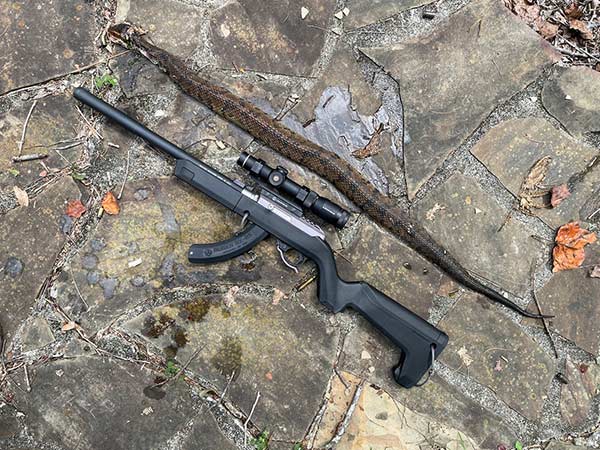
At 44 inches from stem to stern, this was a good-sized water moccasin.
Yeah, I know I’ve seen that title someplace before. Anyway, it was an interesting day yesterday. We live way out in the sticks and have a modest lake for a backyard. It was a great place to raise kids. Now that our children are grown and gone, my wife beats me at a game of some sort every afternoon I’m home. Every now and again, I’ll pull one out, but that’s rare. She always was the smart one. Yesterday, she was busy smoking me at cards when I glanced out the window and saw him — a ginormous water moccasin cruising leisurely across the lake like he owned the place, which he kind of did.
This thing looked like some kind of sea monster, cutting a wake like a heavily laden oil tanker as he plied his way from where he was to where he wanted to be. Without regard for my personal safety, I leapt into action, prepared in an instant to defend my bride from venomous peril. It was also a handy excuse not to lose at least one card game.
Now, many modern sensitive folk will take umbrage with my unfettered genocide of the Agkistrodon piscivorus. Some feel that water moccasins are like big, slithery hamsters and that we should welcome their fanged presence in our living spaces in the spirit of peaceful coexistence. Screw that. I’m a doctor. I have seen what happens when a person gets bitten by one of these monsters. This is a little-known fact, but water moccasins were the reason God first made firearms.
Around the world, some 5.4 million people are bitten by snakes every year. Those bites result in between 1.8 and 2.7 million envenomings. Roughly 100,000 people die from snake bites per annum. About three times that number lose limbs. While most of those casualties are indeed found in Africa, Asia and Latin America, I still like to feel like I am doing my part. I religiously avoid harming non-venomous snakes, but I kill every water moccasin I can find on sight.
Tools Of The Trade
I have tried lots of tools. Shotguns of various sorts are great … at appropriate ranges. I have splattered half a dozen of the toothy monsters from across the lake to no practical effect. In one case, I am fairly certain when next I saw that big gentleman gliding across the lake, he was rocking an eye patch. I have found the ideal counter-snake tool to be a TacSol sound-suppressed .22 rifle.
My example was spendy, but it shoots like a laser and is completely ear-safe. Unlike many .22 rifles, it is also exceptionally reliable. I love this thing. Together, my TacSol and I have accounted for dozens of moccasins over the years.

This is yours truly in his chillaxing clothes, having just smoked
an enormous water moccasin. This example was shockingly heavy.
In this particular case, I tore downstairs, grabbed my rifle, slapped in a magazine, jacked the bolt, and ran outside only to find that the scope was frosted darker than Chuck Schumer’s soul. I live in rural Mississippi. It is a literal jungle down here. In the summertime, the humidity is so high you can tear off a chunk of air and gnaw on it. When you take a cool piece of glass and put it in a really hot, wet place, moisture condenses on the lens. As a result, I keep a blow dryer by the back door. A quick five-second blast front and back solves the fogging problem. It’s the price we pay to live in God’s country.
By the time I finally got to the water’s edge, he was at a slant range of about 20 meters, his massive triangular head perched jauntily above the surface. I drew a careful bead, attended to my breathing, and popped him through the nugget. Then I shot him 24 more times, just to be sure. I really, really hate poisonous snakes.
I climbed into the canoe and paddled out to retrieve my prize. This one was a real gentleman, measuring a full 44 inches from tail to beak. When I hefted him up with my paddle, he was shockingly heavy. He also reeked of rotten fish, as do they all.
I often skin these things, particularly the big ones. I wouldn’t eat a water moccasin for love or money, but they do have pretty hides. You nail the head to a tree, ring the neck, and tease the skin back, flaying it free with a 10-blade scalpel. Then, drop the skin in a mason jar filled half-and-half with rubbing alcohol and glycerin. Let the skin soak for a month or two before stretching it out on a board. The end result is both durable and gorgeous. However, if you store the hides in your workshop, the mice will eat them. Ask me how I know this.
Anyway, some lunatic shot this lovely specimen full of holes, so I just snapped a few pictures and then tossed him back in the lake. The hungry turtles looked grateful. This was the 62nd moccasin I have culled from my backyard in the 20 years we have been here. I keep count. At the end of the day, however, the world is now down one massive water moccasin. It has indeed been a lovely afternoon.

Two of the best dogs I ever had were Princess & Smedley. All the cats for block around diappeared. Yes I really do hate Cats.
Grumpy

Much of the coverage of the U.S. Supreme Court’s recent decision to overturn the Chevron Deference doctrine suffers from one of two problems: Either it’s written by lawyers for lawyers and is therefore unintelligible for anyone without a juris doctor, or it’s written by the corporate media and is chock-full of errors, omissions and untruths.
Bill Sack, director of legal operations for the Second Amendment Foundation, agreed to help clarify this landmark Supreme Court decision, which it turns out is good for gun owners and bad for the ATF.
Q: What is the Chevron Deference doctrine?
A: “By a vote of 6-3, the justices overruled their landmark 1984 decision in Chevron U.S.A., Inc. v. Natural Resources Defense Council, Inc., which gave rise to the doctrine known as Chevron Deference. Under that doctrine, if Congress has not directly addressed the question at the center of a dispute, a court was required to uphold the agency’s interpretation of the statute as long as it was reasonable.
What the Chevron Deference doctrine did was when administrative agencies write regulations, they often will have their own administrative courts that interpret the regulations the agency has drawn up.
For example, if the EPA makes a regulation that says a factory can only put out so much pollution, and there is a question as to whether a specific factory violated the regulation, the first place the factory has to go is the EPA’s administrative court, where an EPA administrative judge will interpret the EPA’s regulations.
If the factory is unsatisfied with the EPA judge’s decision, they can appeal to federal court. What Chevron Deference did was this: If the administrative court’s decision was appealed, the federal court was then supposed to be heavily deferential to the findings of that administrative court.
Basically, the doctrine put a thumb on the scale in favor of the administrative agency.
The federal court was supposed to give a lot of deference to what the administrative agency found. From a liberty perspective, this is a separation of powers problem. The administrative agency, as an executive agency, is supposed to enforce the law.
It’s not supposed to write the law. It’s not supposed to interpret the law. These alphabet agencies were writing regulations, which is a legislative function. They were enforcing the regulations, an executive function, and then they were interpreting the regulations, which is a judicial function.
The ATF and the alphabet agencies were doing the jobs of all three branches of government and if challenged, the federal courts were supposed to defer to what their administrative courts found. Even if the federal court thought the agency’s administrative court got it wrong, they didn’t always overrule the decision.
They believed that these agencies were the experts, who were best at administering and interpreting the own regulations. For example, the courts acted like since the EPA found that the EPA did nothing wrong, we’ll defer to them since they’re the experts.”
Q: What specifically did the U.S. Supreme Court decide?
A: “Chevron was overturned formally based on the Administrative Procedures Act, which sets out the procedures that federal agencies must follow as well as instructions for the courts to review actions by those agencies. The Supreme Court decided that this deference was unlawful. The Supreme Court said federal courts should start from scratch, rather than showing deference to the alphabet agencies. The High Court removed their thumb from the scale.”
Q: How will this decision affect the ATF?
A: “Hopefully, it tones down all of the administrative agencies because it returns power to the judiciary. It should tone down the ATF just like the rest. They can no longer adjudicate their own rules and say, ‘we’re right because we said we’re right.’
The writing has been on the wall for some time that Chevron would get knocked down. In a few of the (Administrative Procedure Act) challenges, the ATF has said they are not relying on Chevron to make their point. I suspect they didn’t want to hang their hat on Chevron. During the pistol brace and bump-stock cases, the ATF specifically said they were not relying on Chevron Deference.
If Chevron Deference were still alive, the ATF could write a rule like pistol braces. If someone was prosecuted for it and believed they shouldn’t have been found guilty in an ATF court, the ATF could rely on Chevron Deference during the appeal.
It was a big tool that every administrative agency had in their quiver.”
Q: How will the Supreme Court’s decision affect cases already in litigation, such as bump-stocks, pistol braces, frame and receiver and who needs an FFL?
A: “I don’t believe it will affect any of the current cases against ATF because the ATF has already disclaimed using Chevron.”
Q: Will this decision have any impact on the hundreds of gun dealers who have had their Federal Firearm Licenses revoked by the ATF for minor clerical reasons? (This question was posed to Adam Kraut, the Second Amendment Foundation’s executive director.)
A: “No. Revocation is entirely within the administrative process. The ATF only has to show a single willful violation. It’s not ambiguous where it would be difficult to ascertain what Congress meant. The courts have defined what willful is – they did something the law said they can’t do. Whether it was intentional, or they transposed some numbers, it’s still willful. There’s no deference in that regard. They don’t have to defer to the ATF to interpret anything,” Kraut said.
Q: Do gun owners still need to go through the ATF’s administrative process or can they now go straight to federal court?
A: “They still have administrative courts. They will still adjudicate violations of their own regulations, but if you want to appeal, the federal court has much greater leeway to overturn the administrative agencies with Chevron gone. The courts should be much better equipped to keep the administrative state in check,” Sack said.
Q: How will the Supreme Court’s decision affect gun owners?
A: “Big picture – for ATF and all of the other administrative agencies – it will hold their feet to the fire to interpret their own regulations fairly.”

California gun owners have long been besieged by a lengthy list of unjust, unconstitutional firearm laws that make practicing their Second Amendment right more difficult. And a new law that just took effect is going to make freedom even more scarce in The Golden State.
The new law, passed by the legislature last year and signed by anti-gun Democrat Gov. Gavin Newsom, required credit card networks to make a new firearm-specific Merchant Category Code (MCC) available to banks and other financial institutions by Monday.
At issue is a special MCC for gun and ammunition purchases adopted last year by the International Organization for Standardization. MCCs are used by payment processors (like Visa and Mastercard) and other financial services companies to categorize transactions.
Prior to the creation of the specific code for guns, firearms retailers fell under the MCC for sporting goods stores or miscellaneous retail. If the new code is used, credit card companies and other payment processors can tell the purchases were firearms, basically creating a de facto registry of firearms and firearm owners.
While many find that distasteful—even illegal—California Democrats and Newsom embraced the idea. Consequently, for any firearms or ammunition now purchased in California with a credit card, there is a record kept that it was for a firearm or related product.
As NRA’s Institute for Legislative Action has pointed out in the past, collecting firearm retailer financial transaction data amounts to surveillance and registration of law-abiding gun owners. Those promoting this scheme are in favor of firearm and gun owner registration. Consequently, it should be assumed that the goal of this program is to share all collected firearm retailer MCC data with government authorities and potentially private third parties that might include gun control organizations and anti-gun researchers.
Being able to know if a purchase was for a gun or ammo must sound like a great idea to Newsom and his gun-ban cronies, and a few other states have passed similar laws, including Colorado and New York. However, just as with many gun-related issues, while California seeks to punish gun owners, many states have sought to protect them from such overreach as the use of the new gun-specific MCC. In fact, more than a dozen states have passed laws outlawing the uses of such codes, including nine states—Indiana, Utah, Wyoming, Kentucky, Iowa, Georgia, Tennessee, Alabama and Delaware—just passed such measures this year.
