


Month: January 2024
Your walkin’ around rifle must reflect who you are. Here’s a primer on what makes an ideal one.
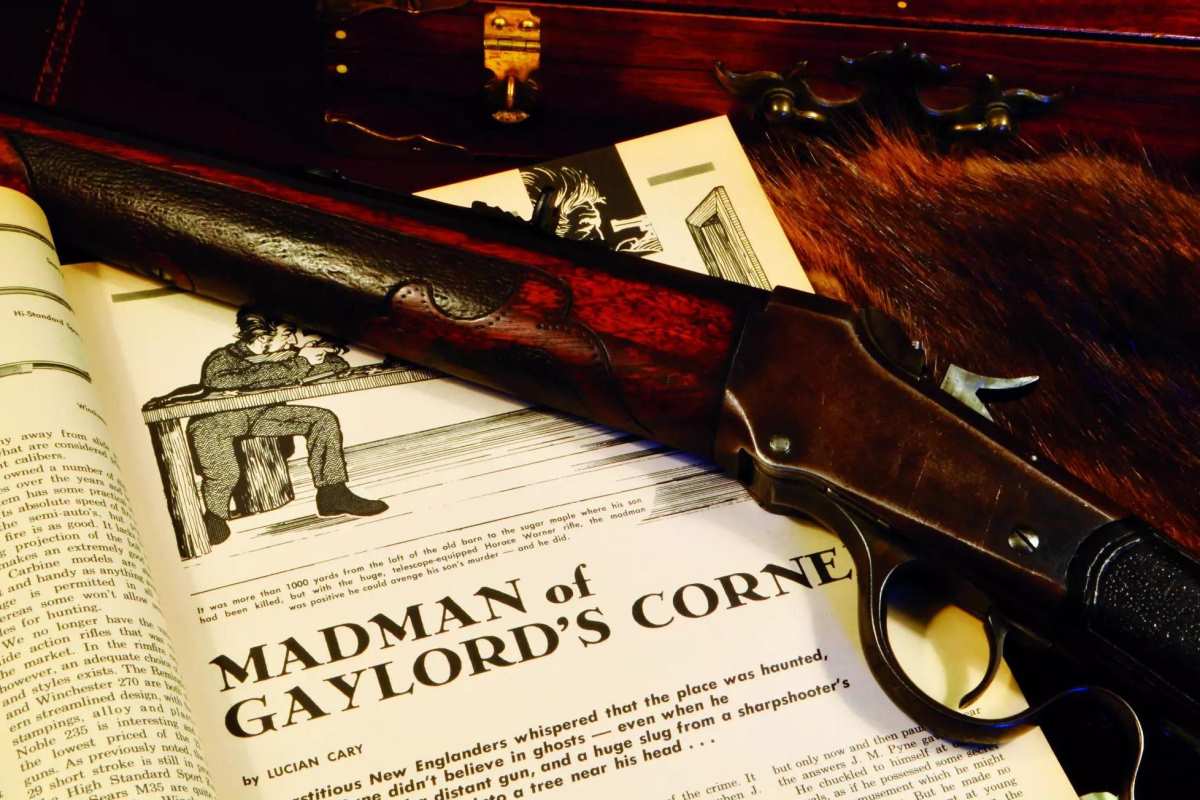
This vintage Winchester Low Wall in .25-20 SS undoubtedly belonged to someone’s grandfather and was undoubtedly treasured. It is a fine example of a walkin’ around rifle.
In truth, quite often, “small-game hunting” is not so much an activity as a reasonably credible excuse to go out and wander the creek bottoms with a rifle under your arm or stalk along a ridge to see what you see.
Certainly, one could do those things without a rifle, but having one with you serves the same purpose for modern man as a musketeer’s rapier or a warrior’s bow or a mountain man’s Hawken. Psychologically, at least, your rifle is part of you. The reasons for this are buried so far back in history that it would take three shrinks and an archaeologist to explain it. It just is. And, quite frankly, I don’t care why.
I do, however, care about the “what.”
What makes a good walkin’ around rifle? First, it has to be light enough to carry with the insouciance of a boulevardier with his walking stick. Second, it has to balance in the hand like a throwing knife. Third, it has no sling and no scope to get in the way. Fourth, it’s chambered for a cartridge that has just enough power but not too much, sufficient authority without being overbearing.
It’s easier to give an example than it is to list the attributes, so mine is a Winchester Low Wall with a 26-inch barrel and open sights, chambered in .25-20 or .32-20. Preferably, it’s at least a century old, has much of the bluing worn off, and not much left in the way of checkering, if it ever had any in the first place. If it was your grandfather’s rifle, so much the better, but as long as it belonged to someone’s grandfather, that’s good enough for me.
Obviously, there are alternatives. A Stevens No. 44 or 44½, pre-Great War, will do just as well, or one of the many fine old British rook rifles now floating around and commanding a lot less than they did a decade ago. Ruger’s short-lived No. 3 single shot is another. So is the Martini Cadet.
As for cartridges, anything between .25-20 at the short end and .357 Magnum at the long, will do just fine. (In the latter case, you can shoot .38 Specials when you don’t need the muscle.)
A key point about the walkin’ around rifle is that it cannot be junk—crude, cheaply made, intended for the penniless-farm-boy market. Like the musketeer’s rapier, it tells people who you are. Vastly more important, it tells you who you are.
I’m always reminded of Lucian Cary’s superb short story, “The Madman of Gaylord’s Corner,” when J.M. Pyne picks up his rifle to carry up the mountain, seeking the source of the shot that was intended to kill him. If you haven’t read it, do. Cary does not go into detail, but you just know Pyne’s rifle is as comfortable for him—low-powered though it might be; it’s a modest .25 caliber—as his jacket or gloves.
Alas, there is nothing available on the market today, unless you go in for seriously high-dollar custom work, that really fills the bill. There are some cheap rifles available, and some expensive target rifles, and a few intended to provide either maximum firepower or pinpoint accuracy with a scope. But we are looking for none of the above.
Fortunately, the Winchester Low Wall was made in sufficient numbers that they can be had for not much money, and you can apply as much or as little restoration as you see fit. The Stevens 44½ is harder to come by—relatively few were made between 1902 and 1916—in good shape and will cost more.
It has the advantage of a barrel that is easily interchangeable; buy one in something obscure like .28-30-120, and you can have a barrel made in .357 Magnum that will turn it into a different animal. That will set you back about $800, but you’ll have a rifle unique to you.
Just remember, when you look at your walkin’ around rifle, you’re looking in a mirror. You want to like what you see.
Categories
Artillery Lugar

 Here is where all this stuff comes from. I live on my laptop
whenever I’m not at the clinic, asleep or in the shower.
I write a lot. It’s honestly a compulsion not unlike alcohol or drugs. Other guys are addicted to porn. If I don’t bang out a Guncrank column every week, I start to feel like I’m developing a skin rash. We all have our burdens.
I typically post my writing efforts on Facebook as they come out. I don’t know why, but I’ve been doing it for years. A lot of my patients are Facebook friends and comment on the latest efforts when I see them in clinic. There’s never any profanity, and my politics are pretty tame relative to the rest of the planet. I wear Jesus on my sleeve and strive to treat others with respect and kindness. I like to think that comes through in my prose.
I recently posted a piece about flying a vintage Grumman Goose floatplane with some buddies back when I was in the Army. For reasons I cannot begin to fathom, Facebook tagged that as offensive content and deleted it. The stated justification was that I was somehow using subterfuge to get “Likes” or some such.
I enjoy the adoration of an army of hot, rabid cheerleader groupies just as much as the next obscure gun writer, I suppose, but I really never paid much attention to “Likes.” I just felt Facebook was a good vehicle to share my work with anyone who cared enough to read it. I had never been cancelled before. It was a weird experience.
I clicked on the review tab and, in due time, got a note back that my post was reinstated. Facebook said they had removed it by mistake. And then it got removed again. I subsequently penned a brief second rebuttal that formed the basis for this column. My story about flying WWII airplanes got duly banned once more. I still have no idea why.
 Apparently the automated Facebook Gestapo does not care
for lighthearted tales about flying vintage-WWII airplanes in Alaska.
Grand Scheme
I published 255 commercial writing projects last year. I am hardly the best writer in my genre, but I am arguably the most prolific. As I said, I can’t help it. However, getting banned was thought-provoking.
This is quite literally nothing. So the Facebook spam filter is set to Nazi Gruppenfuhrer and excludes homey little tales about flying in Alaska. What difference does that make? Well, perhaps a lot.
I met a young lady several years ago who had recently spent six months living in China — the massive communist sort, not the tiny free island. I asked her what that was like. She was a college student — sweet and smart but naïve. She said at first, having everything she did scrutinized was kind of novel, exciting and cool. She felt like a character in a spy movie. After a while, however, she began to notice a trend.
Whenever she would say anything, even vaguely negative, about the government or the country in an email, she noticed that her internet connection would fail for a while. Over time, that became predictable. After six months, she was starving to get back to home and freedom. Living in a draconian dictatorship for real was simply suffocating.
We’re really not so far from such stuff over here on our side of the pond as we might think. We enjoy such a precious birthright of freedom that we do not adequately appreciate. All that could be gone with a headline.
If anybody cares about my opinion, I think censorship in most any form is bad. The Nazi death camp guards thought they were the “good guys.” Whoever wrote the Facebook content restrictions probably believed they were acting in the best interest of the common good. It is simply that absolutely everyone is biased. We can’t help it.
We live in the Information Age. The free flow of information defines our everyday lives. Humankind has never lived like this before. We’re figuring it out as we go along. It’s a brave new world.
That can indeed be dangerous. I am fairly convinced this is where so much ADHD comes from. We bombard the human mind with loud, flashy stuff from the moment we first draw breath and then subsequently struggle to pay attention. Who could have seen that coming?
I certainly acknowledge that folks do stupid things in response to propaganda. History is littered with bad behavior that spawned from passionate oratory or carefully metered information. A lot more people have died as a result of behavior safeguarded by the First Amendment than ever perished by that of the Second.
That being said, methinks we still need to be careful letting the censor bots determine what we should and should not be allowed to read. I’ve seen those movies. They never end well. I don’t trust any of them. It’s not that I’m paranoid, it is simply that I’d sooner not end up someday paying taxes to my microwave.
Categories
Remington-Lee Model 1885
