Month: January 2024
Categories
The Grizzly Conundrum
NASHVILLE, Tenn. (WKRN) — Gun control defined last year’s session in Tennessee. Though thousands protested for more of it, no legislation was passed.
It’s expected to look similar this session.
“As far as Tennessee doing something to limit guns, we’re not going to do that,” House Republican Caucus Chairman Jeremy Faison (R-Cosby) said. “We believe in the Second Amendment, and we believe that our Constitution was written correctly. We’re not going to take guns from people.”
In fact, if anything happens, it might be to expand gun rights, not pull them back. Lawmakers are planning to revive a bill from special session to allow people to carry guns in schools.
“Whatever vehicle that is to get us to the point where kids can be protected in these schools, that’s what I’m going to be supportive of,” Rep. Chris Todd (R-Madison County) told News 2 back in September. “If it means running this bill again, I certainly will do that.”
Instead, Republicans are pushing for more mental health reform, particularly after a recent shooting at Belmont University left a young student dead.
“The Second Amendment in the Constitution is very clear about firearms and possession of firearms,” Lt. Gov. Randy McNally (R-Oak Ridge).
The suspect in the case was free even though he faced earlier charges of aggravated assault with a deadly weapon because he was ruled incompetent to stand trial.
“They shouldn’t be released just right back out into the community,” House Majority Leader William Lamberth (R-Portland) said. “For their safety and the safety of the community, that person should be committed. If they are committed, they absolutely should not be able to possess or purchase a firearm.”
It’s a change Democrats are in favor of.
“We have to deal with the fact that people are not safe at all from random gunfire. This is no longer a situation of, ‘It takes a good guy with a gun to stop a bad guy with a gun,’” Sen. Jeff Yarbro (D-Nashville) said. “None of that matters if you’re not even there, if you’re just being shot because you’re a bystander in a situation or you’re just driving your car.”
But after the deadly Covenant shooting last year, Democrats felt there was a chance to see some new laws through, though that didn’t happen.
“I expressed then to the Republican Leader, Speaker and the Governor that if we didn’t do it then, it’s going to be hard-pressed to get it done in an election year,” House Minority Leader Karen Camper (D-Memphis) said.
In an election year, lawmakers are less likely to vote against what their party tells them to so as to not anger their donors.











.gif)



.png)






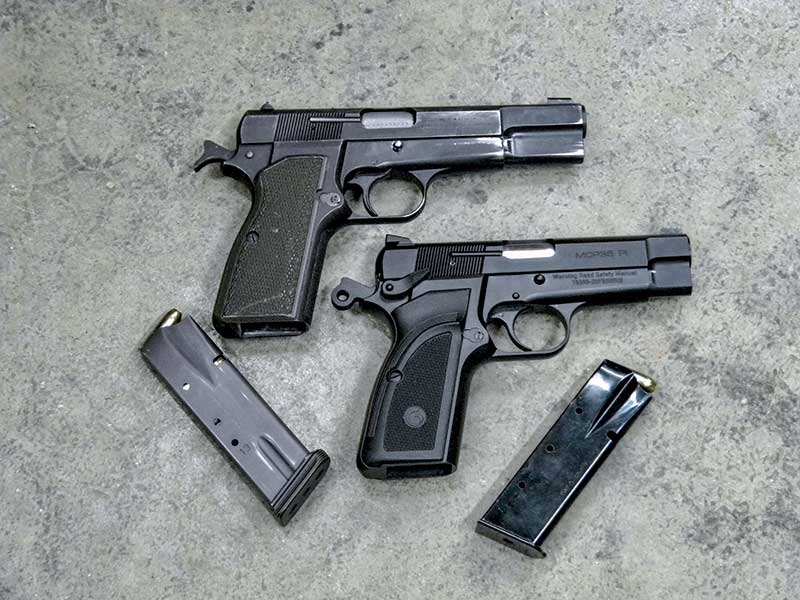
Girsan’s PI has a barrel and slide 1″ shorter than the traditional Hi-Power,
which reduces the weight from 1.8 to 1.6 lbs. It accepts all Hi-Power magazines.
There’s no debating that the FN Browning/Saive 9mm “Hi-Power” pistol — 1935 — is iconic. It was manufactured and used by both Axis and Allied powers during WWII and has seen military and law-enforcement use in over 90 countries around the globe. The Hi-Power has also been cloned by numerous manufacturers worldwide, some licensed by FN, some not. One of the rarer and more desirable of these clones was the “Detective” Hi-Power, a short-slide variant produced by Fabricaciones Militares of Argentina. Luckily, the short-barreled Hi-Power has been resurrected by Girsan of Turkey as the MC P35 PI — “Private Investigator” — which is being imported into the U.S. by EAA.
FM produced “Detective” Hi-Power pistols and conversion kits you could install on standard Hi-Power frames. Both pistols and kits and their advertisements in Shotgun News disappeared in the early 2000s. Occasionally, there’s a Detective for sale on the ’net, but they’re expensive. Master Hi-Power gunsmiths will shorten full-length Hi-Powers, but like any detailed, precision work, it’s costly. The new Girsan short barrel “P.I.” is readily available and affordable.
Girsan has been producing a variety of firearms in Turkey since the mid-’90s. In 2019 they entered and earned respect in the 1911 market. A couple of years later, they released the MC P35 Hi-Power, available in several variations, including a red dot sight-equipped model. The short-barrel “P.I.” is their latest addition to their Hi-Power line.
The frame of the “P.I.” is standard double-stack Hi-Power fare. The slide and barrel have been shortened approximately one inch — from 4.87″ to 3.88″. This reduces the pistol’s weight from 1.8 lbs. to 1.6 lbs. These numbers might seem slight, but it’s a 20% reduction in slide length and a 12% reduction in total weight. For a pistol that’s carried all day, every day, this is significant. The shorter slide is easier to conceal and clears the holster just a little sooner on the draw. With the factory-supplied 15-round Mec-Gar magazine and one in the chamber, it’s a compact, reliable package holding 16 rounds.
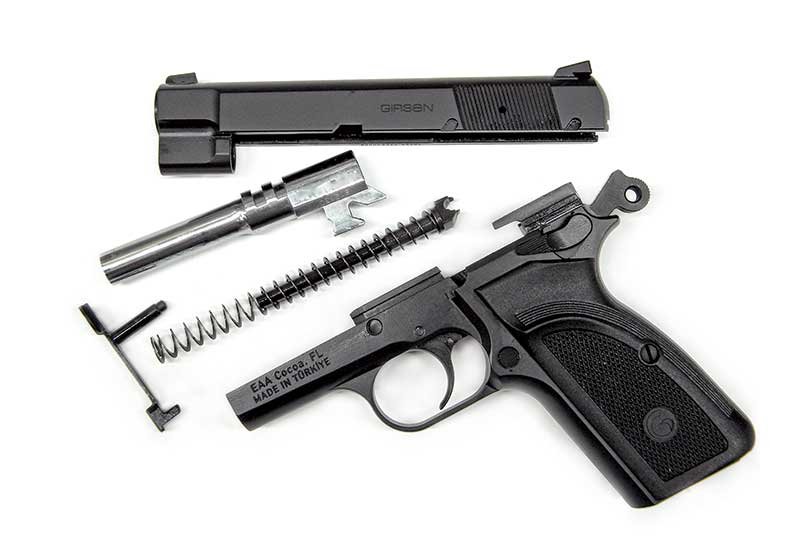
The PI is easily field stripped, like any Hi-Power. Lock the slide to
the rear using the thumb safety, remove the slide stop and slip
the slide off the frame.

The small parts inside a pistol reveal a lot about its quality.
All the pins, springs and internals of the PI spec out and
function as they should.
Parts And Pieces
When it comes to non-FN/Browning Hi-Powers, there’s a lot of variation in quality. Some were considered equals in fit and overall character. Others, not so much. Girsan’s P.I. is one of the good ones. The matte black finish is smooth, even on the small parts. The chrome finish on the barrel is a little shiny for my taste but will hold up well in hot, humid environments. The “P.I.” comes with an Mk III style ambidextrous thumb safety, a Commander-style “ring” hammer and Mk III style synthetic stocks. It also retains the original design’s magazine disconnect; it will not fire without a mag locked in place. Blame this on the French military’s “demands” that this feature be included in the original design. The white-dot sights are set in dovetail slots cut into the slide. The front of the slide has a hole below the barrel that the guide extends through when the slide is cycled.
The first thing I do with a “new” firearm — used or factory-fresh — is take it apart completely. The Hi-Power is easy to field strip. Lock the slide to the rear using the thumb safety, remove the slide lock and slip the slide forward off the frame. The “P.I.” uses a flat recoil spring instead of a spring formed from round wire. It’s strong — the guide rod is long and has to line up with its hole in the slide. Initially, it’s difficult to remove the spring and rod from the slide; it takes just the right combination of push and wiggle to remove and install. You only need a few punches and a hammer for complete disassembly of the slide and frame. On this subject, and all other things Hi-Power, I recommend Stephen A. Camp’s book, The Shooters Guide To The Browning Hi-Power.
The Hi-Power uses a sear lever that pivots in the slide to transfer movement from the trigger lever, which pushes upward, to press the sear down, releasing the hammer. It’s kind of like a see-saw. The P.I.’s sear lever is a late-model Mk III-type Devel lever, which has a wing that blocks the firing pin, preventing forward movement unless the trigger is pressed.
The factory Mk III style stocks didn’t fit my small hands. The thumb rest is right next to the magazine release, and I couldn’t press it efficiently. I pulled a variety of different stocks from my stash to test their fit; some fit well, while others had a little wiggle. This isn’t uncommon with aftermarket stocks and various “Browning” clones. Stocks from a FEG fit and those from a Springfield SA 35. It may require experimenting, but finding the right fit for you shouldn’t be a problem.
Small parts like pins and springs are a big indicator of a pistol’s quality. The “P.I.’s” internals spec’d out at the proper size and tension. Another sign of a properly made Hi-Power is the fit between pins that hold parts like the sear, sear lever, extractor and ejector and the frame. The pins shouldn’t require much force to tap them in and out. Plus, as long as you use the proper punches, the pins shouldn’t deform during removal and installation. The P.I.’s internals look good, but the true test is at the range.
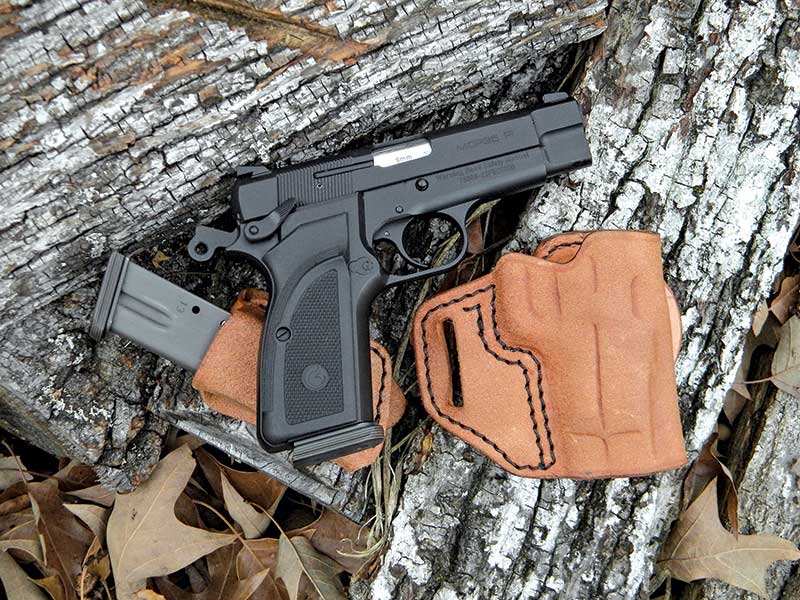
The Girsan MC P35 PI is an iconic pistol based on a reliable platform.
You can use 13- or 15-round magazines — or 10 for those less fortunate.
Add a quality holster like this Ritchie Holsters model and it’s an excellent
carry package.
Range Day
“Range Day” is the most exciting part of testing a new gun. The two most interesting characteristics of any firearm are reliability and accuracy, which are only revealed through live fire. “Fit” and “feel” are also important but more subjective. Does this pistol feel right in your hands?
Lives depend on the reliability of a defensive pistol. A clean, freshly oiled gun with quality ammunition and magazines should function. Factory-recommended “break-in” periods and such do not apply. A defensive pistol shouldn’t be finicky about what ammo it will fire. I test a pistol’s reliability by putting it through the “trash ammo” test.
I loaded 15- and 13-round Mec-Gar magazines with “homeless” rounds lying on the range, stray ammunition from the dusty cardboard box in the shop and all the questionable stuff rattling around the floorboard of my truck. The “Private Investigator” ate everything with no malfunctions. It also displayed very consistent extraction and ejection. Empty cases landed in a one-foot square area about 7′ to 8′ from the shooter at 4 o’clock. Perfect.

One difference Hi-Power fans will notice immediately is the hole in the
slide beneath the barrel for the recoil spring guide rod to extend through
when the slide is cycled or locked to the rear.
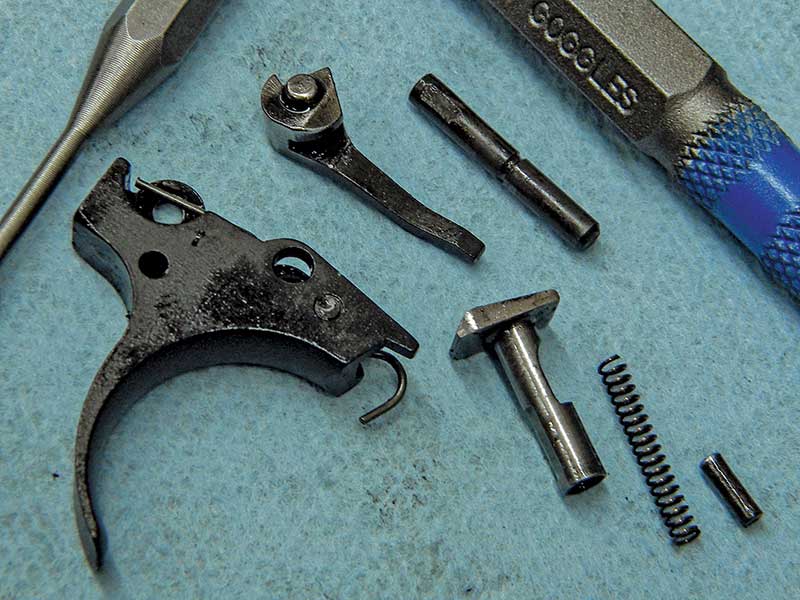
The PI retains the original Hi-Power magazine disconnect. As the trigger
is pressed, the disconnect is pushed against the magazine. The trigger will
not release the hammer without a mag locked in place.
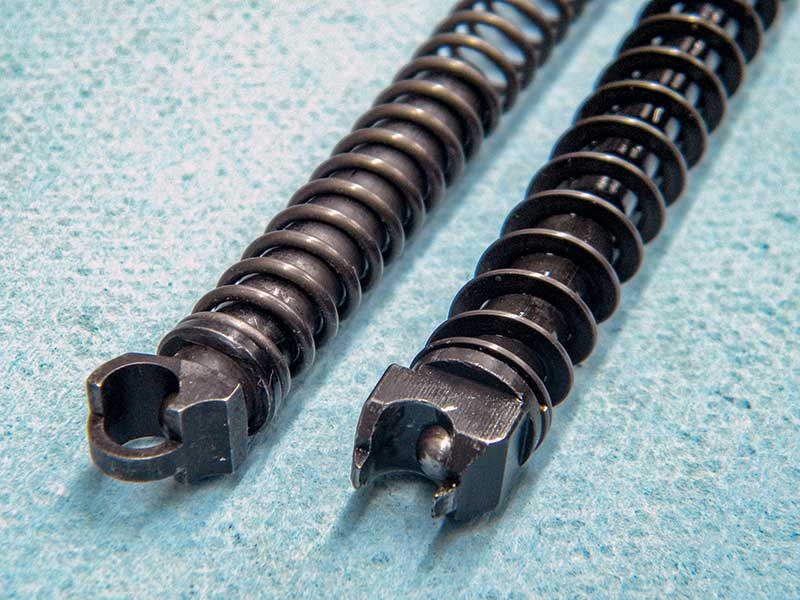
The PI’s recoil spring is wound from flat wire instead of round wire. The strength of the spring and longer guide rod make it a little tricky to remove them from the slide until you figure out just the right moves.
Like all Hi-Powers with the magazine disconnect, you can feel some grittiness in the trigger as the disconnect engages the magazine. This is something that wears in over time. Or, you can easily polish the parts. Girsan offers full-size Hi-Powers without the mag disconnect and will hopefully follow through with similar models of the “P.I.” The trigger is crisp and breaks at 7½ lbs. For a military-style weapon, it’s a good trigger. As an experiment, I removed the magazine disconnect to get an idea of what the trigger would feel like after some tuning and polishing. This brought the pull weight down to a perfect, crisp 5½ lbs. Like all “military” style pistols, there’s improvement to be had.
Accuracy is subjective. An accurate defensive pistol might not fire tiny groups during a bullseye competition. Under stress, with both you and the threat moving, accuracy involves placing hits in the proper locations of the threat’s body. Defensive accuracy is more about what you can do with the pistol, as opposed to how tight a group it will shoot under perfect conditions.

There are plenty of aftermarket options for Hi-Power accessories. Hi-Power
clones vary in actual dimensions, so some stocks may require building up the
area on the inside of the panel where it indexes with the frame.

If you’re interested in all things Hi-Power, you need to pick up a copy
of Stephen A. Camp’s book, The Shooter’s Guide To The Browning Hi-Power.
I used factory-fresh ball ammo to test practical accuracy. You can expect improved precision with quality defensive rounds if a pistol groups well with ball ammunition. At seven yards, slow fire, the Girsan grouped well — minus one shot I called “bad” because of my trigger press. The group size was better than I normally get with more expensive pistols. Hi-Powers are always a pleasure to shoot; the “P.I.” actually seemed to recoil less than the full-length barreled Brownings.
At 75 yards, I had to aim about a foot low and slightly left to hit the torso target. Most people never fire their pistols at these distances. But it’s a good idea because there are enough documented situations that required long-distance pistol shots. This reveals the difference between the pistol’s point of impact and point of aim. The “Investigator’s” long-distance accuracy is up to that task if you are. Eventually, I’ll adjust the sights to my eyes and shooting style, much like zeroing a rifle.
The MC P35 PI is the first Girsan pistol I’ve handled. After inspecting it inside and out and spending time with it on the range, I can safely say it won’t be my last. The “P.I.” is an excellent pistol with the right features at an affordable price. Those new to Hi-Powers will be very pleased; longtime fans of the “Browning” won’t be disappointed. And, if you’re thinking about a custom pistol build, the Girsan is the perfect starting point. That’s a win, win, win.
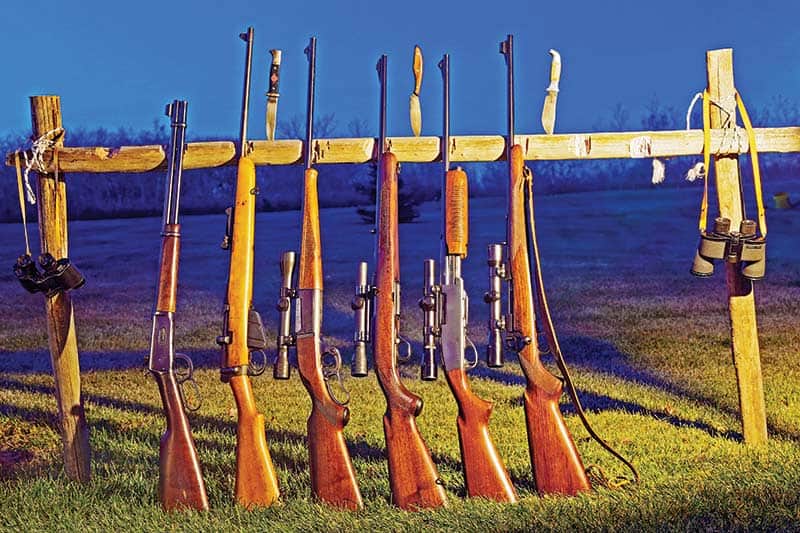
Rifles from the ’50s and ’60s (from left) — Winchester 94 .30-30, Lee Enfield
.303 British, Savage 99 .250 Kollmorgen 4x, Winchester 100 .308 Kollmorgen 2 3/4x,
Remington 760 .257 Roberts Weaver 2 1/2x, Winchester 70 .308 Kahle 4x.
Big game rifles have evolved continuously with the introduction of new models, new cartridges, new manufacturing methods, changing hunting conditions and methods.
I’ve illustrated some of the changes with hypothetical gun racks from deer camps beginning with the 1950s, both heavy cover whitetail hunting and open country mule deer and antelope hunting, as I did plenty of both.
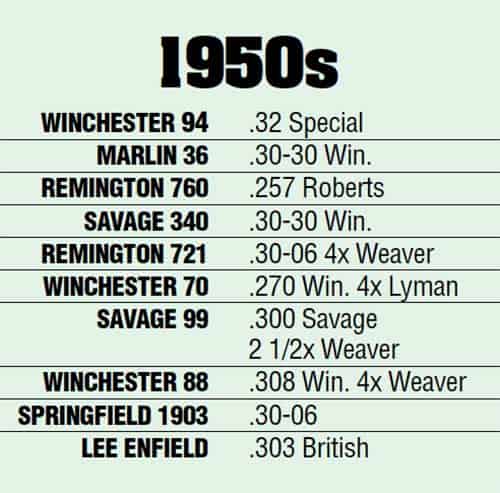
1950s
The post-WWII era was a time of tremendous economic growth in the U.S. with a corresponding increase in hunting and shooting. Converting surplus military rifles for sporting use was a major business. Several cartridges were introduced. The big change in my view was the shift from iron sights to scopes. In 1950 it was unusual to see a hunting rifle with a scope. After the early ’60s it was safe to assume a rifle that could be scoped would be scoped.
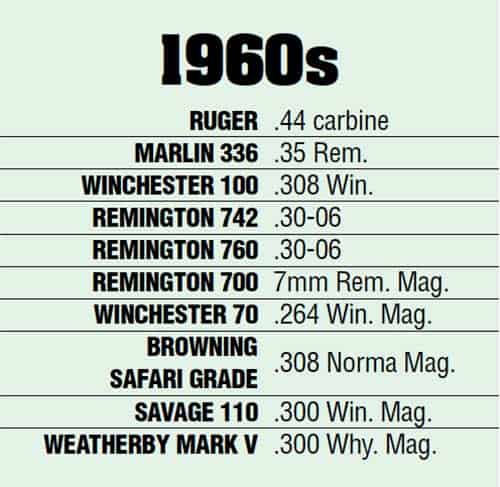
1960s
The big change I saw in the 1960s was increased interest in Magnum cartridges in large part due to the brilliant and tireless efforts of Roy Weatherby. Whitetail hunters liked semiautos and pump actions and began finding scopes useful even on running game in wooded terrain.
The Remington 700 7mm Rem. Mag., usually fitted with a 3-9 Redfield, was the hot set-up of the era. Both rifle and cartridge were in such demand they were often hard to find for sale.
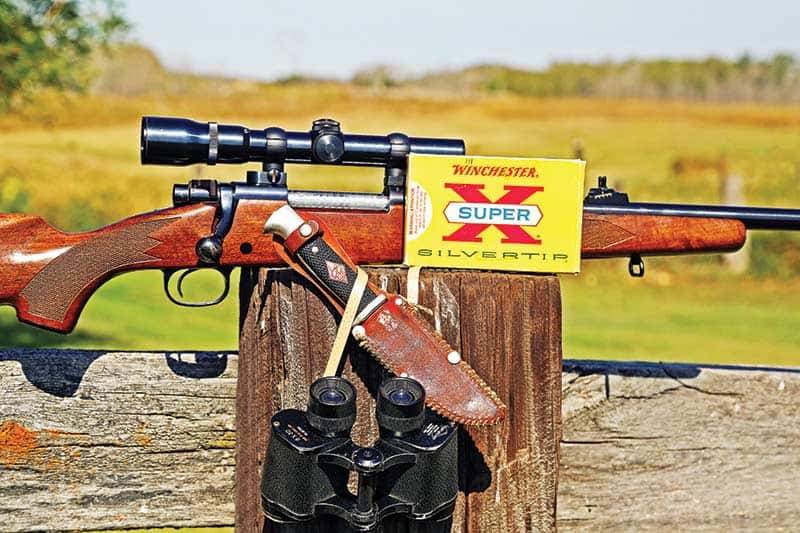
Dave’s first “modern” hunting rifle (above) following a Winchester 94 .30-30
and Lee-Enfield .303 British — an early ’70s era Winchester 70A in .270 Win.,
Weaver 1.5 – 4.5 scope. Remington pump rifles have been taking deer reliably for 70 years.
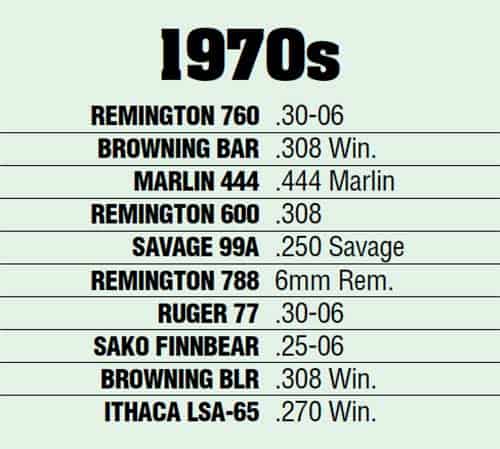
1970s
This decade saw manufacturers trying to respond to the demands of rifle enthusiasts for better quality control, improved fit and finish, cut instead of impressed checkering and in general, a more aesthetic and less utilitarian approach. Computer-assisted manufacturing was taking its first baby steps.
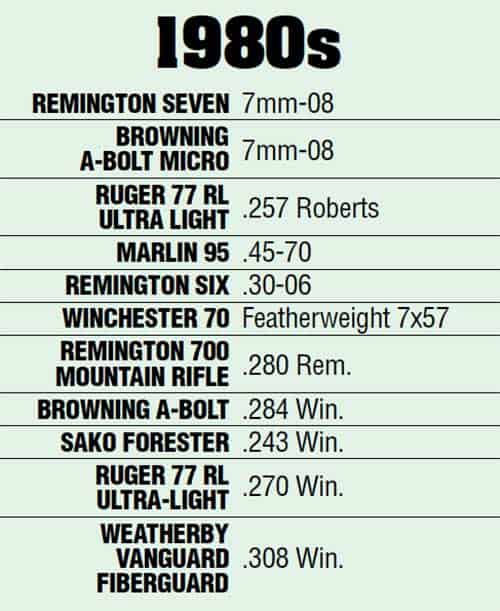
1980s
The rifle trend I remember most from the 1980s was the demand for “mountain rifles” though there were never a lot of mountain hunters. Major manufacturers came out with lightweight/featherweight models — actually not very light by today’s standards — while quality control, fit and finish continued to improve. “Standard” cartridges made a comeback and major manufacturers began offering synthetic stocks.
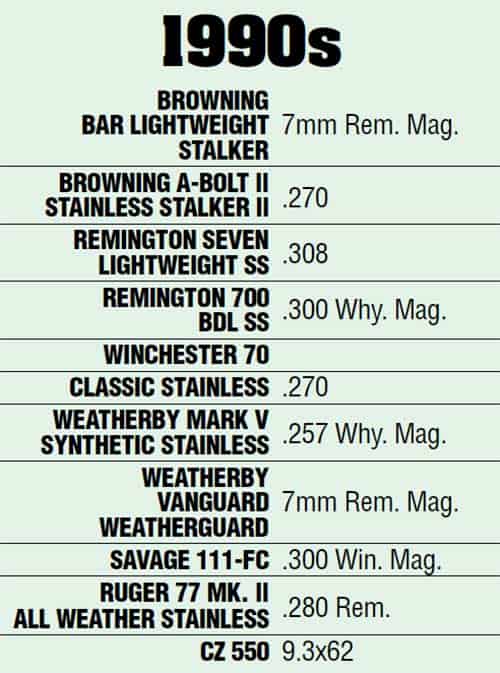
1990s
The biggest change I recall from the 1990s was the rapid acceptance of synthetic stocks and stainless steel components.
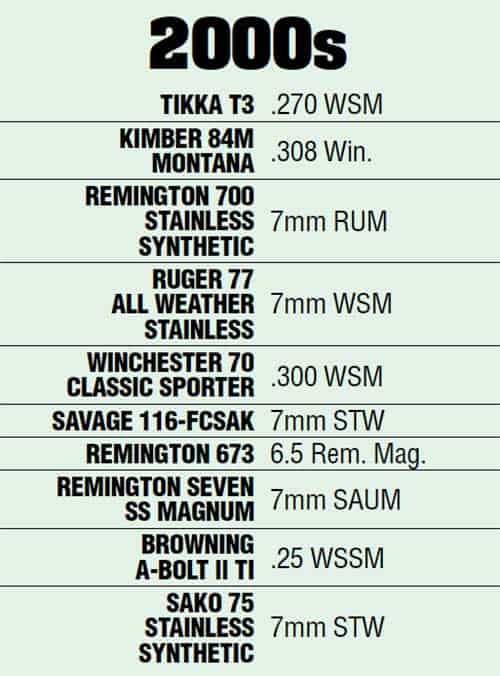
2000s
Laser rangefinders were being used by the military in the 1960s. In the 1990s small personal-use laser rangefinders were being used by golfers and rifle shooters and rapidly got more accurate, more user-friendly and more affordable. New cartridges appeared so quickly it seems some got dropped almost before the shooting world knew of them.

Left is a ’50s era model in .257 Roberts. At right, essentially the same
rifle but a .243 with synthetic stock from around 2015.
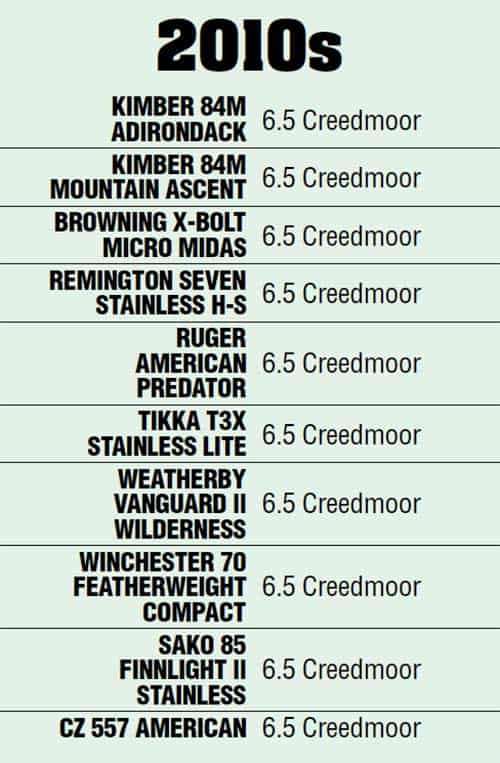
2010s
Through the 2000s rifles became more accurate and more consistently accurate. Much of the improvement came from greater manufacturing precision in rifle barrels and triggers. A major and often overlooked improvement resulted from the application of computer design to bullets. The ballistic efficiency of modern bullets is astonishing.