Categories
All About Guns War Well I thought it was neat!

PANZERFAUST — THE STORY OF GERMANY’S “TANK FIST” By Will Dabbs, MD

In the throes of World War II, a weapon emerged from Germany’s war machine, earning a fearsome reputation from the American and Soviet soldiers alike. The Panzerfaust, a crude yet deadly anti-tank weapon, transformed the battlefield with its potent ability to penetrate armor. This article unravels the story of this humble device that armed even the least experienced German soldier with the power to destroy the mightiest tanks.

infantry soldier with panzerfaust
A Finnish soldier armed with a Panzerfaust is stalking a Soviet tank near Vuosalmi on July 26, 1944. Image: Finnish Defence Forces

The old vet was decades out from war. He had since enjoyed a successful career in business, raised a family, and just generally made the world a much better place. Asking him to relate his experiences in Europe during World War II clearly took him back to a very different place.

german sergeant teaches soldiers how to use the panzerfaust
On the Eastern Front, a German sergeant teaches his soldiers how to use the Panzerfaust to attack Russian tanks. Note the tall sight and how the launcher is held in the armpit. Image: Polish National Digital Archives

His mind remained as sharp today as it had been in 1944 when he arrived in Europe. He rendered a reasoned opinion about the effectiveness of American small arms. He respected the M1 Carbine for its modest weight and maneuverability and revered the M1 rifle. They all revered the M1 rifle.

german soldier in ukraine during a training exercise with the panzerfaust
In southern Ukraine, this German soldier fires a Panzerfaust during a training exercise in the Spring of 1944. Image: Polish National Digital Archives

There really was only one M1. We call it the Garand, but they generally didn’t. The M1 Carbine was the carbine and the M1A1 Thompson was the Thompson, but the .30-06 semi-automatic battle rifle designed by John Cantius Garand was the only M1. What was surprising, however, was his take on the enemy weapons he faced.

operation panzerfaust
During Operation Panzerfaust, German Waffen-SS soldiers stand outside the Hungarian guard barracks in Buda Castle in Hungary. The man on the left holds a Panzerfaust. Image: Polish National Digital Archives

We are enamored with the StG44 and MG42 for their groundbreaking design, and rightfully so. The terrifying ripping sound that the MG42 made as it cycled at 1,200 rounds per minute got this man’s attention as well. However, the one German weapon he held in highest esteem was the Panzerfaust.

damage to tank from panzerfaust
A Finnish soldier inspects a hole in a Soviet Union tank made by a Panzerfaust during the Continuation War, July 20, 1944. Image: Finnish Defence Forces

It’s tough to imagine how junky modern war is. Industrial nations pour themselves into war production and simply blanket the battlefield with weapons, ammunition, and gear. In this case this man said his unit captured German Panzerfaust antitank weapons by the unopened crate. He made a point to keep a handful of these handy little monsters in his jeep at all times.

finish soldier prepares to engage a russian tank
A Finnish soldier prepares to engage Soviet armor with a Panzerfaust during July 1944. Image: Finnish Defence Forces

By 1945 Axis tanks were not the omnipresent scourge they had previously been, and Allied tanks, tank destroyers and fighter bombers were forever on the prowl for the big German cats. However, the Panzerfaust was just the ticket for making an unannounced entry into an occupied building. If your mission is to seize a defended structure from a determined enemy the last thing you want is to knock on the front door. This old vet said that captured Panzerfausts would reliably blow a hole through stucco or plaster that was adequate to admit grenades or even assault troops. He said they burned through dozens of the things and loved them.

Details on the Tank Fist

Panzerfaust literally translates to “tank fist,” and it was one of several desperation weapons fielded by the Germans in the closing months of World War II to blunt the Soviet juggernaut and the increasing threats on the Western Front. First developed in 1942, as Germany’s fortunes waned, the combination of low cost and ease of training made the Panzerfaust a mainstay of the final defense of the Reich in 1943 and beyond. In Normandy, the Panzerfaust accounted for 6% of the Allied tanks knocked out in combat. By war’s end, when the battlefield was dense with poorly trained Volkssturm units, that number climbed to 34%

finish soldiers armed with panzerfaust
A Finnish Panzerfaust team moves into position to attack a Soviet tank on August 5, 1944. Image: Finnish Defence Forces

The prototype Panzerfaust was code-named Gretchen (“Little Greta”). The technical appellation was faustpatrone or “fist cartridge.” The casual observer could be forgiven for presuming the Panzerfaust was a rocket launcher. However, it was really more of a recoilless gun firing a projectile from a disposable tube. The design was a study in simplicity.

soviet isu-152 destroyed by a panzerfaust
A Finnish tank hunting team claimed this kill of a ISU-152 with a Panzerfaust. Image: Finnish Defence Forces

The warhead contained a shaped charge comprised of a 50/50 mix of TNT and trihexogen explosives. Fitted to the warhead was a wooden dowel adorned with folding sheet steel fins that deployed when fired. The round was shipped attached to a simple steel tube. Propellant was otherwise unremarkable blackpowder. The Panzerfaust came in four different sizes. Each variant was designated by its expected effective range.

The first model, the Panzerfaust 30, weighed 11.5 lbs. and burned 3.5 oz. of blackpowder propellant. The warhead moved at 30 meters per second and had an effective range of, you guessed it, 30 meters. The Panzerfaust 30 would burn through 200mm of steel armor, or just shy of 8”. The Panzerfaust 60 weighed 13 lbs., burned about 4.5 oz. of black powder, and traveled at 45 meters per second. The Panzerfaust 100 weighed 15 lbs., burned 7 oz. of powder, and traveled at 60 meters per second.

german soldier aims a panzerfaust
A German soldier prepares to fire a Panzerfaust on an advancing Russian tank in southern Ukraine during December 1943. Image: Polish National Digital Archives

The Panzerfaust 150 sported a redesigned warhead that could accept a fragmentation sleeve to improve its anti-personnel effects when it would explode. Though 100,000 copies were produced, none were known to have been used in combat.

panzerfaust and panzershreck carried by finnish troops
Finnish troops armed with both Panzerfaust and Panzershreck weapons return from hunting enemy tanks. Image: Finnish Defence Forces

A prototype Panzerfaust 250 developed at the end of the war used a reloadable launch tube with a pistol grip but never went beyond the design stage. It is believed it could penetrate thicker armor in addition to other upgrades. This weapon served as the inspiration for the Combloc RPG-2 that was subsequently widely exported.

Firing the Panzerfaust

The Panzerfaust did not have a trigger in the classical sense. In its place was a lever just behind the warhead that was squeezed to detonate the boost charge. When the operator was ready to ignite the boost charge, he cradled the weapon underneath the armpit and used the simple pressed steel sight to align the warhead.

panzerfaust sight
The Panzerfaust sight is clearly visible in this photo of a soldier practicing with the anti-tank weapon. Image: Finnish Defence Forces

The Panzerfaust 100 had holes punched into the folding sight marked 30, 60, 80 and 150 meters along with luminescent paint to make the launcher easier to use at night. Most launcher tubes had the words “Achtung. Feuerstrahl.” printed on the side which translated to “Beware. Fire jet.” The backblast that came out of the rear end of the tube was considered dangerous out to about two meters.

german soldier teaches vokssturm volunteers how to fire the panzerfaust
A German officer explains the use of the Panzerfaust to Volkssturm volunteers in early 1945. Image: Polish National Digital Archives

Though I’ve never had the pleasure, I’ve read that firing the Panzerfaust in combat was a serious gut check. The thing was fairly imprecise on a good day, and the huge plume of white smoke produced by the propellant charge invariably attracted a crowd. It took some proper stones to get within 30 meters of an enemy tank screened by infantry and touch one of these puppies off. However, the warhead was undeniably effective when it did connect.

starker feuerstrahl
This Panzerfaust is labeled “Starker Feuerstrahl” which roughly translates to English as “a strong jet of fire.” Image: Finnish Defence Forces

Despite the crudeness of the design, the beyond-armor effects of the Panzerfaust, particularly in its later versions, was undeniably impressive. Where the American 2.75” bazooka typically punched a roughly half-inch hole in armor plate, that of the later Panzerfausts was about five times that diameter. Subsequent spalling and incendiary effects were distressingly horrible. I once met an old vet in the VA who had lost a Sherman to a Panzerfaust. He had great respect for them.

Panzerfaust Legacy

The Panzerfaust was the classic desperation weapon. Churned out in vast quantities in a vain effort to slow the inexorable Allied tide toward the end of World War II, the Panzerfaust was not important so much for what it was as for what it became. Yes, it did stop many a Soviet tank and caused more than a little concern for Allied tank crews. The German antitank weapon caused many crews to improvise supplemental tank armor in the field: from sandbags to welded iron and steel additions.

volksturm armed with panzerfaust anti-tank weapons
Members of the German Volkssturm stand with Panzerfausts near a defensive barrier on March 10, 1945 in Berlin. Image: Polish National Digital Archives

The technology spawned by the German infantry weapon inspired the M72 LAW, the AT4, and the infamous RPG-7 AT weapons developed after the Second World War. In so doing, the Panzerfaust changed the face of modern war.

Categories
A Victory! All About Guns

Somebody hit the jackpot there!!!

Categories
All About Guns Ammo

MODEL 83 .500 WYOMING EXPRESS REAL PISTOL POWER WRITTEN BY JOHN TAFFIN

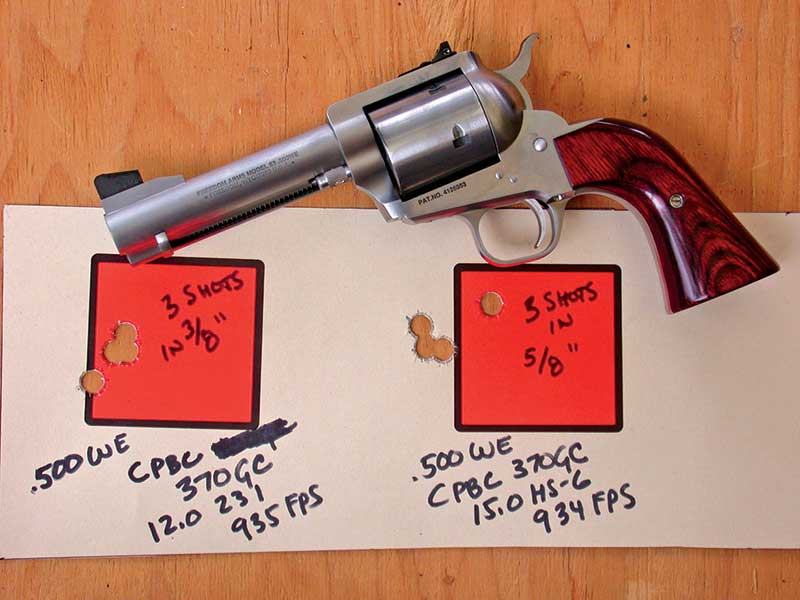
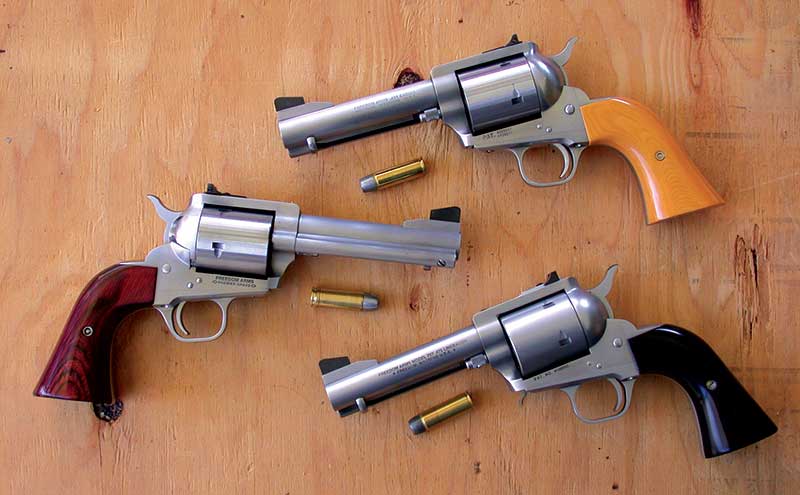
The .500 WE shows its family relationship to the same basic guns in .454 and .475.


This is a Potently Powerful Package. It can be Pleasurable or Painful, it comes at a Premium Price, and it’s even Purty. It’s the latest candidate for the title of Perfect Packin’ Pistol. The cartridge it houses is Proprietary and the sixgun itself will last in Perpetuity. This Phenomenon is the latest sixgun/cartridge combination from Freedom Arms, the .500 Wyoming Express. Perfect Packin’ Pistols are highly Personal and very dependent upon the Perception of just what is Perfect and quite often dependent upon the user’s locality. For anyone looking for the most Power Per Pound of Packing weight, this is it!

Since 1983, Freedom Arms has been producing the finest single-action sixguns to ever come from a factory. In the early 1980s, Wayne Baker and Dick Casull came together to produce not only the finest single action ever manufactured but the most powerful as well. That sixgun was the Freedom Arms .454 Casull. Both the sixgun and cartridge were destined to change the sixgunning
scene drastically. The .357 Magnum had arrived in 1935 heralded as the world’s most powerful revolver, unable to be handled by mere mortals. Twenty years later the .44 Magnum arrived pushing a bullet 100 grains heavier at the same speed of the early .357 Magnum loads. As a teenager I fired an early 4″ Smith & Wesson .44 Magnum with Remington factory loads and from my perspective then, I could not see any way I could ever handle one. It was a long learning process as I grew older.

While our early heroes were experimenting with heavy .44s in various forms, Dick Casull was experimenting with the .45 Colt. Casull started using heavy loads in the then new solid head .45 Colt brass in Colt Single Actions. When he soon discovered his loads where too heavy for production Colts, he started making his own fiveshot cylinders.

It did not take long to get past the safety factor and he soon decided to build his own larger, stronger revolver. He not only entered new levels of sixgun power he also disproved the old myth of .45 Colt brass being weak. However, when his .454 Magnum became reality the .45 Colt case was lengthened to prevent any of these heavy loads entering the chambers of older .45 sixguns, especially black-powder guns where the results would be decidedly disastrous.


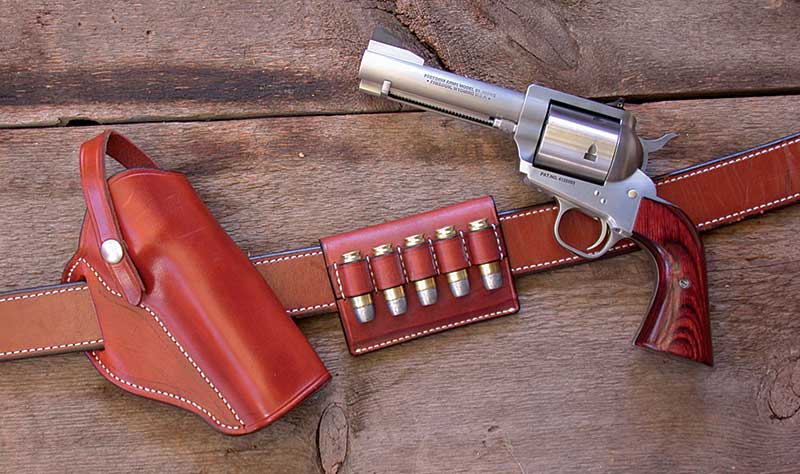
FA X-Draw holster, Sparks belt and Von Ringler carrier.

The Beginning


In the 1970s a very few .454 Casull chambered five-shot revolvers were produced by North American Arms, however it remained for Wayne Baker to form Freedom Arms and really begin producing what is now known as the Model 83 revolver. From the very first, these premium quality, five-shot, stainless steel sixguns were built with the best materials and exceptionally tight tolerances to be able to handle the power of the .454 Casull. In those days it was not easy to convince many writers to even try the .454. It gives me great pleasure to have been one of the first to spotlight the .454 as well as provide extensive loading data in Handgunner in the mid-1980s. It took awhile for the shooting public to discover the .454 and Freedom Arms went from a vault full of sixguns looking for owners to a back order situation. Handgun hunters especially, went for the .454 in a big way.

Freedom Arms did not stop with the .454 Casull-chambered Model 83. They soon offered their premium revolver in .44 Magnum, .357 Magnum, .41 Magnum and even the greatest of all cartridges, the .22 Long Rifle. A very few were even chambered in .50 Action Express. While Freedom Arms was producing those first .454s, John Linebaugh was experimenting with even larger calibers first using cut down .348 Winchester for his .500 Linebaugh (see The Sixgunner in this issue), which was followed up by the .475 Linebaugh using .45-70 brass. In the 1990s, Bob Baker of Freedom Arms took a good look at the .475 for chambering in the Model 83, however the rims were too large to fit the five shot cylinders of their production revolvers.

Baker experimented with the .475 by reducing the diameter of the parent .45-70 brass rims and found the cartridge would perform exceptionally well in the Model 83. However, he did not wish to produce a revolver for which shooters could not obtain factory loaded ammunition or at least factory brass of the proper dimensions. When loaded ammunition arrived from Buffalo Bore as well as factory brass from Starline, the Model 83 was chambered in .475 Linebaugh and to this day sixgunners still argue over which is more powerful, the .454 or the .475 Linebaugh. My answer in these types of situations is always “Buy ’em both!”

The next natural step up in caliber was the .500. However, this cartridge is so large that even by trimming the rim it was impossible to make it fit the Freedom Arms cylinder without also altering the cylinder ratchet. Baker hit on the answer and showed me the cartridge nearly two years ago. Meanwhile, Baker spent a long time experimenting with loads, tweaking the brass, and as he reached the top level of power possible with the new cartridge, he told me “I’m getting too old for this!” That should tell you something about the power possible in the new .500 Wyoming Express as Bob Baker handles the .454 Magnum like it’s a .44 Special.

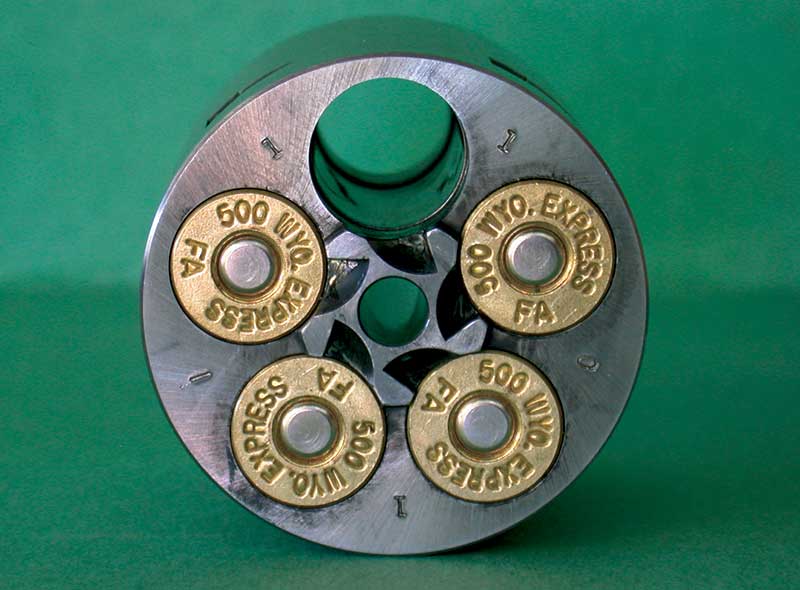
To solve the problem of cylinder size the Wyoming Express uses a belted case. Baker says of the new cartridge: “The .500 WE is a proprietary cartridge of Freedom Arms, Inc. using a 1.370″ length belted case. The belt provides reliable head spacing on a small shoulder which was required to work in the Freedom Arms Model 83 revolver. It also uses a .500″ diameter bullet with a maximum nose length of .395″ which gives a maximum overall cartridge length of 1.765″.

The cartridge was designed to not only get outstanding and predictable ballistic performance but to also minimize forcing cone erosion, thereby extending the useful life of your Freedom Arms revolver. This is done by matching powder column length, powder volume and bullet diameter to an expected range of bullet weights, velocity ranges and pressure levels.

Notice a couple of things here when comparing the .500 Wyoming Express to the .500 Linebaugh which inspired it. The .500 Linebaugh uses a large rim, the .500 Wyoming Express head spaces on a belt. The .500 Linebaugh brass is 1.400″ while the .500 WE is set at 1.370″. Bullets are not interchangeable with the .500 Linebaugh using .511″ diameter bullets and the .500 Wyoming Express designed for the use of true 1/2″ diameter bullets.


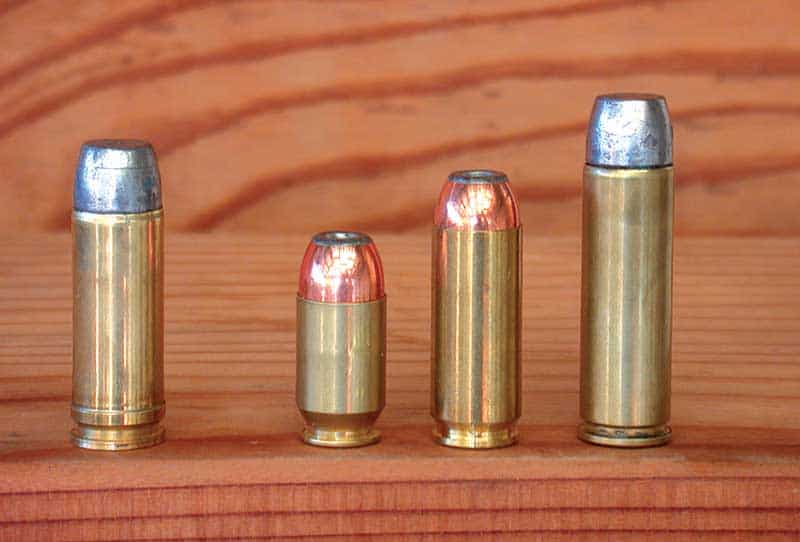
Left to right: .500 WE, .50 GI, .50 AE, .500 S&W Mag.

Strong Spirit/Weak Flesh


When Bob Baker first provided me with his experimental loading data for the .500 Wyoming Express with 350- and 370-grain bullets at 1,600 fps, 400s at 1,500 fps, and 440s at 1,400 fps (Freedom Arms will supply this data with their revolver) I remembered his
comment of “I’m too old for this!” I responded with “How do you think I feel with about two decades on you?” I knew there was no way I was about to be able to handle the heaviest loads in the .500 Wyoming Express. Twenty years ago, maybe; today, no way!

My heaviest loads just topped 1,200 fps and while manageable in a 71⁄2″, scope-sighted Model 83, they were brutal in the relatively lightweight 43⁄4″ version. The heaviest loads I used in the Perfect Packin’ Pistol 43⁄4″ Model 83 was the Cast
Performance Bullet Co.’s 440-grain Hard Cast Gas Checked LBT over 19 grains of Blue Dot for 1,201 fps in the 71⁄2″ version and 1,143 fps in the short barreled PPP. In the latter I was able to put three shots in 7/8″ at 20 yards and there is nothing I
am ever likely to encounter in the game fields I cannot take cleanly and completely with this load.

As I was testing both sixguns, my loads, and myself with the .500 Wyoming Express I thought of Elmer Keith and Tom Ferguson. When Keith finally got his much awaited .44 Magnum after 30 years of urging of manufacturers on his part, he reported in 1957 he had fired 600 rounds the first year; I fired more .500s than that from the Freedom Armsrevolvers in three days.

When Ferguson tested the .500 Linebaugh many years ago he fired a one-shot group and said that was enough. Both were smarter men than I am! Believe me even with the “lighter” loads the .500 WE recoils more, much more, than comparable revolvers chambered in .44 Magnum.


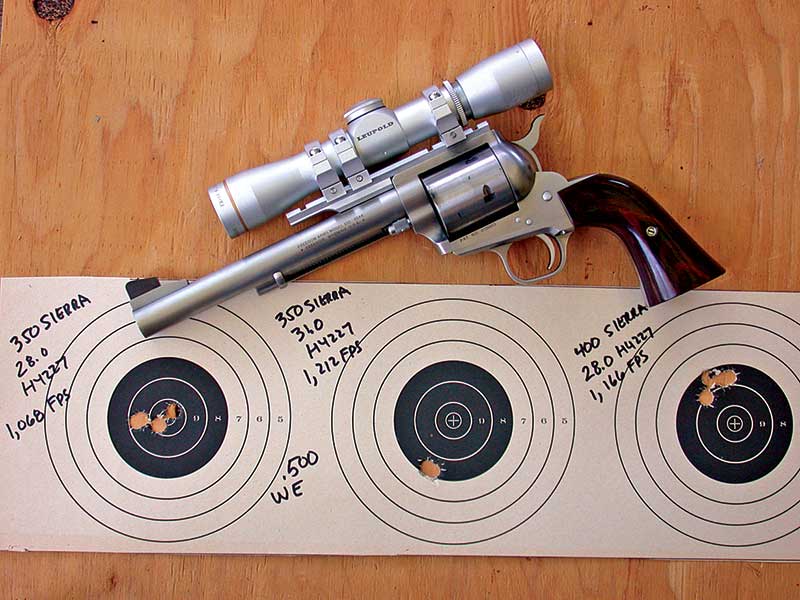
The middle 5-round “group” was fired by t he .50-g r. Sierra.

20-yard groups.

Test Guns


My pair of test guns were a brand new 43⁄4″ Freedom Arms Model 83 chambered in .500 Wyoming Express and my 71⁄2″ Model 83 .50 Action Express which was returned to the factory to have a second cylinder fitted in .500 WE. While it was there I had Freedom Arms fit an SSK T’SOB scope base as there is no other I will trust with really hard kicking revolvers. For a scope I chose a Leupold, as I’ve had excellent results with their products on hard kicking sixguns and single shot pistols for more than two decades. In this case the choice was one of their silver, 4X long eye relief scopes mounted with three rings on the T’SOB base.

Any Model 83 originally chambered in .50 AE can be retrofitted with a .500 WE cylinder, however at least at this time Freedom Arms is not offering the .50 AE cylinder as an option with the .500 Wyoming Express.

Freedom Arms is also offering the .500 Wyoming Express brass in plastic cartridge boxes holding 64 rounds as well as RCBS loading dies. The carbide three die set includes a special die setting gauge which is actually a washer which will place the carbide sizer at the proper position to not engage the belt on the cartridge case when full-length sizing. This washer is placed on top of the shell holder and the sizing die is then screwed down until it meets the washer. Once this is accomplished there is no danger of squeezing the belt, which would result in poor head spacing and possible misfires. Freedom Arms recommends seating and crimping in two separate operations so it would be handy to have a second sizing-crimping die.

For my loading of the .500 Wyoming Express I used four hard cast gas checked designs, Oregon Trails’ 370, and from Cast Performance Bullet Co. came 370, 400, and 440 LBT bullets. For jacketed bullets my choice was Sierra’s 350 JHP and 400 JFN. These were originally designed for the .500 S&W Magnum and when seated normally in the center of the cannelure that serves as a crimping groove will protrude from the front of the Freedom Arms cylinder.

I was able to use them by crimping at the very top of the crimping groove, however Sierra will be offering .500 WE versions with the cannelure set a little higher. Even in my hands the .500 WE has proven to be exceptionally accurate. The scope-sighted 71⁄2″ version is an excellent choice for the hunting of big, heavy, mean, nasty critters, while many will find the 43⁄4″ version to be the Perfect Packin’ Pistol. Should I dare to roam among mean nasty critters looking to end my sojourn here I would certainly load it to full horsepower. If needed, I doubt I would even feel the recoil! I like ’em both.

For more info:
Freedom Arms, P.O. Box
150, Freedom, WY 83120,
(307) 883-4432,
www.freedomarms.com

Leupold,
14400 NW Greenbrier Pkwy,
Beaverton, OR 97006,
(503) 646-9171
www.leupold.com

Categories
Paint me surprised by this

Former NRA executive pleads guilty to fraud, agrees to testify ByAaron Katersky

Former National Rifle Association operations director Joshua Powell has settled civil claims of fraud and abuse brought by the New York Attorney General’s office.
The admission comes hours after Wayne LaPierre, the executive vice president of the NRA, announced his resignation ahead of a trial scheduled to begin Monday. LaPierre cited health reasons, according to the NRA. The resignation will be effective Jan. 31.

Powell was employed by the NRA from 2016 through January 2020 and in that time “Powell breached his fiduciary duties and failed to administer the charitable assets entrusted to his care by using his powers as an officer and senior executive of the NRA to convert charitable assets for his own benefit and for the benefit of his family members,” the settlement agreement said.

“Joshua Powell’s admission of wrongdoing and Wayne LaPierre’s resignation confirm what we have alleged for years: the NRA and its senior leaders are financially corrupt,” New York Attorney General Letitia James said in a statement Saturday.

The attorney general is suing the NRA, which is registered in New York as a non-profit charitable corporation, and its senior management for misappropriating millions of dollars to fund personal benefits, including private jets, family vacations and luxury goods.

The NRA tried to file bankruptcy in 2021 but a federal judge rejected its petition, saying “the NRA did not file the bankruptcy petition in good faith.”

James’ lawsuit seeks an independent monitor to oversee the NRA’s finances.

As part of his settlement, Powell admitted he breached his fiduciary duties of care, loyalty and obedience by using the NRA’s charitable assets for his own benefit and the benefit of his family. He also admitted he failed to administer the charitable assets entrusted to his care properly.

He agreed to pay $100,000 in restitution and accept a permanent bar from serving as an officer in a nonprofit. He also agreed to testify against LaPierre and others at trial.

LaPierre previously said the New York AG’s lawsuit was an “unconstitutional, premeditated attack aiming to dismantle and destroy the NRA — the fiercest defender of America’s freedom at the ballot box for decades.”

Categories
Fieldcraft

Mysterious knot

Categories
All About Guns You have to be kidding, right!?!

Guess that I am going to the Gunshop in the morning

Categories
All About Guns

Original Springfield Trapdoor Officer model meets original Ideal 45-70-500 tool

Categories
Soldiering This great Nation & Its People War

Clyde Childress: WWII Guerrilla in the Philippines

Papers of Colonel Clyde C. Childress, USA

click on image to enlarge

Papers of Colonel Clyde C. Childress, USA - Record Group 109 Opens in new window
Colonel Clyde C. Childress served as commander of the 107th Division, 10th Military District, during World War II. Serving in the prewar Philippines with the American 31st Infantry Regiment, Childress was chosen to help train the new Philippine Army when it was called into service under Douglas MacArthur’s new United States Army Forces Far East (USAFFE) command in July 1941.  Shipped to Panay, where he became a battalion commander in the 61st Philippine Infantry, Childress was there when war erupted with the bombing of Pearl Harbor and Clark Field on December 7-8, 1941.

Though still green and untrained, the 61st infantry was shipped to the southernmost island of the Philippines; Mindanao.  Positioned on the south coast of the island, the unit was to guard the air field and coastal region near the town of Malabang.  The 61st was quickly overrun with the Japanese invasion of the Cotabato region in April of 1942.  Childress was cut off from his command being on the right wing of the defenses when the Japanese routed the 61st.  Along with his men Childress retreated by jungle trail to the north coast of Mindanao.  During their eight day trek north, the Philippines were surrendered.  Childress and his men were now unsurrendered fugitives.  Most of his men came from Panay Island and that is where they were headed.  Childress, on the other hand, needed to hide.

Clyde Childress’s rare 1909 Colt revolver that he carried in the guerrilla war on Mindanao Opens in new window
Physically destroyed by his jungle trek, Childress took refuge with American expatriates on the Zamboanga Coast and recuperated.  Like all the Americans that went into the jungle, Childress would not have survived had it not been for the hospitality and complete selflessness of the Filipinos and Americans that helped them.  Not all Filipinos, however, were friendly.  At one point during his recuperation Childress got word that the local Philippine Constabulary officer was going to come with his men and disarm him.  Childress was not one to wait for trouble and instead went looking for it.  He showed up at the Filipino’s headquarters.  As he approached he noticed the constabulary soldiers smiling at him and knew they were on his side.  Childress walked right up to the officer and basically told him to make a move.  The officer balked and Childress disarmed him.  He would have no trouble from anyone else.

After four months, the “bamboo telegraph” brought word that an American General had arrived in Mindanao by submarine.  Childress made the trek by foot along the north coast of Mindanao from Zamboanga to Misamis Occidental.  Upon arrival in Jimenez, Childress found the “General.”  It was a reserve U.S. Army engineer officer, Lt. Colonel Wendell W. Fertig.  Fertig made up the ruse of being a general to gain the support of the local populace and set up his own guerrilla kingdom.  Looking like the “wild man from Borneo,” Childress was taken in and cleaned up by the Ozamis sisters of Jimenez, women who risked everything to give support to the guerrillas of Mindanao.  Given a shave, bath, and a new uniform, Childress met in conference with Fertig on 20 November 1942.

Much to Childress’s surprise, he was meeting with Fertig and Major Ernest McLish, who had been a fellow battalion commander in the 61st regiment.  Childress and McLish had not seen each other since being overrun at Malabang in May 1942.  At Jimenez the agreement was made with Fertig that McLish and Childress would go east and organize the eastern areas of Mindanao.  McLish, who had already started a guerrilla in the Bukidnon region, was designated as commander of the 110th Division of Fertig’s 10th Military District command on Mindanao with Childress as his Chief of Staff.  Fertig felt he could use the two to further his end of being the top guerrilla of not only Mindanao by all the Philippine Islands.  He thought Childress the stronger of the two, and would never see eye to eye with McLish.  McLish and Childress left by sailboat for the two day trip to Balingasag and the Misamis Oriental region of Mindanao.  They wondered “what was the story” with the guy who was calling himself a General.

click on image to enlarge

A map Mindanao Island showing all the different regions of the island Opens in new window
The 110th Division encompassed a wide area of western Mindanao encompassing the Misamis Oriental, Agusan, Surigao and Davao regions.  It was populated with bands of guerrillas all acting on their own initiative and in many cases as bandits.  McLish and Childress, with the help of a host of unsurrendered Filipino and American fighters brought order to these areas by supporting legitimate guerrillas and suppressing the bandits.  By March 1943, most groups in the Misamis Oriental and Agusan regions were under the control of the 110th Division.  The question became, “What do we do now?” It didn’t take long to come up with an idea.

In March 1943, Major Luis Morgan, Chief of Staff of the 10th Military District and the real muscle behind the establishment of Fertig’s guerrilla organization, arrived in the 110th Division area.  At odds with Fertig, Morgan had been sent on a tour of Mindanao and the Visayan Islands trying to bring all guerrillas together in purpose.  Morgan was a former constabulary officer from the Lanao region of Mindanao.  After the American surrender, Moslem bandits began raiding the Christian coastal areas of Lanao.  In a brutal campaign of bloodletting, Morgan put a stop to it.  He liberated the north coast of Mindanao for Fertig, and was always up for a fight.  Going into conference with McLish and Childress, who were just itching for some payback against the Japanese, they came up with a plan to attack the Japanese garrison at Butuan at the head of the Agusan River.

The attack on Butuan was a lesson in working with untrained guerrilla fighters, most of who were unarmed and ran at the first shot.  Initially the town was taken, but the Japanese garrison took defensive positions in a concrete schoolhouse.  Lacking any heavy weapons to assault the schoolhouse, the attack became a stand off and the guerrillas had to retreat before Japanese reinforcements could arrive.  The guerrillas captured a number of ocean going boats and freed future Leyte guerrilla leader Ruperto Kangleon from the Butuan prison, and though they could not take the town, the Japanese garrison was removed a short time later.

March 1943 was when everything changed in the guerrilla war on Mindanao, for this is when the first submarine from Australia arrived on the south coast of Mindanao.  Carrying Lt. Commander Charles “Chick” Parsons and Captain Charles M. Smith, a dozen radio sets with generators and a few tons of supplies, the arrival of the submarine USS Tambor on 5 March was the first sign to Filipinos and Americans on Mindanao that they had not been forgotten and “the Aid” was finally going to come.  The “bamboo telegraph” was again active and it didn’t take long for word to reach the 110th Division.  Childress set out for Fertig’s headquarters at Jimenez to find out what was going on and what supplies might be available for the 110th.  Childress arrived only to be volunteered to accompany Parsons on his trip across Mindanao and up to the island of Leyte.

click on image to enlarge

Major Clyde Childress sits with the Ozamis sisters and Lt. Cmdr. Charles “Chick” Parsons  Opens in new window
Parsons and Smith had not just come to Mindanao to bring supplies.  They had come to assess Fertig and his organization and to establish coast watcher stations on the islands of Mindanao and Leyte.  Lt. Colonel Charlie Smith knew Fertig fairly well, having hid in the jungles of Mindanao with him after the surrender, and he was convinced of his ability.  (See New Acquisitions, RG-106, Papers of Lt. Col. Charles M. Smith) MacArthur’s headquarters, however, was staffed with career U.S. Army soldiers who were disgusted at someone promoting himself to General.  They needed reassurance that Fertig was stable.  Parsons, like Smith, had no problem with Fertig and found him most capable.  That established they began the next leg of their journey.  Smith went to Davao, Mindanao to set up a coast watcher station and Parsons travelled to Leyte to do the same.  Childress and a few of his men acted as Parsons’ guide and muscle.

click on image to enlarge

Papers of Colonel Clyde C. Childress, USA Opens in new window
Up until June 1943, 10th Military District guerrillas roamed at will right out in the open.  Once the Philippines had surrendered, most of the Japanese forces moved on to the Southwest Pacific fighting in the Solomon Islands and New Guinea.  Mindanao became a backwater and the Japanese did not have the forces to put large garrisons in the towns.  Once a submarine from Australia landed, however, that changed the whole dynamic and the Japanese decided to move against Fertig’s organization.  On June 30th they moved into the Misamis Occidental region in force and Fertig’s men scattered before the onslaught.  Fertig had to move his headquarters to the area of Lanao that was to the east of Misamis Occidental.  By November 1943, however, the Japanese pressure on Lanao was growing and Fertig again moved his headquarters.  This time he moved to the Agusan region of Mindanao, which was the area controlled by McLish and Childress.

click on image to enlarge

Papers of Colonel Clyde C. Childress, USA - USS Narwhal Opens in new window
After the success of the USS Tambor mission that brought Lt. Cmdr. Parsons and Captain Smith to Mindanao, submarine supply missions became more frequent to the Philippine islands.  Once the U.S. Navy saw the benefit of the coast watcher stations set up by Parsons and Smith, they were more than willing to provide more submarines for guerrilla supply.  Two of the biggest submarines in the U.S. Navy, the USS Narwhal and USS Nautilus, began regular missions to the Philippines and it was in the Agusan region of the 110th Division that they made most of their runs in late 1943 and early 1944.  McLish and Childress, therefore, became the supply quartermasters for Mindanao.  They would receive the supplies, store them in safety, and then make sure they got to the other guerrillas on the island.

By early 1944 the area controlled by the 110th Division became too great and it was decided to create a new command to oversee the southern regions of Mindanao surrounding Davao.  The new command was to be the 107th Division and Clyde Childress, now a Lt. Colonel, was given command.  His main objective was the protection of Fertig’s new headquarters deep in the interior of Mindanao at the town of Waloe on the Agusan River. It was in this pursuit that Clyde Childress won the Silver Star Medal for gallantry in action.

click on image to enlarge

Clyde Childress stands in the bow holding a rifle on “Admiral” Vincente Zapanta’s  banca Athena on t Opens in new window
In March 1944 the Japanese forces made a huge push into the Agusan region of Mindanao.  They had learned that supply submarines had been arriving there and also that Fertig had moved his headquarters to that area.  Pushing up the west bank of the Agusan River they were met by the forces of Major Khalil Khodr, a regimental commander of the 110th Division.  On March 17th, Lt. Col. Childress arrived with some forces of his 107th Division.  There at the battle of Vitos Hill, Childress singlehandedly manned a 37mm artillery piece and drove off the Japanese as his and Khodr’s men captured the hill.  Childress was awarded the Silver Star for this action.

Throughout the guerrilla war on Mindanao, Colonel Wendell Fertig leaned heavily upon the talents of Childress and McLish, but as the war progressed he developed a deep distrust of them.  It was a process he would repeat with many of the men he led on Mindanao.  His reports on the two men were always glowing, yet in his diary he would gripe or demean things they did.  Face to face, Fertig was friendly, but behind their backs he “bad mouthed” them to headquarters and other guerrillas.  After MacArthur’s return to the Philippines with the landing on the island of Leyte in October, 1944, many of the guerrillas wanted to rejoin the American forces and leave the stress filled life of a guerrilla; always looking over your shoulder, eating next to nothing, and always suffering from some tropical ailment.  McLish and Childress both opted to leave Mindanao shortly after the return of the Americans.  In December 1944, both Childress and McLish left Mindanao by PT boat for American headquarters at Leyte.  Both arrived on Leyte to find that Fertig had stabbed them in the back.  He had sent reports saying they were disloyal, incompetent, and had done little for the effort in Mindanao.  It was a bitter pill to swallow for the two men who had done more for the guerrilla effort on Mindanao than perhaps any other soldiers.

click on image to enlarge

Certificate of Membership In The American Guerrilas of Mindano Opens in new window
Clyde Childress was a long time friend of the MacArthur Memorial.  His death in 2007 was a great loss for the MacArthur Archives and America.  He was the last surviving officer of the prewar 31st United States Infantry.  We are proud to be the repository for his artifacts and papers from his time in the guerrilla war on Mindanao.
Categories
All About Guns Allies War Well I thought it was neat!

The Yangtze Incident – Britain’s Last Battle in China 1949

Categories
All About Guns

OLD WEST CCW BOOT GUNS AND BABY DRAGOONS WRITTEN BY MIKE “DUKE” VENTURINO

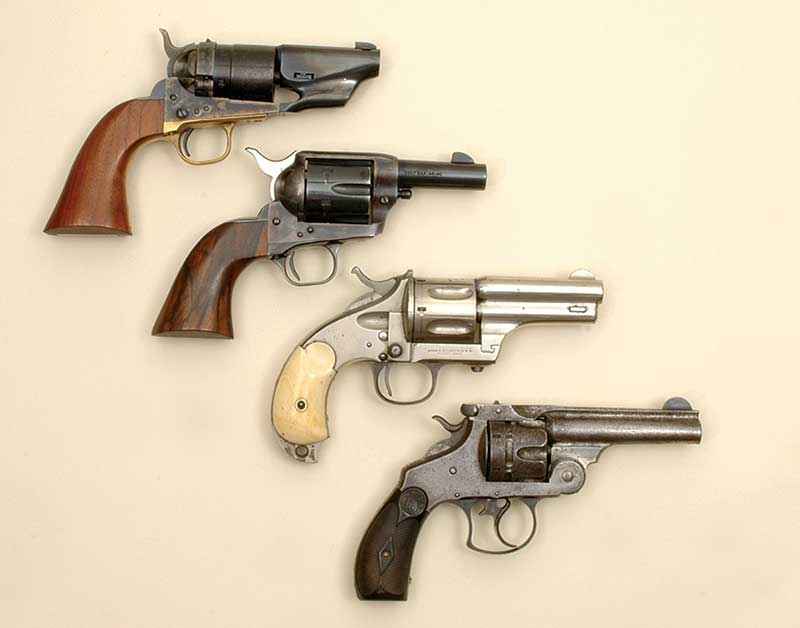
TOP: Colt Richards Conversion .44 with barrel snubbed to 3″.
SECOND FROM TOP: Colt Sheriff’s Model .44-40 with 3″ barrel.
THIRD FROM TOP: Merwin & Hulbert .44-40 with 3.5″ barrel.
BOTTOM: S&W Model 1881DA .44 Russian with 4″ barrel.

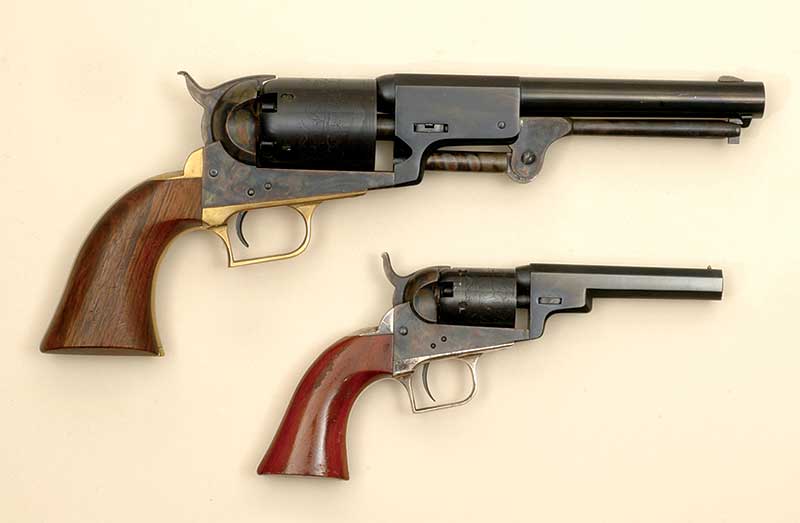
The Colt Baby Dragoon .31 (bottom) was a scaled-down version
of the huge 4-pound Colt Dragoon .44 (top).


Hollywood would have us think that back in the “Wild West” every man went about his daily affairs packing a big sixgun in a leather holster on his belt. NOT! Drovers, Frontiersmen and Indian Scouts likely did, and of course Texas Rangers and all sorts of other lawmen certainly carried handguns openly.

Not so town and city dwellers. Pocket pistols were a hot item in the Old West. Town dwellers and well dressed travelers also packed iron, at first actually in pockets. As the trend progressed to bigger and more powerful they were often concealed in a holster under a coat. Consider this; Colt and S&W alone produced well over a million concealment-intended handguns between 1848 and 1900. That’s amazing considering the population of the United States in that era.

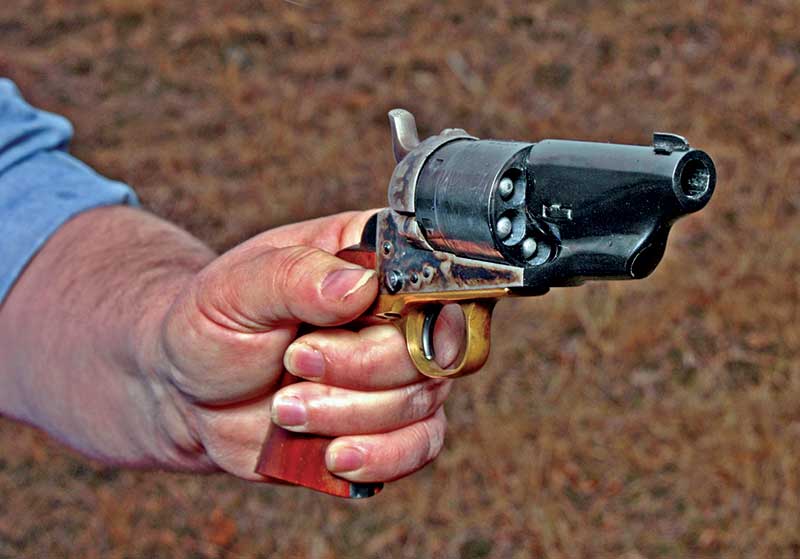
Concealable handguns were so hot an item that it’s a fact when Sam Colt got his firearms-manufacturing business up and running the second time in the late 1840s, one of his first concerns was coming up with good “pocket pistols.” That was in 1848 and those little babies were only .31 caliber, and five-shooters to boot. Collectors even call them Baby Dragoons, after the huge 4-pound horse-carried Colt Dragoon revolvers they were based upon. Even by modern standards a Baby Dragoon was light at only 22 ounces with a 4″ barrel.


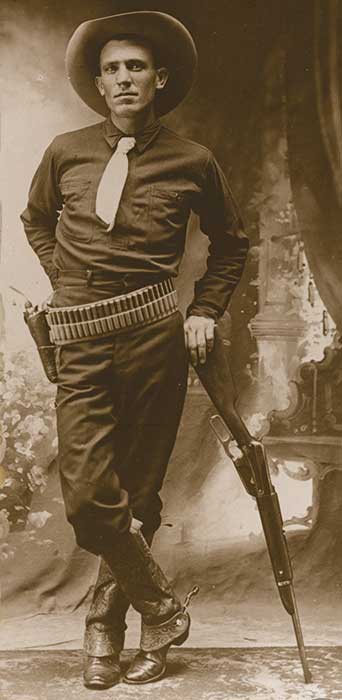
Lawmen certainly went openly armed. This turn of the century Texas Ranger was named Jules Baker. Photo courtesy Herb Peck Jr. Collection.

Merwin & Hulbert offered their Pocket Army .44s with twin barrel sets.
They were 3.5″ and 7″ and could be changed in seconds.

Cowboys and outdoorsmen likewise went openly armed.
Photo courtesy Herb Peck Jr. Collection.

The Bad News


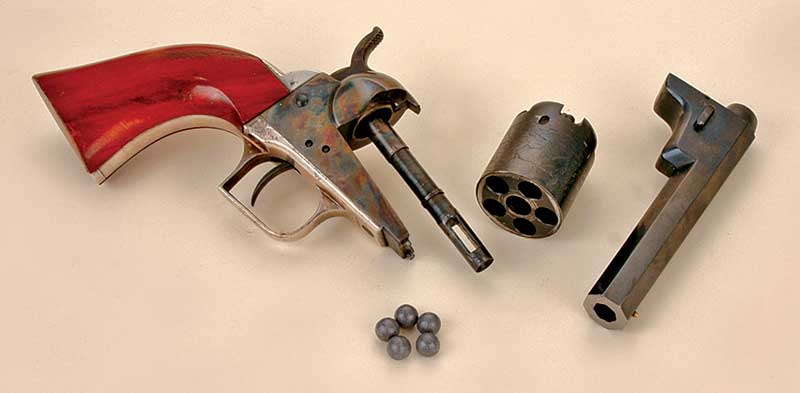
That was the good news. The bad news was they were punch handicapped. With really hot loads, they were popping to break 700 fps with a 48-grain round ball. In foot-pounds of energy that’s sort of in-between a .22 Short and .22 Long. After those five pipsqueak charges were fired it would take an experienced shooter about 10 minutes to get them up and running again. The gun had to be broken into three pieces for reloading. I doubt if many wayfarers gave up their Bowie knives upon buying a Baby Dragoon.

But get this — Sam Colt sold 15,000 of those little .31s in only a year or so and then upgraded to a Model 1849. It used the same frame but with a loading lever beneath the barrel. Reload time was cut at least in half. Hear this too. The Colt factory turned out more than 325,000 of them before production ceased in 1873. That’s 24 years. It took Colt 68 years and several government contracts to produce 357,000 Colt Peacemakers. Who says people in the old days didn’t carry concealed?

Those gun-toters weren’t stupid either. They knew the little .31s were puny. Using the rebated cylinder design Colt eventually put five-shot .36 caliber cylinders on the little Model 1849 frame and called them Model 1862s. (Collectors named them Pocket Navy and Pocket Police depending on their exact configuration.) Those would push an 80-grain round ball all the way to 850 fps. That brought pocket pistol power up to .32 ACP ballistics. Things were humming then.


This Colt Richards Conversion may be snubbed off, but it would still
look dangerous from across a card table.

These are Model 1862 .36s. Front is Pocket Police. Rear is Pocket Navy.

Metallic Magic


Now think in terms of metallic cartridges. S&W actually got their business up and rolling in the 1850s and 1860s with concealed-carry-type handguns. This was their No. 1, which actually was the introductory vehicle for the .22 Short. Between 1857 and 1881 they sold over a quarter million of those itsy-bitsy little SAs.

Today’s cowboy-action shooters would be perfectly happy with those puny popguns. Heck they even try to make their big .45s recoil like .22 Shorts. But, back in those days when you didn’t smoke up your assailant’s sorry butt with the handgun, a knife fight likely commenced. People really wanted more power from their CCW guns.

For that reason, in 1876 S&W introduced the .38 S&W cartridge for pocket handguns and the revolver introduced along with it has always been known as the Baby Russian. (Gun people of the late 1800s sure liked that “baby” moniker.) It was so called because the design was scaled down from large frame revolvers the company was making for the Russian Government. A year later Colt came up with their idea of a concealed carry, cartridge firing handgun and this one was even DA! The Colt Model 1877DA was made in .38 Colt and .41 Colt calibers. Somehow they then became dubbed “Lightning” and “Thunderer” respectively.

None of these new concealed weapon calibers struck like lightning. The .38 S&W had loads with 145- to 150-grain bullets over 14 or 15 grains of black powder, while the .38 Colt load used 150-grain bullets over a whopping 19 grains of the same. The .41 Colt was loaded with 200-grain bullets and about 21 grains of black powder. None of these loads could have given over 750 fps, even from a long barreled revolver. Still they were better than a .22 Short. At last people started leaving the Bowie knives at home.


These mid-sized concealed. concealables were introduced in the
1870s. Top to bottom: Merwin & Hulbert Pocket .38, Colt Lightning
.38 and a Colt Thunderer .41.

The rise of trouser belt loops actually made it possible for larger more powerful handguns to be holstercarried while These mid-sized concealed.

Early concealment handguns were meant for pocket carry.

Little Big Guns


Another trend in CCWs got started circa the late 1870s and early 1880s. That was when gun-toters began packing short-barreled versions of big revolvers in holsters under their coats, instead of a diminutive one in their pocket. A for instance would be the so-called Colt SAA Sheriff’s Model with 3″ barrel and no ejector rod or housing. By this time S&W was also making its SA New Model No. 3 with short barrels, and their Model 1881DA was simply the No. 3 adapted to a DA trigger mechanism. It was common with 4″ barrel.

Why the change about that time? Because trouser belts for men became common. Now, I’m no expert on Old West clothing, but my seamstress wife does have some antique pattern catalogs from that era showing men’s pants starting to have belt loops Hence there was finally something to hitch a revolver holster onto without giving obvious notice the wearer was packing iron.

Old West gunmen were also known to have gunsmiths aid them in their quest for concealable handguns, and also to find innovative ways to pack them. For instance around 1881 El Paso City Marshall Dallas Stoudenmire was known to pack a Colt Richards Conversion .44 with its barrel shortened from 8″ to only 3″. Then he had a special leather-lined pocket built into his trousers to house it. By the 1890s shoulder holsters were common. Reformed outlaw John Wesley Hardin was packing either or both a Colt Lightning and S&W Model 1881DA in
such a rig when he was gunned down in an El Paso saloon.


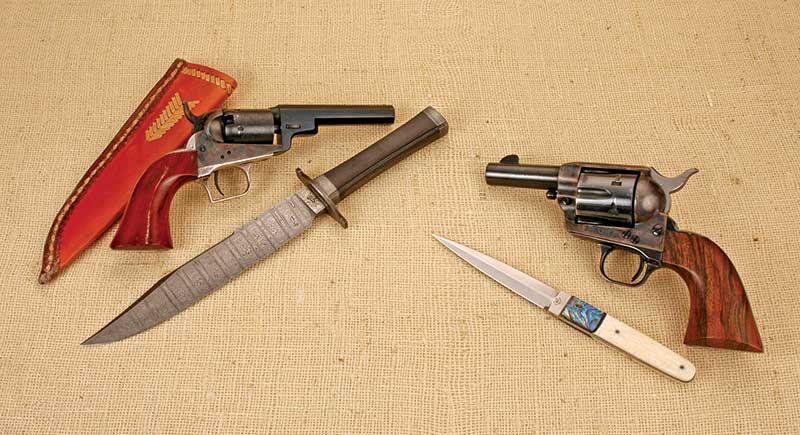
After its five tiny round balls were fired the Colt Baby Dragoon .31 had to be dismantled to three pieces for reloading.

As concealed-carry handguns got more powerful, fighting knives got smaller.
Left: Colt Baby Dragoon .31 & Steve Brooks Bowie knife. Right: Colt Sheriff’s
Model .44-40 with dagger by unknown maker.

Other Ideas


Some companies got downright brilliant about concealed-carry and self-defense handguns. Merwin & Hulbert for instance offered a Pocket Army .44. It was a normal-sized sixgun and much too large to carry in a pocket. But, they offered the option of two pre-fitted barrels. One was 7″ long and the other 3.5″. They could be switched in a matter of seconds. The idea was for the long barrel to be worn openly on the trail, and then the short one replaced for concealed carry. Then M&H took matters one step further. The revolver’s butt came to a point called the “skullcrusher” for when altercations became more intimate. Wouldn’t lawyers have a field day with that now?

Over the years I’ve managed to add an assortment of Old West concealed carry weapons to my shooting collection of handguns. A Baby Dragoon .31 and both versions of Model 1862 .36s are from Colt’s second generation of cap & ball revolver production of the late 1970s and early 1980s. There’s also an S&W Model 1881DA .44 Russian, a Merwin & Hulbert Pocket Army, and a Colt SAA Sheriff’s Model. Both of those are .44-40s. Some years back I even went to the trouble of having Wisconsin gunsmith Kenny Howell build me a facsimile Richards
Conversion .44 with snubbed-off barrel similar to Dallas Stoudenmire’s favored concealed sixgun. It’s in the original .44 Colt caliber.

The little S&W No. 1s and Baby Russians have eluded me so far but there is a “Baby” Merwin & Hulbert .38 in my collection that is of similar size and power to the S&W Baby Russian. Also, about this time someone is likely thinking, “What about derringers? The dummy is forgetting them.” No I’m not. I’ve just never been interested in them, and won’t blow smoke up your wazoo and say someday I’ll do an article covering derringers. Somebody else can do that. This is a revolver article.


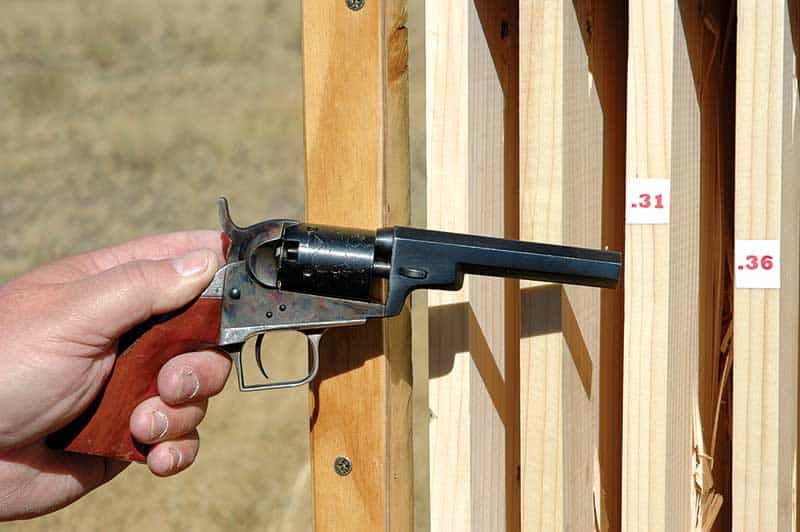
The puny Baby Dragoon .31 penetrated two 7/8″ boards and lodged in the third.

The point of a Merwin & Hulbert’s butt was called “The Skullcrusher.”

Duke’s Opinion


So here’s my take on Old West concealed-carry handguns. The little .31 caliber Colts were better than nothing, but if you had to take on someone with one you better hope they weren’t wearing a lot of clothing or a heavy leather vest. I shot mine into a baffle box and it went through two 7/8″ pine boards and lodged in the third. I think it was these pipsqueaks that gave rise to the legends
of pocket bibles or a sheriff’s badge stopping a bullet. Ditto in spades for the S&W No. 1 .22 Short.

The S&W Baby Russian and M&H .38s were a great step up. They were still compact enough to actually be pocket-carried, and yet have a modicum of pistol power. There are plenty of accounts about wounds from guns like that causing death from infection days or weeks after a gunfight. Unfortunately, often it was the bad guy that expired weeks later while the good guy was beaten or knifed to death at the scene. They weren’t stoppers.

That leaves us with the short-barreled, big-bore revolvers meant to be holster-carried. Actually they were pretty good self-defense handguns. The .44 Russian would have had a 246- to 255-grain bullet over 23 grains of black powder. From a 3″ or 4″ barrel that load gives 725 to 750 fps. The .44-40 load would have a 200- grain bullet over a full 40-grain charge. It was snorty! Even from a 3″ or 3.5″ barrel it will break 800 fps. If none of that impresses you “modern” guys then just think again. In terms of muzzle energy those ballistics pretty much equal a .45 ACP from one of the compact Model 1911s.

Personally, if I had been walking the streets of a tough town in the 1880s, and had my choice of what to carry concealed, it would be a toss up between the S&W Model 1881DA .44 Russian, or the Merwin & Hulbert .44-40. The Colt Sheriff’s Model .44-40 is attractive but it would be my third choice just because of the slow reload factor. Both the S&W and M&H offer simultaneous cartridge extraction.

And then I would have slipped an S&W or M&H “Baby” .38 in a pocket for backup — and had a knife in my boot too. And if you were a bad guy after me then, you might keep in mind I might have a good friend nearby equally ready. Like Clint Smith says, “Always cheat, always win.”