Month: December 2023

Though heavy, the HK33 is nonetheless a reliable and effective infantry rifle.
The manual of arms is an acquired taste, but the weapon runs like a lawyer after money. The 5.56x45mm HK33 was a direct evolutionary development of the 7.62x51mm G3.
Life at the Antarctic National Science Institute Station 4 was typically tedious on an apocalyptic scale. Situated as it was within one of the most hostile environments short of outer space, just surviving demanded an exorbitant amount of effort.
Like any remote austere outpost, such a bizarre life attracted bizarre personalities. When the crew heard the rhythmic throbbing of the Norwegian helicopter approaching in the distance, they assumed it might be some welcome company. Then they heard the gunfire.
The noise drew the station’s crew. Once the Jet Ranger grew closer it became obvious the Norwegians were inexplicably shooting at a sled dog now racing madly for the camp. The dog made it safely to the station just as the helicopter touched down. A mad Norwegian with a scoped HK33 rifle leapt from the aircraft, firing at the dog on the run. In the process he also fumbled an incendiary grenade and destroyed the helicopter, killing its pilot. Throughout it all he shouted in unintelligible Norwegian.
The station commander produced a big Smith revolver and unceremoniously killed the man with a single shot to the head. All involved were confused and frightened and the dog escaped into the bowels of the station. Had anyone spoken Norwegian, however, they would have realized that this was no ordinary dog. It was the Thing from Outer Space….

Hollywood Gold
Thus began the epic 1982 John Carpenter horror classic The Thing. While most normal folks would revel in the gripping tension, tight drama, snappy dialogue and impressive analog creature effects, I was — as always — fixated on the guns. The scoped HK33 rifle used by Lars, the maniacal Norwegian, is actually quite unusual on the big screen.
The HK33 is rare in Hollywood because it is also fairly rare out here in the real world as well. Despite enjoying some simply epic parentage and having been made by what is arguably the world’s premiere arms-maker, this roller-delayed blowback 5.56mm assault rifle just never really found its commercial legs. However, the gun’s particulars remain fascinating.
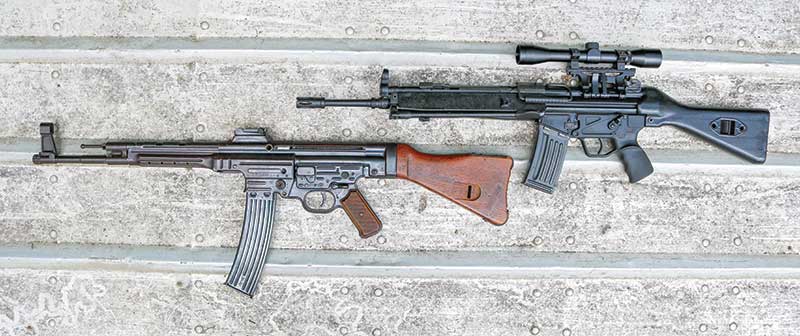
The HK33 design was based upon that of the wartime German MP44.
The similarities are obvious if you look for them.
In the Beginning …
The German HK33 traces its lineage back to the Second World War. The StG45 assault rifle never made it past prototype stage but nonetheless promised to revolutionize the way the world made infantry rifles. Combining the pressed steel receiver inspired by the MP44 and the roller-delayed blowback action of the MG42 belt-fed machinegun, the StG45 would have been cheap to build and reliable in action. However, the war ended before the gun could see final deployment.
The weapon’s designers took the basic StG45 idea to Spain, modified it slightly and created the CETME assault rifle. After a few tweaks, the CETME became the G3, manufactured and marketed by the burgeoning arms-maker Heckler & Koch starting in 1956. The G3 won the trials for the new West German Bundeswehr infantry rifle in 1959 and HK became a recognized arms maker.
The G3 proved to be a fertile foundation for a lot of other things. Following the success for the 7.62x51mm G3, the firm produced the 7.62x39mm HK32, the 5.56x45mm HK33 and the 9mm Parabellum HK54. The HK54 was later designated the MP5. While the G3 sold well around the world, the HK32 sort of fizzled. The HK33 was adopted, generally on a fairly small scale, by dozens of countries. The MP5 dominated the submachine gun market for decades.
The HK33 was first launched in 1968 and was produced both in Germany and under license by MKEK in Turkey. HK dropped the weapon from its catalog in 2000, while MKEK still produces the gun today. In the mid-1960s, Harrington and Richardson churned out a modest number of license-built copies of the HK33 titled the “T223” here in the United States. U.S. Navy SEALs used a few of these novel rifles in the latter stages of the Vietnam War. They were most taken with the gun’s generous 40-round magazines along with its reliability in action.
Six years after the HK33 hit the streets, HK launched the dedicated semiautomatic HK43 rifle intended for the civilian market. Once equipped with a 16″ barrel to comply with U.S. gun laws, it was redesignated the HK93. The HK93 sold briskly in America up until 1989 when it fell prey to executive order import bans under President Bush the First.
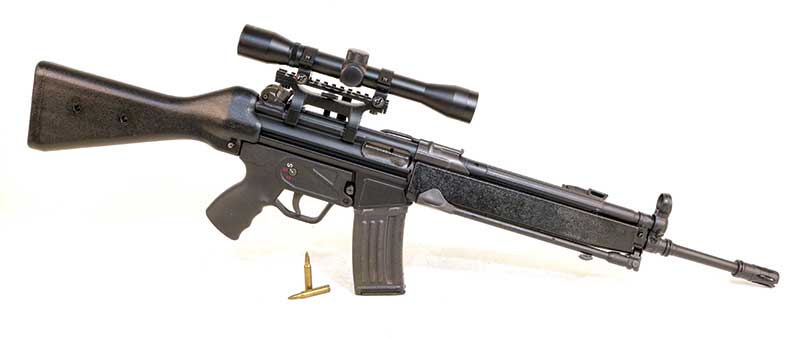
The HK33 assault rifle represented the state of the art at the time
of its introduction. For a variety of reasons, however, not a lot of people
wanted it. This example sports the 25-round magazine.
Technical Details
The HK33 orbited around the same sort of pressed receiver and roller-delayed action as the G3 and MP5. In fact, the interior diameter was the same in all three receivers, though the mechanical particulars were obviously quite different. The standard rifle was offered with a 15.4″ barrel and the gun weighed about 8 lbs.
Like all HK weapons of its era, the HK33 was a thoroughly modular design. Pushing out a couple of pins allowed the user to mount up either a fixed or collapsible stock. Magazines came in 20-, 25-, 30- and 40-round versions. The modular fire control unit offered safe, semiauto, full auto and a variety of burst options. Though the construction was predominantly inexpensive pressed steel and welding, these HK weapons had a well-earned reputation for quality.
Furniture was made from robust polymer and the slotted flash suppressor had a notch in the front end for use as a wire cutter. The basic HK33 rifle would accept the same folding bipod and claw scope mount as the G3. The scope mount, while effective, was heavy and more complicated than the human female.
Though the full-sized HK33 found a tepid audience on the international arms scene, the SMG version titled the HK53 with its 11″ barrel made a bigger splash. Offering the power of an assault rifle in a package roughly the same size as the MP5, the HK53 was popular with law enforcement agencies. The HK53 was 2 lbs. lighter than the full-sized rifle.
Trigger Time
Like the G3 that came before it, the HK33 charges via a non-reciprocating cocking handle in the left front aspect of the forearm. The bolt does not lock to the rear on the last round fired, so magazine changes start with manually securing the bolt to the rear using the retention notch in the cocking tube.
The operator then swaps out magazines and slaps the cocking handle down to close the bolt on a fresh round, looking just super cool in the process. This chore is a bit slower than the same routine with an M4, but it is undeniably sexy. GI weapons have both a pushbutton and flapper magazine release though the civilian versions had just the button.
The standard HK military trigger is as long as your niece’s interminable piano recital and as creepy as crazy Aunt Edna’s new mail order boyfriend. However, for general military applications, it is completely serviceable. The HK33SG/1 features an improved target trigger and is designed for use with a telescopic sight.
The HK33 has a different personality on the range than either a direct gas impingement M4 or a piston-driven rifle like the FN Scar or HK416. The recoil impulse is somehow snappier. Regardless, the experience remains nonetheless pleasant and the rifle is a joy to run.
The cyclic rate of fire for the rifle version is around 750 rounds per minute or roughly the same cadence as a standard M16A1, the gun’s most direct competitor. The shorter HK53 runs about 50 rpm slower for some reason. Bursts are easily managed with a disciplined trigger finger, though mechanical 2- and 3-round trigger packs were factory options. The HK33 shoots as straight as any comparable rack-grade infantry arm.
Ruminations
The generous 40-round magazine was the real discriminator between the HK33 and competing rifles of its vintage. However, the HK33 was undeniably heavy. The modularity was cool, but 8 lbs. get tedious on a long ruck march.
The HK33 was superseded briefly in the HK catalog by the similar but different G41. With the advent of the polymer-framed G36 in 1997, the HK33 died a natural death. Nowadays semiauto 5.56mm versions of the HK33 are available from producers both foreign and domestic. They have been and always will be fairly expensive.
HK had hoped the HK33 would be competitive with the M16. The roller-delayed action is arguably more reliable and less maintenance intensive and the manual of arms is easy enough to master. However, the gun is still a pound and a half heavier than a comparable direct gas impingement M16A1. This and a relative market glut conspired to kill the HK33.
Despite its atypical entrails, the HK33 is an undeniably fun gun on the range. The mass and inline architecture help keep the muzzle down and the thing is all but indestructible. It would even be a good choice were you ever called upon to trek to the frozen wastes of Antarctica to do battle with a shape-shifting alien monster.
Categories
S&W Model 58 review and firing
Categories
Swiss K31 Chapter 2

Dave’s nephew Mike Decker asked for advice on buying his first big game rifle and Dave said get a .243. A couple of weeks later Mike showed up with a Winchester 70 in .300 Win. Mag.
Friends and relatives sometimes ask for advice on cartridge choice for big game hunting and they seem surprised I don’t have any particular favorites. I tell them the most important things are: (1) shot placement and (2) bullet action. The ability to place shots accurately on demand is important, so factors influencing shooting ability such as rifle fit, trigger quality and sighting equipment matter. Oh, and practice. The shape of the cartridge case and its head stamp matter very little.
I’ve shot big game with at least 40 different cartridges, some only one or two head, others in three figures. Some get used more than others mainly because I like certain rifles, not because of the cartridge. Still, a young fellow recently came up with convincing arguments why I should give some specific recommendations.
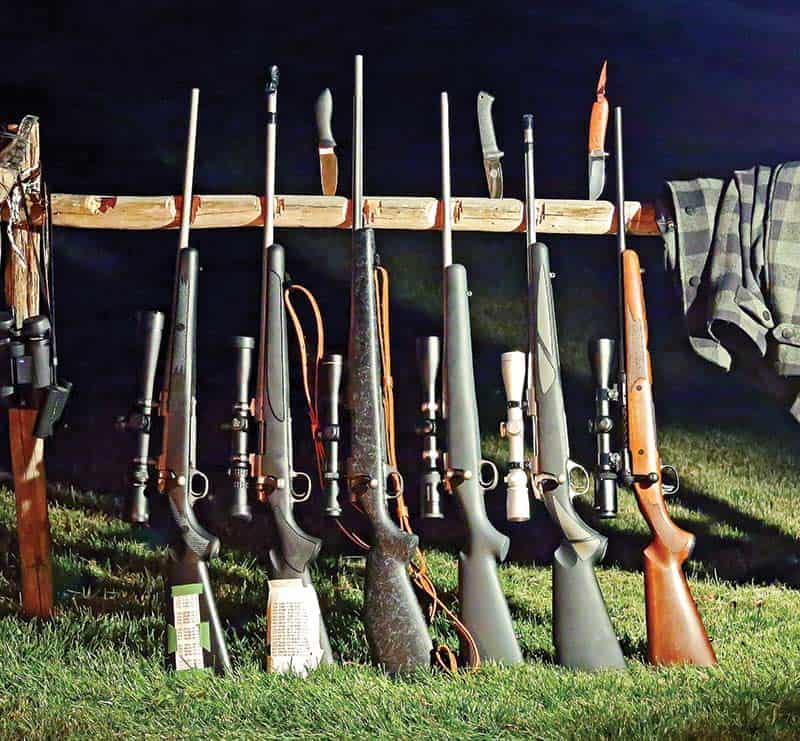
A selection of light-recoiling rifles that are actually fun to shoot. From left,
Ruger Hawkeye .223, Remington 700 .243, Weatherby Vanguard .240 Why.,
Kimber Montana .223, Sako Finnlight .243, Savage lightweight .260 Rem.
Questions
The young fellow is a doctor, a podiatrist to be specific, who has been attending to my feet. Just chatting along — I thought — he mentioned watching a war movie marathon over the weekend. He noticed when the bad guys wanted to torture information out of the good guys, they would go for the toes. “Toes can be really painful,” he said, taking some kind of medieval torture device from a drawer. He poised the device over my already painful toe. “By the way, what is your favorite big game cartridge?”
“It doesn’t matter much,” I started to say, when he squeezed the handle of the torture device and two small razor-sharp blades started chomping as the device got closer to my toe.
“The .270 Winchester and .300 Win. Mag.! Love them both equally! Spare my toes and I’ll give you one. I’ll give you BOTH!”
“No need,” he said mildly. “I already have a .300 Win. Mag. Besides, doctors aren’t allowed to take gifts from patients. Wouldn’t be ethical.”
“But threatening my toes with torture is ethical?” is what I said, but not out loud.
“So why do you like those two cartridges?” I didn’t want to answer but the whirling razor choppers were now within inches of my painful big toe. “I got the .270 because Jack O’Connor and John Jobson recommended it and I found a Winchester 70 on sale. I shot deer and antelope with it, they all died quickly and as far as I know are still dead.”
“What about the .300? Another good deal?”
“Actually it was, another Winchester 70, later my real favorite, a Ruger 77 Sporter. A bit heavy with its laminated stock but it has about the most recoil I can tolerate without thinking much about it. By that I mean I can hold and shoot this .300 the same as a .223 or .243. If recoil gets heavier, I have to start taking it into account, for example, making sure there is plenty of eye relief with a scope, holding firmly with the left hand to help take up recoil, having a recoil pad, keeping the stock firm against the shoulder.…”
I continued “Another nice thing about the .300 Win. Mag., — the .30-cal. bullet weighs about 30 grains more, while .270 bullets having similar sectional densities and with the same bullet form, similar ballistic coefficients, similar velocities and therefore similar trajectories.”
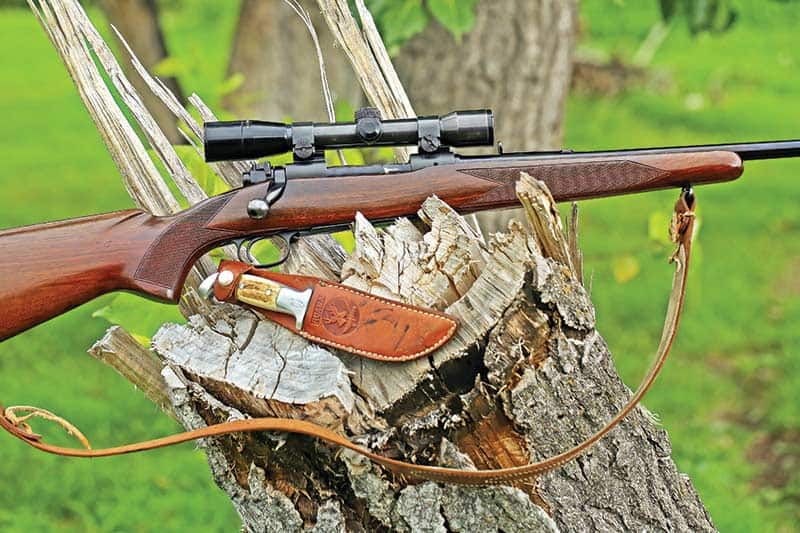
Vintage pre-’64 Winchester 70 Featherweight .308, vintage Kahles 4x scope,
vintage Ruana knife. They worked 60 years ago and work just as well today.
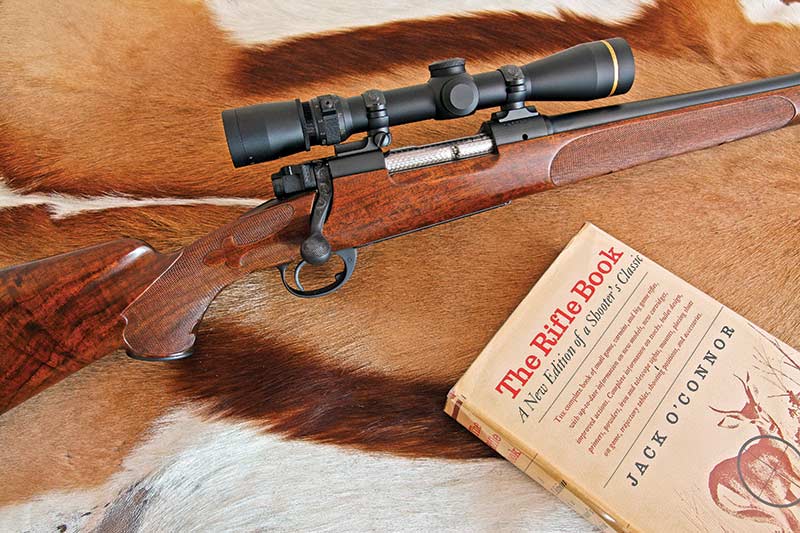
Dave’s three-generation Biesen rifle, built by Al and Roger Biesen and
engraved by Roger’s daughter Paula. It’s a pre-’64 Winchester 70 in .270 Win.
— a classic cartridge in a classic rifle.
More choices
The doctor put the toe chomper away and got out an even more terrifying tool, this one with a motor. “Bet you think you’re mighty smart tossing around terms like sectional density and ballistic coefficient. Do you know what dendritic synovitis is? How about pemphigus? Acrokeratosis paraneoplastica? See, you’re not so smart. Are you saying I should get a .270 to go with my .300?”
“No! You should get a .22LR, a .223 and a .375, either H&H or Ruger, to go with your .300. Now I’ve told you the truth, you tell me the truth. Do you really enjoy shooting the .300 Magnum?”
“Of course I do! I love it. Recoil doesn’t bother me at all.”
I’d been watching my chance. Now I grabbed the motor-driven toe torture tool from his hands. One pull on the starter cord and the two-stroke engine roared to life. “I guess the foot’s on the other shoe now!” I said, holding the whirling blade near his toes. I’ll teach him to wear sandals to work. “Speak the truth, do you enjoy shooting the .300 Magnum?”
“No! It’s too loud. It’s too expensive. It kicks too hard. I got a scope cut. Recoil does bother me. After five shots I flinch like a patient with an ingrown toenail. I need help!”
“Very good. On Saturday we’ll go to the gun store and find a rifle that fits you in any one of 30 or 40 cartridges you will actually enjoy shooting.” I turned off the motor of the fearsome tool but didn’t put it down. “I acknowledge you are the medical expert, so carry on. We’re not going to hurt one another, are we?”