Month: September 2023
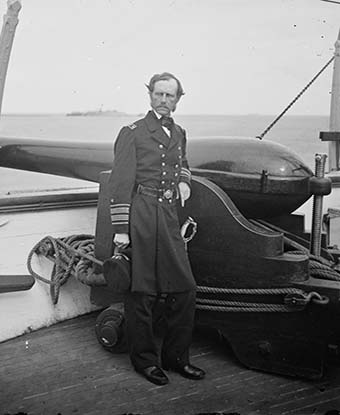
| He was born in Philadelphia, PA, and when he turned 16 he joined the U.S. Navy as a midshipman. After many years at sea he was assigned to the navy’s ordnance bureau at Washington, D.C. in 1847. When the Civil War broke out in 1861, he became the head of the Washington Navy Yard after Captain Franklin Buchanan resigned that post to enlist in the Confederate cause. In 1862 Dahlgren was promoted to captain and named head of the navy’s Ordnance Bureau. In July of 1863 Dahlgren was promoted to rear admiral and assigned command of the South Atlantic Blockading Squadron.Dahlgren weapons are usually divided into three groups – bronze boat howitzers and rifles, iron smoothbores, and iron rifles. The designer, John A.B. Dahlgren of the U.S. Navy, developed the weapons primarily for use on small boats that patrolled the waterways. The necessity for these weapons was demonstrated by the Navy’s experience during the Mexican War when small launches and other craft were assigned to patrol close to river and creek banks.
Dahlgren was a Lieutenant when he was assigned to the ordnance department at the Washington Navy Yard. The first weapon systems were adopted by the Navy in 1850. These bronze 12- and 24-pounder pieces were specially designed for use on the small launches, but were also included on most naval vessels during the Civil War. His iron smoothbores were adopted in 1850 (9-inch gun) and 1851 (11-inch gun). Although these guns were designed for use against wooden ships, the iron-clad Monitor class ships carried two of these in their turrets. These weapons were later replaced by the 15-inch Dahlgrens in 1862. By the end of the Civil War, John Dahlgren, now a rear admiral, was responsible for the development and design of 12-pounder boat howitzers in several weight classifications (small, medium, and light), 20- and 24-pounder howitzers (some, including the 12-pounders, were rifled); 30-, 32-, 50-, 80-, and 150-pounder rifles; and 8-, 9-, 10-, 11-, 13-, 15-, and 20-inch rifles. |
FILE – New Mexico Gov. Michelle Lujan Grisham speaks at the Arcosa Wind Towers, Aug. 9, 2023, in Belen, N.M. Grisham on Friday, Sept. 8, issued an emergency public health order that suspends the open and permitted concealed carry of firearms in Albuquerque for 30 days in the midst of a spate of gun violence. (AP Photo/Alex Brandon, File)
SANTA FE, N.M. (AP) — New Mexico Gov. Michelle Lujan Grisham on Friday issued an emergency order suspending the right to carry firearms in public across Albuquerque and the surrounding county for at least 30 days in response to a spate of gun violence.
The Democratic governor said she expects legal challenges but was compelled to act because of recent shootings, including the death of an 11-year-old boy outside a minor league baseball stadium this week.
Lujan Grisham said state police would be responsible for enforcing what amount to civil violations. Albuquerque police Chief Harold Medina said he won’t enforce it, and Bernalillo County Sheriff John Allen said he’s uneasy about it because it raises too many questions about constitutional rights.
The firearms suspension, classified as an emergency public health order, applies to open and concealed carry in most public places, from city sidewalks to urban recreational parks. The restriction is tied to a threshold for violent crime rates currently only met by the metropolitan Albuquerque. Police and licensed security guards are exempt from the temporary ban.
Violators could face civil penalties and a fine of up to $5,000, gubernatorial spokeswoman Caroline Sweeney said. Under the order, residents still can transport guns to some private locations, such as a gun range or gun store, provided the firearm has a trigger lock or some other container or mechanism making it impossible to discharge.
“I welcome the debate and fight about how to make New Mexicans safer,” she said at a news conference, flanked by law enforcement officials, including the district attorney for the Albuquerque area.
John Allen said in a statement late Friday that he has reservations about the order but is ready to cooperate to tackle gun violence.
“While I understand and appreciate the urgency, the temporary ban challenges the foundation of our constitution, which I swore an oath to uphold,” Allen said. “I am wary of placing my deputies in positions that could lead to civil liability conflicts, as well as the potential risks posed by prohibiting law-abiding citizens from their constitutional right to self-defense.”
Enforcing the governor’s order also could put Albuquerque police in a difficult position with the U.S. Department of Justice regarding a police reform settlement, said police spokesman Gilbert Gallegos.
“All of those are unsettled questions,” he said late Friday.
Lujan Grisham referenced several recent shootings in Albuquerque in issuing the order. Among them was a suspected road rage shooting Wednesday outside a minor league baseball stadium that killed 11-year-old Froyland Villegas and critically wounded a woman as their vehicle was peppered with bullets while people left the game.
Last month, 5-year-old Galilea Samaniego was fatally shot while asleep in a motor home. Four teens entered the mobile home community in two stolen vehicles early on Aug. 13 and opened fire on the trailer, according to police. The girl was struck in the head and later died at a hospital.
The governor also cited an August shooting death in Taos County of 13-year-old Amber Archuleta. A 14-year-old boy shot and killed the girl with his father’s gun while they were at his home, authorities said.
“When New Mexicans are afraid to be in crowds, to take their kids to school, to leave a baseball game — when their very right to exist is threatened by the prospect of violence at every turn — something is very wrong,” Lujan Grisham said in a statement.
The top-ranked Republican in the state Senate swiftly denounced the governor’s actions Friday to restrict guns as a way to stem violent crime.
“A child is murdered, the perpetrator is still on the loose, and what does the governor do? She … targets law-abiding citizens with an unconstitutional gun order,” Sen. Greg Baca of Belen said.
Miranda Viscoli, co-president of New Mexicans to Prevent Gun Violence, applauded the governor’s order as a courageous and necessary step to curbing gun violence, even if the measure’s legal fate is uncertain.
“If it saves one life, then it’s worth doing,” Viscoli said.
Since 2019, Lujan Grisham has signed a raft of legislation restricting access to guns, including a 2020 “red flag” law allowing police or sheriff’s deputies to ask a court to temporarily remove guns from people who might hurt themselves or others, an extension of background-check requirements to nearly all private gun sales.
She also signed a ban on firearms possession for people under permanent protective orders for domestic violence.
Friday’s order directs state regulators to conduct monthly inspections of firearms dealers statewide to ensure compliance with gun laws.
The state Department of Health will compile a report on gunshot victims at New Mexico hospitals that includes age, race, gender and ethnicity, along with the brand and caliber of firearm involved and other general circumstances.
___
Associated Press writers Scott Sonner and Gabe Stern in Reno, Nevada; Terry Tang in Phoenix; Rio Yamat in Las Vegas; and Felicia Fonseca in Flagstaff, Arizona, contributed to this story. Stern is a corps member for the Associated Press/Report for America Statehouse News Initiative. Report for America places journalists in local newsrooms across the country to report on undercovered issues.

Every enthusiastic shooter and collector has a list of guns they want to own, or maybe just to shoot. How to narrow it down?
Well, that is not easy. But I have managed to narrow my recommended list of rifles down to five. So, without further ado, here are five rifles you should shoot before you die, in no particular order.
Winchester Model 1873
I know I said, “in no particular order,” but the “Gun That Won the West” is the exception. While preceded by the 1860 Henry and the 1866 Winchester, it was the ’73 Winchester that made the name “Winchester” synonymous with “repeating rifle.”
In production for fifty years, from 1873 to 1923, the 1873 was only produced in cartridges also used in revolvers, from the .22 Long Rifle (rare) to the .44 WCF, better known as the .44-40 Winchester. About 720,000 guns were made, which means that it is not terribly difficult to find a shootable example even today, ninety-seven years after the end of production.
It is important to note that you can now buy a brand-new Model 1873. In 2013, ninety years after production of the “Gun That Won the West” ceased, Olin/Winchester brought back the Model 1873, made in Mikoru, Japan, along with most other Winchester and Browning-labeled arms. I’ve handled but not fired one of the new Winchesters, and the feel and balance are essentially the same, although the new rifles have an improved ejector (the originals had an unfortunate tendency to kick hot brass back toward the shooter) and a safety mechanism that doesn’t allow the hammer to drop unless the trigger is pulled. Uberti also makes an excellent and somewhat more faithful replica.
If you get the chance, though, try an original, and when you are shooting, try to imagine all the tales that old rifle could tell if only it could speak.
Winchester Model 70 (Pre-64)
There is a reason the pre-64 Winchester Model 70 was called the “Rifleman’s Rifle.” This ultimate development of the ’98 Mauser was a refinement of the also excellent Winchester Model 54. The Model 70 entered production in 1936 and is still in production today, although the pre-1964 versions command a well-deserved premium in price. Why? There are a couple of reasons.
The original Model 70 (like the newer “Classic” versions) uses a big Mauser claw-type extractor and a controlled-feed system, wherein the cartridge is picked up from the magazine by the extractor and fed securely into the chamber; the Mauser extractor maintains its grip on the case rim from feeding through firing and ejection, resulting in a very reliable action.
General fit and finish were much finer on the pre-64 guns. A better grade of wood was used, with cut checkering; the polish and bluing were generally better, and the guns just showed overall better craftsmanship.
When Winchester decided to re-make the Model 70 in 1964, one of the gun writers they informed was Jack O’Connor, long a proponent of the Winchester bolt gun. At that time, O’Connor wrote: “I was informed by Winchester brass that the Model 70 was being redesigned. I told them that I was glad to get the information so I could lay in four or five more before they loused the rifle up. Then I saw the pilot model of ‘New Model 70.’ At the first glimpse, I like to fell into a swoon. The action was simplified, the trigger guard and floor plate made of a flimsy-looking one-piece stamping.”[i]
Despite this, the post-64 Model 70 was still a pretty decent rifle. There was even one improvement. The post-64 bolt head completely enclosed the case head, adding strength to the design, but that was offset by the cheap aluminum floorplate and trigger guard and the lower-quality stock with stamped checkering. However, it was still a good enough rifle to prompt O’Connor to amend his earlier statement: “Actually the post-1964 Model 70 is not a bad rifle in spite of the fact that rifle aficionados have never taken it to their bosoms the way they did its predecessor. It is a stronger action than the pre-1964. The head of the bolt encloses the head of the case. It has a small, neat hook extractor, which is adequate. With this extractor the cartridge is not as surely controlled as it is with the Mauser-type extractor. However, the new model seldom gives feeding problems.”[ii]
About 700,000 Model 70s were made prior to the 1964 retooling. If you want to experiment with the “Rifleman’s Rifle,” try to find a pre-64, but as with many things, in this question, there really is no wrong answer. Pick up any Model 70 made from 1936 to today, and you’re handling a pretty fine rifle.
Browning Automatic Rifle
No, not that BAR, although that would be fun as well. In 1966, the Browning Arms company introduced something new: a commercial, gas-operated semi-auto that handled full-length and even magnum rifle cartridges. In fact, the BAR is the only semi-auto (aside from the clunky and awkward-looking Benelli R1) that handles my favorite big-game round, the .338 Winchester Magnum.
The BAR, like the Model 70, is still in production and is, in fact, still made by the folks at the FN plant in Belgium. Like so many manufacturers, Browning has allowed the BAR to be offered with camouflage, all-black, and various other Tacticool-seeming finishes, but you can still get this fine arm in what Browning calls Safari Grade; this version still offers fine walnut furniture and high-polished blued steel. I am something of a traditionalist myself, and so would prefer the Safari Grade, but as my late Grandpa used to say, “Every cat its own rat.”
For some years now, I have toyed with finding a BAR in my favored .338 Win Mag, but to date, the only one I have had a chance to fire was a long-action version in .270 Winchester. It was a joy to shoot, with the eight-pound weight and gas operation reducing recoil to almost beneath notice. Empty cases pinged reliably out to the right rear, and I had no trouble keeping the ten rounds I fired in a 4” circle at a hundred yards, shooting from the sitting position. The commercial BAR is an interesting piece.
Remington Model 8/81
We have seen state-of-the-art, so let us also include one of the first commercially produced semi-auto sporting rifles, the famous old Remington “piano leg.”
In 1900, the great John Browning was granted U.S. Patent #659,786 for a long-recoil action semi-automatic centerfire rifle, which would be the first commercially successful semi-auto centerfire rifle sold in the United States. As were so many Browning designs, the rifle was built in Belgium by FN for non-U.S. sale, being called the FN Model 1900; but in the United States, the design was licensed to Remington, who built it from 1905 to 1911 as the “Remington Autoloading Rifle,” from 1911 to 1936 as the “Remington Model 8,” and from 1936 to the end of its production in 1950 as the “Model 81.”
The new auto fired four proprietary rounds especially designed for this piece, including the .25 Remington, .30 Remington, and .32 Remington, which were essentially rimless versions of the .25-35, .30-30, and .32 Special rounds. They also introduced the .35 Remington, a new design, a good mid-range thumper of a woods cartridge that remains in use today.
In 1936, the Model 81 was introduced, featuring several improvements in the action, and offering the .300 Savage chambering, giving the old piano leg a round that rivaled the later .308 Winchester in performance.
The Model 8/81 rifles are funny-looking things by today’s standards. They were clunky and awkward in appearance, with a heavy full-length barrel jacket that formed part of the long-recoil action adapted from the Auto-5 shotgun. But they had one great virtue: Like most Browning designs, they worked, and they kept on working, unusual for a first-generation semi-auto. You do not have to go too far to find one in the game fields, even today, with 150,000+ rifles built. A childhood friend’s dad had a Model 81 in .300 Savage, and he took a great deal of game with it. The “piano leg” is a singular piece; there’s not another rifle quite like it.
Sharps
Note that I do not specify a model or caliber here. There are just too many original variants and replicas available to land on any one in particular.
With a history that spans from Christian Sharps himself to Matthew Quigley and on to the present day, the 1848 introduction of the falling-block single-shot breechloader would rattle a lot of cages in the gun world. The original Sharps rifles used a paper cartridge, and either a musket cap or tape primer to fire the charge, but later, the Sharps would become one of the few rifles to smoothly make the transition to brass cartridges, eventually being offered in .45-70, .45-110 and .45-120 rounds, among others. The Sharps even broke into movie stardom when a Uberti Sharps replica co-starred in the 1990 film Quigley Down Under with Tom Selleck, Alan Rickman, and the lovely Laura San Giacomo. In one famous scene from that film, the aforementioned Matthew Quigley (Selleck) waits patiently on a hilltop for two minions of the villain Marston (Rickman) to line up so he can use the famously accurate Sharps to send one bullet through both; to this day, killing two enemies with one shot is known in the military sniper community as “pulling a Quigley.”
The Sharps ushered in an era of solid single-shot falling-block rifles, starting a family that included such greats as the Browning/Winchester Low-Wall and Hi-Wall and the Ruger #1/#3 singles. An interesting side note: The original Sharps Rifle Company closed its doors in 1881, but the last rifle designed and produced there was the Sharps Model 1878 Sharps/Borchardt, designed by a German, Hugo Borchardt, who also designed the toggle-actioned Borchardt pistol that became the parent design of the P08 pistol – making the last Sharps rifle a first cousin of the German Luger.
There are originals floating around, many in shootable condition, but there are also excellent replicas, including the Uberti “Quigley” Sharps. They are great rifles to this day, heavy, accurate, and powerful. Once you learn to allow for the rainbow trajectory of the old black powder rounds they are designed to use, you will find them a lot of fun to shoot.
In Conclusion
You will notice, unusually, given my admiration for the man, that only one of these is a John Browning design (the BAR was introduced well after John’s death and was designed by John’s grandson, Bruce Warren Browning, along with FN’s Marcel Olinger.)
There’s an old saw that goes: “Wealthy guys shoot shotguns. Riflemen are generally broke.” I guess I am somewhere in between. As I have grown older and financially more comfortable, I’ve tended to favor old shotguns more, particularly Brownings and Winchesters; I’ve made no secret of my love for the Model 12, for example.
But I still love a good, accurate, reliable rifle, and if you need a tool for serious business, a rifle is what you want. The guns on this list are good examples; all solid, all reliable, and all interesting in their histories and their design. If you get the chance to shoot one, grab it.
[i] Jack O’Connor, The Rifle Book, 3rd Edition, p. 57, Alfred A Knopf (1978)
[ii] ibid

Ward Clark hails from Alaska’s Susitna Valley, where he maintains his rural household in one of America’s last free places. Ward is a twelve-year veteran of the U.S. Army including service in Operation Desert Storm and Operation Joint Endeavor, and today is a staunch minarchist libertarian, along with being an author, self-employed small businessman, woods bum and semi-professional bad influence.
Follow Ward on Twitter at @TheGreatLander.

This interview excerpt about the lessons on gunfighting, supposedly said by the legendary lawman, gunfighter, and frequent movie subject, Wyatt Earp, comes from a 1994 book written by Stuart Lake, Wyatt Earp: Frontier Marshal. You can find the book online at a hefty price since it’s long out of print.
“I was a fair hand with pistol, rifle, or shotgun, but I learned more about gunfighting from Tom Speer’s cronies during the summer of 1871 than I had dreamed was in the book.
Those old-timers took their gunplay seriously, which was natural under the conditions in which they lived. Shooting, to them, was considerably more than aiming at a mark and pulling a trigger.
Models of weapons, methods of wearing them, means of getting them into action and operating them, all to the one end of combining high speed with absolute accuracy, contributed to the frontiersman’s shooting skill.
The sought-after degree of proficiency was that which could turn to most effective account the split-second between life and death. Hours upon hours of practice and wide experience in actualities supported their arguments over style.”
Also this
1. “No wise man ever took a handgun to a gunfight.”
Earp obviously knew the advantage of weapon superiority. If you know your opponent is armed with a handgun, bring a shotgun, or rifle. Give yourself every advantage possible. You don’t want to fight fair. You fight to win. Something to think about for home defense.
2. “The most important lesson I ever learned was the winner of a gunplay usually was the one who took his time. The second was if I hoped to live on the frontier, I would shun flashy trick-shooting, grandstand play, as I would poison. In all my life as a frontier peace officer, I did not know a really proficient gunfighter who had anything but contempt for the gun fanner, or man who literally shot from the hip.”
The saying “slow is smooth, smooth is fast” applies here. Also, a fast miss never neutralized anyone. Guns have sights on them for a reason. Use them! Pick up your front sight during combat shooting. As Gunsite, famous fighting school preaches, “front sight, press” is the key to winning armed confrontations.
3. “Fast is Fine, But Accuracy is Everything…”
Again, a fast miss never helped anyone.
Take the time to use your front sight for making solid hits. The spray and pray mentality is useless with today’s high-capacity semi-autos.
4. “The most important lesson I learned was the winner of a gunplay usually was the one who took his time.”
This is related to #3. Take your time, but do it quickly, ensuring a smooth draw. Pick your front sight up and press your trigger smoothly, not jerking your shot, missing your adversary.
5. “Shooting at a man who is returning the compliment means going into action with the greatest speed of which a man’s muscles are capable, but mentally unflustered by an urge to hurry, or the need for complicated nervous and muscular actions which trick shooting involves.”
All this means is don’t lose your head. Easier said than done, but a cool head will prevail. Focus on the mechanics of a smooth draw and calculated shot. Fast shooting is useless in the “spray and pray” fashion. Remember your training. We all revert to training under stress … which emphasizes how vital proper training is.
If you’re not formally trained, do it. Training is the most important accessory you can buy, more than any gun, or ammo.