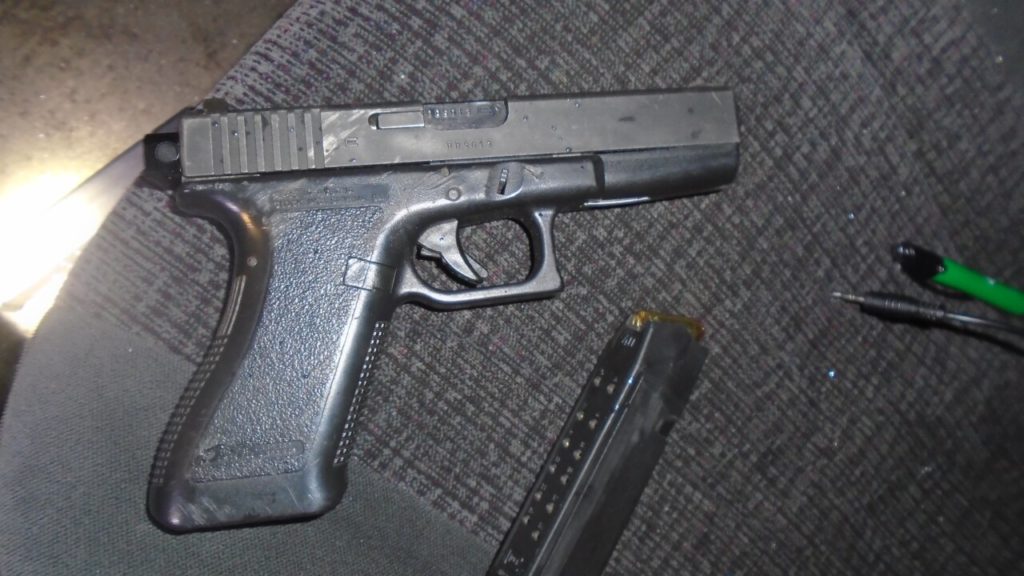
Minneapolis authorities have arrested a pair of twin brothers equipped with modified handguns fit with auto sears. Police say they seized three of the machine guns from their vehicle after a chase.
The brothers, Cortez and Quantez Ward, 18, are charged with possessing firearms illegally altered to be able to fire fully automatically, according to the Hennepin County District Court. A third man, Muhnee Bailey, 21, was also arrested.
The police received a tip that the brothers were likely armed with the modified guns and were conducting surveillance at the funeral for 15-year-old Santana Jackson, which they were expected to attend. Jackson was killed last New Year’s Even in what appeared to be a robbery.
The arrests took place after police attempted to pull over their black Jeep at a local gas station. Police say their vehicle drove off after the stop and crashed.
Cortez Ward was arrested immediately but his brother and Bailey tried to flee on foot before also being arrested.
Police say the number of modified full-auto pistols is on the rise in Minnesota. The modification process is simple, and the parts are available on the black market, Chinese sources online as well as in the form of easy-to-produce plans for 3D printing them.
Some vendors even advertise the parts on social media, as airsoft parts or other devices entirely. Law enforcement agencies across the country are increasingly on the lookout for these often very illegal parts.
Nicknamed “Glock switches,” the auto sears work as a kit that replaces the slide plate on the popular pistols. Installing them is about as easy as detail-stripping the slide and reassembling it with the kit.
“It can be done in about 60 seconds,” said Assistant Special Agent Jeffrey Reed with the local Bureau of Alcohol, Firearms, Tobacco and Explosives, the BATFE or ATF.
“They’re out there a lot,” said Quantrell Urman, the founder of the street outreach program Turf Politics. “They’re everywhere.”


 The homeless often lived in tents – or shack or lean-tos they’d built themselves. Having a place to live, even a basic one, was better than sleeping rough.
 Life insurance policies were a safety net for those who had them. If money ran out the policy could be cashed in, helping keep the family afloat for a few more months.
 People learned that you can eat almost anything if you’re hungry enough. Tumbleweed was used as fodder for cattle; then people found it could be eaten. Young plants are best.
 People learned to make and repair clothes. Any fabric could be used. Rural families made clothes from feed sacks. One woman turned a casket’s fabric lining into kids’ dresses.
 Communities became closer, giving mutual support and organizing donations of food or cash to those who needed them the most.
