Categories
You have to be kidding, right!?!

SQUIRRELS, SPORTSMEN AND PARADOXES WRITTEN BY JEFF “TANK” HOOVER


Every deer hunter knows from whence I speak. It starts as your heartbeat quickens and blood pressure skyrockets to astronomical levels at the unmistakable rustling of dry leaves. You know darn well it’s the trophy buck you’ve caught glimpses of while driving to work early in the morning or standing out in the field at sunset as you return home.

You’re cagey enough not to turn your head, for fear of scaring the buck, so you continue sitting statue still. Slowly, the rustling gets louder as the buck gets closer. He’s close enough now that you “snick” your safety off but keep your finger off the trigger. Slowly, the rustling is to your left, perfect for a right-hand shot. Just a few more steps and the buck of a lifetime will be in your field of view.

You try with all your might to keep your heart from exploding and your wits about you, to hold your rifle steady as you imagine placing your crosshairs snug behind the shoulder as the buck unknowingly saunters by. He’ll never know what hit him, you sheepishly grin to yourself. Then it happens!

Your buck isn’t a buck after all. Somehow, he’s managed to morph into a Boone & Crocket sized squirrel scurrying around at daybreak. Your body dumps all the pent-up adrenaline you’ve been holding back, as you disappointedly “snick” your safety back “on” and give the squirrel your best stink eye.

Scenes like this play out during hunting season thousands of times a year, fooling hunters everywhere. If it hasn’t happened to you, you’re fooling yourself. It’s no wonder frustrated hunters hate squirrels for getting their hopes up high.

Sure, I’ve hunted squirrels, eaten them, fed them, and watched them raid our bird feeders and garden during the year. My wife and I even joke we have the best fed squirrels in the neighborhood. But they’re still no buck.

Getting Hands-On

Speaking of squirrels, we had a large pin oak tree that had seen better days. At full maturity, its lifespan was declining. Bores, along with a fatal fungus, started the decaying process. The bark peeled, exposing the wood. As the decay continued, we knew we needed to cut the large oak before a strong wind knocked it over.

A few calls, some estimates, and we had a date. A large crane was used to attach large limbs as they were cut and safely lowered to the ground. It only took three hours to have the entire tree cut down.

We also knew there were still two nests in the tree. But we weren’t sure if there were babies or not. Who wants to evict a nest full of baby squirrels? We sure didn’t.

Sure enough, the tree cutter gingerly lowered a large branch to the ground with three baby squirrels in it. My wife retrieved a box and scooped part of the nest and the babies into the box. She then called an animal rescue about how to proceed with the newly orphaned babies.

The rescue lady told my wife that mother squirrels in particular, are wonderful mothers and to place the babies in a box with a sock full of heated rice to keep them warm, along with some of the nesting material. She continued to then place the box near the tree.

I’ll admit I was skeptical, but we set the box on one of the freshly cut stumps and left it alone. Half an hour later momma squirrel returned, retrieving each baby by the scruff of the neck, taking them to the back-up nest in our neighbor’s yard.

Thinking our rescue was over, my wife dumped the remaining nesting material consisting of shredded leaves, sticks and some cotton from this past years Christmas decorations in the front yard into our garden. About a half hour later my wife told a friend about the adventure and went out to take a picture of the nesting material. It was gone! I guess momma squirrel needed more nesting material for the new home and took advantage of the old material.

Perplexing Paradox

I’ll admit those baby squirrels were too stinking cute to do anything but rescue. This all ties into one of the biggest paradoxes known to man. Killing what you love to sustain yourself while enjoying nature during hunting season. Hunting is conservation and keeps the animals in check.

If it’s not hunting season, most hunters bend over backwards to help wildlife in need. Even in-season, sporting hunters help animals, choosing to pass on vulnerable critters. It’s called being a sportsman. Hunters I know with land all have a “hands-off” policy on home-range critters. These animals are practically “pet-like” and considered off limits.

Categories
All About Guns

Restoring a 1906 Heavily Rusted Pump Action Rifle

Categories
I WANT ONE ASAP!!!

Very Clever!

Categories
All About Guns Allies

A History of the Remington Rolling Block Single Shot Rifle | Gun History | MidwayUSA

Categories
All About Guns

Minute of Mae: British Charger Loading Lee-Enfield Mk I*

Categories
All About Guns Anti Civil Rights ideas & "Friends"

But of course!

Categories
All About Guns

The Last .44 Magnum I Would Ever Sell Chapter 2

Categories
N.S.F.W. This great Nation & Its People

Today is Purple Heart Day, So I am offering my humble thanks for your sacrifice! NSFW

Categories
All About Guns

This Old Gun: Winchester Model 1890 by S.P. FJESTAD

Winchester Model 1890 Slide-Action Pump-Action rifle repeater old

This feature article, “I Have This Old Gun,” appeared originally in the November 2005 issue of American Rifleman. To subscribe to the magazine, visit the NRA membership page and select American Rifleman as your member magazine.


Two Winchester 1890 receivers metal old vintage takedown rifle carbine pump-action slide-action metal wood

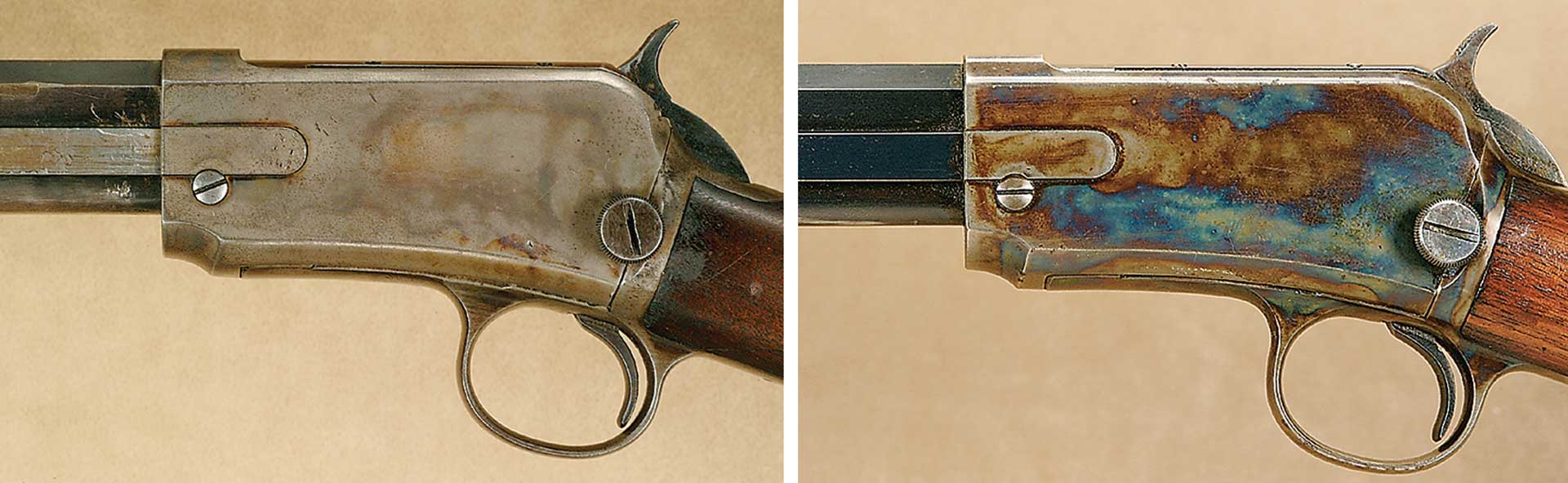
Left: NRA Antique Very Good—10%-20% receiver case colors. Right: NRA Antique Excellent—80%-90% receiver case colors


These three images (above) actually represent two Model 1890 slide-action rifles in different condition factors.

Model 1890 fans will immediately recognize these guns as Second Models with the takedown screw visible on back of the case-colored receiver. While manufactured only two years apart (1896 and 1898), there is a huge difference in values, based on the original condition factors. The rifle at the top of the page with the corresponding close-up image on the left has very few original receiver case colors left, having mostly worn and faded with a few traces of original finish remaining. Observe finish wear on the sharp edges of barrel, including wrench marks, and how the color of the stock varies, probably indicating sanding and possible refinishing.

The close-up image on the right is a different Model 1890 in much better condition. The color-casehardening of steel or iron parts is achieved by baking the selected gun parts at more than 800 degrees Celsius, while packed tightly in a charcoal and bonemeal mixture. Once the necessary temperature has been reached, the individual components are removed from the baking crucible and quenched with cold water.

The resulting finish is very thin, but as you can see from this gun, very colorful. Superior original case colors (note the vivid blue, green and brown swirling colors) remain on the receiver, trigger guard and hammer. Also observe the near-perfect bluing and lack of finish edge wear on the barrel, slide and magazine tube.

Even though almost 850,000 Model 1890 rifles in various .22 rimfire calibers were manufactured between 1890 and 1932 (retail was $16 until 1917), only a handful remain in this type of superior original condition. Most were heavily used and possibly abused, like the one on the left. Moral to the story: most common guns are not rare. Rather, superior original condition is rare, desirable—and expensive!

—S.P. Fjestad

Categories
All About Guns

REGULATE THIS WRITTEN BY TOM MCHALE


Once again, the Second Amendment debate is front and center in the news. Whenever people violate the rules of human decency, exposing foundational flaws in our society even a turnip knows will never be fixed with some new law, people scream for action. “Just do something!”

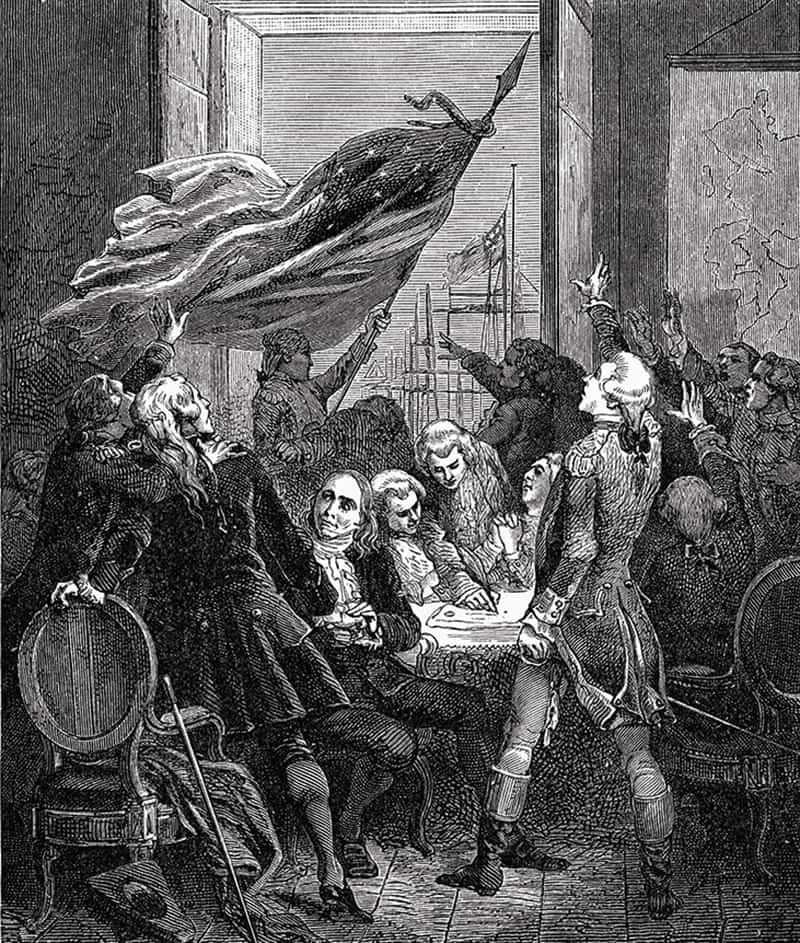
Predictably, the “do something” drumbeat points to proposed new gun laws and a challenge to the Second Amendment in principle. Then the pontificating begins (from those who’ve not read seven syllables of writings by our country’s founders) with, let’s say, creative and again predictable, hot takes.

“The founders never envisioned fully semi-automatic weapons.”

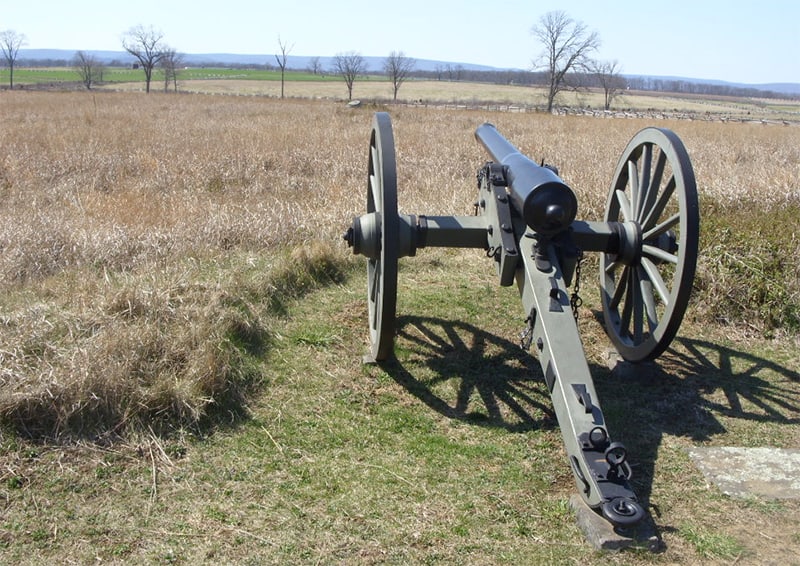
“The founders weren’t okay with people going out and buying cannons.”

And my personal favorite: “The Second Amendment itself says guns are supposed to be ‘well regulated’ so the founders clearly understood, and welcomed, government control over firearms usage and ownership.”


Doug Kerr from Albany, NY, United States, CC BY-SA 2.0 , via Wikimedia Commons

What The Term Really Means


Being in the words business, we at least make an effort to understand the correct meaning and context of important terms. While the phrase “well regulated” sounds like a demand for government intervention to today’s gun-control advocates, it doesn’t take much effort to understand what the term really means.

“Remember, the thinking of the day was exactly the opposite — the government should have little if any control over much of anything related to the individual.”

Much of the angst related to the “regulated” clause stems from the natural evolution of terminology over the years. The way we use words, even the same words, changes over the long haul. Consider …

You used to get “sick” with the flu, or maybe a mild case of irritable bunion syndrome. Or you might get “sick” of someone, like Justin Bieber. However, in today’s vernacular, cool things like cars, video games and half-pipe snowboard tricks are “sick.” This particular word hasn’t just evolved, it’s taken on an opposite meaning.

Once upon a name, “dick” was either a proper name or a synonym for detective. If you called someone “Dick,” you wouldn’t get punched in the face, unless the “dick” caught you robbing a bank.

As for “well regulated,” you might think of it in terms of “properly functioning,” like a finely tuned watch. The word “regulated” had nothing to do with governmental control or oversight. It doesn’t require much intellectual horsepower to remember all those guys sporting wigs and ponytails just finished fighting a war to get out from under the thumb of government regulation. Can anyone really believe the very first post-war action was to say, “Hey, we ought to make sure the new federal government has vast regulatory power over individual rights?”

Remember, the thinking of the day was exactly the opposite — the government should have little if any control over much of anything related to the individual. Who do you think provided all the cannons used by the Colonial Army? That’s right, many were privately owned.

While today we use “regulated” most frequently to mean “controlled,” the word still occasionally serves in its original capacity. Consider those Activia yogurt commercials pitched by Jamie Lee Curtis. She claims it keeps you “well regulated.” Does this really mean government maintains oversight of your … well, you get the idea.