Month: August 2023

The 10mm Auto is not everyone’s cup of Tetley. It creates 37,500 psi of pressure and has a sweet tooth for 180-grain bullets that average about 1,300 fps muzzle velocity and about 708 ft-lbs. It is a hard-hitting round that offers stout recoil. I’ve always thought the 10mm Auto tries its best to destroy pistols. At the very least it tries to rattle grips panels loose and aftermarket magwells. Sometimes iron sights, too.
Table of contents
1911 Platform for the 10mm Auto
The 1911 pistol design is a good platform for the 10mm Auto cartridge. It makes sense since the 1911 was one of the first pistols chambered for the caliber. Numerous manufacturers of the 1911 platform chamber guns in 10mm Auto. Tisas, a firearms maker in Turkey, is one of those manufacturers and produces the model D10. The Tisas is a full-size, aka government size, 1911 with a forged stainless-steel frame, barrel, and slide. The slide stop—the Jesus nut that keeps the pistol together—is carbon steel.
I’ve run a few .45 Auto pistols from the Tisas Issued Series that are dead ringers for World War II era 1911A1 pistols and found the quality and performance to be excellent and at a reasonable price. I expected the D10 to have the same quality and performance with more power and a bit more kick.
Series 70 Design
The D10 uses a Series 70 design so there is a firing pin block in the slide. Most 1911 purists prefer Series 70 guns compared to say Series 80 guns, which link the trigger to a firing pin block. The Series 70 design is a cleaner designer and does not have a firing pin block built in.

Contemporary 1911 Features
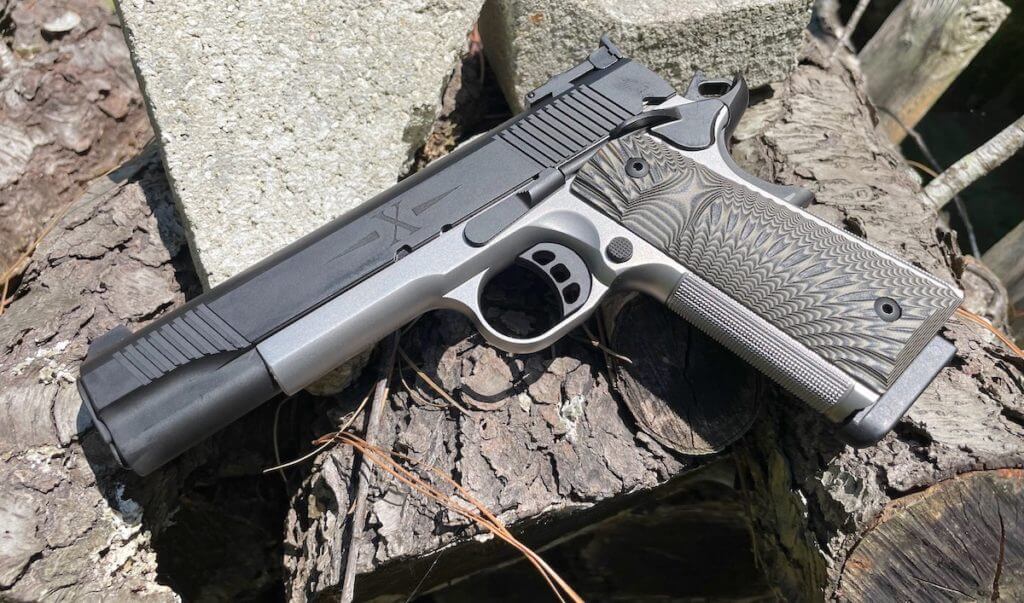
The Tisas has a two-tone finish with a matte stainless frame and black Cerakote slide. All the controls—skeletonized trigger, slide lock, grip safety, hammer, magazine release, and manual safety—also have a black Cerakote finish. This gives the pistol distinct and rakish good looks.
There are no markings to take away from the aesthetics except on the left side of the slide, which has a large X. The Roman numeral for 10 was my first guess. Maybe the D10 has that X factor? Maybe X marks the spot—in the web of my hand. Either way, I could have done without the X marks the spot engraving. A nice, small discrete D10 rollmark would work better for me. The Tisas eagle logo is at the rear of the slide in the spot Colt reserves for its prancing pony logo. But that’s trivial since the D10 runs and runs well.

The D10 Slide
Slide serrations are cut both forward and aft and are deep offering a good grip when racking the slide or performing a press check. Sights consist of a dovetailed front post that is wide and serrated to cut sun glare. The dovetail is something seen in more high-end 1911s. It’s a nice touch. The rear sight is Bomar target style and fully adjustable. It offers a wide notch with just enough space to allow light between the sides of the front sight. This is a good compromise sight if you plan to hunt with the D10 or carry it for defense. The front blade is a bit too wide for action shooting. I’d prefer a thinner front sight. The adjustment screws for the rear sight clearly marked. The shooter-facing edge of the rear sight is serrated to minimize glare.

The barrel chamber is marked 10mm. Tisas uses a GI-style muzzle bushing and a single stout recoil spring. The spring is strong to handle the recoil from the 10mm Auto round, so it takes a bit more effort to rack the slide.

The Checkered Grip
The front grip strap and flat mainspring housing have 25 LPI checkering which provides a good hold without being sharp and toothy. It allows you to hang onto the pistol without the texture gnawing the skin of your hand. The contoured trigger guard is undercut for a higher grip which can help with managing recoil. With a snappy round like the 10mm Auto, you need to rethink the grip texture. The G10 grip tones down the texture, which is a good thing for a 1911 chambered in 10mm Auto. More aggressive textured grips are fine for 1911s chambered 9mm and 45 Auto, but course textured grips on a 10mm Auto will chew you up.
The left grip has a smooth channel that allows a right-handed shooter easy access to the magazine catch button. The rear of the thumb safety is nicely blended with the frame with no sharp edges that can abrade the skin during recoil. The bottom edge of the grip is beveled and the magwell has a distinct chamfer to aid reloading. Another feature usually found on more expensive 1911s is the inset in the frame for the slide stop. The beavertail and speed bump are what I expect of a 1911. The beaver tail keeps me safe from hammer bite and the bump is large enough to disengage the grip safety even if my grip on the draw is not perfect.
Included in the hard case are two 8-round stainless steel magazines with nice size rubber bumper pads. A bushing wrench, wire brush, and patch rod are also in the case. Foam cutouts in the case hold all the pieces in place.

Inexpensive Yet Well Built
What is impressive about the D10—other than the 10mm Auto caliber—is that there is no wiggle between the slide and frame. The slide racks smoothly. If I didn’t know this was a $700 1911 I would have guessed the pistol cost was at least $1,200 since is so well built.
Going hot in 10mm Auto is not for the faint-hearted or those predisposed to flinching. The cartridge creates recoil that requires you to pay attention since it has power and performance between the .357 Magnum and .41 Magnum. The recoil from a .357 Magnum revolver can be stout depending on the frame size and material, and plus revolvers transfer all the recoil to the shooter’s hand. A semi-automatic pistol, however, like the 1911 pistol absorbs some of the recoil and the D10 does a great job of it. The fact is if you want to tote and shoot a powerful round, recoil is the price of admission.

Trigger Time with the D10
I used one trying round and two defense rounds while I rung the D10 through its spaces. The Armscor 180-grain FMJ had an average muzzle velocity of 1081 fps and 467 ft-lbs. of energy. The best 5-shot group with the Armscor training round was 2.0 and I averaged 2.1 inches at 15 yards. Moving to the bear killer or defense loads, I tried Federal HST pushing a 200-grain JHP at 1122 fps with 559 ft-lbs. of energy. That should be able to handle Cocaine Bear or some other mutant beast brought on by global warming.
The best group measure 2.2 inches and my average was 2.4 inches. Winchester Defender is stoked with a 180-grain Bonded HP and squirts out the barrel at 1180 fps. Its muzzle energy is 466 ft-lbs. The best was another 2.2-inch group and the average was 2.65 inches.

The D10 Has Some Zing
Touching off the Armscor FMJs you can immediately tell by the recoil this gun means business. The defense loads were noticeably hotter with more zing at both ends. For speed shooting and reloads, I ran a bunch of Failure Drills and found the big 10mm can get away from you if you don’t pay attention with those two fast shots to the center of mass. The one surgical headshot was easy to master due to the trigger and the sights. Though the sights are not the best for fast shooting—there needs to be a bit more light on the sides of the front sight blade by using either a smaller front sight blade or opening up the rear notch. Again this is just trivial bitches on a gun that ran without incident. It is a very capable pistol at a very affordable price.

Magazines And Holster
The stainless steel magazines hold eight rounds and are easy on your thumb when loading. Empty magazines dropped free and the slight chamfer simplified reloading. To tote the D10 you need a heavy belt and sturdy holster. The D10 weighs 40 ounces fully stoked and that’s some heavy metal to carry on your hip. I like Kydex for striker fire pistols, but I opt for traditional leather with a 1911. I used a Falco rig consisting of an A105 IWB “Falcon” holster and K102 belt. All two pieces had a deep mahogany brown finish. There is no retention screw on the holster, just friction. There was a break-in period and there always is with leather, then the draw was smooth.

Is the Tisas D10 Worth It?
If you are looking to get into a 10mm Auto, then the Tisas 1911 D10 is an inexpensive option. This pistol offers a lot of quality and performance for a little coin.
1911’s
My first 10MM AUTO pistol was a PARA Elite LS Hunter, a 1911 sporting a six-inch match barrel and VZ G10 grips. I used and reviewed the pistol, took a number of hogs with it, and it is still one of my go-to handguns for hunting.
The PARA started me on 10MM pistols a decade ago, and I’ve tried to use and review the newest 10MM offerings ever since. Increasingly, that’s meant poly-framed 10MM’s with ammunition capacities far above my PARA and its 8+1 load.
Then, I noticed that Taylor’s & Company, which I knew from Old West reproduction firearm imports, offered the Full Size (FS) Tactical 1911 10MM pistol–a steel-framed 1911 in 10MM for what seemed a ridiculously low suggested retail of $699.99.
No, it wasn’t a long slide like my $1,200 PARA but still…under $700 for a 1911 in 10MM with a five-inch barrel, ambidextrous butterfly safety as well as the grip safety, plus two magazines? And that $699 suggested retail likely meant much closer to $600 in-store and on the Internet.
A quick check on the web of prices for other 1911s chambered in 10MM had most models right around $1,000. Which made me wonder: at this relatively low price point, could the FS Tactical 1911 10mm pistol actually be any good?
Yes. It could be good because it actually is a quality pistol.
The 1911 Plunge
As noted, Taylor’s & Company is best known for the historical firearm reproductions it has been importing for years now. From black powder revolvers to 1873 single actions to an amazing number of 1873 and 1892 lever actions, Taylor’s & Company imports these firearms from manufacturers that include Chiappa, Pietta, and Uberti.
More recently the company began selling 1911s, and FS Tactical is made in the Philippines by Armscor.

I received a new Full Size (FS) Tactical 1911 10MM pistol for testing and evaluation, and upfront all looked fine. Standard 1911 Government, fairly heavy, with ambidextrous manual safety and grip safety. The pistol felt very good in the hand and pointed nicely.
10MM Meets 1911 Accuracy
At my outdoor range, I first shot the FS Tactical using the odd rounds I’ve collected over the last few years of 10MM shooting. Have three rounds of 10MM range leftover from a review? Into the quart freezer bag it goes. A handful of self-defense 10s that didn’t get shot up? Into the bag.
I did all of my shooting of the FS Tactical at ten yards offhand. My assumption: if a pistol can produce good groups at ten yards offhand, better groups can certainly be had at self-defense distances like five yards; decent groups, at the least, should be very possible at 15 and 20 yards.
By my third magazine loaded with a variety of 10MM ammunition, my groups had tightened up nicely, closing in on 1.0 inches; five rounds in the fourth magazine printed a .80-inch group.

Despite the magazines being loaded with various brands of 10MM ammunition, I never had a failure to eject or load. Different brass, range, and hollow-point loads, all of it cycled in and out nicely.
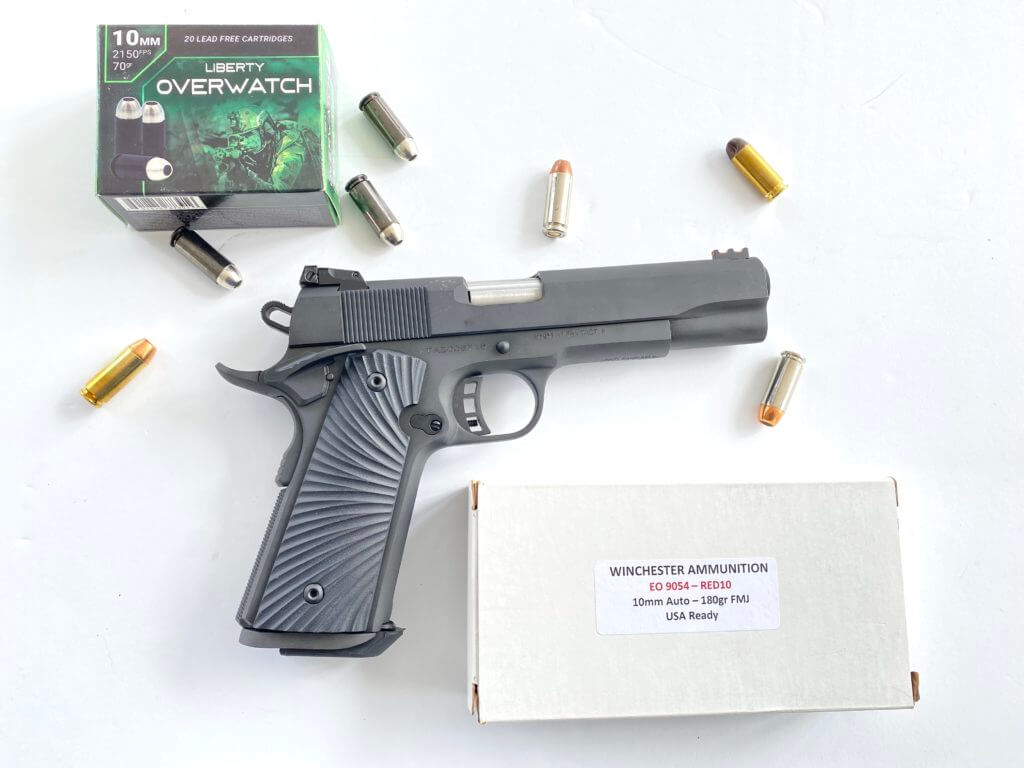
I switched over the Winchester USA Ready 10MM load, a range round launching a 180-grain full-metal jacket bullet. Initially, I placed five-shot groups right at 2.0 inches, but several magazines later I was able to peg groups of 1.2- and 1.1 inches.

New Self-Defense 10MM Ammo
I ended my shooting with a self-defense round, the Overwatch made by Liberty Ammunition. The ammo was new to me, and I wasn’t sure how it might function given that it is loaded with a 70-grain lead-free bullet rated 2,150 feet per second at the muzzle.
The Overwatch bullet sports a very large hollow area inside the bullet’s front. Once it penetrates the initial barrier the bullet expands rapidly, the hollow pointed area quickly filling with fluid. With the round’s very high velocity, the result, says Liberty, is massive rupture of the bullet and massive displacement of tissue.
I had no way to test that displacement (though I hope to do some testing with ballistic gel at a later date), but I found the Overwatch easier to shoot than the other loads simply because it recoiled less. It was also extremely accurate.

I shot the FS Tactical with the Overwatch at five yards offhand, more of a self-defense distance. The shots clustered like champs. My best group came in right at 1.0 inches.
Well, with such close shooting, I thought, groups should be tight.
I backed off to ten yards. And I still shot several groups right at or just slightly larger than an inch, including a five-shot, 1.0-inch thump to the head of a Birchwood Casey Shoot-N-C Bad Guy target.
At ten yards, I concluded that any groups over 1.5 inches with the FS Tactical were the result of sloppy shooting on my part.
Good Sights, A Quality Trigger
Rarely have I met a 1911 trigger I did not like, and the FS Tactical’s trigger was no exception. The skeletonized trigger featured a grooved front for a nice, tactile interface between the finger pad and trigger. There was just a bit of uptake and then the trigger broke very cleanly at an average of approximately 2 pounds, 7 ounces, according to my Lyman Electronic Trigger Pull Gauge.

FS Tactical G10-Style Grip
The FS Tactical featured G10-style grips and a checkered backstrap. These provided good control over the pistol even when firing rapidly. The front strap is grooved but those grooves didn’t do much to improve my grip on the pistol. There was little contact between the front strap and the inside of my fingers, which may well be due to the structure of my fingers. But I think the grooves would have to be slightly wider and deeper to aid in gripping the FS Tactical.

The pistol’s red fiber optic front post came right to my eye and the two white dots on either side of the rear sight’s notch helped align that front post easily. The rear sight was also adjustable for elevation and windage, though my FS was on target from the start.
The FS Tactical is sold with two, 8-round magazines, made of steel with rubberized base plates attached. The magazines loaded easily with my fingers, no speed loader was required. The magazines popped into the grip nicely thanks to a beveled, slightly oversized magwell.

One Issue
The one issue I experienced: ejected brass sometimes struck the slide right behind the ejection port. I’m no 1911 gunsmith, but I’ve been told by those who are that this is usually an extractor problem. So, I think either the tension on the extractor would need to be adjusted or the extractor itself might need replacing. There are likely other explanations, too.

Self-Defense, Range Time and…Hunting?
Is the FS Tactical a concealed carry option? Not for me. Too large and heavy for effective carry for this guy.
Yet, I do know people who carry a full-sized 1911 and the FS Tactical and its 10MM AUTO power would certainly do the job.
To me, the FS Tactical would be a better fit for home defense, range time and, yes, hunting. If this was my go-to hunting handgun, the only thing I would change is the sights, which are a bit small for distances past 20 yards or so, at least for my eyes. I’d want a rear sight with a deeper notch. I’d also consider the addition of a red dot.
All in all, especially when considering the 1911 market for pistols in this caliber, the FS Tactical represents a great way to get into the 10MM game without deciding between next month’s groceries or dropping that $1K+ at your local FFL.

Specs: Taylor’s & Company Full-Sized Tactical 1911 10MM Pistol
Caliber: 10MM AUTO
Action: Single, semi-automatic
Barrel: 5” steel, Parkerized finish, 1:16 Twist
Frame: Steel, Black Parkerized Finish
Sights: Rear Adj. Notch, Two White Dots; Front Post, Red Fiber Optic
Grips: Black, G10 Style
Safeties: Grip and Ambi Thumb
Overall Length: 8.54”
Weight: 37 oz.
Magazines: 2 Steel, 8 rounds each
Misc: Combat Hammer, Skeletonized Trigger, Extended Beavertail
MSRP: $694.27
—————————————————————————————-Whoppee, Another knock off of the 1911 in a hard to find round out here in LA !!!!!!!!!!! Be still my little heart!!! But I guess there is a market for these guns. Anyways I think that I might go to the range and shoot my Colt Officers Model.  Grumpy

|
In this, John Buxton’s first print, we see troops of the British Royal American Regiment seeking a moment of sanctuary from exhaustion and thirst. It is September 1758 along the high ledges of Laurel Ridge approaching Loyalhanna Creek, where Fort Ligonier will eventually be constructed. An army commanded by General John Forbes with his Second-in-Command Lieutenant Colonel Henry Bouquet are constructing an inland road through the Pennsylvania wilderness. Their objective is to capture the French stronghold located at the forks of the Ohio River known as Fort Duquesne. This “Forbes Road” was a different route than that made by Braddock’s army which was unsuccessful in its attempt to remove the French from the Fort three years earlier. The Forbes Road however was successfully |