.jpg)
Month: August 2023

Early in the morning of March 3, 1991, Rodney Glen King was driving a 1987 Hyundai Excel along the Foothill Freeway in the San Fernando Valley of Los Angeles. He was accompanied by his friends Freddie Helms and Bryant Allen. King and his buddies had killed the previous evening watching basketball and drinking at a friend’s house. At around 1230 in the morning, King passed Tim and Melanie Singer, a husband/wife California Highway Patrol team. The Singers initiated a pursuit, eventually reaching speeds of 117 mph. King refused to pull over.

King later admitted that he knew a DUI charge would violate his parole and send him back to prison. 2.5 years earlier King had robbed a Korean grocery store while armed with an iron bar. He assaulted the store owner and made off with $200 cash. King was eventually apprehended, tried, and convicted. He served one year of a two-year sentence before being released.

King departed the freeway and led the cops on a merry chase through residential neighborhoods at high speeds. The pursuit eventually involved multiple police units from different agencies as well as a police helicopter. After some eight miles the officers finally cornered King and stopped his car.

King’s two companions were removed from the vehicle and arrested albeit with some violence. Freddie Helms was later treated for a laceration to his head. For his part, King purportedly giggled and waved at the orbiting helicopter. The senior LAPD officer onsite took charge and directed the LAPD contingent to swarm King for a takedown.

Up until this point the cops were clearly in the right. However, everybody involved was energized. The arresting officers beat King mercilessly and tased him at least once. Medical personnel later documented a right ankle fracture, a crushed facial bone, and sundry contusions and lacerations. King’s Blood Alcohol Content indeed showed him to have been legally intoxicated. His tox screen was also positive for marijuana. Without the knowledge of the police, a local plumbing salesman named George Holliday shot a video of the brutal beating. This footage eventually made it into the media.

The story behind the Holliday footage is simply fascinating. The opening biker bar scene from Terminator 2: Judgment Day was being filmed just across the street from where the cops finally stopped King’s Hyundai. Holliday actually had his video camera set up in hopes of catching a glimpse of Arnold Schwarzenegger.
During a subsequent interview he said, “Before the beating, right across the street from where we lived was a biker bar, and they were filming Terminator 2: Judgment Day there. I actually have footage on the original tape of Schwarzenegger getting on the bike and riding off.” Had they not been filming the movie, Holliday would not have had his video camera in position and ready.

Thirteen days later, 15-year-old Latasha Harlins entered Empire Liquor in Los Angeles and put a $1.79 bottle of orange juice in her backpack. Soon Ja Du, a Korean-American woman who owned the establishment along with her husband, confronted her about it. Du claimed that Harlins denied having the juice. Two young witnesses disputed that claim, asserting that Harlins had the money for the juice in her hand and was planning to pay for it.

Latasha Harlins was the product of some of the most sordid stuff. Her father regularly beat her mother until they eventually separated. When Latasha was nine years old her father’s new girlfriend shot and killed her mother in a dispute outside an LA nightclub. The poor girl was subsequently raised by her maternal grandmother.

Harlins and Du got into a shouting and shoving match, and Du ended up on the floor. As Harlins turned to leave, Du retrieved a revolver from behind the counter and shot the girl once in the back of the head, killing her instantly. Though she was convicted of voluntary manslaughter, Du was only sentenced to five years’ probation, a ten-year suspended prison sentence, 400 hours of community service, and a $500 fine. The sentencing judge stated that the fact that Du had been robbed multiple times before affected her actions and mitigated her culpability.

The four police officers who beat Rodney King were subsequently tried and acquitted. Film director John Singleton was in the crowd outside the courthouse when the news was announced and stated, “By having this verdict, what these people done, they lit the fuse to a bomb.” His words were prescient.
The Riots

The synergistic combination of Rodney King’s vicious videotaped beating, the acquittal of the officers involved, and Soon Ja Du’s mild sentence in the killing of Latasha Harlins precipitated a hurricane of violence. Riots began the day after the verdict was announced. Soon much of LA was in flames.

64 people died in the violence, and another 2,383 were injured. 3,600 fires were set and 1,100 buildings were immolated. Fire calls came into dispatchers at a rate of one per minute for a time. First responders were utterly overwhelmed.

The government invoked a dusk-to-dawn curfew and mobilized the California National Guard along with Federal Law Enforcement and some active-duty military personnel. The violence continued for six days. Property damage ultimately ran between $800 million and $1 billion.

One extraordinary episode demonstrated why military troops should never be used in Law Enforcement roles. When responding to a domestic violence incident a combined force of LAPD officers and US Marines closed on a Compton home. A violent criminal was holding his family hostage inside. Upon their approach, the suspect fired two shotgun rounds through the front door, injuring a police officer. One of the LAPD cops then shouted, “Cover me!”

In keeping with their training, the Marines immediately laid down a withering base of fire to cover the cop’s maneuver. In a matter of moments, they had saturated the house with some 200 rounds. Miraculously the inhabitants were unharmed. A bit shocked, I rather suspect, but nonetheless unhurt.
Rooftop Koreans

In general, Koreans were the local shop owners, while African-Americans were their customers. There was a low-grade antipathy percolating between these two ethnic groups that boiled over after the Harlins incident. As a result, rioters targeted Korean-owned businesses for destruction. Police were so overwhelmed as to be unable to respond to calls for help. Countless established family businesses were burned to the ground.

The businesses that survived were those that were adequately defended. In a violent, chaotic, lawless world, some Koreans armed themselves, retreated to their rooftops, and prepared to shoot looters. The resulting iconography created a modern legend among responsible armed Americans. The controversy surrounding those people, their actions, and those images roils even today.
The Guns

I studied all the pictures I could find to see what sorts of weapons these armed Americans were using. In 1991 California gun control laws were not quite so draconian as is the case today. For the most part, these armed Koreans wielded fairly mundane ordnance.

Standard-capacity combat handguns like Beretta 92’s, Glock 17’s, and sundry Smith and Wesson pistols were in evidence. There were numerous bolt-action hunting rifles along with sporting shotguns of various flavors. I spotted a couple of Mini-14 rifles and an AK. The most intriguing weapon I could find was a Daewoo Precision Industries K2.

The K2 is currently the standard service rifle of the South Korean military. Development began in 1972 and spanned a variety of prototypes in two different calibers. The definitive 5.56mm version was first fielded in 1985.

The resulting weapon reflected the state of the art. A gas piston-driven design based upon the proven Kalashnikov action, the K2 fed from STANAG magazines and featured a 1-in-7.3 inch, 6-groove barrel. GI weapons included safe, semi, 3-round burst, and full auto functions. Small numbers of semiauto variants were briefly imported by Kimber, Stoeger, and B-West in the 1980s. The 1989 import ban via executive order by Bush the First capped the numbers in the country and rendered the gun an instant collector’s item. From what I have seen at least one of these superlative weapons made its way onto the rooftops of these Korean-owned businesses during the LA riots.
The Rest of the Story

Rodney King was ultimately awarded a $3.8 million civil judgment and became fairly wealthy as a result. He bought a house for his mother as well as another for himself with the proceeds. Tragically, King never mastered his sobriety. In 2012 he fell into his swimming pool and drowned. He had cocaine, marijuana, PCP, and alcohol in his system at the time. He was 47.

Two of the four cops involved in the beating were eventually convicted of violating King’s civil rights and spent 30 months in federal prison. All four left Law Enforcement. None of them remained in California.

Reginald Denny, a passing white truck driver, was dragged from his vehicle by an angry mob and brutally beaten. One rioter struck him in the back of the head with a cinder block, severely fracturing his skull. After extensive surgery and therapy, Denny eventually regained the capacity to walk. I guess that’s something.
Ruminations

Today the uprising is referred to as “Sa-i-gu” within the LA Korean community. This translates as “April 29,” the day the violence began. During those six horrible days, multiple warning shots were fired, but no rioters were injured or killed by the rooftop Koreans. Like all parasitic scavengers, the rioters gravitated toward the areas with the easiest pickings. Businesses bristling with armed Koreans were essentially left alone.

Modern commentary on the phenomenon of the rooftop Koreans is delightfully biased. Left-wing commentators state that the willingness of these shop owners to arm themselves in defense of their businesses was pure unfettered racism. They further assert that those of us who venerate this behavior are knuckle-dragging neanderthals awash in toxic masculinity and driven by insensate, race-based venom. I must respectfully disagree.

Speaking solely for myself, of course, I don’t care one whit what color the people were who were defending their businesses or burning them down. I tend to judge others based on their civic-mindedness and propensity toward responsible behavior. Regardless of ethnicity, I categorize those who burned down their neighborhoods as the Bad Guys and those who prevented them from doing so as the Good Guys. Failure to appreciate that obvious truth seems fairly incomprehensible to me.

There is but a thin veneer of civility that separates human animals from the lesser sort. We never seem to be more than one headline away from violence and carnage. To those who might defend the actions of the rioters, you’re all idiots. Feel free to venerate the criminals if that be your wish, but don’t act surprised when the rest of us find solace in our firearms and sense of community.

I don’t minimize the egregious nature of the Rodney King and Latasha Harlin’s tragedies. However, they both had their origins in deep societal brokenness. Until we can repair the basic family structure in these derelict communities nothing will ever get better. Guns, poverty, drugs, and violence are simply symptoms. Dysfunctional families, a dearth of responsible fathers, and a lack of positive role models is the underlying disease. It remains to be seen if anyone has the moral fortitude to stop screaming about the symptoms and conjure an effective cure.
Categories
S&W 44 magnum ( The Rundown )
Categories
Best Guns for Wild Hogs
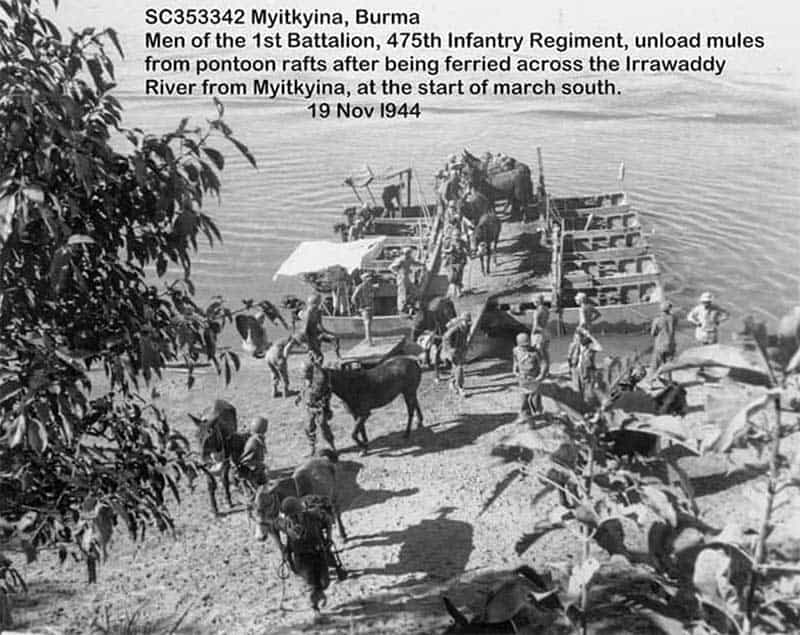
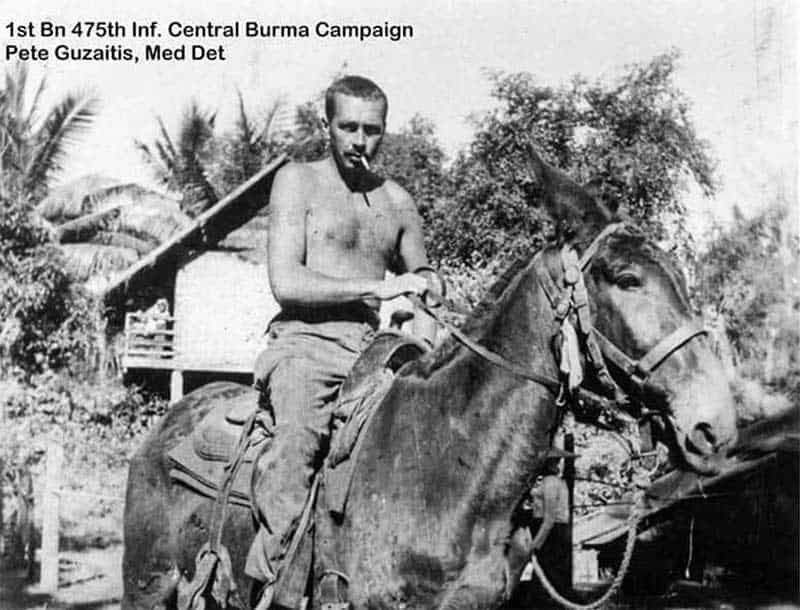
It was only a few years ago I learned about Merrill’s Marauder’s and mules, the famous unit who traversed Burma during WWII. Afterward, I wrote an article about them which led me to meeting a Kentucky gentleman by the name of Ted. His daddy had mules, and naturally, he did too. It was the beginning of a great friendship. The more I read and heard about mules, the more fascinated I became.
Ted told me stories of being lost in the fog in the national forest and letting the ol’ mule blindly lead him out. Sure, they can be stubborn, after all it’s where the saying came from, but most times it’s because they know they’re right and we may be a touched confused.
Nothing is more “sure footed” than a mule either. They have tremendous stamina, combined with a great work ethic. No wonder they’re used for carrying supplies through impenetrable mountains and other rough terrain. I’m going to share a story I recently read to keep it alive, as in my mind, it’s worthy of repeating.
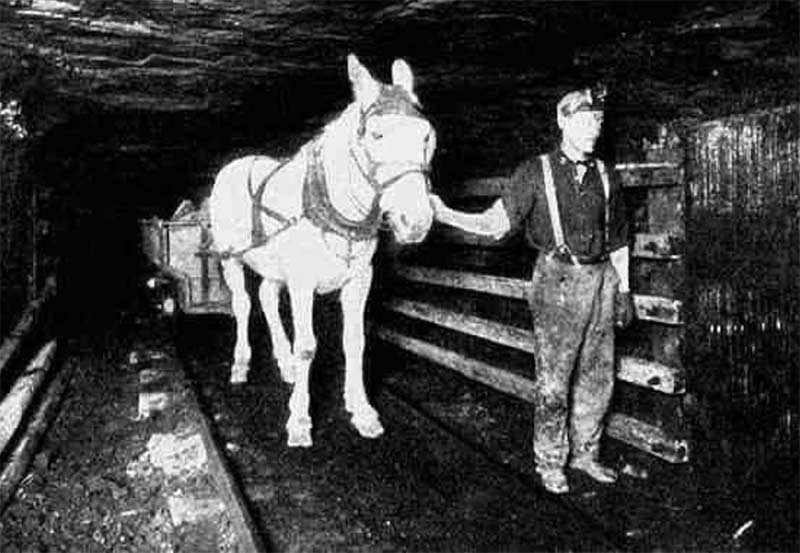
Legend of the White Mule
In 1880, the Bodie mines were producing tons of ore, rich in gold and silver. Shaft depths reached between 400 to 600 feet deep, with two shafts reaching the 1,200-foot mark — the Standard and the Lent.
In total, the Bodie Mining District, located in in eastern Mono County, Calif., consisted of 32 mines, with 60 miles of tunnel work and over 2,000 men working the hard rock. The mule’s value was priceless in the mines with their impressive strength making it possible to pull heavy ore carts from the bowels of the mountain.
Cave Dwellers
Living in underground stalls, handlers fulfilled the mules needs by delivering and feeding prime hay to them. It was common to purchase young mules to be lowered into the narrow shafts where they were trained to pull ore carts. The mules quickly learned the routine, working diligently, without complaint.
Sadly, most mules never saw the light of day again, for as they grew, they were too large to fit into the hoisting cages. The miners respected their loyalty, and intelligence while caring for them, naturally becoming attached to them. They’d name the mules after friends, relatives or politicians. Due to the mules’ horrible fate, superstitious stories became popular, stating the mules’ spirits roamed the mines.
The Standard Mine was the most productive. When it reached the 500-foot depth, a mule was summoned to transport the ore cars. Two company men were sent to a stock ranch near Mono Lake to look for a potential contender. Paying the full price of $8.00, they picked a snow-white mule with sky blue eyes and straight teeth. On the road back to Bodie, they named him Jerry.
Like most mules, Jerry learned his job quickly. Carrots were his favorite reward. Jerry snored while waiting for his ore cart to be loaded and got hiccups when he drank water too fast. As time went on, his size tripled, as did his strength. This saddened the miners, as they knew the reality that Jerry would never leave the mine.
They built a comfortable stall where he enjoyed his off time. When it was decided Jerry was needed at the 600-foot level, an incline connection was built so Jerry could be used at both levels. They named the incline, “Mule Canyon.”
Fateful Fire
It was toward the end of the day shift, when a carbide lamp was knocked over, igniting a dry wood beam on the 600-foot level. The fire pushed up heavy smoke, squeezing out fresh air through the narrow tunnels. The screams could be heard from below and the men at the 400-foot level gave the signal that there was fire in the mine. Jerry was released from the ore car to fend for himself. Like ants, the men toppled over one another to reach the hoist that would bring them to the surface. On that dreadful day, no man perished.
When the danger was over, the company sent a volunteer crew below to assess the damage. Many of the volunteers were miners that worked with Jerry. The mood was solemn as they probed thru the burnt timbers. Although the damage was not as bad as they anticipated, they held little hope that Jerry could have survived. They found him lying in his stall. The heavy smoke had been too much, Jerry did not survive. Special permission was granted for Jerry to be buried in a marked grave at the bottom of Mule Canyon.
A few months later, an unknown miner who was working at the 575-foot level, claimed to have seen the ghost of a white mule. The ghost was blocking his way into the new tunnel. The man escaped without injury but was emotionally shook up. The men who knew Jerry began to wonder if there was any truth to the miner’s story. They didn’t have much time to question him because the next day he was killed when he fell to his death down an unmarked hole inside the new tunnel. News spread quickly that the ghost of the white mule tried to warn the miner of the danger that lay in the dark.
From that day on, the legend of the white mule lingered in and out of the mines of Bodie. It was believed that Jerry was watching out for the men who worked underground. Miners were a superstitious bunch, and if anyone reported seeing a white mule, they listened closely to the details. Most men quit right then and there, not wanting to risk their lives any further.
Epilogue
I’ve never owned a mule, but I think about them often. The men I know who have owned them said there’s nothing like them. Sure footed, stubborn, faithful and loyal are words used to describe them. All in all, that isn’t such a bad way to be remembered. Mules were an important part of our heritage and history, especially for venturing out west. Do yourself a favor and investigate the contributions these animals have made to the development of our country. You’d be surprised!

Big, heavy, full-sized guns are a great ticket to taming recoil. More mass helps!
There’s a reason why most people shoot a .22 better than a .44 Magnum. Recoil has long been the enemy of realizing the full measure of a gun’s mechanical accuracy. At my range, I’ve seen many very strong and hardy young men talk up hard-kicking handguns like the Desert Eagle and the S&W 500. I’ve also watched many of those strong, hardy young men flinch magnum rounds into the dirt.
To paraphrase George Bernard Shaw, youth is wasted on the young. Now that I’ve shot long enough to shut off my inner reptile brain, my hands are admittedly achier than they once were. (Note: being a writer has not helped this condition.) As such, I certainly find myself in the ranks of those who see the worth of a “soft shooting” handgun.
You might find yourself with a similar value system for reasons of your own. If so, you’ll likely ponder the following: What makes one handgun shoot more stoutly or softly than another? This is an answerable question and one that transcends discussions of caliber alone.

Hogue grips have been a recoil reduction mainstay for decades.
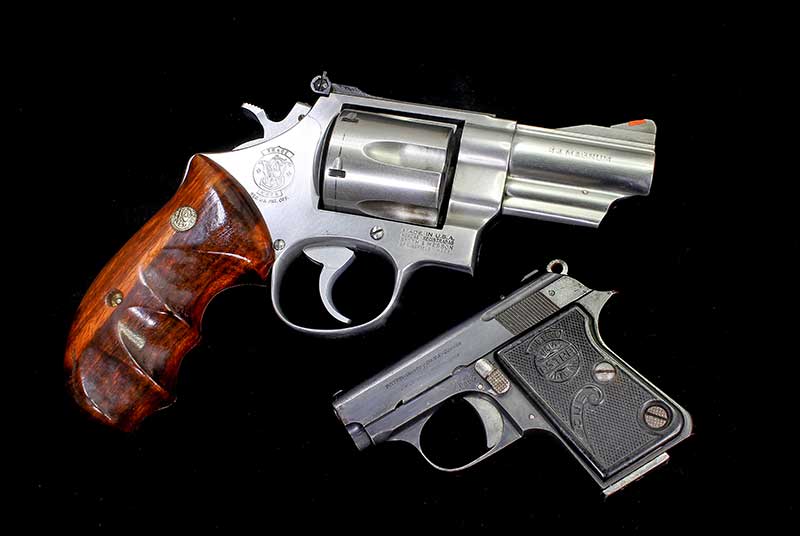
Size And Weight
It’s been a while since many of us took high school physics, but we might dimly remember that force is equal to mass times acceleration. Many of us tend to focus on “force.” We can think of this as the power of the cartridge for which any particular firearm is chambered. However, we should be equally concerned with acceleration, and by that, I mean how rapidly any given gun accelerates into your hand under recoil. Newton’s second law tells us that acceleration and mass are inversely related for any given force.
Put more simply, big guns kick less than small guns of the same caliber. This seems counter-intuitive at first: Witness the number of well-meaning husbands who buy snub-nosed revolvers for their wives. Small guns seem cute, genteel, and easy to handle. That said, show me a lady who shot a scandium J-Frame .38 as her first gun, and I’ll show you a lady who had a horrible first trip to the range — and likely never returned.
If you want to keep recoil to a minimum, extra mass is the ticket. It’s another reason why I tend to prefer barrels of 6″ on revolvers and 5″ on autoloaders: More sight radius is nice, sure, but the extra weight out at the front of the gun adds just a little “special sauce” when it comes to taming recoil.
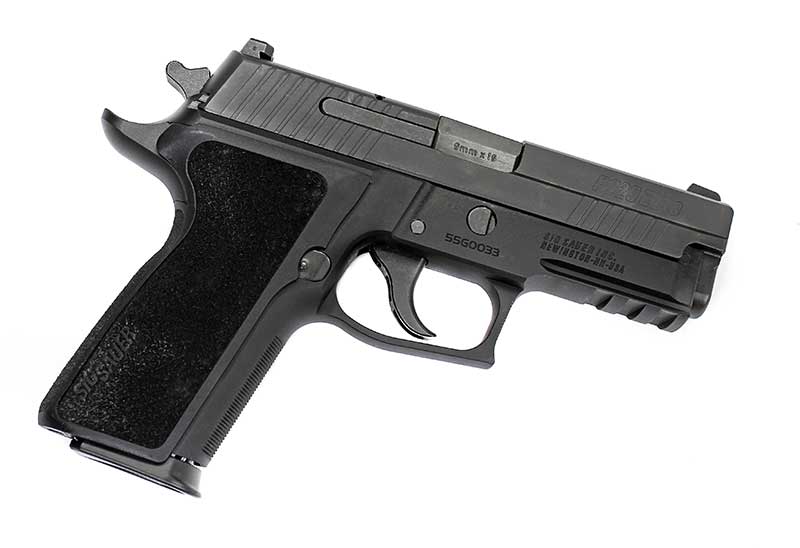
Ergonomics matter! Sig’s P-series guns are designed to ensure
a near-perfect meld with the human hand.
Ergonomics
A deceptive category, to be sure! Many people buy a revolver or semi-auto because it feels “good in the hand.” That’s better than nothing, but one also wants to make sure it feels good under recoil. The platonic ideal is a gun that fits one’s hand just so, with no gaps or recesses. This will allow the firearm and hand to behave as one unit under recoil, distributing all forces evenly. When this isn’t the case, it can feel like the gun is slamming back into one’s palm.
Sometimes our own biology is at fault when it comes to amplifying the negative effects of recoil. Many big-handed dudes have been cut by the slides of Walther PPKs and bit by the beak-like hammer of a Browning Hi-Power. Even a gun with a modest “kick” can be quite painful under recoil if your hand doesn’t interface with it well.
Personally, I don’t play well with medium- and large-framed guns from a certain manufacturer. Thanks largely due to their rectangular grip frame, they tend to vector recoil right into the knuckle at the base of my thumb — no thanks, I say. Not every pistol will work for every user, as we may perceive the effects of recoil differently from one another.
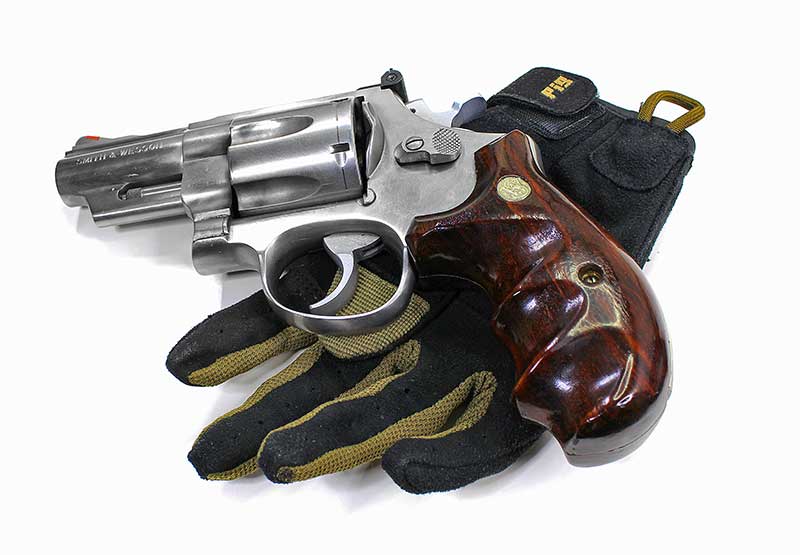
Gloves are an excellent way to ensure a more consistent human/gun
interface, reducing the perception of felt recoil.
Grip And Grip Material
Wooden grips on a revolver can be a thing of beauty. However, there’s a reason why Ruger ships its Super Redhawks with big, cushy rubber stocks: Metal and wooden grips have absolutely no “give.” On a heavy kicking gun, hard grips won’t make things worse, but they certainly won’t make things better. Instead, rubber grips once again help to distribute recoil over a larger part of the hand and over a longer duration of time. Those gray-pebbled rubber Hogue grips might not be someone’s first choice of shoes for a vintage S&W, but aesthetics be damned — they work.
Another interesting variable comes in the form of polymer construction. Almost as a rule, polymer frames will be lighter than those made from aluminum or steel. Based on our previous discussion of weight, one would think this would indicate they’d be harder kickers. And yet, I’ve shot some polymer guns that shoot as softly as their metal-framed brethren.
I think the phenomenon comes down once again to “flex” or “give.” Some polymer compounds can act as shock absorbers, as they can be compressed or deformed more easily than metal but will rebound to their original, molded shape. The effect is slight but not negligible!
Additionally, how one grips the gun is important. A strong grip locks the firearm into place and again aids the goal of allowing the gun, wrist, hand and arm to move as one unit. (And, as a combined mass, will therefore accelerate less under the same recoil force.) But supposing one has a weak and/or improper grip, the gun will squirm in hand and distribute recoil forces unequally. Good technique will absolutely reduce the perception of recoil.
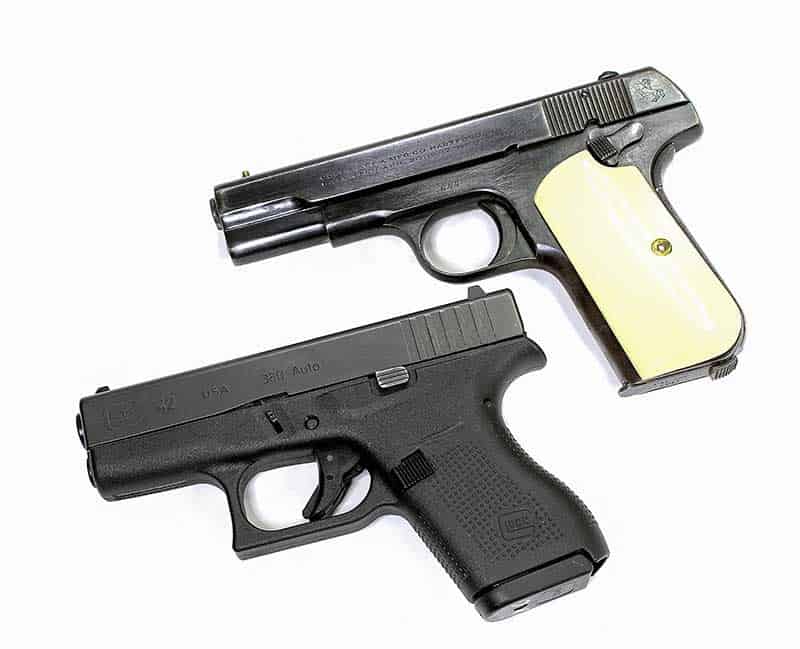
Two .380s, two action types. The locked-breech GLOCK 42 is a
softer kicker than the Colt 1908 despite less mass.
Action And Slide Velocity
Remember our previous discussion of a force being exerted over time? Well, it also applies here, and not all guns are created equal. While exceptions exist to the rule, most autoloaders can be classified into “blowback” and “locked breech” designs.
Blowback actions are the simpler of the two. When a round is fired in a gun of this design, only the stiffness of the recoil spring and mass of the slide inhibit its rearward movement until the chamber reaches safe pressures. As the gun cycles, the slide (and only the slide) moves backward, usually at a high velocity, contributing to a “snappy” feel when it rams into the rear of the frame. Usually, this action is reserved for guns chambered in smaller calibers.
Conversely, just about any gun chambered in 9mm or larger is going to have some kind of locking mechanism. If you watch a video of a 1911 or Walther P38 in extreme slow motion, you’ll see the barrel and slide travel together for a bit before the barrel unlocks and the slide continues its rearward movement. Recoil forces act on more things, in more directions and over a longer period of time. Recoil is generally felt more like a shove than a snap.
Guns chambered for .380 ACP — of which there are a lot — can be one of the two action types. My GLOCK 42, a locked breech design, is very comfortable to shoot. My Colt 1908 is far less pleasant, thanks to its blowback action. I’d also be remiss if I didn’t note there are blowback guns in larger calibers.
Additionally, springs are a factor. For example, H&K’s USP series of handguns utilize a dual spring system, where the last bit of slide travel under recoil is further dampened by a second, stiffer recoil spring. As I understand it, H&K moved away from this design in the name of simplification — why use two parts when one will do? I see the logic, but I (and other devotees) simply love how the USP setup feels.
Also, when guns have no springs or slides, there’s little to attenuate the recoil. A single-shot handgun or revolver typically has greater recoil than an autoloader of identical size, weight and caliber.
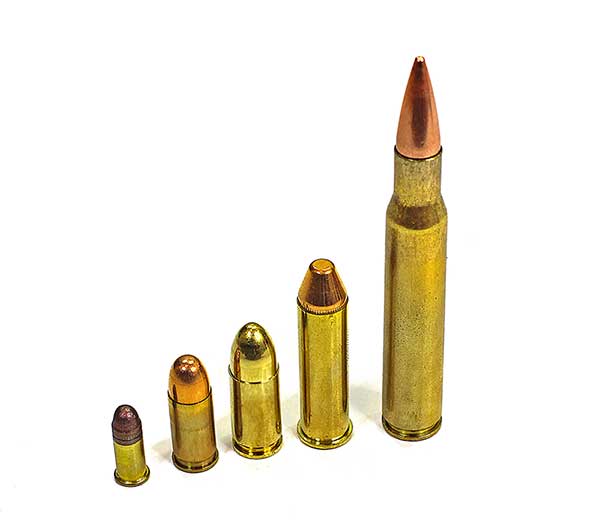
It’s a physical law: Recoil increases as heavier bullets are driven progressively faster.
The .22 short (28 grains @ 800 fps) will do less pushing than the .30-06 (165 grains @ 2,800 fps).
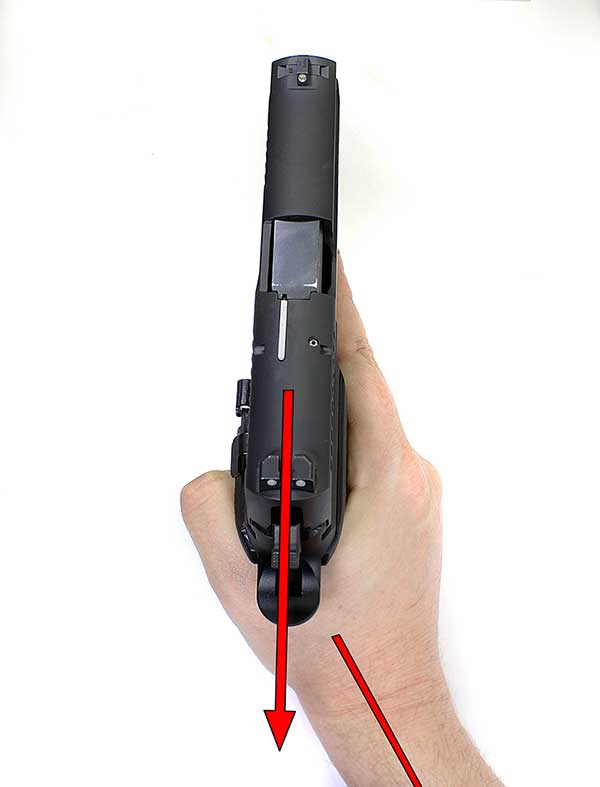
A bad grip. The gun is not set into the web of the hand nor aligned
with the bones of the dominant forearm. Felt recoil: Increased!
And Egads … More?
We haven’t even begun to touch on the effect of muzzle brakes, bullet weights and velocities, slow-burning vs. fast-burning powders, torque, weight changes as magazines deplete, aftermarket parts and add-ons and the much-ballyhooed subject of bore-over-frame height. And I’m sure there are even some factors I’m forgetting.
The main takeaway is there are so many different variables and so many guns we’re rarely able to make apples-to-apples comparisons when it comes to recoil. Sure, I can tell you a 4″ gun will kick more than a 6″ gun if it’s the same make, model and caliber. Or an M&P .40 will kick more than an M&P in 9mm. However, if you were to ask me off the top of my head whether a Ruger LCR in .327 Federal kicks more than a .45 ACP-chambered 1911 stoked with +P+ ammo … who knows?
Don’t get me wrong: Keeping track of all of the above variables is certainly helpful when it comes to identifying soft shooters or hard kickers. However, the real world almost always complicates our well-crafted theories. Sometimes you just have to shoot a gun to find out how much you can tolerate the kick, push, shove, or slap it transmits when you pull the trigger.
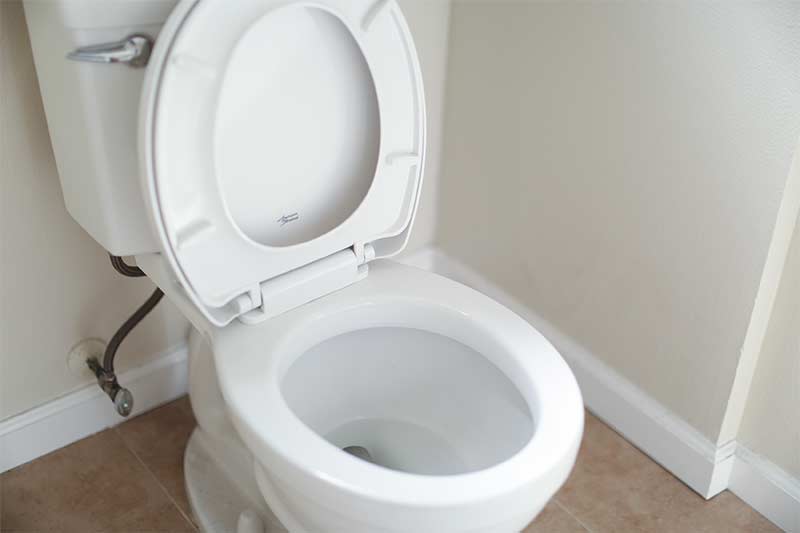
This pedestrian toilet seems a fairly inoffensive common household implement.
However, on this particular day it did something markedly more sinister.
One night while taking call for our busy medical practice I got a most extraordinary inquiry. A woman called the clinic after-hours line to report an unusual medical emergency. She reported that somebody had crept into her home and cursed her with testicles.
I pondered her quandary for a moment, imagining the medical article I could get out of that patient presentation. A grown women sprouting a set of testicles should be good for the cover of “The Lancet” at the very least. Alas, I simply questioned whether or not she had been taking her psych meds regularly and discovered a much more plausible explanation for her problem. However, that did spark an interesting train of thought.
Testicles are indeed a curse. American women live, on average, a full five years longer than men. 93.2% of the incarcerated population in America is male. If that doesn’t sound like a curse, I fail to fathom what might.
The deleterious effects of testosterone toxicity have been vigorously explored in this very venue. I would assert, however, that the dark influences of this most potent poison take hold at a shockingly young age. In the case of the young man we will discuss momentarily, it began at a most sensitive time.

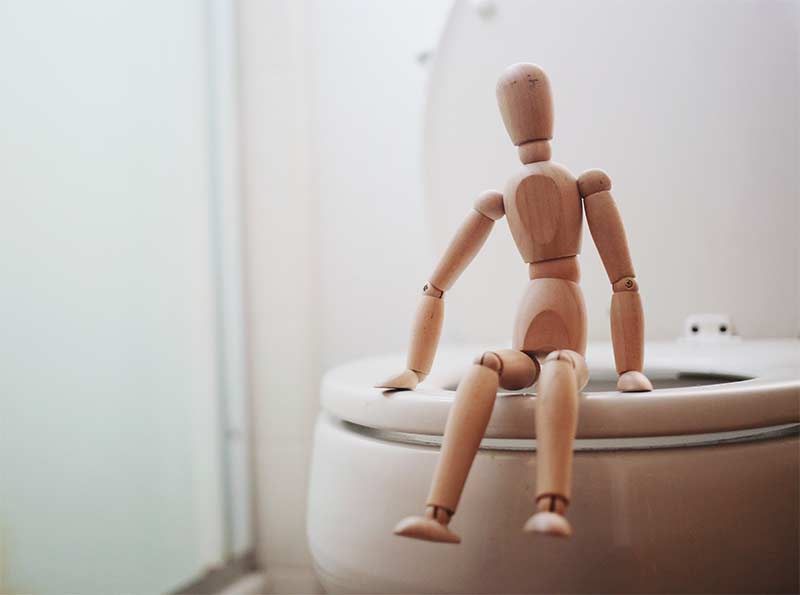
Mastering the basics of bodily functions can be a challenge for little guys this age.
Potty training is a difficult period in any kid’s life. One day you’re tearing about peeing anytime and on anything as the spirit leads, and the next your parents are imploring you to apply a certain unnatural discipline to this most natural of functions. That process can go smoothly or not so much.
Our hero was a little tow-headed nit, the kind of scamp whose very presence brings a smile. The only time he sat still was when he was unconscious. Some of his sustenance was derived via food he shoved down his gullet, while the rest he seemed to absorb through his face. This young man was simply adorable.
His parents were making great strides in the potty training process. The kid was eager to please, and his folks made it a game. No matter what he was doing, when the urge hit he scampered into the bathroom, threw up the lid, and did his business.
The kid had to step up on his tiptoes to accommodate the geometry of Mr. Crapper’s masterpiece (No kidding, the guy who perfected the flush toilet was an Englishman named Thomas Crapper. One of his nine patents covered a contraption called the Floating Ballcock. Google it.) Thusly configured, his little miniature manhood was just barely up to the task.
The kid’s mom had adorned the toilet seat lid with one of those covers made from thick shag carpet that were popular back in the day. I have no idea why people ever gravitated towards those things. It made the commode look like some enormous turquoise space fungus. Those thick covers also had some unfortunate effects on the physics of the device.
One day the young man was busily attempting to destroy the entire world when the urge struck. He duly dropped whatever it was he was breaking and made a beeline for the water closet. In one practiced motion he threw up the lid and threw down his pants. He strained up on his toes to get his plumbing properly arranged and let fly. However, in his haste he had approached the throne from a quartering angle.
As luck would have it the fluffy toilet seat cover kept the lid from quite reaching its position of rest past dead center. Occupied as he was with his urinary marksmanship the poor kid failed to notice the offending toilet seat as it gradually crept back his direction. With shocking ferocity the combination seat and lid slammed back down. Alas, fate is a foul mistress. One of the two plastic feet on the bottom of the seat described an arc straight down onto the poor kid’s diminutive manhood.
Much of human learning is the result of basic Pavlovian conditioning. Positive experiences draw us closer, while the negative sort tend to push us away. It was this time-rested process that ultimately put robots on Mars. In this sordid circumstance this inopportune geometry set back toilet training some months. Having a heavy toilet seat smack his little penis like a hammer was adequate to precipitate an insensate dread of all things bathroom-related. I lost track of the family soon thereafter, but the poor guy might yet insist on just going in the backyard to this very day.