Categories
Some Red Hot Gospel there! Some Scary thoughts

THE ENTERPRISE OF DEATH WRITTEN BY WILL DABBS, MD

32

The mechanism really doesn’t make all that much difference, the end result is the same.

It really doesn’t matter what you did. By this point, none of that really matters. Once these gears start turning there is no stopping them.

Nobody has to think about anything — and that’s intentional. There is a big book, and at each stage of the operation those tasked with its execution need only turn to the appropriate page and do what it says. It helps absolve those who must undertake this macabre operation of any undue moral responsibility. They were just doing what the book directed.

Twenty-four hours in advance, the prison SWAT team reports to your cell to move you to the observation area. You can walk along with them peacefully or not, but they will move you.

The observation cell has entire wall constructed of nothing but bars. It’s here where you take your last meal. The prison makes every reasonable effort to accommodate this request. Some poor guy sits and stares at you for the full 24 hours. This is to keep you from killing yourself. The government will not be denied.

A few hours before the big event, the SWAT team shows up again, this time to move you from the holding area to the place of execution. There is a series of stone steps leading down to the death room. As I walked down these steps, I couldn’t help but imagine what it might feel like to do this for real.

Two walls are one-way glass, one window is for government witnesses and the other is for the victim’s family. The inside is covered with acoustic soundproofing. The ceiling is formed from those banal institutional ceiling tiles, but more on those in a minute.

Once in the room, the SWAT team ensures you stretch out peaceably on the table. There are extensions for your arms. The table looks like a cross, and the thing is festooned with straps. Your arms, legs, torso and head are securely affixed. There can be a little movement but not much. I assumed the position. This may seem unduly dark, but I wanted to know how it might feel.

Paramedics then start a large bore IV in each arm. Physicians are intentionally excluded from the process as this would be such an egregious violation of the Hippocratic Oath. The IV lines run through a pair of innocuous-looking holes in the wall. And then you wait.

This is the lethal injection room at San Quentin (Ca.) Penitentiary.
Mine was a bit different. (Source: Wikipedia)


There is a bank of five identical telephones with sequential phone numbers standing side by side. Should there be a last-minute stay there is no way word won’t get there in time. On the other side of the wall are two little closets. Inside each closet is a handcrafted wooden contraption to hold the mystical elixir affixed to each IV line. One is normal saline, the other is something else. On the wall is also a pair of lights, one red and the other green.

Meanwhile, the subject of this exercise stares at those accursed ceiling tiles. Think back to the last time you were enduring some ghastly dental procedure or other. It’s like that, but much worse.

There is a little microphone hanging down from the ceiling; a tiny corner of one tile carved away to accommodate its cord. At the appointed time the warden enters the room and reads the charges against you. The condemned then has three minutes to say anything they want. The warden actually has a stopwatch. At the end of three minutes the warden turns and leaves whether you are still speaking or not. When you die, you die alone.

Gravity is ultimately the engine behind this enterprise. The IV bottles sit inverted in their holders. The executioners enter their closets and wait for the lights. When the lights change, they each flip the bottles upright and leave, never seeing the object of the exercise. This is by design.

As I lay on that hard table, technically padded but only just, I was so viscerally struck by those ceiling tiles. They’re the last thing one sees. It doesn’t matter what a heartless bloodthirsty monster you might be, the process of bringing you to this point will invariably break you. You have absolutely no control over anything.

Our actions have consequences, and this is a really big one. The ponderous machinations of the legal system tend to separate cause and effect substantially in situations of such exceptional gravitas. However, Lady Justice is a cold-hearted lass. She ultimately extracts her due.

Categories
All About Guns Allies Well I thought it was neat!

WWII BRITISH SIXGUNS WRITTEN BY MIKE “DUKE” VENTURINO

Top: Webley Mark VI .455. Bottom: Enfield No. 2 .38.


The British have never been ones to march in lockstep with the rest of the world, and a little evidence of that is their choice of handguns in World War II. While most of the world’s major military forces had by that time converted to one sort or another of autoloader, the British decided to stick with revolvers.

Mostly they used four types of double action revolver, although in 1940 the British government even bought some Colt Single Action Army revolvers to help arm their home guard. (Today collectors refer to those as “Battle of Britain” guns.) Issued to regular British forces, however, were their domesticly manufactured Enfield No. 2 .38 and Webley Mark VI .455. The Webley Mark VI .455 had been adopted in 1916, and although it had been officially replaced about 1928 by the Enfield No. 2 .38, it was still in common use.


Top: S&W Hand Ejector No. 2 .455. Bottom: S&W Military & Police .38.


Not having enough of either Webley or Enfield to go around, they also bought many thousands of S&W K-frame Military & Police revolvers chambered for the .38 S&W cartridge. And furthermore, they still had and consequently used many S&W N-frame (Hand Ejector 2nd Models) which they had purchased from 1915 to1917 for World War I.


Duke’s S&W Hand Ejector #2 .455 factory letters to the Canadian Government in 1916.

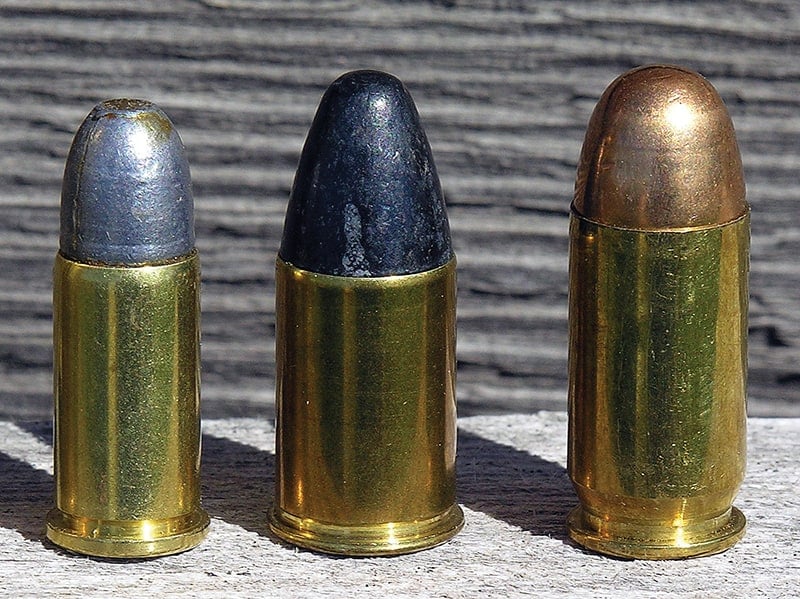
Left to Right: .38 S&W with 190 gr. lead RN, .455 Webley Fiocchi load with 262 gr. lead RN bullet and .45 ACP Black Hills load with 230 gr. FMJ bullet.


Their choice of cartridges for these revolvers also seems strange. The .455 Webley had been with them since the 1870s as a black powder cartridge, but their Mark II version of it introduced about 1897 was loaded with smokeless propellant. By American standards, it would be considered “barely loaded.” That’s because it was rated with 265 gr. bullet at only about 600 fps. In the 1920s the British military determined a .38 caliber 200 grain bullet at about 630 fps gave about the same muzzle energy, and that’s what they converted to. Actually the case they chose to use was a twin to the .38 S&W round. That company had been chambering guns for it since the early 1870s, so when the Brits needed S&W to help them out with revolvers in the 1940s.

I’ve been told by a knowledgeable shooter/collector that prior to WWII the Brits had to reduce bullet weight on their .38s to 178 grains in order to make them full metal jacketed. Otherwise they would have been in violation to the Geneva Convention.


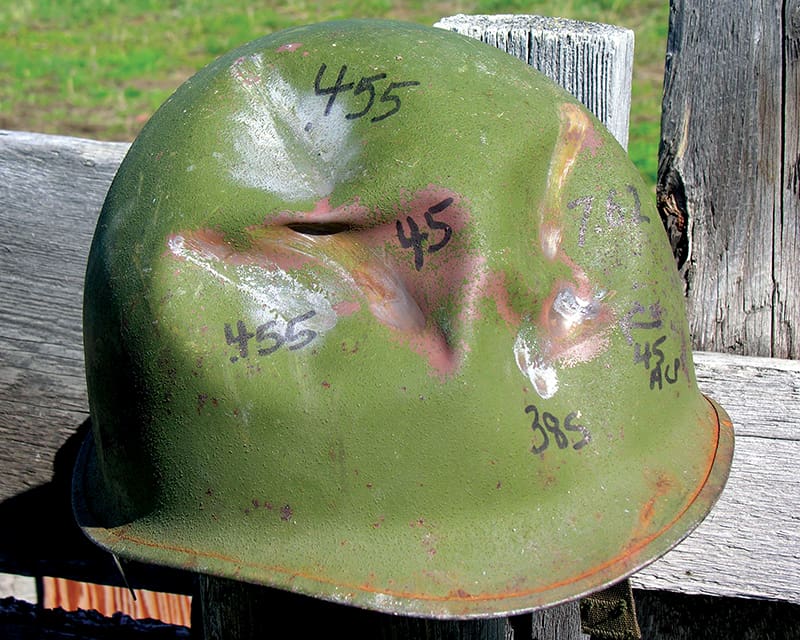
The Brit .38s and .455s barely dented. The big caved-in spot was done with a .45 ACP.

No Common Sense


For some strange reason, probably related to my lack of common sense, my gun trading forays these last few years have netted me samples of the four above mentioned British military revolvers. Two have some minor noteworthiness. The Enfield No. 2 .38 is marked “RAF” (Royal Air Force) and “1936,” while the S&W .455 factory letters to the Canadian government in 1916. I was even able to find a 12-round box of FMJ .455 military loads of Canadian manufacture dated 1943 to go with it. British military .38 loads have evaded me completely. For shooting I bought some of the Fiocchi .455 Webley factory loads with a 262-gr. lead bullet and handloaded some Lyman #358430 cast bullets weighing 190 gr. in the .38. Powder charge was only 2.2 grains of Bullseye. The Fiocchi .455s chronographed at 619 fps, and my .38 handloads were 10 fps faster.

So did I “test-fire” these revolvers for accuracy as any self-respecting gun’riter would do? No way. What I did was spent nine bucks at an Army surplus store for an old GI issue steel helmet. Then I set it on a fence post and fired my British WWII revolvers at it from 10 paces. The .38s wouldn’t have even given its wearer a headache. They didn’t dent it and hardly made it wobble. The .455s did dent it and it wobbled some. Admittedly these were lead bullets and not military FMJs, which might have given more penetration. For comparison, I fired a 230 grain FMJ .45 ACP factory load from a Colt 1917 revolver. It didn’t penetrate either but caved in the side of the helmet, and not only knocked it off the fence post but rolled it 20 yards down the road!

Somebody probably knows why the Brits stuck to revolvers in the years leading up to WWII, and even perhaps why they liked such pee-dunkler cartridges — I don’t. But they’re still interesting handguns, albeit only minor historical footnotes to WWII.

Categories
EVIL MF Soldiering War

Lance-Corporal Hitler – WW1 Trench Runner

Categories
Uncategorized

Something for my Fantastic Readers out there! Grumpy NSFW


Now get to work as somebody has to pay for my Teachers Pension! Grumpy

Categories
Art

The 200th Coast Artillery

On December 8, 1941, at Clark Field in the Philippines, the 200th Coast Artillery found itself in a world war. The Japanese bombed them and would later march them off to the camps, but always in their minds they would know that they were the first to fire on the enemy.

Categories
All About Guns

Cimarron Model 71

Categories
Interesting stuff War

HMS Barham – “Did More Than Just Explode, You Know.”

Categories
All About Guns

A Magnum Research IWI Desert Eagle Mk. XIX in .44 Mag


Categories
All About Guns

From Aircraft to Improvised Infantry: the Vickers MkI No2

Categories
I WANT ONE ASAP!!!

Flame Thrower. Lets Play