Categories
All About Guns

RARE: A Look at the Colt OHWS (SOCOM) Prototype Pistol

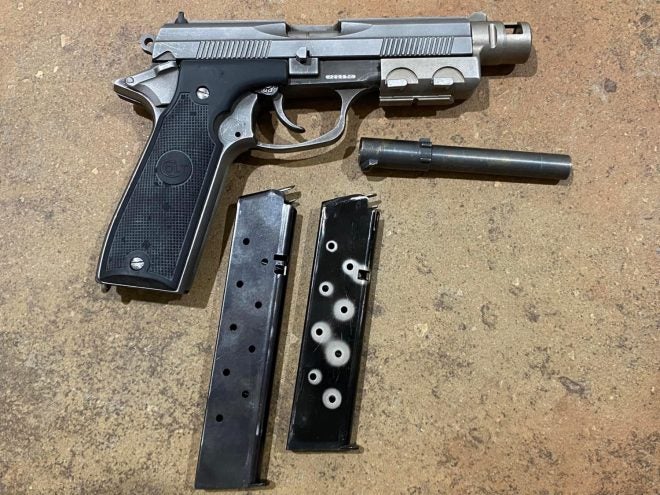
For those who do not know Alex Young, he is an avid aficionado and collector of Colt products and rare AR-15s. I wrote an article on his collection of original Colt roll dies for the AR-15 and M16. Well, Alex has managed to acquire a Colt OHWS. Here are some photos he shared of his Colt OHWS.

OHWS @ TFB:

Back when SOCOM wanted a new Offensive Handgun, the two main competitors were H&K and Colt. H&K ended up winning the contract but what happened to the Colt OHWS? See what Alex wrote about his Colt OHWS.

Colt’s Offensive Hand Gun (OHG) [Colt OHWS]
So this has been something I have been wanting for a while and my first guess was possibly getting one from the Colt archives but was told there weren’t any left.
I also sent an email to a few high end dealers that have dealt with larger collections and higher colt employee collections and still nothing.
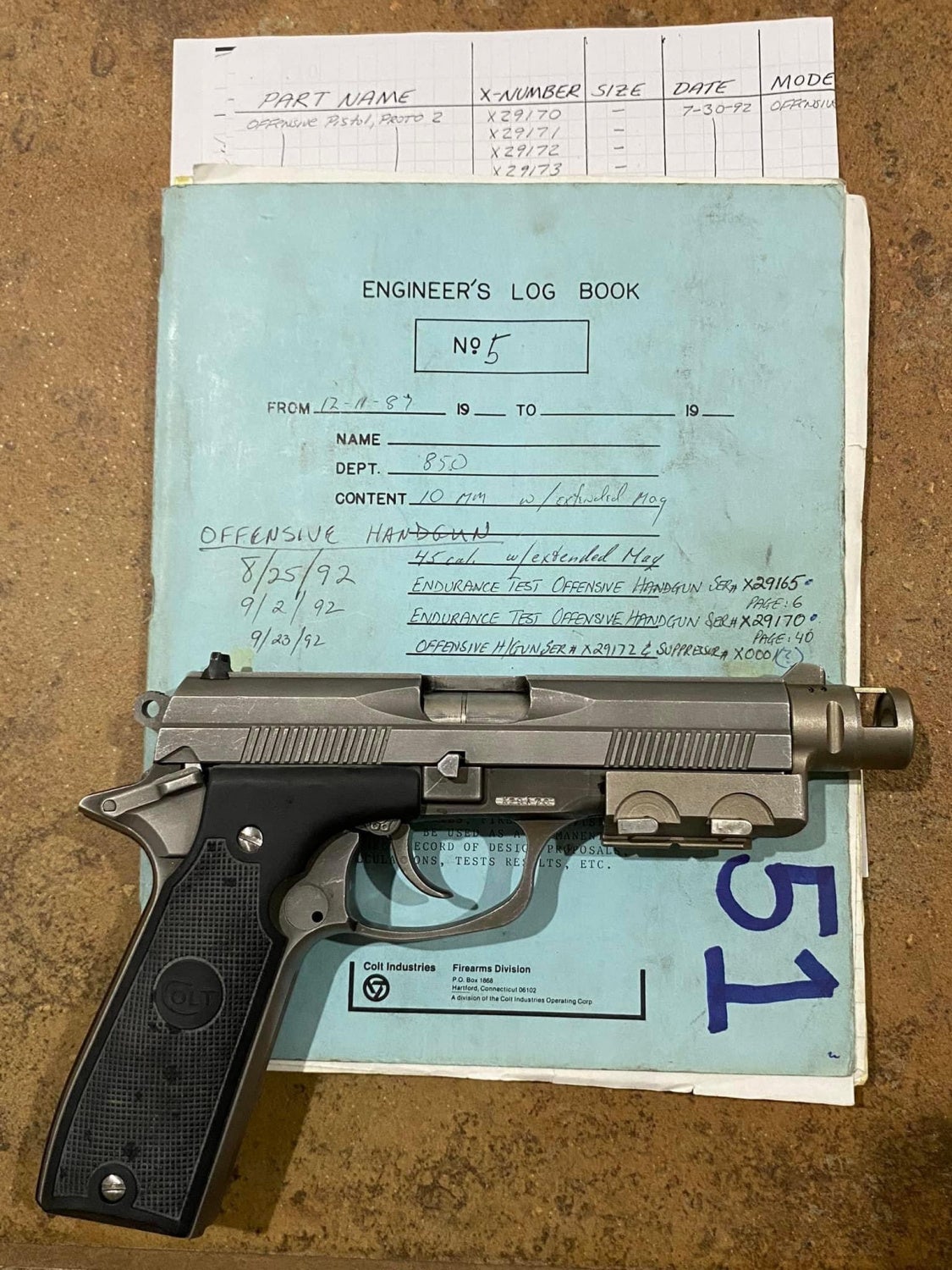
I know 42 [Colt OHWS] serial numbers were made with 30 being shipped to crane in 1992 as tests for the SOCOM’s contract that HK and colt entered. Before that, 2 ‘prototype 1’ guns were made using modified Colt Double eagles with 1 being destroyed. They then moved on to ‘prototype 2’ guns which I was honored enough, thank you to a certain individual putting me in contact with the owner, to get. When I made my offer, I assumed it was for one of the 12 other excess guns colt made. Of those 12, maybe 3-4 still exist. This one was an X marked ‘prototype 2’ version which was the same gun sent to Crane except they had a different finish.
The [Colt OHWS] Offensive handguns were a beast of a gun. The contract stated that it had to be at least 10 rounds of 45 capable of shooting 45 +P, have a laser aiming module, quick detach suppressor, double/single action, decocker, slide lock for suppressed single shot use and then weight and dimension requirements.
Colt management at the time was suffering a huge loss due to the failed Am2000 design they bought from Knight’s and didn’t have 2 cents to rub together. The pistol I bought was from of the design engineers so most information came from him as well the Crane report I will mention later.
With the overwhelming debt Colt had, they saw an opportunity to use the Socom contract money to do more research on some current models they were having issues with. Management made the engineers use the double eagle trigger action and the rotating barrel of the AM2000 both of which the engineers said was a horrible idea, but management wanted the time and money to find a way to fix these 2 systems.
So the engineers made this from what they were allowed to do by management.
Colt even went to S-Tron for the laser aiming module (LAM) which they ended up going bankrupt during phase one testing and could not supply colt with any parts of assistance during testing. Reps were not even sent to Crane to assist in their own product. Almost every unit was deemed worthless at the end of testing due to cheap materials and several didn’t work right out of the gate when the crane soldiers were unboxing them upon delivery.
The muzzle device did have some Eugene Stoner inspiration. When he was accompanying Reed to the back vaults of colt getting anything of value to get reimbursed, the engineer introduced himself to Eugene and asked him about an issue they were having with attaching a suppressor mount to a rotating barrel and he sketched something up really quick and the design was based upon that. Again, rotating barrel, not a great idea but managements idea.
The main issue with this design was that the barrels cracked around the 20k-23k range. The barrels were machined incorrectly from their suppliers and have a sharp face instead of a slanted face to soften the blow so they were cracking right at the sharp face. There were other smaller issues like misc springs and small parts breaking but those are simple fixes. The guns also averaged 6” unsupsressed and 11” suppressed, again due to a managements decision for a rotating barrel.
The magazines that were tested in the prototype phase were adapted off the shelf 11 round magazines that colt later made themselves some 10rd mags for the actual trials.
The colt submission was a last minute design and by the time everything was done and loaded and the drive was made, they had made it to crane within 3 hours of the deadline so they cut it pretty close!
So with this [Colt OHWS] specifically, the engineer was able to save the original engineers log book from the trash for this specific gun documenting all rounds and issues this gun had over its 23k round life. The main things were the barrel cracking at around 10k round and ended breaking at 21,500 and being replaced. Also a few other small parts at the 21k-23k range so if the barrels were machined correctly, probably last a lot longer than that. All of this was with 100% 45+P ammo so pretty good. I also got an original S-Tron manual, pictures of the colt offensive handgun team, crane test team and a copy of the X prefix book showing this serial number.
Also from a different collection just this last week I got the original Crane report that was sent to command in FL for colts pistols [Colt OHWS] showing all serial numbers, testing factualities, pictures of guns, and defects. It also goes over issues they saw and what needed fixed in phase 2 that never ended up happening.
So, excuse my poor article writing and such but hope this was informative and brought some light to an otherwise dark program.

Photo by Alex Young
Colt OHWS

Photo by Alex Young

Photo by Alex Young
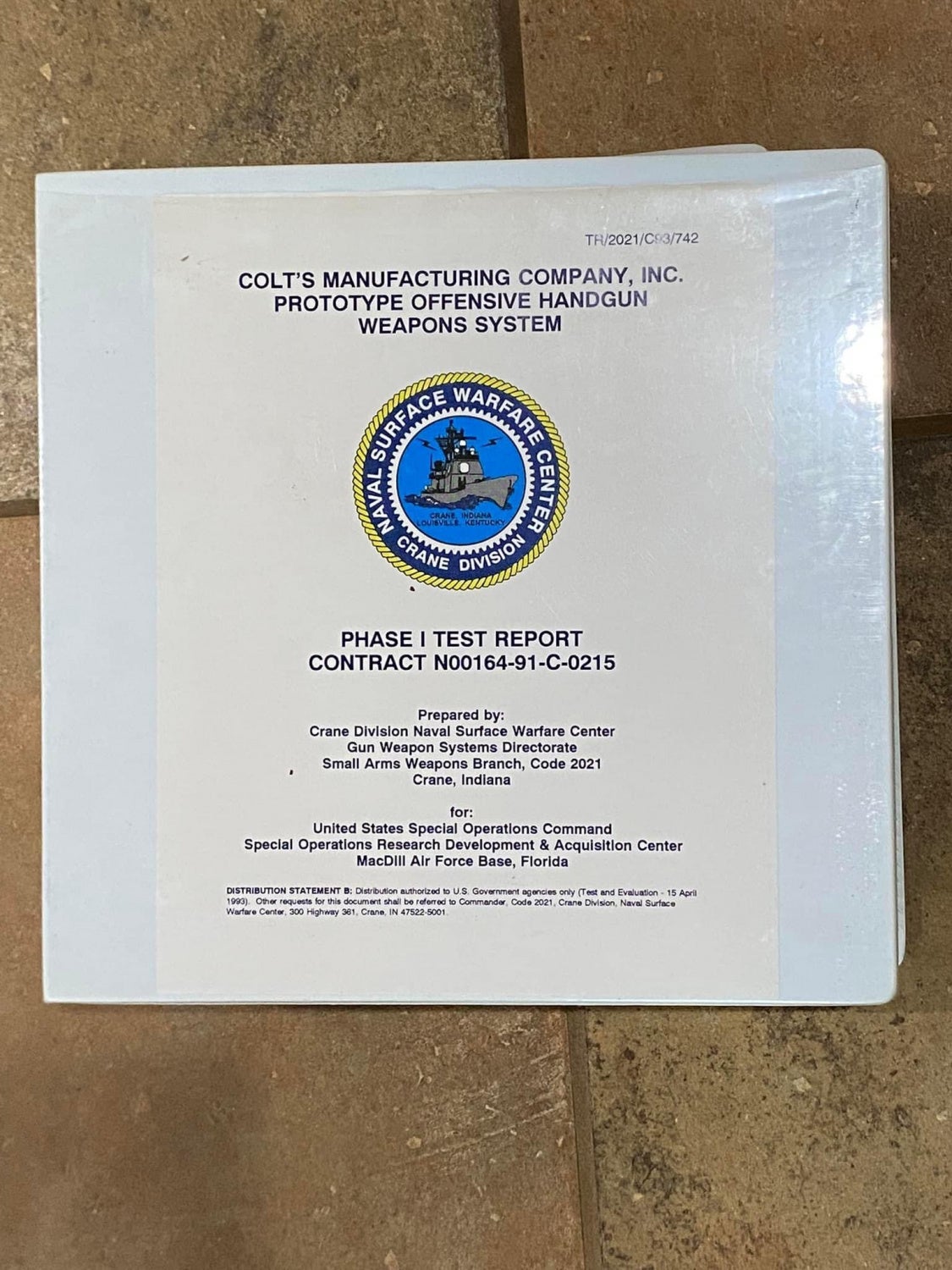
Photo by Alex Young

Photo by Alex Young

What an amazing piece of history and such provenance. Thank you Alex Young for sharing your Colt OHWS with us and the world.
Nicholas C

Steadicam Gun Operator
Night Vision & Thermal Aficionado
Flashlight/Laser Enthusiast
USPSA competitor

Categories
All About Guns Well I thought it was neat!

Early History Of The National Skeet Shooting Association The history of the National Skeet Shooting Association from its 1920s beginnings to the 1976 Olympic Games. by NRA STAFF

Nssa History 1
In 1936, Mrs. Albert F. Walker of Westmoreland Hills, Md., set a woman’s skeet record with a 99×100 score at a skeet club in Kenwood, Md. The following year, she landed the National Skeet Shooting Association women’s skeet championship.

The below is an excerpt from the 1978 book, Olympic Shooting, written by Col. Jim Crossman and published by the NRA.


The National Skeet Shooting Association

By Colonel Jim Crossman

Unlike most shooting events, skeet is of fairly recent origin and it is easily possible to trace the history of this shotgun game and its parent organization, the National Skeet Shooting Association.

Unable to get in enough grouse hunting to satisfy themselves, and not enthusiastic about trapshooting because it did not simulate bird shooting conditions, a group of New England hunters experimented with traps and clay birds until they worked out a game that seemed practical as field training, was fun to shoot, and was not too difficult to set up.

One of the group, W. H. Foster, became associated with a publishing firm which put out two very popular outdoor magazines, the five-cent Hunting and Fishing and the expensive 10-cent National Sportsman. Foster’s articles on the subject of the new game, first called “clock shooting,” aroused so much interest among readers that it was promoted as a new shooting sport. In 1925 complete rules and instructions were published. At the same time a prize was offered for the best name. “Skeet” was the name selected, and a good name it was, so that it remains skeet to this day.

Skeet grew rapidly up to World War II. The designers of skeet had done their work well in working up a game for teaching people to hit moving targets. So, skeet went to war. With the sudden urgent necessity of training aerial gunners as well as anti-aircraft gunners how to hit a moving airplane, skeet was seized upon as an important step in teaching swing and lead on a flying target. Many skeet shooters of the time found themselves in uniform, teaching skeet every day. Thousands of young men were exposed to shotgun shooting for the first time during this training, which was partly responsible for the great increase in shooting and hunting after the war.

The Hunting and Fishing and National Sportsman magazines had a proprietary interest in skeet, since they had originally promoted it and had devoted much money and magazine space to it. Thus, while there was a National Skeet Shooting Association in the 1930s, its officers read like the masthead of the magazines. But with the war and the lack of ammunition, skeet shooting for civilians practically stopped. The two magazines went out of business and the association became inactive.

With the end of the war, the National Rifle Association of America undertook to revive the skeet association. The NRA lent the embryo organization money and provided it office space. E. F. “Tod” Sloan was appointed manager of the organization. Sloan, although a rifle shooter, had long experience in competitive shooting and in promoting civilian shooting, his most recent military assignment having been as the Army’s Director of Civilian Marksmanship.

In 1952, after the organization was on its feet, Sloan resigned and the NRA bowed out, with Sloan taking a position as NRA field representative in the West, a position he filled with distinction. The skeet organization was turned over to the members and their elected officials. For many years, NSSA conducted its championships at various locations across the country, including the International Gun Club at San Antonio, Texas. This was a privately owned beautiful big layout, with all sorts of shotgun shooting taking place and with much room for expansion. The NRA conducted tryouts for its shotgun squads for the 1967 World Moving Target Championships and the 1968 Olympics at this club. In recent years the club ran into financial difficulties and NSSA bought it in 1974 and has moved its headquarters to that location.

Skeet is relatively new to the Olympic Games, although it has been part of the UIT program for many years. Skeet first appeared in the Olympic program in 1968 and it carried on into 1972 and 1976, although in a form barely recognizable by American shooters.

U.S. skeet has gotten away from some of the basic principles of the original game and a few major changes in rules have made it a much easier game. International skeet, on the other hand, is more difficult than the original sport, so there is now considerable difference between skeet as shot in the United States and as shot in international competition. There has been much discussion about making U.S. skeet tougher, both to reduce the large number of perfect tie scores and to improve international chances, but a vote by the directors in 1968 said no to the attempt to make U.S. skeet more difficult.

For those shooters who are interested in international skeet, the NSSA has established a separate International Division and there are a few events at the national championship shot under the international rules. The NSSA, not a member of the UIT, now works closely with the National Rifle Association in promoting international skeet. [Note: USA Shooting took the reins for international and Olympic skeet development and competition in the United States in 1994.]

Categories
All About Guns

The Werndl rifle and the 11.15x58R cartridge – Mad minute

Categories
The Green Machine This great Nation & Its People War

Men like this were the reason why we are not part of the British Empire

Categories
N.S.F.W. This great Nation & Its People

What could be more American than Nude women with Guns? NSFW

Categories
Cops You have to be kidding, right!?!

France Has Fallen: 17-year-old “Victim” was Gangbanger with 15-Count Rap Sheet and History of Running Police Stops By Richard Abelson

Nahel (right) displaying “pistols” in video by rapper JuL (center)

Rioting continued in France Saturday night, after 17-year-old Algerian Nahel M. was killed after a high-speed chase in Paris suburb Nanterre Tuesday. While Mainstream Media fan the flames of hate and violence by blaming the police and portraying Nahel as an innocent victim, the 17-year old hoodlum had a long police record and appeared in a cop-hating gangsta rap video just last month.

At 8 a.m. on Tuesday, June 27, two motorcycle officers saw Nahel M. in a high-powered, bright yellow Mercedes A-Class AMG with Polish license plates, racing through Nanterre, and gave chase. The 17-year old led them on a pursuit over sidewalks, through red lights and down bus lanes until finally forced to stop by traffic at 8:16 am.

The two officers dismounted and confronted the homicidal maniac at gunpoint, demanding he cut the engine. Instead, Nahel M floored it, striking the officer in front of his windshield and possibly triggering the gunshot which hit him fatally in the chest. The speeding sports car then struck an obstacle and flipped on its roof. One passenger fled on foot and one was arrested.

Nahel was 17, too young to have a French driver’s license. The Mercedes A Class AMG typically has 300 Horsepower and can do 0 to 60 mph in 4.7 seconds. The vehicle with Polish license plates was reported to be a rental, of the kind young migrant men like to use for “Fast & Furious” style road races, which often recklessly endanger innocent lives. The brave officers thus can be said to be completely justified in ending Nahel’s rampage at gunpoint.

Nonetheless, the hero officer is now being charged with “voluntary homicide”. French President Macron stabbed the officer doing his duty in the back by calling the young hoodlum’s death “inexplicable,  inexcusable”, all but guaranteeing the courageous officer will not receive a fair trial. French President Emmanuel Macron married his school teacher and has posed with semi-nude gangsters.

Despite not having a license, Nahel had previously been stopped by police at least 5 times and committed “refusal to stop”, as BBC reported. He has at least 15 criminal charges, including drug charges, insurance fraud and forging license plates.

Last month Nahel appeared in a gangsta rap video by French rapper Jul, riding a dirt bike and waving his fingers at the camera like two pistols. The lyrics of the video extol violence and crime, and feature hundreds of gang bangers from French suburbs.

———————————————————————————-I see that we are not the only place that is having “social problems”. God what a mess! Grumpy

Categories
This great Nation & Its People Well I thought it was neat!

Typical Americana!

Categories
All About Guns

The Brand New KelTec R50 5.7 Carbine and KSG410 Shotgun — SHOT Show 2023 by MITCHELL GRAF

KelTec R50 5.7 Carbine

If lightweight, maneuverable, and easy-to-handle firearms are interesting to you, then you better start paying attention to KelTec.

At SHOT Show 2023, KelTec showed off a miniature bullpup KSG chambered in 410 that is lightweight with virtually no recoil. They also unveiled the new R50 5.7 Carbine which is built upon their famed P50 pistol but features a full-length 16-inch barrel and folding stock.

R50 5.7 Carbine

Stock folded and sitting tight with the bottom receiver of the Key-Tec R50.

Very similar to the tried and true KelTec P50 pistol, the R50 rifle features a 16-inch threaded barrel and folding stock to make quite an effective and compact package.

Due to the design, there is no need for a buffer tube and the R50 still ends up with an overall length shorter than AR pistols or other AR-style SBRs. It features a Picatinny rail on the top of the receiver ready for any modern optics and runs off of 50-round standard capacity magazines for the FN P90.

The top of the receiver pops open to reload the R50, and then clamps back down tight. While reloads take a little longer than with some other platforms, they won’t be needed as often due to the 50-round capacity.

Also, 5.7x28mm fired from a 16-inch barrel is zipping through the air fast! This is a pretty sweet setup if you ask me.

Folding mechanism popped open for changing out magazines.

Featuring a folding stock that can rotate in either direction, the R50 is one compact package. The stock felt fairly comfortable and was quick to deploy. Utilizing grooves in the side of the receiver, the stock stows away well.

The R50 5.7 Carbine should be available somewhere between July-August and will have a posted MSRP of around $825.

Specs

  • CALIBER: 5.7 x 28mm
  • WEIGHT UNLOADED: 3.48lbs
  • MAGAZINE CAPACITY: 50
  • OVERALL LENGTH: 30.5″
  • LENGTH COLLAPSED: 21.5″
  • BARREL LENGTH: 16.1″
  • TWIST” 1:7″
  • TRIGGER PULL: 5lbs

KSG410 Shotgun

KelTec KSG410

KelTec was happy to show off its newest shotgun, the KSG410. Rept told us that it is the “lightest, thinnest and shortest 410 bullpup shotgun in the world.”

Maintaining the dual tubes like the traditional KSG, the KSG410 is able to hold 5 + 5 + 1 three-inch shells. It also features a carry handle grip with a fiber-optic sighting system similar to the KS7.

Specifications:

  • CALIBER: .410 Bore
  • WEIGHT UNLOADED: 5.4lbs
  • MAGAZINE CAPACITY: 5 + 5 + 1 (3″ shells)
  • OVERALL LENGTH: 26.1″
  • BARREL LENGTH: 18.5″
  • TRIGGER PULL: 5lbs
  • LENGTH OF PULL: 13″


Coming in at just only 1.7 inches wide, the KSG410 is a very slim platform. Especially so, due to the fact that it incorporates dual tubes for larger shell capacity.

It also weighs in at a mere 5.4 pounds so it can be easily managed by nearly all age groups. While 410 is still a competent round, the KSG410 was built to fire these rounds while being “virtually recoilless by any pump-action shotgun standards.”

Dual tubes sitting just under the barrel of the KSG410.

The KSG410 should be available around Q3 and will have an MSRP of about $495. To read more about the KelTec KSG410, click HERE.

—————————————————————————————Buck Rodgers would like this one! Grumpy

Categories
All About Guns

IWI Masada

Categories
All About Guns

1929 Colt Police Positive Special