Categories
Uncategorized

SMITH & WESSON’S 50TH ANNIVERSARY MODEL 29 S&W SET THE BAR FOR MAGNUM HANDGUN PERFORMANCE 50 YEARS AGO WRITTEN BY JOHN TAFFIN

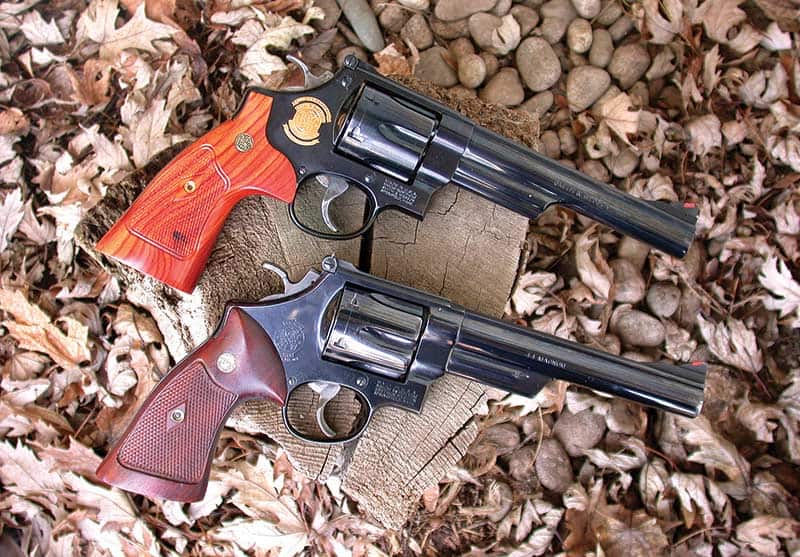
The 50th Anniversary Model 29 has a squarebutt grip just like its predecessor below. The grips will interchange.


After he blew the top strap and cylinder of an old .45 Colt SAA by grinding the black powder into finer granules and putting all he could into the .45 case, Elmer Keith “discovered” the .44 Special, which had been around for 20 years even though he had never seen one, and quickly unlocked its potential. He eventually settled on a load of 18.5 grains of Hercules 2400 under the Keith-designed Lyman No. 429421 250-grain hard-cast bullet in the era’s larger-capacity balloon-head .44 Special brass.

In duplicating this load in balloon-head brass, I found the muzzle velocity to be just over 1,200 feet per second from a 71⁄2″ barrel. When newer solid-head brass arrived in the 1950s, his load was dropped to 17 to 17.5 grains. Keith spent 30 years asking ammunition companies to offer a .44 Special load with a 250-grain bullet at 1,200 fps. He finally got what he asked for, and more, in the new .44 Magnum with a 240-grain bullet at 1,450 fps.
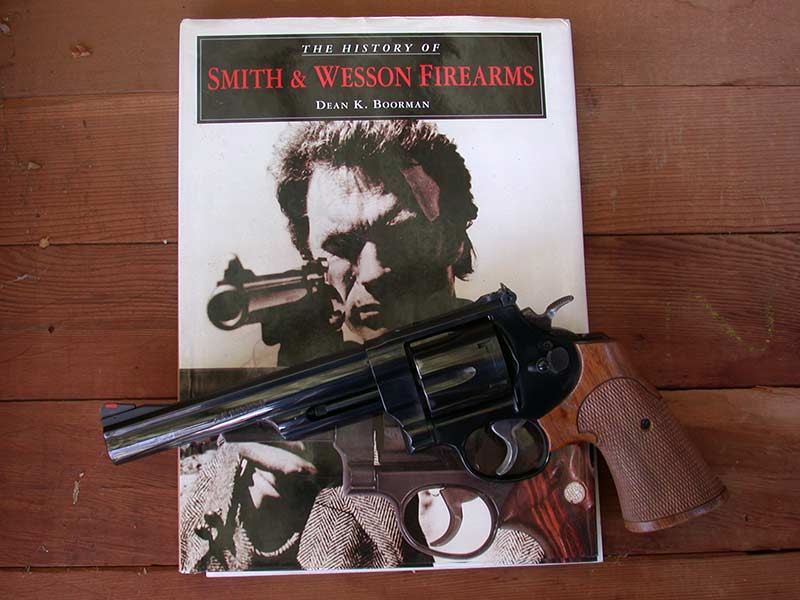
 

The new S&W Anniversary Classic Model 29 would befit the
man who made it a star and a legend — Clint Eastwood.

Keith Made It Work


Keith retired his .44 Specials in favor of the new cartridge, carrying a 4″ Smith & Wesson .44 Magnum daily until his incapacitating stroke in 1981. While he was happy with the new sixgun and the concept, the actual ammunition offered by Remington left something to be desired. The Lubaloy bullets were too soft resulting in barrel leading and Keith felt the pressures were much higher than they should have been.

He soon found a better load, which soon became such a standard it was simply known as the Keith Load — his Lyman No. 429421 hard cast 250- grain bullet over 22 grains of No. 2400 over standard primers. Be informed — it takes about 6 percent less of today’s Alliant No. 2400 to produce the same results Keith’s load did in 1956. Despite ever more powerful cartridges, such as the .454, .475, and .500, this remains a very powerful load and recoil in a 4″ .44 Magnum has not been diminished in any way, shape or form.

Originally, Smith & Wesson 1950 Target .44 Specials were assembled with specially heat-treated cylinders and frames, prototypes of the new .44 Magnum. The 1950 Target with a 61⁄2″ barrel weighed only 39 ounces resulting in excessive recoil — to the shooter, not the gun. Weight was added by using a bull barrel and full-length cylinder filling most of the frame window. The weight of the final production 61⁄2″ .44 Magnum was 48 ounces or an even three pounds.
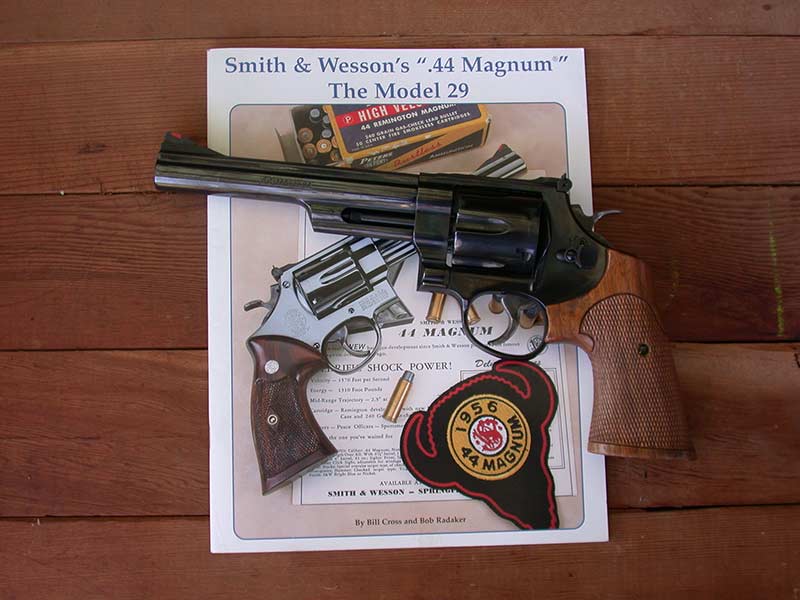
 

Sitting atop and original ad for the Model 29, the Anniversary
Model 29 also has period correct Herrett’s Trooper stocks.

The .44 Magnum Is Born


The early Smith & Wesson .44 Magnums were beauty personified. Not only did they carry a beautiful finish known in those days as S&W Bright Blue, they also came very close to, perhaps even equaled, the precision fitting of the 1907 Triple-Lock. The new .44 Smith & Wesson, superbly finished with a magnificently smooth action and trigger pull, sold for $140. As a teenager I was making $15 a week with a paper route and could only dream of great sixguns. I graduated from high school and moved up to big money — 90¢ an hour — and it was time to start buying my own sixguns.

One of the first .44 Magnum 4″ models to hit my part of the country was rented out by a local gun store/outdoor shooting range. Three of us teenagers stepped forward to shoot, and although the recoil was absolutely awful, none of us would admit it and definitely not to each other.
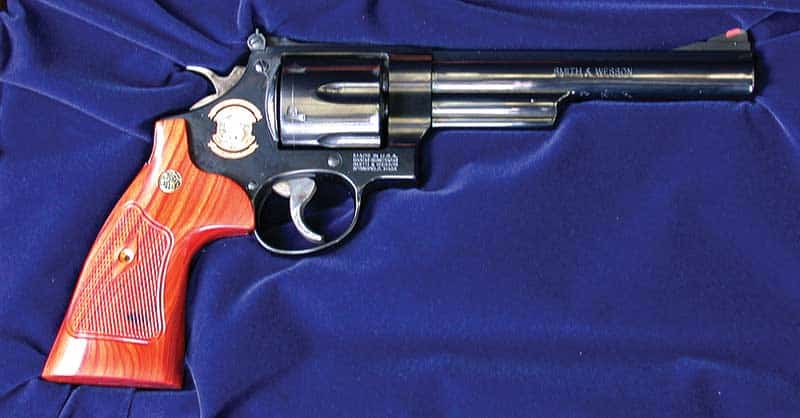
 

The Anniversary Model 29 from Smith & Wesson comes with a wooden presentation
case just as it did 50 years ago. The 50th Anniversary Model 29 is the 21st century
version of the original .44 Magnum. The new sixgun does not have counterbored
chambers or a pinned barrel, but is otherwise a beautifully made piece.

Lace Panties?


Those first .44 Magnums appropriately resided in fitted wooden cases. Guides and outfitters traded in their .357s for the new .44 and a few handgun hunters began using the Smith & Wesson very successfully. However, soon gun stores had used .44 Magnums for sale with a box of cartridges holding six empties and 44 .44s still intact. One cylinder full was all it usually took for many a shooter to realize this was more
pain than desirable.

Remember, this was the 1950s when heavy handgun recoil was represented by the 1911 .45 ACP and relatively heavy .357 Magnum. There were no hard-kickin’ handguns until the .44 Magnum arrived. A well respected writer of the time, Major Hatcher of the NRA Staff, likened the recoil of the .44 Magnum Smith & Wesson to being hit in the palm of the hand with a baseball bat. Keith said it was not as bad as shooting a 2″ Chief’s Special .38, while Col. Askins, always the pot stirrer, countered with anyone who could not handle the recoil should wear lace panties.
 

Unreal Demand Becomes Real


Only the most serious shooters chose the S&W .44 Magnum before the arrival of Dirty Harry. Clint Eastwood’s famous character, whose exploits began in the early 1970s, created an unreal demand for the .44 Magnum not satisfied no matter how much Smith & Wesson increased production. Suddenly .44 Magnums, which had been selling less than retail, were going for double retail and more. The demand created by the movies was unreal and destined to wear itself out, but a real demand was created by two sixgunning activities which really took off in the late 1970s, namely handgun hunting and long range silhouetting.

With the rise of handgun hunting and heavier sixguns, the reloading of the .44 Magnum changed dramatically. The old standard Keith load had been his 250- grain hard-cast semiwadcutter bullet over 22 grains of No. 2400 was, and remains an excellent hunting load. But as bigger and bigger game, including elephant and Cape buffalo were hunted with the .44 Magnum, the standard hunting load became a hard-cast 300- or 320-grain bullet at 1,300 to 1,400 fps.
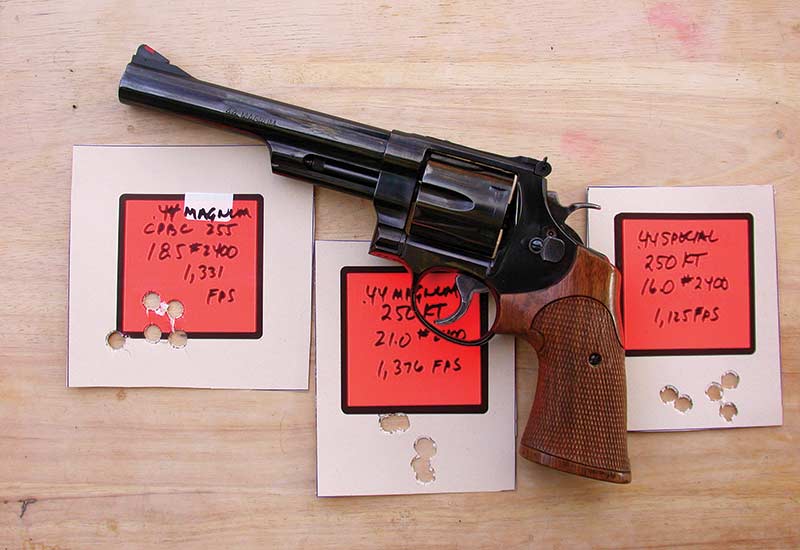
 

For test-firing the Anniversary Model 29, Taffin found 1950s stocks by Herrett’s
worked better than the factory grips and the 5-shot 20-yard groups were exceptional.

In Denial


When silhouetting came on the scene, the Smith & Wesson .44 Magnum was an early favorite. Used sparingly with full-house Keith loads, the S&W performed normally, but shooters soon discovered it would not take the constant pounding of a steady diet of heavy loads. Even though Keith
waited 30 years for his “.44 Special Magnum” he reported in the 1957 Gun Digest firing 600 rounds through his .44 Magnum in the course of a year. That averages to less than 12 rounds a week and no problems were reported.

However, as silhouetters used thousands of rounds in practice and competition, the big Smith started to shoot loose. Parts wore quickly and some sixguns unlocked on firing allowing the cylinder to rotate backwards placing an empty round under the hammer upon the next shot. Smith & Wesson ignored or denied these problems until the 1980s when they announced internal changes to prevent these occurrences.
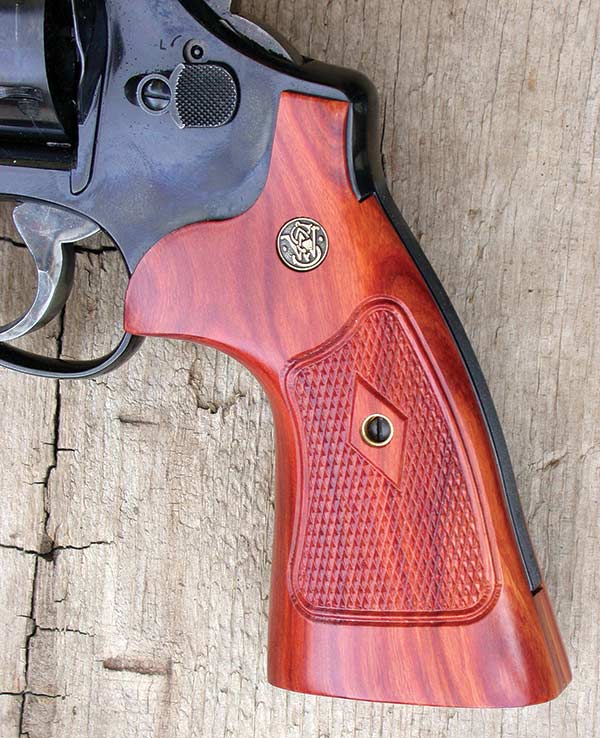
 

Stocks of the 50th Anniversary Model are attractive and feel
very good, but are not fitted well enough for shooting.

The Classic Sixgun


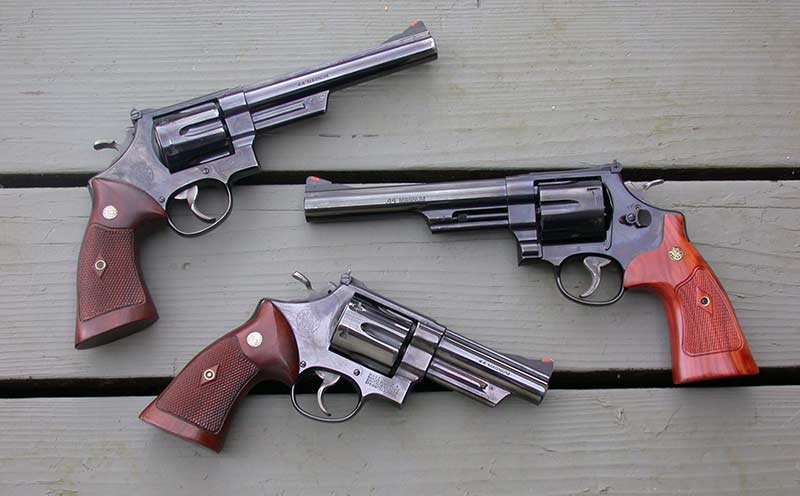
Today, collectors refer to the early guns as pre-29s as the .44 Magnum became the Model 29 in 1957 when all Smith & Wesson handguns were de-personalized with model numbers instead of such great names as .357 Magnum, .38/44 Heavy Duty, Highway Patrolman, Combat Magnum, and of course, .44 Magnum. Those very first .44 Magnums are also known as five screws as they had four sideplate screws and one screw entering from the front of the triggerguard. In 1956 they became four screws with the elimination of the upper sideplate screw, and the 83⁄8″ barreled version arrived in 1958 after going to four screws. The same year also saw a special run of approximately 500 Model 29s with 5″ barrels.
 

Win A Little, Lose A Lot


Over the years, the Model 29 went through a series of changes. In 1960 it became Model 29-1 when the extractor rod was changed to a reverse thread. The 29-2 arrived in 1961 with the changing of the cylinder stop and the dropping of the triggerguard screw, followed by the elimination of the diamond in the center of the grip in 1968. The prefix of the serial number went from S to N in 1969, and then someone must have had a very bad weekend in 1979 when the 61⁄2″ barrel length was changed to 6″. This should never have happened. The 6″ never quite balanced or looked right and was definitely an extreme case of fixing what ain’t broke.

As if to add insult to injury, the Model 29-3 arrived in 1982 without the recessed cylinder and pinned barrel. At the tail end of the 29-3 production in 1987 Smith & Wesson started the Endurance Package which was carried into the 29-4 in 1988. Two years later the 29-5 saw the introduction of longer bolt slots in the cylinder as well as more internal modifications. By 1994 the wooden stocks, which had gone from fairly usable and comfortable to a very blocky shape uncomfortable with all loads, were replaced by Hogue rubber stocks, the top was drilled and tapped for scope mounts, and the front of the rear sight leaf was changed from square to semicircular. This was the Model 29-6. The 61⁄2″ barrel, the pinned and recessed features, the original stocks were all gone and another radical change appeared when the long familiar square grip was dropped for a round butt in 1995. Forty years after the original appeared it was now “improved” to the point of hardly being recognizable. The Model 29 also appeared as a 101⁄2″ Silhouette Model with special sights and then the Classic, Classic DX, and Magna Classic with full under lug barrels.
 

Burial And Resurrection


By 1998’s 29-7, the final changes were made. It now had a MIM trigger and hammer, a frame-mounted firing pin, and more changes to the lock works. All of the changes are not necessarily bad, but it wasn’t the original .44 Magnum. In 1999, Smith & Wesson blew taps over the Model 29 and it was gone, dead and buried. The original had changed so much hardly anyone missed it.

Now the Model 29 is back. No, it is not exactly the same as it was 50-years ago. The original .44 Magnum was built on a design from the 19th century originating in the Military & Police of 1899. Working by 21st century standards and production methods, Smith & Wesson has done an excellent job resurrecting the original .44 Magnum. Some things are the same, some are different and the phrase of the day is “No Whining.” Yes, my spiritual side would have preferred an exact duplicate, however, my realistic side says this’ll never happen.
 

The Good, The Bad, And The Ugly


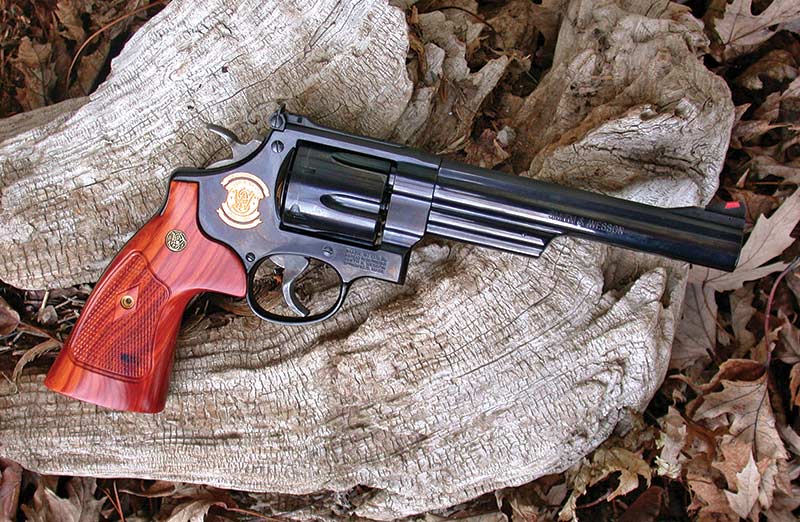
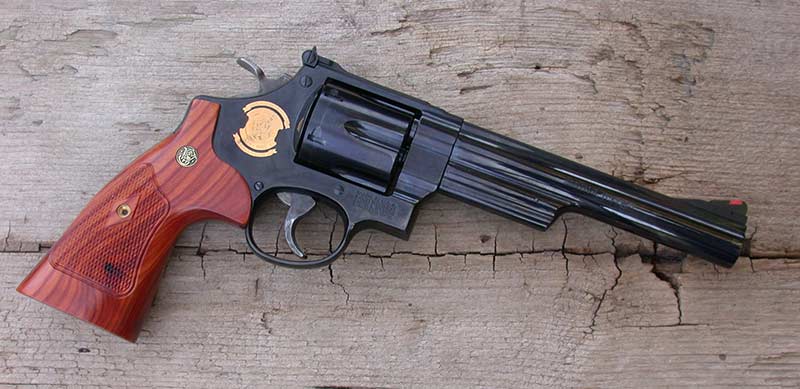
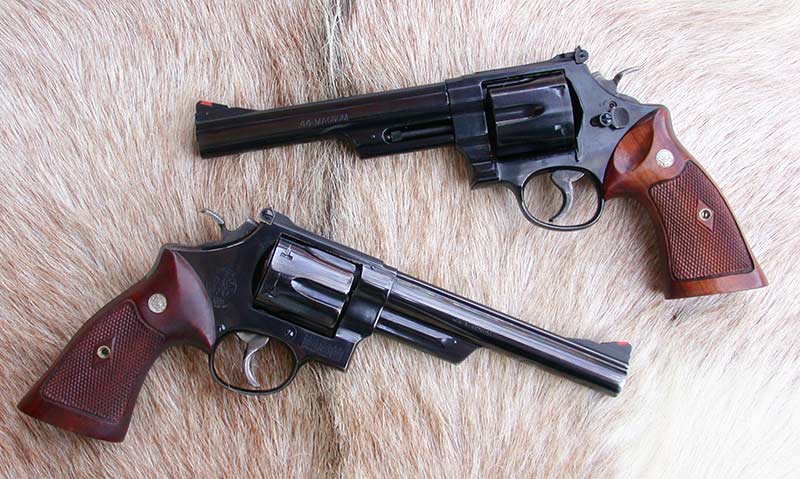
Let’s look at the 50th Anniversary Model of the Smith & Wesson .44 Magnum. The Bright Blue finish almost rivals the old, the sights are a white outline rear and a red ramp front as on the original, and the barrel length is the original 61⁄2″. The hammer and trigger are the original checkered and serrated style and, from the side, the hammer has the best looking profile I’ve seen on a Smith & Wesson or any other factory-produced sixgun for that matter.

The stocks are good news/bad news. The good news is they are the same color, though a lighter shade, as the originals and have the diamond around the grip screw. They also feel much better than the originals being slightly thinner in overall feel and tapered quite a bit to the top of the grip frame. Unfortunately, they are not inletted to the grip frame and depend on pins to hold them solidly. It doesn’t work and
they move when firing even heavy .44 Special loads, so it seemed both prudent and appropriate to replace them with a tight-fitting pair of Herrett’s Trooper stocks almost as old as the original .44 Magnum. The grip frame is a square butt and original .44 Magnum stocks fit, so both the original barrel length and grip-frame configuration are back. The pinned and recessed features are missing and the firing pin is mounted in the frame instead of the hammer.

Yes, it has the internal lock found on all Smith & Wesson revolvers and comes in a lockable, padded plastic case. The sides of the barrel are marked as the original was though in reverse with the left side of the barrel marked “44 MAGNUM”, while the right side carries “SMITH & WESSON.” Since this is a 50th Anniversary Model, there is a gold seal on the right side of the frame announcing “50th ANNIVERSARY, SMITH & WESSON” above the S&W logo with “1956-2006, 44 MAGNUM” found below. All in all this is a most attractive sixgun and I applaud Smith & Wesson for bringing back the best possible 21st century version of the original .44 Magnum.
 

Shoots Fine


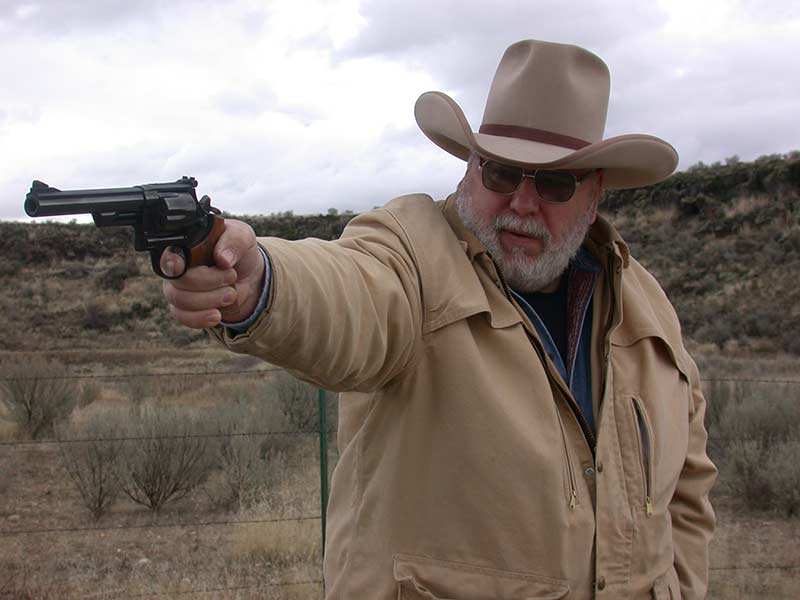
The new Model 29 was tested with both .44 Special and .44 Magnum handloads in very shooter unfriendly conditions with a temperature of 33 degrees and a numbing wind. I would load the sixgun and quickly put on wool knit gloves to fire. In between, I headed for the 4×4 to warm up. Even so, the 50th Anniversary Model performed very well. In Starline .44 Special brass, the 250-grain Keith bullet over 16 grains of No. 2400 clocked 1,125 fps and grouped 13⁄8″ for five shots at 20 yards, while the same bullet over 7.5 grains of Unique or 17.5 grains of H4227 went 975 fps and grouped into 11⁄2″. The best groups came from Starline .44 Magnum brass with a Cast Performance Bullet Co. 255-grain Hard
Cast over 21 grains of 2400 for 1,331 fps and a group of 1″, while the 250- grain Keith over 21 grains of 2400 grouped into 11⁄8″ and clocked 1,376 fps. All loads were chronographed using the easy to set-up and use (really appreciated in cold weather!) PACT Professional Chronograph XP.

The Smith & Wesson Model 29 is the sixgun by which all other .44 Magnums are judged. When it comes to performance some fall short, other surpass it. I view it as the finest-looking doubleaction revolver ever made, and it is definitely the slickest handling of all .44 Magnums. For an everyday Packin’ Pistol with standard loads using 240- to 250-grain bullets or heavy-duty .44 Special loads, it is still top of the mountain when it comes to double-actions. One miracle occurred with the return of the Model 29, it would only take a minor miracle to make it a standard production item next year offered in both 4″ and 61⁄2″ versions. One can hope. Shooting the new old 29 took my mind, soul and spirit back 50 years.

Categories
Darwin would of approved of this!

And we have a Winner for Todays Darwin Award!!

A French “human torch” set two Guinness World Records on fire Thursday after he ran across the finish line while engulfed in flames. Firefighter Jonathan Vero, 39, was licked by intense flames and deprived of oxygen for the entirety of this 893 ft dash around a track in his hometown Haubourdin, a commune 138 miles northwest of Paris.

The best Dumb Shit memes :) Memedroid

Categories
Allies Paint me surprised by this Some Red Hot Gospel there! This great Nation & Its People

Gordon Sinclair – The Americans (A Canadian’s Opinion)

Categories
All About Guns

Sturmgewehr | Old Gun Restoration

Categories
Allies Soldiering

Brits on horseback

United Kingdom
As a courtesy to British visitors, these pages are written in -tentative- English

British Hussars

It would naturally take some time for the “Hussar craze” to contaminate the United Kingdom after sweeping over the Continent. The dash of attire and behaviour displayed on the Napoleonic battlefields in the service of France certainly made the best impression, and in due time the British Army started changing her Light Dragoon Regiments into Hussars, in dress and in title.

A proud tradition was established, and British Hussars displayed their elegant uniforms both in Society and over the Battlefields of the world. Some dramatic events made the stuff of legend. The Crimean War was a milestone, for the undying glory of the Light Brigade or the subsequent drastic changes in uniform.

Queen Victoria’s Army counted up to 13 Hussar Regiments. I may say that they sported some of the most splendid uniforms of the time. The trademark of the Victorian British Army, Regimental particularities, makes it a pleasure scrutinizing those images of the past, on the lookout for the telltale sign that will eventually give out the sitter’s regiment. Army lists and medal Rolls are the necessary companions of the researcher.

A bit more disturbing is the abundance of territorial Hussars in the Yeomanry Cavalry regiments. Uniformology resources are scarce, but a little thoroughness makes up for that.

“Chase me Ladies, I’m in the Cavalry !”
Portrait of the Young Man as a Hussar
The Regiments
(click on the postcard icons to access the various Regiment pages)
3rd (King’s Own) Hussars 4th (Queen’s Own) Hussars 7th (Queen’s Own) Hussars 8th (K.’s Royal Irish) Hussars
10th (P. of W.’s Own) Hussars 11th (P. Albert’s Own) Hussars 13th Hussars 14th (King’s) Hussars
15th (The King’s) Hussars 18th (Q. Mary’s Own) Hussars 19th (Q. Alex.’s Own) Hussars 20th Hussars
21st Hussars
The Cavalry Depôt
When a Regiment was sent to serve overseas, a Squadron would stay in England to do depôt service – training new recruits and horses, to be sent over as reinforcements when needed.
The Cavalry Depôt was reorganized in Canterbury in 1871, and would gather the depôt squadrons of all the Cavalry Regiments on foreign service.
The Cavalry Depôt also served as a Riding School, training the future Regimental Riding-Masters, thus ensuring a certain level of uniformity in the equestrian arts among the various Regiments.
Officers at Canterbury in 1878

Yeomanry Cavalry

Early Yeomanry (territorial volunteer cavalry) uniforms is not as well a covered field as the regular army – but the good news are that most uniforms are quite distinctive. Most Yeomanry uniforms display white / silver lace, as opposed to the yellow / gold of the regulars (though there were, of course, exceptions to a rule that could never be fully enforced).
When faced with a supected Yeoman, first thing is to localize the county where the photographer’s studio was located. That holds the key to most identifications.
The 1898 Army List lists 38 Yeomanry Regiments (not all Hussars, some styling and fitting themselves Lancers or Dragoons), plus two Irish Terrritorial Cavalry units and the London Mounted Brigade.
Here are a few of them, classified by the order of precedence authorised in 1884 by Queen Victoria (when appropriate) :

1. Royal Wiltshire Yeomanry 2. Warwickshire Yeomanry 3. Yorkshire Hussars 4. Sherwood Rangers 5. Staffordshire Yeomanry 8. Cheshire Yeomanry 9. Ayrshire Yeomanry
10. Leicestershire Yeomanry 11.North Somerset Yeomanry 14. Northumberland Hussars 15. South Notts Hussars 16. Denbighshire Hussars
17. Westmorland & Cumberland 18. Pembroke Yeomanry Cavalry
19.Royal East Kent Mounted Rifles 20. Hampshire Carabiniers 21. Royal Bucks Hussars 23. Dorset Yeomanry 24. Royal Gloucestershire Hrs 28. Royal 1st Devon Yeomanry 29. Loyal Suffolk Hussars 30. Royal North Devon Yeomanry
31. Queen’s Own Worcestershire Hussars 32. West Kent Yeomanry 33. West Somerset Yeomanry 36. 2nd West York Yeomanry Cavalry 39. Lancashire Hussars 3rd County of London (Sharpshooters)
The Lost Hussars
It is not always within my capacity to formally ascertain which regiment a subject belongs to ; your help is more than welcome, if you have any clue thanks for contacting me at djedj@hotmail.com
Sergeant in Hull North Somerset Yeomanry ? Cornet  Staff Sergeant Drill Instructor
 
This is knot a Hussar
Ceci n’est pas un Hussard

Many British units sported uniforms that incorporated  traditional elements of the Hussars’ outfit : Hungarian knots, fur busbies, braided jackets…
It is therefore quite natural to mistake them for Hussars.

Some of them are devoted pages on their own right :
– the Royal Horse Artillery
(click on the image to the left)
-the Indian Army
(click on the image to the right).

A few other ones are presented hereunder.

Royal Horse Artillery The Indian Army
Royal Artillery Royal Engineers Rifle Volunteers Lancers Staff Officer
Recommended Readings
British Hussar Regiments 1805-1914
(Almark)
by AH Bowling
The Mess Dress of the Yeomanry Cavalry 1880-1914
by David J. Knight and Robert J. Smith
The Uniforms of the Imperial Yeomanry, 1901-1908
(the Military Historical Society, 2009)
by David J. Knight and Robert J. Smith
Evolution of the uniform patterns ; this deceiptively small book is packed with information and illustrations ; excellent value. Packed with information and illustrations : photos, drawings and colour plates, including some  reference work on lace and braid patterns ; superb work ! To know how the uniforms of the Yeomanry evolved, between proud traditions and the modernity brought up by the Boer War. Another excellent read on a fast moving era.
Recommended Browsings
Soldiers of the Queen The British Empire
A Beautiful Collection of Period Photographs from “Soldiers of the Queen”.
A very inspirational website – the design of mine owes MUCH to SotQ. Great stuff !
Military history and uniformology ; great reference with lots of scholarly commented pictures. I bookmarked the “Armed Forces” pages but there’s more to the website.
Categories
All About Guns Soldiering The Green Machine War

Future Combat Systems: The Abandoned US Weapons Platform That Cost $18.1 Billion Dollars

Categories
Soldiering War

Interview with Neil Vermillion: Being a Volunteer Fighter & Trainer

Categories
All About Guns The Green Machine You have to be kidding, right!?!

The Case for the A-10C by Ivan F. Ingraham (I say give them to the Army & Marines but no!! As that would freak out the USAF)

The United States Air Force’s decision to divest the A-10C “Warthog” has larger ramifications for future wars than just an airframe. The service plans to drastically reduce its capability and capacity to provide Close Air Support (CAS) to ground forces, leaving the sons and daughters of America and her allies to fight without a dedicated CAS aircraft for the first time since Vietnam.  

History First

The venerable “Warthog” is viewed by some as a Cold War relic that only exists as a jobs program for congressional representatives. This is myopic.

With nearly four decades in service, the A-10C stems from the lessons (re)learned after Vietnam. From inception, the A-10C was a purpose-built CAS platform with demonstrated battlefield survivability. Because of its rugged design paired with heavy and diverse payloads of modern stand-off decoys and weapons, each A-10C delivers more firepower to support ground forces than its fighter counterparts. Further, its AAR-47 missile warning system is especially effective at defeating nearly all Man-Portable Air Defense Systems (MANPADS).

I spent a 24-year career as a Marine Infantry Officer, later transitioning to Marine Special Operations Command (MARSOC), commanding at the Team, Platoon, and Company levels in both Joint and Combined combat environments.

On September 26, 2007, my platoon was on the receiving end of a complex ambush against an entrenched enemy. We fought our way out, often engaging enemy fighters inside of 100 meters and sometimes at hand-grenade range. In a difficult and violent action, we broke the back of the enemy’s assault.

We used two A-10Cs to destroy the enemy element isolated in a trench line. The A-10C’s impressive firepower and danger-close delivery of bombs facilitated the extrication of my 35-member assault force without a single U.S. casualty. This simply would not have been possible without the A-10C working in close consonance with my Joint Terminal Attack Controller (JTAC); a trained air support employment specialist.

I’m a living testament to the A-10C’s utility.

A U.S. Air Force A-10 Thunderbolt II close air support aircraft simulates its air-to-ground capabilities during the 2011 Aviation Nation Open House on Nellis Air Force Base, Nev., Nov. 12, 2011. (Tech. Sgt. Bob Sommer) Source.

The Issue

In its 2023 budget, the Air Force revealed a 5-year plan to eliminate its A-10C CAS aircraft without an adequate replacement and to cut Terminal Air Control Party Specialist/Joint Terminal Attack Controller (TACP/ JTAC) manning by 50%.

The USAF is a staunchly fighter-oriented culture where platforms like the F-35 and the NGAD fighter are touted as machines that will provide CAS and fight enemy aircraft with equal aplomb, but the Air Force’s plan will divest nearly all close support expertise, crippling America’s ability to employ airpower in close proximity to friendly forces on the ground. Ground troops would be supported by a small, expensive fleet of fragile aircraft that are far less effective at CAS than the A-10C. In low-intensity conflicts, it will cost lives. In Major Combat Operations, it risks losing battles.

Problem Framing

The U.S. is terrible at predicting the next battlespace and future wars. Having a robust quiver of options is better than eliminating a proven platform like the A-10C. Paradoxically, if the USAF follows its own doctrine to justify getting rid of the A-10C this only bolsters the case for keeping it.

No aircraft engages the enemy alone.  Much like ground forces use “combined arms” (tanks, artillery, infantry, and aviation) to prevail on land, the Air Force uses “Force Packaging” to win in the air. The four major threats to aircraft over a modern battlefield are:

  • Air (enemy fighters);
  • Radar-guided Surface-Air Missiles (SAMs)
  • Air Defense Artillery (ADA), and;
  • Man-portable Air Defense Systems (MANPADS)

The Air Force spends a lot of taxpayer dollars to ensure its fighter team (F-16; F-15EX; F-22; and F-35) can kill or negate enemy aircraft and radar SAMs, but the sensitive skins, engines, and reduced capacity for flares make these aircraft extremely vulnerable to ADA and MANPADS. In contrast, the A-10C is by far the most survivable aircraft against ADA and MANPAD threats found directly above the battlefield and is the only CAS platform specifically designed to protect ground forces in battle.

In a firefight, I sought to dominate high ground, known as “key terrain,” to achieve tactical superiority. The airspace directly overhead the battlefield is the ultimate key terrain.  An American ground commander fighting against a capable and determined adversary needs an aircraft with a massive amount of firepower and eyes on both friendly troops and the enemy. Without the A10C’s capability, the USAF cedes the most important position on the battlefield where CAS is a powerful surgical tool. I can’t imagine fighting without A-10Cs which provided me a critical advantage in a dynamic, highly-contested combat environment.

An A-10 Thunderbolt II deploys flairs over Afghanistan on Nov. 12, 2008. A-10s provide close-air support to ground troops in Afghanistan and Iraq. The A-10’s excellent maneuverability at low air speeds and altitude as well as its highly accurate weapons delivery make it an ideal aircraft for supporting coalition operations. (U.S. Air Force/photo by Staff Sgt. Aaron Allmon) Source.

Further, the A-10C was designed to operate from expeditionary airstrips. This works to the A-10C’s advantage in peer conflicts. Advanced fighter aircraft require concrete or asphalt surfaces of at least 8,000 feet in length. Countries like China will use any weapon they can, like ballistic and cruise missiles, to negate aircraft carriers and airfields capable of supporting fighters. Alternatively, the A-10C can island hop around the Pacific with a small support package and operate from 5,000 to 6,000 feet of dirt, grass, or even a short stretch of highway.

The A-10C thrives using a combination of Force Packaging and intelligent tactics, as evidenced in the 2016 deployment of the A-10C to support U.S. forces in Syria. Although Air Force leadership and Beltway pundits would prefer Congress forget about the A-10C operating within multiple surface-to-air missile engagement zones and merging with Russian fighters during Operation Inherent Resolve, the A-10C proved itself on the modern battlefield.

Dollars and Sense

The decision to divest the A-10C is not new; the platform is always considered for retirement when the USAF talks of modernization. The Air Force’s voracious spending habits force an ever-smaller fleet of overpriced aircraft; a single F-35 costs nearly $145 million, which doesn’t account for the billions of dollars spent researching and developing emerging design technologies. Once procured, F-35 operating costs are more than double that of the A-10C, with sustainment costs three times budget expectations.

The A-10C needs a tech refresh, but the aircraft is paid for, and there is little to suggest that the A-10C can’t maintain its relevance with ~$3 million each in modernization and upgrades. That is pennies on the dollar compared to the F-35; the 10-year cost to replace A-10Cs with F-35s is $68 billion. The USAF, just ten years after the initial fielding of the F-35, spent $4 billion dollars on the research and development of an engine it no longer plans to procure. For comparison, it cost less than $1 billion to build and install new wings on the entire A-10C fleet, and another $1 billion could create an all-new, digitally-enhanced A-10EX, capable of employing next-generation weapons, locating threat systems, and acting as an over-the-horizon communications node.

(U.S. Air Force photo by Airman 1st Class Benjamin Wiseman) Source.

Head-To-Head

Money aside, the Key West Agreement of 1948 charged the USAF to provide Close Air Support to the U.S. Army. The A-10Cs real benefit combines specialists (pilots) with a purpose-built airplane, and the funds used to field the A-10C were pulled from the Army’s own Close Air Support programs. Divesting the only CAS-designed aircraft in the USAF without a replacement is akin to dereliction of duty.

As a mission planner requesting CAS assets for ground operations, I was told to ask for aircraft capabilities to support my mission, rather than specific types of aircraft. Since many aircraft share capabilities (ex. ability to employ GPS-guided munitions) and there are always limited assets to meet multiple demands for CAS, focusing on capabilities creates the flexibility to draw from a variety of platforms to fulfill the requirement.

But this created an argument that U.S. ground forces don’t care what platform delivers ordnance so long as those forces receive it. Advocates of this argument fail to realize that the A-10C is the best CAS platform because of its capabilities. In fact, many JTACs cleverly requested Close Air Support assets capable of “employing forward-firing ordnance, below low weather decks, including 30-millimeter rounds.” This ensured A-10Cs; it provided capabilities no other asset could.

To that point, in June 2018 the A-10C conducted a CAS flyoff against the F-35. The results demonstrated the most effective platform to perform CAS against a peer adversary is the A-10C. The test also highlighted the force multiplication achievable by allowing A-10s to focus on supporting ground forces while fighter assets like the F-35, F-16, and F-18 act in their primary roles to counter air threats and suppress enemy air defenses.

F-35A Lightning II (U.S. Air Force photo/Staff Sgt. Madelyn Brown) Source.

After the fly-off, the A-10C bested the F-35 in CAS, Airborne Forward Air Control, and Combat Search and Rescue mission performance–both in low-threat and high-threat environments. An F-35 pilot was quoted as saying “I need F-35s on the leading edge to detect systems and provide a screen against advanced enemy fighters. I need Warthogs in-depth with the magazine firepower to smite our enemies from the face of the earth.” As a former Ground Force Commander (GFC), I agree. There are two salient reasons for this:

The A-10C has integrated modern technology. First, with four radios and four data-link options that talk to ground troops, its communications package is more compatible with ground maneuver elements than any other fighter.  And second, although some A-10Cs are equipped with the newest jam-resistant GPS, its direct-fire weapons and its pilots’ eyes-on tactics negate the effects of GPS jamming. In GPS-denied environments where communications will be severely degraded, other fighters will struggle to accurately deliver GPS-dependent weapons. This is crucial for a GFC in a close fight where seconds feel like hours.

The A-10C also provides an asymmetric advantage by providing CAS from 75 feet above ground level up to 35,000 feet MSL. With moderate speeds and an extremely tight turning radius, which reduces re-attack timelines, the A-10C is responsive, can remain close to friendly forces for long periods of time, and has flexible, forward-firing weapons. These weapons provide more options to quickly engage targets. No other aircraft provides effective CAS in the low-altitude arena, which the war in Ukraine has shown to be one of the few places CAS can be employed in contested airspace.

Unlike the F-35, which requires a prepared airfield to support GFCs from altitudes miles above the battlespace, the A-10C pilot can remain eyes-on friendly forces; enemy forces; utilize targeting pods to generate coordinates for artillery missions; and dominate an adversary in close proximity from tree-top level using 30-mm armor-piercing incendiary rounds, or from 30,000 feet and dozens of miles away using small-diameter bombs.

Air National Guard Photo. Source.

Humans Before Hardware

The A-10C program is important because it trains pilots to become experts in Joint Fires integration.  Their training is directly focused on Close Air Support, Forward Air Control, and Combat Search and Rescue, all of which are complementary missions requiring detailed knowledge of Joint Fires. On June 22, 2016, Joel Bier wrote in The National Interest, “The oncoming challenge is clear: The Air Force must collectively preserve the A-10C pilot manning pool as a force-in-being to save CAS expertise from the dilution of current training and personnel bureaucracy, regardless of its fiscally based hardware decisions.”

Further, Dan Grazier highlighted the inadequacy of CAS training in the F-35 community, showing through official USAF documents that “…no F-35 pilot of any experience level in any component of the Air Force is required to fly a single close air support training mission in 2023 or 2024.” When an aircraft is primarily responsible for destroying enemy aircraft and surface-to-air missile sites, pilots who exclusively train for those missions do not have the time to focus on supporting ground forces.  Advocacy for the A-10C is based upon its capability to provide CAS better than any other Mission Design Series. A-10C pilots and the Tactical Air Control Party community maintain that legacy.

There is also a looming 50% reduction of air-ground combat integration specialists. Tactical Air Control Party (TACP) represents the largest proportion of Joint Terminal Attack Control qualified personnel in the USAF. They are experts in Joint Fires integration and the employment of surface and air-based fires essential to successful large-scale combat operations and work directly with GFCs to employ air power. For the U.S. Army, this reduction will eliminate TACP support below the Brigade level in a large conflict. These mission-focused teams of CAS professionals habitually train with A-10C pilots to ensure the safe, proper, and expeditious employment of CAS.

U.S. Air Force Senior Airman Corban Caliguire and Tech. Sgt. Aaron Switzer, 21st Special Tactics Squadron joint terminal attack controllers, from Pope Field, N.C., look on as an A-10 Thunderbolt II releases its munitions during a close air support training mission Sept. 23, 2011, at the Nevada Test and Training Range. Source.

I worked closely with these impressive Airmen during my time in Special Operations where we have a saying that “humans are more important than hardware.” In this case, it proves particularly true, and hobbling the USAF’s TACP manning defies logic since it directly affects the Army’s ability to fight our enemies, particularly peer adversaries.

Ground combat is difficult and at times confusing. As a GFC and qualified JTAC, I could control my own air support in combat. My background and training provided a distinct advantage. I understood ground force fire and maneuver, and I could utilize air support assets to maximize my Marines’ abilities to succeed. However, as a JTAC-qualified GFC, I was the exception; trying to manage CAS while maintaining control of my unit was not optimal.

Having CAS-trained professionals in the air above me and a TACP next to me on the ground is the ideal partnership. A TACP at my side, focused on using air to achieve my intent for CAS, significantly improved my unit’s effectiveness. This is especially important in dynamic, asymmetric environments where high-altitude aircraft dropping bombs on coordinates without eyes on the battlefield will be worthless at best, and cause fratricide or civilian casualties at worst.

Loss of the A-10C and a preponderance of TACPs will create a huge gap wherein a dedicated CAS team doesn’t exist for use in combat like the ongoing war in Ukraine; tailor-made for the A-10C as I wrote about here.

An A-10 Thunderbolt II flies a combat sortie on Jan. 7, 2014, over northeast Afghanistan. (U.S. Air Force photo by Tech. Sgt. Jason Robertson) Source.

The True Cost

One of the SOF truths is “competent [forces] cannot be created after the emergency occurs.” Getting rid of the A-10C; its qualified CAS-trained pilots; and the air-ground integration expert TACPs is a recipe for disaster.

Vietnam demonstrated that America doesn’t like to wage wars with overwhelming pain to its people. I don’t know what future war holds, but I do know that the largest risk is assumed by ground forces who will go to war without adequate platforms and the flexible engagement options required to fight effectively.  That Congress and the DoD are ignoring this is a mistake of epic proportions.

The American public deserves an explanation of why the Air Force is putting American sons and daughters at risk and should have an opportunity to weigh in on this incredibly important and costly decision. For more information and to contact your congressional representatives, please visit https://www.troops-in-contact.org/

A-10C “Warthog” (U.S. Air National Guard photo by Staff Sgt. William Hopper/Released) Source.

Ivan F. Ingraham is a freelance writer and veteran. He served for 24 years in the U.S. Marine Corps as a Special Operations Officer. This is his first submission to The Havok Journal.

As the Voice of the Veteran Community, The Havok Journal seeks to publish a variety of perspectives on a number of sensitive subjects. Unless specifically noted otherwise, nothing we publish is an official point of view of The Havok Journal or any part of the U.S. government.

Categories
All About Guns Gun Info for Rookies

Smith and Wesson 39-2 Review and Disassembly

Categories
All About Guns

1925 Colt Police Positive