Month: July 2023

My passion is collecting old British Lee-Enfield rifles. Reading books on Lee-Enfield rifles, investigating their proofmarks and regimental markings, and exploring their developmental history is all part of the fun.
Several years ago, at a gun show, I purchased a somewhat rare Australian Lithgow No. 1, Mk III* club rifle. During the interwar period, owners of No. 1, Mk III* rifles would have gunsmiths install heavy barrels, remove the standard rear sights and install Central or Motty peep sights. The front sights were modified to be adjustable and were held in place with a set screw. Triggers were also re-worked. These gunsmiths would finally install a new top handguard, covering where the leaf sight once was, and re-finish the metal.
The club rifle I purchased has all of these fine qualities. It was re-stocked to accommodate a new rear sight, has a very smooth trigger pull and is beautifully blued. It is fitted with a rear peep sight from Central Mfg. What makes this rifle special to me is the small metal tag tacked to the right side of the buttstock that reads: “John Brennan Concord R.C.” (R.C. meaning rifle club).
Curious to see if I could find the original owner, I sent an email to the New South Wales Rifle Ass’n. About a month later, I received a letter from a Mr. Abbott, who belonged to Concord Rifle Club and knew Brennan. He said they had competed back in the 1960s, and that Brennan had since passed. Abbott was pleased to know I had one of his acquaintance’s rifles. He remembered when Brennan had my particular rifle worked on. He also said Brennan was a fine shot and a club treasure.
Needless to say, my club rifle shoots very well and will stay in my collection.
—John Presensky
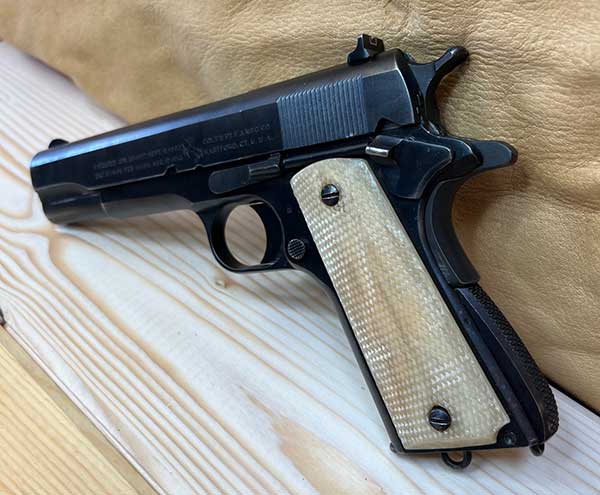
Every gun has a story, and the late Major Joseph W. Marshall’s Model 1911
has plenty. He carried this sidearm in WWII and Korea, while he worked
for the FBI and OSS. (Images provided by Jack Kellum.)
When Joseph W. Marshall, then 78, passed away in Seattle in May 1988, the headline on his obituary in the old Post-Intelligencer newspaper was a bland reference to his having been a teacher at Garfield High School.
Even in those days, a Seattle newspaper might downplay a life’s history full of adventure and service to his country. It took five paragraphs before the unknown author of that obit mentioned how the late Mr. Marshall had served in WWII, where he was “attached to the Chinese army as a colonel and was Chaing Kai-shek’s adjutant general, teaching administration to the Chinese army.” Somewhere in there, he also worked with the Office of Strategic Services (OSS), and learned to speak 13 different Chinese dialects.
But we’ll give the Post Intelligencer the benefit of doubt. Back when I was a weekly newspaper editor well back into the last century, I often tried to be brief in writing obits, so perhaps I shouldn’t be so harsh.
Marshall also had worked for the FBI and was a member of the National Guard coast artillery, stationed at Port Orchard, before shipping out to the war. In addition to all of that, Marshall was also “in the first flying cadet class at the U.S. Army’s Randolph Field School in Texas in 1932.” Additionally, he served during the Korean conflict, and the pistol went along for that ride, too.
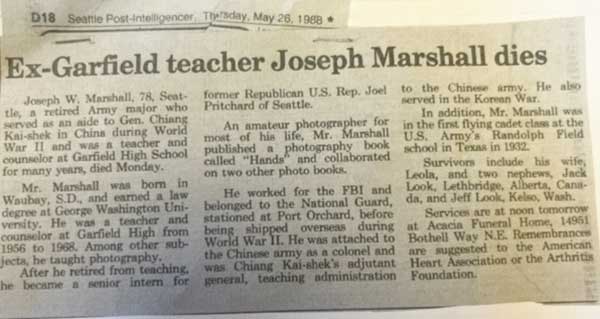
Joe Marshall’s 1988 obituary opened the book on a fascinating
life behind the man identified as an ex-teacher in Seattle.
He earned a law degree from George Washington University. After he left government service, he went into teaching and spent 12 years as a teacher and counselor at Seattle’s Garfield High, where he also taught photography. After he retired from teaching in 1968, he became a senior intern for then-Congressman Joel Pritchard, a Seattle Republican, and in February 1987, he was commissioned a “Washington General” by then-Gov. Booth Gardner, only 15 months before he passed away.
For a kid born in Waubay, South Dakota, a small town about two hours east of Aberdeen, that’s not a bad lifetime of work and accomplishments, maybe two lifetimes.
Enter Jack Kellum, now an Eastern Washington resident who was raised in Seattle and “grew up reading Elmer Keith.” Jack is also an American Handgunner reader. He had a bit more of a story to tell about Joe Marshall. And it involved a particular Model 1911 pistol, which accompanied him all over the place. Kellum has at least one image to prove it. Nowadays, he also has the pistol.
“Joe carried it here in Washington, then in China, the FBI and in Korea,” Kellum said in a telephone conversation.
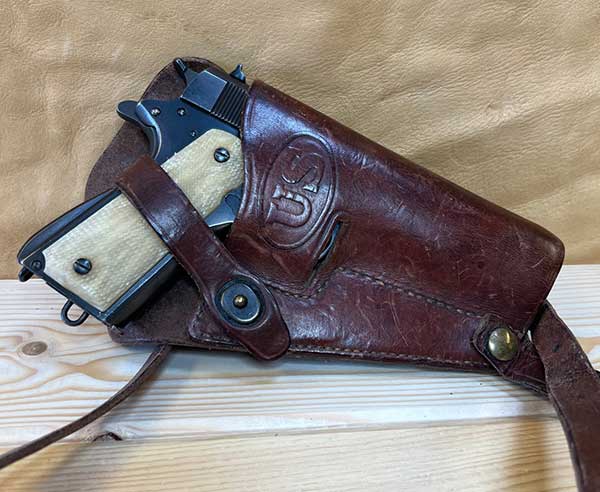
Here’s an image of how Joe’s Model 1911 looked in a tanker-style
shoulder holster when Jack Kellum, who grew up knowing this
fascinating man, and inherited his pistol.
Yes, Indeed
Let’s see if I can do this pistol, and the man who owned it, complete justice. I have doubts, but here goes. Joe’s pistol was marked “United States Property.” Serial No. 577129.
When he was stationed in Korea, then-Major Marshall corresponded with FBI Director J. Edgar Hoover, sending the original G-Man some photos and information about the troubles they were living through.

This somewhat faded snapshot of Joe Marshall was from Inchon,
South Korea in 1951. That’s his pistol in the tanker holster.
“The tragedy that these children are going through,” Hoover wrote in part, “is written on their faces and it makes one doubly conscious of the responsibilities which adults assume in declaring war.”
In one of the images Kellum provided for this report, one sees a younger Joe Marshall in uniform, wearing a tanker-style shoulder holster holding his Model 1911 pistol, by then fitted with fake pearl grips. The image was taken at Inchon in 1951
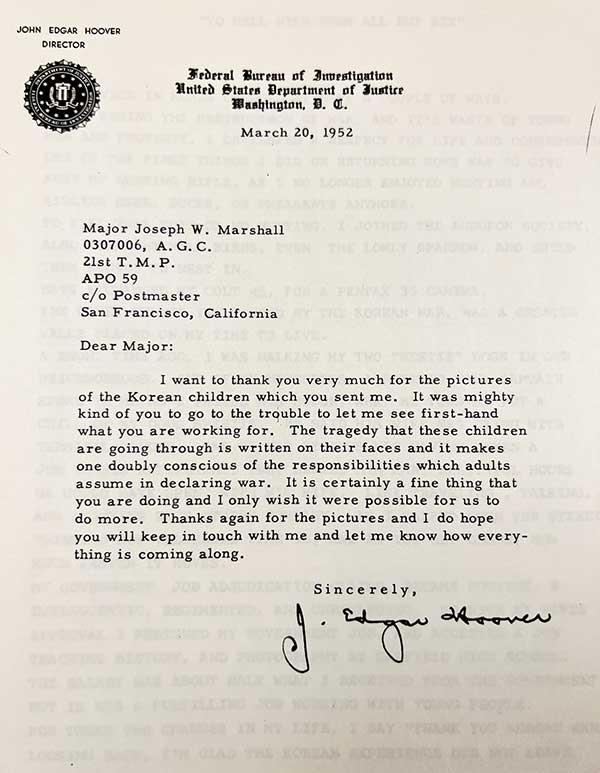
Letter from J. Edgar Hoover to Joe Marshall, regarding photographs the major sent the FBI director.
According to Kellum, Major Marshall “shot the pistol a lot” and wanted to carry it while with the FBI, but he “couldn’t see the sights well enough to qualify,” so at some point, he installed replacements from Kings with the white line around the square rear notch.
After he moved into teaching, Marshall continued his interest in photography. He published a photography book titled “Hands” and also collaborated on two other photography books, according to the Post Intelligencer obituary.
Kellum’s entry into Joe’s life came in 1942, when Jack’s family moved into the home next door. He was but 6 months old at the time, “and grew up as a next door neighbor.”
“Joe was always the guy next door who taught at Garfield,” Kellum told me in a text message. “He was always the pleasant teacher with a positive attitude about life. Never a bad word about anything or person.
“I never knew his background until after I went in the service,” Jack recalled. “I was probably in my early 30s before I slowly learned of some of his past. He died a few months after my Dad.”

Joe’s pistol with a sheathed KaBar knife. You can barely see it, but the sheath is stamped “USMC.”
“My mom helped his wife go through and sort stuff,” Kellum’s narrative continued. “A month or so later, she was coming to visit and brought a large paper grocery bag full of many of Joe’s special items wrapped tight and stapled shut with my name on it, left for me by Joe. At the very bottom was the holstered 1911 in his tanker holster, as seen in the one picture.”
He was survived by his wife, Leola, and two nephews, one living in Alberta and the other living in Kelso, in southern Washington along the lower Columbia River.
It Traveled Some
When Jack’s work took him to Colorado for a while, the pistol went along, and it came back to Washington State with him when the job “went away.”
This may have been the final long trip for a sidearm that had served one man well for decades.
About two months ago, the now-71-year-old Jack Kellum reached out to American Handgunner in an effort to contact either myself, Will Dabbs or Jeff “Tank” Hoover, and apparently I got to him first. Initially, it was his intent to sell this historic sidearm, but in a recent text message, Jack admitted, “Every time I play with it, I just re-embrace it. It’s really a neat piece and screams of its past. If only it could talk. Over the hump in China, FBI service and Korea. It’s got some stories to tell.”
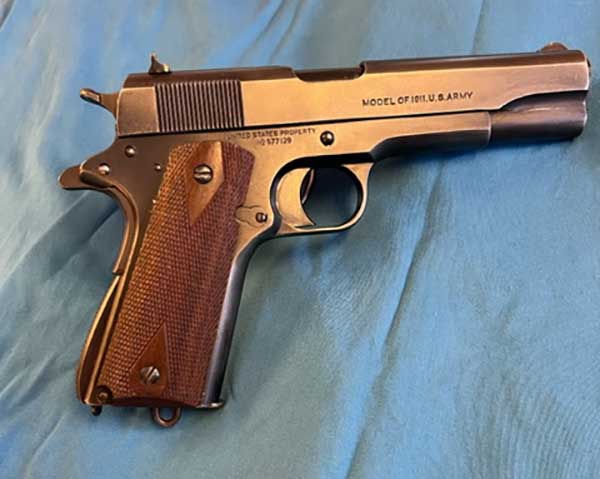
Joe Marshall’s .45 now wears a set of walnut grips, unless it is posing
for photos. Jack Kellum sent far more images than I needed. I appreciate his help.
I hope this article has helped Joe’s pistol tell some of those stories, or at least hint at some of the adventures man and gun shared over the course of a lifetime that might have left high school students awestruck. Like so many kids that age, we never realize that teachers were something else before they entered the classroom. It was certainly that way with Joe Marshall.
I remember some of the teachers I had in junior and senior high school. One man became a hero when he swam out into the ocean on the Washington Coast to save the life of a swimmer in trouble. Another guy had served in WWII, somewhere in Europe, and only mentioned one time about the aftermath of a battle he was in.
Guys like Joseph Marshall certainly leave an impact on the students they meet in class, and they also leave a much wider mark on other lives they touched. When all that remains are images and a keepsake pistol, it reminds all of us we should take stock of the lives we’ve touched, and those who have touched our lives. Somewhere in there are more stories to tell.



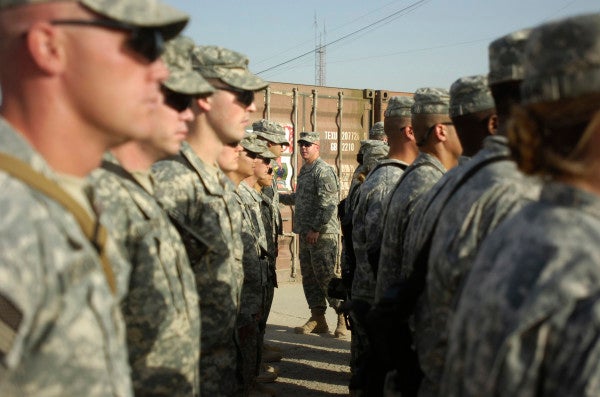
The job of first sergeant, or “top sergeant” as it was once called, is perhaps one of the most rewarding positions for enlisted personnel in the Army. The first sergeant is the arbiter for all enlisted-soldier matters within the company. He or she is the senior noncommissioned officer of the company, with considerable influence over the unit’s culture.
While this is very rewarding, it also means that the first sergeant has to deal with all disciplinary issues within the company. As such, first sergeants have to listen to some of the most outrageous lies ever to come out of the mouths of the junior enlisted. From my own experience and in talking with first sergeants, here are some the “greatest hits” of lies told to the first sergeant.
1. “No, I didn’t smoke the weed, I was just in the room when some people happened to be walking by smoking it.” Sure, the poor soldier somehow managed to get those people to walk by 20 times so that he could get that level of THC in his blood.
2. “My mustache is outside the regulations as prescribed by Army Regulation 670-1? I didn’t know there was a regulation for mustaches.” That soldier probably also doesn’t know there’s a regulation that stipulates the amount of Axe body spray he is using now classifies him as a chemical weapon.
3. “Her? In my room during health and welfare? I don’t know where she came from.” Nor does this soldier know why he has a package of condoms in his hand.
4. “The doc says I am pregnant? But that can’t be, I’m a virgin!” Our battalion physician literally witnessed this conversation.
5. “Um, I’m not wearing my eye protection because my dog ate them.” Troops are great at losing things. Not so great at the explanations under pressure.
6. “So you see, first sergeant, I got a DUI because the cop doesn’t like troops.” Bad answer, because Top’s dad was probably a cop.
7. “First sergeant, I was late to formation because of ice in the road. Yes, I know it’s July.” The mouth moves faster than the brain, in some cases.
8. “The commander is gone, so I’m in charge.” The executive officer is so cute to think that.
9. “No first sergeant, I wasn’t sleeping, I was meditating.” See also under, “I wasn’t sleeping, I was pulling security.”
10. “Yes, we are all sober.” Usually stated during morning physical training. The results of a good three-mile run are enough to show the lie.
“I consider it to be the duty of anyone who sees a flaw in the plan not to hesitate to say so. I have no sympathy with anyone who will not brook criticism. We are here to get the best possible results & you must make a really cooperative effort.” Eisenhower before D-Day.