Categories
Month: July 2023
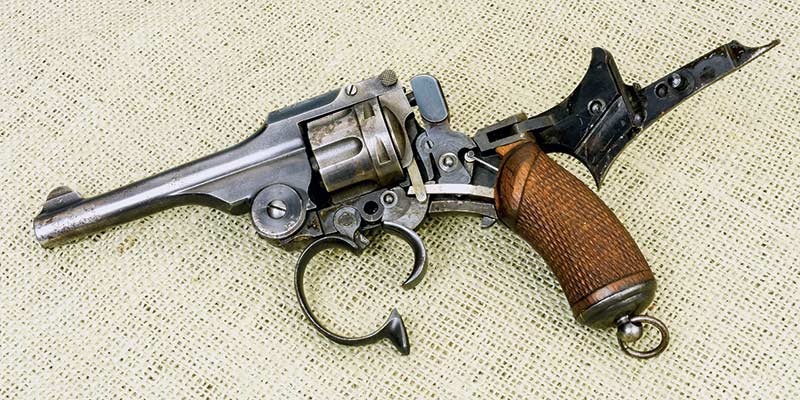
The sideplates of Type 26 revolvers are hinged, revealing their innards.
Great for cleaning, but perhaps an attraction for tinkerers.
Anyone who has studied the history of military handguns must wonder how some ordnance officers formed their concepts of ideal handguns. For instance, consider the Russian Model 1895 Nagant revolver with its odd 7.62mm cartridge wherein the bullet is seated fully inside the cartridge case. That was because when the hammer is cocked, its cylinder is pushed forward over the butt end of its barrel. The idea with such a system is gas cannot leak upon firing. Never mind the gas leakage between barrel/cylinder gap has been of no importance with successful revolver designs for a half century!
American ordnance officers were not exempt from mistakes. In 1892, they chose to drop .45 Colt as the U.S. Army’s handgun cartridge in favor of .38 Colt (aka .38 Long Colt). It was a piddling little round pushing a 150-grain bullet at only about 750 fps. Its lack of power resulted in it being replaced by .45s again in only a few years. The abovementioned 7.62mm Nagant used a 108-grain bullet at a mere 900 fps.

Duke’s Japanese Type 26 9mm (rimmed) revolver with its clamshell style holster.
The Worst Ever?
But personally, I think the biggest joke among military handguns is Japan’s 9mm Type 26 revolver introduced in 1893. Don’t let the 9mm moniker fool you as it has nothing to do with the famous rimless 9mm Parabellum (9mm Luger) that pushes 115/124-grain bullets in the 1,200/1,300 fps range. Nope. The 9mm Japanese revolver cartridge is rimmed and fired a 149-grain bullet at approximately 750 fps. (Did the Japanese ordnance officers copy American’s .38 Long Colt?)
A weak chambering isn’t enough to consign a military cartridge into the silly category. After all, three decades later, the Brits thought a 200-grain .38 at 650 fps was sufficient for combat. It’s just that the Type 96 incorporated several other poorly thought-out features. One is it fires in double-action mode only (otherwise known as self-cocking). Again, a few decades later, the Brits followed with a variation of their little Enfield Mk. 2 No. 1 .38s. They removed the hammer spur, so only double-action shooting was feasible. Supposedly, this was done for tank crewmen because hammer spurs entangled on things inside a crowded turret.
A worse idea with Japan’s Type 26s is that locking bolts only hold chambers aligned with barrels when triggers are pulled. Otherwise, the cylinder is free to rotate. This feature might have back-fired on “Dirty Harry” when he asked, “Did I fire five or six?” With the Type 26, who would bet their life the next round coming up in a free-wheeling cylinder was live? Any sort of strenuous activity might have rotated it.
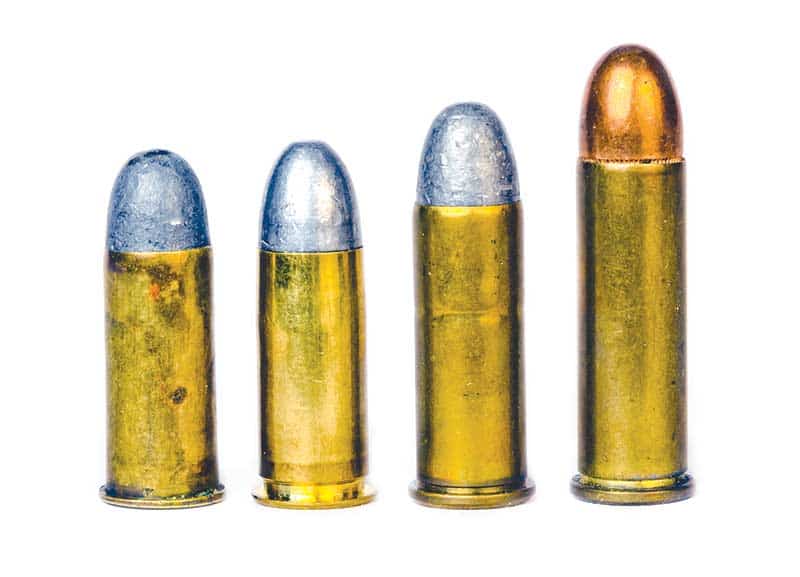
Bottom: From left: original Japanese 9mm rimmed cartridge, Duke’s handload
with Buffalo Arms brass and Oregon Trail 147-grain bullets, U.S. .38 Long Colt
military round, and a U.S. .38 Special military round. Note the FMJ bullet.
Model #3 Inspiration Gone Bad
Type 26s are of top break design, obviously leaning on S&W’s Model #3s from the late 1800s. Lifting the barrel hinge allows it to pivot downwards, which then cams its extractor up simultaneously emptying all six chambers. (Japan had purchased thousands of S&W Model #3s for the .44 Russian cartridge. I recently read of a U.S. Marine on Iwo Jima finding six pristine condition S&W .44s in a cave while the battle was still raging.) Type 26s had 4.7″ barrels and weighed 2 lbs. Sights were a simple groove in top strap for rear and a half moon front. One good feature is the front sight blade is pinned to a stud machined integral with the barrel. Therefore, front sight blades can be changed to help zeroing for elevation. Grips are checkered wood, round in shape and obviously meant for smaller hands than my big American mitts.
Pulling down on Type 26 trigger guards frees side plates so they swing away, revealing the revolver’s inner workings. That would be great for cleaning, but I’m sure Japanese soldiers were instructed not to mess with their revolvers’ innards without supervision. For Americans, with their penchant for figuring out how things work, such instructions would have been considered suggestions or challenges. By World War II, Type 26s were obsolete and mostly were issued to NCOs.
My Type 26 showed up at a Montana gun show, complete with its clamshell holster and carrying strap. It has a minor amount of pitting on it indicating it saw service but still its excellent manufacturing quality is evident. It’s not a hunk of junk; just poorly thought out. Cases can be made from .38 Specials, but I just bought mine from Buffalo Arms of Idaho. My handloads consist of 2.0 grains of Hodgdon’s Titegroup under 147-grain Oregon Trail 0.356″ bullets. Assembling the rounds can be done with .38 Super or .38 Long Colt dies. I have shot it enough to know I cannot hit much with it past about 50 feet.
It’s my pick for the all-time worst military handgun.
Categories
The Death Of The Marine Corps
THE WAR IN 2039
>GySgt Knight is an Infantry Unit Leader (0369) currently serving as an Operations Chief. He has served as every billet from Rifleman through Platoon Sergeant in support of Operations IRAQI FREEDOM and ENDURING FREEDOM. He has also served as Heavy Machinegun Platoon Sergeant, Scout Sniper Platoon Sergeant, and Weapons Company Operations Chief in support of Unit Deployment Program Okinawa.
The Marine Corps was rendered combat ineffective during the opening weeks of the U.S.-China War in December of 2039. First, Second, and Third MarDivs were systematically engaged by the Chinese People’s Liberation Army (PLA) navy, air, and ground forces, which resulted in the reduction of these divisions by a combined 75 percent. China had used a specific and effective strategy to cripple the U.S. military. This process was the development of a worldwide trade route controlled by them, ceasing all trade with the United States and forcing military funding cuts.
In 2013, Chinese President Xi Jinping proposed the development of the Belt and Road Initiative. Seventy-one countries pledged to join in the endeavor.1 China quickly began making deals with these countries to build rail lines, improve roads, and build seaports in strategic locations. They would loan the money to the host country to build each project with only one stipulation, Chinese contracted companies would be hired to assist in the construction. China knew these countries would not be able to repay the accrued debts which allowed China to employ debt-trap diplomacy to gain strategic advantages in some of these areas.
2 By 2017, the countries along the Belt received 35 percent of global foreign direct investments and accounted for 40 percent of global merchandise exports.
3 This had all been part of China’s bigger concept of Tian Xia or world domination.
4 The ground and maritime trade routes expanded their reach throughout the entire globe. This opened the trade routes and allowed China to influence a dominating portion of the trade deals made in the world. China began slowly arranging for resources to be acquisitioned from the countries along the Belt to reduce the number of materials they would need from U.S. suppliers.
During a press release in 2036, President Xi Jinping announced China would no longer receive any imports from the United States effectively gouging the U.S. gross domestic product (GDP) by fourteen percent. China again used debt-trap diplomacy to convince many of its partner countries to do the same.
In total, the U.S. GDP was reduced by 24 percent over the next two years. This drastically affected the markets in the United States and caused an unexpected recession for which the American people were not prepared. Many companies that relied on exports went bankrupt and millions of Americans were laid off.
The unemployment rate rose to eleven percent and the government was forced to start cutting its spending. By 2038, the defense budget was reduced by fifteen percent forcing the different branches to begin tightening their belts.
Due to these budget cuts much of the equipment the military used, including ships, could not be maintained. The Joint Chiefs of Staff decided to reduce the number of personnel in each of the branches to free up some funds to maintain its gear.
The Marine Corps was reduced to 165,000. This forced the Marine Corps to disband all three battalions of the Fourth Marine Regiment and both battalions of the Eighth Marine Regiment as well as numerous support battalions. The Navy was also required to put 30 ships in long-term storage.
The Third and Seventh Fleets took the brunt of the reduction as their ships had seen more use and required the most maintenance. This left a crucial gap in the maritime defenses in the Pacific, which Chinese military leaders exploited when they attacked the West Coast of the United States.
On 7 December 2039, U.S. Navy ships from the Third and Seventh Fleets came under fire from Chinese DF21D anti-ship ballistic missiles. These missiles were simultaneously launched from PLA Navy ships, cargo ships, and ground bases. The missiles were controlled by the Yaogan family of defense satellites they had launched between 2009 and 2012.
The PLA Navy was able to target U.S. ships by monitoring their electronic emissions from the 8G personal electronic devices used by sailors aboard the ships. This attack successfully rendered both fleets’ combat ineffective.
The PLA Navy then moved eight group armies (approximately 650,000 troops) from the PLA Ground Force to the West Coast of the United States unimpeded by utilizing ships that had been pre-staged and trade routes they had already established. Simultaneous with the attack on the U.S. Navy, the PLA Air Force conducted a massive aerial bombardment of Marine Corps Base Hawaii and Camp Butler Okinawa Japan.
This raid was conducted by Xian H-6 long-range bombers launched from the Chinese Xi Jinping Air Station on the man-made Mischief Reef Island in the South China Sea. The raid effectively targeted the infrastructure and equipment of 3rd MarDiv resulting in a reduction of 90 percent.
The PLA Ground Force invasion was contested by the 1st MarDiv as well as the U.S. Army’s 40th Infantry Division and the California National Guard. This joint task force, named Task Force Bear, was able to hold the PLA Ground Force in California until they could be reinforced by the 2nd MarDiv and the rest of the U.S. Army but not before being reduced by 85 percent. The 2nd MarDiv took 50 percent casualties during the intense fighting that followed. The loss of two of the three divisions was a fatal blow to the Marine Corps as a fighting force.
In the aftermath of the bloody U.S.-China war, Congress established a policy to prevent the country from becoming reliant on exports for such a large percentage of the GDP. This would prevent an adversary country from being able to reduce our GDP and defense budget just by monopolizing trade.
When it came to the Marine Corps, Congress was also left with a choice. Re-constitute the divisions or amend Title X thereby dissolving and abolishing the Marine Corps. Ultimately, they chose the latter. On 10 November 2040, the Marine Corps Colors were retired for the final time. The remaining personnel and equipment were absorbed into the other branches.
Notes
1. Lily Kuo and Niko Kommenda, “What Is China’s Belt and Road Initiative?” The Guardian, July 30, 2018, https://www.theguardian.com/cities/ng-interactive/2018/jul/30/what-china-belt-road-initiative-silk-road-explainer.
2. Ibid.
3. Caroline Freund and Michele Ruta, “Belt and Road Initiative,” The World Bank, March 29, 2018. https://www.worldbank.org/en/topic/regional-integration/brief/belt-and-road-initiative.
4. Howard W. French, Everything Under the Heavens: How the Past Helps Shape Chinas Push for Global Power (New York: Vintage Books, 2018).
-
The ATF revoked the Federal Firearms Licenses (FFLs) of Morehouse Enterprises, a gun shop that after they sued the federal government over the now-defunct frames & receiver rule.
-
The ATF cited 5 violations, including 2 paperwork errors & 2 more severe violations related to firearm transfers & background checks.
-
Gun Owners of America (GOA) & Morehouse Enterprises claim that the ATF’s actions are arbitrary, vindictive, & a violation of due process & 1st Amendment rights.

VALLEY CITY, North Dakota — The Bureau of Alcohol, Tobacco, Firearms and Explosives (ATF) has revoked both Federal Firearms Licenses (FFLs) belonging to a gun shop that sued the federal government over the now-dead frames and receiver rule.
Morehouse Enterprises in North Dakota teamed up with Gun Owners of America (GOA) to fight the ATF’s attempt to regulate unfinished frames and receivers through bureaucratic Fiat. The ATF created a rule in response to a White House order to ban 80% firearms that President Joe Biden calls “ghost guns.” This lawsuit was the first case in the country to challenge the now-vacated rule.
Shortly after Morehouse Enterprises filed suit, the ATF launched an inspection of the gun shop. This ATF visit was the first inspection that the store ever received from the ATF. The Industry Operations Inspector (IOI), Jacob Temp, jokingly told the store owner that the ATF discussed whether the inspection would look like retaliation for the court case. The IOI said that the ATF originally would delay any inspection for at least three years, pending litigation, but the Bureau decided to inspect the store anyways.
IOI Temp said that the store did well on their overall level of compliance and expressed approval for the job the shop has done to ensure they followed ATF regulations. Every single firearm was accounted for. All 2700 guns that the store acquired were documented. So were the 2400 dispositions of firearms. The shop felt good about the inspection, but that was all about to change.
Then on March 6, 2023, the ATF issued a “Report of Violations.” The ATF found five policy violations, three of which or simple paperwork errors. The first violation was the store forgetting to record the return of a firearm to a customer that brought the gun in for gunsmithing. The second violation was the store accidentally writing a customer’s Social Security number in the NICS transaction number (NTN) box. A third clerical error was a number left off a NICS transaction number.
The store had two other more serious violations. The store had transferred a handgun to a Georgia resident. FFLs are not allowed to transfer handguns to residents of another state due to the differing gun laws surrounding handguns. In this case, Georgia law is not stricter than North Dakota law.
A second violation was allowing the customer to use a Georgia concealed carry permit in place of a NICS background check. The Brady law allows exceptions to background checks. One of these exceptions is if a state’s concealed carry permit meets or exceeds the same scrutiny as a NICS check. Georgia’s concealed carry permit does that, but it can only be used in lieu of a NICS check in the state of issue.
On May 23, 2023, the ATF informed Morehouse Enterprises of its intent to revoke both of the company’s FFLs, even though the second FFL did not have any violations. President Biden has pressured the ATF to shut down FFLs through his zero-tolerance policies.
FFL revocations are up 500% since Biden took office, but even under Biden’s zero-tolerance policy, the store’s violations do not rise to the level for revocation. Under the president’s policy, the violations only merit a “Warning Conference.”
GOA has once again teamed up with Morehouse Enterprises to defend the company against the ATF’s actions. The gun rights group claims the Bureau’s actions are “Arbitrary, Capricious, an Abuse of Discretion, and Not in Accordance with Law.” The plaintiffs also claim that the ATF is violating the right to bear arms by restricting the acquisition of guns.
The plaintiffs also claim that the ATF is acting in a vindictive manner. They claim that Morehouse’s due process rights have been violated via retaliatory prosecution. They also claim that Morehouse’s First Amendment rights have been violated because the ATF is interfering with the plaintiff’s right to sue the government.
Whether or not the ATF move was retaliatory because of the guns store’s lawsuit is up for debate and will be settled in a court of law, but the optics are not good for the ATF.
Trying to shut down the business of a company suing you looks retaliatory and vindictive regardless of the reason.
About John Crump
John is a NRA instructor and a constitutional activist. John has written about firearms, interviewed people of all walks of life, and on the Constitution. John lives in Northern Virginia with his wife and sons and can be followed on Twitter at @crumpyss, or at www.crumpy.com.
Categories
Gun?, What gun? NSFW


Russell Fincher is a high school history teacher, a Baptist pastor, and a part-time gun dealer. He also coaches Little League in his hometown of Tuskahoma, Oklahoma, which has a population of around 151 souls.
Fincher, 52, has had a Federal Firearm License for three years. He has no brick-and-mortar gun shop. He’s what used to be called a “kitchen table FFL.” He sells most firearms at gun shows, including Wanenmacher’s Arms Show in Tulsa.
“Living in Southeast Oklahoma, if you don’t have a gun under $400, people ain’t buying it,” he said Thursday. “Rarely do people come to my house to buy a gun.”
In April, Fincher received a call from the Bureau of Alcohol, Tobacco, Firearms and Explosives. They wanted to do an inspection at his home.
“I told them they were welcome anytime,” Fincher said.
Two ATF inspectors arrived a few days later. They spent three hours in his home. They took pictures of his 4473s with their cell phones, which Fincher has since learned is an illegal, although common practice.
“Honestly, they were way nicer than I expected,” he said. “They said I had some guns that had traces on them, which concerned them. It concerned me too.”
The inspectors returned two weeks later. They had some “concerns” involving Fincher’s penmanship, which they couldn’t read on several forms. They also found he had juxtaposed the model number of a firearm with the weapon’s serial number, which Fincher was attempting to rectify.
On June 16th, 2023, Fincher and his son were packing for a gun show in Tulsa when the phone rang. It was the ATF. They said they wanted to talk to him before he left for the gun show.
“We can come out to your house,” he recalls the agent saying. “I told them sure; I’d be home.”
That is when seven vehicles roared up to his home and disgorged a dozen ATF agents wearing tactical gear, armed with AR-15s.
“It was like the Trump raid. They called me out onto my deck and handcuffed me. My son was there and saw the whole thing. He’s 13 years old,” Fincher said. “They held me on the porch for about an hour. I was surrounded by agents. One by one, they yelled at me about what I was doing. In my mind I decided if they were going to beat me up over every little thing, I’m done. As soon as I said, ‘If you want my FFL, you can have it,’ one of the agents pulled out a piece of paper and said, ‘Well then sign here.’ He had made three copies in case I screwed one up. It was exactly what they wanted. I was shocked.”
As soon as Fincher relinquished his Federal Firearm License, the ATF began loading up his guns, including a Colt Commander, five Glocks, and a mint AK – a Polytech Pre-ban milled under-folder, which is worth thousands of dollars.
“They took more than 50 of my personal guns,” Fincher said. “I asked them why, and they said they were ‘evidence.’ I’d estimate they took $50,000 to $60,000 worth of guns.”


ATF Threats
After ATF’s SWAT team cleared Fincher’s home, they called the agent in charge of the raid – Special Agent Theodore Mongell – and told him it was “safe to come up.”
“You’re done. We have to shut you down,” Fincher recalls Mongell saying. “You tell all your FFL buddies we are coming for them. We are shutting the gun shows down.”
“One agent told me they hate home FFLs,” Fincher said. “He said if I wanted to sell a Browning shotgun to someone at a gun show with no paperwork, that’s no problem, but when I sell a Glock or an AR lower that’s a ‘gangbanger.’ I asked him where it said that in the regs. He said no gangbanger would be shooting people with a $2,000 Benelli. To me, that was one of the dumbest statements he could have made.”
Several agents accused Fincher of making too much money through his gun show sales. He told them at the last show he attended, he only sold $75 worth of ammunition, but spent $1,200 on hotels, tables, gas, and food.
“They said I was basically using my FFL to sell guns personally,” Fincher said. “They said I was going around the system, putting guns on the street that should not be.”
Fincher was told to load the firearms ATF didn’t want into the back of his pickup, which he later took to another FFL. Toward the end of the ordeal, Fincher asked Mongell about his guns they had seized.
“He told me, ‘If you’re willing to forfeit them, we can make a lot of this go away,’” Fincher said. “This sounds to me like a shakedown. They seized my guns as punitive damage. They knew how to get me, by taking all my guns. There was no rhyme nor reason to what they took. Honestly, they took the most expensive and rarest ones.”
ATF Response
The Second Amendment Foundation’s Investigative Journalism Project contacted ATF Special Agent Theodore Mongell on his cellphone Thursday afternoon and asked him why he raided Fincher’s home and seized his guns.
“I can’t answer any questions,” he said. “I’m not supposed to do that, per my agency. Actually, I’m not supposed to talk to anyone until I get approval from my higher ups. I have to verify who you are, take down your info and go through my agency.”
Despite his promises, Mongell never called back.
Takeaways
There does not appear to be any justification for a SWAT team raid or such a massive show of force. After all, Fincher invited the ATF into his home.
After berating him for more than an hour, the agents never even told Fincher if or when he would be charged with a crime. He fears he would lose his teaching job if he’s charged with a felony.
“They have my life in the palm of their hands, and they have very little accountability,” he said. “I’m just trying to make a living and it takes three jobs just to make ends meet. Dealing as little as I have with the ATF, when you ask them a specific question, they’ll tell you it’s a grey area. Well, a grey area can send you to jail. I’m not Hunter Biden. I’m not going to get my weapon charges dropped.”
About Lee Williams
Lee Williams, who is also known as “The Gun Writer,” is the chief editor of the Second Amendment Foundation’s Investigative Journalism Project. Until recently, he was also an editor for a daily newspaper in Florida. Before becoming an editor, Lee was an investigative reporter at newspapers in three states and a U.S. Territory. Before becoming a journalist, he worked as a police officer. Before becoming a cop, Lee served in the Army. He’s earned more than a dozen national journalism awards as a reporter, and three medals of valor as a cop. Lee is an avid tactical shooter.

Categories