Month: July 2023
Categories
6 Cartridges Better than 6.5 Creedmoor
SAN JOSE, Calif. (KGO) — The City of San Jose is calling it a victory in the fight against gun violence a judge upholding the city’s Gun Harm Reduction Ordinance.
In 2022, the city of San Jose passed the first-of-its-kind ordinance requiring gun owners to have liability insurance.
The challenges against it began immediately with the city facing a lawsuit from groups like the National Association for Gun Rights.
Late last week a court dismissed the Second Amendment claims.
In effect since the start of 2023, gun owners have to have liability insurance and pay a fee of $25.
That fee would go to a nonprofit with the money to be used for firearm safety training, suicide prevention and more.
From the time the ordinance was announced it has faced backlash.
In January 2022, Harmeet K. Dhillon who represented the National Association for Gun Rights spoke at a press conference held to announce the lawsuit:
“It’s going to be the law-abiding citizens who actually deter crime by having weapons in their homes who are going to be the ones who bear the burden of this unconstitutional ordinance,” Dhillon said last year.
Along with the National Association for Gun Rights, plaintiffs also included the Howard Jarvis Taxpayers Association.
Attorney Tamarah Prevost, a partner with Bay Area firm Cotchett, Pitre and McCarthy, took on the city’s case pro bono.
“We felt very confident that the ordinance was constitutional,” Prevost said. “The city did a lot of work on the front end to really craft something that it believed would be upheld, because the city is not taking guns away from people. It isn’t banning certain guns.”
The case was being fought as the U.S. Supreme Court came down with the Bruen Decision, one of the most significant cases regarding the Second Amendment.
The decision changed Second Amendment analysis in the courts and in turn, impacted the fight over the San Jose ordinance.
“We had to change gears and the judge had to change gears and apply a different legal standard that came down from the U.S. Supreme Court,” Prevost said. “The ordinance had to be evaluated based on historic precedent, what the framers in the 1800s would have thought of at the time, and whether an ordinance has historic roots as it were.”
With the change, Brady, a nonprofit that pushes for gun safety, was looked to by the court to weigh in.
The federal judge ruled Thursday that the insurance requirement for gun owners does not restrict gun firearm possession or use.
In a statement sent to ABC7 the National Gun Rights Association for Gun Rights said:
“This ruling is what happens when judges rely more on anti-gun groups like Brady than the actual ruling authorities here – namely the U.S. Constitution and the U.S. Supreme Court. This ruling makes a mockery of the Supreme Court’s Bruen standard with the claim that requiring an annual tax just to exercise a Second Amendment right somehow doesn’t actually violate that right.”
The statement goes on to say:
“No one would argue that having to pay $25 a year to petition your government or speak your mind wouldn’t violate those rights – and yet that is exactly what this court has claimed when it comes to the right to keep and bear arms. This is a truly astounding example of bad-faith judicial acrobatics.”
The $25 fee that was also part of the ordinance still hasn’t been completely worked out by the city. As a result, the court said the fee is not ready for judicial review yet allowing the plaintiffs time to file an amended complaint.
The Howard Jarvis Taxpayers Association’s, chief counsel Timothy A. Bittle sent ABC7 this statement:
“The ruling last week by the federal District Court on the City’s latest motion to dismiss our Consolidated Amended Complaint in the San Jose gun fee case is nothing new. This is the third time the City has moved for dismissal and the third time its motion has been granted, but with leave for plaintiffs to file an amended complaint.
This revolving door of amended complaints and motions to dismiss is due to the City’s long delay in implementing the gun fee ordinance. The ordinance requires gun owners to annually pay a fee of an unspecified amount to a nonprofit organization that the City will designate. However, the City has yet to fix the final amount of the fee, set a date for payment of the fee to commence, or identify a nonprofit organization to collect the fee.
The City has argued in its motions to dismiss that, until these steps are taken, plaintiffs’ legal challenge is premature. The Court has repeatedly granted the City’s motion, setting a date by which the City is “expected” to take the necessary steps, followed by a specific deadline for plaintiffs to file an amended complaint. When the City fails to take the necessary steps by the expected date, plaintiffs ask the City to stipulate to an extension of time for the filing of their amended complaint. The City refuses. We file an amended complaint. The City files a motion to dismiss, and round and round we go.
Fortunately, in again granting us leave to amend this time, the Judge did not impose a date certain for us to file our amended complaint, but rather gave us an open-ended deadline of 14 days after the City reports that the necessary actions have been taken.”
While it’s still not entirely clear yet whether appeals or amended complaints will be made by the plaintiffs, Prevost says she and the City of San Jose are ready to continue fighting.
“We are going to fight for the constitutionality of this law until the very end,” she said. “It may go up to the U.S. Supreme Court, we’re prepared for that.”
13-year-old boy crashes stolen car into LAPD motorcycle officer, another vehicle, police say
A 13-year-old boy faces a charge of assault with a deadly weapon after he struck a motorcycle officer with a stolen car, then hit another car in the San Fernando Valley, according to the Los Angeles Police Department.
Around 3:30 p.m. Thursday, a motorcycle officer was flagged down about a reported stolen car, and when the officer found the allegedly stolen vehicle, it did not yield to a traffic stop, the LAPD said in a news release.
During “a short pursuit,” the allegedly stolen car hit the officer’s motorcycle, then “another uninvolved motorist,” the release said.
The boy driving the car and the passenger, a 15-year-old girl, were taken into custody, police sai.d
While the girl was released, the boy was booked into juvenile hall on a charge of assault with a deadly weapon. His identity is not being released due to his age.
The officer and third-party motorist have been hospitalized and released.
BOLINGBROOK, Ill. (WLS) — Police in Bolingbrook said two people are dead after a gun went off as its owner cleaned it Saturday evening.
Police said a preliminary investigation found 61-year-old Simeon Hendrickson was working on one of his guns inside his home in the 700-block of Dalton Lane Saturday around 5:45 p.m. when it accidentally discharged.
The bullet struck his wife, 60-year-old Laurie Hendrickson.
It was not clear if Hendrickson called 911, or if one of his neighbors heard the gunshot and called for help.
Hendrickson then took his own life with the handgun. He was pronounced dead at the scene.
Laurie Hendrickson was taken to a local hospital for treatment, where she later died.
Police said the incident remains under investigation. No further details have been released.

This is an early Colt SP1 AR15, similar to my first one bought
after year’s toil as a janitor in a print shop.
God designed us to work. Anything outside that paradigm is innately deleterious to the human psyche. I got a job about 10 minutes after I got my driver’s license and I’ve worked pretty much every day since.
Back in my day, you got your license at your fifteenth birthday. I wouldn’t trust today’s 15-year-old boys unsupervised with underarm deodorant, much less an automobile, but it was a different time. I actually took my first solo jaunt behind the wheel at 13-years-old, but that’s a story for a different time.
My very first job was arguably the coolest I have ever had. I was a janitor in a print shop and got to wear any raggedy clothes that might cover my gangly carcass. I learned to operate an offset press, run a Heidelberg windmill and clean the heck out of a toilet. I also came to appreciate that smoking can be very bad for you.
My partner in crime was a delightful soul named Maurice. Maurice was unimaginably cool, but he was also a heavy smoker. We maintained big drums of some kind of cleaning fluid used to clean the presses. It was kerosene, or nitroglycerine, or pure liquified plutonium or something. I, myself, was a bit afraid of the stuff. We dispensed it from those squirt bottles that restaurants use for ketchup.
This was the Mississippi Delta in summertime, so it was Africa-hot. The air was so thick you could tear off a chunk and gnaw on it. There was no air conditioning, so we kept the doors standing open. There was a fan, as I recall, but stirring around superheated air doesn’t help much, thermodynamically speaking.
Maurice hovered over a printing press fretting with something or other, the ubiquitous cigarette dangling from his lips. I was on the other side of the shop but glanced up just in time to appreciate the setting. As luck would have it, he was standing with his back to the open door.
Maurice squirted some of that vile elixir across the top of the press just as he took a quick inhale on his smoldering coffin nail. Gasoline is actually 15-times more energetic per unit gram that Trinitrotoluene (TNT). Though I don’t know exactly what this stuff was, it was something like that.
The explosion produced a palpable overpressure within the building. The force lifted Maurice up and propelled him backwards out through the open door. When I got to his side he was on his back and a bit singed, but otherwise unhurt, the cigarette still dangled from his lips. We even got the fire put out on the printing press without any lasting deleterious effects.

My experience working at that print shop taught me both the value of hard work and the dangers of smoking.
A Man On A Mission
I toiled away under such conditions as those for a full year, scraping and saving to buy my first black rifle. I bought that SP1 AR15 in 1982; my dad had to do the 4473 for me. It cost me $486, or the equivalent of $1,329 today — wow!
I stripped that rifle down to pins and springs and learned every nuance of its design. I bought ammo every time I could afford it — a box or two at a time — and shot it into the side of the old levee out near the Mississippi River. I didn’t own a set of ear plugs, so it’s a wonder I can hear at all today.
I once shot a squirrel with that thing but immediately wished I hadn’t. I am a strict adherent to the axiom that one should not kill anything one isn’t planning to eat, and afterwards this particular tree rat was no longer comestible. However, I did get to the point where I could run the weapon both quickly and well, skills that held me in good stead later when I was issued something similar.
Ruminations
I brought that rifle to school on occasion, most commonly to show off either to fellow students or faculty. As Satan had not yet invented school shootings, I even had my picture taken for the yearbook with it. Innocence once lost can never again be regained.
In a fit of insensate stupidity, I traded that rifle for a SIG SAUER P226 at a gun show. I have since replaced it with another made in 1966, the year of my birth, but it’s just not the same. That black rifle represented the fruits of an entire year’s toil replete with copious heat, sweat and filth. In retrospect, I think it was a steal.
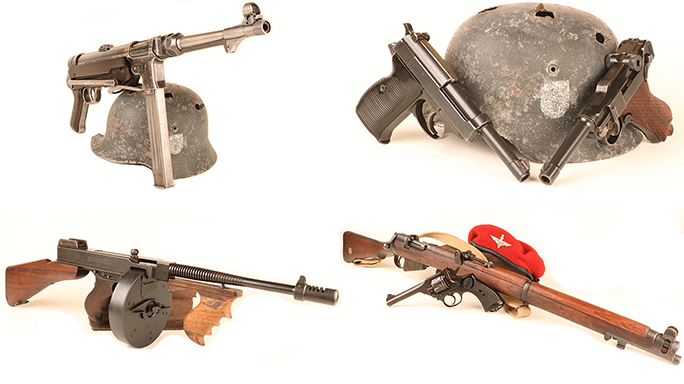
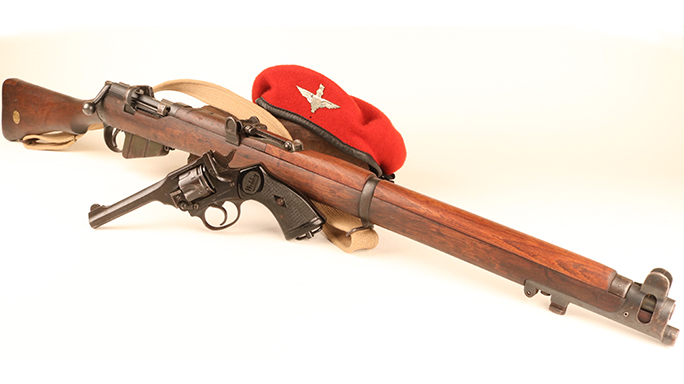
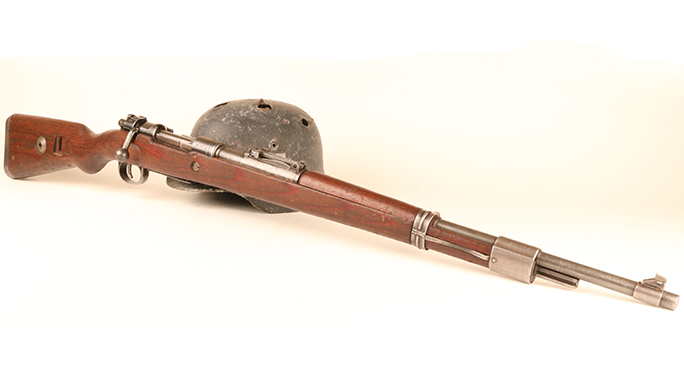
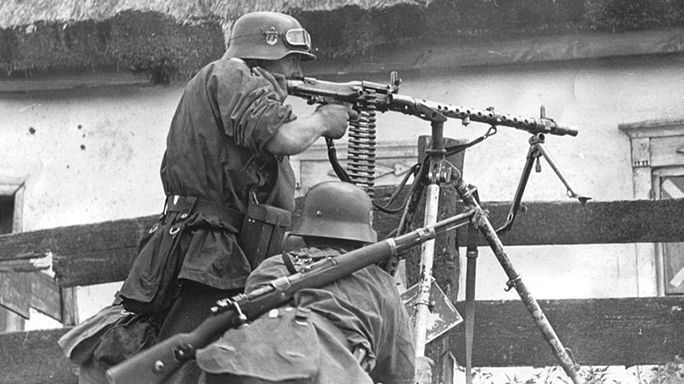
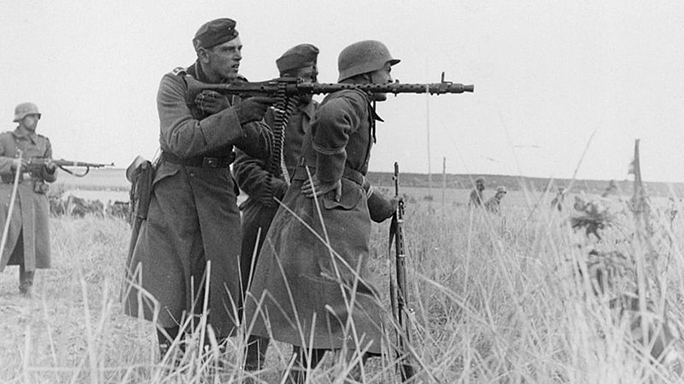
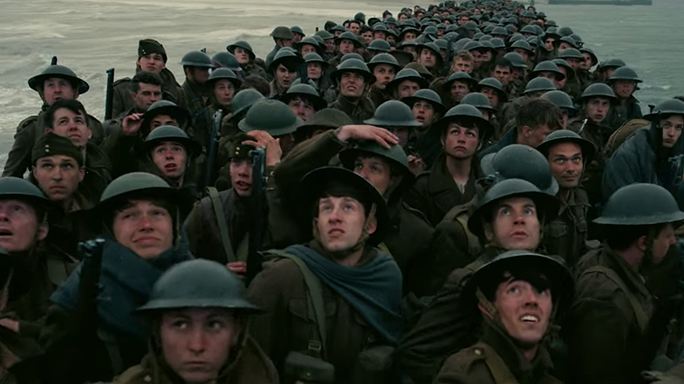

Over the course of 10 days in late May and early June of 1940, British military and civilian vessels evacuated 338,226 Allied troops from the beaches of Dunkirk in Western France. The Dunkirk operation has been described as the most effective military evacuation in human history.
Had the Dunkirk evacuation failed, the entirety of Europe might yet be paying taxes to Berlin, even today. More than any other singular moment in history, during this time the fate of Western civilization teetered precipitously. Success meant survival. Failure would have plunged the world into darkness.
RELATED VIDEO: First Full Trailer Released for Christopher Nolan’s World War II Film
Heinz Guderian’s Blitzkrieg or Lightning War was the precursor to the modern concept of combined arms warfare. This synergistic combination of tanks, infantry, artillery, and air power formed a coordinated mobile force that circumvented traditional battlefield obstacles to seize terrain by means of mobility, shock effect, and violence of action. As a result, the Germans overran most of Europe in just a few short weeks.
The infantry weapons each major combatant power used during this early phase of World War II reflected the relative importance that nation put on its military readiness. The British, thoroughly wearied after seeing hundreds of thousands of its troops ground up in the fetid trenches of World War I, were equipped primarily with the weapons they used during this earlier conflict. The Germans, by contrast, sent the Wehrmacht into battle with the finest infantry arms the state of the art could provide.
With the Christopher Nolan-directed film “Dunkirk” hitting theater screens this weekend, we’ve decided to examine the guns used in the evacuation.
Submachine Guns
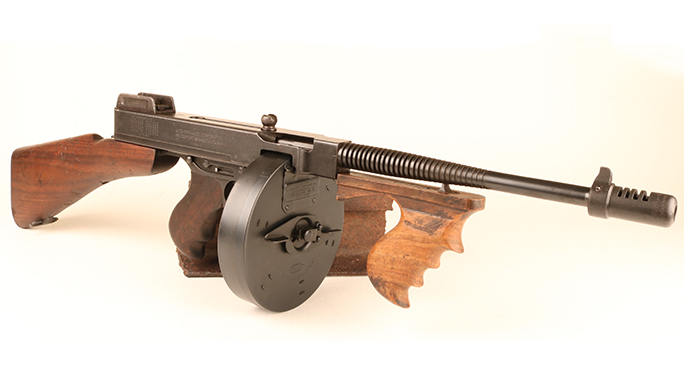
When the British entered World War II, they did not have an indigenous submachine gun. The Sten was still in development during the Dunkirk evacuation. Early on and desperate for weapons the British purchased as many 1928 Thompsons as the Maguire Company could produce. Russell Maguire acquired the struggling Auto-Ordnance Corporation just in time to take advantage of World War II and got rich as a result.
While the Thompson was technically obsolete by 1940, it was the only proven submachine gun available in quantity. The Thompson, while powerful and effective, was heavy, expensive, and difficult to build en masse.
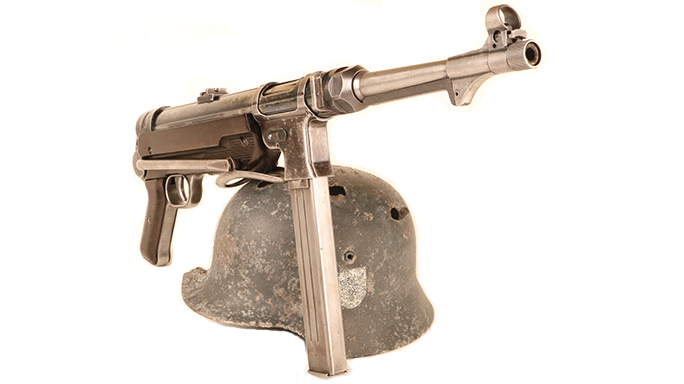
By contrast, the German MP40 was the world’s first truly modern submachine gun. Produced via industrial stamping and eschewing wooden stocks completely, the MP40 ushered in a new era of utilitarian industrial gunmaking.
The MP40 is front heavy but reliable and imminently controllable in action. Its folding steel stock renders the gun compact for transport. Generations of mass-produced Infantry weapons stemmed from the sorts of industrial processes initially perfected in the manufacturing of the MP40.
Handguns
The British employed a variety of handguns produced both at home and abroad throughout World War II. However, at the time of the Dunkirk evacuation Webley and Enfield revolvers predominated. Though relatively antiquated, these robust wheelguns were optimized for combat. Their break action design made for relatively fast reloading, while their double-action triggers offered rapid target engagement.
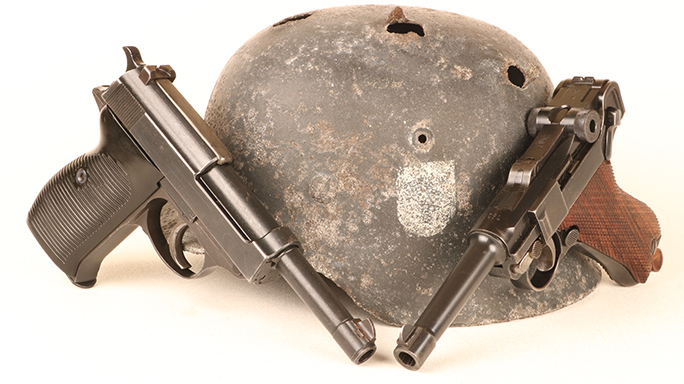
In 1940, the Nazis issued a mixed bag of P08 Luger and P38 handguns, as well as a variety of lesser models. The P08 was an antiquated World War I-era pistol that was meticulously executed, yet overly susceptible to battlefield grime as a result. The P08 exhibited the rakish grip-to-frame angle ultimately made popular in the modern Glock handgun.
The P38 was a thoroughly advanced design that introduced the world to the single action/double action autoloading pistol. Reliable, safe, and effective, the only real shortcomings of the P38 were its eight-round single column magazine and its heel-mounted magazine release. The P38 was adequate to soldier on in Austrian service until replaced by the Glock in 1982.
Rifles
The British entered the war armed predominantly with the Short-Magazine Lee-Enfield, also left over from the previous war. Feeding from a 10-round box magazine, the SMLE bolt-action rifle cocked on closing and subsequently offered an impressive rate of fire in trained hands. The rimmed .303 cartridge that the SMLE fired was dated yet offered long range and reliable function.
The German Karabiner 98k was itself an evolutionary development of the earlier Gewehr 98. Its 7.92x57mm rimless round was a generation advanced from the British .303 and offered comparable range. Adopted in 1935 and the last in a long line of Mauser bolt-action rifles, the Kar98k was relatively lightweight and portable compared to its forebears. By the standards of the day it was a state-of-the-art bolt action infantry rifle.
Machine Guns
The British Vickers belt-fed machine gun was based upon the same action that drove the MG08 Maxim gun the Germans used to such great effect in the trenches of World War I. Designed by American inventor Hiram Stevens Maxim, this basic action spilled blood by the vat on both sides of no-man’s land during the Great War.
The Vickers, a water-cooled design, offered unparalleled durability and massive volumes of sustainable fire at the expense of portability and excessive weight. The Vickers gun was fired from either a tripod or fixed mount.
The Lewis gun was designed by an American Army officer named Isaac Newton Lewis in 1911 and by 1940 was hopelessly obsolete. Fed from a top-mounted drum magazine carrying either 47 or 97 rounds and driven by an unusual clockwork spring, the Lewis gun is easily recognized by its large tubular barrel shroud. Though difficult to maintain in the filth of combat, the Lewis did offer a portability not previously available from heavier water-cooled belt-fed designs.
The BREN gun was arguably the finest light machine gun of the war. A license-produced copy of the Czech ZGB-33, the Bren chugged along at a sedate rate of fire of around 500 rpm. Firing from the open bolt and feeding from top-mounted 30-round box magazines, the BREN gave the dismounted infantry squad a portable base of automatic fire that could maneuver with dismounted ground forces.
Though heavy by today’s standards, the BREN was rugged and dependable. Individual British soldiers typically carried spare BREN magazines that could be consolidated with the BREN gunner as needed.
The German MG34 was a seminal firearm. As the world’s first GPMG (General Purpose Machine Gun), the MG34 could be fired off of its integral bipod and used by infantry units on the assault or from fixed mounts for longer range engagements. The MG34 also served as a standard vehicular-mounted machine gun, as well as an effective close range antiaircraft gun.
The MG34 was air cooled with a quick-change barrel that could be readily exchanged by the gunner. It fired from the open bolt via non-disintegrating linked belts of ammunition. Multiple belts could be hooked together as needed, though a small drum carried a standard 50-round belt on the gun when used in the dismounted role. The MG34 cycled quickly at around 900 rounds per minute, though that paled alongside the 1,200-rpm MG42 that eventually supplemented it.
The MG34 was a meticulously well-built weapon that was as a result expensive and a bit finicky in action. However, the MG34 was the first infantry machine gun to serve in multiple roles via a single versatile chassis. This same basic concept drives the GPMGs of every major military in the world today.
Dunkirk Ruminations
The British Expeditionary Force escaped the Dunkirk beaches largely intact but without most of their weapons. As a result, the British nation was desperate to re-equip its force quickly. This desperation led to the Sten submachine gun and simplified Lee-Enfield No. 4 Mk 1. The industrial might of the United States eventually intervened, tipping the scales with the Lend-Lease program. This massive undertaking put British troops into American Sherman tanks and jeeps for their push back across the channel into Europe and eventually to Germany itself.
The Nazis, for all their moral depravity, produced both superb engineers and soldiers. The engineering advances spawned by the Germans during World War II brought us the assault rifle, the GPMG, the modern combat submarine, and the jet-powered fighter plane. Their small arms at the time of the Dunkirk evacuation were, for the most part, a generation ahead of those of the Allies.
Dunkirk saved the British Army. The subsequent deterrent effect of the intact British Army along with the RAF’s victory over the Luftwaffe during the Battle of Britain combined to cancel Operation Sea Lion, the planned German amphibious invasion of England. This hard-won victory preserved Great Britain as the Unsinkable Aircraft Carrier from which Allied forces staged to retake the European continent from the Nazis four years later.
For 10 days in 1940 the fate of the planet turned on the grit and fortitude of British soldiers, sailors, airmen, and civilians. Under conditions of unimaginable deprivation, these Englishmen faced the full fury of the Nazis, snatching the remnants of the Allied forces back from the brink of annihilation. In so doing, these brave men, often wielding weapons built a generation before, literally saved the world.
Categories