Categories
Month: July 2023
Categories
Battle of Quebec 1759




I quess that I was wrong as usual on this subject! Grumpy
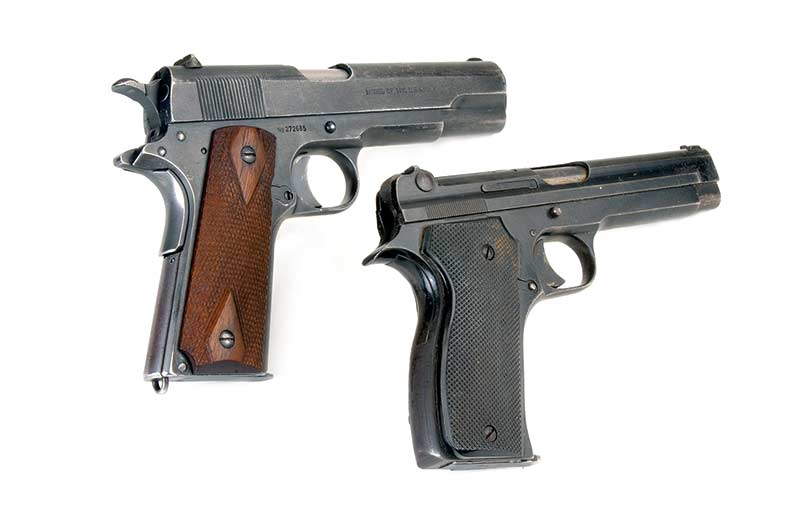
At right is a French Model 1935A. At left is a U.S. Model 1911.
There is much hoopla in the firearms press about the new .30 Super Carry and the handguns being built for it. I don’t own one of the pistols, have never seen one of the cartridges and doubt I ever will shoot a .30 Super Carry. This isn’t being ugly; it’s just the Way of the Dinosaur. (That’s me.)
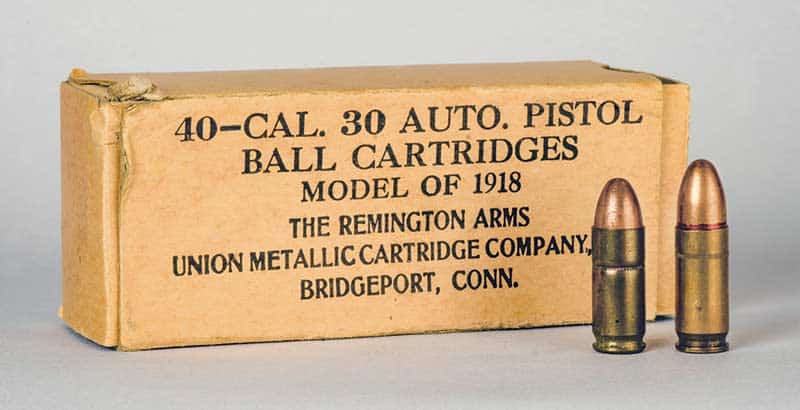
This is an original box of the U.S. .30 Auto Pistol Model of 1918 ammunition.
The cartridge at the left is a round from the box. At right is a round of French 7.65mm Long.
The Pedersen Device
But I can give you some interesting backstory. Let’s return to 1917/1918. The U.S. Army was embroiled in World War I’s trench warfare. Invading German trenches with five-round capacity Model 1903 Springfield rifles battle-zeroed for 547 yards and fighting at off-the-muzzle ranges just wasn’t an optimal situation. Especially considering the Germans had thousands of their 8″-barreled P08 “Artillery” 9mm Lugers with 32-round drum magazines with which to shoot back. Of course, the reverse was true when German Sturm Truppen landed in Doughboy trenches.
Therefore, a solution to the U.S Army’s dilemma was envisioned in 1917 by noted arms designer J.D. Pedersen. On his own, he developed a device that could be fitted to M1903 .30-06 Springfield rifles converting them from bolt action, five-round shooters to semi-auto, 40-round shooters. U.S. Army officials were wild about the idea.
However, the Pedersen Device necessitated a new cartridge. Mr. Pedersen had developed it too. It used a rimless case, 0.78″ long with a 0.308″, 80-grain bullet giving nominal velocity from an M1903’s 24″ barrel of 1,300 fps. The U.S. government christened it with the lengthy name of U.S .30 Auto Pistol Model of 1918. (The words “Auto Pistol” were used to fool German spies.)
The Pedersen Device fed those rounds from an awkward-looking magazine angled from the top right of special Mark I M1903s and ejected fired cartridges through a port on the action’s left side. Pedersen Devices and its “.30 Auto Pistol” ammunition made it to France but hostilities ended before them seeing action.
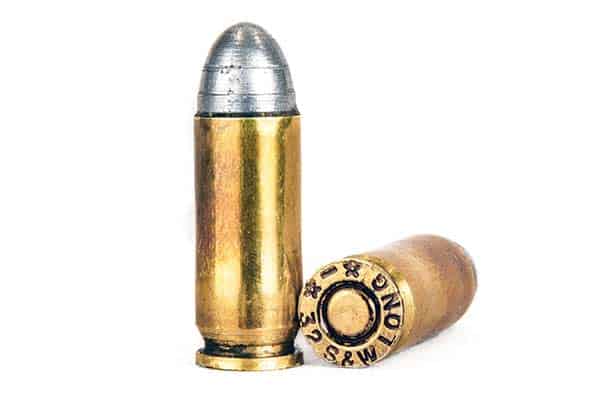
Duke’s favorite 7.65mm Long handload uses 81-grain cast bullets from
Lyman mold #313249 in newly manufactured Starline brass.
The French Go .30
Now we’re into the mid-1930s. A French engineer named Charles Petter, working for Societe Alsacienne de Constructions Mechaniques (SACM), designed a new pistol for the French Army. Although it vaguely resembled the American U.S. Model 1911, it was petite in comparison. Barrel length was 4.30″ with a weight of only 26 oz. Chambering was for a likewise petite cartridge called 7.65mm Longue (Long). Have you figured out where I’m heading here? That’s right, the “new” French cartridge had a rimless case of 0.78″ length, with an 85-grain bullet at a nominal velocity of about 1,100 fps. Evidently, the French had obtained some of the U.S. .30 Auto Pistol Model of 1918 ammunition and liked it, except they increased the bullet diameter to 0.310/0.311″.
France’s new military pistol was designated Model 1935A. It is a delight to handle with a slightly curved grip frame that fits hands better than most straight grips. Also, its checkered black plastic grips are comfortable. Safety is a hammer block type. Flip it up and solid steel blocks the hammer from hitting its firing pin. A magazine disconnect doesn’t allow the pistol to fire if its magazine is absent. Sights are simple: a small blade front dovetailed to the slide and notched rear machined integral with the slide. What ruins its aesthetics is a baked-on, black paint finish.
Are you wondering why I’m so familiar with the French Model 1935A? The story is too long to detail here, but I got my first while in my teens and sold it long ago. I bought another in 2010. I managed to purchase some original French ammo with the newest one. In sealed boxes and looking pristine, not one round of it would fire. My shooting has been chiefly with cast bullets from Lyman mold #313249, sized to 0.313″ and weighing 81 grains. Brass is brand-new from Starline. In fact, I use properly adjusted .32 Auto reloading dies. My velocities are running around 1,100 fps, depending on the exact handload.
What Comes Around, Goes Around
So how does this connect to the new .30 Super Carry? Well, the new case is rimless, 0.827″ long and loaded with 100- to 115-grain, 0.313″ jacketed bullets. The velocity quotes I see mention 1,250 fps but with stupendous pressures of 45,000 psi. By comparison, the maximum 9mm Luger pressures are 35,000 psi. Is the .30 Super Carry just a copy of the old U.S. .30 Auto Pistol Model 1918 round but made a mite longer for safety’s sake? Supposedly not. Regardless, there is definitely a backstory worth considering.
Categories
SMITH & WESSON EQUALIZER
Categories
‘LONGSTOP HILL 1943’
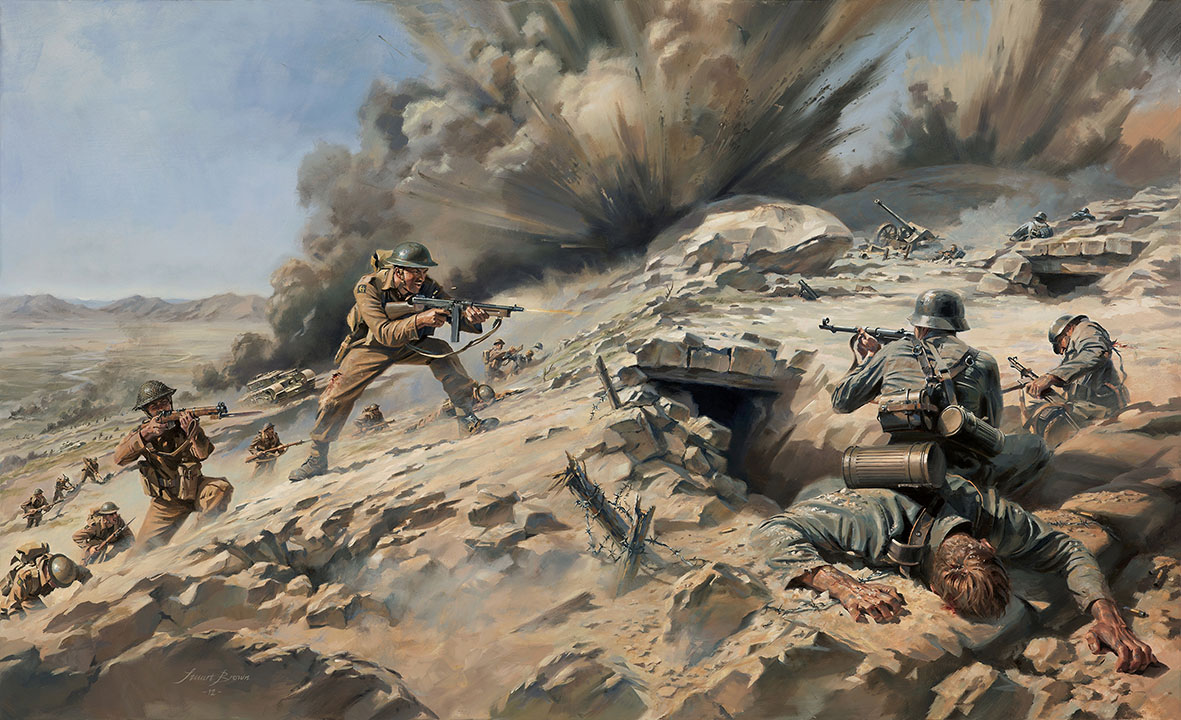

MAJOR J.T.M. ANDERSON VC DSO
8th (Argyllshire) Battalion The Argyll and Sutherland Highlanders.
In Tunisia, strong resistance on Longstop Hill blocked the Allied advance on Tunis. On 23 April 1943 the 8th Battalion launched their attack supported by tanks of the North Irish Horse.
On approach, the Commanding Officer and his headquarters were killed. 25 year old Major ‘Jack’ Anderson assumed command. Despite a leg wound, he led the uphill assault, personally overcoming several enemy machine gun posts and mortar positions. The toll was heavy, reducing the Battalion to about 44 officers and men, but the objective was taken with 200 prisoners.
For his gallant leadership, Anderson was awarded the Victoria Cross. He was killed in action in Italy some months later.
A full-sized pistol that’s optics ready, hammer-fired with a 30 (!) round capacity magazine.

Smith & Wesson has just released the new M&P22 Magnum, a full-sized polymer-framed pistol chambered in .22 Mag.
This latest addition pistol brings more capacity, and more features to the M&P series. The internal hammer-fired design is paired with the Smith & Wesson’s unique Tempo gas-operated barrel system that keeps components locked in place until the bullet passes the gas port, increasing accuracy and performance. The rimfire .22 Mag. cartridge has a significantly thinner diameter than most centerfire cartridges, which allows the M&P22 Magnum to have a standard capacity magazine that holds thirty rounds.
The pistol ships with two magazines and comes with a fiber optic front sight and a black notched rear sight. It has a flat-face trigger, and it is also optics-ready, allowing you to direct-mount most of the popular micro red dots available today. It is also fully ambidextrous, with a 4.35-inch stainless steel barrel that has an Armornite finish and has a Picatinny-style rail for mounting accessories.
“The M&P22 Magnum combines the best features of our internal hammer fire control system with the patented TEMPO barrel design, creating a smooth operating experience for the shooter. The .22 WMR is a versatile and field-savvy cartridge that has been a legacy among American shooters, hunters, and trappers for decades. Smith & Wesson is proud to offer a new pistol that further supports the use of this cartridge outdoors or on the range,” said John Myles, Senior Manager of New Products.
Smith& Wesson M&P22 Magnum Specifications
- Width: 1.1 inches
- Length: 8 inches
- Height: 5.6 inches
- Weight: 22 ounces
- Caliber: .22 WMR / .22 Mag.
- Capacity: 30 rounds
- Action: Internal hammer fired
- Barrel Length: 5 inches
- Grip: Polymer
- Sights: Fiber optic front, blacked out rear
- Optics Ready: Yes
- Safety: Thumb safety
- Threaded Barrel: No
- Frame: Polymer
- Number of magazines: 2
- Barrel Material: Stainless steel
The M&P22 Magnum has an MSRP of $649, and for more information on this pistol as well as other products from Smith & Wesson, please visit smith-wesson.com.
______________________________________________
Little hint, not cheap huh & a little hard to find also at the store. Grumpy


M1909 Benet Mercie – American’s First LMG
This Benet-Mercie is being sold by Morphys on October 30, 2018.
The first light machine gun adopted by the United States was the M1909 Benet-Mercie, made by the Hotchkiss company in France. The gun was adopted when the US military realized that machine gun doctrine reuqired different guns for the light and heavy roles, and the M1904 Maxim gun was only suitable for use in the heavy role.
Less than 2,000 of the M1909 guns were acquired, virtually all of them being made under license by Springfield Arsenal and the Colt company. They were used as training guns by US forces mobilizing for World War One, but did not see combat in that war.
Indeed, the only action of note the Benet-Mercie saw was in Pancho Villa’s 1916 raid on the town of Columbus, New Mexico.

There’s quite a lot of science that goes into modern expanding bullets.
In the end they do exactly what they are supposed to do.
It still amazes me after all these years that I can speak so dispassionately about this stuff. Ours was a fairly large, extremely violent city, and I didn’t know many people. The possibility that a patient might be an acquaintance was small. This made it easier to depersonalize. An inability to depersonalize would disqualify you from service. Nobody could do this long-term otherwise.
The cops rolled in with the ambulance. Witnesses said this guy’s car veered off the crowded Interstate and onto the shoulder. The vehicle gradually lost speed until it came to an unceremonious but not unduly violent stop against an overpass abutment. The first bystander opened the door to find that the driver’s head had exploded.
That’s not hyperbole. The front bit looked quite normal. However, there was a defect to the right rear occiput, the back part of the skull, that would admit an adolescent tangerine. The skull was peeled outward, and a substantial volume of the poor guy’s personality was still back in the car someplace. Amazingly, when we met he was still breathing.
Of the literally countless things I found shocking about medical training, principal among them was just how tough it can be to kill a man. I’ve seen folks shot straight through the brain who kept on kicking and twitching for a quarter hour or more before their bodies finally got the memo. So it was here. There was clearly no happy ending to be had, but we still needed to go through the motions.
The physics behind guns and gunshot wounds can at times seem otherworldly.
When it was all done we put the guy in the Trendelenburg position. Modern medicine is so freaking stupid. Trendelenburg simply means you orient a person head down and feet up. Why we couldn’t just say “lower his head” or something similarly sensible escapes me. To make it worse, to orient a patient head up and feet down is called “Reverse Trendelenburg.” Please…as though the study of modern medicine were not sufficiently complicated already. We arranged a big garbage can underneath his nugget and let him be for a while.
I was just a medical student, but I spoke guns more fluently than anyone in the hospital. The cops literally had no idea what happened to the guy. There was no visible damage to the vehicle—no bullet holes or blown-out windows—and they could find no weapons in the car. He had apparently just been cruising down the Interstate when his head detonated. To exercise a tired cliché, the authorities were baffled.
I went back into the trauma room alone to study the guy for a while. Aside from being motionless and a little colder nothing was different. I donated a pen to the cause and started poking around the exit wound. A substantial piece of skull had been lifted loose and rolled back but was still attached to a flap of scalp. As I explored amidst the gore I saw it.
There was a circular scrap of gold-colored metal trapped between the skull fragment and scalp. I tugged it free, ran it under the sink, and studied it in good light. To the experienced eye it was clearly the base of a bullet jacket.

I moved around to the front and studied the dead man’s face. There just wasn’t anything out of the ordinary there. I then pried his mouth open and oriented the bright trauma room light so it would angle down his gullet. There back in the deepest recesses of his oropharynx I could see the beginnings of some powder burns. This was a suicide. The guy had shoved the muzzle back past the back of his tongue before he stroked the trigger.
I miked the bullet jacket on a piece of EKG paper at eleven millimeters. I then put it in a little bag and tracked down the cop who had come in with the guy. Our dude had killed himself with a .45ACP handgun. The pistol was still in the car someplace. They just hadn’t found it yet. The cop made a radio call.
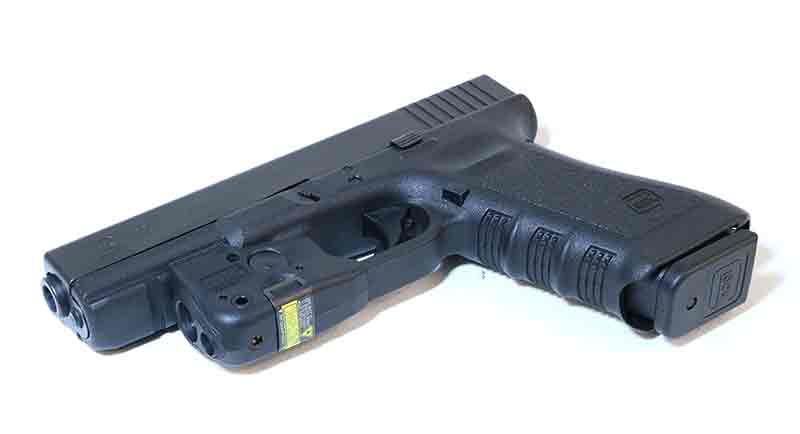
They found the .45-caliber Glock deep underneath the passenger seat. Nobody had any idea the physics that could have put it there. The bullet core was lodged in the headliner and impossible to see if you weren’t specifically looking for it. I was just a lowly med student at a Level 1 trauma center, but that night everybody thought I was a rock star.