Month: February 2023


Categories
S&W Model 53 in 22 Remington Jet
/cloudfront-us-east-1.images.arcpublishing.com/gray/L73ZY7FWVZE7NHS7UYRZFIBC6E.png)
WXIX reports the Animal Friends Humane Society is offering those with a not-so-special ex the opportunity to have their name added to a litter box.
Representatives with the shelter said for a $5 donation the team will write your ex’s name in a litter box and allow their cats to take care of the rest.
The shelter said it is taking donations through Feb. 12 for the promotional event.
The Animal Friends Humane Society team said they will post a video via Facebook on Valentine’s Day to showcase all of the names they received in their litter boxes.

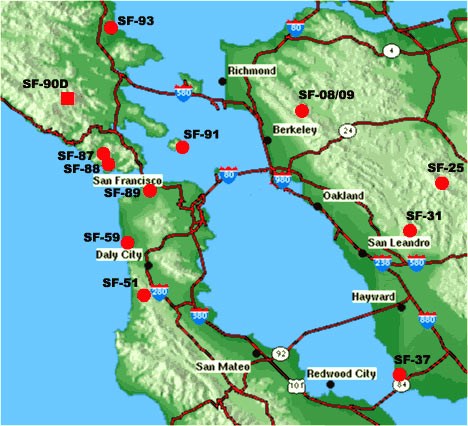 This map shows all the Nike missile sites in the Bay Area.
NPS image
Categories
Works for me


Parkerized and minimalist, the Commando was obviously engineered for hard use on the battlefield • Released by a simple pull latch, the six-round cylinder is robust • Colt’s rollmark indicates the pistol’s martial background.
At the turn of the last century, Colt and Smith & Wesson were the two most prolific American revolver manufacturers. Both were vying for the military and civilian markets that clamored for the newly developed .38 Spl. cartridge. While Smith & Wesson hit the market with its .38 Spl. Military & Police revolver first (1899), Colt was soon in the game with its Army Special, also chambered in .38 Spl., in 1908. By America’s entry into World War II, Colt’s Army Special was now called the Official Police, and sales were brisk at $28.50 each.
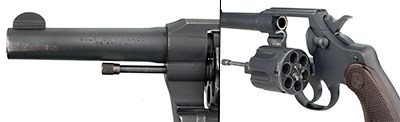 As you can imagine, following the attack on Pearl Harbor in December, 1941, the U.S. Government was scrambling to provide arms and supplies to millions of new recruits. The standing army of the U.S. was slightly less than 500,000 men in 1940, but it would grow to nearly 16 million by 1945. The Defense Supplies Corporation (DSC) was established in 1941 to provide arms and ammunition to the thousands of non-military guards and police charged with protecting America’s munitions plants, war production factories, depots, trains, rail yards and dozens of other sensitive sites. In July, 1942, the DSC contracted with Colt for 20,000 .38 Spl. revolvers. It selected the 4-inch-barrel .38 Spl. Official Police as its choice, but balked at the $28.50 price tag.
Colt countered with a version of the Official Police that was Parkerized (Parco-Lubrite) and had plastic (Coltwood) grips lacking checkering on the trigger, hammer and cylinder release latch. The Colt Commando was born, yielding a $2.50 savings over the MSRP of the Official Police. (Smith & Wesson had done the same with its M&P and called it the Victory Model).
According to Charles W. Pate’s excellent book, “U.S. Handguns of World War II” (1998), a few prototypes of the Commando were initially sent to the Chief of Ordnance in October of 1942 and the first deliveries of the 4-inch Commando were begun in early March, 1943.
In a strange arrangement, the U.S. Army’s Ordnance Department inspected and received all the Commandos produced by Colt initially and then delivered the guns to the DSC, charging them a “handling fee,” which no doubt put the cost of the guns back over the $28.50 price that the DSC had tried to avoid in the first place. By mid-1944, the DSC was able to procure the Commando directly from Colt, eliminating those “handling charges.” (By the end of the war, Colt had raised the price to $32.30).
I’ve often heard folks say, “If this gun could talk, I wonder what tales it would tell.” And to that I would counter, “Let’s give it a look over and see what it can already tell us.” According to Pate, the Colt Commando was serial numbered from No. 1 to No. 50,280, accounting for the full run of more than 50,000 produced during World War II. Of that 50,000, the U.S. Army Ordnance Department received the first 36,000 between March, 1943, and June, 1944. So, if a Commando falls below the serial number of 36,000 it should have U.S. military markings on it such as an Ordnance bomb cartouche on the upper left side of the frame. Of these 36,000 revolvers, 20,000 or so were sent to the DSC for distribution to the non-military end users as stated above. However, 16,000 revolvers were used by the U.S. military in a number of roles. Some made it over to Europe—even GA Eisenhower was known to have one. The CID and OSS were each also recipients of the Commando for clandestine operations. After June of 1944, or serial number 36,000, Commandos encountered without inspector marks were Commandos that were sold directly to the DSC. Those destined for military use were stamped with the ordnance bomb, “W.B.” or “G.H.D.” There are some exceptions to this rule as the Army “loaned” some revolvers to the DSC when urgencies arose unexpectedly and vice versa, so the best way to know is to write to Colt and have the company provide an official letter.
Almost from the receipt of the first prototypes in 1942, Colt began to produce a 2-inch-barreled model that some call “The Junior Commando.” The Ordnance Department began receiving the first shipments of the 2-inch model around the same time that the first shipments of the standard 4-inch model were arriving in March, 1943. It is believed only 3,450 of the 2-inch “Junior Commandos” were manufactured and used during the war.
The Army and the DSC were not the only ones to employ the Commando during the war, as approximately 1,700 were delivered to the U.S. Navy. In early 1944, a U.S. Navy Sailor dropped his Smith & Wesson “Victory” model on the deck of his ship and it discharged, fatally wounding him. The delivery of the Smith & Wesson revolvers was placed on hold while a suitable fix was found to prevent their accidental discharge. Colt was able to bridge the gap somewhat by delivering Commandos to the Navy during the interim period.
The Colt Commando mostly saw service during the war as a stateside guardian, a vital role, no doubt. The limited numbers produced—50,000 total—pale in comparison to the Smith & Wesson Victory model in .38/200 (775,000 manufactured) and .38 Spl. (350,000 manufactured).
According to the “43rd Edition of the Blue Book of Gun Values,” an example of the Colt Commando in “as-issued” condition is worth about $1,350, while the .38 Spl. version of the Smith & Wesson Victory model runs about $100 more.
The reader is encouraged to see Charles W. Pate’s “U.S. Handguns of World War II” as well as Gary H. Peer’s “The Colt Double Action Snub-Nose (Pocket) Revolver” for more information about the fascinating revolvers of this period.
