Month: February 2023
Categories
US Equipment in the East in WW2
Earlier this week, the always excellent and interesting Baldilocks shared a thread on Twitter dealing with the perceptions and thoughts of a certain class of Russians in regards the war. The thread is well worth reading, as are some of the comments to her tweet and my retweet.
What was reported matches what I am seeing and hearing from that class, and from others. For all that one must support the war in public, or face draconian consequences, even in private it has a lot of support. As in a WAG on my part of better than fifty percent. Yes, there are segments that don’t support and are not thrilled with things, and they tend to fall more on ethnic lines from what I’m seeing. Overall, the war has a surprising strong, wide, and deep level of support within Russia. Not universal, but pretty darn significant.
Support for Vladimir remains quite high. This varies as one goes through demographics and ethnicities, but overall strong. Two areas where this may not be true are in what I call the political oligarchia: the politicians, power brokers, oligarchs, and wanna-be oligarchs who make up the upper levels of power. The old nomenklatura concept is dead and gone. In public, this upper level is very pro-Vladimir. In private, well, it’s still not clear to me if some of what is going on behind the scenes is simply preparation for his retirement or death, or if there is something more active going on. To be fair, there are days I’m not sure those playing the great game in Russia truly know themselves. The other area is the bottom of the demographics pile, which tends to be ‘yeah, support, whatever; none of them give a damn about us.’ That may be as close to a universal concept across cultures as anything.
An important point within this is the response of that educated class to the pushback by Ukraine, NATO, and others. Note the surprise, shock even, that Europe and others not only opposed the invasion, but that they are helping Ukraine (most of whom are sadly misled and should be welcoming the return of Russia) resist. That they would potentially gut their economies to do so. This is seen as bigotry and ignorance by that class of Russians. And by others within Russia, to be honest.
That plays almost perfectly into the great Russian paranoia that everyone is out to get them. That has been a hallmark of Rus/Slav psychology going back into ancient times. They have always been treacherously set upon by others, even as they were peacefully raping, murdering, and pillaging those that set upon them. Now, Russia does have a few legitimate times when they weren’t doing something like that at the time they were attacked, but I am overall reminded of a certain criminal class here in the U.S. that was never ‘doing nothing’ when “attacked” by those they were robbing, etc.
It also brings to the fore a concept that seems to continue to elude far too many: outside reactions and considerations were not and are not a factor of consideration. The war was not started with Western or other reaction in mind, other than that it was felt that the Biden Regency and others would just go along with it and not do anything of significance against it. Token reparations maybe, but that was it. Given that the Regency and the Meat Puppet seemed to be egging it on at one point, I can see how they thought that. But, that was only a fleeting thought to them and not even a serious point of consideration.
The dynamics that drove the decision to invade are almost entirely internal. They are based in culture, politics, and other areas that create the internal dynamics that are not understood and not even being considered by far too many outside of Russia. There is no path to peace without taking those dynamics, and the overwhelming support for the war and for creating a new Russkiy Mir, into consideration.
Therein lies the problem. Outside opinions and even responses do not matter to the large majority of the population of the Russian Federation. At best, such are seen as bigotry and an attack. At worst, they were not even a consideration. That holds true for the leadership as well. For all intents and purposes, the people of the Russian Federation live in a bubble, and the upper leadership lives in an even more dense and impenetrable bubble.
Stephen Green, who does some truly great coverage I do recommend reading, has two (sadly VIP) posts up, here and here, on “Putin’s Stupid and Unnecessary War.” By our standards, completely true and valid statements. The war is stupid, unnecessary, and even foolish. From a Russian societal perspective, however, it is extremely necessary and even overdue. Stephen asks a good question that I can see before it hits the paywall, about the military leadership should have known the military was not ready and should have prevented the war as a result.
Again, by our standards and culture, an obvious point. By the standards of Russian culture, however, invalid. Keep in mind the two bubbles already mentioned, as there are more. Vladimir sacked a lot of real generals a while back so that various apparatchiks, oligarchs, and wanna-be oligarchs could get in on the fun of what we would see as outright corruption. Russians today just see it as how business is done. Those that were smart cut officers in on the take, and smart officers made sure the men didn’t starve. As it was, the troops often looted items to sell on the black so they got pay, food, etc. Gundecking reports has a long and honorable tradition in Russia going back almost to the very earliest days. Yet more bubbles, and people who needed to know things didn’t. Given the lack of esteem given to the military these days, the general public and leadership really didn’t care if they starved or not, or what was happening to them. Or what would happen if they had to go to war.
It was only when war came, and some people got a cold douche of reality, that anything began to change. Part of that change was that a number of people in demographics and ethnicity that meant they would be called up to fight decided to beat feet. Quite a few citizens of the Russian Federation, and not just the government, consider them traitors to be dealt with later and who should never ever think of returning to the Rodina. Understand, your average citizen of the Russian Federation has no problem with people dying for the war and the cause of Russkiy Mir — so long as it’s not them. Marginalized groups or ethnicities? Who cares, it will improve the gene pool.
Nuclear war? Go for it. Our mighty Russian military will protect us while devastating our enemies. We have far more bombs and missiles than they do. We have far greater, more powerful, and more accurate defenses against missiles and other attacks.
That their nuclear and nuclear defense forces might be in a shape similar to their other weapons and stockpiles has penetrated few if any bubbles as far as I can tell. How many will work (on either side)? Who knows, and I’d really rather not find out. That said, I’m in the camp of 20 percent, i.e. an 80 percent failure rate. In light of this, I also highly recommend reading this from Sgt. Mom. Our own military is in many ways in no better shape. We are not capable of fighting a one front war for more than a few days (if that), much less a two-front war as we are supposed to be able to do.
Which leads us, finally, to the growing “peace at any price crowd.” I’m seeing it a lot on social media these days, and from some surprising quarters. As I noted in posts before, putting in place a cease fire or a forced peace as things stand will only guarantee a far worse war with far worse consequences later. Even one that gives Ukraine the Donbas and Russia the Crimea will result in the same. See this post and this post for some of the previous discussion on outcomes.
Right now, I do not see any easy, good outcomes. Far too much of what is being discussed and pushed is not in touch with the reality of Russian culture and internal dynamics, much less that of Ukraine. Anything that does not take such into consideration will fail. Spectacularly. Creating something viable, or at least make each step suck the least, requires strong, informed, and capable leadership. Looking at the Biden Regency, Castreaux, Macaroon, Charles/Sunak, Shultz, Vladimir, etc., yeah, right.
Prepare, pray, and hope for the best. It’s about all we truly can do right now.
Getting hit by lightning is not fun! If you w
Categories
The 1863 Sharps cavalry carbine




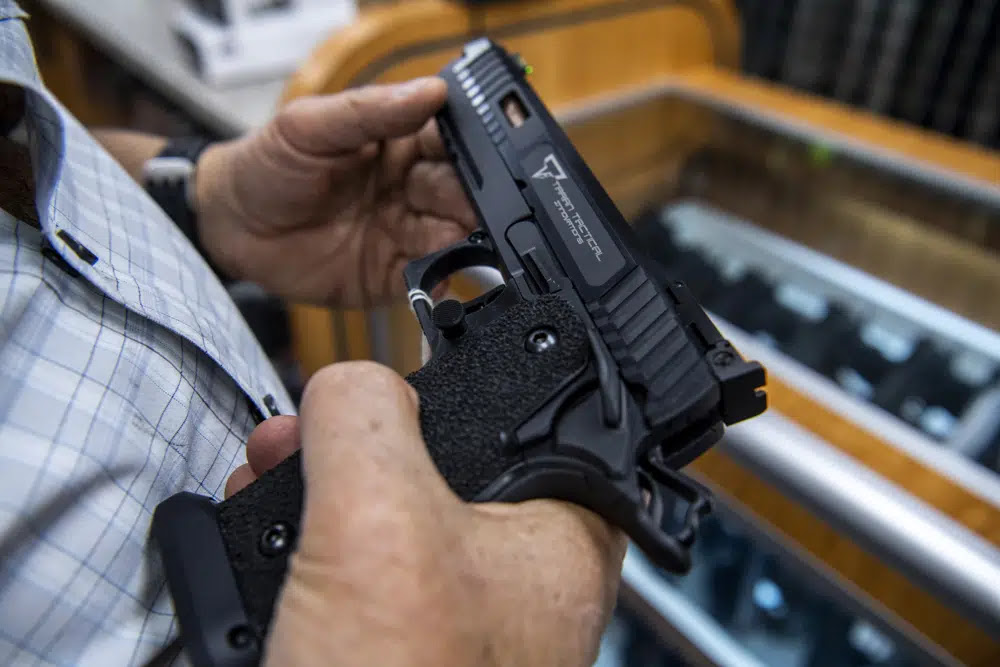
A customer checks out a hand gun that is for sale and on display at SP firearms on June 23, 2022, in Hempstead, New York. A landmark Supreme Court decision on the Second Amendment is dismantling gun law across the country, dividing judges and sowing confusion over what firearm restrictions can remain on the books. Experts say the high court’s ruling that outlined a new test for evaluating gun laws left open many questions, resulting in an increasing number of conflicting decisions as lower court judges struggle to figure out how to apply it. (AP Photo/Brittainy Newman, File)
WASHINGTON (AP) — A landmark U.S. Supreme Court decision on the Second Amendment is upending gun laws across the country, dividing judges and sowing confusion over what firearm restrictions can remain on the books.
The high court’s ruling that set new standards for evaluating gun laws left open many questions, experts say, resulting in an increasing number of conflicting decisions as lower court judges struggle to figure out how to apply it.
The Supreme Court’s so-called Bruen decision changed the test that lower courts had long used for evaluating challenges to firearm restrictions. Judges should no longer consider whether the law serves public interests like enhancing public safety, the justices said.
Under the Supreme Court’s new test, the government that wants to uphold a gun restriction must look back into history to show it is consistent with the country’s “historical tradition of firearm regulation.”
Courts in recent months have declared unconstitutional federal laws designed to keep guns out of the hands of domestic abusers,felony defendants and people who use marijuana. Judges have shot down a federal ban on possessing guns with serial numbers removed and gun restrictions for young adults in Texas and have blocked the enforcement of Delaware’s ban on the possession of homemade “ghost guns.”
In several instances, judges looking at the same laws have come down on opposite sides on whether they are constitutional in the wake of the conservative Supreme Court majority’s ruling. The legal turmoil caused by the first major gun ruling in a decade will likely force the Supreme Court to step in again soon to provide more guidance for judges.
“There’s confusion and disarray in the lower courts because not only are they not reaching the same conclusions, they’re just applying different methods or applying Bruen’s method differently,” said Jacob Charles, a professor at Pepperdine University’s law school who focuses on firearms law.
“What it means is that not only are new laws being struck down … but also laws that have been on the books for over 60 years, 40 years in some cases, those are being struck down — where prior to Bruen — courts were unanimous that those were constitutional,” he said.
The legal wrangling is playing out as mass shootings continue to plague the country awash in guns and as law enforcement officials across the U.S. work to combat an uptick in violent crime.
This week, six people were fatally shot at multiple locations in a small town in rural Mississippi and a gunman killed three students and critically wounded five others at Michigan State University before killing himself.
Dozens of people have died in mass shootings so far in 2023, including in California, where 11 people were killed as they welcomed the Lunar New Year at a dance hall popular with older Asian Americans. Last year, more than 600 mass shootings occurred in the U.S. in which at least four people were killed or wounded, according to the Gun Violence Archive.
The decision opened the door to a wave of legal challenges from gun-rights activists who saw an opportunity to undo laws on everything from age limits to AR-15-style semi-automatic weapons. For gun rights supporters, the Bruen decision was a welcome development that removed what they see as unconstitutional restraints on Second Amendment rights.
“It’s a true reading of what the Constitution and the Bill of Rights tells us,” said Mark Oliva, a spokesman for the National Shooting Sports Foundation. “It absolutely does provide clarity to the lower courts on how the constitution should be applied when it comes to our fundamental rights.”
Gun control groups are raising alarm after a federal appeals court this month said that under the Supreme Court’s new standards, the government can’t stop people who have domestic violence restraining orders against them from owning guns.
The New Orleans-based 5th U.S. Circuit Court of Appeals acknowledged that the law “embodies salutary policy goals meant to protect vulnerable people in our society.” But the judges concluded that the government failed to point to a precursor from early American history that is comparable enough to the modern law. Attorney General Merrick Garland has said the government will seek further review of that decision.
Gun control activists have decried the Supreme Court’s historical test, but say they remain confident that many gun restrictions will survive challenges. Since the decision, for example, judges have consistently upheld the federal ban on convicted felons from possessing guns.
The Supreme Court noted that cases dealing with “unprecedented societal concerns or dramatic technological changes may require a more nuanced approach.” And the justices clearly emphasized that the right to bear arms is limited to law-abiding citizens, said Shira Feldman, litigation counsel for Brady, the gun control group.
The Supreme Court’s test has raised questions about whether judges are suited to be poring over history and whether it makes sense to judge modern laws based on regulations — or a lack thereof— from the past.
“We are not experts in what white, wealthy, and male property owners thought about firearms regulation in 1791. Yet we are now expected to play historian in the name of constitutional adjudication,” wrote Mississippi U.S. District Judge Carlton Reeves, who was appointed by President Barack Obama.
Some judges are “really parsing the history very closely and saying ‘these laws aren’t analogous because the historical law worked in a slightly different fashion than the modern law’,” said Andrew Willinger, executive director of the Duke Center for Firearms Law.
Others, he said, “have done a much more flexible inquiry and are trying to say ‘look, what is the purpose of this historical law as best I can understand it?’”
Firearm rights and gun control groups are closely watching many pending cases, including several challenging state laws banning certain semi-automatic weapons and high-capacity magazines.
A federal judge in Chicago on Friday denied a bid to block an Illinois law that bans the sale of so-called assault weapons and high-capacity magazines, finding the law to be constitutional under the Supreme Court’s new test. A state court, however, already has partially blocked the law — allowing some gun dealers to continue selling the weapons — amid a separate legal challenge.
Already, some gun laws passed in the wake of the Supreme Court decision have been shot down. A judge declared multiple portions of New York’s new gun law unconstitutional, including rules that restrict carrying firearms in public parks and places of worship. An appeals court later put that ruling on hold while it considers the case. And the Supreme Court has allowed New York to enforce the law for now.
Some judges have upheld a law banning people under indictment for felonies from buying guns while others have declared it unconstitutional.
A federal judge issued an order barring Delaware from enforcing provisions of a new law outlawing the manufacture and possession of so-called “ghost guns” that don’t have serial numbers and can be nearly impossible for law enforcement officials to trace. But another judge rejected a challenge to California’s “ghost gun” regulations.
In the California case, U.S. District Judge George Wu, who was nominated by President George W. Bush, appeared to take a dig at how other judges are interpreting the Supreme Court’s guidance.
The company that brought the challenge —“and apparently certain other courts” — would like to treat the Supreme Court’s decision “as a ‘word salad,’ choosing an ingredient from one side of the ‘plate’ and an entirely-separate ingredient from the other, until there is nothing left whatsoever other than an entirely-bulletproof and unrestrained Second Amendment,” Wu wrote in his ruling.
____
Richer reported from Boston.
———————————————————————————– Nobody likes a sore loser! Oh well!!!!!!!!!!!! Grumpy