Categories
Month: February 2023
Flying a Cobra gunship is a bit like wearing it. The first time I climbed into the cockpit of an S-model AH-1 Cobra, I was struck by how skinny the thing was. The aircraft just wraps around you. Particularly from the front seat, the view is simply spectacular.

The S-model represented the apex of Cobra evolution in Army service. They were universally referred to as Snakes. The Marines took them to yet more rarefied heights, but the AH-1S was the end of the road for the Army’s first dedicated helicopter gunship. It was an undeniably sexy beast.

There are two broad categories of helicopter rotor systems. The semi-rigid design found on Hueys, Army Cobras, and OH-58s is akin to a teeter-totter. This two-bladed system pivots at its midpoint to compensate for the dissimilar physics experienced by the advancing and retreating blades when the aircraft is in forward flight. By contrast, the fully-articulated systems used on the CH-47, UH-60, and AH-64 are designed such that each individual blade pivots on a hinge attached to the rotor head. The practical differences are fairly significant.

Fully articulated rotors are fairly forgiving of quasi-aerobatic maneuvering, but a semi-rigid rotor system must always remain under a positive G-load. Our maneuvering limits for the UH-1, AH-1, and OH-58 were one-half positive G. Practically speaking, that meant that you had to be careful when clearing a terrain feature at low level and high speed. Pitching the nose down sharply unloads the rotor head and flirts with weightlessness. Be unduly aggressive with this, and the rotors can come apart. Don’t tell anybody, but that didn’t stop me from rolling a Snake inverted once in the high-speed dive box at Fort Rucker. Young men are so terribly stupid.

The semi-rigid rotor produces a stark one-to-one vibration as you power up the aircraft. It’s a weird feeling. Once you get the aircraft up to speed, however, it is a joy to fly. One of my warmest memories as an Army aviator was chasing alligators in a Cobra flying about three feet above some forgotten Alabama river.
Origin Story
In the early 1960’s, the U.S. military first established the doctrine of vertical envelopment and air assault using early combat helicopters. UH-1 Hueys offered unprecedented mobility and shock effect for troops on the battlefield, However, these lightly-armed aircraft were terribly vulnerable, particularly as they approached a contested landing zone. Air Force strike fighters were handy, but they were really too fast to offer the sort of precise fires necessary to support the lift aircraft down in the dirt. The first dedicated helicopter gunship was actually adapted from the piston-driven H-13.

The H-13 was the grasshopper-looking aircraft used on the TV show MASH. However, this spindly machine lacked the payload to be an effective gunship. The first truly effective helicopter gunships were Mike-model Hueys. These modified UH-1 transport helicopters were called Hogs and sported four M-60 machineguns along with a pair of 2.75” rocket pods on side pylons and a 40mm automatic grenade launcher in the nose. Sometimes the four M-60s were replaced by a pair of M-134 miniguns. However, this was a stop-gap solution. The result was the new AH-1G Cobra.
The earliest AH-1G Cobras first saw combat service in Vietnam in the summer of 1967. While the AH-1 and UH-1 were visually quite dissimilar, those early Snakes actually shared a great deal of engineering with their lift brethren. The main rotor, tail rotor and engine were common between the two machines.

As the machinery evolved so did the tactics. In short order, Cobras were being employed as part of Pink Teams consisting of one or two Cobras paired with an OH-6 Loach observation aircraft. The Loach flew low and slow, scouting targets down in the weeds, while the Snake orbited up high, waiting for prey. These two aircrews coordinated their every move via radio. Once targets were identified, the Loach would break clear so the more heavily armed Cobra could roll hot from altitude and bring the pain.
Details
Those early AH-1G Cobras could be equipped with a variety of weapons including pylon-mounted M-61 Vulcan automatic 20mm cannon. However, the most common load-out was four 2.75″ rocket pods under the stubby wings, each carrying either seven or 19 rockets. The rockets fired along the aircraft centerline and were typically managed by the pilot who sat in the rearmost position in the cockpit. The co-pilot/gunner in the front ran the chin turret. The turret typically mounted an M-134 minigun on one side and a 40mm automatic grenade launcher on the other. These mounts were universal, however, so individual aircraft could fit a pair of miniguns or a pair of grenade launchers as the tactical situation demanded.

Once the Vietnam War drew to a close, the Army’s mission evolved. Where previously the enemy was well-entrenched jungle fighters in small groups, in the 1970’s and 80’s, the problem was massed Warsaw Pact armor on the plains of Europe. This demanded a radical rethink of both the design and employment of attack aircraft. The result was the AH-1F and AH-1S Cobras.

The S-model is distinguished from the previous sort at a glance by its flat plate windscreen and tapered rotor tips. For reasons I never fully understood, the tail rotor was moved to the opposite side as well. These Cold War gunships packed a single three-barrel M-197 20mm cannon in the chin turret and the fire control equipment to manage TOW missiles off of the wings.

TOW stands for Tube-launched, Optically-tracked, Wired-guided. These weapons were purpose-designed to kill tanks. They reach out to around three kilometers. A few TOW missiles were used against advancing NVA armor at the end of the Vietnam War, but most of their combat usage from airborne platforms took place in the Middle East. These late-model Snakes still carried 2.75″ rocket pods as well.
Ruminations
I will forever carry a soft spot in my heart for the Cobra gunship. However, once they added applique armor and all the fire control equipment required to manage the TOWs, the resulting aircraft was fairly underpowered. The thing was still fast — its VNE (Velocity never-to-exceed) was 170 knots or nearly 200 miles per hour. However, the Cobra was sluggish with a full load of fuel and ammo. In hot/high conditions, a full combat load would often exceed the aircraft’s performance limitations.
A nicely tuned AH-1S cruised at around 149 knots and had a maximum takeoff weight of 9,500 pounds. Its Lycoming T53-L-703 turboshaft engine put out 1,800 shaft horsepower. As the world’s first truly dedicated helicopter gunship, the Snake laid a foundation for much greater things to come.
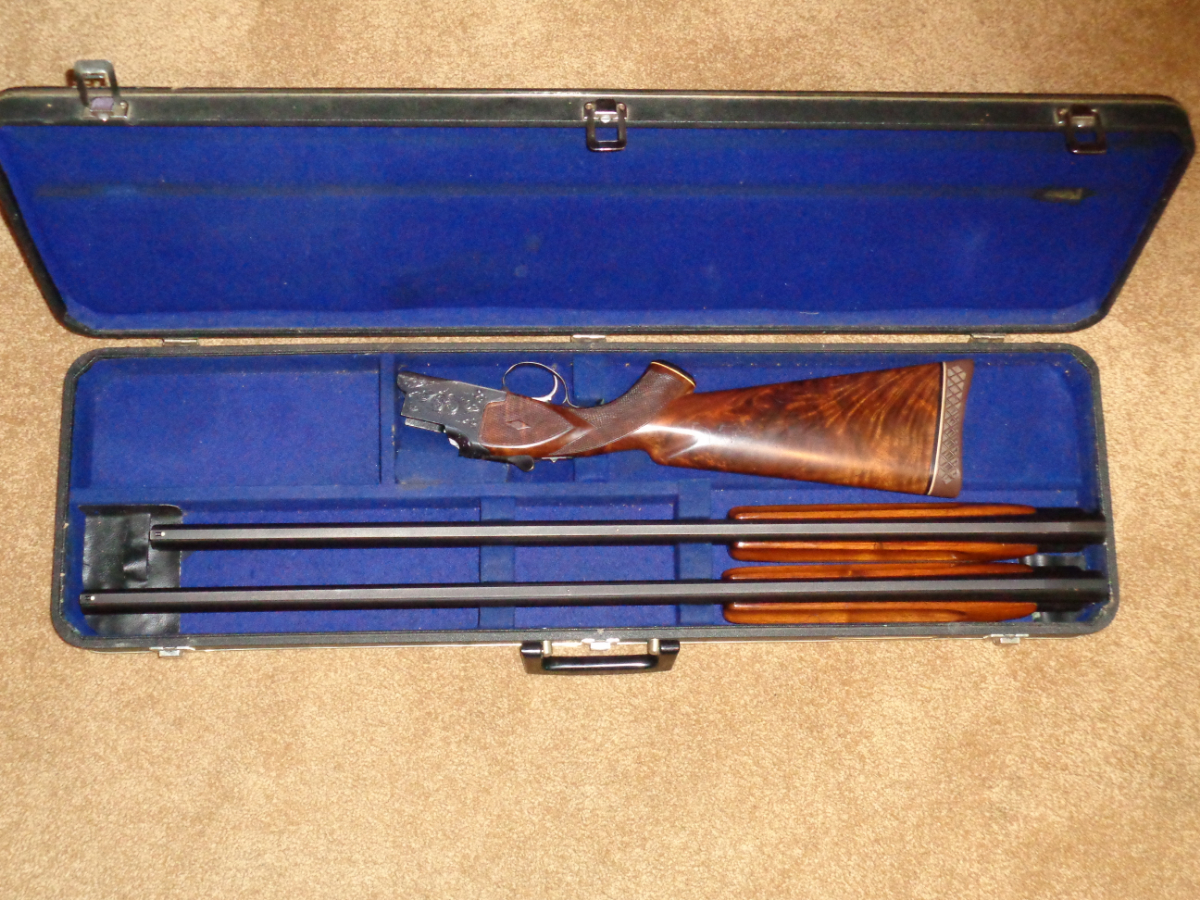
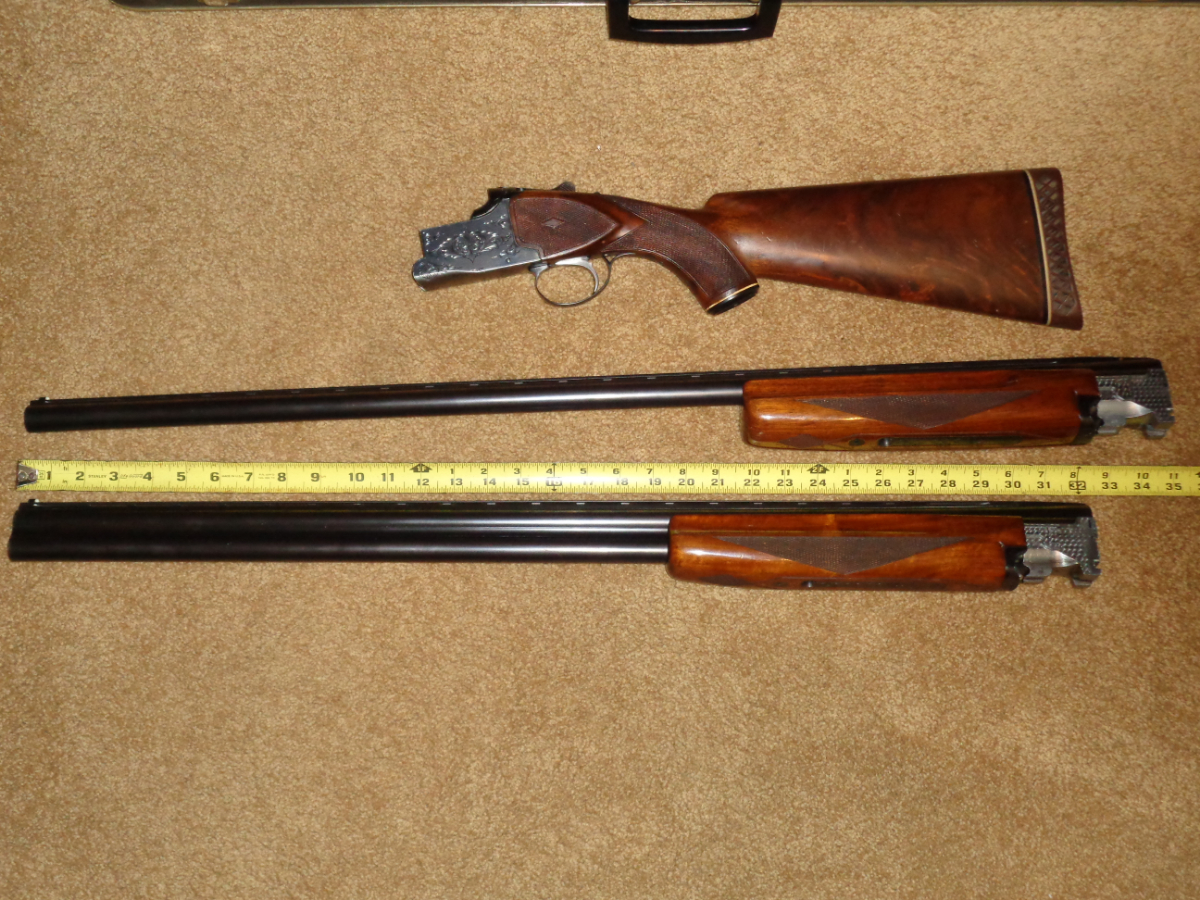
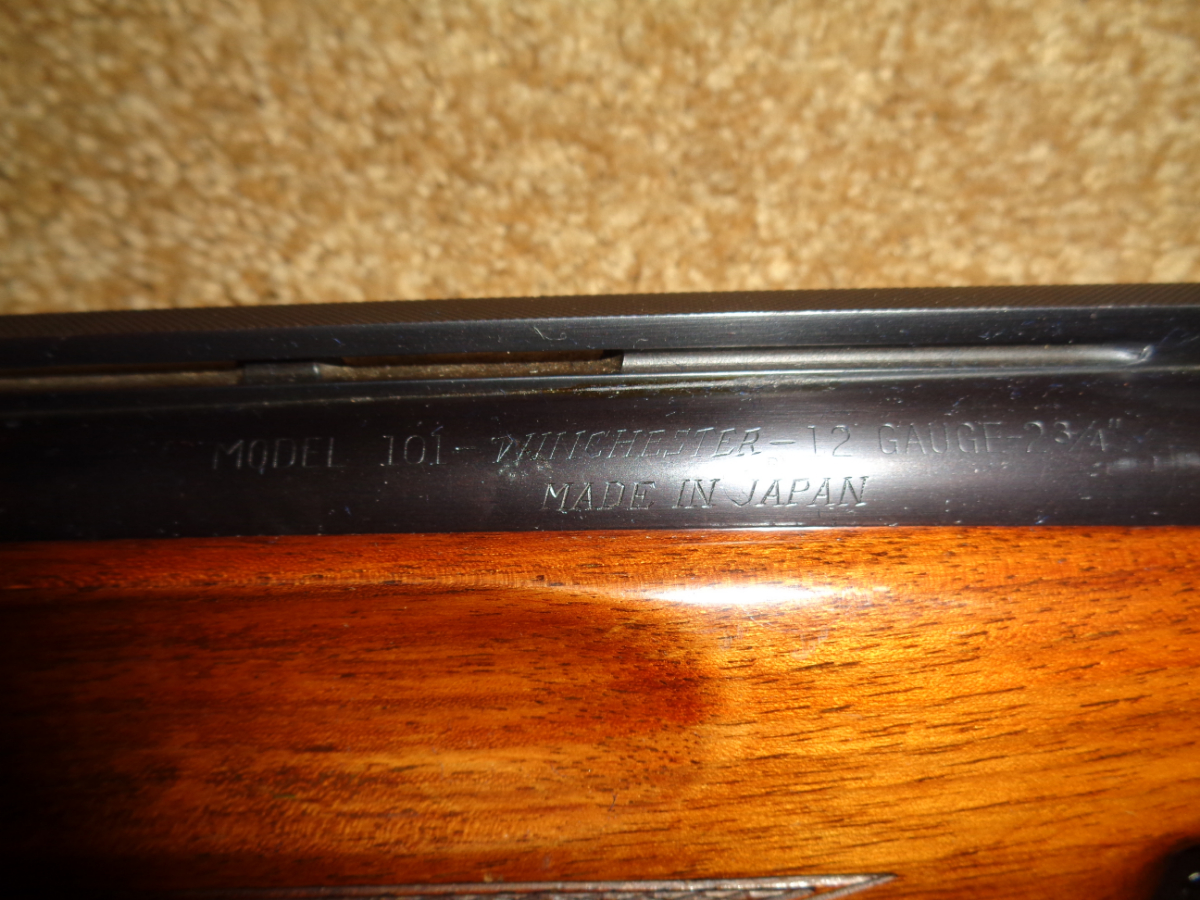
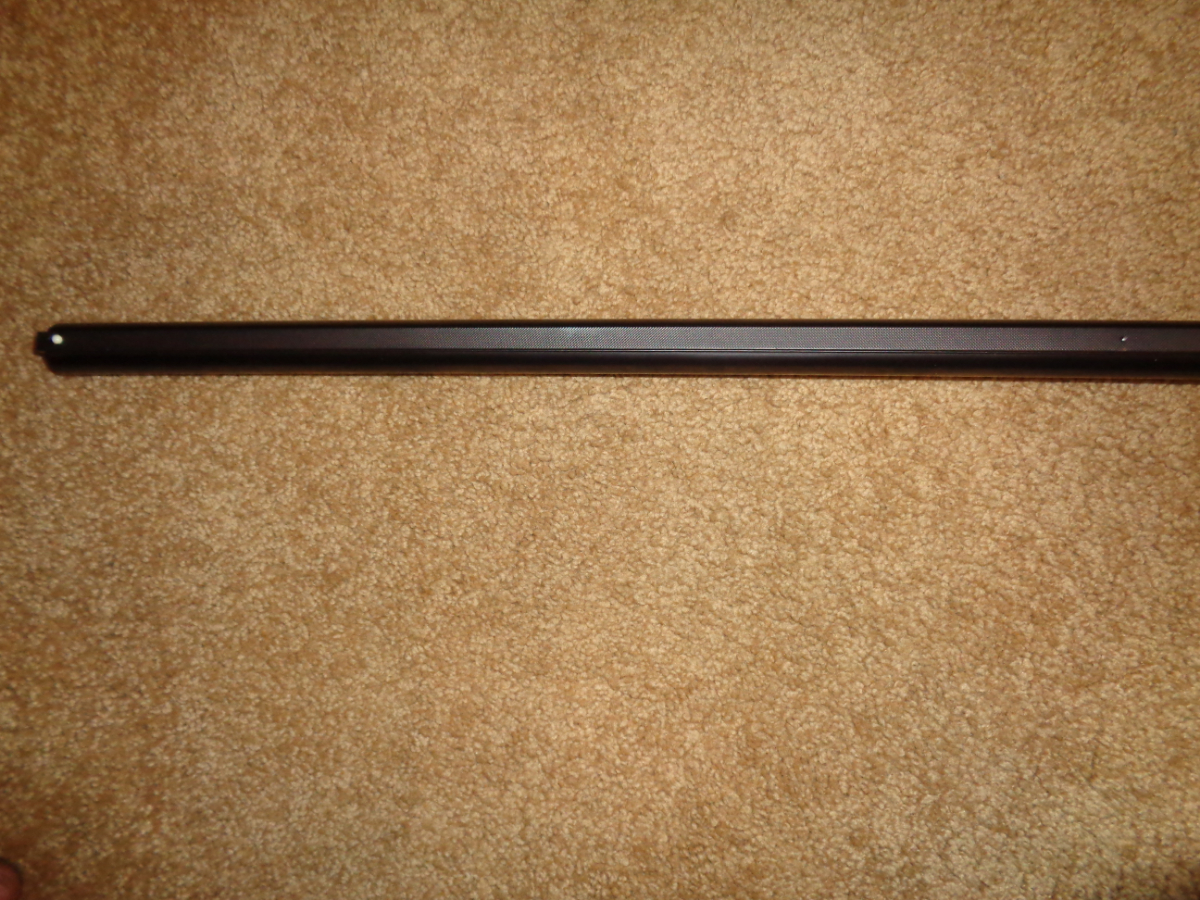
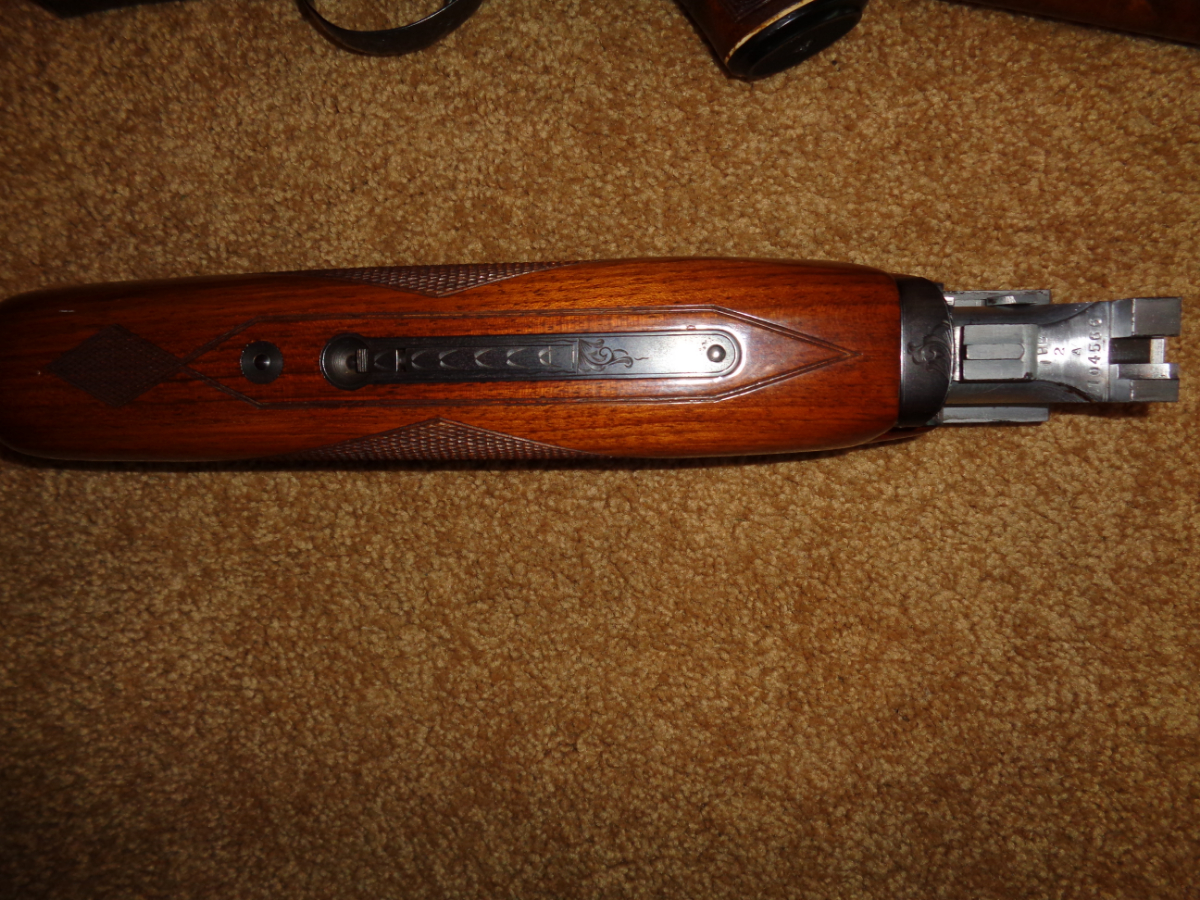
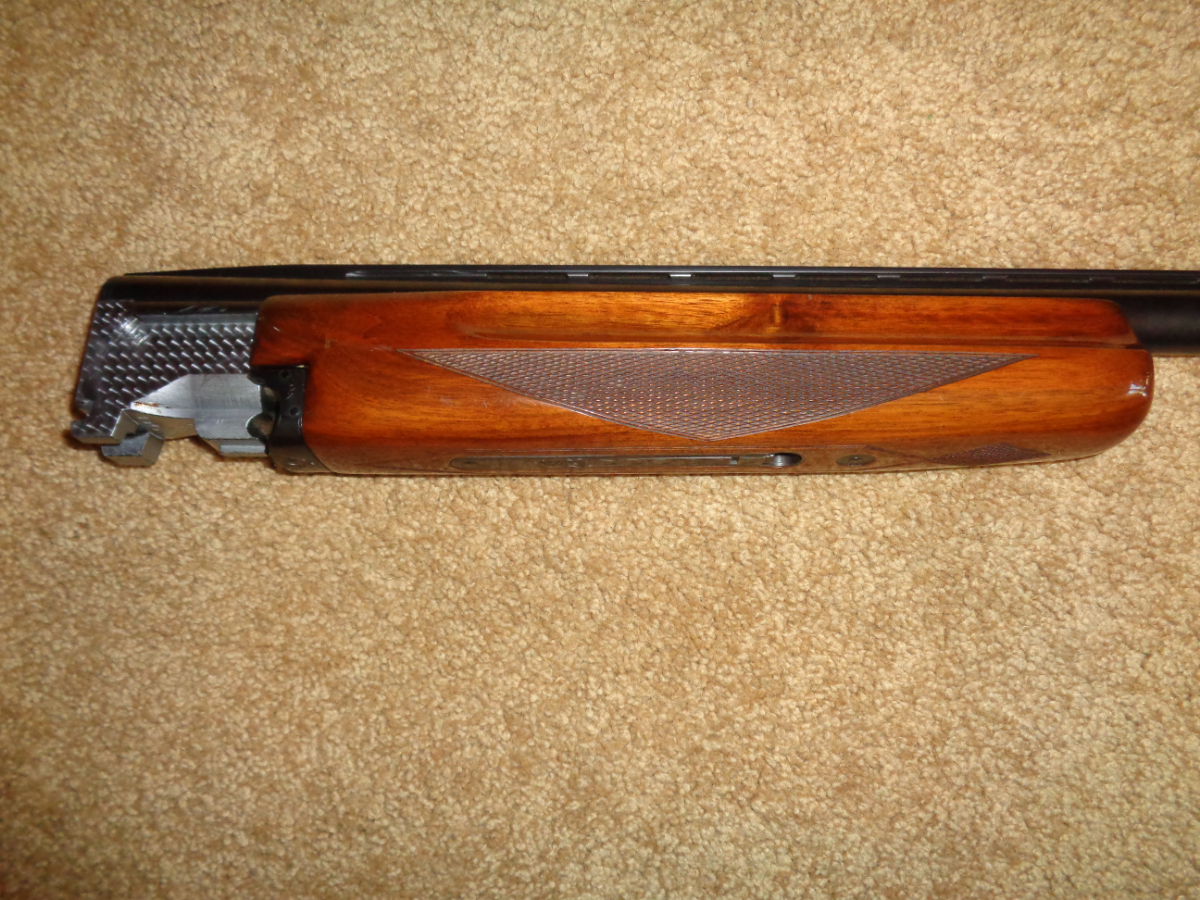
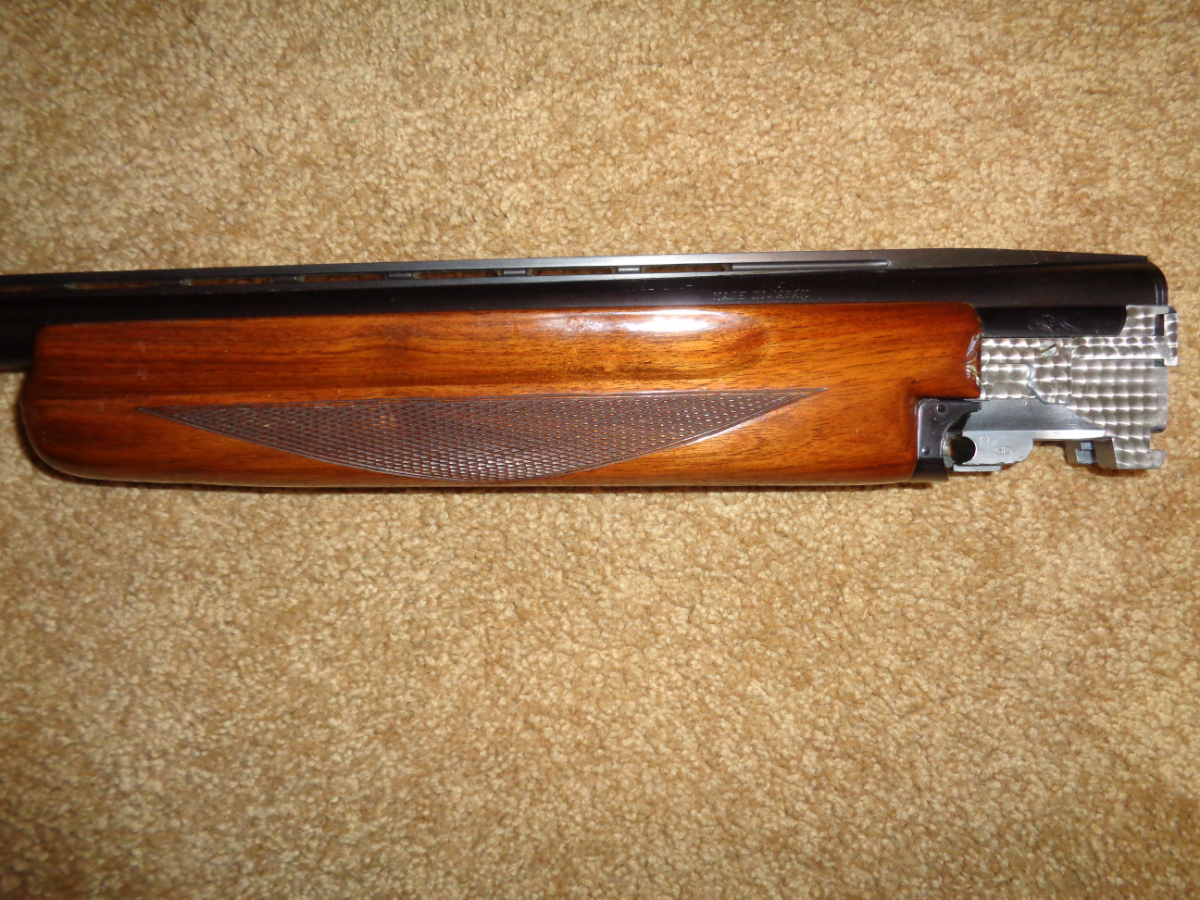
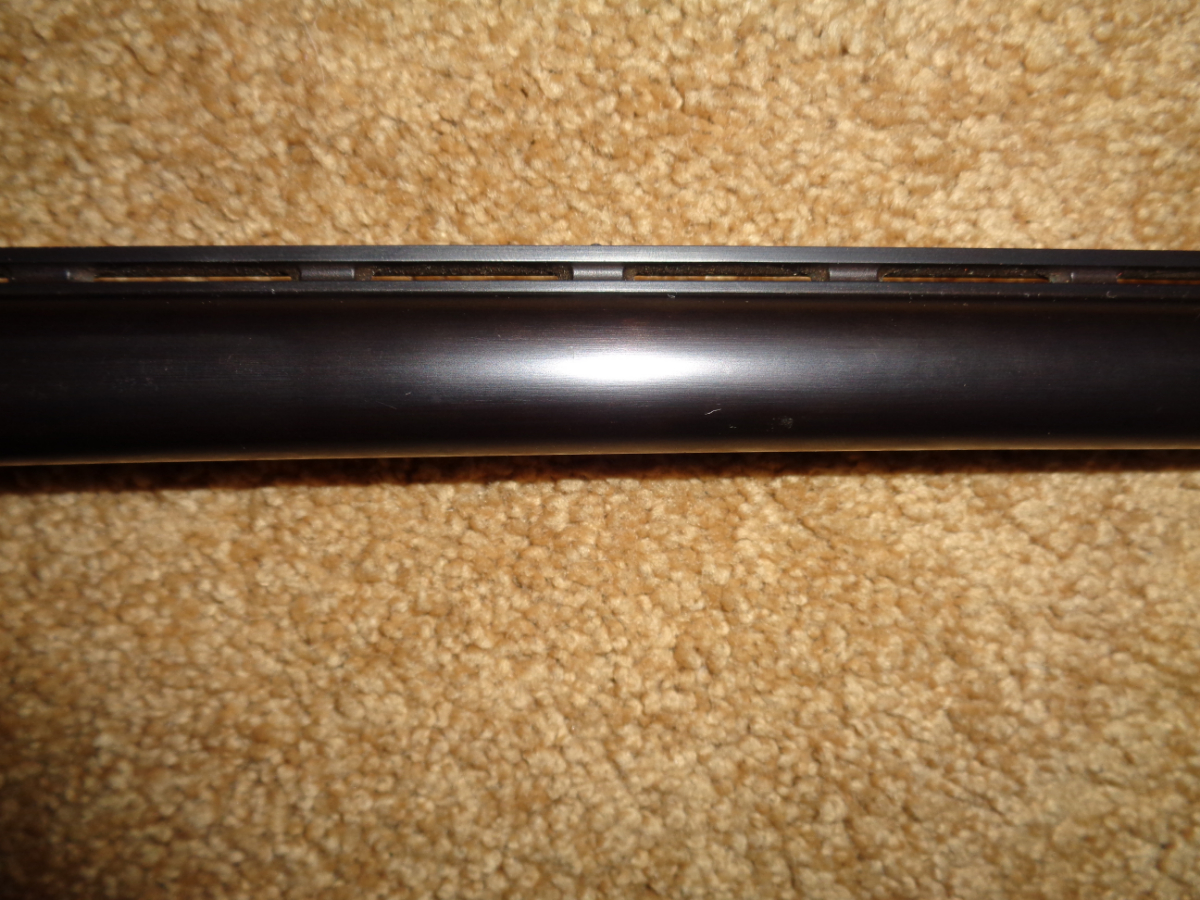
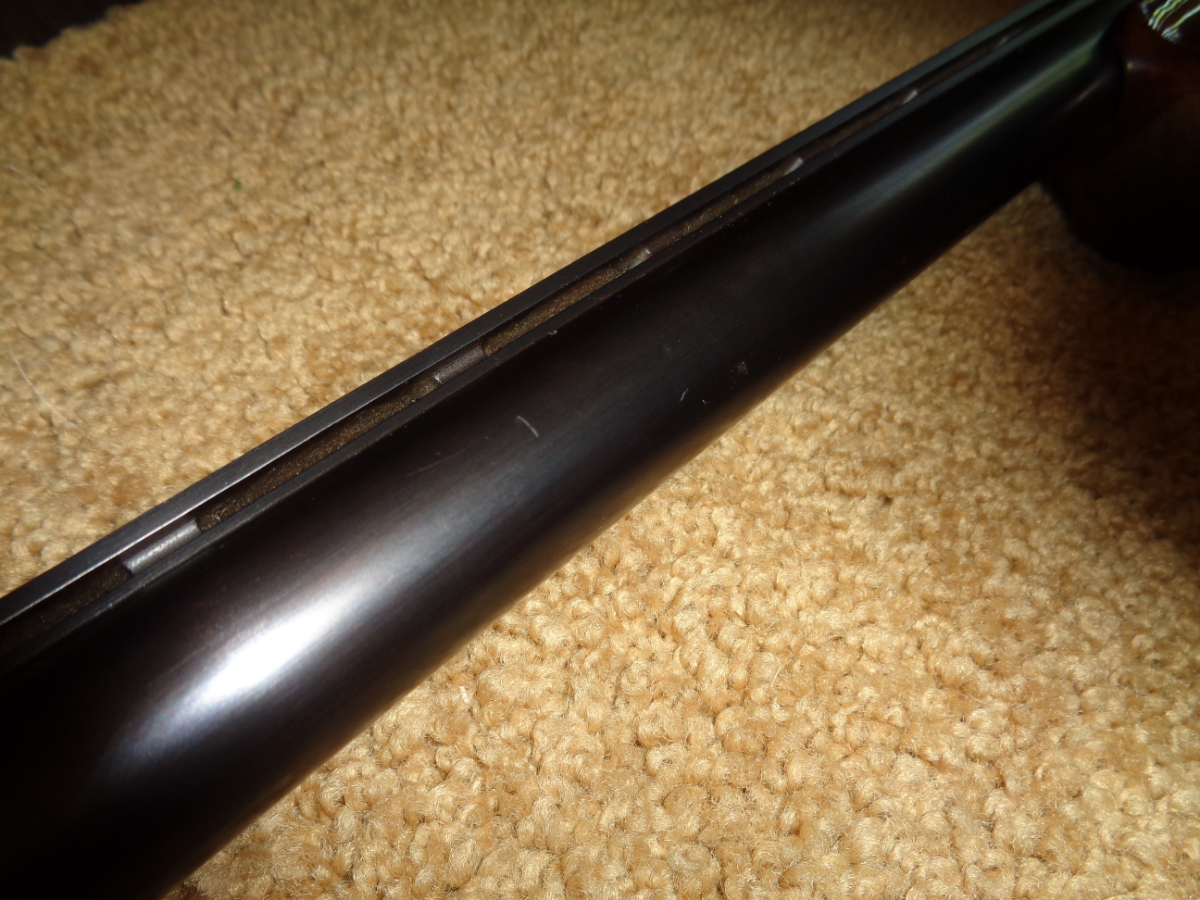
Now that is some really great looking wood in my humble opinion! Grumpy
Categories
The Gewehr 43 – Hitler’s Garand of WWII
Things are just different in Australia. Many of their mammals are unique to the continent and sport weird pouches they use to raise their young. Additionally, their snakes seem all to be just super deadly. And then there’s the platypus. What’s that all about?

Apparently, all that intrinsic “Down Under” strangeness extends to their small arms as well. Back during WWII when gun designers were crafting such conventional weapons as the German MP-40, America’s M-3 Grease Gun, the Russian PPSh, and the British Sten, an Aussie named Evelyn Owen crafted an upside-down SMG that ultimately took his name. The Australian Owen was unique among the pantheon of wartime SMGs, as it fed 9mm rounds from the top — among other quirky features.
Origin Story
Evelyn Ernest Owen was born in 1915 in Wollongong, New South Wales. He finished high school, but did not otherwise much take to formal education. He did, however, have certain natural mechanical proclivities. By 1938 he had developed a submachine gun design that fired .22 LR. He approached the ordnance officers at Victoria Barracks in Sidney, but they showed little interest. The Australian Army at the time was operating on the British model and had scant use for submachine guns. Their combat tactics orbited around massed rifle fire and heavy machineguns.

Disappointed, the young Mr. Owen enlisted in the Australian Army. Just before he was to deploy to the Middle East, Owen met Vincent Wardell, the plant manager for a manufacturing concern in Port Kembla called Lysaght’s.
Though they had no experience building weapons, Wardell discussed the project with Essington Lewis, the owner of the company. Intrigued, Lewis used his influence to have Owen temporarily exempted from his military service and seconded to the plant for development of the weapon.

Owen adapted his rimfire design to fire .32 ACP and then .45 ACP before settling on the 9mm. By 1941 with war clouds looming on the horizon, the Australians were warming to the idea of SMGs. However, they were already in the pipeline to receive British Stens. Percy Spender, the Minister for the Australian Army, nonetheless ordered 100 copies of the Owen as a speculative venture.

By the summer of 1941, Owen was formally released from his military obligation so he could work on his gun full-time. The weapon was field-tested alongside the American Thompson, the British Sten and the German Bergmann. In water, mud and sand tests, the Owen was found to be the most reliable of the lot. As a result, that first order was increased from 100 copies to 2,000. Australian industry tooled up to mass produce the weapon soon thereafter.

Details
The Owen was a conventional submachine gun quite unconventionally executed. As Evelyn Owen had little formal schooling and no experience designing weapons, he approached the project without preconceptions. This fresh unspoiled take resulted in a shockingly reliable design.

The most radical aspect of the Owen’s design was that it fed from the top. The gun’s detachable box magazine carried 33 rounds of 9mm ammunition. This unusual orientation allowed for gravity to assist in feeding rounds into the weapon. It also facilitated easier firing from the prone. As a result of the top-mounted magazine, the gun’s sights were offset to the left for access by right-handed shooters. Left-handed people were just screwed, but we should be used to that by now.
The Owen fired from the open bolt by means of a fixed firing pin milled into the bolt face. The drawn tubular steel receiver incorporated a smaller internal tube that helped keep crud away from the bolt and improved reliability. Oddly, the ejector was built into the magazine rather than the weapon itself. This facilitated easy removal of the barrel for disassembly or maintenance. The simple wire buttstock was removable but did not fold or collapse.
Practical Tactical
The Owen gun developed a well-deserved reputation for reliability that made it popular with Allied troops operating in the fetid jungles of the South Pacific. The Aussies affectionately referred to the gun as the “Digger’s Darling,” with “digger” being a slang term for soldiers in Australia. New Zealand troops fighting in Guadalcanal and the Solomons binned their Thompsons in favor of Owens for their improved reliability. General Douglas MacArthur was so impressed with the weapon that he investigated the possibility of sourcing the gun for use by American troops in theater.

The Owen gun required a unique manual of arms, and it was heavy at 9.33 lbs. empty. With a fully-charged 33-round magazine, the gun tipped the scales at a whopping 10.7 pounds. However, this impressive weight combined with the weapon’s 700 rpm rate of fire and modest 9mm chambering made it exceptionally controllable. For the sorts of desperate close range engagements that defined the Pacific theater, the Owen gun was superb.
The Rest of the Story
By war’s end, the Australians had produced some 45,000 Owen guns. The price at the time ranged from $24 to $30 apiece. That would be about $516 today. Production of the Owen wrapped up in 1944.

The Owen remained in service with Australian troops through both the Korea and Vietnam Wars. The weapon was not retired until 1971 when it was supplanted by the Australian F-1 SMG, a subsequent more advanced top-feed 9mm design.

The Owen gun design was patented in 1943, and Evelyn Owen received a small royalty for each gun produced. He eventually sold the patent rights for the weapon to the Australian government. All totaled he made about £10,000 off of the Owen gun design.

Evelyn Owen took the money he made from his eponymous subgun and opened a sawmill near his hometown of Wollogong. With the war over he continued experimenting with firearms, most commonly sporting rifles. However, there was not a happy ending to be found here.

Evelyn Owen liked to drink and is said to have done so in excess. He eventually developed a gastric ulcer that hemorrhaged in April of 1949. Owen subsequently bled out and died at the young age of 33. The gun he designed, however, would be his legacy, helping save his nation from tyranny.
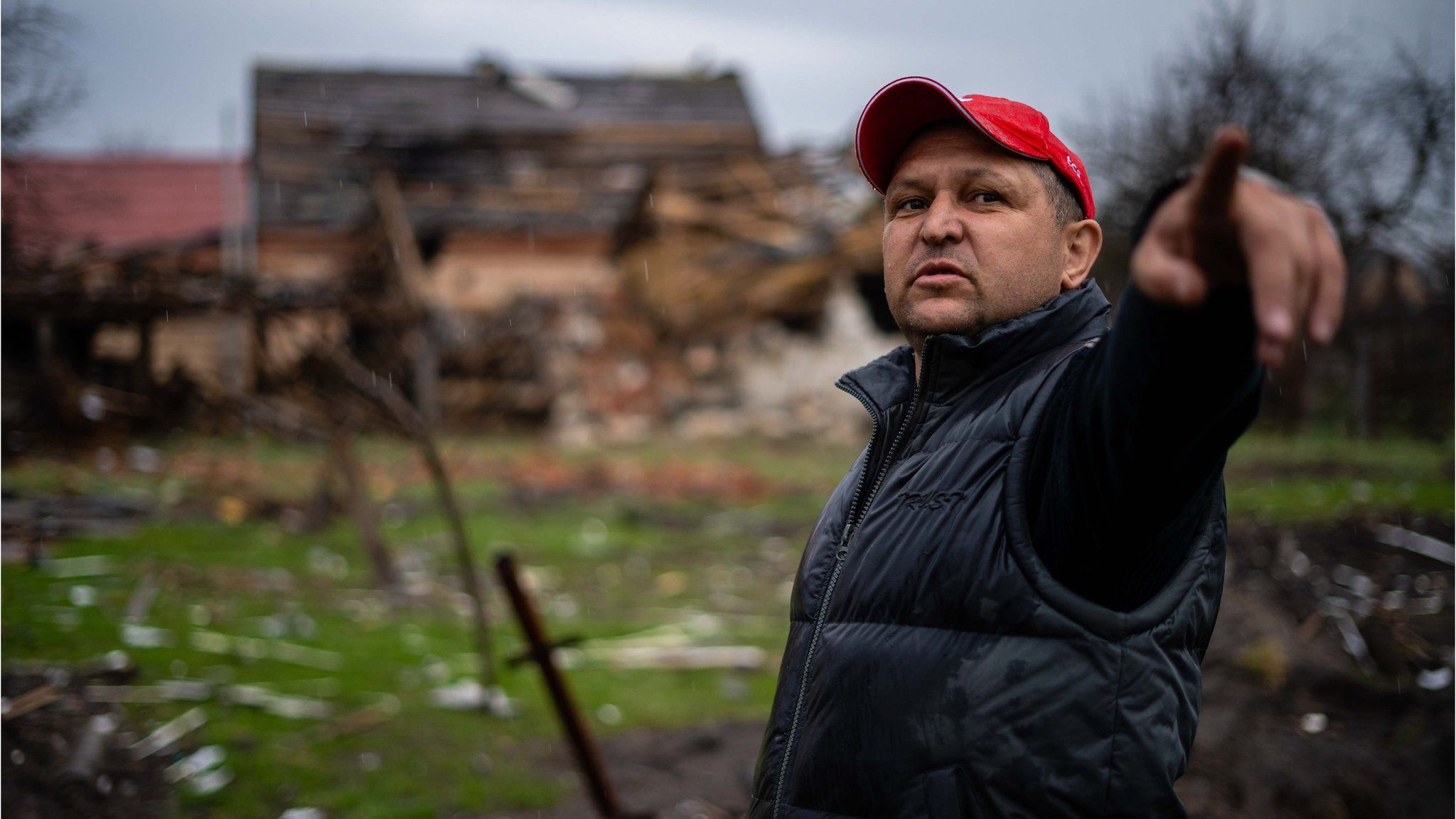
Three days into Russia’s invasion of Ukraine, a huge 10-mile (15.5km) line of armoured vehicles was spotted by a satellite in the north of the country. The very same morning in Bucha, just outside Kyiv, 67-year-old Volodymyr Scherbynyn was standing outside his local supermarket when more than a hundred Russian military vehicles rolled into town. Both Volodymyr and the satellite were witnesses to a key part of President Vladimir Putin’s plan for a quick and overwhelming victory. They were also witnesses to its failure.
The western media called it a convoy. In reality, it was a traffic jam and a major tactical blunder. Forty-eight hours after that first satellite photograph, on 28 February 2022, the line of vehicles had grown to a colossal 35 miles (56 km) long. The vehicles were stalled for weeks. Then finally they retreated, and seemingly disappeared overnight.
What happened? Why did such a massive force fail to reach Kyiv?
A BBC team spoke to dozens of witnesses; including military personnel, national and international intelligence services, civilians, veterans, and the territorial defence, all of whom came into contact with the convoy. It also gained access to Russian maps and documents that shed light on what the plan actually was, and why it went so spectacularly wrong.
Satellite images of the convoy captured last year © 2022 Maxar Technologies
The first hours
The story starts on the first day of the war, in the north of Ukraine at its border with Belarus.
Stepping outside for his first cigarette of the day, 23-year-old Vladyslav from Ukraine’s 80th Air Assault Brigade saw a flurry of bright lights in the night sky.
“I remember watching the lights emerge from the whole forest. At first I thought they were car headlights. But then I realised they were Grads [self-propelled multiple missile launchers]. They were firing at us.”
Camped deep within the forest of the Chernobyl exclusion zone, Vladyslav’s unit was on patrol when the first Russian vehicles crossed into Ukraine.
“The whole earth was shaking. Have you ever been in a tank? There’s no other sound like it. It’s a powerful thing.”
As planned in the event of any attack, Vladyslav and the rest of the 80th brigade blew up the bridge connecting Chernobyl to the next big town, Ivankiv.
The Russians would be forced to waste time building a replacement pontoon bridge, giving Vladyslav and his unit time to pull back to Kyiv.
“At first I was surprised, why didn’t we stop them there in Chernobyl? But we needed to learn about our enemy. So that’s what we did.”
This close to the Belarus border, the Ukrainians could not afford to open fire and risk starting another conflict. Their priority was to first understand Russia’s battle plan, before sending their troops into the line of fire.
Putin’s master plan
What Vladyslav saw were the first vehicles of what would become the convoy.
Contrary to many media reports at the time, the 35 mile-long (56 km) column was in fact 10 separate Russian tactical battalion units, according to the Ukrainian Armed Forces.
The Russian army also attacked Ukraine in the east and south, but the mission for these 10 units was specific – enter Ukraine from Belarus, overthrow Ukraine’s capital city and remove the government. In military terms: a decapitation attack.
One Russian document, seen by the BBC, shows a timetable for the plan. After the first battalion crossed into Ukraine at 04:00 am on 24 February, their orders were to advance straight to Kyiv arriving by 14:55.
Several of the battalions were to advance to Hostomel, just north of Kyiv, to back up the troops who’d been airlifted in to secure the airport.
The rest were to head straight into the centre of Kyiv.

Luibov Demydiv (R), a pensioner from Demydiv, points on the map to where she saw the convoy circling after a bridge was destroyed, stopping their advance
The assault heavily relied on two elements – secrecy and speed.
According to the Royal United Services Institute (RUSI) (a UK-based security think tank) by keeping plans about an attack on the capital under wraps, Russian soldiers could outnumber the Ukrainian forces by 12 to one in the north of Kyiv.
However, Putin’s secrecy came at a cost. So successful was his deception, even most of his commanders did not receive their orders until 24 hours before the invasion.
On a tactical level, this left them vulnerable. They lacked food, fuel and maps. They were without proper communication tools. They had insufficient ammunition. They were even ill-prepared for the winter weather.
Kitted out with the wrong tyres and surrounded by snow, the Russians drove straight into a mud bath. Civilians close to Ivankiv describe Russian soldiers telling Ukrainian farmers to help pull their tanks out of the sludge.
Unable to progress, the Russian vehicles needed to divert to paved roads in order to avoid soft ground, forcing thousands to group into a single column.
But with limited communication between the battalions, they almost immediately converged into one almighty traffic jam.
As one military expert on the ground put it: “You don’t ever travel into hostile territory in a long convoy. Ever.”
Based on witness testimony and intelligence from the Ukrainian military, we were able to map the ground the convoy covered in the time between the outbreak of war and the end of March. By avoiding travelling across fields, vehicles ended up on most of the main roads north of Kyiv.

By the time the column had grown as long as 35 miles (56 km) it included up to 1,000 tanks, 2,400 mechanised infantry vehicles and 10,000 personnel, as well as dozens of supply trucks carrying food, fuel, oil and ammunition.
Stalled north of Kyiv and running out of food and fuel, the Russians had also underestimated their adversary.
A united resistance
For three days Volodymyr Scherbynyn and his fellow volunteers, the majority of them pensioners, had been preparing for the arrival of the convoy in their hometown of Bucha.
Armed with one machine gun between the 12 of them, they took down all the road signs, built checkpoints, and prepared hundreds of petrol bombs.
Until finally, on Sunday morning the Russian tanks rolled into town.

Maksym (L) Volodymyr (C) and ‘”the colonel” (R) stand in front of their bombed out office for local volunteers
For nearly 30 minutes, Volodymyr and his grassroots unit battered the tanks with what little they had.
“We set two of the vehicles on fire and slowed down the whole convoy,” says Volodymyr.
But then came the retaliation.
“When they saw us throwing bottles they opened fire,” says 30-year-old Maksym Shkoropar. “I was a barman. I didn’t have any military training.”
By the end of that half hour, every one of Volodymyr’s party had been shot and evacuated to hospital.
But even from the sick bay, Volodymyr kept on fighting – receiving and cross-checking sightings of the convoy from civilians all over the Kyiv region and calling them in to the Ukrainian authorities.
On the other end of the line was 23-year-old local deputy governor for Irpin, Roman Pohorily.

Lawyer and councillor by day, Roman searches for Russian posts on social media by night.
He tells the BBC he didn’t sleep for three days.
“My colleague and I were manning the hotline at the council office, taking calls about the column, as well as saboteurs – people who were painting marks on the ground for the convoy to follow.”
A councillor by day, Roman is also an open source intelligence expert by night. Co-founder of the highly regarded website DeepState, he pools together social media and intelligence reports. He geolocates them, then reposts them on his website.
“On their way to Kyiv, the Russians were posting videos on social media. We reposted the videos to expose their movements. They were just showing off, but in doing so, they got busted.”
Most important during the assault on Kyiv, says Roman, was the sense of a united Ukraine.

Ukrainian volunteers distributing food
“Everyone was doing something. I admit it was very hectic in those first few days. But there were veterans helping civilians. Everyone wanted to defend their city.”
In towns and villages all across the region, hundreds of attacks took place against the convoy, from civilians armed with homemade weapons to mechanised infantry and artillery.
Outdated tactics
In stark contrast to the Ukrainians, the Russian forces repeatedly exposed their inability to make dynamic decisions on the ground.
“The Russians were all carrying large metal boxes marked ‘secret’,” says Vladyslav from the 80th Brigade. “We seized one during an ambush. We found their maps marked with their entire route. After that we knew their whole strategy.”
Their navigation tools were also woefully out of date. In the year since the invasion, the BBC has continued to find maps left behind by Russian troops that date back to the 1960s and 70s. Whole towns exist now that were not on the maps that they were using to navigate. We also found semaphore flags, a vastly outdated way to communicate between units.
One successful tactic by the Ukrainian resistance was to blow up bridges and dams ahead of the convoy, thus forcing the Russians to reroute. Reliant on old maps and with limited communications back to their high command, the Russian units frequently became paralysed by indecision.
Several satellite images show the Russian vehicles literally driving round and around in circles.

Occupation
Under pressure from Ukrainian air strikes and artillery, the Russian convoy was finally brought to a standstill just outside of Kyiv’s city boundary. For thousands of civilians living close to the stalled troops, the experience was horrendous.
“They robbed everything from everywhere. They emptied the shops,” says Vladyslav. “They also used civilians as human shields.”
What happened in many villages and towns to the north and west of Kyiv is still being investigated by numerous authorities, including the International Criminal Court.
After four long weeks the Russians finally started to withdraw.
Two of the largest remaining battalions were defeated close to Hostomel airport. Another 370 tented army trucks, seemingly abandoned in Zdvizhivka village, were destroyed by artillery.
The Ukrainian military kept on pushing them back until 19 March, after which the Russians began to retreat from Kyiv Oblast.
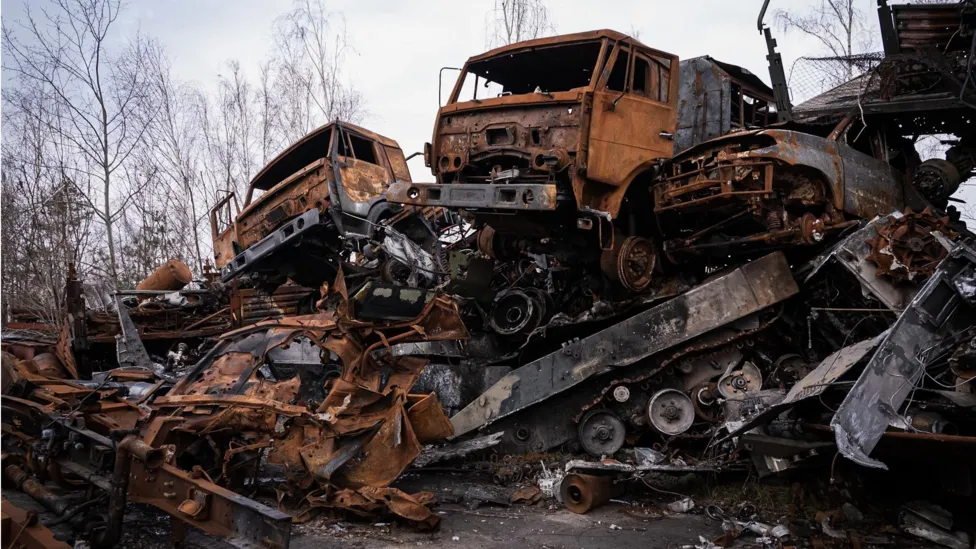
A graveyard of Russian vehicles from the convoy piled high in Hostomel
Russia is continuing to push into the eastern industrial heartland of Donbas, and strike in the south, in the direction of the Kherson and Zaporizhzhia regions.
Despite the speculation of a renewed attack on Kyiv, the majority of experts agree it would be unlikely as we have not seen a large-scale deployment of Russian troops to the Belarus border.
But still watching via reconnaissance drones close to the border, are the Ukrainian recruits.
“I’ll always remember that night in Chernobyl,” says Vladyslav. “When I went out to smoke with my friend. But by the time I’d finished my cigarette the war had started.
“My friend and I have this dream, that we will go on shift, just like we did that day, and as we smoke another cigarette we will hear that the war has ended. And that we won.”
Special thanks to Slava Shramovych, Marcus Buckley, Michael Whelan, Alastair Thompson, Ben Allen and Tim Coey.