Behold the target of the bigot in modern American society.
There is little tolerance on the political Left for white male gun owners.
Tolerance is the new holy gospel in America. Bigotry is the unforgivable sin of the Information Age. It doesn’t matter what good you might have otherwise accomplished, in the 21st century, if you can be painted as intolerant, you are an irredeemable reprobate.
Given the purported pervasive prevalence of bigotry in our society, I propose that we explore the holy dicta of tolerance as they relate to the traditionally conservative American gun owner. This stuff is important. Microaggressions can evolve into macroaggressions. If we tolerate bigotry, then we begin flirting with fascism. The next thing you know some yahoo will be trying to clone Hitler from a tooth fragment. Literally, nobody wants that.
Start With The Basics
Bigotry is formally defined as “intolerance of those who hold different opinions from oneself.” In the modern age, bigotry is the manifestation of innate animosity toward an individual or people group based upon their unwillingness or inability to conform to the bigot’s expected norms of philosophy, worldview, or behavior. Now, how might we recognize bigotry when confronted by it?
For starters, the offending behavior that drives the bigot must be harmless. I think we can all agree that a little innate disdain for Nazi death camp guards or serial murderers is both warranted and healthy. However, if the target of the bigot’s ire causes no discernible harm, then we must question the underlying motivations. Is the bigot driven by the furtherance of the public good, or is he actually trying to impose his will unfairly upon others? Such imposition reeks of rank imperialism and is obviously a throwback to a darker, more misogynistic and institutionally oppressive age.
The Landscape
Crime rates have been demonstrably falling since the 1970s, whilst rates of private gun ownership have been skyrocketing. Cherry-picking statistics and fixation on isolated tragedy can indeed drive a false narrative. However, statistically speaking, the reality is that America has become steadily safer as we have become ever better armed. It is simply that egregious examples of violence are now pumped into our pockets via our phones where, in decades past, we lacked this capacity.
In the wake of the 9/11 terrorist attacks, America saw a drastic rise in concealed carry. In 2017, there were 17,251,354 concealed carry permit holders in the United States. In a nation with a population of 328 million, that is roughly one in twelve adult Americans. Considering half of the 50 states also now allow some form of permitless carry the absolute number of Americans wandering about armed in public staggers the imagination.
In 1980, the rate of overall property crime in America was 5,400 incidents per 100,000 people. Today, the number is less than half that. These same trends hold true for burglary, larceny, auto theft, and murder. The media will not tell you that because a demonstrably safer world doesn’t earn clicks.
The Very Definition Of Bigotry
With the assistance of biased and complicit media, Leftists control the presidency as well as both houses of Congress. Among their published legislative priorities is the re-enactment of an assault weapons ban, a ban on standard-capacity magazines, and sweeping restrictions on gun ownership. All this is in the face of demonstrable reductions in crime rates since the 1980s.
Thirty-two percent of American adults admit to owning at least one firearm. It follows that 68% of American adults are, therefore, not gun owners. That makes gun owners in America a statistically significant minority. Of those 66,921,246 gun owners, at least 66,910,242 are not criminals. Why then should there be such abject animosity directed toward this one people group by those who do not share their worldview? Is that not the textbook definition of bigotry?
Ruminations
I once heard a CEO pontificate that the only thing she would not tolerate was intolerance. I came to appreciate later that what she actually meant was that the only thing she would not tolerate was anyone who did not conform to her standard of normality. Tolerance is a one-way street in America. You can sleep with road kill and be considered some sort of protected minority. However, in certain circles, if you admit to being a white hetero gun-owning Christian, you are viewed as some kind of malevolent leper. Ask me how I know this.
So the next time someone gives you a hard time about gun ownership, just politely state that you choose not to associate with bigots and move on. The oppression of law-abiding gun owners is the practical manifestation of institutional bigotry. Perhaps as a persecuted minority we could get some kind of special license plates or something. I’m not holding my breath.
Carlos Gove was good at what he did — making guns and shooting.
Gove was born in New Hampshire in 1817 but found himself in Denver, Colo., by the 1860s where he set up business as a gunsmith. Within a few years he developed a feud with a rival gunmaker, Morgan Rood, which grew so hot the men sniped at each other through the local papers of the time, questioning the other’s gun making and shooting prowess.
Gove retired in 1884, by now relatively wealthy and became active in local politics, serving on Denver’s police, fire, and sewer boards. He was the first president of the Denver Rifle Club.
In the early 19th century, the frontier was west of the Appalachian Mountains. Rifles were long-barreled, and weight wasn’t a concern in the woodlands of the eastern United States. As settlers pushed west, the rifle changed. It was less about fancy furniture on the gun and more about its functionality.
“The man on the prairie wanted more of the purchase price put into range and power and less of it into thin patch boxes and curly wood which couldn’t survive a fall from a pitching mustang,” wrote Charles E. Hanson in “The Plains Rifle,” published in 1960.
This George Feder signed incised carved flintlock American longrifle that sold in Rock Island Auction Company’s May Premier Auction has a 46 1/2 inch barrel longer than American Plains rifles.
Settlers wanted a gun with the power to stop a grizzly bear or buffalo, not just a deer or rabbit, bringing about the popularity of the “plains” or “Hawken” rifle that bore the name of famous gunmaker brothers Jacob and Samuel Hawken, who set up shop in St. Louis from 1825-1840.
Samuel Hawken passed on the business to his son William who worked out of the Denver area for a time.
This Half stock percussion rifle with signed S. Hawken St. Louis marked barrel is trending toward a shorter barrel than the long rifle but is 37 inches long.
Carlos Gove’s Early Years
Gove left home at 16 and went to Cambridge, Mass., where he worked in a brickyard for a couple of years before becoming an apprentice to a Boston gunsmith. In 1837, he enlisted and became an Indian fighter.
Gove was assigned to the First U.S. Dragoons and saw action in the Seminole campaigns in Florida before transferring to the Second Dragoons on the western frontier, and finally mustered out in 1840 at Fort Leavenworth, Kans.
He took on the job of blacksmith through the Office of Indian Affairs, serving the Chippewa, Ottowa, and Pottowtomie Indians at Council Bluffs. Gove found the work wanting. The Pottowatomie asked that he serve as a private gunsmith for the tribe.
This large engraved Plains style single shot percussion pistol is attributed to Carlos Gove when he was working as a gunsmith in St. Joseph, Mo. It was sold by Rock Island Auction in December 2014.
Gove soon became restless, moving to St. Joseph, Mo., where he opened a gunshop in 1852. Two years later he returned to Council Bluffs, Iowa. When the Colorado gold rush hit in 1859, Gove saw an opportunity. He bought 20 tons of supplies and six wagons in 1860 and went west where he sold his goods before returning to his family at Council Bluffs.
He did the same thing the following year but found the grocery business too competitive. Instead, he returned for his wife and children and moved them to Denver. His first shop was on Blake Street between E and F streets in 1862.
This engraved A. Wurfflein half-stock percussion rifle with gold inlaid breech bands is a good example of a plains rifle with a 30 7/8 inch barrel.
Morgan Rood
Morgan Rood, Gove’s Denver rival, also hailed from the east, born in Rochester, N.Y. in 1816. He worked for several area gunsmiths before moving to Michigan in 1841. After moving around Michigan a few times and divorcing two wives, he set out for the California goldfields in 1858. He landed in Denver where he set up shop in 1862, about the same time as Gove.
Gove and Rood were the largest gunsmiths in Denver during the Civil War.
Shooting Feud
Gove didn’t use tobacco or alcohol but he was addicted to trash talking.
Both men were fine shots with Gove perhaps better at short range while Rood excelled at long range. An early shooting match left hard feelings and by 1866 the feud was no longer simmering. It became a war of words in the pages of the “Denver Gazette” and the “Rocky Mountain News.”
Rood wrote in the “News” that he challenged Gove to a match and accused the gunsmith of cheating.
“I am near-sighted, and will acknowledge his eyes and skill in open sight shooting superior to mine, also his nerve, experience, or judgment in a wind, and he is clear ahead of me in skullduggery and foul play,” Rood wrote.
Gove accused Rood of paying a man to throw a shooting match, selling gunpowder to Native Americans, having two wives, and being “not fit to work in a first class shop or to handle a good gun.”
In the newspaper, Rood denied all of the accusations, saying it was a subordinate who made the powder sale while he was out of the shop, that he was properly divorced from his former wives, and “As for my workmanship I can do as fine a job on the outside, and a better job on the inside of a gun than this blowhard.”
Despite their bitter exchange, there was never a direct shooting match between Rood and Gove. The two competed in local fairs and expositions. Rood won first prize at the Colorado Agricultural Society Fair in 1866.
By 1874, Rood lost interest in gunsmithing and was physically affected by a stroke that made it impossible to shoot or hold smithing tools. He died in 1881.
An advertisement for Carlos Gove’s gunshop and a photo of the man himself.
Carlos Gove’s Business
Considered a skillful gun maker who produced super-accurate rifles, Gove partnered in 1872 with another respected gunsmith, John Lower, as well as a son-in-law to make their “Denver Armory” one of the largest firearms makers in the West. The partnership lasted until Lower departed in 1875. Gove made two types of guns, muzzleloaders made entirely by him, and alterations to later cartridge rifles.
Gove’s percussion guns were hunting rifles, target rifles, and shotguns. He made few pistols since the guns needed on the Denver frontier were mostly for hunting and protection. Buffalo Bill Cody was a customer of Gove’s.
This Colt 1871-1872 Open Top revolver, a precursor to the Single Action Army shipped to Carlos Gove’s Denver gunshop in 1874, two years before Colorado statehood. It realized a price of $47,000 in the May 2021 Premier Auction.
Rock Island Auction recently sold a Colt 1871-72 Open Top revolver, the precursor to the Single Action Army, shipped to Gove’s shop in 1874, two years before Colorado statehood.
Characteristics of Gove’s guns included heavy buttstocks with an oval cheek piece on the left, heavy iron “Kentucky” style butt plate, a key fastened fore end with pewter tip, and a hickory ramrod retained by an iron rib and thimbles.
In 1865, Gove’s shop advertised Henry and Spencer rifles, Hawken rifles as well as Colt, Remington and Smith & Wesson for sale and “guns made to order.”
His alterations to other commercially-available guns were adding his style of stock and cleaning rod, mostly to Remington and Sharps models.
Gove’s business also included selling guns made by others including Hawken and Sharps. In the 1870s, Gove’s armory was the largest dealer of Sharps rifles west of the Mississippi River. Before he retired, Gove sold more than 1,000 Sharps, mostly plains hunting and military rifles.
Carlos Gove was a prolific seller of Sharps rifles, selling more than 1,000 during his career, like this Model 1874 Hunters rifle that Rock Island Auction sold in December 2016.
“It is doubtful if any man in the West sold more firearms than Mr. Gove and many of those that he sold were of his own make,” wrote Ned H. Roberts, the author of “The Muzzle-Loading Cap Lock Rifle. “His sole amusement was hunting and rifle-shooting and rest shooting with the heavy muzzleloading rifle.”
At its peak, Gove’s gun shop employed seven full-time gunsmiths as well as 25 to 30 other employees. He sold the business in 1884 and went into municipal politics. Gove died in 1900.
Among the gunsmiths Gove employed were: J. M. Hamilton, C. R. Sieber, George Schoyen, Olaf Schoyen, Patrick Hand, Almon Dibble, and Anslow Buhlmier. Schoyen taught A. W. Peterson, who opened his gun shop in 1886. Peterson sold his store to Leighton Baker in 1953. Baker moved the A.W. Peterson store to Mount Dora, Fla., where it still operates.
Peterson made about 600 to 700 rifle barrels in his career. Around the time of World War I, he spent time in Utah with the Brownings to assist in the development of their 1917 machine gun. Peterson is credited as the inventor of the bottom ejection principal in pump action guns. Remington asked permission to use it in their guns which Peterson gave without requesting anything in return. Like Gove, Peterson was also a competitive shooter.
This percussion American Plains rifle made by legendary gunsmith Carlos Gove is on offer in Rock Island Auction Company’s June 22-24 Sporting and Collector Auction.
This half stock American Plains rifle is in parts and requires a number of minor and major replacement parts that should attract someone interested in working on and restoring an historic firearm, just like Gove would’ve wanted.
Made by legendary gunsmith Carlos Gove in his prime from 1862-1884, this American Plains rifle is an opportunity to latch onto a piece of 19th century Americana from the early days of Denver and Colorado and Rocky Mountain fur trade, made by a man who was an Indian fighter, frontiersman, and embodiment of the American entrepreneurial spirit and make it your own. The Carlos Gove made Half Stock Percussion American Plains rifle is available in the June 22-24 Sporting and Collector Auction.
To learn more about the men who made the guns that made the west and the men and women who carried them, subscribe to the RIAC newsletter and YouTube channel.
Sources
“The Feuding Gunsmiths of Denver,” by Frank M. Sellers
“The Muzzleloading Cap Lock Rifle,” by Ned H. Roberts
Hunting dangerous game requires a cartridge of substantial size, one powerful enough to handle those species that have the potential to turn the tables. There are those who find the lighter cartridges—the 9.3mms and .375s—to be the pinnacle of versatility, because they offer trajectories similar to some of the popular deer cartridges, such as the .308 and .30-06, yet carry enough horsepower to handle even the largest game.
And then there are those who feel that anything smaller than the .500 Jeffery or .500 Nitro Express is a waste of time, because no smaller cartridge could possibly stop a charge. I feel that somewhere in the middle lies the best balance of trajectory, striking power and ease of shooting—those lower .40-caliber cartridges.
Yes, the .various .450s , .470s, .475 and their clones work great. After all, the .450 Nitro Express set the benchmark for dangerous-game cartridges—but their trajectories give up a considerable amount to those lower .40s. And, in comparison to the .375s and 9.3mms, the bullet weight (along with correlative energy) of these lower .40s makes a definite difference when it comes to penetration.
Am I suggesting that cartridges such as the revered .375 H&H Magnum aren’t sufficient for dangerous-game hunting? No sane gun writer would ever put those words in print, and I’m a longtime proponent of the .375. But even with the 350-grain Woodleigh Weldcores, the .375 H&H doesn’t quite hit as hard as the .40s do.
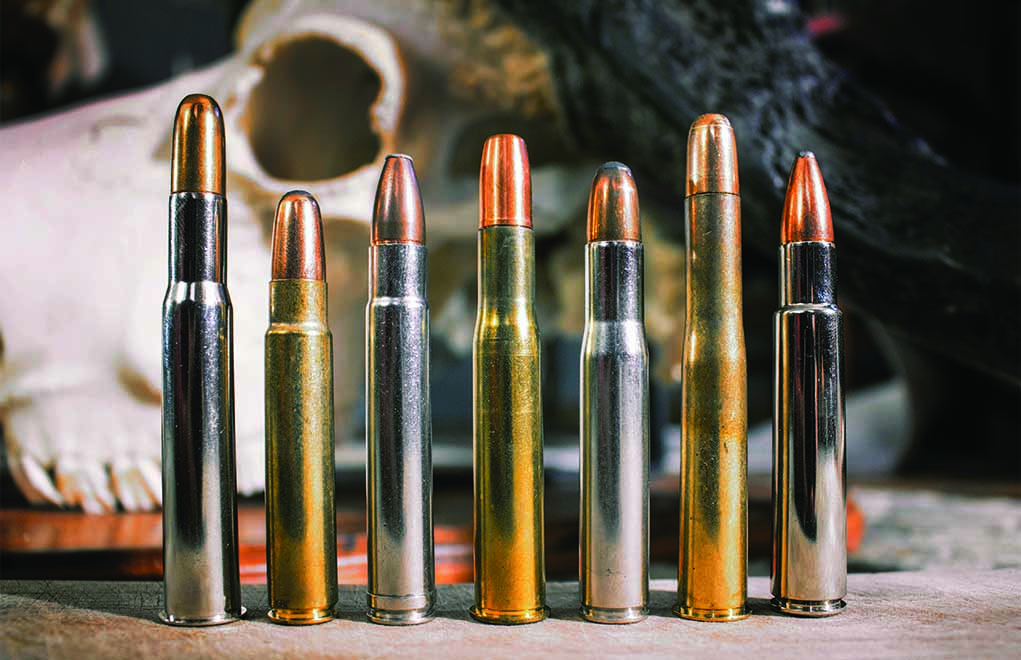
Here’s the crop of the lower .40-caliber cartridges, including their strengths and weaknesses.
.405 Winchester
Starting with the least potent of the lot, the .405 Winchester is a straight-walled cartridge released in the Model 1895 Winchester lever-action rifle. It was a particular favorite of Theodore Roosevelt, who dubbed it his “medicine gun” for lions.
Launching a 300-grain, .411-inch-diameter bullet at 2,200 fps for slightly more than 3,200 ft-lb of muzzle energy, the .405 Winchester is definitely light, especially in comparison to the .375 H&H with heavy bullets. Roosevelt used this .40-caliber on lions and other game on his 1909–1910 safari and obviously lived to tell the tale, but I’m of the opinion that there are much better choices.
.450-400 3-Inch Nitro Express
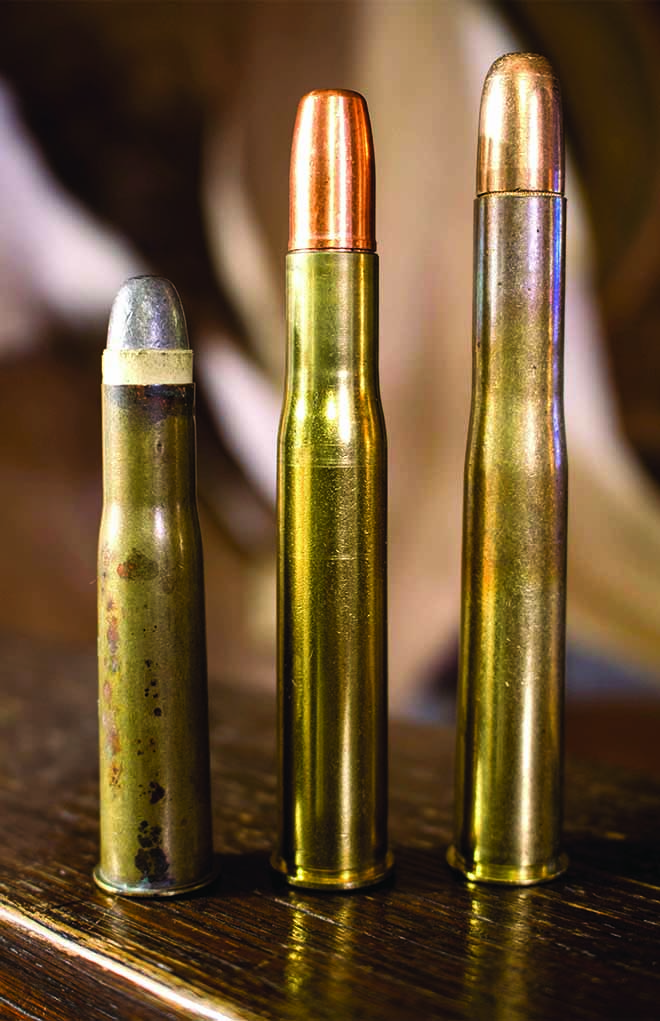
Three variations of the .450-400 theme: the 2 3/8-inch; the 3-inch NE; and the 3¼-inch NE.
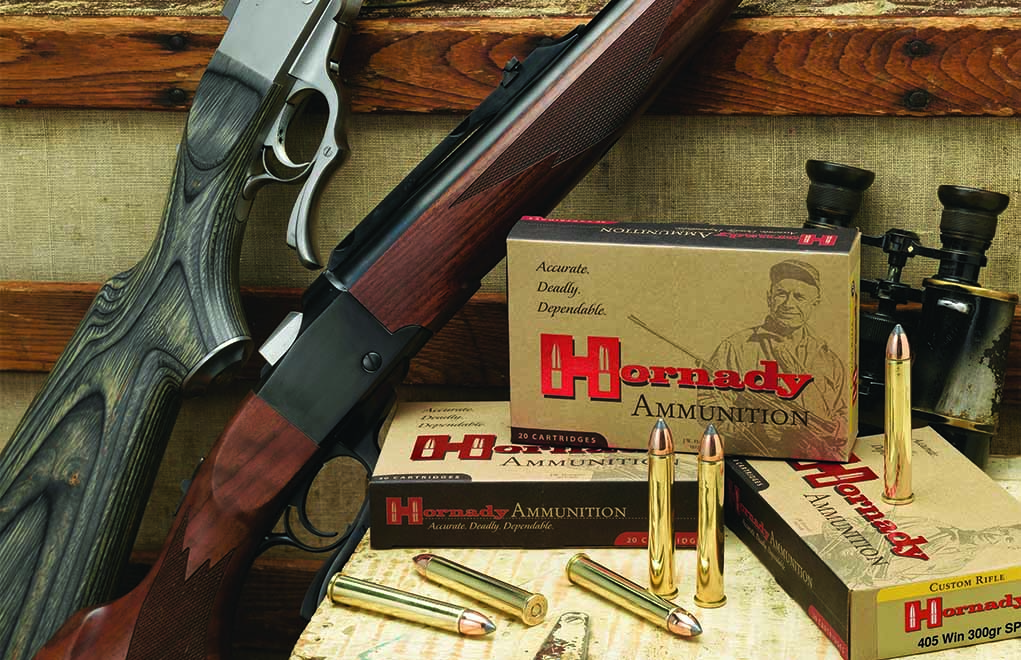
The .450-400 (the British naming system uses the parent cartridge first) has gone through several iterations, at various lengths (2 3/8 inch, 3 inch and 3¼ inch) and has been fueled by black powder and smokeless alike. The 3-inch variant has been the most popular with many new double rifles, as well as the Ruger No. 1 single-shot, with ammunition produced by Hornady.
Using a .410-inch bullet, the classic .450-400 3-inch load consisted of a 400-grain bullet at 2,050 fps for 3,732 ft-lb of energy. While its paper ballistics indicate that the .375 H&H 300-grain load has more energy (4,263 ft-lb. vs. 3,732 ft-lb), the heavier bullet weight of the .450-400 gives it an advantage in the field.
The old .40-caliber cartridge (released in 1902) was used by Jim Corbett for tiger and leopards in India, as did John “Pondoro” Taylor in Africa. I used this excellent cartridge for a handsome Cape buffalo in Mozambique. It remains a great choice for a light-recoiling double-rifle cartridge capable of handling all game, including elephant. The .450-400 3-inch is also known as the .400 Jeffery.
.400 H&H Magnum
An obscure offering from Holland & Holland, this .40-caliber is usually revered by its users. Based on the belted .375 H&H case, using an 8-degree shoulder and the .411-inch-diameter bullets of the .450-400, the .400 H&H hasn’t really caught on. Yet, pushing a 400-grain bullet to 2,375 fps is a recipe that’ll most certainly have great success in the field. While I think the ship has sailed, there’s nothing wrong with using a .400 H&H for all dangerous-game hunting.
.416 Rigby
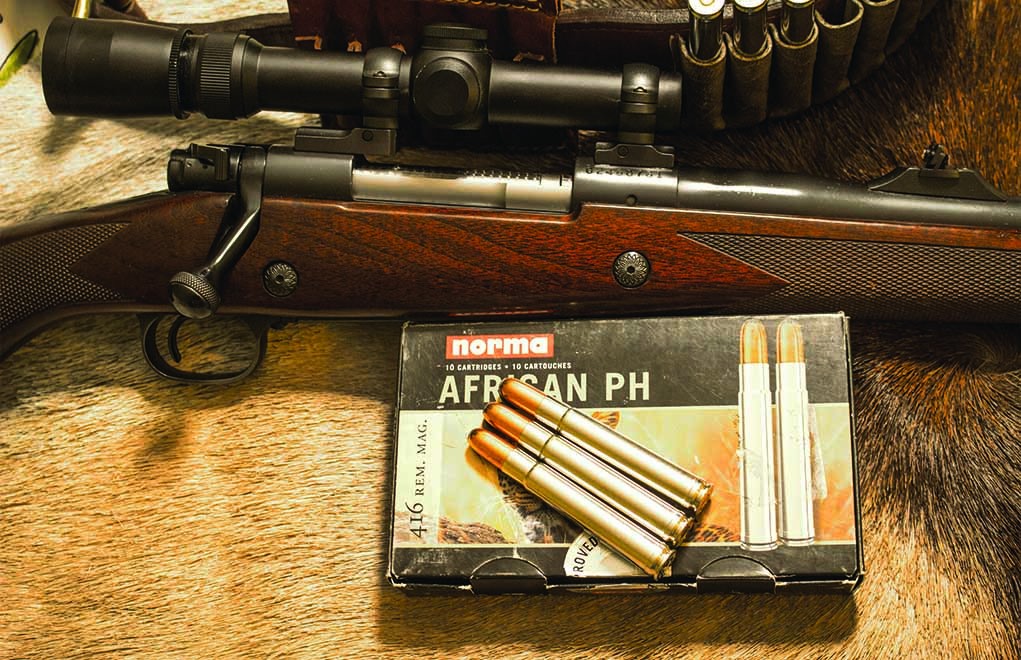
With its voluminous case and a 45-degree shoulder, the .416 Rigby is an absolute classic.
An undeniable classic, the .416 Rigby was released in 1911. Although fewer than 200 rifles were made up until World War II, the writings of Robert Ruark and John Taylor immortalized the cartridge. Simply put: The 410-grain bullet of nominal diameter at 2,370 fps (modern loads use a 400-grain bullet at 2,350 or 2,400 fps) offered more than 5,000 ft-lb of muzzle energy—and virtually unequaled penetration—due to the high sectional density.
Kenyan professional hunter Harry Selby procured a Rigby rifle in .416 Rigby when his .470 double was accidentally run over, and Robert Ruark’s Horn of the Hunter made both the man and cartridge famous. The .416 Rigby is a huge rimless case with a 45-degree shoulder. The case volume is a direct result of the volatility of cordite in the African and Indian heat in order to keep pressures low.
Its recoil, while higher than that of the .375 H&H, is manageable in a well-fitting rifle. And although the volume of the .40-caliber’s case is more than is probably needed with our modern powders, the pressures are low—and that isn’t a bad thing. The .416 Rigby is a flat-shooter, yet it hits like a freight train. To fit properly, a magnum-length receiver should be employed.
Rigby has recently announced the release of the .416 Rigby No. 2, a rimmed version of the classic .416 Rigby that’s built for double-rifles. It shares the same geometry (except for the rim), and its ballistics are nearly identical.
.416 Remington Magnum
The 1980s saw a revival of the .416-inch-bore diameter: Federal brought back the .416 Rigby, and Remington introduced its .416 Remington Magnum, which is officially based on its 8mm Remington Magnum case (but the .40-caliber more than resembles the wildcat .416 Hoffman). Using the belted .375 H&H case as a platform, the .416 Remington Mag duplicates the ballistics of the .416 Rigby, but in a smaller diameter case and at a higher pressure.
The .416 Remington Magnum duplicates the performance of the .416 Rigby—albeit at a higher pressure … but in a smaller case.
The cartridge received some negative press early on, but in a high-quality, controlled-round-feed action, this cartridge is nothing shy of amazing. With the exception of those who’ve handloaded the Rigby case to the red zone, the Remington variant will match the performance of the older cartridge. Yes, its belt is unnecessary; and yes, the pressure is higher than some shooters like, but in the field, I doubt any animal could ever tell the difference between a Rigby and Remington. It shares the same case length as the .375 H&H and fits perfectly in a magnum-length action.
.416 Weatherby Magnum
It was 1989 when Weatherby adapted its big, double-radius case to the .416-inch bore, with the signature increase in velocity in tow. Weatherby’s .416 will push a 400-grain bullet to 2,700 fps, with a correlative recoil level. Of the .416s, I’d say the Weatherby is the least popular, although as with many of its other cartridges, its fans are fervent. With premium bullets, the .416 Weatherby will certainly handle any game that walks the Earth.
.416 Ruger
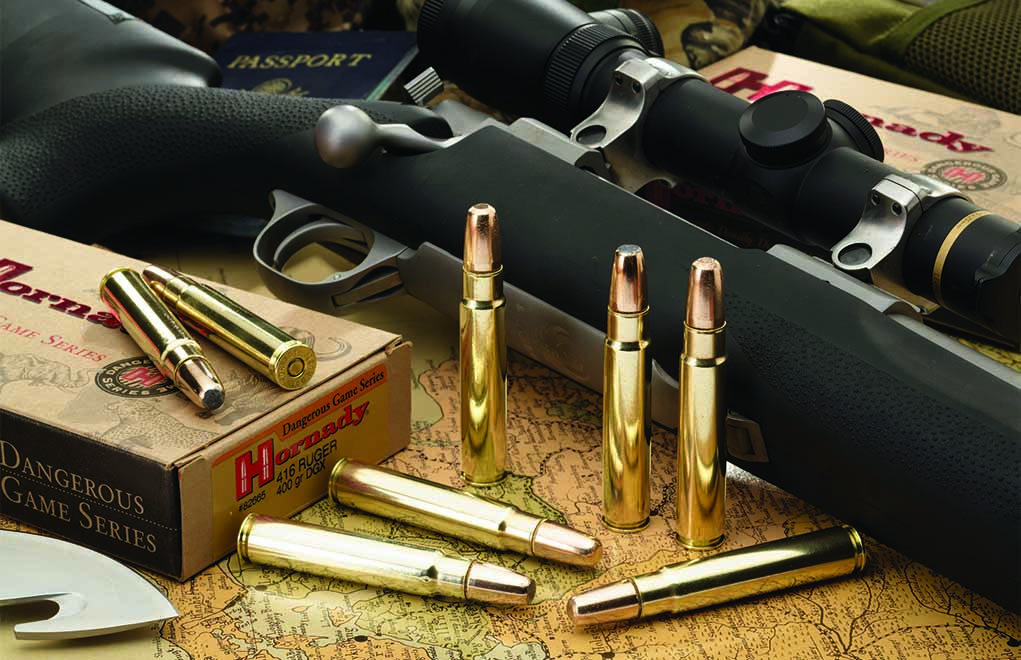
In 2008, the joint effort between Hornady and Ruger was expanded to include the .416 Ruger—a beltless case designed to fit in a long-action receiver, matching the velocity of the Rigby and Remington cases. Chambered in the Ruger Hawkeye African rifle, the .416 Ruger is affordable, effective and, for reasons I can’t quite explain, remains an unpopular choice.
Affordable and effective, the .416 Ruger will cleanly take any and all game animals.
The design is certainly sound: In both factory ammunition and handloaded stuff, I’ve seen nothing but good results from the .416 Ruger. Even so, perhaps it’s the fact that only Hornady provides ammunition; or perhaps the .40-caliber lacks the “look” of power. Nevertheless, rest assured that the .416 Ruger brings the goods.
.416 Taylor
A wildcat based on the .458 Winchester Magnum and necked down to hold .416-inch bullets, the .416 Taylor is a solid design. DoubleTap has offered factory ammo for it in the past, but it remains a handloaded proposition. However, the .416 Taylor (developed in the 1970s by Bob Chatfield-Taylor) will come close to the Rigby benchmark, driving a 400-grain bullet to 2,350 fps. Donor brass is readily available; and, with a good set of dies, you end up with a belted case that fits perfectly in a long-action receiver.
.500-416 Nitro Express
The .500-416 NE is a rimmed cartridge perfectly suited to double-rifles.
This modern rimmed case from Krieghoff uses a 3¼-inch case to push a 400-grain, .416-inch bullet to 2,300 fps and makes a solid choice for a hunter who wants a double-rifle in .40-caliber. Compared to the venerable .450-400 3-inch NE, it has a definite advantage in terminal ballistics and an increase in recoil. Popular in the Krieghoff doubles, the .500-416’s popularity has waned as of late; and, with the introduction of the .416 Rigby No. 2, I expect that trend to continue.
.404 Jeffery
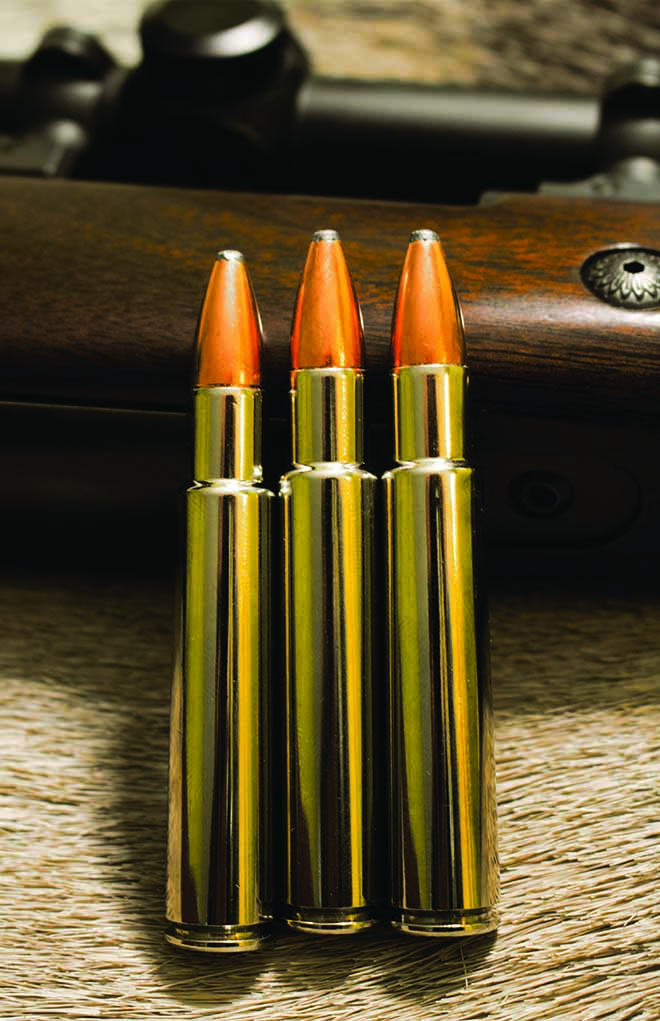
The slender shoulder of the .404 Jeffery allows for a very smooth -feeding rifle. Loaded with premium 400- or 450-grain bullets, the Jeffery can nearly equal the ballistics of the .416 Rigby and Remington.
This has become my personal favorite of the lot. According to the best evidence available, it was released in 1905, and although the .416 got the glory, the .404 did the work. The .404 Jeffery uses a 400-grain bullet of .423-inch diameter, with the original load leaving the muzzle at 2,150 fps and modern loads ramping up that figure to 2,350 fps. This puts it in the same league as the .416 Rigby, Remington and Ruger.
Modern bullets have made this .40-caliber even better. If I were forced to pick a single cartridge-and-bullet combination for all my dangerous-game work, it’d be my .404 Jeffery, loaded with 400-grain Woodleigh Hydrostatically Stabilized Solids to 2,280 fps. This combination has accounted for elephant, buffalo and all sorts of plains game animals at ranges from 16 to 225 yards.
.425 Westley Richards
The .425 Westley Richards came onto the scene in 1909, using a .435-inch-diameter, 410-grain bullet at 2,350 fps for slightly more than 5,000 ft-lb of muzzle energy. The design used a severely rebated rim in order to use the standard .473-inch bolt face of the 98 Mauser, as well as the stripper clips to facilitate fast reloading.
The issue posed by the rebated rim was the tendency for the bolt face to ride over the rim and onto the case body, causing a feeding malfunction. While it’s a unique cartridge, the .425 isn’t incredibly popular, and Kynoch is the only ammunition provider … when this ammo is available.
Compare and Contrast
Looking at the performance level among the .375s, lower .40s and the .45s, using 300-, 400- and 500-grain bullets, respectively, you’ll see the trajectories of the .40-calibers staying very close to that of the .375s, where the .45s drop off quite a bit more.
Yes, the .45s have more weight and a greater frontal diameter, but the energy figures between the lower .40s and the .45s aren’t radically different: They both have roughly 1,000 more ft-lb at the muzzle than do the .375s. And, I’ve found there’s a definite ramp-up in recoil when you go to the 500-grain, .45-caliber cartridges, which run at 2,150 fps and upward.
The beauty of the .375s is found in the wide selection of bullet weights (235 to 350 grains). However, the .40s aren’t exactly married to the 400-grain bullet—although it’s the most popular. There are bullets for these cartridges ranging from 300 to 450 grains.
Sectional Density
The classic cartridges—those that made their reputations before World War II during the “golden age of the safari”—all used a bullet with a sectional density greater than 0.300. While our modern bullet construction has lessened that requirement, the premium bullets of traditional weight extend the performance of these cartridges.
The 400-grain bullet for the .450-400 3-inch—the smallest diameter of the lot—has a sectional density of .340. The 410-grain .425 Westley Richards bullet—the largest—has an SD of .310. All have the desired length for a proper dangerous-game cartridge.
Choosing Yours
The choice of one of these .40-caliber cartridges is as subjective as choosing a deer cartridge. Of the cartridges listed, each has their merits. The .416 Rigby and .416 Remington are the most popular, followed by the .404 Jeffery. In spite of its lower velocity, the .450-400 3-inch remains the most popular of the rimmed cartridges—although I predict the .416 Rigby No. 2 will gain ground over the next decade.
If it’s affordability and availability that concerns you, the .416 Remington might be the best value. However, I’ve become enamored of the .404 Jeffery. But with the exception of that .405 Winchester, any of these cartridges will make you a happy hunter.
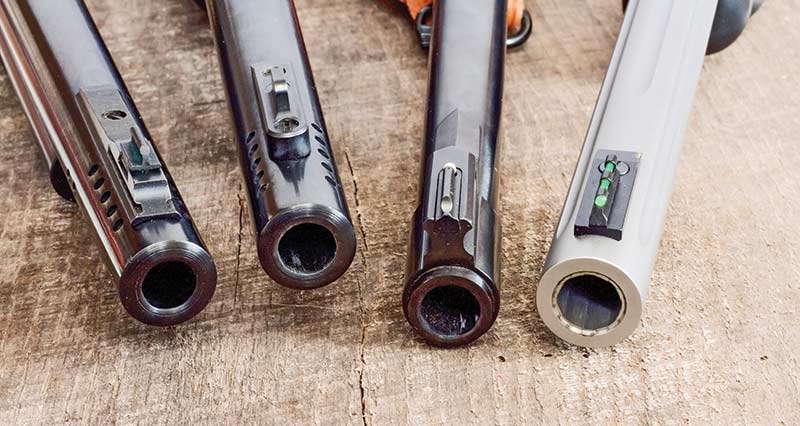
Here’s the “hole” story on the “Fearsome Foursome.” Big bores mean
big bullets! Left to right: The .444 Marlin Outfitter, .45-70 Marlin Guide Gun,
Ruger .475 Linebaugh #1 and lastly, a T/C Encore with .500 S&W Katahdin carbine barrel.
I like big holes, especially at the end of my barrel! Big holes mean big bullets. Big bullets make big holes in things, so there’s no need to rely on expansion to get the results we want. Big holes make things bleed faster and deflate lungs quicker, too. Two holes are better than one at incapacitating the creature we’ve perforated with a sucking chest wound.
Big, heavy, cast bullets have been doing these things for years … just ask any buffalo (actually American Bison). The bullets have a tendency to plow long, deep and straight due to something called momentum. It’s this simple concept that was so effective on Bison with such a
Big Bore, Heavyweight Blunt
Sounds like a motor cop, right? But these are traits we want for our hunk of lead, to be just as, or more effective than the latest controlled expansion, jacketed-bonded wonder bullet. There’s no question these bullets are good, but what fun is it buying them when we can make our own?
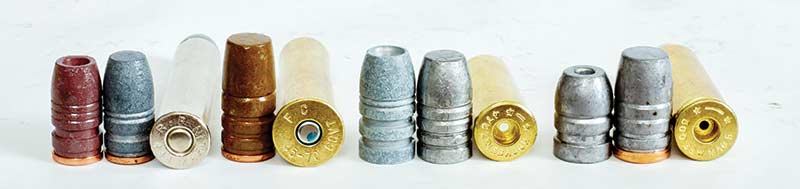
Powder-coated cast bullets next to their respective cartridge cases.
As crude as chucking a big hunk of lead is, it’s still very effective.
Big bullets make big holes.
Powder Coat Isn’t Powder Puff
Powder Coating is simply putting a polymer coating on our bare bullets instead of the “greasy kid stuff” we call bullet lube. By simply tumbling your bullets until covered with powder coat powder, you shake off the excess powder and bake your bullets. What you get is a coating sealing the lead projectile in polymer as it scoots down the barrel. I believe Powder Coating to be the best innovation since the humble gas check.
Cast Of Characters
I’m going to define Big Bore as anything over .40 caliber. My cast of characters are a Marlin .444 Marlin Outfitter, Marlin .45-70 Guide Gun, Ruger #1 .475 Linebaugh and lastly, a T/C Encore with a .500 S&W Katahdin carbine barrel. For simplicity and space sake, I’m going to cut to the chase and just list my pet loads I’ve used for years in some of these guns. So sit back, relax and take in the hole story of Big Bore carbines.
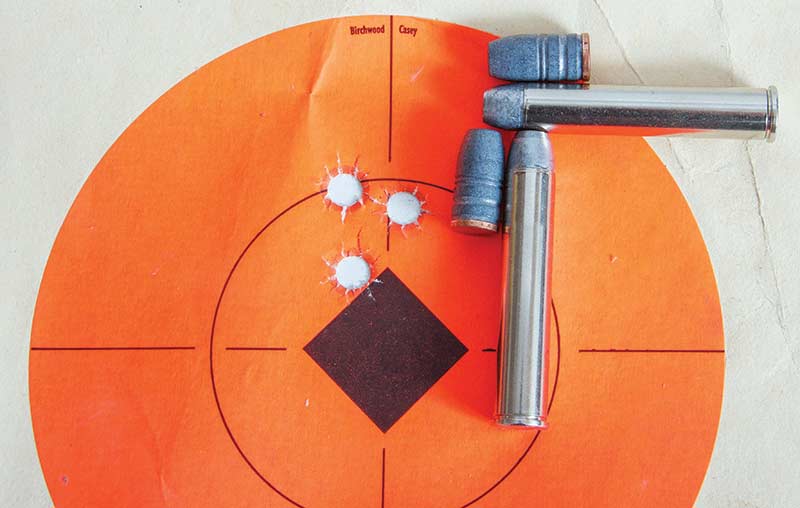
Typical group of Tank’s .444 Marlin at 100 yards.
.444 Outfitter
I started shooting the .444 Marlin about 25 years ago. Basically, it’s just a stretched out .44 magnum. What’s not to like? My favorite bullet is of LBT design and is listed as a 330-grain LFNDCGC design. Let me ’splain. LBT stands for Lead Bullet Technology, the LFN means long, flat nose, DC is dual crimp and GC is gas check. Piece of cake, eh?
These bullets are capable of shooting 0.75″ groups of 3 at 100 yards and I’ve done it regularly with many different Marlins in this caliber. For some reason, .444 Marlins are intrinsically accurate. When 330 grains of lead exits at 2,200 FPS, with this kind of accuracy, things drop when hit. Several deer have been pole-axed when hit by this combo. The 56 grains of Hodgdon H335 is my pet load.
.45-70 Marlin Guide Gun
When it comes to lever guns, the old war-horse .45-70 is one of my favorites. Draped in history, modern loadings give the .45 Government a whole new dimension. Pushing 400+ grain cast slugs over 2,100 FPS is pretty impressive for such an ancient cartridge. My favorite cast bullet is dropped from a cherished Rob Applegate brass mold throwing a 425-grain LWFNGC, or Long Wide Flat Nose Gas Check design.
The meplat is between an LFN and WFN. It is accurate and punches 0.460″ holes with each shot. The 50 grains of Alliant Reloder 7 is my pet load. Its 3-shot groups average around 1.5″ at 100 yards.
Ruger #1 .475 Linebaugh
The .475 Linebaugh gained legitimacy a few years back when factory ammo companies like Buffalo Bore and Hornady started loading for it. Lipsey’s, a large Ruger distributor, had a limited run of these rifles built.
Nothing’s better than carrying a classic single-shot rifle in the woods, the mere act makes a bold statement. It speaks of confidence and the ability to get it done with one shot, as it should be …
My favorite load consists of a 400-grain, powder-coated bullet dropped from a Lee 2 cavity mold retailing for under $20. How’s that for a bargain? I stuff the case with 24 grains of H110 sparked with a Large Rifle primer. From the Ruger, I get just under 1,500 FPS with all the accuracy I could wish for.
T/C Encore Katahdin .500 S&W
While the Ruger #1 is a classic beauty, the T/C Encore is beautiful in its own utilitarian way. The 20″ barrel break-open single-shot makes for a handy package perfect for thick woods hunting. Issued with a dandy peep sight and fiber optic front sight, the T/C Encore is fast pointing and accurate.
My favorite load consisted of a powder-coated, gas-checked cast bullet dropped from a Lee 2 cavity mold. Loaded over 37 grains of Hodgdon H110, velocity was around 1,700 FPS. The 5-shot groups at 50 yards with the factory peeps were around 1″.
‘Holesome’ And Handy
I enjoy shooting and hunting with this “Holesome” bunch of carbines. It’s fun shooting and I like not needing a spotting scope to see where your bullet impacts. There’s also a feeling of satisfaction shooting bullets you’ve cast, powder-coated and loaded yourself.
Your chest will swell and you’ll have to knock the smug look off your face with a grinder after shooting your own big-bore carbines with ammunition of your own making.