Month: October 2022
Lee-Enfield Rifle: The Long Arm of the British Empire and the story of Lachhiman Gurung

The Nepalese Gurkhas are legendary fighters who have served the British crown for generations.
 Lachhiman Gurung seemed an unremarkable sort. He stood all of four feet eleven inches tall when he left his village to buy cigarettes for his father and ended up enlisting as a Gurkha in the service of the British Empire on a whim. However, on May 12, 1945, deep in a Burmese jungle Lachhiman Gurung proved that sometimes some of the most remarkable stuff comes in compact packages.
Gurung’s fighting position was at the foremost vanguard of his unit’s defensive emplacements standing ready against a pending Japanese attack. When the Japanese came they led with 200 seasoned assault troops. In fairly short order Gurung was alone, the rest of his mates either dead or dying.

 Once the Japanese troops got within hand grenade range they began pelting Gurung’s position with grenades. Gurung picked up the first two and threw them back at his attackers. When he hefted the third it detonated in his hand, removing most of his right hand, blinding his right eye, and peppering his body and face liberally with shrapnel. Where most normal humans would have the good grace to just lay down and die, Gurung unsheathed his Kukri knife, shoved it into the ground at the lip of his foxhole, and announced to the Japanese that they would get no further than that knife. He then hefted his Lee-Enfield rifle, chambered a round with his left hand, and invited the Japanese to see what it was like to, “Come fight a Gurkha.”

At only 4 feet 11 inches tall, Lachhiman Gurung did not seem like a particularly imposing figure. However, behind a Lee Enfield rifle he wrought sheer havoc upon attacking Japanese forces despite grievous wounds.
The Japanese accepted Gurung’s offer. For the next four hours, Lachhiman Gurung ran his bolt-action Lee-Enfield rifle one-handed, setting the rifle down to work the bolt or reload with his left hand before taking it up again to kill more Japanese. When the Japanese got close enough to overrun his position Gurung would lay down, let them come in close, and then jump up to cut them down at point blank range, all the while running his bolt-action rifle with his single remaining hand.
When he was finally relieved, there were thirty-one dead Japanese soldiers in and around Gurung’s fighting position. He was heard by nearby troops shouting, “Come and fight! Come and fight! I will kill you!” in an effort at taunting the Japanese in closer. Lachhiman Gurung was awarded the Victoria Cross, Britain’s highest award for valor in combat, for his actions that night in the sweltering Burmese jungle. The fanatical defense of that forlorn combat outpost by a single Nepalese Gurkha, himself less than five feet tall, demonstrated to all involved that a single determined man with a rifle can be a formidable combat implement.
The Gun

The SMLE No 1 armed British troops throughout World War I and into World War II. Many Commonwealth soldiers used this reliable bolt-action repeater through the end of the conflict.
 The Lee-Enfield rifle was first adopted in 1895, and it soldiered on through a variety of marks until it was finally supplanted by the L1A1 variant of the FN FAL in 1957. More than 17 million of the guns saw service. Possession of a Lee-Enfield rifle marks one as a warlord of distinction in Afghanistan even today. Designed by a Scotsman named James Paris Lee, the Lee-Enfield superseded the Lee-Metford rifle. Its longevity in service is exceeded solely by the Russian Mosin-Nagant.
The Lee-Enfield in its sundry guises fed from a detachable ten-round box magazine. However, in action troops were trained to charge the rifle from the top via either loose rounds or five-round stripper clips. Early SMLE (Short Magazine Lee-Enfield) No 1 versions featured a pivoting magazine cutoff plate that only allowed the weapon to be fired one round at a time. Troops who carried the SMLE referred to it affectionately as the “Smelly.” At the time it was introduced it was thought the magazine cutoff might reduce the British troops’ tendencies toward profligate ammunition expenditure. As mechanical restrictions on one’s onboard ammo supply are typically not terribly popular in combat this superfluous appendage was deleted in short order.
 The Lee-Enfield sported rear-locking lugs along with a short bolt throw. In addition, the action cocks on closing while most competing designs cock when you open the bolt. This all conspired to give the Lee-Enfield rifle an exceptionally high rate of fire in the hands of a trained rifleman. British soldiers were trained to fire between twenty and thirty aimed shots per minute as part of a “Mad Minute” exercise. This maneuver was intended to apply maximum fire to an area in as short a period as possible. The current record for performance with a Lee-Enfield rifle is held a British Army rifle instructor named Snoxall who hit a twelve-inch target at 300 meters 38 times in sixty seconds.

The SMLE’s vital statistics are inscribed on the wrist of the weapon. This particular example was produced in 1914 and bears the inscription “GR” for “George Rex.”

The SMLE feeds from a 10-round detachable box magazine.
For all its remarkable performance the SMLE No. 1 was an expensive rifle to produce. The SMLE soldiered on in Imperial service throughout World War II, particularly among Commonwealth troops. It was an SMLE No. 1 Mk III that Lachhiman Gurung wielded that night in Burma. However, after Dunkirk the Brits needed something they could produce a little faster. Enter the simplified No. 4 Lee-Enfield. The No 1 and the No. 4 can be easily discerned at a glance by their muzzle bosses. The No. 1 has a stubby nose. The No 4 sports a small bit of barrel protruding out the front. Each rifle accepts a different bayonet.

Early No. 1 SMLE rifles sported sights that were graduated out to 2,000 yards.

Despite its detachable magazine, the SMLE rifle was intended to be charged from the top via stripper clips. Early models had the magazine attached to the rifle via a short length of chain to prevent its loss.

My SMLE No. 1 rifle has had a cracked forearm meticulously repaired.
The No. 4 came in several variations but most featured simplified flip-adjustable rear sights and somewhat cruder construction. Early SMLE No. 1 rifles had sights graduated out to 2,000 meters. Troops of this era were trained to use their rifles for massed volley fire as well as indirect fire over obstacles. There are numerous anecdotes of German troops in WWII believing they were under attack from machineguns when in reality they were simply being subject to the massed fire from trained British riflemen.
The No. 5 Mk 1 became known as the Jungle Carbine. This Lee Enfield rifle sported a shorter barrel, cut-down stock, and lightening cuts to make the rifle as lightweight as possible. All this conspired to enhance the Lee-Enfield’s already prodigious recoil.
The No. 5 Mk 1 (T) was the dedicated sniper version of the No. 4 Lee Enfield. Equipped with a wooden cheekpiece and a 3.5X telescopic sight, this superb sniper rifle served throughout WWII and Korea. The accuracy requirements for these rifles demanded that they place 7 out of 7 shots within a 5-inch circle at 200 yards.

Early SMLE No 1 rifles sported a magazine cutoff feature that mandated that the rifle be loaded one round at a time. This superfluous device was deleted in short order. Early SMLE No 1 rifles sported a magazine cutoff feature that mandated that the rifle be loaded one round at a time. This superfluous device was deleted in short order.
 I have a friend who was shot in the chest by a Chinese sniper wielding a captured No. 5 Mk 1 (T) during the Korean War. My buddy was wearing a brand new flak jacket at the time. The round struck the 1911A1 pistol he was carrying in a shoulder holster before deflecting into his flak vest, leaving him bruised but otherwise unhurt.
The wrist of the Lee Enfield rifle typically holds the gun’s vital statistics. The “GR” marking stands for “George Rex,” the British monarch reigning during the production of most of these early guns. These rifles were produced at a variety of facilities on several continents to include plants in the US and Canada. The Lee-Enfield saw service everywhere the British fought during the first half of the 20th century.

The No. 4 Lee Enfield rifle was the definitive WWII model. It was cheaper and faster to build than the WWI-era No. 1.

The rear sight on the No. 4 is a simple flip aperture.

This No. 4 is a Canadian version built in 1943 at the Long Branch arsenal.

The No. 4 Lee Enfield sports a stubby bit of barrel out the snout. The No. 1 has a flattened nose cap. This is the easiest way to differentiate the two rifles at a glance.

The shortened No. 5 Lee Enfield included a conical flash suppressor and was called the Jungle Carbine.

The German Kar 98k cocks on opening. The Lee Enfield cocks on closing. This makes the British rifle faster in action.
Post Script

From left to right—the American .30-06, the British .303-in Rimmed, and the German 7.97x57mm Mauser.
Lachhiman Gurung’s primary complaint after the protracted night action that decimated his unit and cost him an eye and an arm was that his injured arm kept attracting flies. He ultimately healed and returned to his native Nepal as a farmer. In time he immigrated to the UK.
In 2008 the UK adopted a policy that revoked the rights of some Gurkha veterans who retired prior to 1997 and lived in the country. The actual term used was that the Gurkhas had “failed to demonstrate strong ties to the UK.” In response, Lachhiman Gurung hefted his ludicrously huge rack of medals and headed for Britain’s’ High Court. In a classic “Don’t Make-Me-Come-Over-There” moment, this rugged little half-blind one-armed man showed the members of the court the face of true dedication and got the onerous law overturned. Lacchiman Gurung died of natural causes in 2010 at age 92.

Lacchiman Gurung lived out his days in the UK as a hero. When ill-advised legislation threatening to strip Gurkha veterans of their benefits he rucked up again and made things right. I wouldn’t want this little half-blind one-armed man after me.
The Lee-Enfield rifle was the backbone of the British armed forces for more than half a century. Rugged, powerful, accurate, and fast, this classic bolt-action rifle and the rimmed .303-inch cartridge it fired expressed the will of the English people at the farthest reaches of their influence. In the hands of extraordinary men like Lachhiman Gurung the Lee-Enfield was the long arm of the British Empire.

The Lee Enfield No. 5 Mk 1 (T) was the scoped sniper version of the rifle. It saw service throughout WWII and Korea.

Technical Specifications
No. 4 Lee Enfield Rifle
Caliber .303 British Mk VII SAA Ball–Rimmed
Weight 9.06 lbs
Length 44.45 in
Barrel Length 25.2 in
Feed System 10-Round Detachable Box Magazine/5-Round Charger Clips
Sights Fixed and Adjustable Aperture Sights
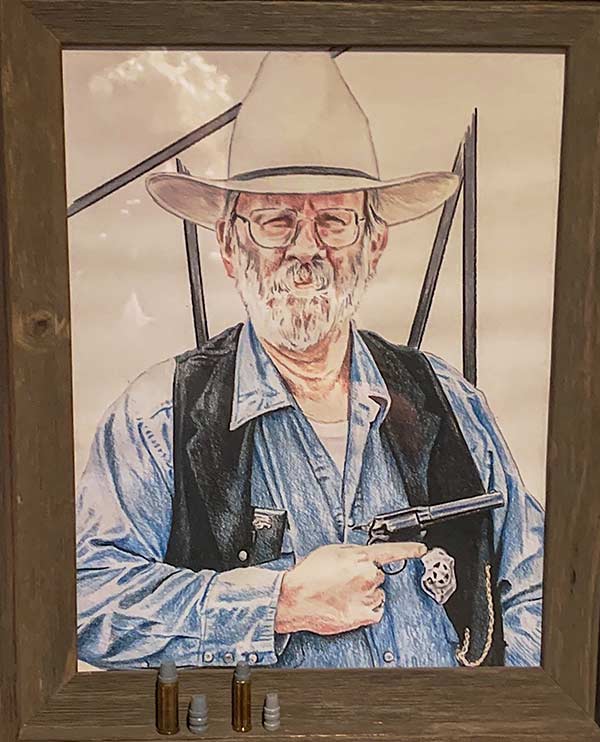
Here’s a nice print of Terry hanging in Tank’s basement.
Terry Murbach was a lovable ol’ cuss! He’s been gone a few years now and I miss him, as do a lot of other folks. For the past 10 years I’d see him every June at the NRA’s Whittington Center. Words describing Terry would be cranky, cantankerous and opinionated. He reminded me of a cross between Festus on Gunsmoke, and a Tasmanian Devil, for you never knew what was going to set Terry off. It was also one of his most lovable traits.
Those who didn’t know him well weren’t quite sure how to take Terry. But like most, once he warmed up to you, you found out he was the nicest guy in the world, willing to do anything for you. I know he was bestfriends with John Taffin, and that speaks volumes. Over the years, I got to know Terry pretty well. Besides talking about guns, handloading, Elmer and Skeeter, we’d talk about old authors, particularly Russell Annabel.

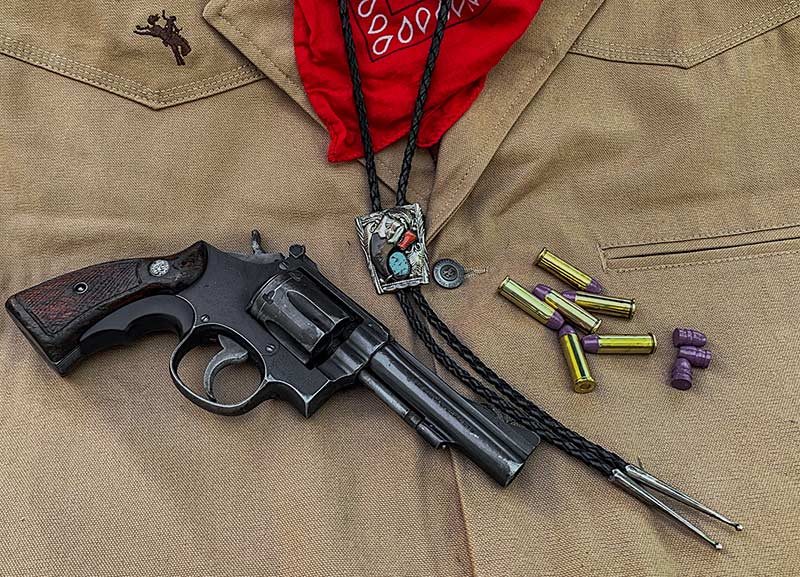
Here’s the Murbach gun with some nice, easy shooting pink powder coated .38s.
Book Club
Back then, I’d recently read a few of Annabel’s books and was hooked better than a steelhead on Rusty’s stories about Alaska. I mentioned his name and Terry said he kinda’ remembered reading him as a kid in Outdoor Life and Sports Afield. So, I sent Terry a book, the first in the series of short stories by Annabel from Safari Press.
This opened the floodgates to our relationship. After he read the book, he let Judy, his wife, read it also. Terry joked it was the cause of a few arguments later on, as Judy would tell Terry to hurry up and read faster, so she could get her hands on the next book. Over time, I’d sent the whole series to him. Every year we’d talk about the different stories Annabel wrote.
Terry would ask, “Whatever happened to that Indian girl, Olinka?” and we’d stop shooting and talk and talk about the stories. Later, after some of my articles were published, I’d always get a phone call from Terry, giving pointers, praise, or opinion, in a warm manner. I looked forward to the calls. My last call from Terry, he told me about getting hit by a car and how banged up he was. It was his last.

The S&W model 14 is in perfect shape for Tank’s purposes.
Special Guns
Terry had an extensive gun collection. I knew I wanted something from my amigo. Some were out of hand, pricewise, but then I saw the perfect gun.
Terry didn’t like recoil much. None of us really do, we just tolerate it, to be quite honest. But Terry made no qualms about it. Shooting .22 LRs, or easy loaded .38 Specials were more to his liking. He could shoot, “so why would I want to ruin it with recoil?” he’d ask. Terry was full of bitterly honest statements like that.
The gun I saw was a well-worn S&W model 14 .38 Special. The price was low enough to not make too much of a dent in the bean fund, so I bought it. The fact it was well used made it even more attractive. Terry’s DNA is oozing from this gun, I’m sure, making it even more special to me. I only shoot low-recoiling loads in it, the way Terry would want, keeping wear and tear to a minimum, on both me and the gun.
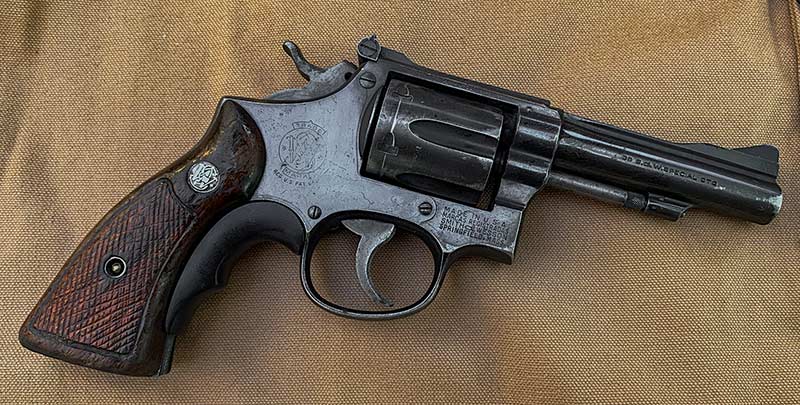
This gun speaks volumes, if you know how to listen.
The Terry Load
I have a nice 130-grain RFN slug from a Lee six-cavity mold perfect for this application. My standard load is four grains of 231 with this bullet, but my “Terry Loads” use a scant three grains of Alliant Bullseye powder, for 700 FPS of recoil-free plinking perfection. It’s also a very accurate load! I’m sure Terry would approve, but I’d have to raise his hackles a bit and use pink powder coated bullets. We’d get a good chuckle from that, but he appreciated the wonderful traits powder-coated bullets provided, as I’d let him shoot some before.
Special Guns
Most Gun men/women have special guns they hold close to their hearts from special people in their lives. While hating the circumstances of obtaining such special shooters, they are indeed well appreciated. They keep memories alive, the powder burning, and the stories to be re-told, every time the pistol rug is unzipped, and someone asks, “Nice gun, where’d you get that one?
Categories
Following a Made to Measure Perazzi
Mother charged after ‘recklessly’ putting gun in child’s backpack, authorities say
The mother was charged with putting the gun in the child’s sack before school.
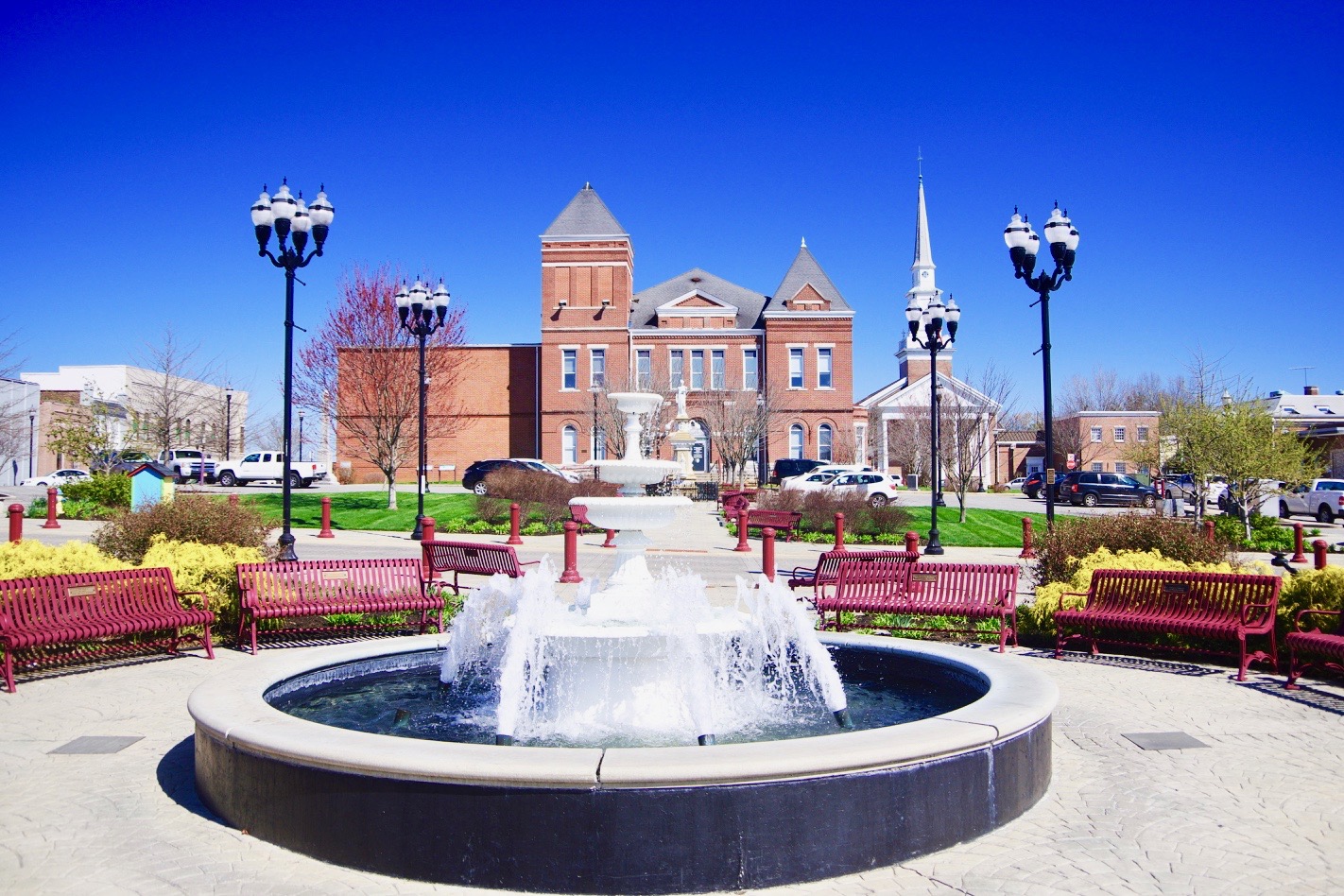
MCMINNVILLE, Tenn. (WSMV) – A mother was arrested Monday after investigators say she “recklessly” put a loaded firearm into her child’s backpack.
The firearm was found in the backpack of a student at Hickory Creek Elementary School in McMinnville, Tennessee.
District Attorney Chris Stanford said in a media release the gun was loaded with 15 bullets. After investigating, deputies with the Warren County Sheriff’s Office said the incident was isolated and did not present further harm to the public. However, Stanford said the incident still put multiple people in danger.
The child’s mother, Kristen Holland, was charged with reckless endangerment with a deadly weapon.
“I want to praise the work of our school employees and school resource officers in a situation where their training and preparation led them to respond flawlessly,” said Warren County Director of Schools Grant Swallows. “We believe this was an isolated event with no intent to harm, but regardless, we take all instances with extreme and abundant caution. Because of the work of our staff and the Warren County Sheriff’s Department, our students were never in danger and the situation was resolved quickly.”
Parents and staff were notified of the incident. No lockdown procedure was ever initiated because no imminent threat was ever determined, Swallows said.
Categories
Have a nice Weekend! Grumpy
.gif)
.gif)
.gif)

.gif)
.gif)
.gif)




.gif)
Categories
Relatives at 3:00!

Born Gordon William Lillie in Bloomington, Ill., on Valentine’s Day in 1860, Pawnee Bill was a rival of Buffalo Bill Cody before joining forces with the legend in the business of selling the Wild West.
Pawnee Bill was an Indian interpreter, trapper, cowboy, land boomer, and businessman, but was best known as proprietor of his Wild West show, “Pawnee Bill’s Historical Wild West, Indian Museum and Encampment.”
His family moved to Kansas when he was a boy. That is where he met the Pawnee people and became an interpreter to the U.S. Indian Agent who worked with the tribe, earning his nickname. In 1883, Buffalo Bill, already larger than life, was putting together his “Buffalo Bill’s Wild West,” a circus-style extravaganza, and hired Pawnee Bill to translate and coordinate with the Pawnee troupe in the show. Within a few years, Pawnee Bill had a Wild West show to rival Buffalo Bill’s.

An incredibly rare, factory engraved Savage Model 1907 semi-automatic pistol inscribed to Pawnee Bill is available in Rock Island Auction Company’s May 13-15 Premier Auction. The Wild West artifact, similar to one owned by Buffalo Bill, is documented and includes a factory letter.
Pawnee Bill and May, A Love Story
War and death often accompany stories about guns, but any talk of Pawnee Bill’s Wild West adventures should include his wife, May. They met in 1884 when Buffalo Bill’s Wild West Show encamped in Philadelphia. She was 15 and the daughter of a doctor.
She caught his eye as the Wild West troupe paraded. They courted long distance for two years before marrying in August, 1886. Pawnee Bill gave May a Marlin .22 rifle and a pony as wedding gifts.
She would go on to perform as the “Champion Horseback Shot of the West,” help run Pawnee Bill’s Wild West shows, and manage their Oklahoma ranch. Newspaper reviews of her performances called her the “Princess of the Prairie.”

Oklahoma Land Rush and Pawnee Bill
May’s parents urged their son-in-law to start his own show, which toured in 1888 as Pawnee Bill’s Wild West. The season proved to be a financial failure.
That same year, Pawnee Bill moved to the forefront of the Boomer movement, dedicated to opening Oklahoma’s Unassigned Lands to white settlers. In 1889, the 1.887 million acres of land ceded by the Creek and Seminole Indians following the Civil War was opened to non-Native Americans.
Pawnee Bill led 4,000 settlers in the land run of April 22, 1889 into Kingfisher County. His role settling the central part of the state and leading the land rush thrust him into the national spotlight. Taking advantage of his newfound recognition, “Pawnee Bill’s Historical Wild West, Indian Museum and Encampment” traveled the United States and Europe with his wife, May, as one of the stars.

The show featured a grand parade, western enactments like a stage coach heist, Native American dancing, trick roping and riding, as well as May putting on a riding and shooting exhibition.
At its peak, Pawnee Bill’s show employed 645 people and traveled with 400 horses and steers, a herd of 20 buffalo, carriages, and elephants.
Buffalo Bill Cody and Pawnee Bill
Pawnee Bill’s show evolved and prospered, thanks in part to May’s money management, and by 1907 was touring as Pawnee Bill’s Wild West and Great Far East Show, with Mexican cowboys, Pawnee and Sioux scouts, Chinese and Japanese performers, and Arab jugglers.
The following year, Buffalo Bill’s show was struggling financially. Pawnee Bill bought a one-third interest in Buffalo Bill’s Wild West Show and eventually owned the whole endeavor. The two Bills’ shows merged to become Buffalo Bill’s Wild West and Pawnee Bill’s Great Far East.
May opposed the partnership. She considered Buffalo Bill as a poor businessman and disapproved of his reputation for drinking and womanizing. She returned to the couple’s buffalo ranch that was established in 1902 near Pawnee, Okla.
The two Bills’ show went on until 1913 when it went bankrupt.

Pawnee Bill Ranch
In the meantime, the couple had built a 14-room mansion at their ranch, located northwest of Tulsa. The buffalo herd grew. The house had running water and electricity powered by a generator. In 1916, the couple adopted a baby boy, named Billy.
The couple diversified, opening an oil refinery, raising cattle on the ranch, and starting a movie production company. They also invested in real estate and banking.
Tragically, young Billy died in an accident on the ranch when he was 8.
Buffalo and a Highway
Pawnee Bill was passionate about bringing back the American Bison – or buffalo, and did more than just build a buffalo herd on his ranch. He also lobbied Congress to protect the animal. His work led to the establishment, in 1901, of the Wichita Mountains National Wildlife Refuge located southwest of Oklahoma City. It is the oldest managed wildlife facility in the U.S. Fish and Wildlife Service system.
Early on, Pawnee Bill saw the future of automobiles in America and modern highways. He served as the president of the Highway 64 Association. The section of U.S. 64 that runs through Oklahoma – and past the ranch — was named after him.
He later built “Pawnee Bill’s Old Town and Trading” not far from their ranch as a tourist destination. It featured rustic cabins for rent, restaurants, and buffalo grazing. It burned down in 1944.

Fatal Car Crash
Pawnee Bill and May celebrated their 50th wedding anniversary in Tahoe in 1936. A short time later, the couple celebrated with friends after returning to Oklahoma. On the way home from that celebration, Pawnee Bill lost control of the car and crashed. May, “Princess of the Prairie,” died from injuries in the crash. She was inducted into the National Cowgirl Hall of Fame in 2011.
Eleven days before his 82nd birthday in 1942, the spectacular showman and promoter of Wild West legend died. The couple’s amazing mansion and ranch are now The Pawnee Bill Ranch and Museum housing family memorabilia and Wild West artifacts. A buffalo herd still roams the grounds. It is now owned by the Oklahoma Historical Society and hosts a re-creation of Pawnee Bill’s original Wild West show every year.
Pawnee Bill’s Savage Arms Pistol
Rock Island Auction Company had the most recent pleasure of selling a Savage Arms Model 1907 pistol inscribed to Buffalo Bill Cody in September, 2021. The gun was inscribed “Col. W.F. Cody” with engraved scrolling on the backstrap and original and rare pearl grips. Advertisements showed Buffalo Bill’s fondness of the Savage Arms pistol and he ordered five of them engraved with the names of friends.
Pawnee Bill’s gun is not among those ordered by Buffalo Bill. The factory-engraved Savage Arms Model 1907 pistol bearing Pawnee Bill’s name, Major G.W. Lillie, shares similarities, but differences, too. Modest coverage of the engraving on the barrel and around the grip are similar. On the side of the gun — rather than the backstrap like Buffalo Bill’s – is prominently engraved “Major G.W. Lillie”

Pawnee Bill was a Wild West showman on par with Buffalo Bill whose path through a colorful life included translating for native Americans, joining in the Oklahoma land rush, conserving buffalo, and promoting the highway system all while enjoying the lifelong love of a woman who was amazing in her own right.
The Savage Arms 1907 pistol is a rare western artifact of Pawnee Bill, who stood alongside an American legend in creating the spectacle of the Wild West. It is available at Rock Island Auction Company’s May 13-15 Premier Auction.
Sources:
Oklahoma Historical Society
Pawnee Bill – Another Wild West Showman, Legendsofamerica.com
National Cowgirl Museum and Hall of Fame
Wild Woman Wednesday: May Manning Lillie, by Chris Enss, Cowgirl magazine