Month: September 2022

Categories
All that I can say is WOW!


As much as I enjoy hunting my native New York—with its Catskill and Adirondack Mountains and all the other beautiful places—I simply love traveling abroad to hunt new countries and continents. Canada, Alaska, the Rockies, Africa, Europe and Australia—there is an entire world out there to be explored and hunted. Doing so is not as easy as hunting in your home state; it requires an extra measure of research and planning.
The legality of traveling with a firearm for hunting can be a daunting task—when leaving the country—due to the multi-national laws involved. I’ve also been on a couple of hunts that involved more than one country, and it took a bit of homework to have things in order before I left. Then, you face another set of hurdles once you return to the US of A, so there is an entire flock of ducks to have in a row.
Let’s deal with the trips that stay in the continental US first. You’ll need a good gun case—one that meets all the TSA requirements—and a set of TSA approved locks. These locks feature a unique key for you, but they can be opened by a TSA master key for inspection. I’d highly recommend that you break down your firearm (if possible) within the case, by removing the bolt or dismantling a double-barrel shotgun, to assure the agents that the firearm is not loaded. Keep any and all ammunition in an approved container (original cardboard box or one of the plastic ammo containers) and put it in your checked-on luggage, separate from the firearm. I declare my firearms to the ticket agent when checking into the flight, and ask them (kindly) to summon a TSA agent. While the ticket agent may look at you in horror at the mention of traveling with firearms, the TSA agents are much more familiar and comfortable with the processes involved. Other than that, if you’re staying in the States, you should be good to go.
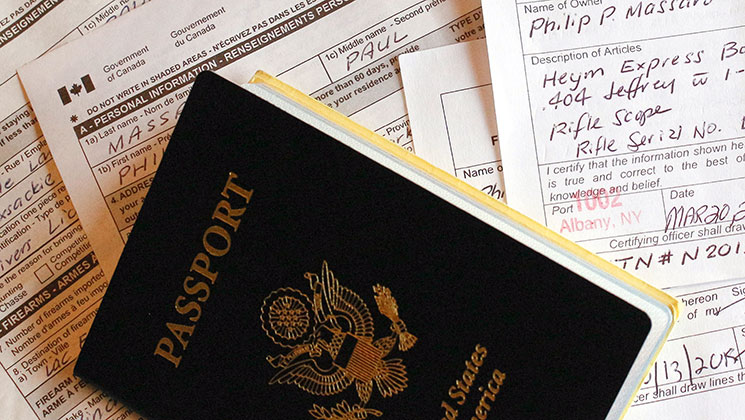
 International travel with a firearm can be a bit of a different story. The same flight rules apply as described above, but there are permits and temporary licenses that must be obtained and carefully guarded throughout your travels. The first stop—long before your trip begins—is to make an appointment with U.S. Customs to have Form 4457 (Certificate of Personal Effects Taken Abroad) filled out and signed by a Customs Agent. This will assure that you can bring your firearm back into the United States upon your return; it is the proof that you owned the firearm before your trip commenced, and that you didn’t purchase it abroad. I’d also recommend that you put your scope and binoculars (with serial numbers) on the certificate to avoid any issues. I like to make a clear copy of my completed Form 4457 and put it in the bottom of my rifle case, as an insurance measure. I’d like to throw a shout out to the ladies and gentlemen at the Albany, New York Customs office; they are pleasant and more than accommodating for the multiple 4457’s I’ve needed over the years.
You’ll definitely need to keep any ammo separate from the firearm case, and I like to keep it in a plastic case—I’ve used MTM Cases for years with great results—and I use a bit of duct tape to keep things secure. Some countries in Africa want you to declare the amount of ammunition brought into the country, and some have limits on the amount you’re able to bring in. Some even collect a surcharge, per round of ammunition, upon entering the country.
There is usually a fee associated with the temporary import of a firearm into another country. I remember Canada gets $25, and the African countries all differ. It will pay to be very familiar with the location of the serial number of your firearms, as they will be required for your temporary permit. That permit, which allows you to carry a firearm in another country, needs to be well taken care of. I remember hunting in Zambia, where we had to make sure that paperwork was with us at all points in time—even in the most remote places—as we were hunting with a government Game Scout at all times, as is common in many African countries.
Once you’re done hunting, you’ll want to keep things equally tidy for the return trip. I save all of the empty cartridges I can (I’m a stingy reloader) to show that I didn’t leave any ammunition in the wrong hands. You’ll need the necessary exit paperwork—usually an exit stamp on your import permit—and upon returning to the Land of the Free, U.S. Customs will need to see that Form 4457, and you should be all set.
There are several travel agencies that specialize in assisting the traveling hunter, my own personal favorite being my pal Steve Turner over at Travel With Guns. They have all the necessary forms and the know how to help you get in and out of your destination without a hitch. Steve and his team can give you the requirements on medications (a very important point when traveling to an area known to harbor malaria), as well as handy maps of and tips on the area you’re visiting. While they charge a nominal fee for their services, it is money well spent; there’s been more than one occasion where Steve & Co. have helped me out of a jam. I remember sitting in the Bulawayo, Zimbabwe airport, waiting in a long line for guys to fill out the import paperwork (and needing to share the vintage carbon paper); we had the forms already filled out thanks to Travel With Guns and avoided a long wait. There was also a time Steve got us out of JFK Airport a day early because of an impending hurricane. When I travel to hunt in a different country, Steve gets my business.
You’ll want to make sure that your passport is valid for at least six months after your trip is over, to avoid any hassles. Many times, you can fill out paperwork for international transportation ahead of time—which helps get through the process quicker—and you’ll need to provide your passport number. I always keep the number of the US Embassy in whatever country I’m hunting tucked away in my wallet, along with a Xerox copy of my passport, just in case. And, let me leave you with one last piece of advice: pack light. The overweight baggage costs are astronomical; I learned that the hard way!
The last part of the hunt can often be addressed before you leave, and I’d recommend you do. Getting your trophies home—especially if the species you’re hunting falls under a CITES classification—can be not only a hassle, but a real drag. Contact a good import company—I use Bob and Rosella Quartarone of Safari Specialty Importers—to provide my trophies with the best possible care during the trip back to my taxidermist. They will provide identification tags, so your hard-earned trophies don’t get lost in the shuffle. Though there are other companies to choose from, I feel Bob and Rosella are among the most knowledgeable and diligent in the industry.
Pick up the phone, fire up the laptop, and plan your adventure; life is indeed short and international hunting will provide some of the best memories of your hunting career.
THE PENTAGON — The Air Force HAS announced a new medal, the National Place Saver Medal, which has been approved and will be awarded starting Jan. 1, 2023. Air Force leaders say the rapid approval came in response to the Pentagon’s decision to discontinue awarding the National Defense Service Medal at the end of the year.
“When we realized that starting next year some Basic Training graduates will only be eligible to wear from one to three medals, we sprang into action,” said Lt. Gen. Mark McAllister, an Air Force spokesman. “We like our best airmen to be decorated like leaders of a third world junta. With the National Defense medal going away, we needed to do something.”
“Plus, the feng shui of a single ribbon is just terrible.”
To earn the award, the Air Force member must have been honorably serving and breathing at any time starting this January.
“We didn’t want our newest graduates to feel left out,” said Lt. Col. Meredith Tanner. “Imagine reporting to tech school and only having a single ribbon on your rack. How humiliating.”
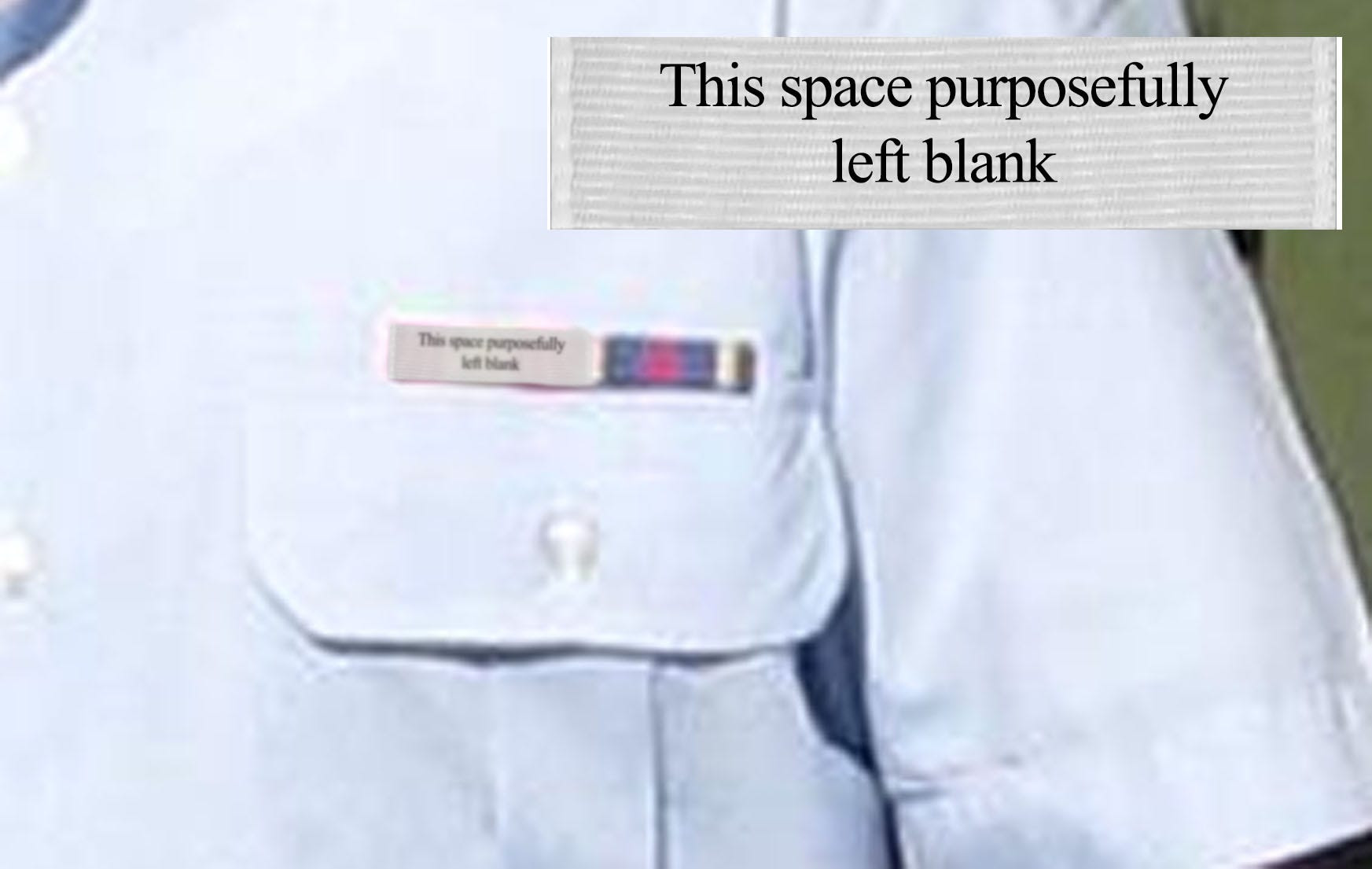
The medal is a subdued, off-white color. Unlike any other, however, the ribbon for this medal has the words “This space purposefully left blank” inscribed on it.
“The medal isn’t meant to be a permanent award, given in perpetuity,” said Clyde Baskins, who works on awards and decorations at the Air Force Personnel Center. “Once we get another national emergency and the NDSM comes back, the NPSM will be set aside until needed.”
This isn’t the only new award that airmen may qualify for.
“Air Force leaders were concerned by the decision to narrow who qualifies for the Global War on Terror medal,” said Baskins. “That’s why airmen may soon get to wear a new ‘I Took the ASVAB medal’ right next to their Air Force Training ribbons. It will look glorious!”
W.E. Linde (aka Major Crunch) writes a lot. Former military intelligence officer, amateur historian, blogger/writer at DamperThree.com. Strives to be a satirist, but probably just sarcastic. Twitter @welinde

The list of available rifle cartridges is a long one, even if we only consider those that the rifle companies currently chamber for. Thumbing through a volume like “Cartridges of the World” will show that the historical list is indeed dazzling. While scouring the gun shops, I’ve found a few gems that fire an older, obscure cartridge, but not yet one of the ones I dream about. I’ve picked five cartridges here, that may whet your appetite to learn more about the ammunition of yesteryear, and maybe you’ll find a rare rifle that fires one of the cartridges that has been pushed out of the limelight.
.318 Westley Richards
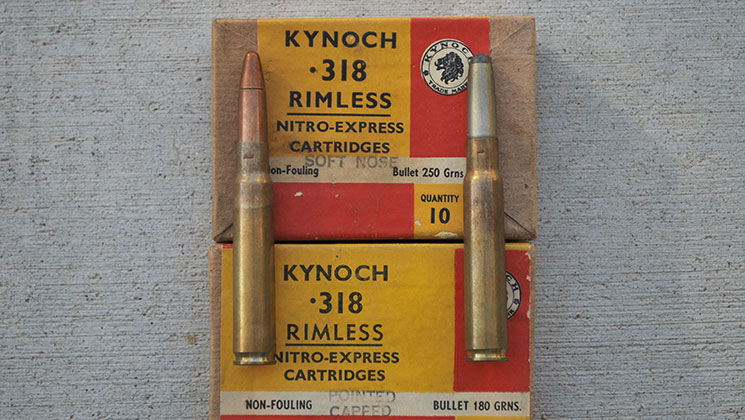
This is a particular favorite of mine, and although the firm of Westley Richards still makes rifles and ammunition, the one-time star of the African Game Fields has been shoved off the stage. Introduced in 1910, using a case similar to the .30-’06 (but a bit shorter and with a smaller rim diameter), it uses a .330” diameter bullet, and in British fashion is named for land diameter, instead of groove diameter. The 250-grain bullet is driven to 2,400 fps, and quickly made a reputation as a great big game caliber (slight similarity to the .338-06, eh?) and the lighter 180-grain load worked well on smaller antelope and deer. The .318 took a bashing when some folks got trampled and gored trying to use it against elephant and buffalo, and this cartridge probably had a good hand in the “.375 minimum” we have all come to accept. It is a classic African medium, and would make a fantastic rifle to have in ones cabinet.
.275 Holland & Holland Mag.
Released in the same year as the famous .375 H&H, the 7mm variety of the H&H belted case looks and performs very much like our popular 7mm Remington Magnum. Having a case length of 2.50”, it was the first belted case to be of .30-’06 length, preceding the Winchester quartet (.264, .300, .338 and .458) by more than 45 years. I really can’t conclude the reason it never caught on; the ballistics are certainly there, perhaps the fact that it was never a military cartridge may have played a part. You can easily see where Winchester got the idea for their series of long-action magnums.
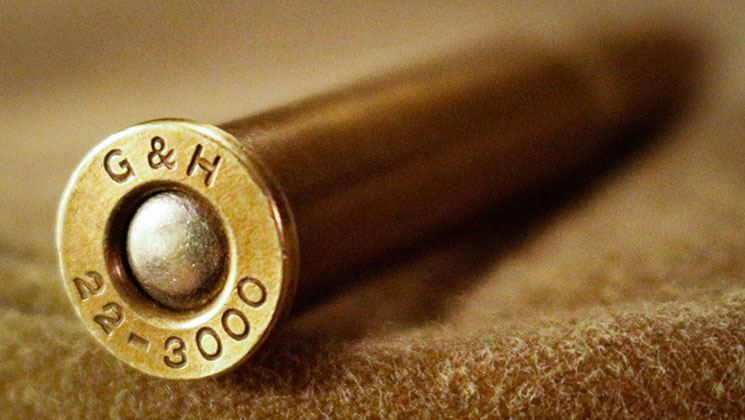
G&H .22-3000
This cartridge, a proprietary cartridge from the esteemed firm of Griffin & Howe, was—legend has it—developed by Harvey Donaldson, and correct headstamped brass cases were produced by Winchester. The .22-3000 case is based on the .25-20 Winchester Single Shot, and pushes a 50-grain bullet to just over 2,700 fps. Griffin & Howe offered a service in which they would rebarrel the Winchester Model 70 or Model 54. There isn’t a ton of information available, but the .22-3000 shows the early stages of development of the uber-fast .22 centerfires.
8.15x46R
My buddy Pat Lane received an antique German stalking rifle as a birthday gift from his brother; a sweet-handling falling block rifle chambered to 8.15x46R, a cartridge I’d never heard of, and I deal with a lot of oddball calibers. The 8.15 is a rimmed cartridge, introduced at the end of the 19th Century, and will push a 150-grain lead bullet to somewhere around 1,500 fps, making it a light game cartridge. If you find one, be sure to slug the bore, as it can vary from .315” all the way up to .323”, so some care must be taken.
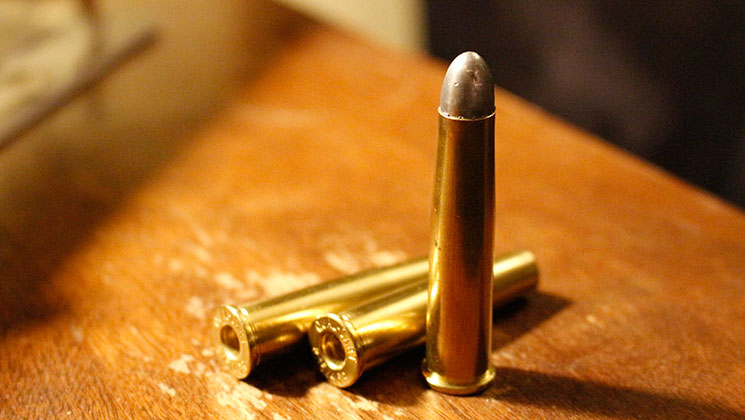
.280 Ross
The first two decades of the 20th century saw some radical cartridge design. Some of those became household names, such as the .30-’06 Springfield and the .375 Holland & Holland Magnum, and others met a different fate. The .280 Ross falls into the latter category. A Canadian cartridge released in 1906, the Ross case achieved ballistics very similar to our modern .280 Remington. The Ross got a bad reputation not due to its design, nor its accuracy, but from the velocity. Simply put, the bullets weren’t strong enough to handle the game they were trying to pursue. George Grey was killed by a lion he had wounded, when the bullets failed to penetrate, however any 7mm is questionable for lion. Although the .280 Ross made a good sniper rifle, the rot was in as a hunting round, and it faded into obscurity.