During the Second World War, the German Wehrmacht primarily relied on bolt action rifles such as the Karabiner 98k as their main infantry weapon. These were augmented by light and submachine guns such as the MP40. By 1944 the German army had suffered devastating losses across Europe. On the Eastern front, the Soviets had countered the German invasion and had steadily been advancing towards Berlin. On the Western front, the Allies had made amphibious landings at Normandy. Germany’s defeat was inevitable. It was at this point that the Wehrmacht introduced the StG 44 Assault Rifle. Its introduction did not serve to change the course of the war but it had a resounding impact on the evolution of small-arms developments after the war. During my time at the RCMI, I’ve been lucky enough to handle such weapons and I’ve learned a great deal about their significance in military history.
Development
The bolt action rifles combined with the submachine guns were effective during the First World War when the rifles could be used to fire across no mans land while the SMG’s could be used to clear the trenches. With the advent of Blitzkrieg and the lightning pace of mechanized warfare during the Second World War, these needs became outdated. The infantrymen required a weapon which would allow them to lay down long waves of fire, especially on the Eastern front where the Soviets heavily outnumbered the Germans.
By 1942, Hugo Schmeisser developed the prototype for the assault rifle, dubbing it the MP-43. In April 1944, it was renamed the MP-44 and distributed to soldiers in small numbers. In late 1944 it was finally dubbed the StG 44 or the Sturmgewehr (Storm Gun) 44. The German industry pumped out 425,977 StG’s for the Wehrmacht until the end of the war.
Breakdown
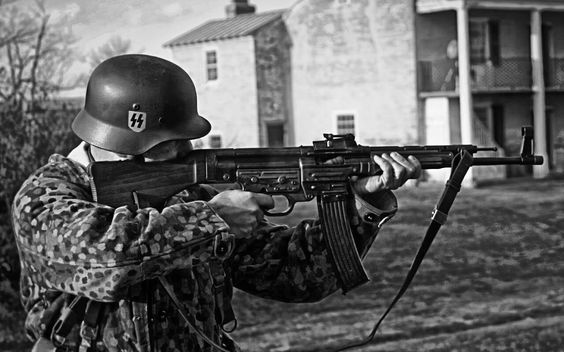
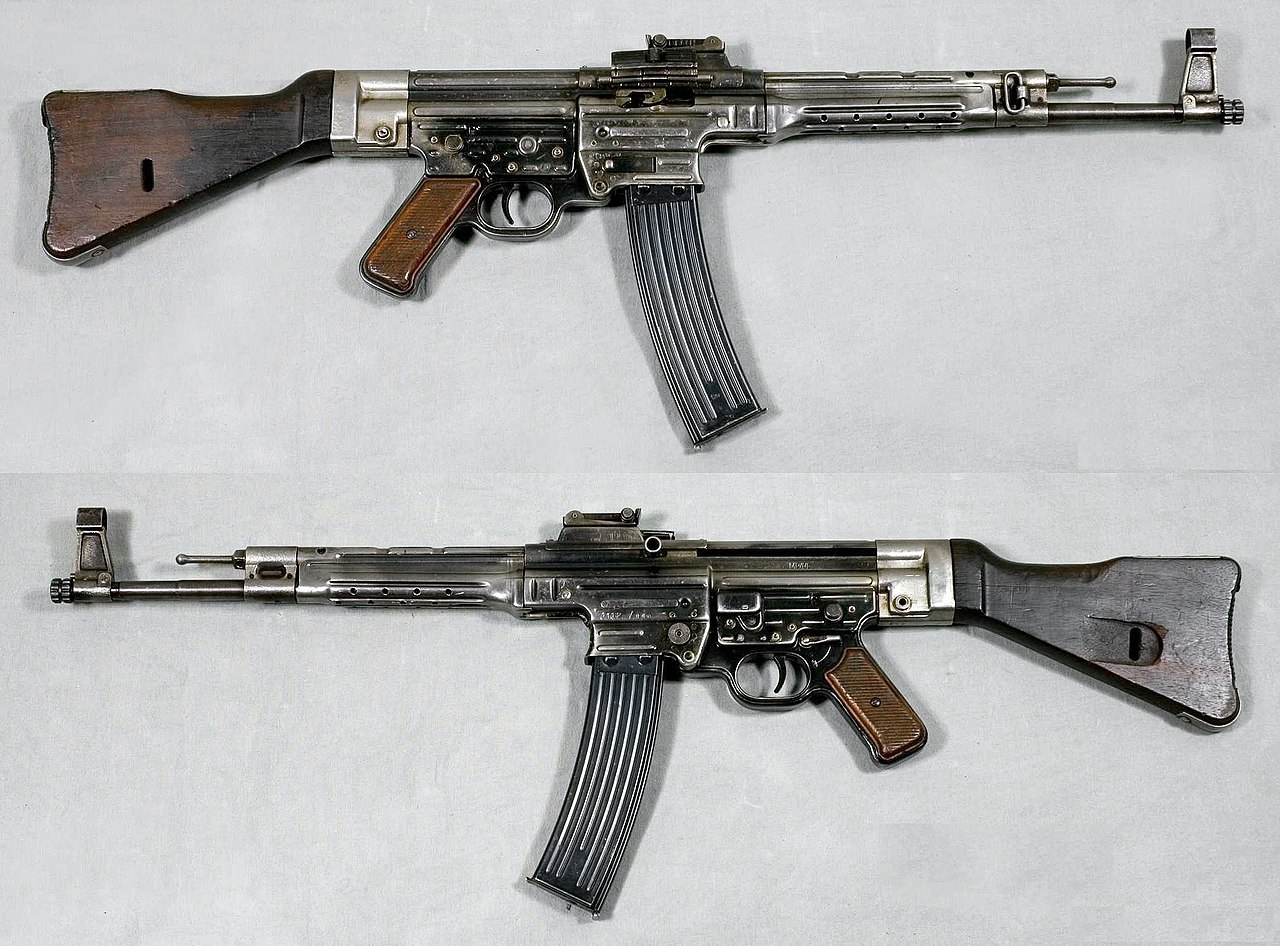
(The StG 44 Assault Rifle)
It utilized the intermediate 7.92×33 round, which fell squarely in between the 7.92×57 Mauser round used by the Kar 98 and the 9×19-millimeter round used by the MP series. This made it a weapon that fell in between the bolt action rifles and the SMGs. It also meant that while it was not as lethal and did not have as much range as the Kar 98, it was capable of fully automatic fire which is what made it significant. It was gas-operated through a piston working in a gas cylinder above the barrel and had a pistol grip, a wooden stock, a 30-round magazine and weighed just over 11 pounds.
Operational History
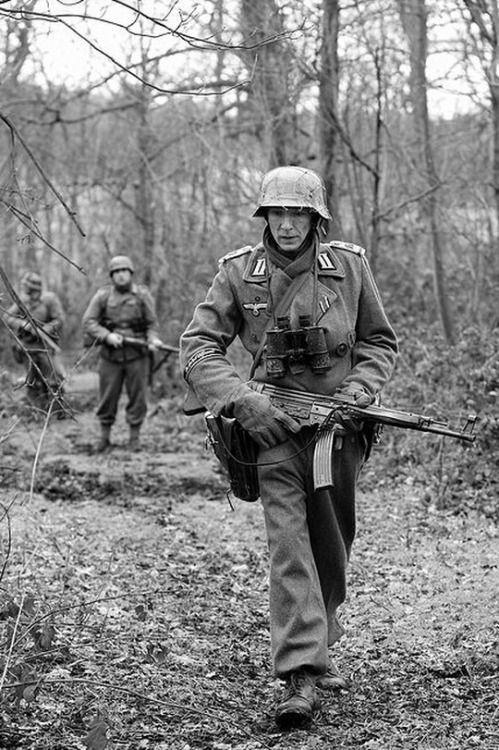
(A German soldier with an StG 44)
Its effectiveness is difficult to measure largely because it came at a time when the war was arguably already lost. It could also not be produced in larger quantities because the Allies had already bombed and destroyed German factories and industries and had encroached on German territory. The StG arrived on the Eastern Front and was used to counter the Soviet’s SMGs. It was very effective in close combat and allowed soldiers to lay down suppressing and covering fire effectively. It was also utilized in the Ardennes Offensive where an analysis of two paratrooper division’s casualties highlights its effectiveness. In comparing the 3rd and the 5thFallschirmjaeger divisions, the 5th division lost almost 9000 men during the offensive while the 3rd division lost around 2500. Why the difference? Both had been in combat together facing the same elements of the US army. The 3rd division had been allocated more StG’s than the 5th. What makes these numbers even more stunning is the fact that the 5th division had more artillery support and was numerically a larger unit.
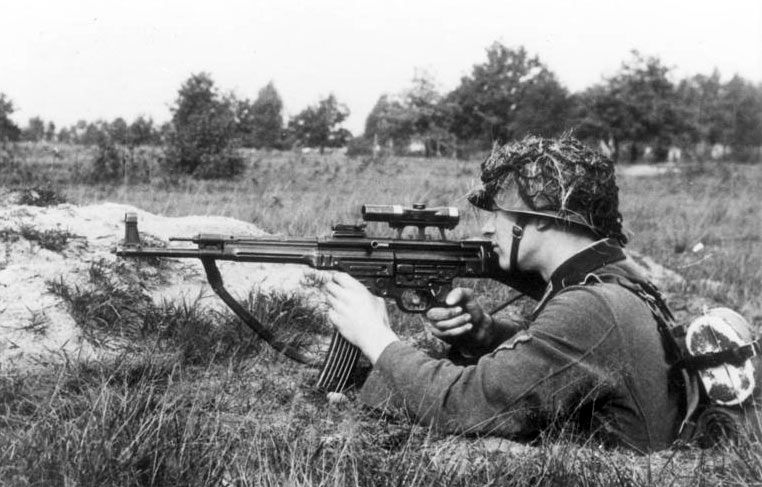
(A German soldier aims down a modified sight on the StG 44)
Significance
As the world’s first assault rifle the StG 44 stands as a superior and technologically advanced firearm. It has also had a significant effect on the development of modern firearms. Its development inspired the creation of the Soviet AK-47, one of the most mass-produced and replicated assault rifles in our modern world. The AK-47 has had a dramatic impact all across the world, utilized by various countries and terrorist groups. The Germans can be credited (for good or bad) with the revolutionary development of the world’s first assault rifle which has radically altered the shape of modern warfare.
(A brief history of the StG on the Youtube channel ‘Forgotten Weapons’)
U.S.A. –-(AmmoLand.com)- For a brief time, .40S&W was quite possibly the most popular service caliber in the United States. Legions of law enforcement agencies chose it for their duty guns, and the civilian market followed suit. Even today, certain demographics still fawn over the forty.
However, times are changing. In the early 2010’s the FBI began returning to the 9mm they’d abandoned less than two decades prior, with many others in law enforcement and the citizen world following suit. With this in mind, are there reasons why someone would choose a handgun chambered for .40S&W as their primary pistol in 2022? Let’s find out.
Shortcomings of 40S&W
Slightly More Expensive
The price difference between 9mm and .40S&W has typically been minor over the past several years. However, there has consistently been a difference, with 9mm usually being on the less expensive end of the spectrum. As of the time of this writing, .40S&W retails online for roughly $0.03-0.06 more per round than comparable practice loads of 9mm for cases of 1,000 rounds. This results in roughly $30-60 more per case when shooting .40S&W. Duty ammunition, seems to be roughly equivalent in price between the two, though 9mm enjoys far more availability and a wider variety of options than its bigger brother.
These differences in price are fairly minimal but can add up over time. I don’t think a few extra pennies here and there will break most people’s banks, but as belts continue to tighten, the extra expense could prove detrimental for many shooters.
More Difficult to Shoot
One of the biggest issues people have with .40S&W is increased recoil compared to 9mm. As a young shooter with a Glock 23, I had a hell of a time getting used to the sharp snap from the plastic fantastic compared to the mild puff from the Beretta M9 I’d traded away. One of the primary reasons cited by the FBI in their shift away from .40S&W is due to the relatively harsh recoil, contributing to reduced accuracy among their agents. Wanting to quantify this difference, I headed to the range to see how they compared for myself.
Range Time
To get as equal comparison as possible with the equipment available to me, I opted to shoot a Glock 34 in 9mm and a Glock 22 in .40S&W. While the G34 does have a longer sight radius, the difference is fairly negligible in my experience. Both guns were 4th generation Glocks outfitted with factory iron sights, with no modifications.
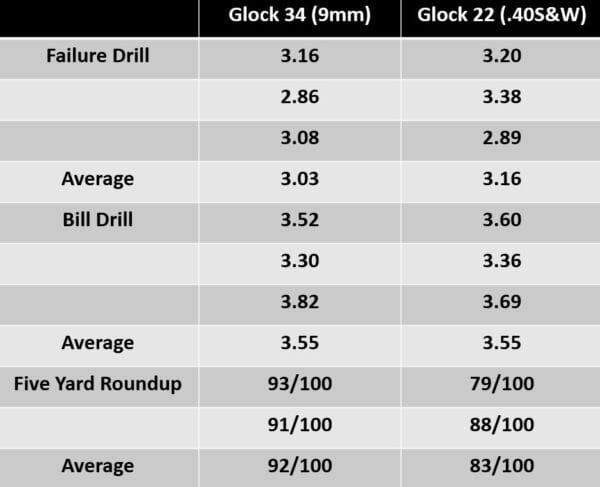
As expected, my performance was better with the 9mm pistol. However, the differences were far less substantial than I imagined I would see. I fired several drills with both pistols, giving each three repetitions per drill to get an average of performance. To ensure .40S&W had a fair chance, I shot the drills cold to avoid any differences in my shooting.
I shot some drills to compare performance between 9mm and 40S&W
To top things off, the G22 was significantly more pleasant to shoot than I prepared myself for. This was honestly a shock for me, as my prior experiences with most .40S&W pistols has been very negative in terms of shootability. This of course can be impacted by ammunition selection, and is highly subjective in the first place. That being said, numbers don’t lie. While the differences are fairly minor, there is a distinct degradation of performance when moving from 9mm to .40S&W. Even with this degradation, I wouldn’t feel significantly disadvantaged with of forty in my waistband.
Increased Parts Wear
This is something that the vast majority of shooters will never have to worry about. That being said, it is something to consider for even mildly serious shooters, those buying used firearms, or people looking to adopt firearms for their agency/organization/whatever. Thanks to the increased pressures associated with .40S&W, users will see increased parts wear compared to 9mm and .45ACP service pistols. But don’t take my word for it.
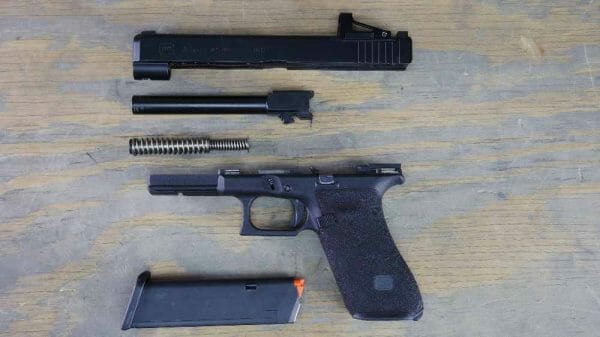
The Glock 34 Gen 5 field stripped.
Recently Greg Ellifritz, of Active Response Training, spoke to common parts breakage on Glock handguns and how to properly maintain them. With experience maintaining the pistols for his agency, and as a national level trainer, Greg has a lot of insight into the subject. Due to this, I asked for his input regarding the differences in parts life between 9mm and .40S&W pistols. Here’s what he had to say:
“My department issued 9mm, .40, and .45 Glocks. I worked on all of them. The .40s would have parts break at 2-3x the rate of 9s and .45s. I think the overall service life is probably pretty equal but you are going to have to do more work to keep the .40s going.”
To add to this, I spoke with Reid Henrichs of Valor Ridge. Reid was the first national-level instructor I trained with back in the fall of 2017. During the course of training, he spoke to the shorter service life of .40S&W handguns compared to their 9mm counterparts. Recently I reached out to Reid for his updated take on the subject. Here’s what he had to say:
“I have seen about 6 pistols blow up on the range, all of them .40 S&W. Some were using reloads but some were not. I have never seen a 9mm blow up. In terms of service life of a pistol, the 9mm Glocks have about a 4-5X longer life than the .40. You will get about 30-50k rounds from a G22/23 and easily 100k+from a G17/19.
The parts that break are the slide and frame. Small cracks become big ones. In terms of maintenance, they are equal as you need to replace the recoil springs every 5k rounds. Other springs should be replaced annually. My range gun, a gen 3 G19 has 120K through it right now and is still going strong.”
No Additional Stopping Power
“Stopping power” is difficult to quantify. We can use ballistics gelatin tests to measure expansion, penetration, and more, but those aren’t a 1:1 comparison of performance against a living threat. We can spend days cherry-picking examples of X round performing perfectly or Y round underperforming. This goes for caliber debates, preferred defensive loads, and even different bullet weights within the same caliber and brand. What truly matters here is good shot placement with a quality round.
Veterans of the 2004 SHOT Show or serious H&K nerds will get this reference.
We’re not here to focus on anatomy today, so we’ll instead discuss what advantages, if any, .40S&W holds of 9mm in the realm of “stopping power”. Turns out the differences between most service calibers are negligible. Whether you’re shooting a 9, 40, or 45, penetration and even expansion are often comparable with quality defensive ammunition.
Several studies have been conducted on this, such as those from Doctor Gary Roberts, Greg Ellifritz, and others. If that’s not enough, the FBI speaks in detail about the myth of stopping power, or any perceived benefits of larger calibers in their whitepaper explaining their switch back to 9mm for service pistols. With several leading experts in the industry all coming to the same independent conclusions, this may be a clue.
Of course this means that .40S&W is perfectly adequate for personal protection. Nobody is arguing that point. But is the juice worth the squeeze when the results are the same at the cost of the other issues mentioned above? Is seems like most people are saying no.
Benefits of 40S&W
If you’ve made it this far, you’re probably thinking that I hate .40S&W. If you asked me a few months ago, the answer would’ve been yes. That being said, I’m not as opposed to it now as I was in the past. There certainly are some benefits to the round. What are they?
Competitive Edge
Some competitive shooting bodies offer different divisions for different calibers, typically based off of Power Factor. In simple terms, Power Factor is bullet weight multiplied by velocity measured in feet per second. Theoretically, a higher power factor means higher recoil. Baselines are established for different power factors, ensuring that shooters don’t load severely underpowered ammunition for an unfair advantage.
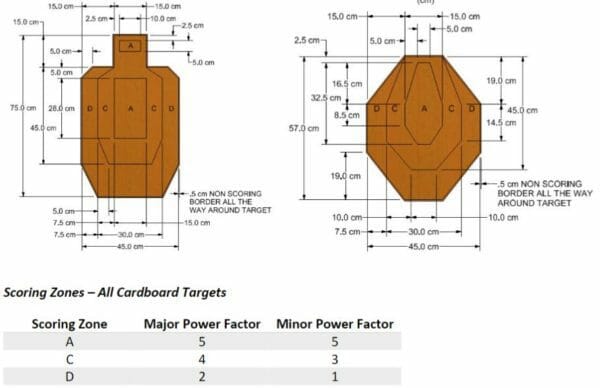
USPSA/IPSC scoring zones for Major and Minor power factor. Circa the September 2021 USPSA rule book
USPSA has two Power Factors, Major and Minor, with Major offering more points for hits outside the A-Zone of the target. This leads many shooters to choose Major, allowing for a little more grace for thrown shots. An easy way to make Major Power Factor is to use heavier bullets, which is often thought to produce lower recoil than choosing higher velocity rounds. A bigger bullet is easier to make heavier. As such, we see .40S&W dominate Limited division in USPSA, allowing for Major, while also providing improved capacity over something like a .45ACP.
Caliber Conversions
Some guns allow you to swap a few parts and convert them into other calibers. My Glock 31, for example, can be easily converted to shoot .40S&W, and 9×19 while still using the same holsters. Often times people tout this as a selling point for guns chambered in .40S&W, as most are readily convertible to 9mm.
However, this is far less common in reality than in theory, and the costs quickly rise. Replacement barrels, sometimes replacement recoil springs, extractors and more, plus the time to swap everything. Zeroing your sights for your new ammunition, ensuring you’re not confusing magazines and ammunition. All of these factors add up to time and money that could potentially be better served elsewhere.
9×19, .357SIG, .40S&W and more can be fired out of the same gun after swapping a few parts
However, I don’t think this is a lost cause. Caliber conversions are helpful in places where the number of guns you can own are limited. It can also be helpful if you use calibers that require fewer parts to be swapped, such as .357SIG to .40S&W. Guns milled for optics can also benefit from caliber conversion, saving the user time and money, not having to send another slide off for weeks to months to get custom milled.
The Used Market
As more law enforcement agencies and private citizens dump their .40S&W guns, the market gets more favorable for those looking to gobble up these trade-ins. One department near me actually switched from 9mm to .40S&W within the past few years, buying guns and ammunition for pennies on the dollar. It was savings like this which led my family to jumping on the .40S&W bandwagon back in 2012. This is one of the more valid reasons I see for going the forty route in 2022, though it is temporary at best.
While not much cheaper, my local shops do sell used .40S&W guns for less than their 9mm counterparts
Unfortunately, a lot of these were bought up during the initial panic of 2020, when thousands of people decided it was time to buy a gun. That being said, you’ll still occasionally come across new trade-ins from time to time. Most people don’t shoot their guns that much, so snagging a gently used .40S&W will likely serve you well for a long time.
Final Thoughts on 40S&W
With modern bullet technology there is not much reason to choose .40S&W over a modern 9mm load. While it certainly performs admirably, and is widely available, it’s just not ideal in 2022. Maybe one day we’ll see a renaissance in bullet technology like we’ve seen with 9mm in the past few years, rocketing .40S&W back to the top of the game. Think about the pros and cons listed above, and decide what is right for you.
Author’s Note: Thanks to Greg Ellifritz and Reid Henrichs for their insight and support with this piece. Give them some love and support.
About Dan Reedy
Dan is an Air Force veteran, avid shooter, and dog dad. With a passion for teaching, he holds instructor certifications from Rangemaster, Agile Training & Consulting, and the NRA. He has trained with Darryl Bolke, Mike Pannone, Craig Douglas, among several other instructors, amassing over 400 hours of professional instruction thus far. In his spare time you’ll find him teaching handgun, shotgun, and less lethal classes.
Dan’s work has been published by Primer Peak, and The Kommando Blog, and he has been featured as a guest on Primary & Secondary.
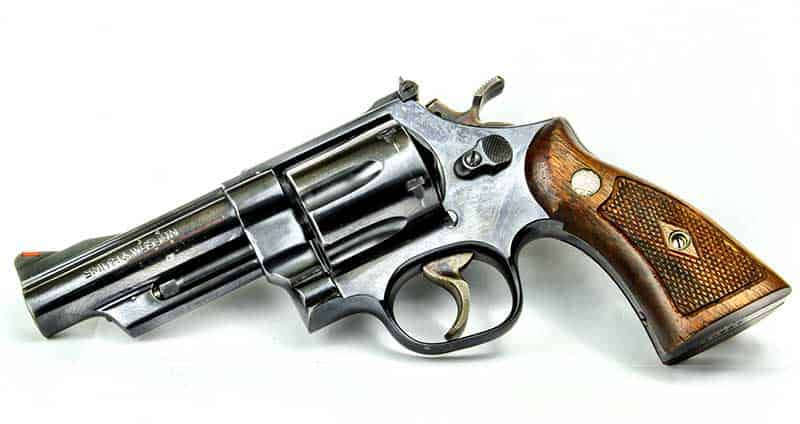
Having a beater gun is a blessing. First, we never worry about them, because hey, “what’s one more nick, scratch, or wear mark, right?” Second, they make perfect project guns. A few years back, I had Ken Kelly of Mag-na-port International fame transform a beater of mine into something marvelous. I’d known about the Combat Mini for years, and it seemed like the perfect time. After all, timing is everything, eh?
Wow! What a transformation! Ken Kelley does top-notch work!
Donor Gun
My donor gun was a passed-around S&W model 29-2. It went from one friend’s hand to another until finally reaching mine one happy Christmas day. If you’re like me, you’ve helped Santa by handing over your list to Santa’s helper (okay, your spouse) and merrily say, “Guess what? I made Christmas shopping easy for you. Here’s this gun I want …”
I know I’m not the only one who does this. After the eye roll, logistics are completed, and the gun is shipped to my FFL.
I shot and carried the gun for a couple of years, but something was nagging in the back of my mind. Years ago, I read an article by Paco Kelly (no relation to Ken) where he tells the story of carrying a Combat Mini and how it saved his life. Mag-na-port did the conversion. I called Ken Kelly, and arrangements were made to have him convert my beater into something neater, a Combat Mini.
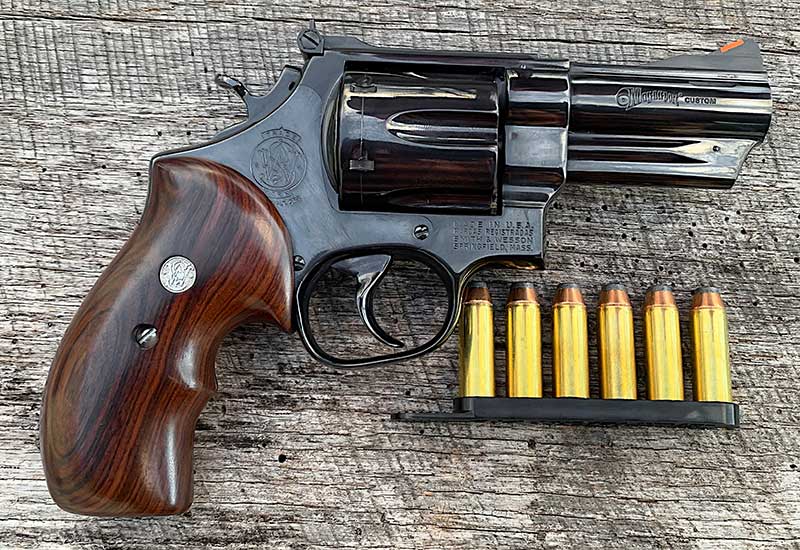
You can see the polished trigger and red sight insert Ken did besides the
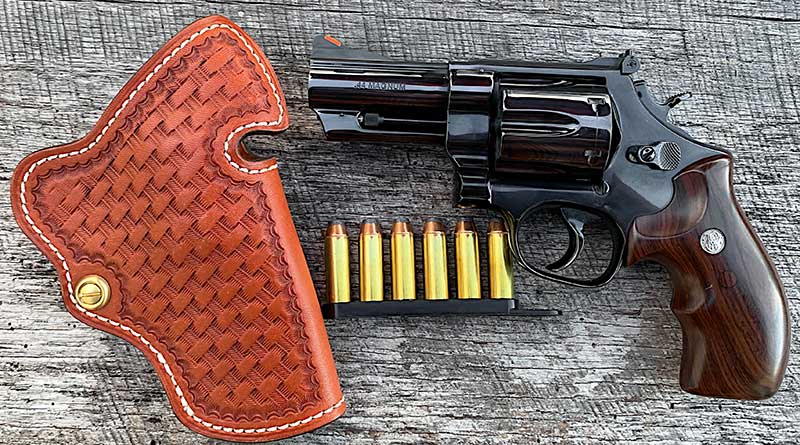
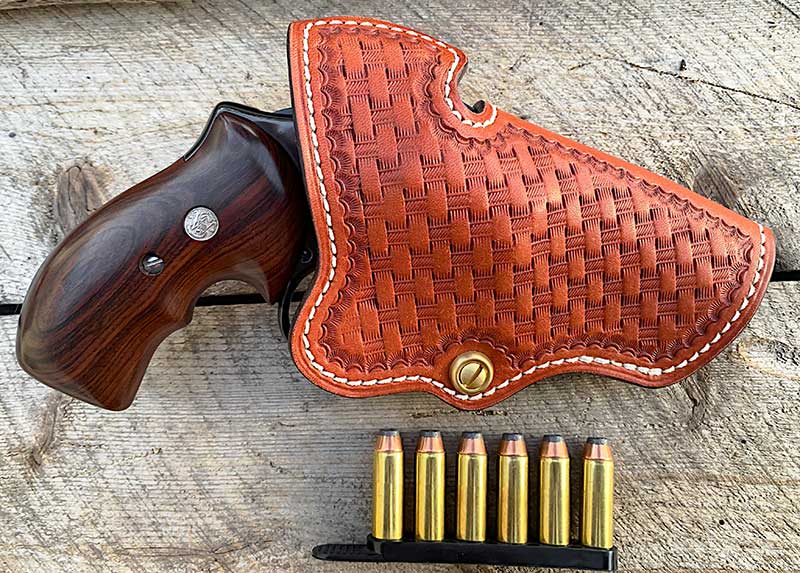
high-luster blue job. The Barranti Leather Hank Sloan carries the Combat Mini in style!
The Trip
Having never been to Mag-na-port before, I figure I may as well hand-deliver the gun. There’s a method to my madness. You see, many folks don’t know this, but Mag-na-port is headquarters for the Handgunner Hall of Fame. Who knew? Inside the front lobby are the many trophies, plaques, guns, photos of every true groundbreaker, innovator and pioneer of handgunning.
Besides all our handgunning heroes, the front lobby is full of just some of Larry Kelly’s, founder of Mag-na-port, game trophies from around the world. You’ll see magnificent deer, elk, moose, lion, kudu, elephant and more, all taken with a humble handgun. How cool is that? There are several cozy couches parked in front of a giant TV where you can watch videos of Larry Kelly on some of his hunts. It’s well worth the price of admission — which is free! If you’re within a 5- to 8-hour drive, it is well worth it to see this magnificent display.
The Hank Sloan protects the rear sight from any inadvertent
bumping of door frames or other objects.
The Drop Off
After picking up Doc Barranti along the way, we head up the Ohio turnpike, and before you knew it, we were pulling into the parking lot of Mag-na-port. We were greeted by Ken and sisters Donna and Doreen, who operate the front office.
Ken’s shop is vast, spacious and a treasure trove for any gun aficionado. The shop smells of coffee, cutting oil and burnt metal from the EDM process. This process allows Mag-na-port to install their proprietary porting system, which reduces recoil and muzzle flash.
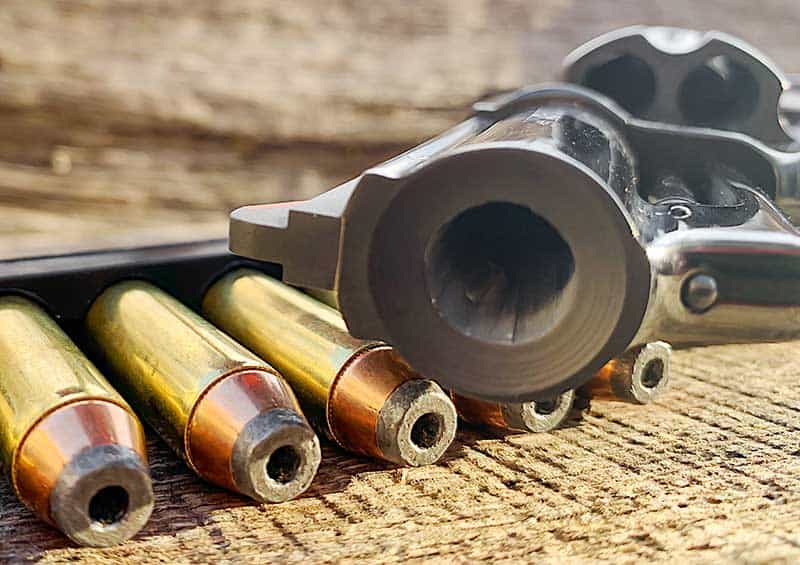
The recessed crown job adds accuracy and protects the rifling from getting any dings.
The Combat Mini
The Combat Mini is a custom design allowing maximum concealability and comfort for large N-Frame revolvers. The grip frame is re-worked into a round-butted K-Frame size providing comfort while still having plenty of grip for controllability when shooting. After the barrel is cut down to 3″, Ken crowns and ports it.
Ken also does a combat trigger conversion by polishing the serrations from the target trigger to a smooth surface, providing a more comfortable pull. He semi-bobs the hammer to keep it from digging into your side during concealed carry.
The action is then tuned, and let me tell you; Ken Kelley knows his way around an S&W double-action. DA pull measures 6 lbs.,14 oz., while SA measured just over 2 lbs. It’s the slickest action I’ve felt, yet it consistently ignites my CCI primed handloads without misfire.
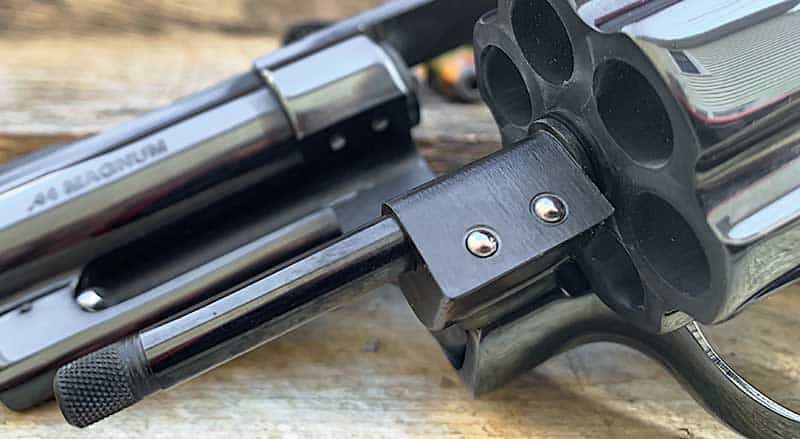
Ken then polished the whole works, giving it the Mag-na-port high-luster blue job while etching the logo onto the barrel. A red insert was added to the front sight. I added some Spegal extended boot grips and a Barranti Hank Sloan holster to finish the kit for a perfect packin’ pistol with power to spare.
Mag-na-port adds two detent ball bearings, adding more lock-up to the cylinder.
Porting Testimony
Some complain of porting, saying it makes the gun louder while never having shot a ported gun. This is false and has been proven with sound equipment in the H.P. White Laboratory years ago. What people forget is heavy recoiling guns are loud! Period. Porting can’t make them louder. What the porting does do is reduce felt recoil. This is accomplished by using the gases to work against recoil by venting through strategically placed trapezoidal cuts. Over 20% reduction has been measured, with shooters saying reduction feels more significant.
 (The StG 44 Assault Rifle)
 (A German soldier with an StG 44)
 (A German soldier aims down a modified sight on the StG 44)




.gif)