Month: August 2022


by Christopher Roach
Beginning in the 1980s, the American economy underwent substantial changes. Just as the earlier age of industrialization had transformed a rural and agriculture economy into an urban one focused on manufacturing, the industrial age gave way to the information age, with a greater priority for tasks like management, information processing, and finance. The workforce and concentrations of wealth followed suit, with finance and high-tech companies displacing the old industrial giants with their assembly lines and armies of workers.
Bill Clinton and Thomas Friedman told us that this was the way of the future and the path to prosperity. In the 1990s and 2000s, the GDP suggested they were right, as American companies focused on the higher-paying decision making and information management functions, while leaving less profitable, labor-intensive functions like manufacturing to others, particularly China.
This all seemed to work, until it didn’t.
COVID and Russian Sanctions Reveal the Fragility Caused By Outsourcing
COVID revealed how extended, China-dependent supply lines meant that more and more products were unavailable and could not be augmented by nonexistent domestic producers during a disruption. In parallel with the supply chain crisis came the Ukraine War and the boomerang effect of severe sanctions imposed on Russia. These effects are even more severe in Europe, which tried to sanction Russia while being highly dependent on Russian energy supplies.
At the beginning of the war, Europe and America treated Russia like a bit player, who would fold quickly under the sanctions’ weight. Commentators mocked Russia, saying its economy was no bigger than Italy’s, ignoring the huge differences between them in purchasing-power parity. Using crude GDP figures, they said Russia was merely a gas station with an army.
If this is true, then Europe is a car-maker with neither an army nor a domestic energy supply. Russia has absolutely essential supplies that Europe cannot easily replace, which has fueled a rally in the Russian ruble. It turns out the more traditional, “industrial age” Russian economy, which is focused on things like food, fertilizer, oil, natural gas, and making tanks, was better prepared than Europe’s economy for a war.
TikTok videos and artillery shells, while both contributing to the GDP, have quite different values once the bullets start flying.
The Information Age At War
As with the information age’s economic cheerleaders, military theorists in the West have also been seduced by the promises of modern technology and information systems. As the economy moved from one focused on high-value production to the management of information, the Defense Department and its top theorists imagined that warfighting would follow a similar evolution.
This anticipated shift had various labels, including the “Revolution in Military Affairs,” “digital dominance” and “fourth generation warfare.” The experts predicted that a high-tech military that detected, decided, and communicated the fastest would dominate the battlefield disproportionate to numbers of personnel, equipment, and firepower.
As with the real economy, the major premise had some flaws. Even in the information age, it turns out, things still need to be made and consumed—whether those things be cars, phones, or food. The often highly technical work of producing these necessities still must be done somewhere, frequently in China. This practice of outsourcing renders information age economies, like our own, vulnerable and dependent, even though self-sufficiency is particularly important in times of war.
Just as an economy needs raw materials and manufacturing, in warfare, communications are not self-sufficient; they must be in the service of delivering firepower. In other words, there still must be tanks and planes and artillery and men with guns to exploit the information being communicated.
While American military procurement has focused on various high-tech information systems, along with similarly sophisticated sensors and communication equipment, the force itself, though shockingly expensive, has also become very small. It is doubtful that the United States and NATO have the industrial capacity or sufficient stocks of weapons to fight a war of attrition with an industrial power, such as China or Russia. Our forces still use 40 year-old tanks, have spent a small fortune to field a new utility vehicle, and we are spending more for less capable ships. Our computers may be top notch, but weapons, numbers, and firepower are equally important.
A good example of the mistaken focus on technology and hubristic theories of future warfare is the Littoral Combat Ship (LCS). It was supposed to be modular and fitted with the latest sensors and computer systems, but the design severely neglected firepower. Following directions from the Navy, it has minimal organic anti-air capability and no vertical launch missile systems.
In the end, the LCS was a very expensive patrol boat with a very short range and little more than a 57mm gun in the way of offensive armament. All the information dominance in the world would not make the LCS a match against modern warships with their over-the-horizon weapons systems, or even old ones, like the retired Oliver Hazard Perry class frigates.
NATO is Losing Its Proxy War Because It Neglected Its Defense Industrial Capacity
While the United States and NATO were trying to make a Ukrainian Army in their image, NATO patrons found comparatively few artillery shells, armored vehicles, or other resources in their warehouses to supply the Ukrainians. Ukraine’s president has repeatedly begged for more, but the West lacks the stores or the industrial capacity to fulfill these requests. It turns out much of the $30 billion that was promised to Ukraine was actually a payoff to defense contractors, who will have to replenish the meager and diminished Western stocks of high-tech missiles and weapon systems being quickly used up by Ukraine.
Before the conflict began, many criticized Russia’s military as outdated, with its large reserves of mothballed equipment and mountains of munitions in storage. But it appears that their approach has certain advantages and may prove prescient. While their strategy and tactics may be ugly and slow, they are slowly grinding down the Ukrainian military and gaining territory, and the Russians have the men, matériel, and a seemingly endless supply of artillery shells to continue.
Western experts, including retired U.S. Army Europe commander Ben Hodges, mistakenly predicted that Russia would run out of shells and missiles back in April or May. But here we are in July, and the Russians are apparently firing 50,000 shells or more per day in comparison to the Ukrainians’ 5,000. At the same time, Russian Kalibr missiles continue to hit sensitive targets deep within Ukraine. It looks like Russia has worked out its logistics problems.
Neither the Ukraine War, nor the recent conflicts involving ISIS, al Qaeda, and the Iraqis, resemble in any significant way the sanitized, information-dominated warfare projected by the theorists. America’s wars in the Middle East ended up being infantry-centric low intensity conflicts, where high levels of manpower may have helped, but were unavailable from the all-volunteer military. The Ukraine conflict appears to be a slightly more mobile version of World War I, with a heavy emphasis on attrition and firepower, after some initial, ham-handed efforts at “shock and awe” by the Russians.
The actual wars taking place require different technologies, skills, and equipment than those being developed to serve the projected revolution in military affairs. As the military is gearing up for “great power competition,” our leaders do not appear to be sufficiently sensitive to the lessons of very recent wars, the risks of nuclear escalation in any conflict with China or Russia, or the need for numbers, mass, and industrial power if, by some miracle, a “near peer” conflict remains conventional.
The whole tone of the discussion is reminiscent of the discredited predictions after World War II and the Gulf War that conventional warfare was basically over, and future war would be a “push button” affair.
Models vs. Reality
Excessive devotion to a theoretical model can distract one from what is visible before one’s eyes. During the height of the COVID pandemic, modelers insisted on the need for masks and lockdowns, even though both had no strong empirical foundation. As the masked and the locked-down had similar outcomes as everyone else, the advice of the theorists did not change, other than to become more shrill and insistent.
While I have been highly critical of America’s and NATO’s involvement in the Ukraine conflict, it still pains me to see our military weakened by a combination of bad ideas and faddish ideology. American military power is an important component of maintaining American independence.
The lessons of the Russia-Ukraine War are still emerging, but it appears likely, as with information-age predictions on the economy, that traditional “industrial age” skills, weapons, and preparations will prove to have an enduring place in warfare. National economic strength is the necessary foundation of military power. But what kind of economic strength?
Domestic industrial capacity, abundant supplies, sufficient manpower, reserves of raw materials, and a streamlined procurement system will prove to be more decisive than high tech communications and information systems in any future war, just as they are now proving decisive in Ukraine.
Without sufficient industrial capacity and firepower, high tech information systems merely communicate the obvious: you are going to lose.
– – –
Christopher Roach is an adjunct fellow of the Center for American Greatness and an attorney in private practice based in Florida. He is a double graduate of the University of Chicago and has previously been published by The Federalist, Takimag, Chronicles, the Washington Legal Foundation, the Marine Corps Gazette, and the Orlando Sentinel. The views presented are solely his own.
Photo “Xi Jinping” by kremlin.ru. CC BY 4.0.

Categories
New for 2021: Kimber R7 Mako
Kimber’s release of its R7 Mako really highlights a dynamic shift in the marketplace of concealed-carry guns. The concept of a micro-compact handgun with increased capacity in a discreet frame has dominated gun sales for the past few years, and now, nearly every manufacturer offers a model that fits this niche. Kimber, known for its traditional lineup of 1911 pistols and similarly configured concealed-carry guns, stepped into the micro-compact market with its first-ever polymer-frame, striker-fired handgun, and it’s an interesting design with a couple features not seen in other guns.
At first glance, the Kimber R7 Mako shares a similar profile with other micro-compact guns on the market, and that’s by design. Kimber, by dint of being a latecomer to the market in this respect, has the advantage of examining all other available options and functionally taking the best elements from each to create a better offering. A closer look at the design reveals some unique elements. Probably the most noticeable is the enclosed ejection port.
Traditionally, today’s semi-automatic pistols feature a barrel hood that locks into the slide. The top of the R7 Mako features no such cutout. Instead, a lug protrudes from the top of the barrel and locks into a rectangular recess at the top of the slide, a slightly different take on what’s otherwise a short-recoil system. Kimber’s claim is that this construction prevents excess gas and debris from obscuring the window on a mounted red-dot optic. It’s also a stiffer, stronger design, simply because there’s more material than there otherwise would be. Preliminary testing by American Rifleman staff has also shown some enhanced accuracy potential that could possibly be attributed to this style of lock-up.
Also aiding in accuracy is another standout feature of the R7 Mako: the trigger. The flat-face design feature a blade-in trigger safety that mimics popular, comfortable options available on the aftermarket. The highlight of the trigger, however, isn’t in the design. Rather, it’s in how it breaks. Kimber designs its triggers to arrive from the factory with a pull weight measuring between 5 lbs. and 6 ¾ lbs. However, because of the extraordinarily clean and abrupt break of this trigger design, it feels lighter than it actually is. Our current test sample arrived with a pull weight measuring slightly above 5 lbs., and it provided consistent results over multiple pulls with a Lyman Trigger Pull Gauge.
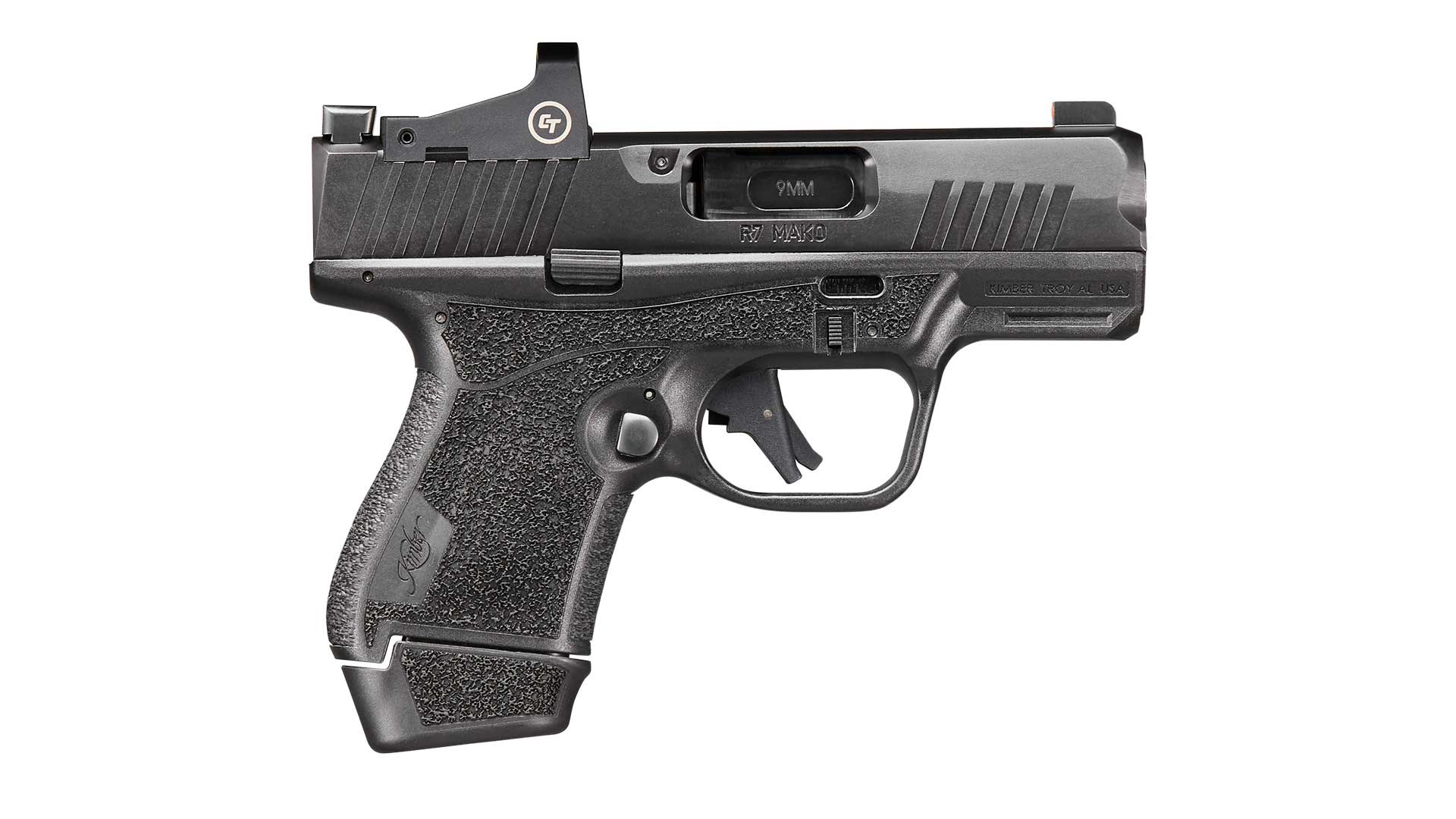
Kimber’s R7 Mako also includes a 13-round extended magazine that only slightly increases the overall height of the pistol.
Ergonomically, the Kimber R7 Mako has some positive features. The grip frame features generous texturing that, at least for some shooters, struck the right balance between aggressive and abrasive. There’s a generously sized heel that fills the palm, and an undercut trigger guard and backstrap allows the gun to sit plenty low in a shooter’s hand. One of the elements commonly encountered among the micro-compact market is noticeable felt recoil, understandable due to the gun’s generally small size combined with a potent, duty-ready 9 mm chambering. However, the Kimber felt comfortable to shoot, even in extended range sessions.
Other highlights include bilateral controls, specifically a mirrored magazine release and slide-stop lever. The gun ships with Truglo tritium-illuminated night sights and a milled, optics-ready slide complete with a cover plate. An Optics Included model is available and ships from the factory with a Crimson Trace CTS-1500 red-dot sight, which features a 3-m.o.a. dot and automatically adjusts brightness to match ambient lighting conditions. The MRD runs off a single CR2032 battery, which provides a continual runtime of up to 5,000 hours on a mid-range brightness setting.
Available in 9 mm Luger, the Kimber R7 Mako ships with one 11-round flush-fit magazine and one 13-round extended magazine while retaining a slim profile measuring just 1” wide. Standard models with a milled slide plate have a suggested retail price of $599, while the optic-included model retails for $799. For more information, visit kimberamerica.com.