






I had just set down my favorite coyote call—a Dan Thompson’s Red Desert Howler—and was regaining my breath after screaming like a tortured cottontail. My dad—Ol’ Grumpy Pants—was with me, sitting about 150 yards over a small ridge, watching the edge of a thicket. It wasn’t 30 seconds until I heard the sharp crack of his .22-250 Remington—only one shot—and I pretty much knew what that meant. I gave it five minutes, waiting to see if perhaps more than one dog had come to the call that morning, but knew his shot had cancelled the party for all others, not to mention ruining the day of that large female coyote. “Good rifle, this,” G.P. confirmed, “dropped her in her tracks.”
Coyote hunting is a great late-season activity, and if you’ve ever seen a live deer, with its hocks and haunches bloodied and half-eaten, you’ll have little issue in pursuing these creatures to the ends of the earth. Let’s take a look at my personal top five choices for a coyote cartridge, in no particular order.
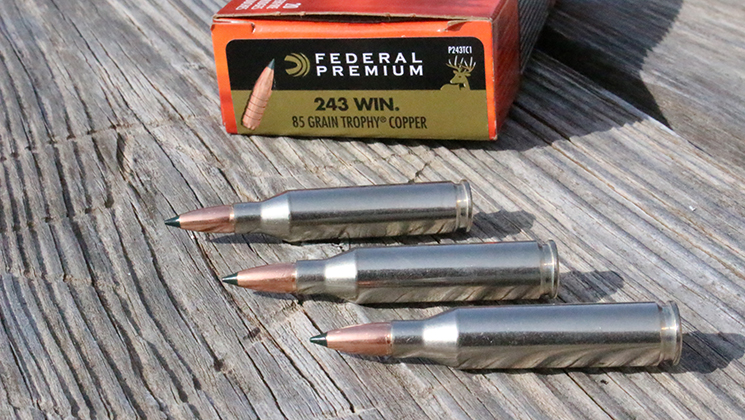
.243 Winchester
Doing perfect double-duty as a deer/coyote rifle, Winchester’s 6mm cartridge—based on the .308 Win. case—offers a great selection of bullets for the coyote. It will drive a 55-grain bullet to over 3800 fps, and that short bullet at that velocity will provide enough hydraulic shock to plant a coyote where it stands. Introduced in 1955, the .243 will also use the 95- and 100-grain bullets—perfect for the really windy hunting days—at just about 3000 fps. The .243 Win. may be a little heavy for long days on a prairie dog town, but for the selective shooting involved with coyote hunting, it makes a perfect choice.
.17 Hornet
I like the little .17s—from the .17 WSM to the .17 Remington—but my favorite among them is the .17 Hornet. Simply the good old .22 Hornet necked down to hold .172” bullets, the .17 Hornet uses light-for-caliber bullets to achieve respectable velocities. Ammo is currently produced by Hornady, Federal and Winchester, with bullets ranging in weight from 15½ grains to the huge 25-grain pill; I’d opt for the 20 and 25 grainers for coyote hunting. While not the speed demon that the .17 Remington is, the little Hornet has a good sting to it, and actually fares decently in the wind. Keep the shots inside of 250 yards, and you’ll have no problem killing even the big dogs of the Northeast. The .17 Hornet has virtually no recoil, and is plenty accurate enough for head shots.
.223 Remington
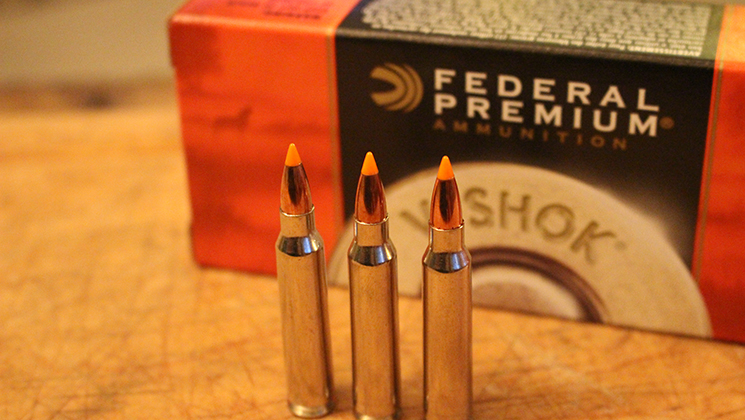
It’s no secret that the .223 is among our most popular cartridges for a number of different reasons, and among those reasons sits the coyote. With the capability to propel a 55-grain bullet to 3000 fps, and equipped with a twist rate fully capable of using the heavier 77- and 80-grain bullets, the .223 Remington in any gun makes excellent coyote medicine. It offers a trajectory flat enough to take coyotes out to 400 yards, and hits hard enough to anchor them. Some hunters prefer the FMJ ammunition, to best preserve the hide, while others like the frangible hollowpoint stuff, for the shock factor. I’ve used both, and probably lean more toward the hollowpoint stuff these days, especially in the lighter bullets.
6mm Remington
Born into this world as the .244 Remington, and receiving a bad rap due to a twist rate that wouldn’t stabilize the heaviest bullets in the caliber. A slight revision to the twist rate—and a legal name change—on the part of Remington yielded the 1963 release of the 6mm Remington. Being the grandson of the 7x57mm Mauser is in no way a bad thing, and the 6mm Remington certainly lives up to the family reputation. As a coyote rifle, the 6mm Rem absolutely shines, as the case can really drive the 6mm bullets. For a deer hunter who wants a gun to cover more than one season, the 6mm Remington may be among the best choices. It will equal and sometimes better the velocities of the .243 Winchester, and coyotes have every reason to fear it.
.22-250 Remington
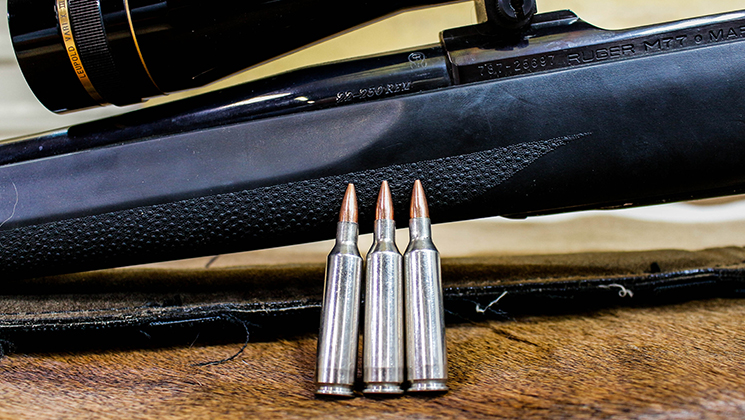
I’m saving my personal favorite for last. Immediately after shooting my first coyote—with a .308, during deer season—I sought out a proper coyote rifle. I pored over the ballistic tables and reloading manuals, trying to find what I considered just about perfect for my own hunting situation here in New York: a combination of close shots in the woods, and the potential for shots of about 400 yards maximum. After much debate with Ol’ Grumpy Pants (we’re Sicilians; read arguing) I settled on a Ruger 77 MkII in .22-250 Remington and topped it with a Leupold 6.5-20 Vari-X III. While I like other rifles and calibers for this class of hunting, I’ve yet to find something that tickles my fancy as much as this gun. I installed a Timney trigger and a Hogue Overmolded stock, but that’s all I’ve ever done to it, and it still prints wonderful little groups. It’ll push my favorite Sierra 53-grain hollowpoints to 3,650 fps—lights the funk out on coyotes. Based on the .250-3000 Savage, this little gem and I have accounted for a good number of coyotes, foxes, skunks, woodchucks et al. It does have one drawback—if a drawback it is—in its twist rate. The .22-250 uses a 1:12” or 1:14” twist rate, limiting the bullet choices to 55 or 60 grains at best. In my opinion, the .22-250 case would serve the heavier .22 caliber bullets very, very well, but alas, it’s not to be. Nonetheless, I like my .22-250 Remington as a reach-out-and-touch ‘em coyote cartridge.
There are other viable choices—the .220 Swift has a helluva following, and the .17 WSM has no flies on it—but these choices are what I like. No matter what you prefer, being afield in pursuit of coyotes is always a good time.

Now in their 20th year, the Golden Bullseye Awards are chosen annually to recognize the firearm industry’s best new offerings. Here is this year’s winner as selected by the editors of “The World’s Oldest And Largest Firearm Authority.”
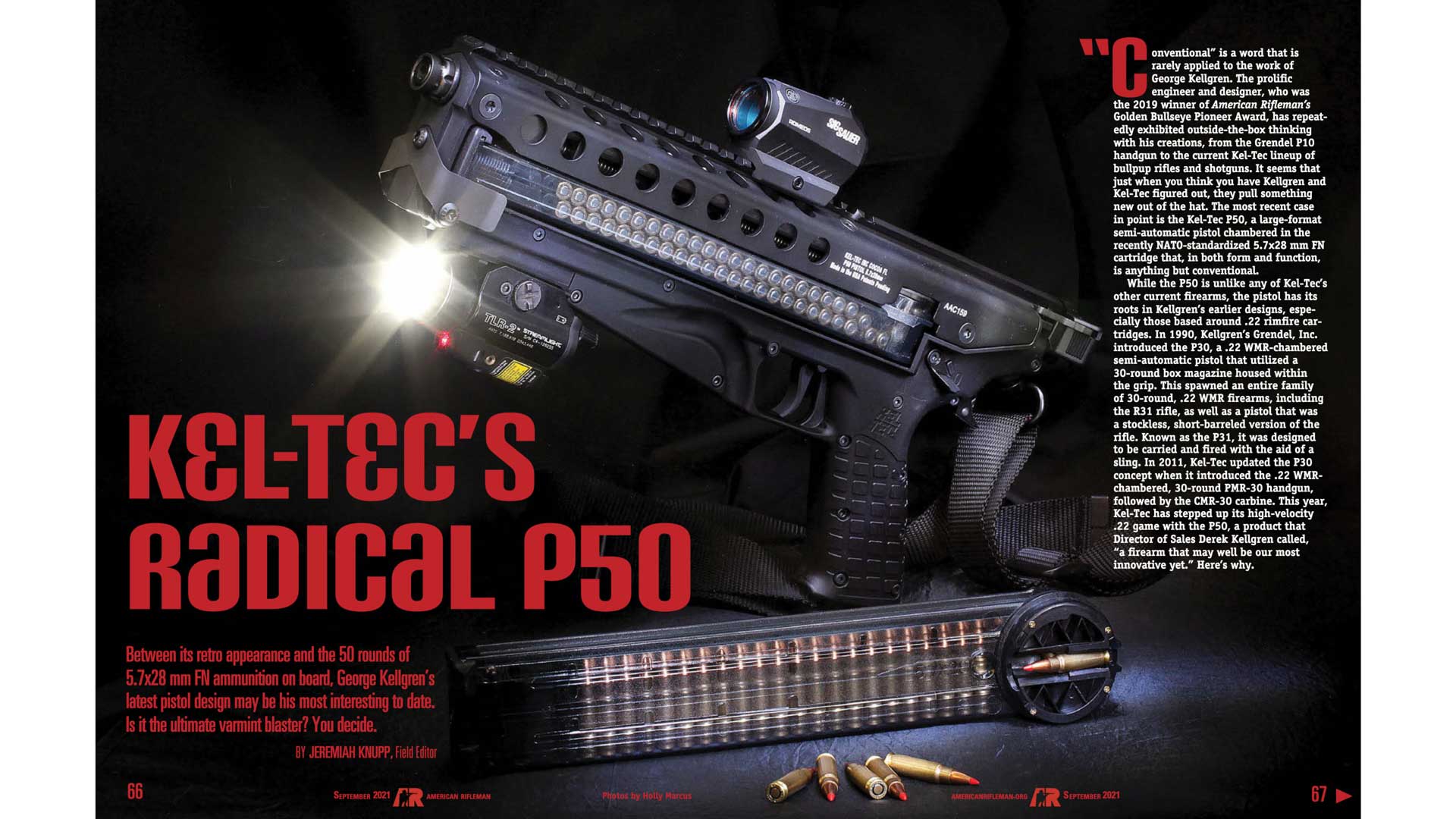
A 56-oz., 15″-long pistol chambered in 5.7×28 mm FN that feeds from the quirky, horizontally mounted 50-round magazines used in FN’s P90/PS90 platform, the P50 exemplifies Kel-Tec’s penchant for creating novel and unorthodox firearm designs. But despite what an odd duck the P50 would seem to be, once he got his hands on one, Field Editor Jeremiah Knupp was impressed by its adaptability, and he expounded upon the pistol’s qualities in “Kel-Tec’s Radical P50.”
“The P50’s compact size, ease of use and capacity … would certainly lend itself to home defense with the addition of an electronic optic and light,” Knupp said. His testing revealed the P50’s accuracy to be excellent—partly attributed to its barrel being fixed to its receiver and partly due to its crisp trigger—and also noted the pistol’s potential as a close-range varmint-hunting tool. For thinking so far outside the box in creating a truly innovative gun capable of a broad range of applications, we determined that the Kel-Tec P50 was deserving of our Tactical Product Of The Year award.
keltecweapons.com
About the Golden Bullseye Award:
The Golden Bullseye Awards were created two decades ago to recognize quality, innovation and value within the firearm industry, with the editors of the NRA Publications Division convening annually to nominate and select the standout performers from the previous year’s crop of new products. The discussions can get animated at times—as each year there are always more new guns, ammunition, optics and accessories worthy of accolade than we could possibly call out—but consensus eventually results in winners being selected, with the passionate back and forth serving as evidence of the firearm industry’s health and innovative spirit.