Month: June 2022
- By modern standards, the tank is completely obsolete and will fare badly in Russia’s invasion.
- Ironically, the larger crew means the T-62 will increase Russian personnel losses in the long run.
The Russian Army has begun deployment of one of the oldest tanks in its stockpile, the T-62 main battle tank. The T-62, which the Soviet Union produced between 1962 and 1973, is poorly armored by modern standards, with little of the protection that modern vehicles offer. Relying on these tanks will only exacerbate Russia’s losses in its ongoing invasion of Ukraine—both in hardware and in human lives.
In just over 100 days, the Russian Army has lost an estimated 15,000 personnel, killed in action. Russian equipment losses have been especially heavy, as well, with at least 761 tanks, 840 infantry fighting vehicles, 271 artillery pieces, 30 fixed-wing aircraft, and an entire guided-missile cruiser destroyed. Much of Russia’s war machine has proved hollow, with numerous cases of substandard or crudely-maintained equipment, poorly-trained soldiers, and overall lousy morale.
Both in the field and in deep storage, the Russian Army has approximately 12,420 tanks, according to Global Firepower, a website that maintains rankings of global military strength. Russia has built comparatively few tanks since the end of the Cold War, relying on thousands of T-72 and T-80 main battle tanks that the Soviet Union produced between the late 1970s and 1991, when the USSR broke up. Decades old, Russia has renovated and upgraded these tanks into improved versions, including the T-72B1, T-72B3, and T-80BVM. Although enhanced, they still suffer from 50-year-old design decisions that make them more vulnerable to catastrophic destruction.
On May 25, social media posts reported sightings of even older tanks—T-62Ms and T-62MVs—loaded on trains arriving in Ukraine. Users also spotted T-62-series tanks in the field on June 5, heading west in the direction of cities like Mykolaiv and Kryvyi Rih. That same day, footage showed the first reported losses of those tanks.
The T-62 is a second-generation main battle tank. The Soviet Union produced it to replace the older T-55 tank; it first deployed the T-62 in large numbers with the Group of Soviet Forces in Germany in 1963. The T-62 was equipped with a U-5TS 115-millimeter main gun and a 7.62-millimeter PK-T machine gun mounted coaxially. The tank had 230-millimeter frontal-turret armor and 100-millimeter frontal-hull armor, making it heavily armored for its time. Unlike later tanks, a humans had to manually load the gun, giving it a total crew of four.

© GEORGES GOBET – Getty ImagesAn Afghan soldier sitting on top of a T-62M tank near the Salang Pass, August 1989. Note the laser rangefinder mounted at the base of the main gun and the additional armor, with white markings, wrapped around the front of the turret.
In the early 1980s, baseline T-62s were upgraded into the T-62M and -MV standard. The tanks featured NII Stali BDD appliqué armor designed to boost the tank’s chances of survival on the battlefield, increasing frontal-turret protection from 230-millimeter to 450-millimeter against shaped-charge warheads used by anti-tank missiles. The tanks also received ballistic computers, laser rangefinders, and an improved gunner’s sight and gun stabilization systems. Tanks upgraded to the -MV standard received reactive armor consisting of explosive boxes meant to counteract the effects of a shaped-charge attack.
Unfortunately, as impressive as this sounds, none of it is particularly useful in Ukraine. The 450-millimeter armor protection was an acceptable standard in 1982, but in 2022, many tanks feature 900-millimeter protection or more. Modern anti-tank weapons provided to Ukraine, particularly NLAW and Javelin, fire their warhead downward through a tank turret roof.

© MAXIM GUCHEK – Getty ImagesA Russian T-72B3 tank sporting a “cope cage.” The cages have not worked as intended.
The T-62 still has just 30 millimeters of turret-roof armor, as much as it did in 1965, leaving it critically vulnerable to modern weapons. T-62s sighted in Ukraine have grid cages installed on the turret roof. The cages, derisively nicknamed “cope cages,” are supposed to provide additional protection against shaped-charge attacks. Unfortunately, there are numerous examples of even newer tanks equipped with the cages destroyed on the battlefield, strongly suggesting they don’t work as intended.
There are other problems with the T-62s. As we’ve seen with the rest of Russia’s vehicle fleet, many tanks and armored vehicles—even relatively new ones—have been poorly maintained and suffer from reliability problems in Ukraine. Any T-62 pressed into service is at least 40 years old, suffering from decades of neglect. Unlike newer tanks, the T-62 has a crew of four, increasing manpower demands on an already manpower-strapped force. And if the tank is destroyed, total destruction of the T-62 results in the loss of four tankers, not three.

© John Moore – Getty ImagesThe T-62 is virtually defenseless against modern anti-tank weapons such as the Swedish NLAW, shown here in Ukraine.
The T-62 tank is so old that the anti-tank weapons facing it were developed long after it was considered obsolete. There is no comparable tank like it left today in the West; it would be unethical to force soldiers to fight in a tank as obsolete as the T-62. Yet to all of this, there is a silver, morbid, lining: if deploying T-62s to Ukraine accelerates Russian army losses, it could hasten an end to the war.
(The Hill) – A handful of House Republicans bucked their party to vote for gun legislation on Wednesday, supporting measures that were introduced after the mass shootings in Buffalo, N.Y. and Uvalde, Texas last month.
The marquee piece of legislation that cleared the chamber was the Protecting Our Kids Act, a package of bills that seek to tighten gun restrictions. Among the provisions are raising the minimum age to purchase a semi-automatic weapon from 18 to 21 and banning civilians from using high-capacity magazines.
The legislation is doomed in the Senate because of widespread GOP opposition. The package passed the House in a largely party-line vote of 223-204. One Republican did not vote.
Five Republicans broke from the party in supporting the measure: Reps. Adam Kinzinger (Ill.), Anthony Gonzalez (Ohio), Brian Fitzpatrick (Pa.), Chris Jacobs (N.Y.) and Fred Upton (Mich.).
Kinzinger, Gonzalez, Jacobs and Upton are all not seeking reelection this year. Jacobs bowed out of seeking another term last week after he came under fire within the party for expressing support for an assault weapons ban.
The lawmakers voted for the package despite party leadership advocating against the legislation. Minority Whip Steve Scalise’s (R-La.) office sent a memo to House GOP offices on Tuesday encouraging members of the conference to vote “no” on the sweeping measure.
“In the wake of the senseless, malevolent shootings seen in recent months, the Majority has thrown together this reactionary package comprised of legislation that egregiously violates law-abiding citizens’ 2nd Amendment rights and hinders Americans’ ability to defend and protect themselves and their families,” the memo read.
In addition to voting on the entire package, the House also held votes on each individual provision. The full package, however, is the only piece of legislation that will be sent to the Senate for consideration.
Last week, Majority Leader Steny Hoyer (D-Md.) said the House would vote on each provision “to place Republicans on record on each of these issues relating to gun safety.”
Six of the seven provisions passed in largely party-line votes, with only a handful of Republicans joining Democrats. The last provision, however, had widespread bipartisan support. It orders the attorney general to submit a report to congressional committees detailing individuals who could not purchase a firearm because they failed a background check.
Rep. Jim Jordan (R-Ohio), the ranking member of the House Judiciary Committee, recommended that members vote against the first six provisions, but signaled support for the final one.
Kinzinger, Fitzpatrick and Jacobs supported all six provisions that Jordan recommended the conference oppose. A number of other Republicans joined the trio in voting for some of the individual measures.
The provision that would impose a ban on bump stocks for civilians received the most GOP support among the measures that Jordan recommended voting against.
The initiative passed in a 233-194 vote, with 13 Republicans bucking the party: Reps. Mike Turner (Ohio), John Katko (N.Y.), Anthony Gonzalez (Ohio), Chris Jacobs (N.Y.), Nicole Malliotakis (N.Y.), Chris Smith (N.J.), Maria Salazar (Fla.), David Valadao (Calif.), Ken Calvert (Calif.) David Joyce (Ohio), Kinzinger, Upton and Jacobs.
The provision that calls for raising the minimum age for purchasing a firearm from 18 to 21 cleared the House in a 228-199 vote. Ten Republicans supported that effort: Turner, Katko, Upton, Gonzalez, Fitzpatrick, Kinzinger, Jacobs, Malliotakis, Smith and Salazar.
The list of GOP defectors was similar for the measure to mandate that untraceable firearms and guns without serial numbers, also referred to as ghost guns, undergo background checks and receive serial numbers.
The House passed the provision in a 226-194 vote, with eight “yes” votes: Fitzpatrick, Kinzinger, Jacobs, Katko, Malliotakis, Upton, Gonzalez and Smith.
On a provision creating new federal crime offenses for gun trafficking and straw purchases of firearms, which is when people who are not able to clear background checks purchase firearms through a proxy, 7 Republicans bucked the party to support the measure in a 226-197 vote.
Fitzpatrick, Kinzinger, Malliotakis, Gonzalez, Jacobs, Salazar and Katko all voted “yes.”
Four Republicans voted for the provision that calls for prohibiting civilian use of ammunition magazines that have more than 15 rounds: Kinzinger, Jacobs, Upton and Fitzpatrick. The measure passed in a 220-207 vote.
The provision that received the least GOP support seeks to bolster safe storage of guns in homes where minors may have access to the firearms. Kinzinger, Fitzpatrick and Jacobs were the only GOP defectors. The effort, however, ultimately cleared the House in a 220-205 vote.


Police across the country have often been caught using excessive force during arrests and other confrontations. Even when such incidents are captured on video, officers are often able to escape punishment or other consequences. Such appears to be the case yet again. In a controversial ruling, a three-judge panel of the Fifth Circuit of the U.S. Court of Appeals ruled that an officer who admitted to twisting a teenage girl’s arms to cause her pain did not violate the law in his actions.
The officer admitted to purposely hurting the teenage girl.
The case at the center of the controversial ruling involves Fort Worth, Texas, resident Jacqueline Craig and her young child. In 2016, Craig called the police to report an assault committed against her then-7-year-old son. Craig said that a neighbor choked the child for “littering” after the young boy had dropped raisins in the neighbor’s yard. But when Officer William Martin showed up on the scene, he berated Craig and her child.
Martin ended up violently arresting the mother and her 19-year-old daughter, Brea Hymond, who intervened in the argument. In the process, Martin purposely hyperextended Hymond’s handcuffed arms, and he admits he did intend to force her to tell him her name and age after she initially refused to do so. Video footage of the encounter between the Craig family and Martin was eventually released online, showing the confrontation that also saw Martin using violence against Craig’s other underage teenage children during the encounter.
The appeals court shot down the family lawsuit and upheld qualified immunity.
The Craig family understandably sued Martin for violating the rights of Craig and her daughter. The lawsuit made its way up through the courts and was initially allowed despite Martin’s claim of qualified immunity, the principle that exempts police officers from consequences for most acts of violence they commit while in the line of duty.
The Fifth Circuit ruling reversed a lower court’s decision and accepted Martin’s claim of qualified immunity in the incident. The court’s ruling also ruled that Martin did not violate Craig’s Fourth Amendment rights. The Fourth Amendment guarantees the right of people “to be secure in their persons, houses, papers, and effects, against unreasonable searches and seizures,” and is one of the most important protections against police overstep. Because Martin did not cause permanent injury to Hymond, the judges ruled his actions did not rise to the level of a constitutional violation.
A dangerous precedent was set by the court.
By ruling that Martin’s intentional use of physical pain did not violate the limitations of the Constitution, the ruling potentially opens the door for police to use increasingly coercive tactics to gain confessions or other information from suspects. Given the many cases of police brutality and even torture that have been documented over the years, any encouragement that police use violence against already detained individuals will likely lead to even greater abuses.
Experts hope that the full Fifth Circuit will overturn the ruling of the three-judge panel. Alternatively, the Supreme Court, which has overruled the Fifth Circuit in other cases, may ultimately be called upon to reconsider this case as well. Either way, there is still hope that the judicial system could deliver justice for the Craig family and in the process protect Americans from police brutality.
Gun control debate
New York has enacted new gun control laws in the wake of recent mass shootings. Will Congress take up national reform?
NEW YORK – New York Gov. Kathy Hochul signed 10 bills into law on Monday intended to strengthen the state’s gun laws after recent mass shootings in Buffalo, New York, and Uvalde, Texas.
Among the new laws is the prohibition of the sale of body armor to civilians, the requirement to have a license to purchase semi-automatic rifles, the making of a threat of mass harm as a crime, and the strengthening of the state’s red flag laws which make it easier to take guns away from dangerous people before they commit a crime.
The other new laws include requiring that all new pistols be equipped with microstamping technology, which uses lasers to imprint markings on a firearm, making it easier to trace guns and raising the minimum age to purchase semi-automatic rifles to 21.
“In New York, we are taking bold, strong action. We’re tightening red flag laws to keep guns away from dangerous people,” Hochul said at a press conference in the Bronx.
Get breaking news alerts in the free FOX5NY News app! | Sign up for FOX 5 email newsletters
New York enacts new gun laws
Gov. Kathy Hochul signed a series of bills into law. One law now requires all purchasers of semiautomatic rifles to be licensed.
“Passing comprehensive gun legislation is quite literally a matter of life or death, and part of this package includes our legislation to require gun manufacturers and dealers to implement micro-stamping technology, which adds a trackable serial number to spent ammunition,” State Sen. Brad Hoylman said after introducing the bill last week. “So literally when a gun is fired, the casing will be inscribed with a code that can then be tracked back from the scene of say a crime to the gun that actually fired the bullet.”
10 new gun laws in NY
Among the ten new gun laws signed by NY Gov. Kathy Hochul is the requirement of a license to purchase semi-automatic rifles.
New York’s Legislature passed the bills last week, pushing the changes through after a pair of mass shootings involving 18-year-old gunmen using semiautomatic rifles. Ten Black people died in a racist attack on a Buffalo supermarket May 14. A Texas school shooting took the lives of 19 children and two teachers 10 days later.
“This is a moment of reckoning for us is in New York and as Americans,” added Hochul.
The Supreme Court was expected to hand down a decision in the coming weeks on the state’s concealed carry law and whether it is constitutional.
Uvalde massacre aftermath
The U.S. Justice Department plans to review the police response to the mass shooting at Robb Elementary School in Uvalde, Texas.
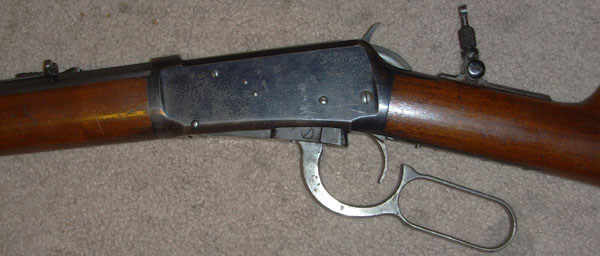
Receiver area of Model 1894 .25-35 test rifle w/action unlocked. Photo by Suzie Patterson.
The rifle that is the subject of this review belonged to Guns and Shooting OnlineSupport person Suzie Patterson’s Grandfather. According to its serial number, it was manufactured in 1907.
At that time the .25-35 WCF was a reasonably popular combination deer, antelope and small predator cartridge, although .25-35 rifles and ammunition sales never approached the levels attained by the .30-30 and .32 Win. Special.
Still, it was chambered in Winchester, Marlin and Savage lever actions for nearly half a century.
It was sufficiently popular to be copied by Remington during the first decade of the 20th Century, when Big Green introduced a line of rimless cartridges for their early pump and autoloading rifles. These Remington rimless numbers were ballistically identical to the .25-35 (.25 Rem.), .30-30 (.30 Rem.) and .32 Special (.32 Rem.).
The Remington rimless cartridges are now obsolete, but Winchester still loads .25-35 ammunition, as do some of the specialty ammo makers, such as Stars & Stripes. Occasionally someone turns out a few rifles in the caliber.
We reviewed a .25-35 Winchester Model 94 Trails End in 2005. We would like to see Winchester chamber their new Model 94 rifles in .25-35 and suggested exactly that in our recent review of a new Model 94 Sporter.
(See the Product Reviews page for the reviews of both these Model 94 rifles.)
We would also like to see Hornady include the .25-35 in their LeverEvolution ammunition line, loaded with a 117 grain FTX boat-tail spitzer bullet at over 2400 fps, which should be easy to do with modern powders.
We like the .25-35 because it represents the lowest level of recoil in a cartridge suitable for hunting deer and other medium size CXP2 game. The present Winchester factory load launches a 117 grain flat point bullet at a muzzle velocity (MV) of 2230 fps, with 1292 ft. lbs. of muzzle energy (ME).
The velocity/energy at 100 yards is 1866 fps/904 ft. lbs., over the 800 ft. lbs. minimum usually recommended for deer hunting. At 200 yards, the numbers are 1545 fps/620 ft. lbs. The maximum point blank range of that load (+/- 3″) is around 200 yards.
These numbers are not impressive compared to the .243 Winchester or .257 Roberts, but they compare favorably with other minimum recoil deer cartridges, such as the .357 Magnum and .44-40 fired from rifles.
In fact, the .25-35 delivers as much energy at 200 yards as the .357/180 grain factory load does at 100 yards or the .44-40/200 grain factory load can muster at the muzzle. Seen in that light, a young or recoil sensitive beginning hunter could do worse than a .25-35 rifle.
According to the “Rifle Recoil Table,” the .25-35 normally produces between six and seven foot pounds of recoil energy in rifles weighing 6.5 to 7.5 pounds, or about half the recoil of a .30-30 fired in the same rifle. That is similar to the recoil of one of the short 6mm bench rest cartridges, only the .25-35 shoots a fatter bullet that is almost 50% heavier.
We occasionally get mail asking what cartridge we recommend for young (10-12 year old), recoil sensitive shooters anticipating their first deer hunt. If modern rifles and ammunition were available, the .25-35 would definitely be at or near the top of our list.
If you agree, please send a note to Winchester Repeating Arms, Henry and Marlin asking for .25-35 rifles and to Hornady and Winchester Ammunition requesting modern .25-35 factory loads.
Our sport desperately needs rifles chambered for moderate, low recoil cartridges suitable for beginning hunters.
The rifle that is the subject of this review is in very good condition and would serve a beginner nicely.
Unfortunately, due to collector demand for old Model 1894 rifles in calibers other than .30-30 and .32 Special, its fair market value puts it out of the typical beginning hunter’s price class.
Few dads would be willing (or able) to spend so much money for their 12 year old offspring’s first centerfire rifle.
Specifications
- Model: Winchester 1894
- Type: Lever action rifle
- Caliber: .25-35 WCF
- Barrel: Octagon; nickel steel for smokeless powder
- Barrel length: 26″
- Twist: 1 turn in 8 inches
- Magazine capacity: 9 cartridges
- Trigger pull: approx. 4 lbs.
- Sights: Gold bead front, adjustable buckhorn rear (also an adjustable, folding tang rear sight)
- Stock: 2-piece black walnut; straight hand with crescent rifle butt plate
- Overall length: 44″
- Weight: approx. 7.5 lbs.
- 2011 used value: Approx. $2500 (75% original finish per Fjestads)
As one might expect of a rifle manufactured in 1907 by one of the greatest arms makers of the time, this rifle is built entirely of forged steel parts and walnut. It was carefully assembled by skilled workers. The bore of our test rifle is somewhat worn, but shiny and in generally good condition.
Safety is provided by a hammer safety notch. When the chamber is loaded, manually lower the hammer from the full-cock position until it engages the safety notch (about 3/4 of the way down).
This is easy to do. Keep the muzzle pointed in a safe direction while you are lowering the hammer. Yes, the hammer can be forced by a perfectly directed, very heavy blow, such as from a carpenter’s hammer, but so what? That is not going to happen in the field.
In addition to the stock sights, this rifle wears a folding, tang mounted peep sight. This is probably the fastest type of iron sight ever devised for a hunting rifle and considerably easier with which to shoot accurately than the standard open sights.
It is especially good for middle aged shooters whose eyes have lost some of their power of accommodation.
We were interested in getting this .25-35 to the range for some shooting. Our friends at Winchester Ammunition kindly provided 100 rounds of Super-X .25-35 ammunition for this review, for which we are very grateful. Please support them by buying and using their products.
As usual, we did our shooting at the Izaak Walton outdoor range south of Eugene, Oregon. This facility offers covered bench rests with target stands at 25, 50, 100 and 200 yards, but we confined our shooting to 100 yards, a long way for iron sights and our aging eyes.
The bulk of the shooting was done from a bench rest over sandbags by Guns and Shooting Online staff members Chuck Hawks and Rocky Hays.
The results were excellent. We found the old rifle capable of shooting 2″ to 2-1/2″ groups, when we did our part, using the tang mounted aperture sight. (Neither Chuck nor Rocky have any use for semi-buckhorn open sights.)
Chuck and Rocky found the recoil to be low and this, of course, promotes good shooting.
Suzie, who is not an experienced rifle shooter, had previously fired her grandfather’s rifle and thought it kicked pretty hard, although she was able to keep her bullets on the target.
This merely illustrates that rifles in common calibers experienced shooters are inclined to take for granted (.30-30, 7mm-08, .260 and others of that ilk) may be beyond the ability of inexperienced shooters to shoot without flinching.
The .25-35 may well be all a beginner can handle and clean kills result from proper bullet placement, not raw power.
We all came away from our range session impressed with the gentle .25-35 cartridge and the accuracy of this turn of the 20th Century Model 1894 rifle.
As mentioned above, our sport desperately needs hunting rifles chambered for moderate, low recoil cartridges suitable for young (and old) shooters and it just doesn’t get any better than a sleek lever action rifle chambered for the .25-35 cartridge.
Categories
Happy Friday! NSFW