

The M1891 Carcano was a frequent butt of jokes by shooters after WWII.
The reputation went from bad to worse when an M38 Carcano was used
to kill President John F. Kennedy
Like cats, people seem to dislike Carcanos for no good reason. Unfortunately, the weapon’s main claim to fame among Americans is forever tied to an M38 found on the sixth floor of a Dallas school book warehouse on November 22, 1963. As if such ignominy wasn’t enough, during America’s golden age of military surplus bolt actions in the 1950s and 1960s, it was frequently the butt of jokes going something like this: “Italian Carcano Rifles For Sale: Excellent shape, barely fired, dropped once.”
Compared to the Germans and Japanese, Italy’s military performance in WWII perhaps warranted the zinger but the Carcano never deserved the reputation it had by the 1970s of being weak, unsafe and badly designed.
This was about the time I got really interested in military guns and if you mentioned you were looking at a Carcano, some gun wag would claim anybody foolhardy enough to shoot one was asking for a bolt in the cranium. For me, such criticism never passed the common sense test. It was, in fact, completely false.
The Italians made most of their Carcanos, over two and a half million, between 1893 and the end of World War I and used them for over half a century with no significant changes aside from sights, stocks and barrel length. Does this sound like a bad gun? I’d like to set the record straight and elevate the Carcano back up to its rightful place among its first generation, small-bore, smokeless powder peers — the French 1886 Lebel, the German Gewehr Model 1888, the Russian Mosin Nagant M1891, the Danish Krag-Jorgensen and the Austro-Hungarian M1895 Mannlicher.
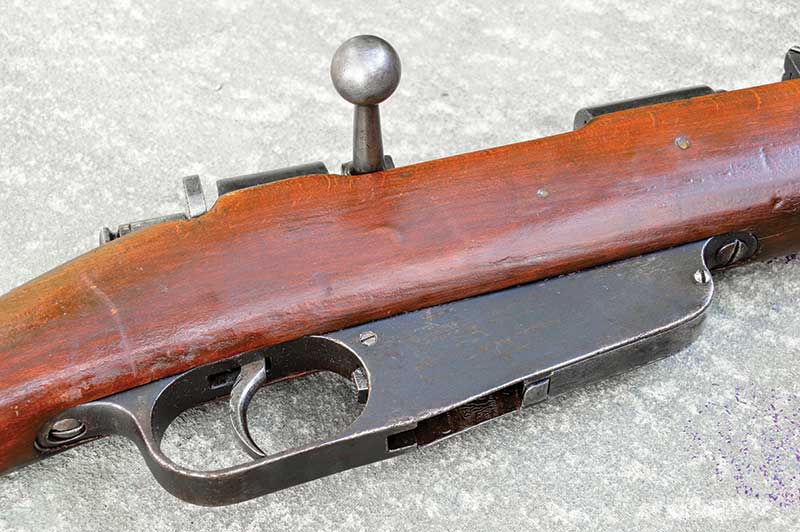
The Carcano had a unique feature allowing its Mannlicher clip to fall free
when empty — but also allowing a portal for mud and grime to enter the action.
In response to France’s revolutionary 1886 Lebel rifle, Italy created a new smokeless, small bore, 6.5 x 52 mm rimless cartridge and rifle to shoot it. While the United States, France, England, Germany and Austrian Hungary were going with various .30 caliber projectiles, the Italians opted to go small with a long, skinny, round-nosed 162-grain 0.268″ bullet traveling around 2,300 feet-per-second. They were the first nation to do so and were ahead of their time in recognizing the military advantages of sub-.30 caliber projectiles — flatter trajectory, less recoil, less weight for the soldier to carry and from a strategic standpoint, smaller ammunition required less material to manufacture.
Their new rifle was the Modello 1891 (M91). Weapons engineer Salvatore Carcano was largely responsible for its design which was well suited to Italy’s industrial capabilities. Italy was a world power, but the weakness of its economy put it substantially behind its European neighbors in the wherewithal to produce, much less pay for, new armaments. When viewed through this lens, the simplicity — and one might even say relative crudeness — of the Carcano put it within Italy’s reach. While it lacked the mechanical refinement and precision of other designs, it did the job. Unlike Japanese Arisakas or German Mausers, there are no “last-ditch” Carcanos. The Italian design was minimalist right at the start which — to me — demonstrates practical brilliance at the strategic level.

The combined trigger, sear, ejector, bolt stop and bolt release mechanism
requires no screws. It has a single pin, held in place by the stock.
The Carcano’s design simplicity is immediately apparent in its combined trigger, sear, ejector, bolt stop and bolt release mechanism. With no screws, it is held in place by a single pin you can usually pull out with your thumbnail. When the action is in the stock, the wood keeps it from falling out. In addition, every Carcano I ever examined had a lot of play in parts fit but they worked fine. As loose tolerances are easier and cheaper to maintain in production than tight tolerances, nothing is gained by keeping tight tolerances where they aren’t needed — a lesson the Germans never fully learned.
The Carcano was also easier to load than a stripper-clip-charged gun thanks to its modified Steyr-Mannlicher clip-fed magazine that Italy purchased the patent rights to manufacture. The disposable clip, made of thin gauge brass or steel, was inserted through the open action as a single unit until the clip release latch in the trigger guard engaged a notch on the spine of the clip. The latch held the clip and bullets in the action until the last round was fired. With no more cartridges, the empty clip was free to drop through the opening in the bottom of the magazine. The Italians modified the clip design so it could be loaded regardless of orientation, as long as the bullet’s pointy end was toward the enemy.
Loading a Carcano was idiot-proof, a desirable characteristic for a military weapon. Better still, Italian clips held six rounds instead of the typical five, giving their soldiers a slight edge in firepower. The downside of this system was the open bottom of the magazine allowed mud and sand to infiltrate the action and, without clips, the rifle became a single shot.
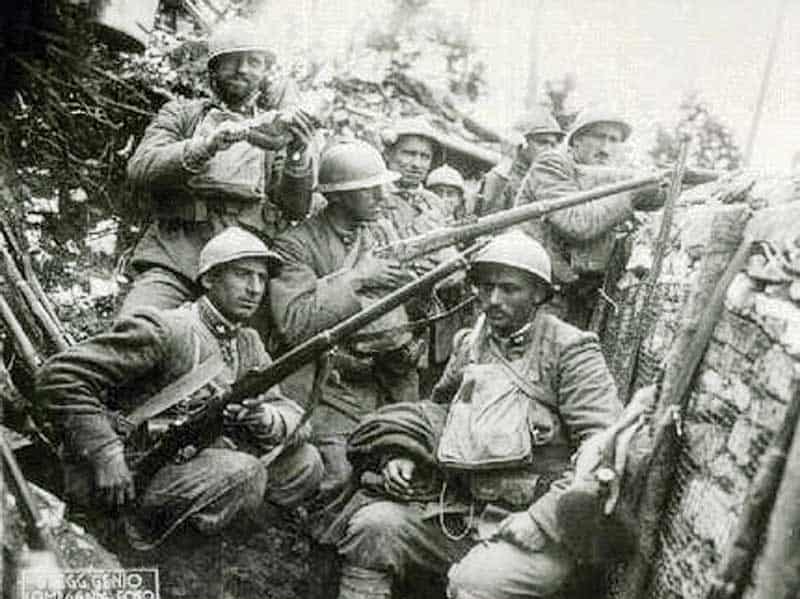
WWI Italian troops in a trench armed with the then-new M1891 Carcano.
It was one of the first sub-.30 caliber main battle rounds.
Though Italy’s 6.5 x 52 mm cartridge had some growing pains, it became a model for the other military 6.5 mm cartridges later adopted by Sweden, Portugal, Greece, Romania, Holland and Japan. To improve bullet performance and extend barrel life, Carcano utilized gain-twist rifling on the M91. It was a unique solution and it worked though I suspect improvements in ammunition manufacturing eventually made its value moot.
In combat, the rifle and cartridge performed adequately except in areas where heavier bullets excelled. I had the pleasure to know a Brooklyn gentleman by the name of Vincenzo Vella who fought in the Italian Army in World War II. He was an infantry sergeant among the 10 divisions sent by Mussolini to fight with the Germans on the Eastern Front. He was wounded and evacuated just in time to miss the spectacular axis disaster at Stalingrad. Vella had no complaints about the Carcano, finding It comparable in weight to the German Kar98 and Russian Mosin Nagant 91/30, but faster to shoot and reload than either, along with six shots to their five. The Carcano action was not as smooth as a Mauser, but better than the Mosin Nagant.
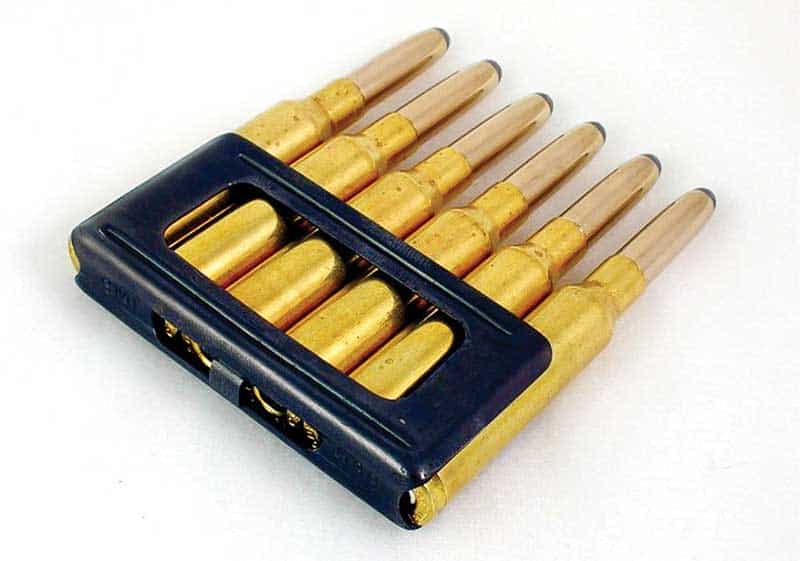
The 6-round Mannlicher clip made from brass or soft steel. They were easier to load than stripper clips and gave the Italians a slight ammo superiority, but also rendered the rifle a single shot if no clips were available.
Original Carcanos in good shape and in their original chambering are pleasant and safe to shoot but stick to modern commercial ammunition. Don’t mess with any military surplus ammo. Prvi Partizan of Serbia makes cases and 0.267″ jacketed bullets for handloading as well as finished ammo. It’s all available through Graf and Sons (Grafs.com). Reduced power, gas-checked cast bullet loads are domestically produced by Steinel Ammunition (SteinelAmmo.com) but cost a little more.
Be aware some Carcanos were even rechambered in 8×57 mm Mauser by the Germans in World War II. They seem to have fared well despite the higher pressure cartridge, but again, I would never shoot any military surplus ammo through these guns. For example, the Germans made many types of 8×57 mm during the war, some of which were NEVER intended for rifles. Stick with the original Italian 6.5mm (or 7.35mm) chamberings and modern factory ammo, or downloaded handloads for the sake of safety. Remember the newest Carcano is 76 years old!