Month: May 2022
This classic pre-’64 Winchester Model 70 bolt-action hunting rifle chambered for perhaps the model’s most classic cartridge – .270 Winchester – is a real keeper.
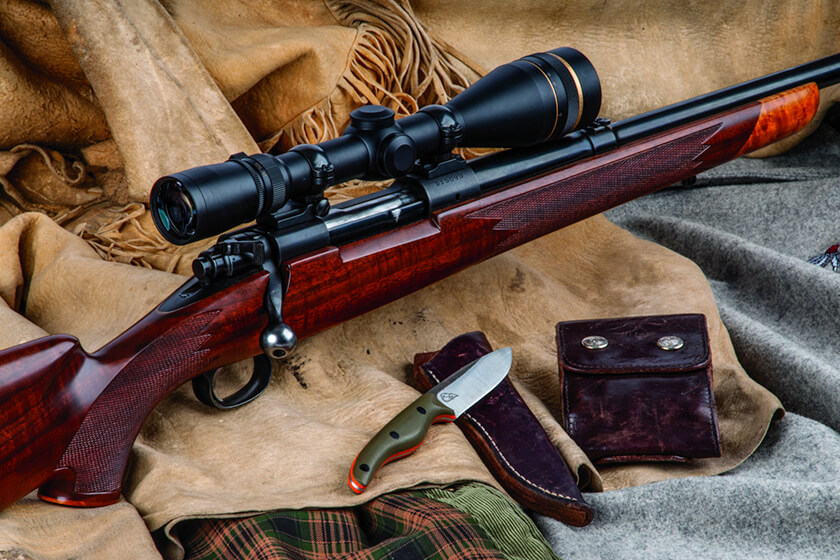
As a teenager, my second foray into the wonderful world of “modern” centerfire rifles was a 1952 Winchester Model 70 in .270 Winchester. It was a simple, standard Sporter version.
During my teens, I trained horses for an old doctor and his wife, and I admired several of the fine vintage guns they owned. When “Doc” passed away, his wife called me and stated firmly, “I don’t believe in giving anything to anybody. Folks never appreciate things they don’t have to pay for, but I’ll sell you a rifle, a shotgun, and a pistol for five bucks each.”
That .270 Win. Model 70 became my primary hunting rifle. Over the next several years I took some significant big-game animals with it, including my first branch-antlered bull elk and a bona fide 33-inch main-frame mule deer buck.
Introduced in 1936, Winchester’s Model 70 was—according to enthusiasts—the ultimate refinement of Mauser’s controlled-feed action design. For 27 years it ruled American bolt-action hunting rifle markets and was dubbed the “Rifleman’s Rifle.” Jack O’Connor adopted it as his favorite and helped make it legendary through his articles and books.
In 1964 a massive cost-cutting redesign knocked the Model 70 from its best-of-the-best pedestal and drove it into budget-rifle territory. Push-feed “Model 70s” are better than many allege, but I don’t think they deserve the Model 70 moniker.
Although primarily sporting rifles, the Model 70 was also sometimes built to order for serious long-range competition and won many championships at the National Matches at Camp Perry. It served in limited capacity in the hands of the Marine Corps in World War II and the Vietnam War. Probably the most famous Model 70 in wartime history was Carlos Hathcock’s .30-06 sniper variant. As readers may know, Hathcock was perhaps our greatest sniper of the Vietnam era.
A tremendous selection of chamberings was offered at one time or another, including some pretty obscure cartridges. Size-wise, the Model 70 was adapted for cartridges ranging from the .22 Hornet all the way up to the .470 Capstick. Three action sizes served all: short, standard, and magnum. In general, the rarer the cartridge, the more collectors value the Pre-’64 Model 70.
Configurations ranged from the light Featherweight (with a 22-inch barrel and a sleek, Schnabel-type fore-end) to the heavy, long-barreled Bull Guns designed for the National Matches. Most common were the standard Sporters, with well-proportioned stocks and 24-inch barrels. That’s what my rifle is, except mine now wears a non-original stock.
Many special-order Model 70s were made, and a line of high-end “Super Grade” rifles was offered. These had premium barrels and a nicer grade of wood, and they had “SUPER GRADE” engraved on the floorplate. A small “S” stamped on the barrel’s shank, inside the stock, confirmed that the barreled action was original.
Mechanicals
The Pre-’64 Model 70 has two forward, opposing locking lugs; a massive claw extractor (for controlled-round feed); a mechanical blade-type ejector; and a wing-type three-position safety located on the bolt shroud. Original Model 70 triggers are legendary for reliability, and their open design enables them to shrug off dust and detritus that could jam up most triggers. As good as the original triggers are, I installed an aftermarket Timney trigger with a clean, crisp 2.5-pound pull. It is a very nice trigger indeed.
In all, the Pre-’64 Model 70 is a superbly durable, reliable, smooth action. The currently manufactured “Classic” version of the Model 70 offers most of the same design features as the original Pre-’64s.
Provenance
After purchasing the 1952-vintage Model 70 from Doc’s wife, I shot it for a while with the original 6X Redfield scope. It worked great, and over the years I shot a number of deer with it. Friends borrowed it when they needed to make a difficult shot because it was so accurate.
While working in a gunshop years ago, I happened upon a lovely walnut stock morticed for a Pre-’64 Model 70 action. I inletted it for my rifle, shaped it, stained it, and gave it a handrubbed oil finish. I even checkered it with the best 22 LPI checkering I’ve ever done. Of course, I kept the original stock.
Now, many years later, I’m conflicted. The high-grade walnut stock is beautiful and some of the best woodworking I’ve done, but I’ve become a real stickler for originality. I almost installed the rifle back in its original stock for this report, but I concluded the aftermarket walnut stock is a big part of my history with the rifle, so I kept it on.
Rangetime
Decades ago, when I got really serious about hunting with the Model 70, I replaced its old 6X scope with a new Leupold Vari-X III 3.5-10X 40mm scope with adjustable objective and went to work developing good handloads with 140-grain and 150-grain bullets.
The rifle reliably shot every handload into 1.5 inches or a bit less. I gradually worked up the charge weight, and to my great satisfaction, three-shot groups averaged 0.6 inch. Velocity was nearly 2,940 fps.
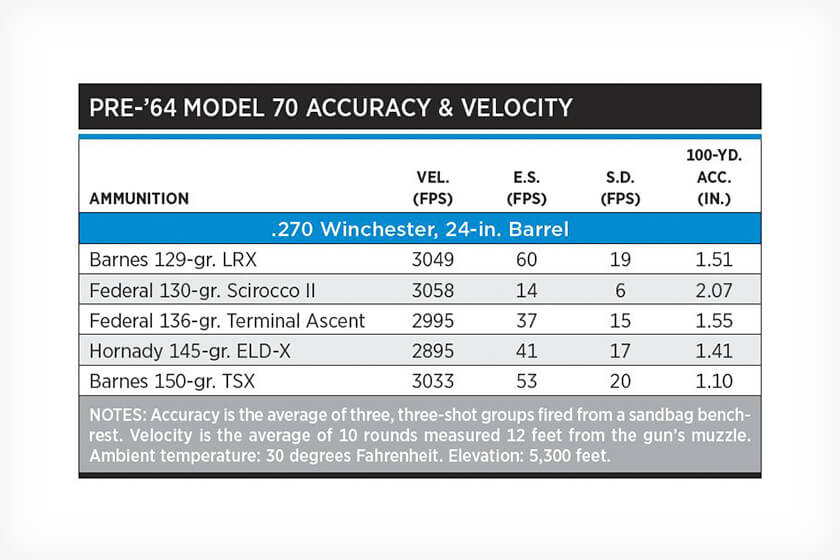
With a surprising amount of anticipation, I recently took the rifle to my personal shooting range and ran five factory loads through it, shooting three, three-shot groups for average with each load. As you can see from the chart, my old Winchester Model 70 still shoots well enough for bagging big game.
Pre-’64 Winchester Model 70 Specs
MANUFACTURER: Winchester Repeating Arms
TYPE: Bolt-action repeater
CALIBER: .270 Winchester
MAGAZINE CAPACITY: 5 rounds
BARREL: 24 in.
OVERALL LENGTH: 44.8 in.
WEIGHT, EMPTY: 9.5 lbs.
STOCK: Walnut
FINISH: Blued barrel and action, oil-finished stock
LENGTH OF PULL: 13.8 in.
SIGHTS: Folding rear, bead front
TRIGGER: Timney, 2.5-lb. pull (as tested)
SAFETY: Three-position wing type
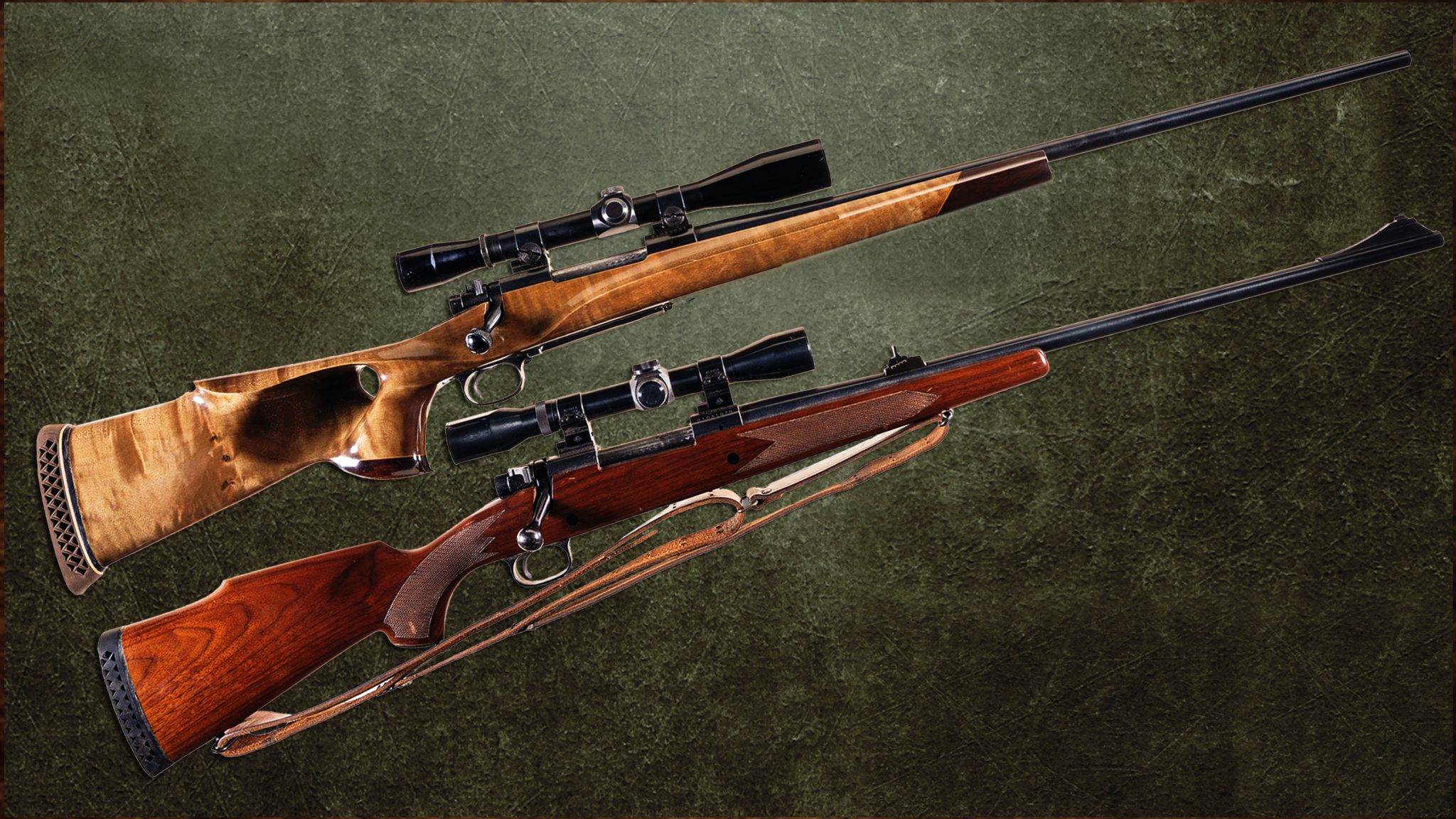
The Winchester Model 70 is a legendary rifle. Tough as nails, extremely accurate, and just plain sexy, it kicked off a monumental shift in American hunting culture. As the Model 70 garnered accolades from similarly legendary gunwriters of the day like Jack O’Connor and Elmer Keith, many hunters started leaving their lever guns in the cabinet and hitting the woods with their new bolt guns.
In 1922, Winchester, a company built on lever-actions, realized the time had come to produce a centerfire bolt-action rifle or be left behind. The gunmaker had flirted with centerfire bolt guns in the late 1800s with the Hotchkiss bolt-action rifle chambered in .45-70; it had a tubular magazine in its stock. Winchester also made the Lee Straight-Pull bolt gun for the US Navy chambered in a special .236 caliber round, along with a civilian version.

Both proved unpopular and were discontinued by 1900. That same year, Winchester produced its first .22 caliber, single-shot, bolt gun: the Model 1900. More rimfire models followed. The company didn’t make another centerfire bolt-action until it began producing Pattern 14 Lee Enfield Rifles for the British in 1914 during WWI.
Winchester knew bolt guns were about to boom in the civilian market, evidenced by how many battlefield rifles were sporterized after the war, and the gunmaker wasn’t about to be left behind.
The Winchester Model 54

The Model 54 hit the market in 1925, borrowing heavily from the Mauser 98 and Springfield 1903 that American Doughboys became so familiar with in the First World War, and not the British Enfield. With the new rifle design came the classic .270 Winchester cartridge. This became one of the first successful bolt-action rifles built and marketed to civilian hunters.
The Model 54 wasn’t a failure, but it wasn’t an overwhelming success either. A combination of outdated design features and the Great Depression caused a period of slow sales. It did, however, become the testbed for the Winchester Model 70. Innovations and new stock designs intended for the Model 70 were introduced for the 54 first to gauge consumer interest and gather feedback before they were incorporated into the new Model 70 design.
The Model 70 Changed Production Rifle Expectations

The Model 70 was an instant success when it was released in 1936. Although it was very much built around a redesigned Model 54 action, Winchester listened to its customers and made key adjustments accordingly.
One of the most outstanding features of this new rifle was its trigger. It was safe, light, and short, and it had a crisp let-off. But most important, it was adjustable. The Winchester design team had a goal of creating a production match-level rifle, and they succeeded. The company redefined the accuracy people could expect from a relatively affordable hunting rifle.
Many of the big names in the outdoor industry of the day praised the Model 70, like the previously mentioned Jack O’Connor, who claimed it was the best production rifle ever made. Elmer Keith, who was instrumental in developing the rifle, was impressed with its accuracy.
In his famous book Hell, I Was There, Keith writes of the M70: “I put sixteen consecutive shots at 200 measured yards in 1 9/16 inches, center-to-center, for the widest bullet holes.” That’s an impressive grouping, even today.
RELATED – Shotgun Shells: The Most Important Developments of the past 10 Years
Advantages of the Winchester Model 70 Over Hunting Lever Guns in the 1930s

For proper context, we have to consider what the average hunter was shooting when the Model 70 was introduced to fully understand how much the rifle impacted the American hunting rifle scene.
Most hunters carried lever-actions afield, like the Marlin 1893, Savage 99, and Winchester 1894. They did the job and did it well, but they had their limitations. For many hunters, those limitations were eclipsed by the affordability of lever guns. In 1941, a Winchester 94 cost about $35 compared with the Model 70, which retailed at just over $60. (That’s $664 versus $1,138 in 2022 dollars.) This, no doubt, played into the continued popularity of the lever-action rifle among hunters for some time.
The greatest limitation classic lever-actions had was the narrow range of chamberings in which they were offered. Their design restricted them to the lower pressure cartridges like the .32-20, .30-30, and .45-70. It is no secret that these calibers are deadly in the right scenarios, but there was a lot of room for improvement, and their range and velocity are limited.
Another problem with lever guns: They were limited to flat- or round-nosed bullets. Most lever-action designs have tubular magazines, even today.
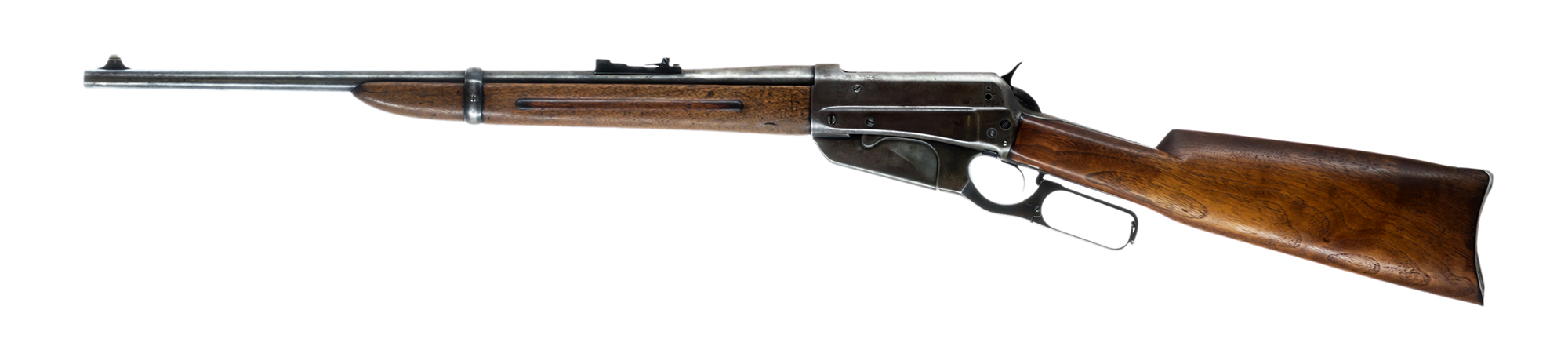 An example of a Winchester Model 1895 lever-action rifle designed by John M. Browning. Adobe
In such a design, when the gun is loaded, the ammunition is held end to end under spring tension in a metal tube with the tip of one cartridge touching the primer of the cartridge in front of it while the gun is being carried and fired. If the ballistically efficient pointed bullets used by bolt guns were used, just the force of recoil could set off all the ammo in the mag tube in what’s called a chain fire, destroying the gun and possibly parts of the user. This is still a concern today with modern tube-mag lever guns.
The first lever gun to get around this limitation was the John Browning-designed Winchester Model 1895, which utilized an internal box magazine instead of a tube magazine. The action was strong enough for modern ammunition, and the gun could run pointed bullets. It was offered in .30-06 and .30-40 Krag, as well as other calibers, but it was a fairly complex firearm that was expensive to produce.
The rifle was sold in significant quantities to Russia as a battle rifle, but it didn’t really catch on with the US military once the Springfield 1903 bolt gun came along, and it didn’t do much better on the civilian market as a sporting rifle either.
The M1895’s descendant, the Savage Model 99, was released in 1899 and was the first popular lever gun that solved most of the platform’s chambering limitations by using a rotary magazine that accommodated bullets with any shape. Later iterations of the rifle used a detachable box magazine. It remained hugely favored by hunters and was in production until 1998.
Lastly, when the Model 70 was introduced, there were few options for mounting an optic on a lever gun; many of the most popular models were top ejecting. This, in my opinion, is the biggest reason the bolt-action became the most popular hunting rifle platform in America.
Due to these factors, the Model 70 soon became the bolt-action hunting rifle that everyone wanted, including Remington. Before World War II, Remington had two failed attempts at a commercial bolt-action: the Model 30 (a sporting rifle based on the Enfield action) and the Model 720. It wasn’t until 1948, with the introduction of the Model 721 in 1948, that Remington became a serious competitor in the bolt-action rifle market. There is a lot of speculation that Remington saw the success of the Model 70 and decided to use the “7” in its bolt-action model numbers as a way to compete.
RELATED – Where Have All the Side-By-Side Shotguns Gone?
What the Hell Happened in 1964?
If you spend any amount of time looking at Winchester rifles, you will find a definitive line between pre-’64 and post-’64 production models. Both the Winchester M94 and M70 rifles are delineated this way, and the difference for collectors is night and day. So what the hell happened in 1964?
Rising costs of both labor and materials caused Winchester’s management to look for ways to save money in the early 1960s. The company began taking production shortcuts, and a lot of the features that made the Model 70 famous were removed. More than 50 changes were made to the gun’s metalwork alone, making it a completely different rifle but marketed under the same Model 70 label.

Gunwriters who originally made the gun so famous immediately attacked the redesign, and sales plummeted.
The post-’64 Model 70 gets a bad rap from some, but all in all, it’s not a bad rifle. In fact, a lot of parallels can be drawn between it and the Remington Model 700. In my opinion, it would have been much better received if it had been given a new model designation. Many consumers saw this as Winchester trying to keep sales up by riding on the reputation of the old model.
It is not all bad news, though. FN purchased Winchester in 1992 and brought back the pre-’64 style Model 70. The new Winchester Model 70s are every bit as good as the old ones and are widely available.
But the bolt gun didn’t kill the lever gun. Saying the lever-action is obsolete is by no means accurate, as companies like Rossi, Henry, the revived Marlin, and other gunmakers sell a whole lot of them every year. As for its role in modern hunting, it is still a viable and popular option for North American hunters. It is an icon of the American West and a classic in the Eastern deer woods. But there’s simply no arguing that a bolt-action is more versatile in most hunting scenarios.

There are exceptions, but they’re not that common.
Then there are those who think that the police are the only ones who really can be trusted with guns, in part because of those negligent discharges, because they’re the only ones with the proper training.
That’s just freaking hilarious.
At least three Los Angeles Police Department officers inadvertently fired their weapons during just one week in late April, the police chief said on Tuesday, May 3.
Two shootings occurred when the officers were inside their apartments, each accidently firing the weapon and sending a round into the unit next door.
The third shooting was at LAPD’s Wilshire Division station on Venice Boulevard. The officer who fired it was handling a coworker’s gun.
“A round was fired in the detective’s squad room,” Chief Michel Moore told the Los Angeles Police Commission. “The round was discharged directly into the floor.”
No one was injured in any of the shootings.
The sudden flurry of unintended shootings drew Moore’s attention and caused concern for some on the commission.
Moore said Deputy Chief Michael Rimkunas of LAPD’s Professional Standards Bureau was conducting an investigation into all three incidents.
Now, understand that even though I don’t believe police walk on water nor are super-trained badasses incapable of screwing up with a firearm, I will acknowledge that this is an anomaly. While officers do have negligent discharges from time to time, the fact that there were three in a single department isn’t common.
It suggests there is a training issue within the LAPD.
However, that’s not necessarily the problem. The officers could have gotten the proper training and still managed to screw it up. A lot of mistakes aren’t the result of insufficient training, but people figuring they know better than their training.
Plus, the LAPD isn’t exactly a small department. At any given time, there are thousands of officers doing something that may potentially cause a negligent discharge. If you look at each occurrence as essentially being random from a statistical point of view, then it stands to reason that sooner or later, you’d see bunches. This might just be one of those bunches.
However, I can’t help but remember things like this when someone tries to tell me I don’t have enough training to carry a firearm with me every day. That may or may not be true, but I do have enough training to keep my snot-slinger away from the bang switch, which seems to put me ahead of at least three LAPD officers right about now.
If they’re not just trusted to carry a weapon, but paid to do so, and are unable to match my own level of training, then I should be free and clear to carry a weapon.
Luckily, I live in a constitutional carry state, so no one can tell me no anyway, which is such a beautiful thing.

U.S.A. –-(AmmoLand.com)- Before the Biden-Harris administration took over the White House, the Bureau of Alcohol, Tobacco, Firearms and Explosives usually revoked an average of 40 Federal Firearm Licenses (FFLs) per year. But, in the 11 months since Joe Biden declared war on “rogue gun dealers,” the ATF has revoked 273 FFLs – an increase of more than 500%. However, rather than targeting the true rogues, Biden’s ATF is revoking FFLs for the most minor of paperwork errors, which were never a concern for the ATF until Biden weaponized the agency.
“This has nothing to do with the ATF and everything to do with the DOJ,” said John Clark of FFL Consultants. Clark is a firearm industry expert who said the ATF announced the number of revocations at a recent Firearm Industry Conference.
“The vast majority of the ATF don’t like this any more than the industry does,” he said. “It’s Biden.”
Clark and business partner John Bocker crisscross the country to help gun dealers fight back against Biden’s overreach – a service that is free to all members of the National Shooting Sports Foundation. Their mantra is: “Get it right the first time.”
“Our goal is to prevent an incident from occurring,” Bocker has said. “Our goal is prevention – get it right the first time. We are the proactive and preventative arm of the NSSF.”
Nowadays, they’re extremely busy. “I had three revocation hearings last week,” Clark said.
Key to the massive increase in revocations is Biden’s zero-tolerance for willful violations policy, which Clark said relies upon a new definition of willful. If a dealer makes a simple mistake, they can now lose their license, because the new definition of willful states that the dealer knew the law, but willfully chose to violate it anyway – regardless of whether it was an oversight, an error by an employee or a simple paperwork mistake.
“They have twisted negligence into willful,” Clark said. “These are not uncommon errors that we’re seeing. Things happen.”
On paper, Biden’s new policy seems clear:
Absent extraordinary circumstances that would need to be justified to the Director, ATF will seek to revoke the licenses of dealers the first time that they violate federal law by willfully.
- Transferring a firearm to a prohibited person
- Failing to run a required background check
- Falsifying records, such as a firearms transaction form
- Failing to respond to an ATF tracing request
- Refusing to permit ATF to conduct an inspection in violation of the law
However, Clark and Bocker are seeing these rules pushed far beyond the realm of common sense or fairness, and local gun dealers are paying the price.
For example, the transaction number for a NICS background check requires nine digits. If a gun dealer mistakenly omits a number, their license can be revoked for failing to run a background check. Under the Biden-Harris administration, there is no longer any room for human error.
Similarly, the ATF has started contracting out its trace requests, Clark said. He and Bocker have talked to a dealer whom the ATF accused of not complying with a trace request. They fault, they found, actually belonged to the ATF, which hadn’t updated its records from the contractors. Until this was clarified, the dealer was at risk of losing everything.
Their firm offers a free webinar for gun dealers, which addresses Biden’s policy.
ATF Breaking Federal Law
Biden first announced his zero-tolerance policy for “rogue gun dealers” in June of last year. He claimed these dealers were responsible for skyrocketing violent crime rates in major cities historically controlled by Democrats.
The violence wasn’t caused by weak prosecutors who refuse to hold criminals accountable, or gangs or underfunded police departments or by any combination thereof, he said. It was all the fault of “rogue gun dealers,” who Biden claimed willfully transfer firearms to prohibited persons, and/or refuse to cooperate with a tracing request from the ATF.
To vet Biden’s rogue gun dealer theory, the Second Amendment Foundation’s Investigative Journalism Project immediately sent a Freedom of Information Act (FOIA) request to the ATF, seeking the following:
Copies of documents that show the number of Federal Firearms Licensees (FFLs) and their state of residence, who have been prosecuted for willfully transferring a firearm to a prohibited person over the past three years (from June 23, 2018 to June 23, 2021.)
Copies of documents that show the number of Federal Firearms Licensees (FFLs) and their state of residence, who have been prosecuted for ignoring and/or refusing to cooperate with a tracing request from the BATFE, over the past three years (from June 23, 2018 to June 23, 2021.)
(Note: We did not seek the names or other identifiers of any FFL.)
We’re still waiting for a response.
In the 11 months since the FOIA request was filed, the ATF has not complied with the law. The ATF is in a trick-bag of sorts. They can comply with federal law and provide the documents, which will likely reveal that Biden’s rogue gun dealer policy is just a ruse, or they can continue to deny and delay the FOIA request even though their actions violate federal law.
Takeaways
If there is a dealer who transfers firearms to prohibited persons, fails to conduct background checks and ignores requests from the ATF to help trace firearms used in a crime, they should lose their FFL. I don’t know anyone who disagrees with that. However, these are not the type of dealers the ATF is targeting at Biden’s behest. The Biden-Harris administration has ordered the ATF to revoke FFLs for even the most minor of paperwork errors, solely to support its rogue-dealer myth.
There is no doubt Biden will soon hold a press conference touting the effectiveness of his zero-tolerance policy and the hundreds of “rogue gun dealers” whose licenses were revoked as a result. What he won’t mention is that none of the dealers who lost their livelihoods contributed to the skyrocketing violent crime rates of major metros. They were simply law-abiding men and women who made a minor paperwork error, which Biden has now criminalized as part of his ongoing war on our guns.
This story is presented by the Second Amendment Foundation’s Investigative Journalism Project and wouldn’t be possible without you. Please click here to make a tax-deductible donation to support more pro-gun stories like this.
About Lee Williams
Lee Williams, who is also known as “The Gun Writer,” is the chief editor of the Second Amendment Foundation’s Investigative Journalism Project. Until recently, he was also an editor for a daily newspaper in Florida. Before becoming an editor, Lee was an investigative reporter at newspapers in three states and a U.S. Territory. Before becoming a journalist, he worked as a police officer. Before becoming a cop, Lee served in the Army. He’s earned more than a dozen national journalism awards as a reporter, and three medals of valor as a cop. Lee is an avid tactical shooter.

Duffel Blog obtains top secret Russian military files
Russia’s military is apparently as leaky as SCOTUS
 |
By Task Force Football Bat
Duffel Blog’s team of investigative journalists has obtained a trove of sensitive Russian military documents that contain everything from Russian battle plans to LOL emojis shared between now-deceased generals. These documents shed light on inside conversations at the highest levels of leadership in the country’s military over the course of the past few months.
Our team of translators has analyzed what appears to be the Russian military’s detailed pre-invasion battle plan — briefed to President Putin as he clung for life to a table. Both the original and our translation are below.
 |
Our team also obtained more granular orders, apparently issued at the outset of the country’s latest incursion into a sovereign neighbor. One such order, translated below, gives insight into the Russians’ tactical prowess, which the world has feared for decades.
 |
Of course, these early plans did not materialize as successfully as Putin and his team of generals had envisioned. Leaked text messages from a few days into the full-scale invasion begin to tell the tale, while also giving an idea of the deep empathy Russian officers have for the troops they lead.
 |
Messages from the same chat roughly six weeks later give a sense of how the conflict has evolved.
 |
With the conflict persisting longer than hoped, Putin and his team are turning to the country’s robust information operations capability, looking to highlight what they see as key threats in Ukraine to both justify their actions and call on the West to halt its support of the Ukrainians as they defend themselves.
An undated press release cuts to the chase in classic Russian fashion.
 |
Duffel Blog is continuing to analyze and giggle at the large number of documents obtained.

In 1963, after Winchester had released its initial trio of belted magnums—the .264, .338 and .458 Magnums, all based on a shortened .375 H&H case—they announced the coming of the .30 caliber version. Most folks anticipated a case of similar dimension and datum line (the distance from base to shoulder) to the .338 Win. Mag. and .264 Win. Mag., just necked to hold a .308” diameter bullet. However, Norma had filled that void a few years prior with their .308 Norma Mag., which is very similar to the .30-338 wildcat. Winchester thought outside the box, and developed a case completely different from the prior three.
The .300 Win. Mag. represented (until the advent of the .30 Nosler) the most potent .30 caliber cartridge one could get, at the standard “long”, or .30-06-length action. Winchester took the .338 case, at 2.500” in length, and extended it 0.12” to 2.620”, while reducing the neck dimension to 0.264”, in order to maximize case capacity. The resulting cartridge was, and is, what I consider to be the finest .30 caliber cartridge ever made.
Yes, the .30-06 Sprg. is an undeniable classic, and probably holds the honor of being the single most popular cartridge among modern hunters. Likewise, the .308 Win. has proven itself as a viable and extremely accurate hunting cartridge, and the .30-30 WCF remains an undeniable player despite its age and a changing market. But, for me, when I think about a .30-caliber cartridge that can do it all and do it well, I think .300 Win. Mag. Being a .30-caliber cartridge is a good thing; there are an unprecedented number of bullet weights and choices, and there really is something for just about any hunting situation shy of Cape buffalo and elephant.
The .300 Win. Mag. will drive a 180-grain bullet to an average of 2,960 fps—sometimes faster—and delivers a trajectory that will make shots within sane hunting ranges completely feasible. It is faster than the benchmark .30-06—generally offering a 150 fps velocity gain—yet it has a recoil level that is manageable by most shooters; definitely less than the larger-cased .30 caliber magnums. Personally, I’ve used bullets weighing between 140 and 220 grains in a number of varying game fields, worldwide.
Dimensionally, some have criticized the .300 Win. for having that short neck—less than one caliber in length—but it has never posed a problem for me. Like the .30-06, you can tailor the bullet for the game at hand, whether it’s a pronghorn antelope or Dall sheep at quite a distance, or a bear at relatively short distances. The .300 Win. may be the optimal elk cartridge, and will cleanly handle moose.
The 180-grain loads are among the most popular for larger game, and most .300 Win. loads will show a preference for bullets of this weight, or very close to it. Most ammunition manufacturers offer good .300 Win. loads, from the Federal Premium loads, to Norma’s fantastic ammo to the Winchester, Hornady and Remington offerings. Many of these loads take full advantage of the premium bullets, and that will only enhance the already great performance of the .300 Win. Bonded-core, monometal, polymer tipped spitzers, round nosed cup-and-core; all are present in the factory loads for the .300 Win.
Personally, I’ve used the .300 Win. Mag. as much, if not more, than any other caliber. I’ve used it for pronghorn antelope on the plains of Wyoming, for caribou in the taiga of Quebec, and for whitetails and black bear in the hardwoods and evergreen forests of the Northeast. I’ve also used the .300 Win. for gemsbok, waterbuck, kudu and other plains game across Africa.
For the reloader, the .300 Win. offers a very versatile cartridge, which is easy to load for. The belt—which was carried over from the Holland & Holland design—really serves no purpose, as the .300 Winchester will headspace off the steep shoulder. You may see some stretching just in front of the belt, and that’s a consideration for any belted magnum case. Use a good Large Rifle Magnum primer and a healthy load of slow burning powder and you’ll see good results. Handloaders can take full advantage of the big .300 case, as you can safely load it down to .308 Winchester velocities, or load it to full-house velocities if you choose.
You’ll see the .300 Win. Mag. in the hands of military snipers and big game hunters alike, with good reason: it is a very accurate cartridge. The case can easily handle the long, sleek bullets that possess the best Ballistic Coefficient for the long range game, and equally handle the heavy, round nose slugs that those who hunt at closer ranges prefer.
The .300 Win. was, undoubtedly, the cartridge that knocked the .300 H&H off the stage, and while I have a special place for the .300 H&H, the .300 Winchester just makes more sense. My own pet .300 Win. is a Model 70 Classic Stainless that has been all over with me; I know it well, it’s very accurate, and I have all kinds of faith in it. The .300 Win. has been the cartridge I’ve reached for most throughout my career, and I don’t think that’s about to change any time soon. The .300 Win. Mag. just plain works.
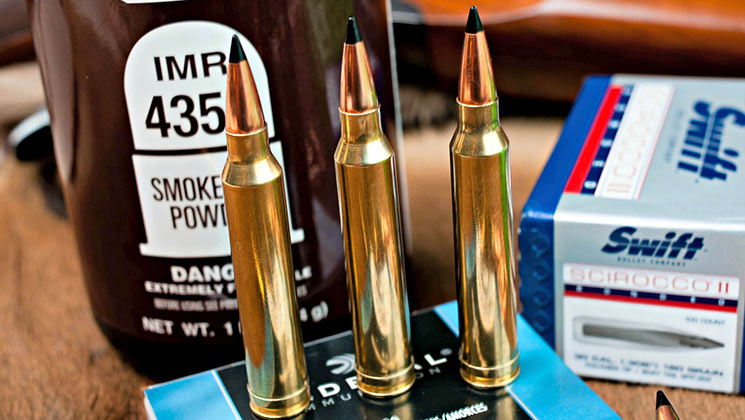

We had been stalking the herd for the better part of the morning, when we finally saw the bull come wide to the left side of the herd. My father brought his rifle to shoulder, and sent a 400-grain Swift A-Frame into the base of the bull’s neck, precisely where the guide instructed, dropping the beast where it stood.
His smile was equally inspired by the bison he stood over—we were hunting the quarter-million-acre Triple U Ranch in South Dakota, where “Dances with Wolves” was filmed—and by one of his favorite rifles: a Browning Model 1886 in .45-70 Government.
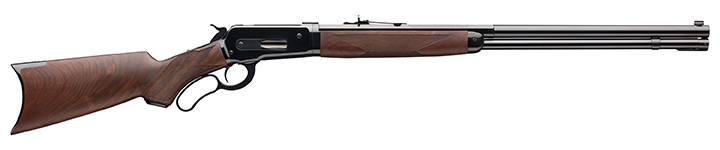
That rifle Dad carried was released in 1986, as a centennial celebration of the release of one of John Browning’s finest designs, and one of the strongest lever-action rifles ever developed.
The Model 1886 was much stronger than the Model 1873 or Model 1876, using two vertical steel bars to keep that action closed and the bolt firmly in place; the receiver was also different in that it was long enough to handle the popular and plentiful .45-70 Government cartridge, among other powerful blackpowder cartridges like the .50-110 WCF, .45-90 (albeit with shorter bullets) and .40-82 WCF. Browning’s beefy lever gun would also prove to be strong enough to survive the transition to smokeless powder when fitted with a nickel-steel barrel, being chambered for the .33 Winchester in 1903. It was even chambered for the 32-gauge shotshell, available as a custom order.
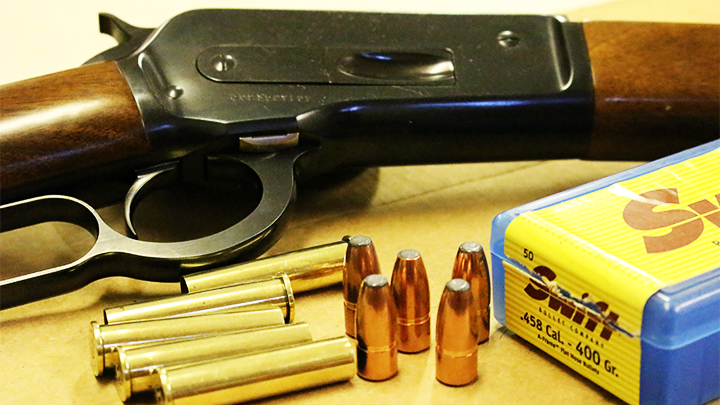
In production from 1886 until 1935, the Winchester Model 1886 has that inimitable feel to its action; just working the lever gives the user an idea of its strength. The ’86 action locks up like a bank vault, and that strong action allowed me to handload those 400-grain A-Frames—seated over a healthy charge of Hodgdon’s BL-C(2)—to a muzzle velocity of just over 1800 fps from his 26-inch octagon barrel. Mind you, that is from a modern rifle, but it is indicative of the strength of the 1886.
A buckhorn rear sight, with a serrated elevator for vertical adjustments, could be drifted in its slot for windage adjustments, and the rifle was produced with a variety of front sights over the years of production. A tubular magazine—both full-length and half-length magazines were available—sits underneath the barrel, and is fed through a loading port on the right side of receiver.
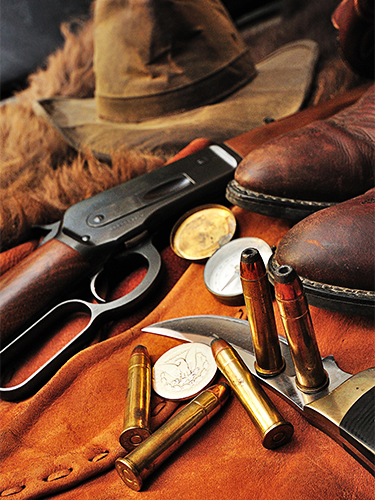
The 1886 was available with a single trigger, though a double-set trigger was available. A two-piece walnut stock—predominately straight-gripped though also made with a curved pistol grip—rounded out the furniture, and was generally plain, except for the Sporting Deluxe variant, which was checkered front and rear. Some models had a straight shotgun butt, and others a curved steel buttplate. Like so many of John M. Browning’s other designs, the simplicity is a part of the elegance. There are some neat takedown models in both half- and full-magazines.
The 1886 was discontinued in 1935, when it was replaced by the Model 71 Winchester—itself based strongly on the 1886 action—chambered in the powerful .348 Winchester. While there is no denying the success of the Model 71, which was designed to be the premier lever-action rifle, like its bolt-action counterpart the Model 70, there is also no denying the importance of the 1886 in the progression of repeating rifles.
Browning released a pair of commemorative rifles in 1986; Dad bought the standard grade with blued metalwork and plain stock, and there was a High Grade version as well with a nickel-plated engraved receiver and checkered stock. Both were chambered in .45-70 Government.
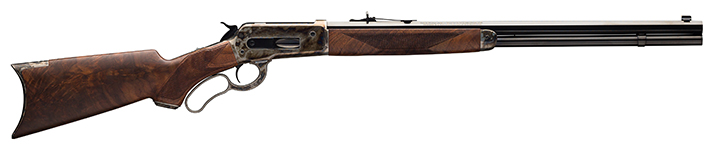
Thankfully, Winchester has re-introduced the 1886 to its lineup, in several variations. There is the Model 1886 Deluxe Case Hardened comes with a curved pistol grip, checkered stock and case-hardened appointments and a 24-inch octagonal stock, chambered in .45-70 Government. The Model 1886 Deluxe has a similar conformation to the Case Hardened variant, except that it is available in .45-70 and .45-90, a new option for 2020. They share that classic crescent steel buttplate, which digs into your shoulder, but hey, that just comes with the territory.
The new Winchesters aren’t true replicas or reissues; they do have the tang safety common to the newer model Winchesters. But, they offer the 1886 experience to a whole new generation of shooters and hunters, with modern metallurgy, in a rifle capable of handling the modern, stout .45-70 loads like the Hornady 325-grain LeveRevolution at 2050 fps and the Buffalo Bore 400-grain load at 2000 fps.
There are so many excellent lever-action rifles to choose from, including the classic Model 1894 Winchester, the Model 1893 Marlin and Model 1892 Winchester, up through the more modern designs like the Marlin 336 and Winchester Model 88, to the Browning BLR, but to me, the 1886 Winchester remains at the top of the heap.
It is heavier than some of the other designs, but I like the heft and balance of the 1886. It settles down well for the shot, and even the heavier .45-70 loads are tolerable, though the points of that crescent buttplate can and will bruise your shoulder when shooting from the bench.
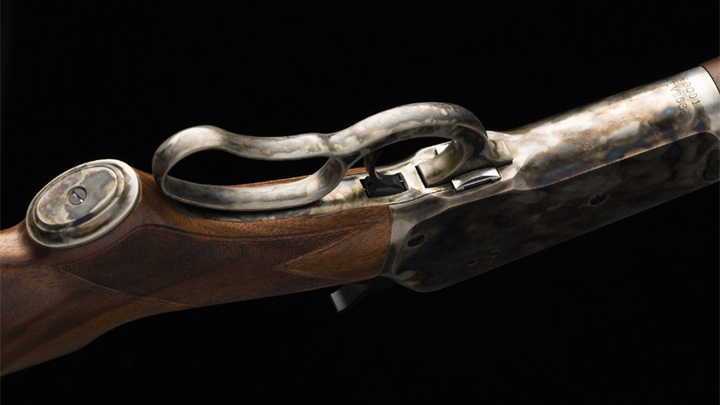
Whether new or vintage, having a Model 1886 in your safe is never a bad idea, and it makes a great choice for nearly any big game at ranges suitable for the big rimmed cartridges. I still enjoy shooting Dad’s Browning—now almost 35 years old—and enjoy his smile when he shoots it. I’m still on the hunt for an ’86 of my own, probably a vintage takedown, but who knows; there are so many cool variations one never knows what can be found in an old gun shop.