Month: March 2022
Categories
A Elgin Cutlass Pistol
Categories
50 BMG Vs Running Car
Categories
Curator’s Corner: British SMLE

Top: The Winchester Model 94 XTR Big Bore carbine was the first, and one of the few, guns chambered in the .375 Win.
I’m here to praise the .375 Winchester, not lay it to rest, although over the years a lot of dirt has been shoveled on the cartridge for various reasons.
The .375 Win. cartridge was introduced in 1978 in the Winchester Model 94 XTR Big Bore carbine. Here was a cartridge that fired considerably heavier bullets than the .30-30 Win., and in a rifle that weighed a packable 6.5 lbs. I bought my .375 Big Bore off the used gun rack at a local sporting goods store and became a fan of the cartridge once I started shooting and hunting with the rifle.
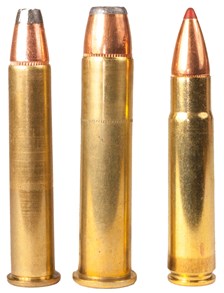
The .375 Win. (left) stands in next to some large competition, such as the .45-70 Gov’t. (center) and .35 Remington (right).
The .375’s maximum average pressure is 52,000 copper units of pressure (CUP), much higher than the .30-30 Win.’s 38,000 CUP. To contain the .375’s relatively high pressure the rear of the Big Bore’s receiver, surrounding the rear vertical locking lugs, is about a quarter of an inch thicker than the receiver of regular Model 94s. The XTR was an upscale edition of the Model 94 with checkering on its straight grip and forearm, high gloss bluing and a red thin butt pad. In 1983 the Angle Eject feature added so cases ejected out the right side of the receiver to allow mounting a scope over the receiver. A raised comb and a transfer-bar safety were also added to these Angle Eject carbines. But I was one of the few who liked the cartridge, because it was dropped from the Model 94 line after a short 9-year life in 1986.
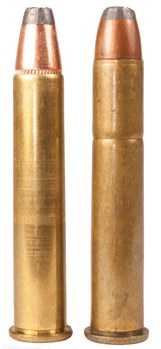
The .375 Win. (left) was intended as a modern rendition on the old .38-55 Win. (right). A .38-55 cartridge will fit in a .375 chamber, however, its longer length makes it dangerous to shoot in a .375. The .375’s high pressure makes it dangerous to shoot in a rifle chambered in .38-55.
For an even shorter time, other rifles were chambered in .375. Marlin chambered its 336 lever-action in .375 and called it the Model 375 from 1980 to ’82. Ruger chambered it in its single-shot No. 3 and Savage in its lever-action Model 99 chambered it for a short while.
The .375 Win. resembles the older .38-55 Win. and may have been introduced as a modern form of the old Winchester cartridge. Winchester initially loaded the .375 with 200-gr. Power-Point bullets with a muzzle velocity of 2,200 f.p.s. and 250-gr. Power-Points at 1,900 f.p.s. Winchester stills lists the 200-gr. load on its website. But availability is sparse. One Internet sites sells Winchesters for $60 a box, plus shipping. Buffalo Arms sells .375 ammo loaded with Barnes Original 255-gr. bullets for $60.89 for a box of 20.
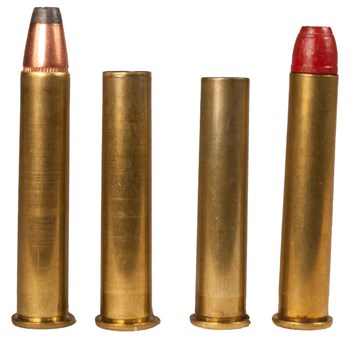
Cases for the .375 Win. are difficult to find and expensive when you do. Necked out .30-30 cases work fine for low-pressure loads. The two cases on the left are .375s and the two on the right are necked out .30-30s.
The closest I came to a box of factory .375 ammunition was at a gun store a few years ago. A box of Winchester cartridges had sat on the shelf so long the print on the face of the box had completely faded. On the end of the box was a price tag of $43.
I asked the clerk, “Is that price correct?”
“Let me check,” he replied.
He returned a minute later. “Nope, that’s not the right price. It should be $58.”
Such expensive ammunition does not bode well for a cartridge’s longevity.
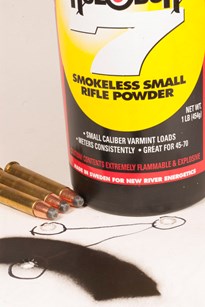
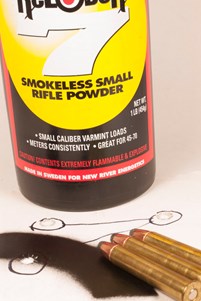
A Winchester Model 94 XTR Big Bore .375 shot this group (left) at 100 yards shooting Barnes Original 255-gr. bullets and Reloder 7 powder. A Winchester Model 94 XTR Big Bore .375 shot this group (right) at 100 yds. shooting Barnes Original 255-gr. bullets and Reloder 7 powder.
That leaves handloading. Cases are ridiculously expensive, if you can even find any. Thankfully, I bought 100 Winchester cases along with my rifle. But they are reserved for full-power loads because of their thick construction. Necked out .30-30 cases work in a pinch. The resulting cases average 0.05” shorter and 18 grs. lighter than factory .375 cases and work fine for reduced-pressure loads.
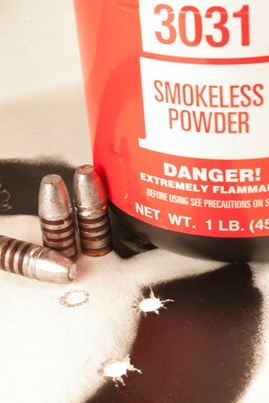
A Winchester Model 94 XTR Big Bore .375 shot this group at 100 yards shooting cast bullets and IMR 3031 powder.
Bullets for handloading are somewhat more available. Sierra sells a 200-gr. flat nose and Barnes its Original 255-gr. soft point. Hawk Bullets sells 180, 200 and 250-gr. flat point bullets suitable for the .375. That’s about it.
Bullets are always available when you have a bullet mold in hand. The .375’s velocities top out at about 2,100 f.p.s., which are just right for cast bullets. Lee, Lyman, RCBS and Redding SAECO sell molds that cast flat nose bullets for the .375. My Lyman 375449 mold casts bullets that weigh 267-grs., with the addition of a gas check.
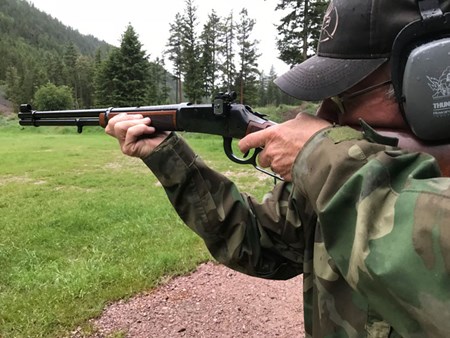
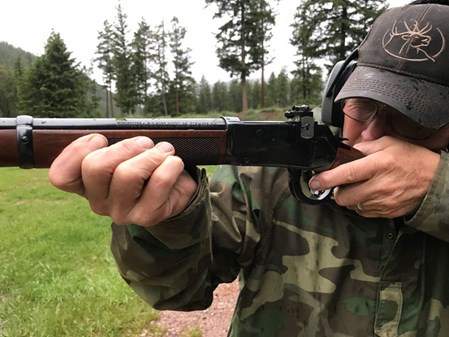
A Winchester Big Bore Model 94 chambered in .375 Win. provides some serious clout in a light rifle.
I’ve shot the cast Lyman and Barnes 255-gr. bullets with 8 powders, Accurate 5744 on the fast side to W748 on the slow end. Reloder 7, by far, provided the best accuracy and highest velocities. For hunting, 30.5 grs. of Reloder 7 fired the Lyman bullet at 1,938 f.p.s. with groups of 2” to 3” at 100 yds.
The .375 and .38-55 are 2 peas in a pod. So the .375 should share the .38-55’s reputation for accurately shooting cast bullets at about 1,400 f.p.s. I loaded the .375 with the Lyman bullet with 26.0 grs. of IMR 3031to attain about that speed. Two, 3-shot groups at 100 yds. averaged 2.35”, which is pretty good for my eyes aiming iron sights.
.375 Plight
The first whitetail I shot with the .375 ran down off the ridge without missing a step. The deer’s tracks stopped after 50 yards with the deer dead next to a log. The Lyman cast bullet had poked a hole about the size of a quarter through both lungs. My son shot two whitetails with Barnes 255-gr. bullets with the same results. My son, though, looks at the .375 as a relic of an ancient era. He considers the .375’s ballistics feeble and would rather hunt with bolt-action rifle chambered in 7 mm-08 or .300 WSM.
The majority of hunters agree. The 200-gr. bullet still loaded for the .375 by Winchester really offers no better performance on game than a 170-gr. bullet from a .30-30 or 200-gr. bullet from a .35 Remington shot at the same speed. Those cartridges have well-filled the “brush cartridge” niche. Ammunition and handloading components for the .30-30 and .35 are also readily available.
Only when shooting heavier bullets does the .375 offer anything superior to some other short-range hunting cartridges. The heavy-hitter .45-70 Gov’t, though, has staked out that position. And once again, with existing ammunition and handloading components.
So while I praise the .375 Win., except for hunting rifle fanatics, the cartridge is most likely no more.
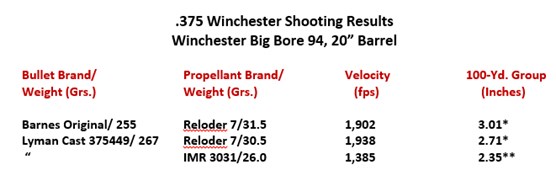
Velocities were recorded 9’ in front of the Winchester’s muzzle and are the average of 6 shots. Groups are the average of 2, 3-shot groups. *-Winchester .375 cases and **-necked-out Remington .30-30 cases used with Winchester Large Rifle primers. Temperature 55 to 60 degrees.

The .375 Win. is perfect for hunting white-tailed deer in the timber. However, several other cartridges offer the same advantages.
As we celebrate the Bicentennial of the Bill of Rights, evidence has been discovered that shows the Second Amendment was prompted by British plans to disarm each and every American.
In 1777, William Knox, Under Secretary of State in the British colonial Office, circulated a proposal entitled “What is it to be Done with America?” Knox advocated the creation of a ruling aristocracy loyal to the Crown, establishment of the Church of England throughout the colonies and an unlimited power to tax. To keep them servile, Knox offered the panacea of disarming all of the people and relying solely on a standing army:
The Militia Laws should be repealed and none suffered to be re-enacted, & the Arms of all the People should be taken away, & every piece of Ordnance removed into the King’s Stores, nor should any foundry or manufactory of Arms, Gunpowder, or Warlike Stores, be evre suffered in America, nor should any Gunpowder, Lead, Arms or Ordnance be imported into it without License; they will have but little need of such things for the future, as the King’s Troops, Ships Forts will be sufficient to protect them from any danger. (1)
It all began in September 1768, when rumors of an impending occupation by British troops, allegedly to suppress riots and collect taxes, inflamed Boston. A group of the freeholders led by James Otis and John Hancock met at Faneuil Hall and passed several resolutions, including the following:
WHEREAS, by an Act of Parliament, of the first of King William and Queen Mary, it is declared, that the Subjects being Protestants, may have Arms for their Defence; it is the Opinion of this town, that the said Declaration is founded in Nature, Reason and sound Policy, and is well adapted for the necessary Defence of the Community.
And Forasmuch, as by a good and wholesome Law of this Province, every listed Soldier and other Householder (except Troopers, who by Law are otherwise to be provided) shall always be provided with a well fix’d Firelock, Musket, Accountrements and Ammunition, as in said Law particularly mentioned, tot he Satisfaction of the Commission officers of the company; . . . VOTED, that those of the Inhabitants, who may at present be unprovided, be and hereby are requested duly to observe the said Law at this Time. (2)
A convention of Boston and several other towns met to consider the resolutions, and then petitioned the royal governor. When the governor rejected the petition, a patriot “A.B.C.” (probably Samuel Adams) wrote:
It is reported that the Governor has said, that he has Three Things in Command from the Ministry, more grievous to the People, than any Thing hitherto made knonw. It is conjectured 1st, that the Inhabitants of this Province are to be disarmed. 2d. The Province to be governed Martial Law. And 3d, that a Number of Gentlemen who have exerted themselves in the cause of their country, are to be seized and sent to Great-Britain.
Unhappy America! When thy Enemies are rewarded with Honors and Riches; but thy Friends punished and ruined only for asserting thy Rights, and pleading for thy Freedom. (3)
Two days later, the British troops landed in Boston and took over key points, including Faneuil Hall. (4) However, only one report could be found that the inhabitants were being disarmed.
Advices, so late as the 10th of October, mention….
That part of the troops had been quartered in the castle and barracks, and the remainder of them in some old empty houses..
That the inhabitants had been ordered to bring in their arms, which in general they had complied with; and that those in possession of any after the expiration of a notice given them, were to take the consequences. (5)
It is difficult to imagine much compliance with such an order, especially since such reports were not widespread with extensive protests. However, disarming the colonists was clearly being contemplated. From London, “it is said orders well soon be given to prevent the exportation of either navel or military stores, gun-powder, &c. to any part of North-America.” (6)
In an article he signed “E.A.,” Samuel Adams recalled the English Bill of rights as explained by Sir William Blackstone:
At the revolution, the British constitution was again restor’d to its original principles, declared inn the bill of rights; which was afterwards pass’d into a law, and stands as a bulwark to the natural rights of subjects. “To vindicate these rights, says Mr. Blackstone, when actually violated or attack’d, the subjects of England are entitled first to the regular administration and free course of justice in the courts of law—next to the right of petitioning the King and parliament for redress of grievances—and lastly, to the right of having and using arms for self-preservation and defence.” These he calls “auxiliary subordinate rights, which serve principally as barriers to protect and maintain inviolate the three great and primary rights of personal security, personal liberty and private property”: And that of having arms for their defence he tells us in “a public allowance under due restrictions, of the natural right of resistance and self preservation, when the sanctions of society and laws are found insufficient to restrain the violence of oppression.”—How little do those persons attend to the rights of the constitution, if they know anything about them, who find fault with a late vote of this town, calling upon the inhabitants to provide themselves with arms for their defence at any time; but more especially, when they had reason to fear, there would be a necessity of the means of self preservation against the violence of oppression. (7)
Adams made clear that private citizens could use arms to protect themselves from military oppression. He went on to point out that the same persons who opposed the right to have arms also opposed the right to petition:
But there are some persons, who would, if possibly they could, persuade the people never to make use of their constitutional rights or terrify them from doing it. No wonder that a resolution of this town to keep arms for its own defence, should be represented as having at bottom a secret intention to oppose the landing of the King’s troops: when those very persons, who gave it this colouring, had before represented the peoples petitioning their Sovereignm, as proceeding from a factious and rebellious spirit. . . . (8)
For the next half decade, the disputes escalated, from the shooting of civilians “armed” with sticks (what became known as the Boston Massacre in 1770), to the embargo on shipments of arms to America and the self-arming of the populace into militia in 1774. In September 1774, pro-British rulers in Boston proposed the disarming of the people, but the measure was voted down, perhaps because of the protest it would have evoked:
It is said, it was proposed in the Divan last Wednesday, that the inhabitants of this Town should be disarmed, and that some of the new-fangled Counsellors consented thereto, but happily a majority was against it.—The report of this extraordinary measure having been put in Execution by the Soldiery was propagated through the country, with some other exaggerated stories, and, by what we are told, if these Reports had not been contradicted, we should by this date have had 40 or 50,000 men from the Country (some of whom were on the march) appear’d for our Relief. (8a)
Nonetheless, by early 1775, the British began a de facto policy of disarming the colonists.
What was actually going on may be exemplified by the experience of one Thomas Ditson, who was tarred and feathered by British soldiers. In his affidavit, Ditson claimed, “I enquired of some Townsmen who had any guns to sell; one whom I did not know, replied he had a very fine Gun to sell.” (9) Since the one who offered the gun was a soldier, Ditson continued:
there was something not right . . . and left the Gun, and coming away he followed me and urg’d the Gun upon me. . . . (10)
When he finally paid money to the soldier, several other soldiers appeared and seized Ditson, whom they proceeded to tar and feather. However, instead of entrapment, the soldier swore in his affidavit that it was a case of a rebel trying to obtain arms and urging a soldier to desert. The citizen said “that he would buy more Firelocks of the Deponent, and as many as he could get any other soldier to sell him. . . .” (11)
The British were wise to the American game, and the following ammunition seizure reported from Boston also alleged that soldiers killed people along the road:
The Neck guard seized 13,425 musket cartridges with ball, (we suppose through the information of some dirty scoundrel, of which we have now many among us) and about 300 lb. of ball, which we were carrying into the country—this was private property—The owner applied to the General first, but he absolutely refused to deliver it. (12)
The Revolutionary War was sparked when militiamen exercising at Lexington refused to give up their arms. The widely published American account of April 19, 1775, began with the order shouted by a British officer:
“Disperse you Rebels—Damn you, throw down your Arms and disperse.” Upon which the Troops huzz’d and immediately one or two Officers discharged their Pistols, which were instantaneously followed by the Firing of four or five of the soldiers, then there seemed to be a general discharge from the whole Body. (13)
Three days later Gen. Gage represented to the Selectmen of Boston that “there was a large body of men in arms” hostilely assembled, and that the inhabitants could be injured if the soldiers attacked. (14) The next day a town committee met with Gage, who promised “that upon the inhabitants in general lodging their arms in Faneuil Hall, or any other convenient place, under the care of the Selectmen, marked with the names of the respective owners, that all such inhabitants as are inclined, may depart from the town… And that, the arms aforesaid at a suitable time would be return’d to the owners.” (15)
Bostonians proceeded to turn in 1778 muskets, 634 pistols, 973 bayonets and 38 blunderbusses. (16) However, when “the inhabitants gave u their arms and ammunition- to the care of the Selectmen: the General then set a guard over the arms. . . .” (17) Gage then refused to permit the people to leave. “The same day a town meeting was to be held in Boston, when the inhabitants were determined to demand the arms they had deposited in the hands of the selectmen, or have liberty to leave town.” (18)
An anonymous patriot addressed “the perfidious, the truce-breaking Thomas Gage” as follows:
But the single breach of the capitulation with them [the people of Boston], after they had religiously fulfilled their part, must brand your name and memory with eternal infamy—the proposal came from you to the inhabitants by the medium of one of your officers, through the Selectmen, and was, that if the inhabitants would deposit their fire-arms in the hands of the Selectmen, to be returned to them after a reasonable time, you would give leave to the inhabitants to remove out of town with all their effects, without any let or molestation. The town punctually complied, and you remain an infamous monument of perfidy, for which an Arab, Wild Tartar of Savage would despise you!!! (19)
On June 12, Gage proclaimed martial law and offered a pardon to all who would lay down their arms except Samuel Adams and John Hancock. (20) A patriot responded with a poem entitled “Tom Gage’s Proclamation,” which told how the general had sent an expedition “the men of Concord to disarm” and how he afterwards reflected:
Yet e’er I draw the vengeful sword,
I have thought fit to send abroad,
This present gracious Proclamation,
Of purpose mild the demonstration;
That whosoe’er keeps gun or pistol,
I’ll spoil the motion of his systole;
Or, whip his breech, or cut his weapon,
As has the measure of his Treason:—
But every one that will lay down
His hanger bright, and musket brown,
Shall not be beat, nor bruis’d, not bang’d,
Much less for past offences, hang’d,
But on surrendering his toledo,
Go to and fro unhurt as we do:—
But then I must, out of this plan, lock
Both SAMUEL ADAMS and JOHN HANCOCK;
For those vile traitors (like debentures)
Must be truck’d up at all adventures;
As any proffer of a pardon,
Would only tend those rogues to harden:—
But every other mother’s son,
The instant he destroys his gun,
For thus doth run the King’s command)
May, if he will, come kiss my hand.—
* * *
Meanwhile let all, and every one Who loves his life, forsake his gun. (21)
Gage’s seizures and attempts to seize the guns, pistols, Brown Bess muskets and swords known as hangers and toledos of the individual citizens of Boston who were not even involved in the hostilities sent a message to all of the colonists that the right to keep and bear private arms was in a perilous condition. A report from London that the British were coming to seize the arms of all the colonists hit the headlines in Virginia and Maryland:
It is reported, that on the landing of the General Officers, who have sailed for America, a proclamation will be published throughout the provinces inviting the Americans to deliver up their arms by a certain stipulated day; and that such of the colonists as are afterwards proved to carry arms shall be deemed rebels, and be punished accordingly. (22)
The final break came when the Continental Congress adopted the Declaration of Causes of Taking Up Arms on July 6, 1775, which had been drafted by Thomas Jefferson and John Dickinson and which complained:
It was stipulated that the said inhabitants having deposited their arms with their own magistrates, should have liberty to depart. . . . They accordingly delivered up their arms, but in open violation of honor, in defiance of the obligations of treaties, which even savage nations esteem sacred, the governor ordered the arms deposited as aforesaid, that they might be preserved for the owners, to be seized by a body of soldiers. . . . (23)
Debate now turned to war, and William Knox’s 1777 plan that “the Arms of all the People should be taken away” was far too late, had it ever been possible.
The above is only a small portion of newspaper extracts showing British attempts to disarm the Americans in the years 1768-1775. The grievances expressed led to the adoption of right to bear arms guarantees in the state Declarations of Rights beginning in 1776 and the federal Second Amendment in 1789.
The British resorted to every possible tactic to disarm the Americans—entrapment, false promises of “safekeeping,” banning imports, direct seizure and finally shooting persons bearing arms. As the Bicentennial of the Second Amendment approaches, the American people must make a renewed commitment to understand the historical origins for the Bill of Rights, in order to preserve their liberties.
Notes
1. Sources Of American Independence 176 (H. Peckman ed. 1978). Emphasis added.
2. Boston Evening Post, Sept. 19, 1768, at 1, col. 3, and 2, col.1
3. Boston Gazette and Country Journal, Sept. 26, 1768, at 3 cols. 1-2
4. Boston Evening Post, Oct. 3, 1768, at 3, col. 2 (includes an account of the invasion).
5. New York Journal, Feb. 2, 1769, at 2, col.2
6. Boston Gazette, and Country Journal, Oct. 17, 1768, at 2. col. 3.
7. Id., Feb. 27, 1769 at 3, col. 1. Adams’ authorship in confirmed in 1 H. Cushing ed., The Writings Of Samuel Adams 316 (1904)
8. Id.
8a. Massachusetts Spy, Sept. 8, 1774, at 3, col. 3.
9. Massachusetts Gazette; and Boston Weekly News-Letter, March 17, 1775, at 3, col. 1.
10. Id.
11. Id., col. 2
12. Connecticut Courant, April 3, 1775 at 2, col. 2
13. Essex Gazette, April 25, 1775, at 3, col. 3
14. Attested copy of Proceeding between Gage and Selectmen, April 22, 1775, reprinted in Connecticut Courant, July 17, 1775, at 1, col. 3, and 4, col.1.
15. Id. at 4, col. 2 (April 23, 1775).
16. R. Frothingham, History Of The Siege Of The Boston 95 (1903).
17. Connecticut Courant, May 8, 1775, at 3, col. 1.
18. Connecticut Journal and New-Haven Post-Boy, May 19, 1775, at 6, col.2
19. Connecticut Courant, June 19, 1775, at 4, col. 2.
20. Connecticut Journal and New-Haven Post-Boy, June 21, 1775, at 3 cols. 1-2.
21. Connecticut Courant, July 17, 1775, at 4, col. 1.
22. Virginia Gazette, June 24, 1775, at 1, col. 1; Maryland Gazette, July 20, 1775, at 1, col. 2.
23. Connecticut Courant, July 17, 1775 at 2, col. 1. The Declaration was published in virtually every colonial newspaper.
The Continental Congress adopted a similar address on “To the People of Ireland” which complained that “the citizens petitioned the General for permission to leave the town, and he promised, on surrendering their arms, to permit them to depart with their other effects; they accordingly surrendered their arms, and the General violated his faith…. “Id., Aug. 21, 1775, at 1, col. 3.

STEPHEN P. HALBROOK is a Senior Fellow at the Independent Institute and author of the Independent books The Right to Bear Arms, Gun Control in Nazi-Occupied France, Gun Control in the Third Reich, The Founders’ Second Amendment and That Every Man Be Armed.