Month: March 2022

Ever since I began my study of defensive handguns, I’ve been fascinated with pocket pistols. These are the smallest of the small semi-automatics designed to be discreetly concealed for up close-and-personal defensive situations. I believe my preoccupation with petite pocketables can be traced back to one gun in particular: the Baby Browning .25 ACP. Not only is it an exceptionally well-made example of the vest pocket size pistols of the mid-20th century, it’s also a little piece of family history as well.
The story begins with John Moses Browning, the famous inventor of the 1911 pistol. He designed the .25 ACP (6.35×16 mm SR) semi-rimmed pistol cartridge for what would become the M1905 Vest Pocket pistol. It was literally designed to fit in a business man’s vest pocket, the one usually reserved for coins. By 1931, Fabrique Nationale d’Armes de Guerre in Herstal, Belgium (FN) launched an even smaller .25 ACP pistol developed by the company’s chief designer, Dieudonné Saive.
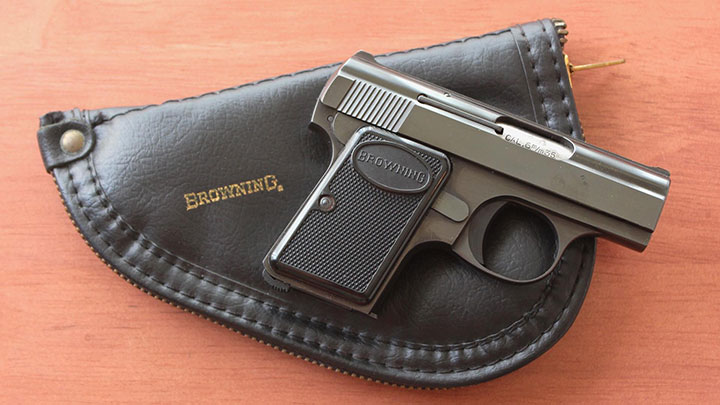
The Baby Browning in .25 ACP.
It was dubbed the Baby Browning for the market cachet his name offered, even though Mr. Browning had passed away in 1926. It is a simpler and more refined pistol than the 1905 with features that included a magazine safety and a more intuitive external thumb safety lever, which was moved from the slide down behind the trigger guard. The Baby Browning finally made its way into the U.S. market when the Browning Arms Co. decided to carry it in 1954.
It was a popular seller for several years because of its small size, reliability and high quality of manufacture. However, when the Gun Control Act of 1968 kicked into gear, the Baby Browning was among those small defensive handguns banned from importation. FN continued to make it until 1979, including beautifully hand engraved Renaissance models and the Lightweight version with its 6061-T6-aluminum frame.
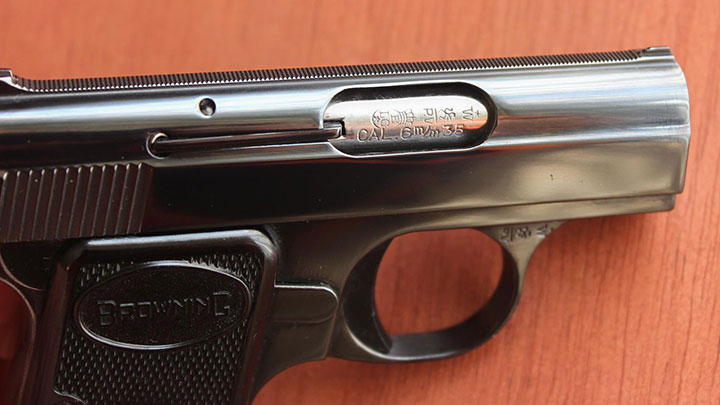
A closer look at the chamber markings on the Baby Browning.
My family’s history with the Belgian Baby Browning began in the fall of 1969 with the purchase of a blued steel model made in 1968, which made it into the country just ahead of the ban. My dad had moved the family to Texas in order to participate in a lucrative construction project. Within a few weeks, he noticed irregularities in the staff, work arrangements and inventory provided by the project’s partners.
Most of the supervisors had no construction background, whole truck loads of building materials mysteriously disappeared from secured work sites and so on. Some additional digging on his part revealed that what seemed like poor management on the partner’s part turned out to be company-wide corruption involving kick-backs, bribery and theft.
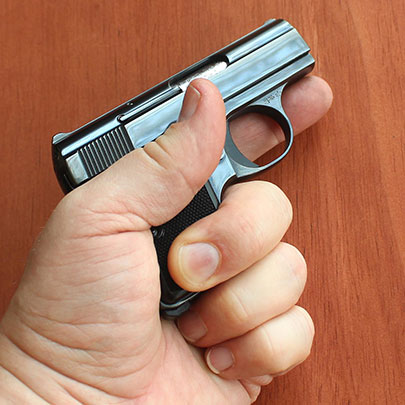
A size comparison of the Baby Browning to a hand.
Since he didn’t have the kind of hard evidence needed to prove the presence of the corruption he had uncovered, he used his authority as the General Superintendent to tackle the problems on his own. But he soon learned that he had kicked a hornet’s nest filled with con-men and fresh-from-prison felons working to establish a foot-hold in Texas for a well-known crime syndicate.
There was an ‘accident’ at a worksite that almost put him in the hospital, a mysterious dent that appeared on his car while driving that was about the same size and shape as a rifle bullet. And then there was a late-night meeting that would have gone quite differently for my dad if not for a few ex-military members of his work crew that tagged along, just in case.
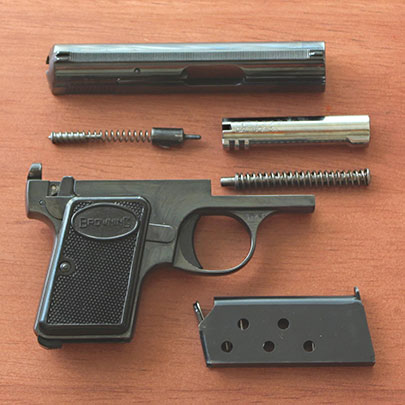
The Baby Browning disassembled.
After that meeting, Dad decided he wasn’t going to continue with the construction project unless he was armed. Driving to a gun shop on the other side of town, he looked over the pistols they had in stock. A large, powerful handgun capable of medium- or long-range shots would not fit his needs. He wanted something he could always have on-hand in case of an up-close, short-range encounter. A small, lightweight pistol that could ride in the pocket of the sport coats he wore to work and church would have to do.
The pocket pistol options in the shop were limited. Snub-nosed .38 Spl. revolvers produced a noticeable bulge. A Walther PPK was the right size and thickness for his pocket, but the weight of it caused a tell-tale sag. He kept looking until he found the Belgian Baby Browning . He wanted a quality gun with a name he could trust, and Browning was hard to beat. He paid around $50 for it, or about $350 in today’s dollars.
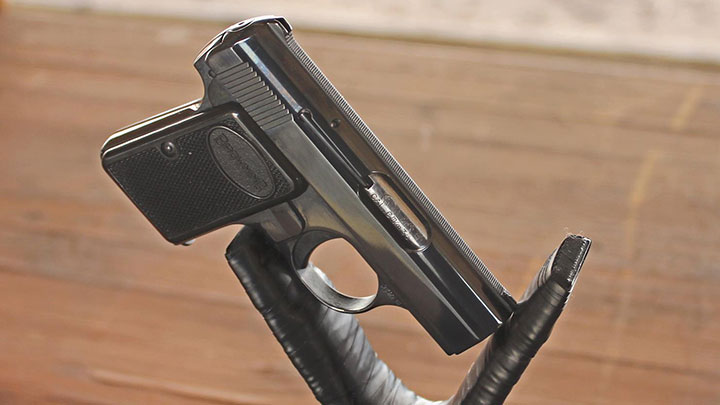
The Baby Browning on a pistol rest at the range.
The simplicity and features of the Baby Browning are surprisingly satisfying to modern defensive pistol sensibilities for a 90-year-old design. This blow-back operated semi-automatic is striker fired with a single-action trigger, a cocked striker indicator and a magazine safety. The tiny fixed sights are the smallest I’ve ever seen on a handgun but the top strap of the rounded slide is serrated to reduce glare, just in case you want to squint at them.
The trigger exhibits a short, clean trigger pull of 5 lbs., 1 oz. The 1960s-era nylon impregnated black polymer grip plates are checkered with the word “Browning” in a circle at the top. The single-stack magazine holds six rounds of ammunition and is secured by a heel-mounted magazine release.
The pistol’s clean lines are appealing, and it has the precision machining of a Swiss watch. It’s one of the few .25 ACPs that can be counted on to run reliably. However, this is not the easiest pistol to master. The Baby Browning’s slick, thin grip frame only provides enough room for a one-finger grip. Therefore it tends to buck and twist when it recoils.
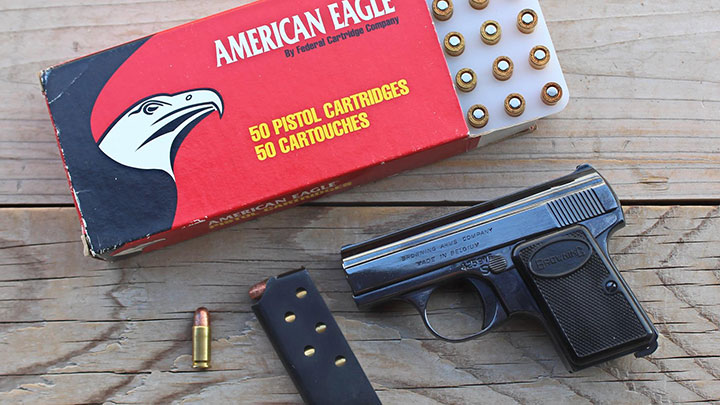
The Baby Browning and Federal American Eagle 50-gr. FMJ ammunition used in the accuracy test.
The lack of a beaver tail above the grip frame exposes the shooter’s hand to the sharp edges of the recoiling slide. As a result, it will ‘bark the skin’ off the shooting-hand thumb knuckle if the operator is not paying attention (the inside joke in my family is that the Baby’s slide bite is nearly as lethal as the cartridge it fires).
It’s been some time since I shot this pistol, and I had yet to chronograph it. I rustled up a box of Federal American Eagle 50 grain FMJ cartridges and a LabRadar chronograph and headed to the range. This load generated a 10-shot average muzzle velocity of 787 f.p.s. for 69-ft. lbs. of muzzle energy. With the aid of a pistol rest, I was able to tap out a best single five-shot group of 2.29″ at 7 yards with a five-group average of 2.52″.
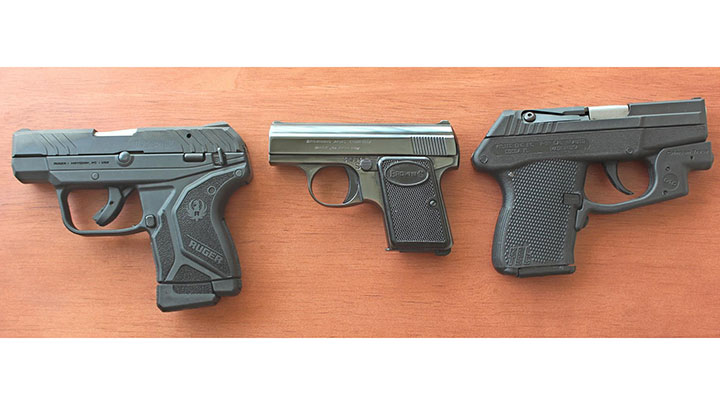
The Baby Browning compared with the Ruger LCP II and Kel-Tec P-32.
By today’s pocket-pistol standards, the Baby Browning is too small for a few reasons. Most folks have bigger pockets and more sophisticated holster systems, which allow for larger-caliber pistols to be carried. So the absolute smallest isn’t a requirement these days. The Baby’s slick one-finger grip, the vestigial sights and the very real risk of slide bite makes it a tough gun to work with, and that’s coming from someone who shoots handguns for a living.
Then there’s the .25 ACP cartridge itself. With performance comparable to a .22 LR pistol, small .25 ACPs are easily outclassed by similarly sized .32 ACP and .380 ACP pistols. In speaking with my dad, he agreed that if he had access to the slim, flat, light-weight polymer semi-automatics available today, such as the Kahr Arms CW 380 or Ruger LCP II, he definitely would have chosen a more powerful option. But as it was, the Baby Browning was the best fit for the job.
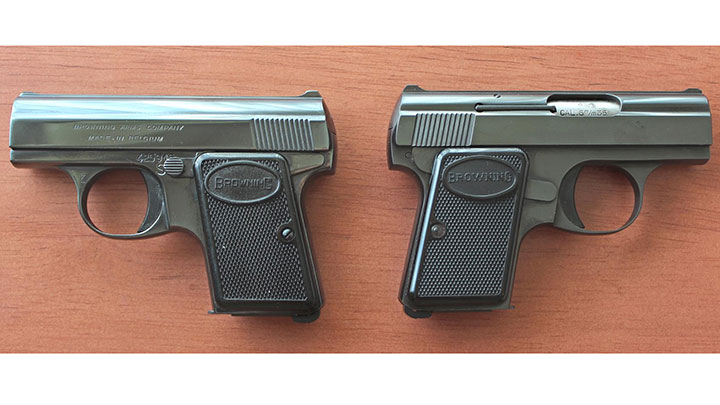
A view of both sides on the Baby Browning.
Thankfully, my father made it out of that situation without ever having to draw his little .25 ACP. Working with associates in law enforcement (who also watched his back), he gathered the evidence needed to launch an official investigation and then moved his family out of state. Although I’m not in a position to share more of this story here, I can say that I am alive, well and able to write this article today because, half a century ago, good guys with guns kept bad guys with guns from putting an abrupt end to my father’s life.
You see, I wasn’t born until a few years after these events took place. This piece of family history is just one of the reasons I take our 2nd Amendment rights personally. Let’s work together to ensure that, 50 years from now, we’ll have more stories to tell our grandchildren about how we took action to ensure that they, too, would have the means to protect their homes and families.
Specifications:
Manufacturer: Fabrique Nationale d’Armes de Guerre, 1931 to 1979
Model: Baby Browning
Action Type: blowback-operated, striker-fired, semi-automatic, centerfire pistol
Chambering: .25 ACP (6.35×16 mm SR)
Finish: blued
Stocks: textured black polymer
Sights: fixed
Trigger: single-action, 5-lb., 1-oz. pull
Barrel Length: 2.00″
Overall Length: 4″
Height: 2.75″
Width: 0.75″
Weight: 9.70 ozs.
Magazine: six-round detachable box
Rifle Grooves: 6
Categories
Minie Ball Cartridge Kit Tutorial

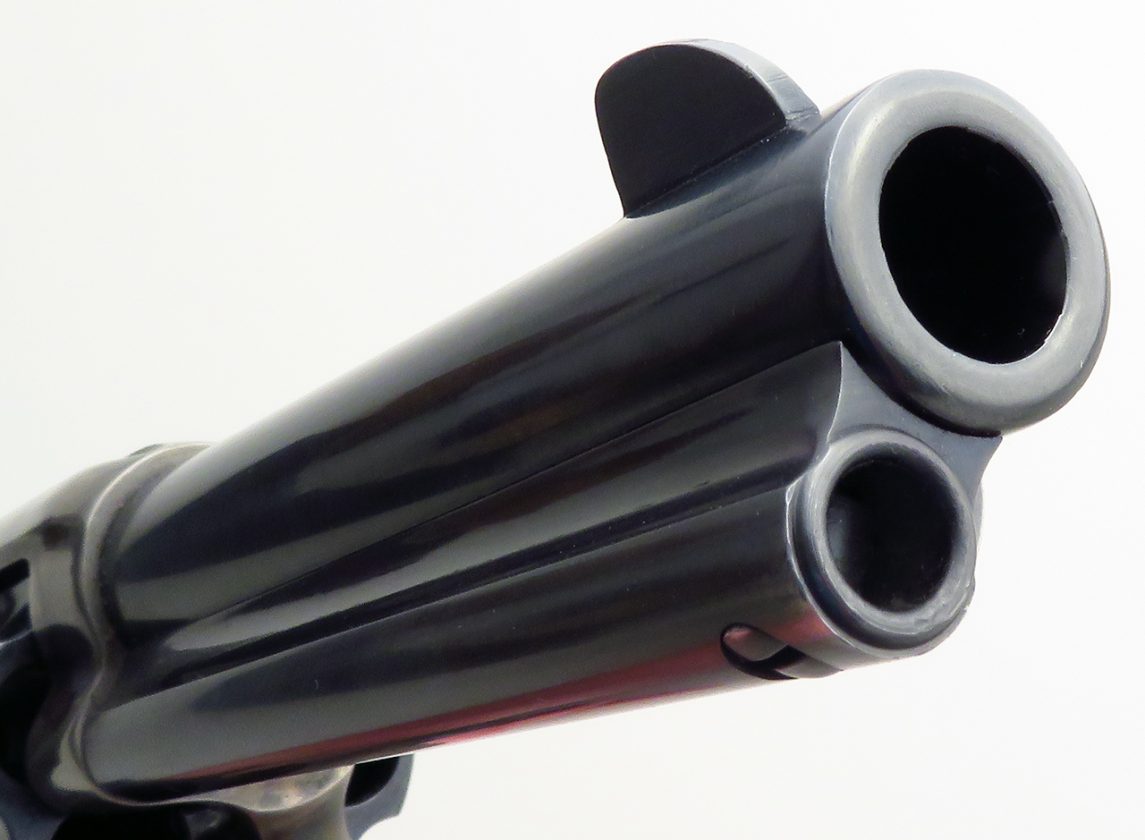
Top image: Smith & Wesson 22/32 Kit Gun courtesy collectorsfirearms.com
When somebody comes up with a great gun idea, one of the first things demanded after its initial success is either a scaled-down or scaled-up version. Smith & Wesson’s Hand Ejector series of double-action revolvers has become the icon of the company and was the benchmark of revolvers for more than a century. The first Hand Ejectors were brought to market in 1895 in two frame sizes: the .32-caliber I-frame and .38-caliber K-frame. It should be noted that there were some .32-caliber revolvers made on the K-frame as well. These revolvers found immediate favor among target shooters, as well as police officers and the general shooting public, and the company immediately began putting together a plan for producing revolvers from .22 caliber to .44 caliber in various frame sizes.
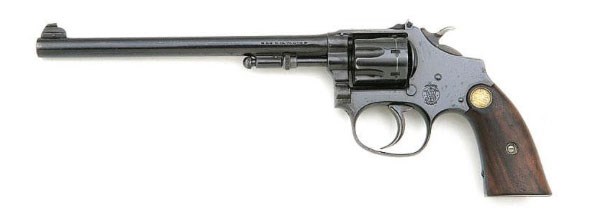
.22-cal. LadySmith revolver image courtesy invaluable.com
Smith & Wesson introduced the first Ladysmith built on its smallest M-frame in 1902. The Ladysmith was the only revolver made on this frame and featured a 7-shot cylinder chambered in .22 Long. Barrel lengths ranged from 2 to 6 inches. The Ladysmith was discontinued in 1921 with some 26,154 revolvers made in three variations. A major factor in consideration for halting production was the size of the revolver. It is said that the M-frame and its components were so small that the men assembling them had a fair amount of difficulty doing their job, thus increasing the cost of production substantially and lessening the profit on such pieces compared to their larger counterparts. These miniature Smith & Wessons are highly sought after by collectors today.
In 1910 a San Francisco-based gun dealer named Phil Bekeart began calling for Smith & Wesson to chamber its .32-caliber I-frame in .22 caliber. Bekeart felt that a heavy framed .22 would be a big seller among target shooters of the time. He was so committed to the idea that he pre-ordered 1,000 revolvers. This 22/32 Heavy-Frame Target model had a 6″ barrel, a six-shot cylinder, adjustable sights, checkered walnut stocks that extended beyond the square butt, a la the single-shot Smith & Wesson target revolvers. Bekeart’s faith in the popularity of the 22/32 Heavy-Frame Target model was a bit ambitious. Just 292 of the original order of 1,000 revolvers were shipped. Though this revolver remained in the Smith & Wesson catalog into the 1930s, it did not set the world on fire. Target shooting, while still popular, had pretty much reached its peak, and then—much like today—other forms of recreation began to make inroads into it, vying for its time and tools.
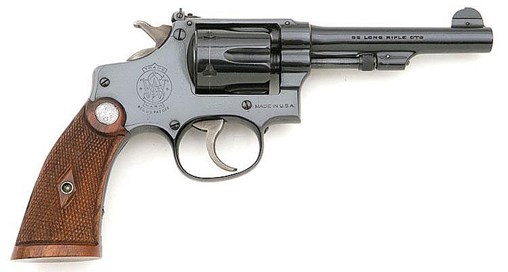
Smith & Wesson Transition 22/32 image courtesy invaluable.com
During the depths of The Depression—1936—Smith & Wesson introduced a 22/32 revolver with a 4″ barrel. Christened the Kit Gun, it was marketed to hikers and fishermen who wanted a handy, lightweight revolver to deal with pests and snakes. The term Kit Gun meant that its intent was to be carried within one’s kit as they traveled around the backcountry and streams. World War II curtailed virtually all civilian guns, including the 22/32 Kit Gun, but it returned to the S&W lineup in 1950. The post-war guns featured a change to the then-new hammer block, as well as a new micrometer-click rear sight.
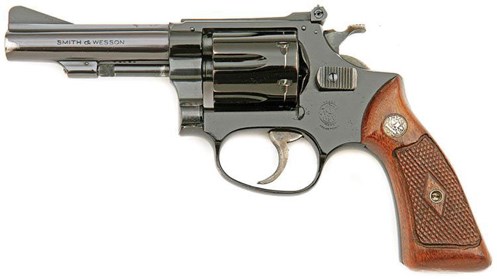
Smith & Wesson Flat Latch image courtesy invaluable.com
Three years later a new series was introduced, the 22/32 Kit Gun Model of 1953. The most notable change was an improvement to the I-frame by the replacement of a leaf-type mainspring with a coil spring. A 2″-barreled version was also first offered. In 1955 the fourth screw at the top of the sideplate was eliminated. Model numbers were assigned to all Smith & Wesson handguns in 1957, and the 22/32 Kit Gun became known as the Model 34. The I-frame was replaced by the J-frame in 1960; the primary difference being a larger cylinder window to make room for a longer cylinder that could accept .38 Special cartridges. Though this didn’t directly impact the Model 34, it followed with the J-frame to simplify the line. The M prefix to the serial number was added in October 1968 in order to distinguish these from others in the line. Fifteen examples of the Model 34 were started without the micrometer-click rear sight; instead a groove in the topstrap served. Of these, just four were shipped. As can be imagined, collector interest is quite high in these four revolvers.
In 1954 a prototype variation featuring an aluminum frame and weighing 14 1/2 oz. was built. Christened the Model 43, it was cataloged in 1955 but not in full distribution until 1958. A Model 51 chambered in .22 WMR was brought out in 1961 and discontinued in 1974. The Model 51 was produced in both round- and square-butt configuration with just 500 in the round-butt, making it quite rare and generation considerable collector interest.
A stainless-steel Kit Gun, dubbed the Model 63 was introduced in 1977 and made until 1998. It was available with either a 2″ or 4″ barrel, round or square butt.
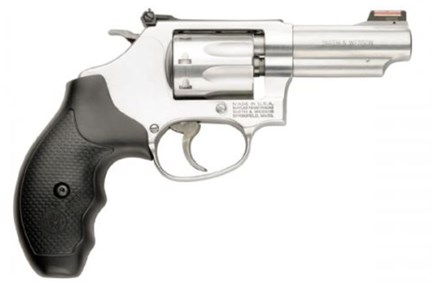
Smith & Wesson Model 63
The Model 34 was discontinued in 1991 though there were a few reissues. Today it exists in two more modern configurations, the Model 317 with an aluminum frame, 3″ barrel and an eight-shot cylinder or the Model 63, with a stainless steel frame, 3″ barrel and an eight-shot cylinder. The newer versions carry an MSRP just north of $750. Vintage Model 34s range from the mid-$500s to more than a grand, depending on condition and whether the original box and accessories are included. Add 75 percent to 150 percent for the 1953 version, and 200 percent to 300 percent for a pre-War Model 22/32 Kit Gun. Like Smith’s big .44s and .45s, there is considerable interest in these “micro” Smith & Wessons.


“We support the Second Amendment. If you own a gun, keep that gun. Nobody wants to take it away from you – at least I don’t want to do that.” That’s what Robert Francis “Beto” O’Rourke told voters in an April 2018 radio interview, when he was running against Republican Ted Cruz in the Senate election in Texas. Asked specifically about AR-15s (“I own an AR-15. A lot of our listeners out there own AR-15s. Why should they not have one?”) Beto responded (at the 0:24 mark), “To be clear, they should have them. If you purchased that AR-15, if you own it, keep it. Continue to use it responsibly.”
As a 2020 Democrat Presidential candidate, though, Beto became best known for his total repudiation of those sentiments. During the primary debate in Houston on September 12, 2019, he famously proclaimed, “Hell yes, we’re going to take your AR-15, your AK47…!” His campaign capitalized on this by selling t-shirts with the catchphrase, and Beto reiterated his call for mandatory confiscation in a CNN interview. Asked “Are you, in fact, in favor of gun confiscation?,” he replied, enthusiastically, “Yes, when it comes to AR-15s and AK-47s…”
This melodramatic rhetoric did nothing to improve his chances and he dropped out of the race a few weeks later. However, his call for mandatory gun confiscation was echoed by Kamala Harris and Joe Biden, who went so far as to promise that Beto was “going to take care of the gun problem with me. [He’s] going to be the one who leads this effort. I’m counting on ya.”
Beto is now running as the Democratic gubernatorial candidate in “Come and Take It” Texas. News reports indicated that he initially stood by his toxic stance on guns and confiscation, but – true to form – did another complete about-face ahead of the March primary amid speculation that it was just too much uncomfortable baggage in the intensely pro-gun state. At a campaign stop on February 8, Beto responded to a question with, “I’m not interested in taking anything from anyone. What I want to make sure that we do is defend the Second Amendment.” Deafened, perhaps, by the collective sound of jaws dropping across America, a spokesperson for O’Rourke’s campaign “declined to comment” on this stunning reversal.
The latest, but doubtless far from final, shift from Beto occurred at the SXSW 2022 festival in Austin, Texas, in a March interview by Evan Smith, CEO and co-founder of The Texas Tribune. “After some prodding, O’Rourke gave a direct answer” on his position that month on mandatory firearm confiscation:
I don’t think anyone should have [assault-style weapons]. And if I can find the consensus within the Legislature to have a law in the state of Texas that allows us to buy those AK-47s and AR-15s back, we will. As you said earlier, I cannot mandate or dictate anything as the next governor of the state of Texas. I’m going to have to do this by listening moving forward.
As positions go, this new one registers on the confiscation dial somewhere between “Hell yes!” and “Not interested in taking anything from anyone,” being “I hope I can get the Legislature to fall in with my gun confiscation plan.” We’re not seeing this slogan on Beto’s campaign t-shirts just yet, so a fresh take (or two, or more) is certainly possible between now and the election in November.
Perhaps Beto genuinely believes that defending the Second Amendment is completely compatible with his gun bans and mandatory gun grabs of ordinary semiautomatic firearms. Or maybe he’s still holding out hope that Joe Biden will make good on his promise, and is keeping his anti-gun credentials in working order.
Certainly his most recent swivel demonstrates an obvious lack of situational awareness, given that gun buys by law-abiding Americans have surged to unprecedented highs since (and possibly because of) his “Hell yes!” threat in 2019. Texas alone logged over 2.3 million NICS background checks in 2020 (compared to less than 1.5 million in 2019), many of which involved first-time gun owners. These Texas voters are unlikely to find Beto’s lip-service to the Second Amendment convincing, especially as, in the larger context, his shameless vacillating calls to mind the worst stereotype of the pandering, habitually opportunistic shill of a politician who will say anything he thinks will help elect him.
For those who are confused, uncertain or mystified about where Beto stands on firearm rights, please know our position is simple, straightforward and unchanged. Hell no, Beto.