People across social media are talking about receiving denial letters on select Form 1 applications. (Photo: ASA)
According to multiple social media outlets, home gunsmiths looking to go through the legal process of building suppressors are being denied their applications by the ATF. Both the American Suppressor Association (ASA) and the law firm, Prince Law, are investigating these allegations.
“Numerous reports are emerging that the ATF is categorically denying Form 1 applications to make and register a suppressor,” said the ASA. “We’re working with our colleagues [the Firearms Regulatory Accountability Coalition] to gather the facts and address this head-on.”
“The Firearms Regulatory Accountability Coalition, Inc. (FRAC) was created by industry leaders and its stakeholders to improve business conditions for the firearms industry by ensuring that firearms regulatory agencies, including the Bureau of Alcohol, Tobacco, Firearms and Explosives (ATF), operate in a fair, transparent, and consistent manner,” says FRAC.
Dillon Harris, speaking for Prince Law, said “I have continued to be in contact with ATF attempting to gain clarity on this issue.” A number of these denials appear to involve suppressor-making kits sold by Diversified Machine, which the ATF shut down this January.
“As it currently stands, ATF’s apparent position is that Form 1 silencers manufactured using ‘silencer parts’ from Diversified Machine are contraband and must be surrendered to a local field office,” explained Harris. “I have confirmed with some of our local field offices in Pennsylvania that this is ATF’s position as they are aware of it, and they are prepared to received these items.”
“If you would like to speak with an attorney regarding your specific circumstances or how you should proceed, contact us today,” Harris said.
“It is a violation of federal law to manufacture, receive, transport, and/or deliver a silencer not registered in the National Firearms Registration and Transfer Record (NFRTR) (26 USC §§ 5861(a),(d),(e),(f), and (j)),” said the ATF.
“The possession of a silencer (to include silencer parts and kits) sold by Diversified Machine is a violation of federal law,” the agency said. “Only special occupational taxpayer (SOT) manufacturers, importers and makers may lawfully register a silencer in the NFRTR, and they may only do so if it is registered prior to the importation, making or transferring of the item (26 USC § 5841).”
Any individuals who receive a denial letter from the ATF are encouraged to get legal counsel as soon as possible.
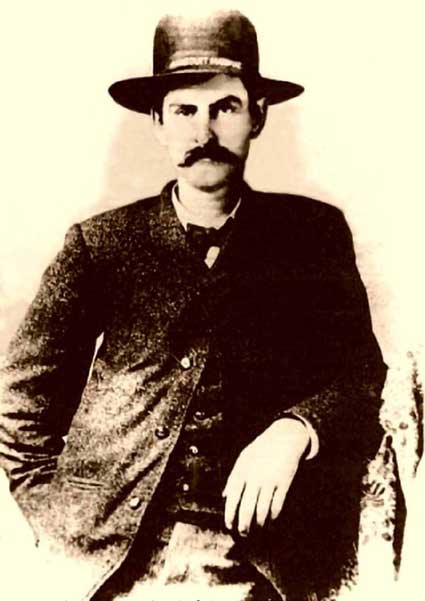
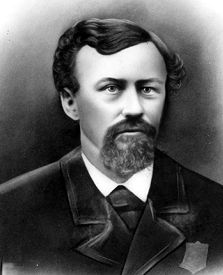
David Allen Mather, better known as Mysterious Dave, was born on August 10, 1851, to Ulysses and Lycia Mather. Dave had come from a family of seafaring lawmen in Massachusetts, and his ancestors had been rugged English sailormen of the Seven Seas.
Mather was proud of his English heritage, and it was common to see him dressed in royal blue and red, even when he got older. Some of his immediate family members were also lawmen in Massachusetts, from whom Mather acquired the desire to become a lawman himself.
A smallish man with square but frail shoulders, dark eyes, and a mustache, Mather was a man of few words, which gained him the nickname “Mysterious Dave.”
Though Mather had aspirations to be a lawman, he, like so many other officers of the Old West, rode both sides of the fence, sometimes on the side of the law and, just as often, riding with outlaws.
By the time Mather was 16, his parents were dead, so he and his brother, Josiah, headed west. Around 1873, Mather became involved in cattle rustling in Sharp County, Arkansas. In 1874, Mather made his first appearance in Dodge City,Kansas, where he frequently returned as a lawman and an outlaw.
About this same time, Mather was often seen about the saloons of Denver, Colorado, always with twin Colts bulging under his coat. He keenly watched the players at the faro, blackjack, and poker tables, but he never gambled himself.
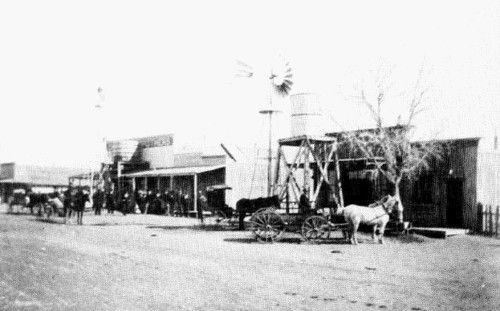
Mobeetie, Texas, early 1900s
By 1878, Mather had found his way to Mobeetie, Texas, and into the company of Wyatt Earp, where one suspiciousness account related that the two ran a con game peddling “gold” bricks to the naïve citizens of Mobeetie.
In 1879, Mather hooked up with outlaw Dutch Henry Born, the leader of a horse-stealing ring operating in a vast area from Kansas to eastern Colorado and New Mexico and the Texas Panhandle. Mather was arrested with Henry Born but was later released. He was soon picked up for complicity in a train robbery near Las Vegas, New Mexico, but was acquitted. Afterward, Mather was appointed as a Deputy Las Vegas Marshal, becoming part of the notorious Dodge City Gang terrorizing Las Vegas, New Mexico.
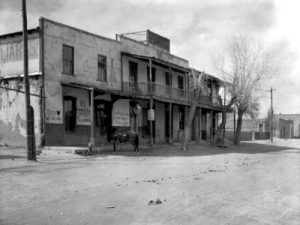
Las Vegas, New Mexico Saloon
On January 22, 1880, T.J. House, James West, John Dorsey, and William Randall were parading about town, sneering, laughing, and looking for trouble. When they entered the Close & Patterson Variety Hall, Marshal Joe Carson asked them to check their guns, but they refused. A wild gunfight ensued, and Carson was killed immediately, while Deputy Dave Mather killed Randall and dropped West. John Dorsey, though wounded, and T.J. House managed to escape.
On February 5, the whereabouts of Dorsey and House were learned; they were at the home of Juan Antonio Dominguez in Buena Vista, 30 miles north of Las Vegas. A posse comprised of J.J. Webb, Dave Rudabaugh, and five other men surrounded the home and called for the men to surrender. Dorsey and House complied after assurance of protection from the citizens of Las Vegas was given. However, this assurance would mean very little, as, within hours of the men being placed in the Old Town Jail, vigilantes relieved the jailers of the prisoners. Taking them to the windmill on the Plaza to hang, Mrs. Carson opened fire on the men, depriving the lynchers of their opportunity.
After Marshal Carson’s death, Mather was appointed the Las Vegas Marshal. However, Mather soon moved on again after being accused of “promiscuous shooting” in his capacity as marshal. Next, he was known to have served for a short time as Assistant Marshal in El Paso, Texas. However, after an altercation in a brothel in which Mather was slightly wounded, he returned to Dodge City, where he was hired as Assistant City Marshal.
AD
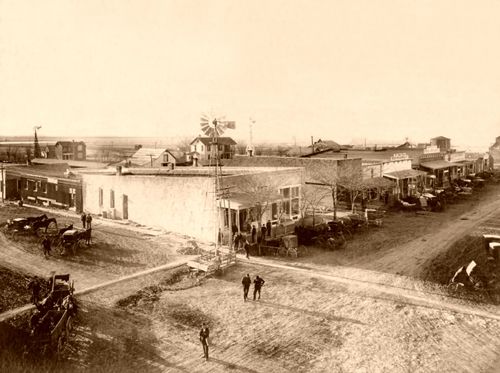
Dodge City in the late 1800s
By the time Mather returned to Dodge City, the existence of gambling, drinking, prostitution, and dance halls, often in open violation of the law, had heated up as a major town issue. The “Dodge City War” in the spring of 1883 was followed by pressure from the Santa Fe Railroad to clean up their town. The reform-minded and status quo factions were still feuding when David Mather accepted the Dodge City Assistant Marshal position. Before long, Mather also became the co-owner of the Opera House Saloon on Front Street.
Thomas Nixon
Because of its prominent downtown location, the city council objected to Mather’s decision to turn the Opera House Saloon into a dance hall and soon passed an ordinance banning all dance houses. However, the council took no action against another dance hall owned by Thomas Nixon, allegedly because of its remote location. For several months, Nixon and Mather battled to put each other out of business.
In 1884, the city government replaced Mysterious Dave with Nixon as the Assistant Marshal, and the feud brewing for several months came to a head. On the evening of July 18, 1884, Nixon drew a gun and fired at Mather but only sprayed him with a few splinters. Three days later, Mather approached Nixon from behind and fired four bullets into his back, killing him instantly. Later, Mather was heard to say, “I ought to have killed him six months ago.”
Although Mather was acquitted of Nixon’s murder, he killed another man the following year and was run out of town by Marshal Bill Tilghman. After serving as city marshal in a few small towns in Kansas and Nebraska, Mysterious Dave moved to San Francisco, California, where he took a ship to Vancouver.
Some reports say he soon enlisted in the Royal Canadian Mounted Police, proving his prowess by showing what he could do with a pair of six guns and a horse. Allegedly he was still seen in the royal blue and red as late as 1922, but those reports have been refuted, and his true fate is unknown.
Soldiers of the 3rd Infantry Division participate in an esprit de corps run around Fort Stewart, June 13. The run is in celebration of the Army’s 239th birthday on June 14.
POWER BELTS, EYE PROTECTION, AND HAND GRENADES — LEADERSHIP LESSONS FROM THE FRONT
Power belts, eye protection, and hand grenades — oh my! And all the sergeants major said, “Hell yeah!” While the staff sergeants rolled their eyes.
Let me explain.
In the Army, the senior enlisted service member of any (battalion-level or above) unit is the command sergeant major (CSM), the “Smaj” (rhymes with badge). But never call a CSM “Smaj” to their face.
The CSM has the most experience, has been around the longest, and is typically the oldest and most likely the crabbiest of all the soldiers in the unit. The CSM is typically around 40 with 20 to 22 years in service. They’ve seen it all. As top adviser and “Ranger buddy” to the commanding officer, they are big difference makers.
Sgt. Maj. of the Army Dan Dailey speaks during a panel hosted by US Army Command Sgt. Maj. John W. Troxell, senior enlisted adviser to the chairman of the Joint Chiefs of Staff, at the Pentagon, March 13, 2018. DOD photo by US Army Sgt. James K. McCann, courtesy of DVIDS.
But why is the CSM crabby all the time? Well, because the CSM is typically roaming the unit area spot-checking for compliance to unit standards, which inevitably drives the staff sergeants (SSGs) bananas. They typically lead nine-soldier squads, composed of the SSG, two sergeants, and six soldiers. Squad leaders are the closest “leader of leaders” to the fight. They are tactically maneuvering fighting elements, are typically focused on the mission at hand, and tend to care little about the “rules” they feel don’t apply to them. The mean age is 25 with four to seven years in service.
The credo of the SSG is “Follow the rules you agree with.” If you don’t agree with it, change the standard when you’re out of sight, or claim “shooter preference” or “non-mission essential” when you’re caught outside of the standard. Better to ask forgiveness than permission.
This is the part that really chafes CSMs because “shooter preference” is typically soldier code for “I don’t wanna.”
But “shooter preference” conflicts with a standard if (and only if) someone is monitoring for compliance to the prescribed standard. And in the Army, someone is always watching for the standards because you cannot expect what you do not inspect. Any prescribed expectation left unmonitored is merely a suggestion, not a standard.
Blacksheep, A Company 2/75 Ranger 1999 — the typical response to power belts. This photo basically captures my 20s. The guy in the back walking between the platoons is most likely the CSM. Photo courtesy of Brandon Young.
A lot of people don’t like being told what to do, even in the Army, which is why monitoring standards — especially safety standards — is important. Here are three examples that highlight three common categories of negative responses to prescribed safety standards:
Power Belts (Negative Response Category: “I don’t like” the safety standard)
Power belts are night reflectors that soldiers wear when running or ruck marching on the road. They are often part of the standard physical training (PT) uniform. Soldiers hate them.
I hated my power belt. Some of the more common affronts against the power belt are to claim “It’s not tactical,” or “It’s not like it’s car repellent,” or the ever famous “If I’m going to get hit by a car, I’m going to get hit by a car! This power belt is stupid!”
Looking back in my 40s, I know that as a young soldier I didn’t want to wear a power belt for two simple reasons: because someone told me to and because they look dorky.
I thought power belts were dumb until a Ranger on a tactical march got hit on a highway at night by a speeding car and was injured so badly it ended his military career. Turns out CSM was right about the power belts. Looking lame is a small price to pay for not getting run over.
First Lt. Anthony Aguilar wears the ballistic protective eyewear that prevented a bomb fragment from possibly damaging his eyes when an IED detonated near his Stryker vehicle while on patrol in Mosul, Iraq, February 2006. Photo by Company C, Task Force 2-1, courtesy of DVIDS.
EYE PROTECTION (NEGATIVE RESPONSE CATEGORY: THE SAFETY STANDARD “IMPEDES MY ABILITY TO WORK”)
Ballistic eyewear that protects the eyes from debris and shrapnel — eye protection — is also infamous for capturing the heat and sweat coming off your face and fogging up to obstruct your vision. Typically, it happens right during the decisive point of the operation when you’re most amped up and your need to see the target is the most critical. It’s also typically the moment when you are most likely to encounter debris and shrapnel.
It’s not that eye pro is really hated, especially if you’re rocking Oakleys. In fact, though it was cool to rag on eye pro before the war, all of us got really happy about wearing our glasses once the GWOT started. Especially after that “wear your eye pro” photo with the 2-inch piece of shrapnel sticking out of the dude’s lens started circulating circa 2006.
I hate that photo because it made me love eye pro, and I had one less thing to drive the CSM crazy about.
Ugh … gross. This one! The worst! Composite courtesy of Brandon Young.
Though I had good reason to pull off my eye pro from time to time to see the battlefield, my Oakleys saved my vision more times than I care to recollect, and I’m thankful to have my sight today.
CSM was also right about eye pro, but don’t tell him I said that. I have a reputation as a Ranger to uphold. Which leads me to hand grenades. (You’re welcome.)
Hand Grenades(Negative Response Category: “I don’t agree with” the safety standard)
This may be the trickiest category of all because it’s genuinely founded in a disagreement about right versus wrong. This is where thoughtful perspectives actually collide with one another creating friction if an idea becomes an ideology — a thought that becomes the fixation of the whole.
In 2002, Bagram, Afghanistan, was a tent city on an abandoned Soviet airfield surrounded by Hesco barriers and soldiers on guard. Down the center of the base, paralleling the airfield, was a long, hard-packed dirt road that we were authorized to run on when we left our corner compound.
When we ran on that road, we were required to have a weapon in hand. A weapon to run on a road surrounded by barriers and well-trained American soldiers guarding those of us inside the barriers.
I thought it was dumb, and I was willing to share my rationale.
Bagram 2002. Photo courtesy of Brandon Young.
Why would I need to shoot if we have soldiers on guard? Who am I going to shoot at on the inside of the base? If we are so overrun by the enemy that the guards have been eliminated, I’ll pick up an M4 and get to the fight. And most important, who the hell wants to run while carrying a gun?!?
Ultimately, the CSM was not persuaded by SSG Young’s thoughtful argument, and the safety standard remained in effect. So in one of my finest acts of smartassery, my squad and I complied — kind of.
After the weapons were issued, the boys and I went on a run, as prescribed, with one LAW (Light Anti-tank Weapon, a collapsible rocket launcher) tied up with a piece of 550 cord to one man’s back and eight M67 fragmentation grenades. Every hand had a weapon — a hand grenade.
We were pretty proud of ourselves. The CSMs on Bagram were not amused.
During the next rotation to Afghanistan, sometime in the middle of the night, we got attacked and a Hesco barrier saved many Rangers’ lives (including mine) by taking the full blast of the 107 mm rocket fired at us. I was pleased to have my rifle to return fire from the barrier, especially since none of the guards were reacting to contact. About two squads of Rangers were happy to oblige instead.
Obviously, being armed in the middle of a war is valuable, even if you’re surrounded by well-trained American soldiers. Someone (probably a CSM) made a decision — an unpopular one — about running with weapons that was founded in the best interests of all soldiers.
Lt. Col. Jacob White, commander of 2nd Battalion, 58th Infantry Regiment, talks with E Company soldiers after they received cloth face coverings from Combat Capabilities Development Command Soldier Center in Natick, Mass., April 27, 2020. Photo by Markeith Horace/Fort Benning Public Affairs Office, courtesy of DVIDS.
That’s the challenge with many safety standards, rules, and expectations that create some level of discomfort or disagreement. Many times safety standards feel ridiculous until the moment you need them and you discover why they exist in the first place.
It’s typically in those moments that SSGs and CSMs stop shaking their heads at each other and start thanking the Lord that one of their soldiers is still alive.
Today, I’m a little older, a little wiser, and a little less inclined to fight over something that someone else made a thoughtful decision about in the interest of others’ safety. I still may not “wanna.” It still might “impede my ability to work,” and I still “may not agree with it.” But these days I’m far more likely to just do it for a few reasons. It’s most likely not that big of a deal, it probably doesn’t really disrupt my life (or infringe upon my freedoms), and because I assume the person who made the decision most likely has more information than I do.
I’m still happy to submit a thoughtful response to rules that don’t seem to make sense, but I am more likely to comply with a safety standard because enduring a minor discomfort or inconvenience demonstrates more about my character than it does about anything else.
Namely, that I value discipline more than opinion, and compassion more than comfort.
In doing so, I’ve learned that it’s far better to be known for my character and my actions than for my attitude or opinions. And I’ve learned that showing respect for the governing authorities over minor inconveniences is a simple way to love others through my deeds, not my words.
Brandon Young is a former US Army Ranger and co-founder/principal at Applied Leadership Partners, helping leaders create tightly knit, high-performing teams through executive coaching, speaking, and workshops. He has spent more than 20 years building and leading teams in the military, corporate healthcare, and nonprofit sectors. He’s been published in various peer-reviewed academic journals for his work as a co-developer of the Enriched Life Scale and is currently pursuing a Masters of Divinity in Leadership at Denver Seminary (2023). His passion is faith, family, community, people, and family adventures!
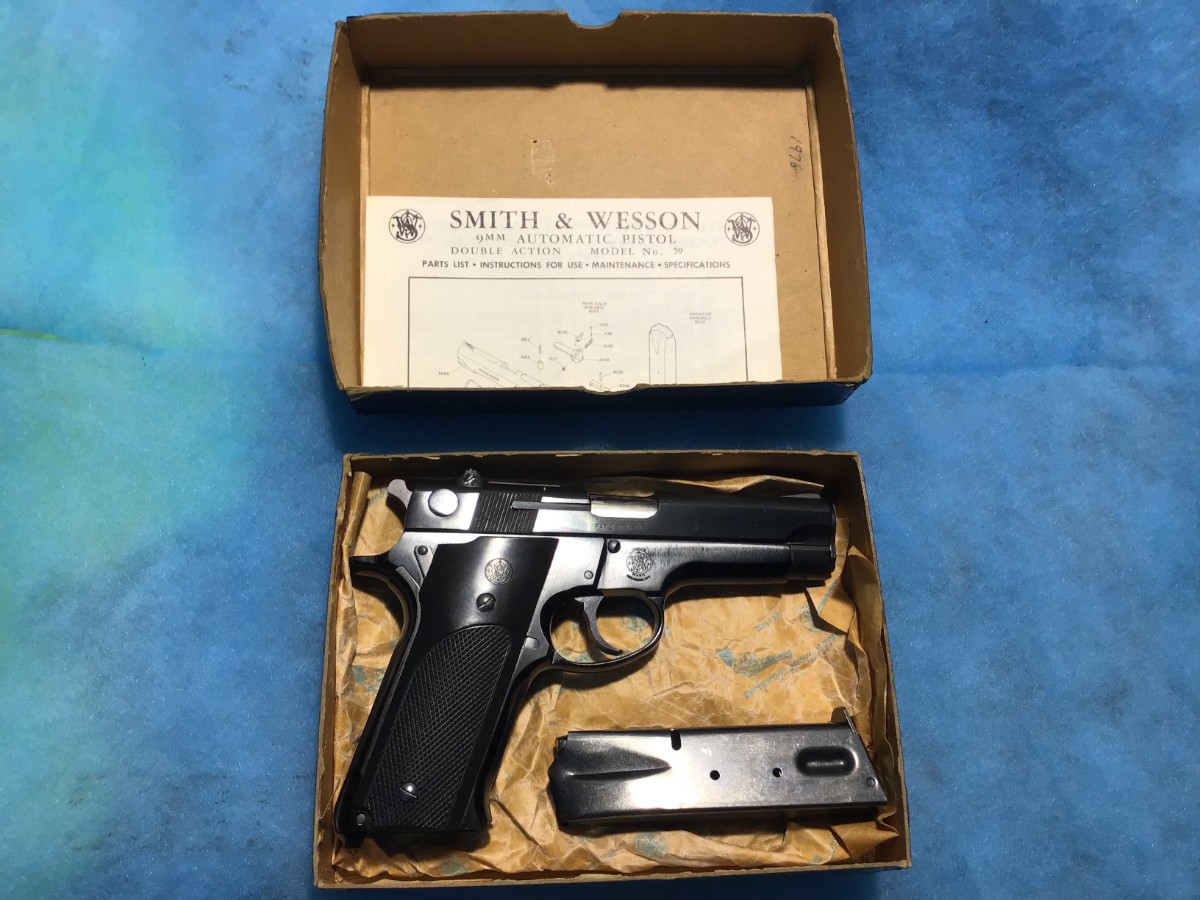
I really liked mine. The only complaint that I had was that compared to Sig Saur or Berretta. It was a pain to tear down for cleaning. But other than that it was a fine pistol! Grumpy