Month: March 2022
Categories
We need more kids like this!

At SHOT Show 2022, Bushmaster Firearms had its new BA30 straight-pull bolt-action rifle on display both on the show floor and during Industry Day at the Range. The BA30 rifle is available in .308 Win. or 6.5 mm Creedmoor chamberings and 18- or 24-inch versions.
Bushmaster says the BA30 is “engineered and built with accuracy, speed and reliability for both hunters and precision shooters, both domestic and international.”
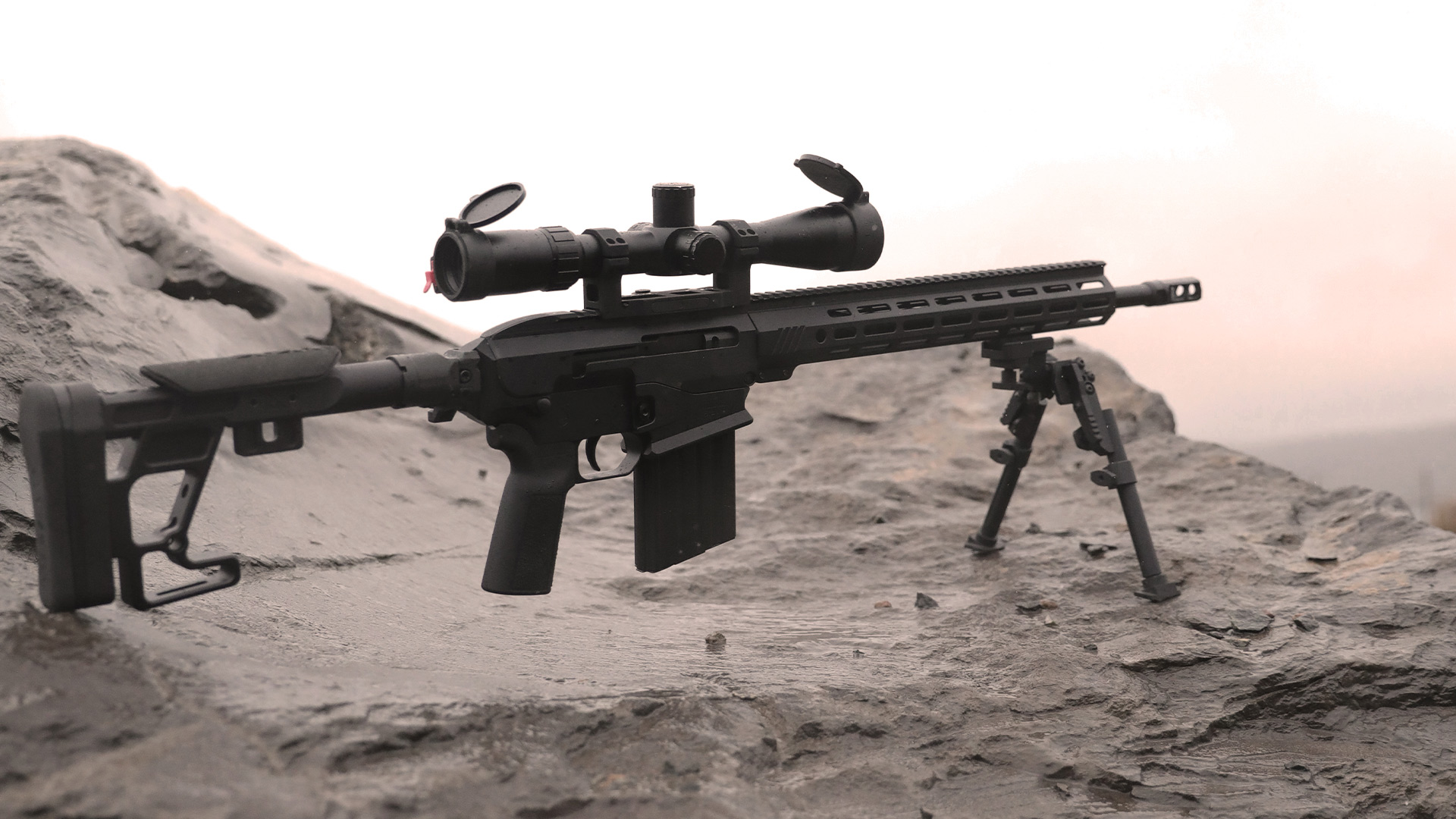
The BA30 barrel twist rates are 1:10 for .308 Win. and 1:8 for 6.5 mm Creedmoor.
The BA30 sports the XM-10 barrel and bolt design, which includes interchangeable XM-10 barrels, bolts, handguards, muzzle devices, grips, triggers, and magazines. Additional features include Type III hard coat anodizing, a 1913 stock adapter and an ambidextrous bolt handle and magazine release.
Bushmaster Firearms International CEO, Sun Naegele, stated:
“Bushmaster is excited to add this easy caliber conversion bolt-action rifle to the market. As you all know, this is not an Adaptive Combat Rifle, but we are full steam ahead on the ACR project for 2022 and are looking forward to bringing it back.”
MSRP price for the new Bushmaster BA30 straight-pull bolt-action rifle begins at $1,799.

Categories
Guilty as charged!

| The .308 Win–MVP of Modern Cartridges |
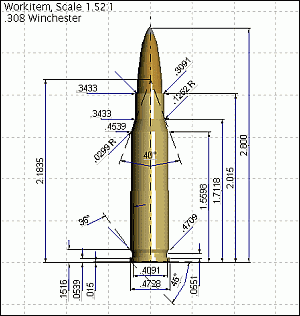
.308 serves police and military marksmen, Palma competitors, F-Class shooters, and deer-hunters equally well. The .308 Win delivers superb accuracy along with outstanding barrel life–it’s not unusual for a .308 barrel to return 5,000+ rounds of accurate service. Along with excellent factory-loaded ammo, a huge selection of bullets and powders is available for the .308 Winchester reloader. Loading for the .308 Win is relatively easy. The round is not finicky and great powder and projectile combinations are well-known.
And if you want “out of the box” precision in a factory rifle, the .308 Win is hard to beat. While it may not be the “ulimate” 1000-yard cartridge or short-range paper-puncher, the .308 remains one of the best cartridges in the modern arsenal, with versatility that few other calibers can match. As a “do-it-all” cartridge that can take game, win shooting matches, and defend against foes, the .308 Winchester has few rivals.
Preferred Brass
For a 6BR, there is one clear choice in brass–Lapua, with Norma the only real second choice. For the .308 Winchester, choice of brass is not so simple. Most of the .308 Win precision shooters we’ve interviewed do prefer Lapua brass, but others are very happy with Norma, Winchester, Hornady Match and even Remington. Black Hills uses Winchester-made brass for its match ammo, which is capable of .5 MOA or better in many rifles. The main advantage of Lapua brass is consistency and quality. Case-wall thickness is very uniform and most lots have shown less variation in weight than other headstamps. But Winchester brass performs very well in the .308. And, at $24/100, Winchester costs 40% less than Lapua brass. Even if you can potentially get more loadings out of a Lapua case, Winchester brass offers more bang for the buck. You’ll find a lot of once-fired Federal Gold Medal Match brass available. While it tends to shoot accurately, we’ve found GMM brass is relatively soft compared to Lapua or Winchester, so the primer pockets tend to loosen up after just three or four reloadings.
In addition to commercial brass, many .308 Win shooters reload boxer-primed military cases such as Lake City, IMI, and Hirtenberger. The Lake City Match brass is pretty good. Some lots have been excellent. The standard Lake City fodder is inferior to Winchester. IMI brass has a reputation for being strong, but we advise you only to purchase it new. Some used lots of IMI brass from Israel have been defective. If you are looking for ultimate accuracy, IMI will probably disappoint you, though it’s good for gas guns that are tough on cases.
The most important thing to remember about military brass is that the internal capacity will probably be less than commercial .308 Win brass, because military brass often has thicker webs or casewalls. Montana Marine reports his fire-formed milsurp cases hold 56 grains of H20 on average compared to 58 grains for fire-formed Winchester. Given the reduced capacity of military brass, you should reduce posted max loads by 1.5 grains when loading with Lake City or most other milsurp brass. However, the IMI MATCH brass is closer to commercial brass in internal case capacity (ICC). Kevin Beggs reports: “Fired, my IMI Match brass runs with an ICC of 55.0gr and bumping the shoulder back .001″ will net me an ICC average of 54.0gr. LAPUA runs an average of 54.4gr and Federal runs an average of 54.3gr ICC.”
Match Bullets
What you see below is just a fraction of the quality 30-caliber match bullets available to .308 shooters. Figure there are at least twenty projectiles you might consider. Still, with such a large selection, nearly all the competitors we interviewed were using one of five bullets: 155 Berger, 155 Lapua Scenar, 155 Sierra MK, 168 Sierra MK, or 175 Sierra MK. A few guys have had good luck with the 168gr Amax (.475 BC), and some guys like to shoot the heavy 185gr Bergers (.569 BC), 185gr Scenars (.521 BC), or 190gr SMKs (.533 BC) at 1000 yards, but the vast majority of .308 shooters are running the 155s, or the 168 or 175 Sierras. Among the 155s, John Whidden has had great success with the Bergers seating them well in the lands. The Lapua 155 has an impressive .508 BC (and you can see that it is even longer than a 175 MK), and you can launch it much faster than a 168- or 175-grainer. Between the 168 SMK (.488 BC) and 175 SMK (.505 BC), most shooters seem to think the slippery 175 is a better bullet overall and it definitely has an edge at longer distance–less drop and less windage. We suggest, in developing initial loads for your .308, that you focus on one of these five projectiles, and then maybe try a few Amaxs or the heavier SMKs. Sierra will start selling a new 210gr SMK early next year. It’s probably a little heavy for a .308, but it should work very well in a 300WM or 30-06.
 |
 Hunting Bullets
The major bullet manufacturers, Barnes, Hornady, Nosler, Sierra, Speer, and Swift provide a wide variety of hunting bullets in .308 caliber with weights ranging from 100 grains or so to 240 grains. For smaller game and varmints, the Sierra 110gr Varminter bullet has proven very accurate. For deer-sized game, a bullet in the 150-grain range (such as the Swift Scirocco) running 2850+ fps is very effective. Reader M700 tells us: “Something that is deadly accurate and has fast expansion gets my vote for mid-longish range deer hunting. Say either a Nosler Ballistic Tip or a Sierra SPBT GameKing. Both have the reputation for fast expansion and excellent accuracy. With a decent .308 Win you can boot the 150 up to around 2900 fps and get excellent accuracy as well as deadly on-game performance.” The Hornady 165gr SST, with its excellent .447 BC, is another good choice for longer-range shots on deer. For Elk and large game, select a heavier, controlled-expansion bullet such as the 180gr Nosler Partition.
Factory Loaded Match Ammo
 One of the great things about the .308 Win is the availability of high-quality factory-loaded ammo. Using 168gr Federal Gold Medal Match this editor managed to coax a .75-moa group from a FAL clone with iron sights. Many shooters who don’t have the time to reload shoot GMM or Black Hills exclusively, and they hold their own in tactical competitions. Jacob Gottfredson, noted writer for Precision Shooting, told us that he often uses Black Hills match ammo in competition: “In tactical matches, an extra quarter-MOA of accuracy (from handloads) won’t make you a winner if you can’t range the targets and dope the wind. You could shoot 175gr Black Hills the whole match and easily end up with a trophy”. Along with Federal and Black Hills, Lapua makes truly outstanding .308 match ammunition fitted with 155gr, 167gr, or 185gr Scenar bullets. The Lapua ammo is capable of shooting under half-MOA in a good rifle. It costs about $25.00 per box of 20 from Grafs.com. For great prices on Federal GMM ($16/20 for 168s) go to OutdoorMarksman.com.
 So which factory ammo is the best? Chances are you should try Black Hills, Federal and Lapua and let your gun decide. SniperCentral.com recently conducted a Match Grade Ammo Comparison test, including M118 LR, used by U.S. military snipers. The tester concluded: “The Federal Gold Medal Match is still the standard by which all other match ammo is judged. How they can get such good accuracy and consistency from such mass produced ammo is a mystery to me. Black Hills match grade ammo is right up there with Federal, is just as consistent, and in my particular rifle, is just as accurate, though I cannot say its any MORE accurate than Federal. It’s a good alternative, with the price per box about $2 cheaper than Federal. The HSM ammo is the cheapest of them all by a large margin (about $5 cheaper then Black Hills, and about $7 cheaper then federal per box). But it’s also not nearly as accurate. You can expect the same accuracy as M118, and it makes a good replacement for those that cannot get M118.”
Choosing the Right Powder and Load Testing
For the 160-175 grain boattails used by the majority of .308 shooters, you want a powder of medium burn rate that gives close to 100% load density. The “classic” .308 load for 168gr SMKs is IMR 4064 with Federal primers. However, these days Varget is probably slightly more popular. Lot variance has frustrated Varget users, however. Jerry Tierney has had to tweak his .308 Palma Varget load up to two full grains to maintain optimal velocity. Tech Note: If you use QuickLOAD, we suggest you select data for ADI 2208 rather than Hodgdon Varget. This, we’ve found, will give more realistic numbers.
In addition to Varget and IMR 4064, a half-dozen or more other powders work extremely well in the .308 case: AA 2460, BLC-2, IMR 4895, Reloader 15, Ramshot TAC, VV N150, and VV N540. Some folks are seeing a little more velocity with RL15 than with Varget, but Varget is still less temperature sensitive–important if you’re running near max. Most of the guys we know shooting the Sierra or Lapua 155s are using Varget. For Sierra’s 110gr Varminter and other light bullets, you can use a faster-burning powder such as Benchmark or VV N135. In general, the .308 seems to achieve its best accuracy with case-filling loads running pretty stout pressures. For safety’s sake, always start at least 10% below recommended maximums, and watch for pressure signs carefully. Often you can be over-pressure even without tell-tale signs on the primer cup. One trick we use is to take a shell-holder to the range. After firing a test case, if you have difficulty sliding it into the shell-holder, the web has expanded excessively, meaning your pressure is too high. For a good selection of “safe” loads, click on the Sierra icon to download Sierra’s .308 Winchester Load Map.
When choosing a load to test, keep in mind that seating depths can make a HUGE difference in pressure. Remember that seating bullets into the lands can raise pressures but moving 0.020″ or more AWAY from the lands can also raise pressures, because you are reducing the effective case capacity. Many readers ask us “should I jam or jump my bullets.” There is no right answer for every gun. For every guy getting great results at .015″ jam, there is another guy doing well with a 0.025″ jump. In general, most popular .308 match bullets (Bergers excepted) are tolerant of jump. This is certainly true of the 168 and 175 SMKs. So don’t worry that you may be sacrificing a great deal of accuracy by loading to mag length, even if that puts you pretty far from the lands.
Primers
We wish we could say something definitive about primers–but the truth is both Federals and CCIs are winning their share of matches. Federal 210m, and CCI BR2s have both proven accurate with all the most popular propellants for match ammo. We can say that if you have experienced issues with cratering and primer piercing, go with the CCIs. They have a harder cup. Among other primers, WLRs are used in Black Hills match ammo and they perform admirably. Russian primers are the newest thing to hit the market, and by all indications they work as well or better than the best domestic primers (so long as the rather hard Russian cups are firmly seated to proper depth). Note, Russian primers are currently distributed by PMC and retailed in PMC boxes. However, PMC will not import them after the first of the year. AccurateShooter.com has been informed that a large, well-known foreign ammunition company will take over importation of the Russian primers and they should be readily available by the second quarter of 2006.
Reloading and Die Selection
Reloading for the .308 is straight-forward. The cartridge is very forgiving and performs exceptionally well with a wide variety of powders and bullets. Different applications require different tools and techniques, however. Those shooting semi-auto “gas guns” such as the M1A and FN-FAL clones should full-length size after each firing. Palma shooters, who need to be at near-max pressures to be competitive, should use the strongest brass available and should pay special attention to seating depths. At high pressures, Palma shooters can also benefit from body-sizing or full-length sizing after each firing.
Full-length Sizing (Body and Neck): The problem with full-length sizing is that virtually all commercial dies reduce the neck diameter much more than necessary. This results in excessive neck tension and can make bullets difficult to seat smoothly. There are two good solutions to the problem, and neither is very expensive.
1. Purchase a Forster .308 full-length sizing die. Measure a loaded round with a bullet seated, and note the outside neck diameter. Then send your die to Forster and for $10 (plus shipping) Forster will hone the neck to the dimension you specify. For bolt guns, we suggest .002″ under the neck diameter of a loaded round. For gas guns, go .003″ under. Total cost is about $45.00, including the die.
2. Hornady can make you a custom full-length sizing die for about $75.00 plus shipping. Just send them a few fired cases and a reamer print (if you have it). They can create a die that gives you ideal neck tension, as well as just the right amount of sizing at the shoulder and web. Call Hornady and ask for Lonnie Hummel. Scott Parker recently had a die like this made and he reports: “Average runout for 65 rounds was .0004″. All 65 rounds showed less than .001″ runout.”
 Neck Sizing Only: If you are not working your brass too much with very hot loads, you can probably get by with neck-sizing only. Bushing dies are convenient and allow you to adjust tension as easily as swapping in a new bushing, but this can contribute to build-up of brass at the neck-shoulder junction. If you do neck-size only, you should experiment with the bushing position. Some shooters get best results only sizing one-half to two-thirds of the neck. Another inexpensive option is the Lee Collet Die. This works by squeezing the neck around a metal mandrel that extends down into the case. Collet dies can produce very low run-out, they don’t cause brass build-up at the neck-shoulder junction, and they are inexpensive. However, it is somewhat difficult to precisely control the amount of tension and the collet’s fingers can leave marks on your brass. Still, some .308 shooters swear by the Lee die.
Neck-Sizing with Optional Body Sizing: Most .308 shooters can get away with neck-sizing only for a while, but after 4-5 firings extraction becomes difficult. Then it’s time to size the brass. An inexpensive Redding body die is the way to go. Getting just the right amount of sizing is the hard part–you want to just size the case enough so that it feeds and extracts easily. With some presses, the ram must be set to “cam-over” in order to size the case enough. This means you must first set the bottom of the die to touch the shell-holder, then screw it down a little further, 1/8th turn at a time.






History
The Winchester-Hotchkiss rifle was first conceived by Benjamin Hotchkiss in 1875, and by 1877 he had four US patents on the design (numbers 99898, 169641, 184285, and 186566) which he sold to the Winchester company in early 1877. Winchester was able to have three sample rifles constructed in time to submit to the 1878 Ordnance Board trials for the US Army, which were tasked with investigating the possibility of adopting a magazine rifle. The Hotchkiss did remarkably well in the trials, proving itself to be one of the fastest rifles tested (in close competition with the Lee turnbolt design), and also passing the sand, rust, and defective cartridge tests. If suffered a broken bolt in the final test (overcharged cartridges), due largely to a manufacturing defect. Winchester remedied the problem, and at the end of the trials the Board recommended adoption of the rifle. The US Secretary of War appropriated $20,000 for manufacture of rifles for more extensive field testing.
Winchester was not satisfied with just preliminary interest from the US military, however, Immediately after the US trials concluded, Winchester also made a series of sample Hotchkiss rifles chambered for the .577-450 Martini Henry cartridge for testing by the Turkish military (this effort would fail when Turkey chose the Peabody-Martini rifle instead). They also exhibited the rifle at the International Exhibition in Sydney Australia in early 1879. This would prove to be a fruitful marketing event, as made Asian nations had delegations and Winchester received orders for 500 Hotchkiss rifles for Japan, 100 for Siam (for the King’s bodyguard), and 1,000 rifles for China.
The US Army order consisted of 500 rifle and 500 carbines, and the last of these were delivered in July of 1879. A sample rifle sent to the US Navy resulted in an order for 1,500 rifles for that service (the US Army and Navy at that time purchased arms and equipment independently of each other). Winchester also marketed the gun as a sporting and target rifle, and while it did make some sales in this vein, they were less than anticipated.
It was not long after the US Army order was delivered that some weaknesses of the design became clear – primarily that the stock was weakened by the magazine cutoff lever and prone to cracking there. By January of 1880, company engineers (William Wetmore and Thomas Bennett) had redesigned the magazine cutoff and wrist of the gun to strengthen it. This became known as the “New Model” or “New System” Hotchkiss, and it went into full scale production in June of 1880. In addition, 506 existing guns were converted to the improved pattern for the Army – but another 2,449 were made to the original design after production began of the new model (these were guns for a Chinese contract already underway). In total, 6,396 of the first pattern of Hotchkiss rifle were made by Winchester – 5,199 military pattern muskets, 812 carbines, and 563 sporting rifles.
With the introduction of the New Model, civilian interest increased slightly, and military marketing efforts continued. Several samples were made in .43 Spanish caliber for sales efforts in Central and South America (areas dominated by the Remington Rolling Block in most military forces at the time). The sporting orders received a bit of boost when George Albee (a veteran of Berdan’s Sharpshooters) used a New Model Hotchkiss to win the Lorillard Gold Medal for rapid fire accuracy at Creedmore in 1882. However, the vast majority of New Model rifles (11,000+ of the 13,332 muskets made) were purchased by China in 1882 and 1883. Another 1,000 went to various buyers in Central and South America, and 981 to the US Navy. In total, Winchester built 16,117 New Model Hotchkiss guns.
The final iteration of the Hotchkiss was the Model 1883, which was developed in an effort to alleviate continued complaints of stock breakage. The redesign this time involved a significantly reshaped receiver, and the use of a two-part stock (a buttstock and a separate foreend) in place of the one-piece stocks used on previous models. The safety and magazine cutoff levers were moved back to the sides of the receiver similar to the cutoff placement on the original 1879 design, where they were now supported by the steel receiver instead of a wooden stock. Samples were ready in time to submit to the US Army’s 1882 magazine rifle trials, where they once again performed well enough to merit a contract for field trials. The design had been finished in the summer of 1882, but Winchester delayed putting it into production until Congress approved the Army contract, using the time to build New Model rifles from the existing stockpile of parts already in inventory. Only on January 1t, 1884 did Winchester announce the new rifle to the public.
Unfortunately for Winchester, the results of Army field trials were not in their favor (nor in favor of any other magazine rifle) – the commanders of the companies in the trials overwhelmingly preferred their Trapdoor Springfield rifles to any of the new repeaters. This was often for reasons more associated with parade than actual combat – one common complaint of the repeaters was that a commander could not easily ascertain their cocked or uncocked status in troopers’ hands at a glance, which the large hammer of the Trapdoor did allow.
At any rate, US military rejection did not hamper sales of the Hotchkiss elsewhere. Winchester ultimately sold 59,446 of the Model 1883. Of these, 56,504 were military muskets (going to countries including Bolivia, Mexico, Morocco, and most of all China). A further 1,669 were carbines and 1,273 were sporting rifles. The numbers of Hotchkiss rifles sold (about 84,500 of all models combined, with the last rifle made in 1904) were not particularly significant compared to other Winchester products like the Models 1892 and 1894 lever action rifles and the 1897 shotgun, they did establish Winchester as a significant player in the bolt action rifle market.
Mechanics and Disassembly
The basic mechanism of the Winchester-Hotchkiss remained basically the same through all three models. The magazine tube extends from the rear of the receiver down into the stock, and it is loaded by placing cartridges in the action and pushing them down backwards into the magazine. A catch grabs the rim of the forward-most cartridge and holds it in place until the trigger is pulled, at which time one cartridge is release to push up into the receiver under pressure form the magazine spring. When the bolt is opened and the empty case kicked out, the bolt’s forward movement catches the rim f this released cartridge, allowing it to be chambered. A magazine cutoff allows the shooter to disable this trigger catch, keeping the rounds locked in the magazine until the cutoff is disengaged. When this is done (or when the magazine is empty), the rifle can be single-loaded by opening the bolt and dropping individual rounds into the receiver.
On the 1879 pattern guns, the magazine cutoff is a rotary switch inletted into the right side of the stock (which also functioned as a safety). On the New Model, the cutoff was replaced by a lever riding alongside the left top of the receiver, which could be pushed forward and back. On the 1883 pattern, the cutoff was moved down to the left side of the receiver, in the form of a lever which could be pushed up to engage the cutoff and down to release it. The New Model and 1883 pattern guns has safeties separate from the magazine cutoffs, located on the right side of the receiver opposite the cutoff levers. I don’t have a New Model to confirm this with, but on the 1883 the safety (which is engaged when up and disengaged when down, in a proper ergonomic configuration) locks both the bolt and the trigger.
It was surprisingly difficult to find instructions for disassembly of the Hotchkiss online, and it turns out the procedure is both very simple and difficult to figure out through experimentation. To remove the bolt assembly, lift the bolt handle and retract the bolt until the handle is just at the end of the receiver. Then grasp the cocking piece and rotate it 90 degrees clockwise. This will disengage the bolt head from the bolt body. The bolt body may be removed out the back of the receiver, and the bold head lifted out of the action. This is all that is necessary for cleaning.
The Hotchkiss was designed only for black powder cartridges, and uses a single locking lug (which is also the mounting point for the bolt handle). There are a pair of vent holes in the rear of the chamber to relieve pressure in case of a ruptured cartridge (an important safety feature).
References
The best resource I have found on the Winchester-Hotchkiss (and the source of most of the data in this writeup) is Herbert Houze’s Winchester Bolt Action Military and Sporting Rifles, 1877 to 1937
You can also find a transcription of both the 1878 and 1882 US Ordnance trials reports at Milpas.cc, which has details on the performance of the Hotchkiss and other rifles that were entered.
Initial Shooting Impressions
I recently acquired an example of an 1883 Winchester-Hotckiss (from a Rock Island auction, actually). Mine is in the 84,000 serial number range, and was one of the very last examples made. It is covered with a rather ugly black paint, which suggests that it may have been used as a Hollywood movie prop for a while (one of the last orders of these rifles went to the California state militia, and many of those ended up with movie studios after they were retired from service). At any rate, is it mechanically intact and in good working order, with the exception of a crack on the left side of the wrist. I soaked some Superglue into that crack, and it seems to be stable enough.
I have thus far only fired about ten rounds through the rifle, all of them being handloaded duplicates of the US cavalry carbine cartridge: a 405 grain cast lead bullet over 55 grains of black powder. The proper load for this rifle should be 70 grains of powder (hence .45-70), but I wanted to start with something a bit lighter until knew everything was working properly. Using these carbine loads, the recoil was very mild, and I had no problems with feeding, firing, extraction, or ejection.
One quirk of the rifle to be aware of is that once a round is in the magazine, the bolt must be closed and the trigger pulled in order to release the round for feeding. The ideal technique is to load 5 rounds into the magazine and then drop a sixth round into the action and chamber it manually. When that single-loaded round is fired, the first round in the magazine is released. Otherwise after loading the magazine you must close the bolt and dry fire the gun in order to release the first round for feeding (which you will see me do in the video below).
My opinion of the rifle is that it is comfortable, fast, and easy to use. The single locking lug and relatively low pressure ammunition makes the bolt very easy and smooth to operate, and while my experience is very limited so far, I can shoot the Hotchkiss as quickly as a Lee Enfield. I am looking forward to loading a lot more ammunition and getting more trigger time on the gun to gain a better understanding of its nuances. I believe the June 2-Gun Action match is going to be a Greasy Grass (aka, Custer’s Last Stand) commemorative match, with all stages based on Old West events. I plan to shoot the Hotchkiss in that match, and will be able to compare its performance to that of a Trapdoor Springfield and a reproduction Spencer carbine shot by friends.
On my one range trip to date with the Hotchkiss, I did get a short bit of video, which will help demonstrate it’s rapidity of fire. More will be coming (including photos) as I have the chance to work with this rifle more extensively!
Categories