Categories
All About Guns Hard Nosed Folks Both Good & Bad

Hardin’s Deadly Tools John Wesley Hardin was a master craftsman of death, and these were the tools of his trade. by Phil Spangenberger

john_wesley_hardin_guns_firearms_gunmen_wild_westWe’ve long held a fascination for the gunmen of the Wild West, and firearms enthusiasts have been especially interested in the hardware used by them.


Unlike most Wild West gunmen, who left behind scarce detailed accounts of the guns they had used during their tumultuous careers, John Wesley Hardin is known to have owned or used several solidly documented guns.

Furthermore, thanks to his autobiography, in instances where his hardware is not known, we can guesstimate what arms were most likely used on given dates, based on firearms production records and other known historical facts relating to firearms chronology. (Keep in mind though, Hardin describes some shootings that have not been documented elsewhere and are thus suspect.)

Hardin, arguably the most deadly of the Old West’s gunmen, was a notorious desperado whose career spanned three decades (minus almost 16 years in prison) that ranged from the end of the percussion era of the late 1860s to well into the age of metallic cartridge arms in 1895.

Although firearms were probably nothing more than mere tools to him, there is little doubt that Hardin was a man who appreciated the mechanics as well as every line and curve of his weapons, as his adept handling of his firearms testifies.

“Hardin was an awful quick man”

To say that Hardin was good with his guns would be an understatement. During his lifetime he was considered to be the best shot, the fastest draw, an excellent horseman and the deadliest gunman in the West—and not simply through hearsay. Hard men of arms, who had witnessed and respected his six-gun handling, recorded his abilities.

Late in his lawless career, in 1877, when Hardin was a captive of the Texas Rangers, famed Ranger James B. Gillett was among a group of Rangers who unchained Hardin and watched him in amazement as he demonstrated his skills with a pair of empty Colts. The Ranger remembered he handled the Colts “as a sleight-of-hand performer manipulates a coin.” They also noted his tricks: “The quick draw, the spin, the rolls, pinwheeling, border shift—he did them all with magical precision.”

A Smiley, Texas, man told Hardin’s great grandson he remembered seeing young Hardin “…get on a horse and run that horse at a pretty good speed by a tree, and unload his gun in a knot on the tree.”

Another contemporary recalled that Hardin was so fast that, “When he was young he could get out a six-shooter and use it quicker than a frog could eat a fly.”

In his El Paso years, despite aging and being away from guns for nearly two decades in prison, Hardin was still lightning fast. One eyewitness, who saw Hardin in action in 1895, said, “Hardin was an awful quick man. I was in Mexico one night with him when a policeman started to arrest Hardin for carrying a gun. The policeman made a break for his gun, but he didn’t have time to pull it. Hardin hit the man in the face and then, pulling his gun, told the Greaser to get out of town, at the same time informing him who he was. The Mexican never did come back, and he hasn’t stopped running yet, I bet.”

While in El Paso, Hardin must have felt himself slipping as he passed into his early forties, for in his autobiography he writes of his earlier abilities with guns, “In those days I was a crack shot.…”

In El Paso, he practiced daily in front of a mirror in his boarding room. He wore a special “calfskin vest with built-in holsters containing his two Colt .41 caliber revolvers,” according to contemporary accounts, although neither this vest, nor a bulletproof vest he was supposed to have worn, have ever turned up.

When interviewed for the August 23, 1895, edition of the El Paso Daily Times (just four days after Hardin’s death), his landlady, Mrs. Williams of the Herndon House, stated: “Yes, Mr. Hardin was certainly a quick man with his guns. I have seen him unload his guns, put them in his pocket, walk across the room and then suddenly spring to one side, facing around, and quick as a flash, he would have a gun in each hand, clicking so fast that the clicks sounded like a rattle machine.”

She went on to say, “He would place his guns inside his breeches in front with the muzzles out. Then he would jerk them out by the muzzle, and with a toss as quick as lightning, grasp them by the handle and have them clicking in unison.”

As a final testimony to Hardin’s speed and skill with his guns, El Paso Constable John Selman, a noted gunman himself, would kill Hardin by shooting him in the back!

Hardware for a Young Shootist

Much of Hardin’s early career—from 1868 to 1877—largely involved the use of cap-and-ball revolvers, since the self-contained metallic cartridge arms were relatively new and were not yet nearly as plentiful as they were in later years.

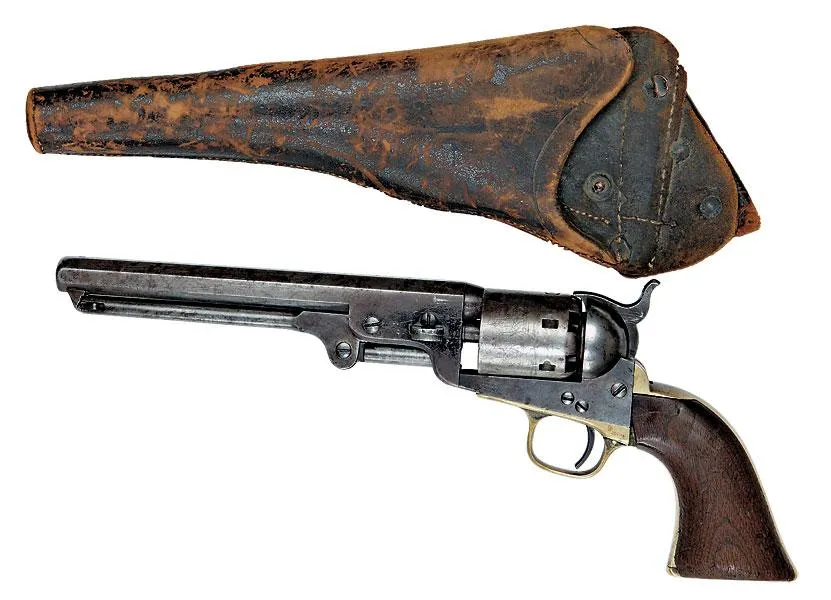
In his life’s story, he frequently makes mention of Colt’s revolvers. Based on the dates of his gunfights, these likely would have been the Model 1860 Army .44s or the 1851 and 1861 Navy models in .36 bore, or possibly cartridge conversions.

Hardin is known to have used at least one 1851 Navy .36, which is identified by serial number in a letter handwritten by Joe Clements, Hardin’s cousin. In the letter, Joe writes that Hardin gave him the gun after Joe had broken up a fight in Gonzales, Texas, and that Hardin got a newer model revolver.

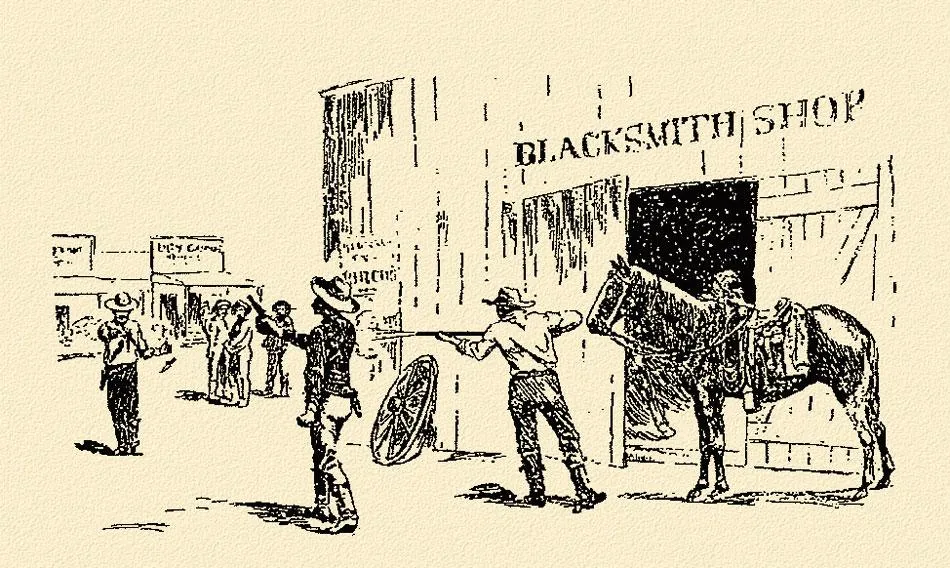
Hardin mentions using a Colt .44 (most likely the 1860 Army model) in his first killing, in 1868, involving a freed slave who had assaulted him. Shortly thereafter, he may well have relied on the same six-gun when a posse of three soldiers discovered his whereabouts and came to arrest the 15 year old for the shooting. The teenaged fugitive selected a spot by a deep creek bed, where they would have to cross, and waylaid the troopers.

In this ambush, which young Wes described as “war to the knife with me,” he killed the three men by “…opening the fight with a double-barreled shotgun and ending it with a cap-and-ball six-shooter.”

Several years later, when Hardin was captured in Pensacola, Florida, on July 23, 1877, he had a ’60 model, .44 cap-and-ball Army Colt revolver on him. He had been unable to draw his six-shooter, since it was strapped to his galluses—much to the relief of the arresting officers.

In recounting his many other fracases, Hardin does not go into detail as to the particular type of weapons used. Like many other Westerners of the day, Hardin referred to them as a cap-and-ball six-shooter or, simply, as “my pistol.” Texas’s Public Enemy No. 1 also spoke of shooting a man with a derringer. Again, he doesn’t stipulate the type or caliber, and such a weapon at that time could have been any of a myriad of hideout pocket pistols.

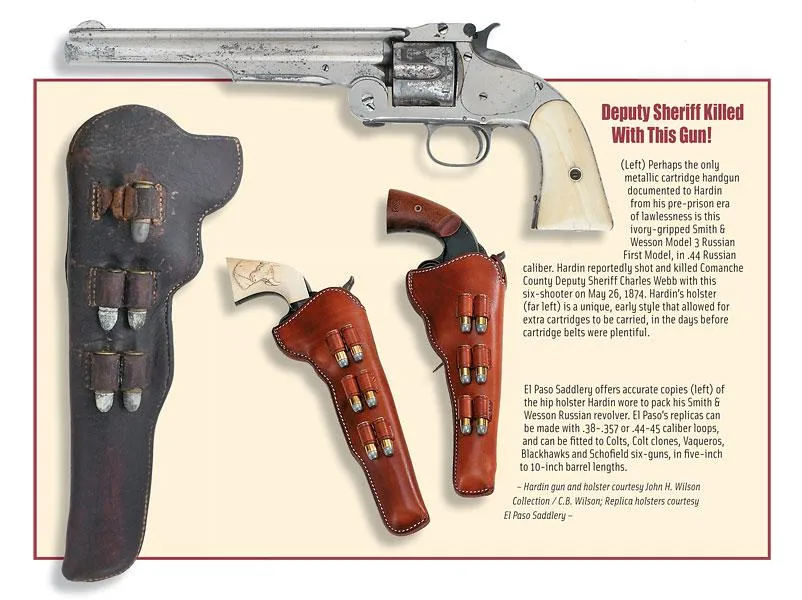
One of Hardin’s known six-guns is a Smith & Wesson Model 3 Russian First Model, in .44 Russian chambering, which he used to kill Deputy Sheriff Charles Webb in Comanche, Texas, on May 26, 1874. This shooting brought about Hardin’s eventual capture and jailing. It is perhaps the only documented metallic cartridge six-gun from Hardin’s pre-prison era of lawlessness.

Although he preferred handguns, he was known to have also used longarms in several shoot-outs. Beside the above-mentioned incident in 1868, when he used a double-barreled shotgun to kill some soldiers, Hardin also used a shotgun to kill Jack Helm in July 1873.

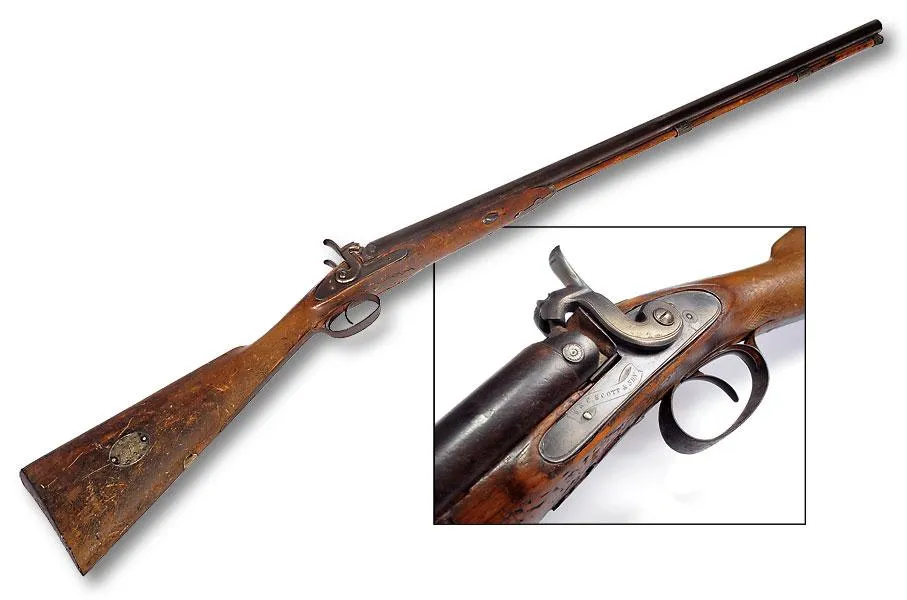
Helm, a former Texas police captain and the DeWitt County sheriff, was also a deadly rival of Hardin’s in the notorious Sutton-Taylor feud. Hardin, who fought for the Taylors, gave Helm a broadside with a British W.&C. Scott & Son, double-barreled, 12-gauge percussion shotgun as Helm approached him. Hardin’s partner, Jim Taylor, then shot the sheriff several times in the head with his six-gun. This Hardin shotgun is on display at the Buckhorn Saloon & Museum in San Antonio, Texas.

On another occasion, the failure of the cap to ignite the main charge on a double-barreled caplock scattergun saved one lawman from joining Hardin’s long list of victims. During a running horse battle in drizzling rain, Hardin and Jim Taylor were escaping after shooting Deputy Sheriff Webb. When Texas Ranger Capt. John R. Waller caught up to the fugitives, he rode hard at them. The outlaw later recalled “…I wheeled, stopped my horse, and cocked my shotgun. I had a handkerchief over the tubes [nipples] to keep the caps dry, and just as I pulled the trigger the wind blew it back and the hammer fell on the handkerchief. That saved his life. Waller checked up his horse and broke back to his men.”

Rifles also sometimes made up Hardin’s personal arsenal. In his autobiography, he gives an account of firing at some pursuing lawmen with a “needle gun,” a frontier term for the .50-70 Allin conversion of the Springfield rifle—an early trapdoor model.

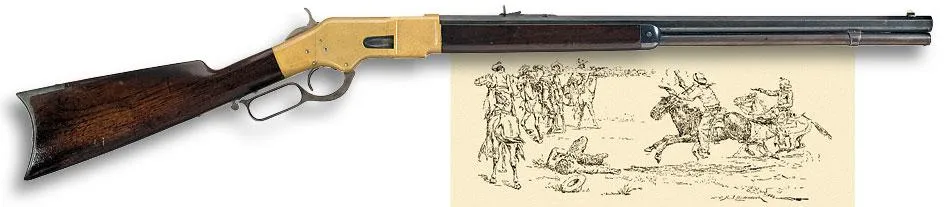
On another occasion, while trailing cattle to Kansas in 1871, Hardin holed up with his Winchester rifle in the bushes of his campsite and got the drop on a group of men who were after him. Based on the date of this incident, this likely would have been Winchester’s 1866 Model—originally dubbed the “Improved Henry.”

Last Guns of the Last Gunfighter

After Hardin’s release from prison in February 1894, the governor of Texas granted him a full pardon. Passing the bar soon afterwards (while in prison, Hardin had made an attempt at reforming by studying law and theology), the ex-convict began practicing law. Yet his inner demons were still plaguing him, and the hair-trigger-tempered Hardin quickly reverted to his old ways of gambling and drink.

The firearms from this notorious Texas pistoleer’s final years are solidly documented through the official court records resulting from an arrest and his murder. They present an interesting assortment of handguns.

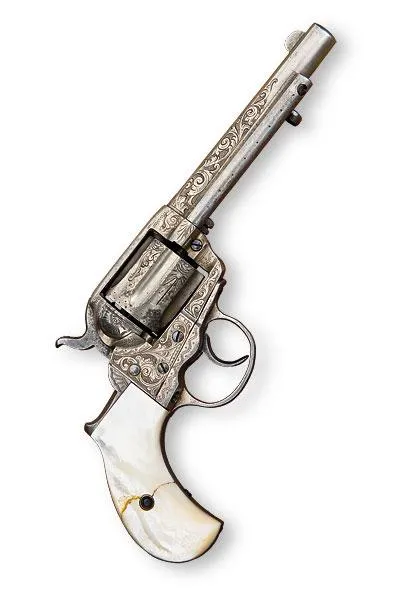
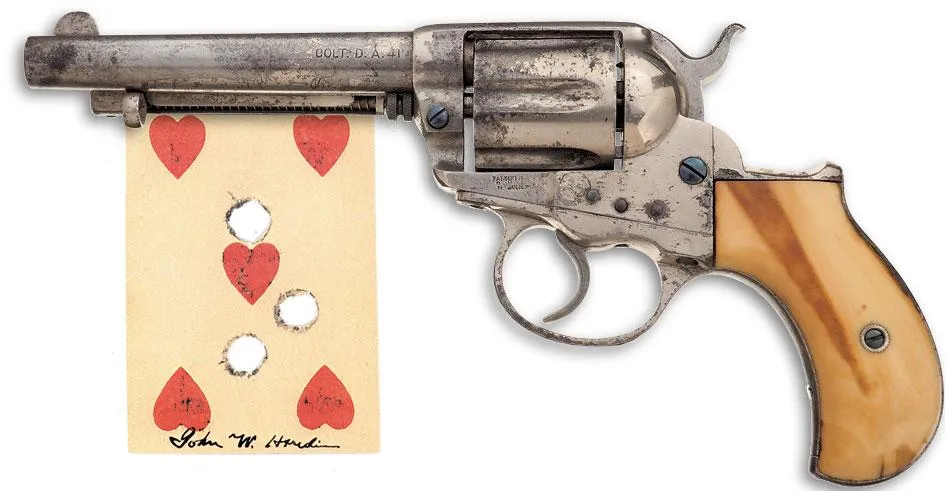
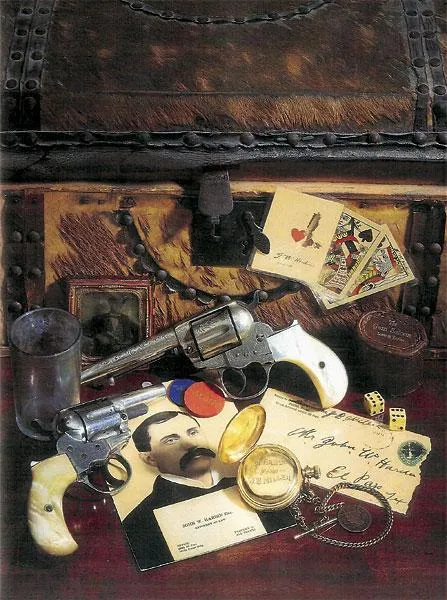
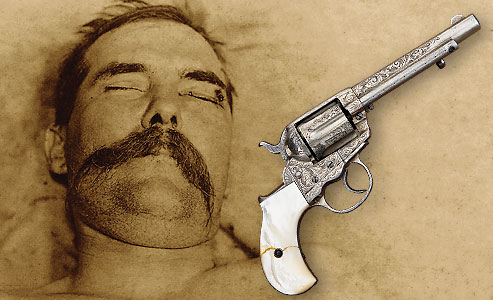
Among these was a nickeled 2½-inch, ejectorless, .38 caliber Model 1877 Colt Double Action “Lightning” with two-piece pearl stocks. This six-shooter was presented to him (along with an engraved and gold-filled Elgin pocket watch, a watch chain and coin watch fob) from his cousin by marriage, “Killer” Jim Miller, for representing him in a legal dispute. Hardin also owned two .41 Long Colt-chambered 1877 Colt Double Action “Thunderers.” One was a 4½-inch barreled, ivory stocked and nickel plated pocket revolver (with ejector) and the other had a barrel of five inches and was nickel plated and ornately engraved with two-piece pearl grips.

Hardin also owned an ivory-stocked, 4¾-inch barreled, 1873 Colt Single Action Army in .45 Colt chambering, in nickel finish, with the ejector housing removed (quite possibly by Hardin himself, for an easier and faster draw from his pocket). Hardin’s 1873 Peacemaker, as well as one of his .41 Long Colt 1877 Colts (the ivory-stocked 4½-inch model), are on display at the Autry National Center’s Museum of the American West in Los Angeles, California.

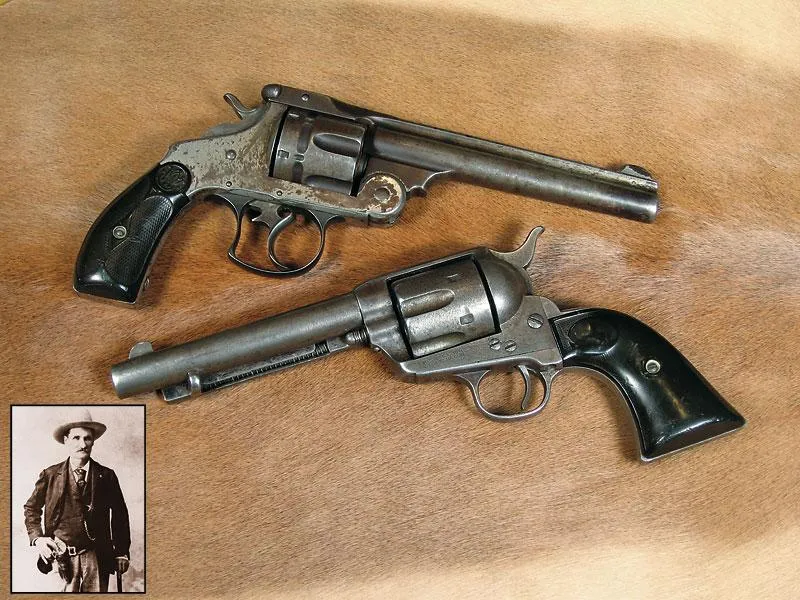
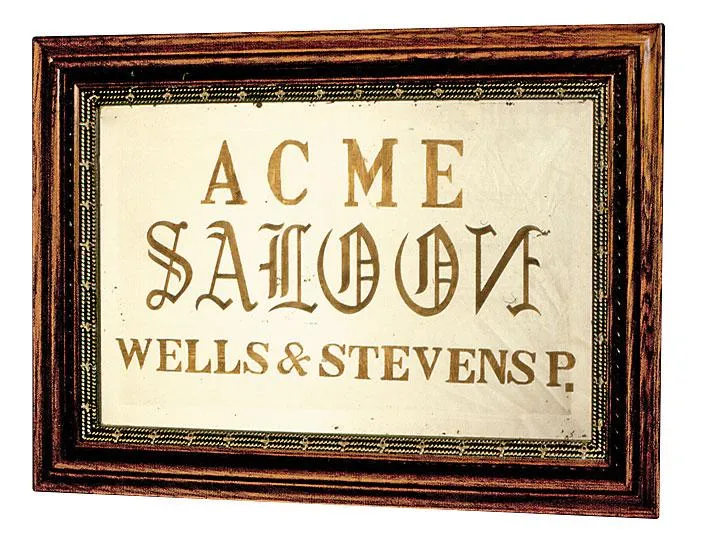
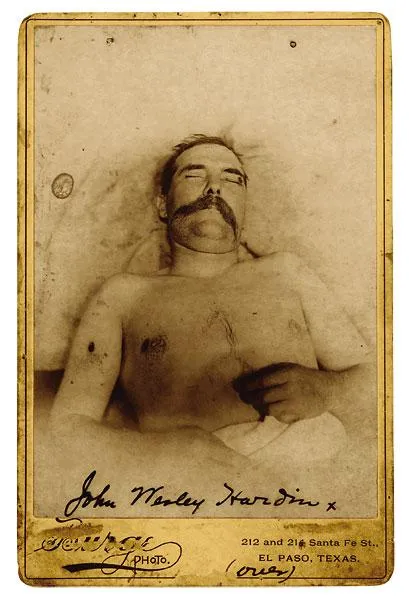
At the time of his death, 42-year-old Hardin was packing a Smith & Wesson Double Action “Frontier” in .44-40 chambering, with black factory hard rubber grips. On the afternoon of August 19, 1895, Hardin threatened the lives of Constable John Selman and his son. That night, Selman walked into the Acme Saloon in El Paso, where the noted gunman was drinking and rolling dice, and coolly shot Hardin in the back of the head with a Colt .45 Peacemaker, killing him instantly.

Ironically, Selman claimed that Hardin had seen him come in to the Acme and went for his guns, although few believed this story. As a matter of interest, Episcopal Minister E.H. Higgins, who had been called to the Acme to attend to Hardin after the shooting, suggested that if Selman had shot Hardin through the eye from the front, “it would be remarkably good marksmanship,” and if Selman had shot him from behind, “it was probably remarkably good judgment.”

Had Selman indeed faced Hardin in a fair fight, the outcome might well have been different. J.W. Hardin was a bona fide expert with his six-guns. In his last year of life, he put on a number of shooting exhibitions during which he shot holes in faro cards, then signed them and gave them away as souvenirs. Most historians, including this writer who has carefully measured the bullet holes in some of these cards, feel that Hardin used his .41 caliber Double Action 1877 Colts to perform these shooting feats. A handful of these unique gunfighter mementos still exist and bring a premium price with collectors, as do any of Hardin’s firearms.

Like so many other shootists of the Old West, Hardin had many guns during his long and violent career. Thanks to court records, Hardin relatives and dedicated historians and collectors, like El Paso’s late Robert E. McNellis, who uncovered several of Hardin’s documented guns and other personal memorabilia, several examples of the Texas gunman’s weaponry have survived. These valuable artifacts not only reveal the types of arms used by Old West gunfighters, but also provide the rare opportunity to see the actual tools of this deadly gunman—one of the frontier’s most notorious shootists—in his violent profession.

Phil Spangenberger writes for Guns & Ammo, appears on the History Channel and other documentary networks, produces Wild West shows, is a Hollywood gun coach and character actor, and is True West’s Firearms Editor.

Categories
All About Guns Anti Civil Rights ideas & "Friends"

Sing it loud & clear Daddy!

Categories
All About Guns

Loading Ammo (Snider Chow) for the 1864 Snider Enfield & Shooting the 577 Snider British Sporting Rifle

Categories
Dear Grumpy Advice on Teaching in Today's Classroom Well I thought it was neat!

Year 536 Was the Worst Year to Be Alive – What Happened? (And you thought the past couple of years was bad)

Categories
Hard Nosed Folks Both Good & Bad

From The Great & Funny Blog – Badass of the Week Volodymyr Zelensky

“I am here. We are not putting down arms. We will be defending our country, because our weapon is truth, and our truth is that this is our land, our country, our children. And we will defend all of this.”

So I spent the vast majority of this fucked-up nightmare hell week planning to write about the Ghost of Kiev becoming the first fighter ace of the 21st century (and doing it in the MiG-29 Foxbat, which, in my books, is one of the most badass-looking fighter planes of all time), but sadly the more we learn about that it’s starting to look like that story is more propaganda than reality, and instead of having some insane fighter ace blowing the asses off of enemy bombers it turned out he was just a dude that was really good at Digital Combat Simulator.  Then I thought, fuck it, I’ll just write about the Ukrainian people, who are out there lobbing Molotovs at BMPs, running in front of tanks to block them from advancing, and manning hand-dug trenches with a makeshift civilian army comprised largely of pissed off computer programmers with assault rifles.

Then, finally, I decided, no – I am going to write about the guy who is inspiring those people to do that shit.  The man who is serving as the primary beacon of Resistance against Russian aggression in the world despite being completely outgunned and outnumbered, remaining defiant in the face of airstrikes, artillery and Chechen assassins, bolstering the morale of his citizens to stand and fight for their land and their country.

It’s pretty nuts that the Ukrainian people elected their version of Sasha Baron Cohen as their President and he ended up turning into their version of Winston Churchill.  And what better indicator of how weird the world is right now that the dude who voiced the Ukrainian dub of Paddington Bear is out there threatening Vladimir Putin, the only G8 world leader who has probably actually killed another human with his bare hands?

And, sure, in the days and weeks following the publication of this article many parts of these stories may change, and many new heroes and heroes will surface, and certainly Zelensky’s story will progress in ways we cannot possibly foresee right now.  Hell, maybe the Ghost of Kiev is real, and the reports of him scoring his 20th kill aren’t complete bullshit.  Maybe some noble 21st century Stanislav Petrov will prevent the nuclear annihilation of Earth, or maybe it’ll turn out that the Ukrainian Reaper is truly some hardass real-life Slavic Simo Hayha who is out there single-handedly defending Kyiv (sorry, I am going to seriously struggle to not keep calling it Kiev, but I have 40 years of conditioning working against me here) by haphazardly flailing his blue-and-yellow ballsack around like the business arm of an industrial construction crane.  But, for right now, the guy at the center of all this is President Zelensky, and I just wanted to take a minute this week to appreciate how the Ukrainian people elected this guy:

And somehow ended up with this:

Because, I mean, that shit is like the Ukraine War version of that damn Travolta meme where they put those driving clips from Grease and Pulp Fiction next to each other and use it as a metaphor for how the last two years took our already-miserable lives and somehow turned our nine-to-five soul-sucking day jobs into the sort of nostalgic experiences that makes us sincerely long for the days when the biggest stressors in our weekday was that nobody could never remember the goddamn passcode to get in to the break room at the office.

Born in the Ukraine in 1978 to a family of Russian Jews, Zelensky’s dad was a Professor of Cybernetics and his Mother was an engineer.  His grandfather served with the Soviet Red Army fighting Nazis during World War II, where he marched through to Berlin and helped avenge the fact that his father and three of his brothers were murdered in Nazi Death Camps.  So, naturally, coming from a badass line of war heroes, engineers and possible Skynet programmers, Zelensky got his law degree, learned to speak three languages, and graduated from the prestigious Kiev National Economic University.

Then he fucked off his law profession and became a professional comedian.

In 1995 Zelensky founded a comedy company called Kvartal 95, did a bunch of sketch shows, an eventually went on to win a national Russian comedy contest called KVN in 1997.  He turned his comedy career into television and film, where he stared in a bunch of rom-coms, goofy TV shows, and what I generally understand to be roughly the Ukrainian version of the American Pie films – which, of course, I am picturing as just being exactly like American Pie except everyone’s wearing those fur caps with the flaps over the ears and has a working knowledge of how to field-strip an AK-47.  In 2006 he was the Season One winner of Dancing with the Stars Ukraine, proving that this dude knows his way around a salsa or two, and then in the 2010s he voiced Paddington in the Ukrainian dubs of both Paddington films – which I also haven’t seen, but the trailers looked pretty fucking adorable, in so much as I am allowed to suggest that anything might be “adorable” while writing text for this website.

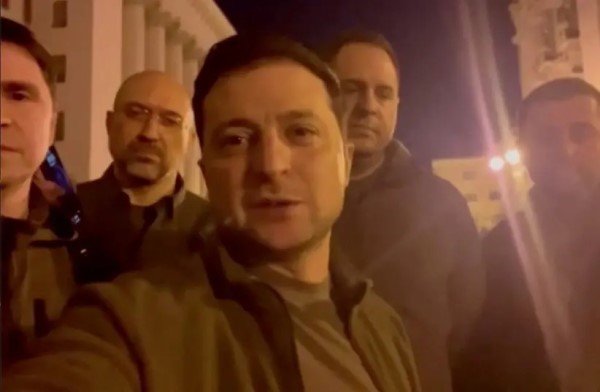
Still, you have to admit — there’s not much in her to suggest that ten years later this guy was going to be taking video selfies in a flak jacket going full Sean Connery First Knight “Never Give Up, Never Surrender” to inspire armed resistance against Russian armored vehicles while dodging artillery shells and KGB sniper fire.

In 2015 Zelensky launched the TV show Servant of the People, where he played a school teacher who accidentally got elected President of the Ukraine, and then has to kind of stumble his way through the political system.  It was a comedy, and most of the cover art of it has a very Mister Bean vibe to it, though some of the publicity photos I saw for it include Zelensky waving a couple Uzis around the Ukrainian parliament, presumably as part of his character’s new “anti-Corruption” platform, so who knows what was going on there.  Foreign comedy is pretty much universally weird, and if you’ve ever tried to watch any foreign-language comedy I can pretty much guarantee that there was at least one moment during the film that left you thinking something along the lines of, “Shit, is this the kind of thing that they think is funny over there?”  I don’t speak Ukrainian, I don’t know any Ukrainian people, and I’ve never seen the show, so I’m not going to really comment on it further other than to say that shit is banned in Russia these days.

Except it’s worth mentioning that this dude was a fucking comedian who played the President on television for three years and did it so successfully that in 2019 he was elected the actual goddamn President of the Ukraine.

 Zelensky defeated a billionaire business tycoon, earned an incredible 73% of the vote, and was elected as the first Jewish President of the Ukraine in 2019, which, I mean, I really want to stress this — this isn’t like electing Martin Sheen during the height of the West Wing success, or electing Dennis Haysbert after the first season of 24.  This guy was a lifetime comedian, and his show was a comedy.  And now he’s out there negotiating military deals with NATO and calling Vladimir Putin a motherfucker in front of the United Nations General Assembly.  And people are rallying around him all around the world as a beacon of light and hope and defiant resistance in the face of overwhelming hostile resistance – a leader of freedom fighters opposing a violent takeover of their native land with fistfuls of flaming molotovs and rocket-propelled grenades.

Before this whole “Land War in Europe” thing went down, the shit Zelensky was best known for most in the U.S. was the whole Trump Impeachment phone call, which I don’t really want to talk about a whole lot right here because I think it’ll detract from the things I actually do want to talk about.  Essentially, Zelensky was given a choice – dig up dirt on Hunter Biden, or we’ll probably revoke the $200 million in military aid that Congress appropriated to send to you.  Zelensky said no, which, even though he could have used some of those anti-tank weapons right about now, was still probably the safe call – his objective was to get a NATO invite from the US government, and he couldn’t afford to take sides right before the election.

Well, between that stuff, then Covid, and now Putin, the actually political career of Vlodymyr Zelensky wasn’t exactly action-packed.  It took him a while to get up to speed, and he tried to introduce legislation to bring peace to the Donbas region and end corruption in the Ukraine, but his polling numbers were pretty middling.  Some folks liked him, some thought he needed to do more to battle corruption, and, presumably, all the corrupt people were kind of hoping he’d do less to stop corruption.  He was… fine.  He did his job.

That all changed a week ago.

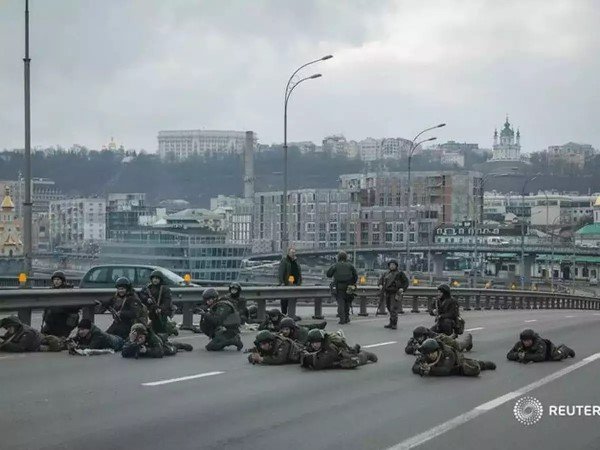
On February 24, 2022, the Russian Federation launched a full-scale invasion of the Ukraine, marking the first time we’ve had a real land war in Europe since the Yugoslav Wars of the 90s.  Enemy tanks, aircraft, armored vehicles, and trucks began flooding into the country from three directions, supported by artillery fire and airstrikes, aimed at encircling, surrounding, and occupying the population centers at Kyiv, Karkiv, and the Crimea.  44 year old comedian Volodymyr Zelensky suddenly became a wartime leader, despite having no combat experience beyond filming that bit with the Uzis.  The Russians – and probably most of the Western powers – figured he’d cave.  This would be too much.  The Ukraine couldn’t hold, they were facing too much opposition, and, fuck, most of them probably would rather be part of Russia anyways and would just surrender the first time a T-80 pointed its coax at them.

That is not what happened.

When the war started, Zelensky had the opportunity to evacuate.  As a VIP, he could have easily been swept out of the country in the early hours of the fighting, and he could be sitting up in a Barcalounger eating Pierogies and drinking high-end vodka in Warsaw right now while a line of European foreign ministers promise him that they’re “fully committed” to helping Ukraine and are willing to take acts as extreme and defiant as not selling Putin any model year 2023 Mercedes and not letting Russia play their national anthem when they compete in the World Cup later this year.   And, in fact, that’s exactly what Russian media posted that he was doing – the story broke within hours of the attack that the Comedy President had shit his pants, taken the first private jet out of the Ukraine, scurried to the safety of his fuzzy European slippers, and abandoned his people to their fate.

And a lot of people believed it.  Until, later that day, Zelensky posted a video of himself standing outside Parliament in the middle of a goddamn artillery storm.  Then he went out and authorized the Ukrainian Tax Office to release a statement saying that if you capture enemy tanks and weapons in battle you don’t need to declare it as assets on your 2022 Tax Return.

It’s true that the US had tried to evacuate him.  It’s also true that he told them, “The fight is here.  I need ammunition, not a ride.”  So now, with enemy troops hunting him, a wall of tanks just 20 miles from his palace doors, Russian bombers streaking overhead, the impressive Russian botnet demonizing him as a Nazi (even though his entire family was literally killed by Nazis) and the rest of the world leaving him to face the daunting Russian War Machine alone, fucking Volodymyr Zelensky is out there making Instagram videos urging his people to fight the invaders with everything they have.

And they are.  The people of Ukraine have rallied in huge numbers, fighting with everything they have, and, against all odds, they’ve managed to hold the goddamn Russian Army back for over a week.

I’m not sure how this is going to end for Zelensky – it’s too early to tell right now.  There was a story just today that he survived three assassination attempts on his life – two by the elite Wagner Group, a PMC of mostly former GRU special forces guys, and one by Chechen Special Forces – all of which were thwarted before they could reach the Ukrainian President.  But here, in this moment, this guy’s a damn war hero.  He’s an inspiration to the West, watching him stand defiantly against foreign aggression to defend his home soil against an invading army that outnumbers him massively, and while the rest of the West has responded to his pleas for military aid by canceling iPhone shipments or seizing superyachts or whatever other useless shit they’re doing, he’s out there dodging assassins, negotiating for humanitarian corridors to safely evacuate his people, and inspiring defiant resistance from a bombed-out bunker in a capital city that is becoming increasingly besieged.

And you have to think that the only thing more embarrassing to Putin than failing to overrun a country he probably thought he’d capture in 48 hours is the fact that the world is becoming increasingly more aware that he no longer has the biggest balls of any world leader in the former Soviet Bloc.

“When you attack us you will see our faces – not our backs, but our faces.”

Categories
All About Guns

Allied WW2 Side Arms in the Movies – Commentated

Categories
All About Guns War Well I thought it was neat!

Oh the Irony – ARE AMERICAN-MADE RPG-7S IN UKRAINE TAKING DOWN RUSSIAN TANKS? By Martin K.A. Morgan

The ironies of contemporary world history are many and sometimes profound. Recently, complicated politics in post-Soviet Eastern Europe dragged a number of towering ironies before the eyes of the world during the Russian invasion of Ukraine. One of these ironies is the fact that many of the weapons being used by both sides were created during the Cold War by the now-dead U.S.S.R. empire — an empire whose geography Russia now seems to be attempting to reacquire.

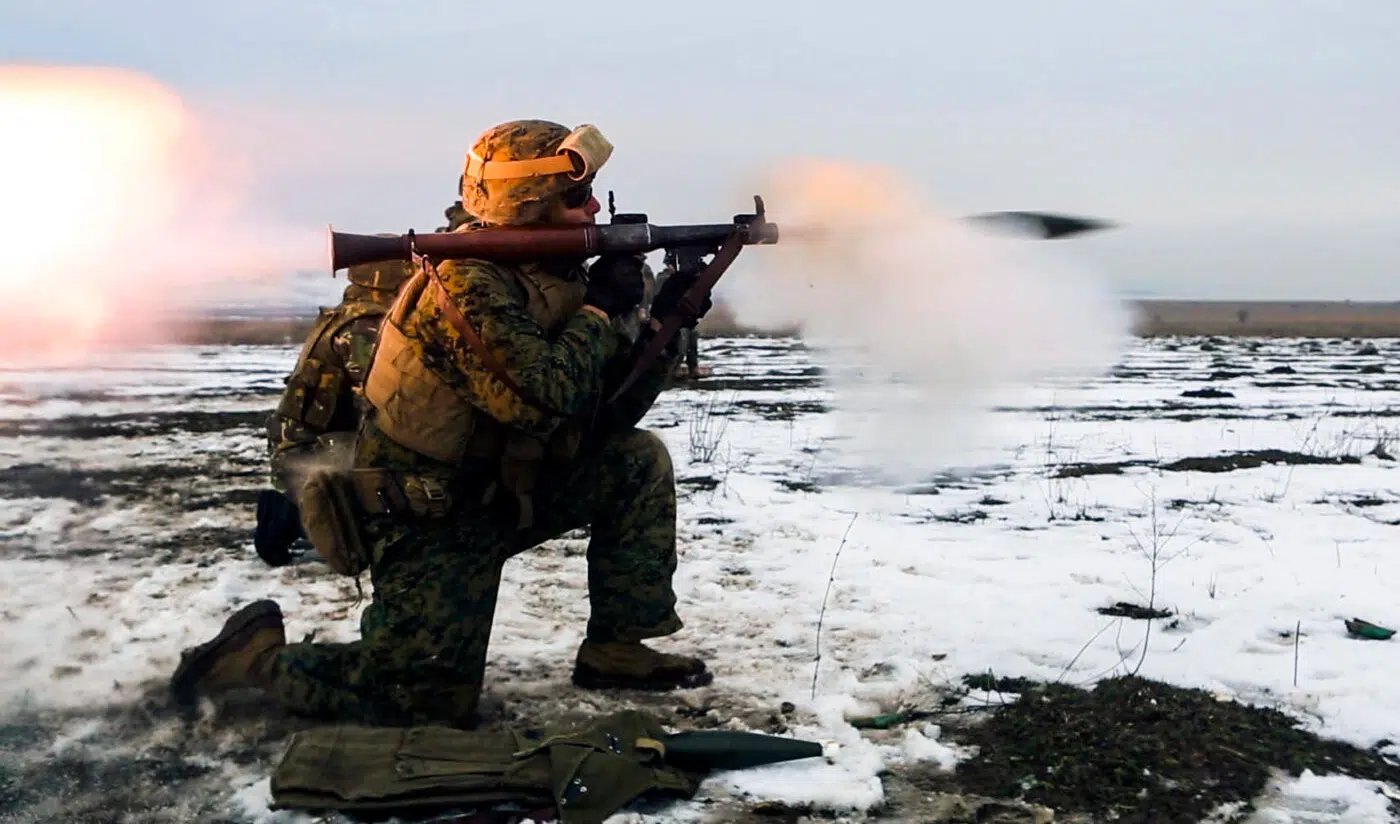
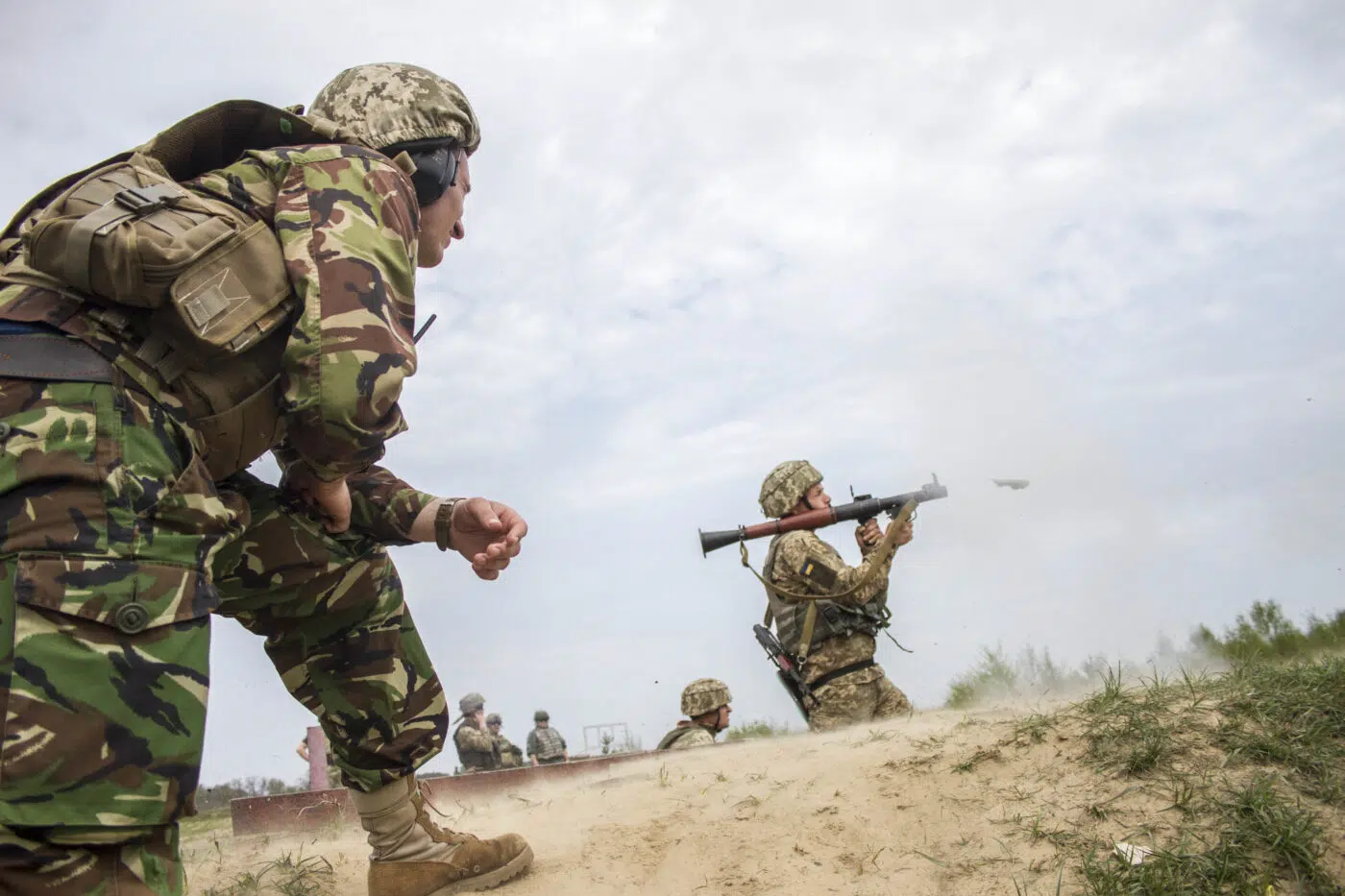
Romanian RPG-7 fired by soldier during training
A U.S. Marine with Black Sea Rotational Force fires the Romanian RPG-7 during Platinum Eagle training exercises. Image: U.S. DoD

For example, contemporary derivatives of the Kalashnikov assault rifle can be seen in the streets of Kherson, Mariupol and Kyiv, and even the humble Makarov pistol has been used in limited numbers. But another old 20th-century Soviet weapon is fighting-on here in the 21st with a renewed importance: the RPG-7 recoilless, shoulder-fired, rocket-assisted grenade launcher.

The Source

During the Second World War, the Red Army learned a valuable lesson from the Germans about individually portable anti-tank firepower. Both the Panzerfaust and the Panzerschreck had demonstrated themselves to be formidable battle implements and the Russians sought to develop something similar.

German soldier using a Panzerschreck
A precursor to the RPG weapons, the Panzerschreck is shown in this photo used by a German soldier towards the end of World War II.

By late 1944, they had a design that combined the lightweight portability of the Panzerfaust and the reloadability of the Panzerschreck with a shaped charge warhead that ultimately received the designation PG-1. After the end of the Great Patriotic War, development of the weapon — now designated RPG-1 (for Ручной противотанковый гранатомёт, Ruchnoy Protivotankovy Granatomyot or “hand-held antitank grenade launcher”) — continued because of difficulties with the launcher’s ignition system and the projectile’s disappointing armor penetration.

By 1947, though, an improved design was taking shape that overcame the RPG-1’s shortcomings. It was designated RPG-2 in 1949 and it used a 40mm diameter cartridge to accelerate an 82mm diameter high-explosive/anti-tank (HEAT) warhead out to a maximum range of 150m/500 feet.

Ukrainian solider firing a RPG-7
A Ukrainian soldier of the 1st Airmobile Battalion, 79th Air Assault Brigade fires an RPG-7 during qualification on May 4, 2017. Image: U.S. DoD

While that provided a noteworthy improvement in the weapon’s external ballistics, the big news was that the PG-2 grenade was capable of penetrating armor with a thickness of up to 7”. This made the RPG-2 such a success that it went on to serve not only the armed forces of the USSR, but also other communist bloc nations like the People’s Republic of China and notably the People’s Republic of Vietnam.

Moving Forward

Soon after the RPG-2 went into serial production in the mid-1950s, Russian ordnance engineers began refining the design. They rightfully recognized that the system needed greater stand-off reach so that opposing armored forces could be engaged at greater ranges. They also realized that the system needed to produce increased projectile velocity because that would reduce the target’s window of opportunity for performing evasive maneuvers. But since the RPG-2 was really just a grenade projector, it was not going to be possible to extract more range or velocity from the system without either increasing the power of the propelling charge or lightening the weight of the projectile.

RPG-2
This RPG-2 was captured from the Viet Cong forces in the 1960s. It was a potent anti-tank weapon during its time. Image: NARA

Toward that end, in 1958 the Russians began working on an improved system that incorporated rocket assist. Inspired by what the Germans had done with the Panzerschreck and what the Americans had done with the Bazooka, the Russians equipped a new 83mm diameter grenade with a rocket motor that increased effective range without having to change the projectile size and, therefore, armor-penetrating capacity.

U.S. soldier carries RPG in Europe
A U.S. soldier from 1st Battalion, 4th Infantry Regiment carries a rocket-propelled grenade during a simulated assault during training. Image: U.S. DoD

In addition to the improved rocket-assisted grenade, they also improved the design of the launcher’s tube by widening it to 45mm diameter and incorporating an expansion chamber, as well as a venturi and a divergent nozzle at its rear end. While these changes brought the weight of the launcher up to 10 lbs., the new features nevertheless provided the desired increase in velocity — an increase that doubled the weapon’s effective range to an impressive 1,000 feet. It received the designation RPG-4 and it passed field trials with flying colors in 1961, but it was not issued to the Soviet military in significant numbers because yet another variant with even better performance was about to be adopted.

Refining the Tools

For all of the RPG-4’s impressive capabilities, it was here one day/gone the next, and it functioned more as a proof of concept than anything. There was room for improvement in the design of the launcher’s expansion chamber, the venturi, and the nozzle, and the grenade’s anatomy also had to evolve because the engineers went back to a 40mm diameter launch tube. All of this design evolution eventually culminated in a weapon that rivals even the legendary Kalashnikov in terms of notoriety and mystique.

Staff Sgt. James Bradsher demonstrates the use of a Soviet made RPG-7 in 1984
Staff Sgt. James Bradsher demonstrates the use of a Soviet-made RPG-7 during exercise Volant Scorpion on January 28, 1984. Image: U.S. DoD

It received the designation RPG-7 and, since it entered Soviet military service 60 years ago, it has become a legendary and infamous source of battlefield firepower. It weighs 14 lbs., it is 37.5” long, and the area of its expansion chamber is covered by either wood or plastic insulation to protect the shooter from heat. The RPG-7 is equipped with flip-up sights, and the adjustable rear sight is graduated from 200m to 500m, but the weapon also has an accessory rail on the left side for mounting the PGO-7 scope. This 2.8x windage adjustable optic features a battery-operated illuminating ranging reticle that provides holdovers for calculating lead and bullet drop.

While the internal design of the launch tube of the RPG-7 is the product of some actual engineering sophistication, the weapon’s ignition system could not be simpler: a hammer strikes a firing pin that strikes a primer that ignites the gunpowder booster charge that propels the grenade out of the tube at 400 feet per second. After about 30 feet, the grenade’s rocket motor kicks-in and sustains flight with a velocity of 1,000 feet per second out to a maximum range of about 3,000 feet. The preliminary gunpowder booster stage is used because without it, the operator would receive the full backblast of the rocket motor.

U.S. soldier holding a captured RPG-7 during combat with Viet Cong forces in July 1967
This RPG-7 was captured by U.S. troops during combat with Viet Cong forces in July 1967. Image: NARA

While several different grenade types have been introduced for use with the RPG-7 system during its six decades of service, the PG-7 high-explosive/anti-tank (HEAT) round is the most common. It is an 85mm diameter shaped-charge warhead weighing 5 lbs. that deploys four stabilizing fins in flight. The PG-7 remains inert and perfectly safe until it is subjected to the rapid acceleration of launch during which the warhead goes from 0 to 500 fps in the blink of an eye. Only those G-forces can initiate the sequence that ignites the sustainer motor and arms the shaped charge’s fuze.

U.S. Marine firing an RPG during training
A U.S. Marine with the Black Sea Rotational Force fires a Romanian RPG-7 during the Platinum Eagle training exercise. Image: U.S. DoD

As an additional safety precaution, the PG-7 is also equipped with a self-destruct timer that will detonate the warhead after it has flown about 3,000 feet. Today, a variety of rounds are available for the modernized RPG-7 that provide greater performance than what was available back in the 1960s, and that includes a high-explosive/fragmentation round, a tandem high-explosive/anti-tank round for defeating modern reactive armor, and even a thermobaric anti-personnel round that produces a high volume, high pressure, high-temperature explosion that can be effective against opposing troops inside of structures.

In Use

The RPG-7 has been produced by nine countries and it has been used by more than 40. Since 1961, over nine million examples have been manufactured, making it the most ubiquitous anti-armor weapon there has ever been. From the Golan Heights to Huế’s Imperial Palace, from Mogadishu’s Bakaara Market to the streets of Marawi and Kyiv, the RPG-7 is one of the most successful weapons in the history of human conflict — right up there with the longbow and the trebuchet.

Russian tanks in Belarus
Russian main battle tanks navigating through the marshland and forests in Belarus. Image: Shutterstock/Maksim Safaniuk

It has materially altered the landscape of contemporary ground combat and it does not seem to be anywhere close to the end of its service life. In fact, it is fighting right now as this article is being written. Although it may have been born of a need to knock-out NATO armor in a great Wagnerian Götterdämmerung in West Germany’s Fulda Gap during the Cold War, it is at this very moment being used by the Ukrainians to destroy vehicles belonging to the armed forces of the country that first created it.

Ukrainian soldier during RPG training
A Ukrainian soldier assigned to the 1st Airmobile Battalion, 79th Air Assault Brigade loads his RPG-7. Image: U.S. DoD

In what is perhaps the greatest irony of them all though, some of the examples of the RPG-7 fighting in Ukraine right now were made in the USA. In 2017, the Ukrainian military began purchasing examples of an RPG-7 clone from AirTronic USA of Spring Branch, Texas. It is designated PSRL-1 and, although it makes use of modern materials and features 1913 accessory rails, it is nevertheless capable of firing any of the PG-7 type grenades that might be encountered worldwide.

Thus, the RPG-7 lives on, albeit now with an American accent.

Categories
All About Guns Soldiering War

Ukrainian DShK as Infantry Support Weapon

Categories
All About Guns Anti Civil Rights ideas & "Friends" Born again Cynic!

Sounds about right to me!

Categories
All About Guns

Smith & Wesson Model 686 357 Magnum Revolver