Categories
The Green Machine This great Nation & Its People

Soldiers of America

Soldiers and Officers in American History

image.png

Categories
All About Guns

A Winchester 1885 Low-Wall 24″ Super Magnum Single Shot Rifle, in caliber .17 WSM

Now I know that that the price of good quality wood has gone thru the roof in the past few decades. But it is really sad for me to see such a fine looking action like this 1885 being married up to some good but nothing fancy looking wood like this. But I guess that is the way the world turns! Grumpy


Categories
Our Great Kids

I still say a much better time than now

Categories
All About Guns Soldiering War

Gods & Generals: Reloading Rifle – What I think is a vastly underrated film

Categories
Anti Civil Rights ideas & "Friends" Born again Cynic!

Our “Friends” of the other side of the Spectrum

Categories
N.S.F.W.

Something for a nice lazy Saturday NSFW


Categories
Ammo Well I thought it was funny!

Ditto for me!

May be an image of 3 people, food and text that says 'YOU USED TO PAY LESS THAN $200 FOR A CASE OF 9MM? IT'S TRUE... ALL OF IT.'

Categories
All About Guns Allies Anti Civil Rights ideas & "Friends"

From Ammo Land – A Distributed Capacity for Violence: A Brief History of Weapons Technology and Political Power

distributed capacity for violence

The Constitution contains a powerful set of ideals and a wise system of governance, based on a deep reading of classical and medieval history as well as Renaissance philosophy. However, none of this matters if no system of force is in place to keep and defend the Constitution.

Ultimately, this what the 2nd Amendment is about: A distributed capacity for violence guaranteed to private citizens so that they may serve as a check and balance on the power of the state.

America’s Founding Fathers understood an uncomfortable truth: Behind every law is the implicit threat of force, and behind every vote is the implicit threat of rebellion. Such a bargain is what holds a free society together. And no society with a wide power imbalance remains free for very long.

This truth was predicated upon the Founders classical education and their deep understanding of the power dynamics underpinning the systems of governance during the Roman Republic and Ancient Athens. The Roman Republic in particular influenced their views. Why? Because it provided not simply a template for government, but a historical warning about what can happen to a republic if precautions are not taken to ensure its survival.

Thus the Constitution intentionally contained concepts like separation of powers and a system of checks and balances. These concepts were predicated upon a core truth, as eloquently stated by Thomas Jefferson in the Declaration of Independence: ‘Governments are instituted among men, deriving their just powers from the consent of the governed.’”

If you picture political power as a pyramid, the intention of the Founders was clear: The individual was paramount, having natural rights, and the individual would then delegate a portion of his or her political power to the state – hence, the state governed with the individual’s consent.

This delegation took place in stages in order to maintain as much decentralization as possible: First, the individual would delegate a portion of their political power to the municipality level. Then the municipal government would delegate a portion of its power to the county level. Then the counties would delegate a portion of their power to the state level. And ultimately the states would delegate a portion of their power to the federal level.

This delegation is best reflected in the Bill of Rights’ 10th Amendment to the Constitution: “The powers not delegated to the United States by the Constitution, nor prohibited by it to the States, are reserved to the States respectively, or to the people.”

Underpinning all of this tiered, sequential delegation was an uncomfortable, yet necessary, truth: That the individual must retain an implied threat of force against the state, and that this threat must be credible, in order to stop the state from deviating beyond the consent given to it or otherwise overrun the individual’s natural rights – what we’d refer to nowadays as a “power grab.”

But what happens when the state’s power grows so vast that individuals cannot resist it whatsoever? That they cannot provide a credible, implied threat of force to counterbalance state power because the state’s weapons have become so devastating? When the state no longer has the consent of the governed, and instead has intimidated the governed into submission?

This is a look at political power and how it has changed as weapons technology has advanced, from Ancient Athens and their virtuous citizen-hopline-freeholder, through the Middle Ages and armored knights, up to our modern weapons of war such as drones and atomic weapons. The concurrent centralization of power, finance, and the capacity to commit meaningful violence is no accident.

But how and why did this happen? And is there any way that we can play the tape backward to regain what we have lost?
distributed capacity for violence

A Centralized Capacity for Violence

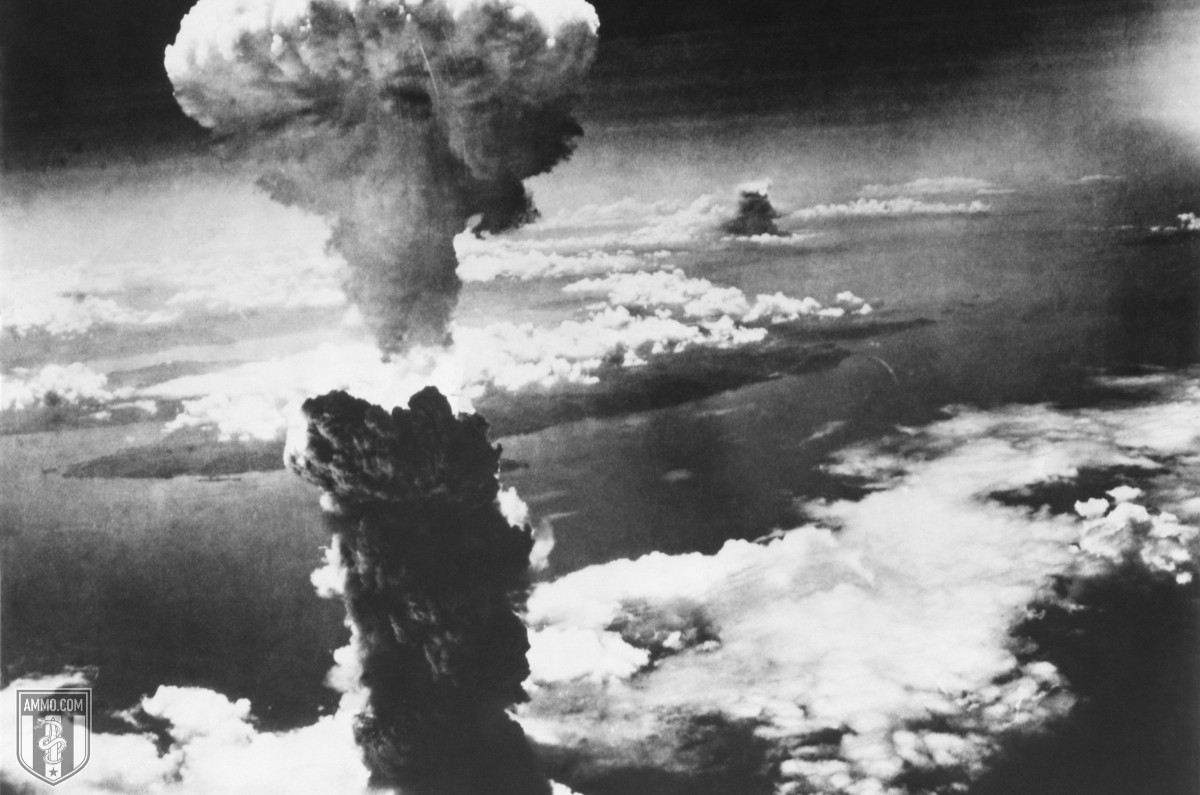
When people talk about the atom bomb as a trump card for home-grown revolution, they’re really talking about the centralized capacity for violence.

The bomb could be anything as it is simply a stand-in for the average man’s recognition of the American military’s phenomenally powerful weapons; weapons in a totally different class than even a fully automatic battle rifle or rudimentary ballistics like TNT.

Atomic weapons are measured in kilotons of TNT – the best our brains can capture the awe and might of the bomb.

It’s a small example, but cuts to the heart of centralized capacity for violence: The increased ability of smaller and smaller groups of men to do greater and greater amounts of damage. In the case of the atomic bomb, the ability of a single man to wipe out millions with the push of a button. This capacity is not limited to just the bomb.

The military is smaller and thus relies on a lighter, more agile, and efficient infantry than it once did. Only one or two men are needed to wipe a city from a map. Compare with an infantry platoon of 27 men. As bombs became bigger, military technology became much more accurate and capable of hitting one specific thing (say, a Sudanese aspirin factory versus a small, neutral village).

America’s nuclear arsenal is the apotheosis of centralized force, giving a single man the ability to kill everyone on earth many times over.

But it is not hyperbole to say our current military technologies are Godlike, even disregarding the bomb. Entire regions can be wiped from the map at the push of a button, and it only takes one man to push that button. Compare with the mounted cavalry of old.

Not to belabor the point, but the term “bomb” fails to capture the magnitude of what a bomb can do. The atomic bomb is like dropping a small sun onto a city. It is ghastly and terrifying, and may mark man’s first true foray into “secrets man was not meant to know.”

In addition to being more precise, violence is much easier to distribute from afar. For context, during the Second World War, carpet bombing was developed because it was so hard to get a single bomb to hit anything, even when you were just a few thousand feet from the target. Now someone on the other side of the planet can send a missile into a cave and navigate the tunnels inside.

This happens at the micro-level as well. Think about the small-town sheriff who, for some reason, has a battle-ready tank. On one level, it’s laughable, the militarization of the police reduced to its most ridiculous cliche. But on another, perhaps more important level, it’s a demonstration of the centralization of capacity to commit force at the local level. The average police department is equipped like a small infantry squad with light tank support.

A well-armed home has a handful of long arms and pistols, with precious little training in things like small squad tactics. Our personal fortresses are anything but secure against the state.
distributed capacity for violence

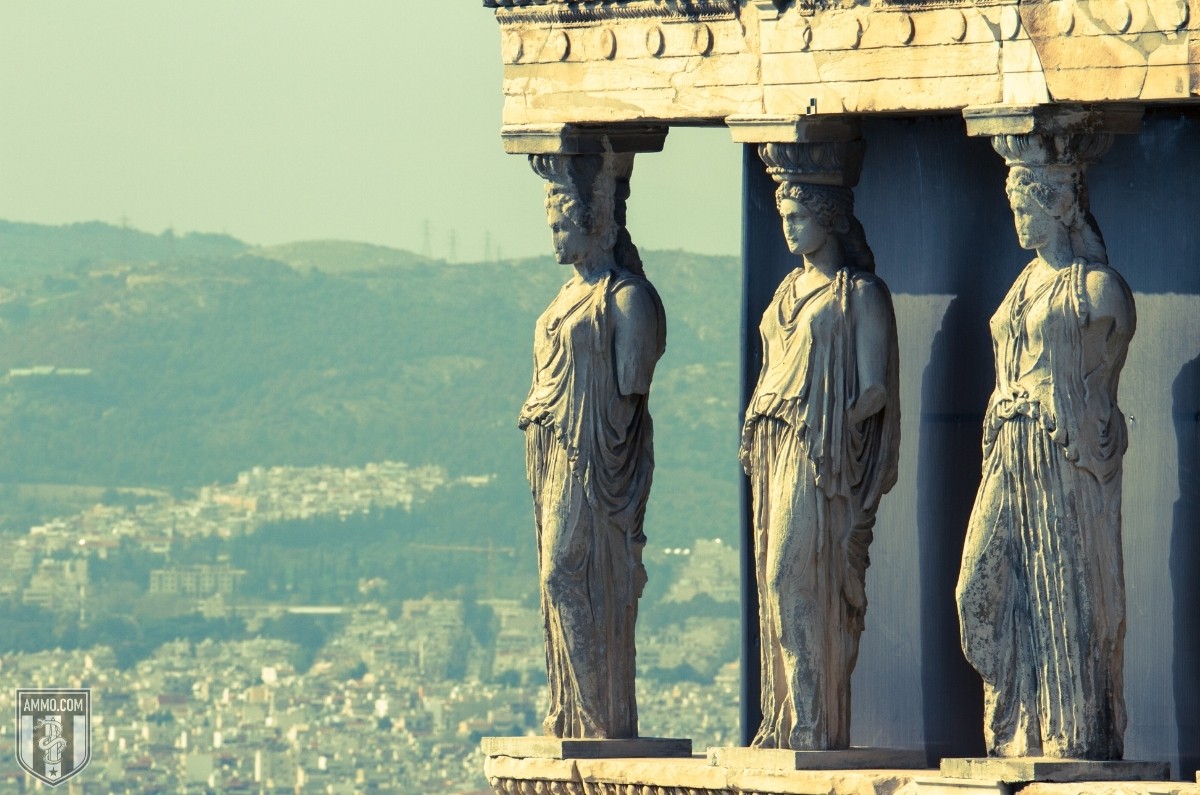
Distributed Violence and Power in Ancient Greece

We think of Ancient Greece as a democracy, and indeed, it was, but its democratic polities were far from egalitarian. Its democratic society was made possible by the hoplite system.

The hoplite was the basic infantry soldier of ancient Athens and other Greek city states. To be a hoplite meant to supply one’s own arms. To supply one’s own arms was only possible for free landholders. Full citizenship was accorded only to men with a full set of gear. Men with only partially complete sets held lower rank, in the military and in society in general.

Hoplites made ancient Greek democracy possible.

Indeed, there is great wisdom to how the Greeks granted citizenship: the benefits of citizenry imply a responsibility to defend the polity. Those incapable of putting up a meaningful fight against invaders (or in the case of Sparta, constant helot rebellions) did not enjoy the full fruits of Greek citizenship.

Ancient Greece was a far more equitable society than its contemporaries because the citizenry were landed men with skin in the game. They couldn’t simply take off for the nearest convenient city. They defended their democratic society — and their land — with their lives.

Decision-making included everyone who was going to fight. No one man held much power relative to others except for his ability to command larger groups of men through legitimately earned leadership and authority.

This isn’t an endorsement of turning America into Starship Troopersbut we should contrast the capacity of the Greek hoplites to commit meaningful violence against the rulers and their neighbors against the feudal system of serfs, lords and mounted cavalry emerged in the fallout after the collapse of the Roman Empire.

We tend to think of medieval lords as holding power due to accidents of birth, but they held civilization together while Rome fell. Their titles, such as duke and marquis, were military titles, implying a duty of military service to their lord and the king. The difference between these medieval lords and the free hoplites of classical antiquity is that the medieval world allowed much smaller groups of men to commit far greater levels of violence. This centralized capacity for violence.

Serfs were drafted, oftentimes reluctantly, when additional forces were needed, mostly for the pure weight of the meat. The medieval world had many peasant rebellions but peasants were, to put it bluntly, useless against men in armor on horseback with crossbows, lances, and strong martial culture.

The average Athenian didn’t have the means for a full hoplite spread, and thus full military service and citizenship. Still, men with only partial kit could do quite a lot, militarily. Thus their input was needed for democratic consensus. But the middle ages saw a greater contraction of the martial caste, due to revolutionary developments in weapons technology.

It took only the humble stirrup to radically alter the distribution of military power in Europe. Previously, men on horseback were simply mounted infantry, not true cavalry. They dismounted to fight. Now they no longer had to. They could attack at speed on horseback, allowing for heavier armor to be worn and heavier weapons to be used.

Fewer men could do more with less. A partial suit of armor and a short sword was worthless against true cavalry armed with broadswords, lances, and crossbows – the Sherman tanks of their day. This revolution in military technology meant that the more democratic society of ancient Greece and the Roman Republic were now impossible.

Far more wealth was needed to obtain a meaningful capacity to commit violence. The smaller group of men with the means to purchase such were also able to commit far greater levels of violence with far fewer numbers.

You are here.
distributed capacity for violence

Modern Revolutions in Distributed Violence

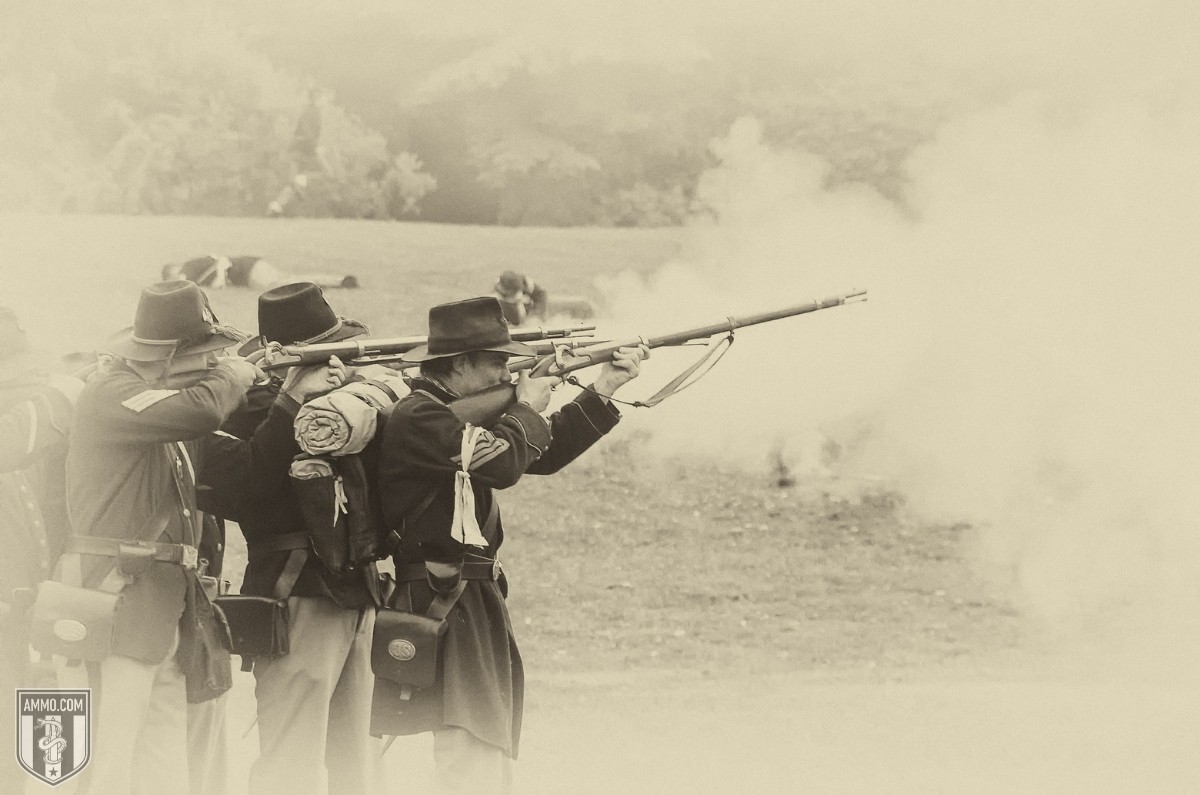
It’s important to note that the centralization of capacity for violence is predicated on the accuracy of weapons. Old school ballistics weren’t the most accurate thing in the world. Two armies could stand on either side of a field, shooting all day. Any kill shots they got were entirely coincidental because muskets weren’t that accurate, hence the need for large formations of men.

Then something changed: Rifling. Gunsmiths learned that by putting grooves inside of a barrel, the accuracy of a weapon dramatically increased. The American Civil War was a bloodbath in part due to the development of the Springfield Model 1861. While wildly inaccurate by modern standards, it was revolutionary at the time in terms of converting the implied threat of violence into a very real promise of death.

The nobility hated firearms because one didn’t need to learn how to use a broadsword to knock off a king. All one had to do was get close enough, point, and shoot. The ability to commit meaningful violence moved from the exclusive province of the military caste to anyone who could get their hands on a gun.

When bombs were developed, they followed a similar trajectory in terms of destructive power. Even as late as World War II, bombs were so inaccurate that German intelligence couldn’t figure out what the British were trying to blow up. Carpet bombing was developed as a way to offset this inaccuracy, an aerial counterpart to the mass formations of pre-rifling musketeer troop formations.

The Springfield 1861 wasn’t the end of firearms development. Nor were the first rudimentary aerial bombs the end of heavy ballistic development. Everyone knows about the arms race with regard to atomic weaponry. Less known is the development of conventional bombs that can actually hit their targets with reliable accuracy. Guided-missile systems were to heavy ballistics what rifling was to long arms.

Between 1967 and 1973, guided-missile systems were developed and proved to be orders of magnitude more accurate in hitting their targets. The clunky, inaccurate bombs requiring a score of men to deploy were replaced with precise systems requiring only one or two men.

It’s often said that during the Great War it took 10,000 rounds to kill a single man. Now one or two missiles could obliterate entire sections of a city. Ten thousand to one are some pretty long odds, but two to one or one to one odds are a virtual certainty. Guided-missile systems don’t kill a single man like the apocryphal 10,000 rounds, they can flatten a military compound, city block, or an entire city. While significantly more expensive, their efficacy makes them a cost-effective investment for the military-industrial complex.

One simple example demonstrates the dramatic increase in the ability of the state to commit violence. Remember how we said British bombs were so useless that the Germans couldn’t even identify the intended target? 50 years later during Desert Storm in 1991, a cruise missile fired from a ship could enter a building through a specific window on a specific floor and hit a specific target inside that building, changing direction at the will of the operator.

distributed capacity for violence

This is important because the state is violence.

At the end of the day, the state is a means of coercion. Coercion relies upon the meaningful threat of violence. With the advent of advanced weapons systems, this threat of violence has been transformed from a mostly idle threat requiring a massive investment of human capital to a near certainty of death.

Conversely, the democratic process provides a means for the populace to express their dissatisfaction with the state. This is an implied threat of revolution, however, now the state has weaponry that can hit you where you live in a single shot while leaving every last building around you standing. The masses have, at best, only long arms at their disposal.

This is a power imbalance that cannot be ignored.

The promise of real violence trumps the empty threat of revolution. It’s certainly true that the United States military has been defeated by much smaller and more poorly equipped forces.

However, none of these small, primarily guerrilla forces – the Vietcong, the Taliban, or similar – presented the threat to American hegemony that a restive domestic population would if roused to rebellion.

This massive power imbalance is not the end of the story, as such situations have arisen in the past.

Consider the citizen-soldier of ancient Greece, whose broad forms endured until the end of Rome. This gave way to the aforementioned mounted knight, who had armor, lances, crossbows, and longswords – the advanced weapons systems of the time. They could run roughshod over peasant populations armed with little more than farm tools. In turn, the mounted knight was dethroned by the development of gunpowder, which dramatically leveled the playing field.

It is no coincidence that the development of gunpowder and effective firearms coincided, roughly speaking, with the rise of the democratic republic. No longer could the nobility simply say “let them eat cake.” Ignoring popular sentiment came with serious consequences.

What technology will mankind develop that will level the playing field today?

It’s hard to say, but futuristic developments like powered armor, cyberwarfare, and fourth generational warfare provide a glimpse as to how technology can be leveraged to put a thumb on the scale and bring the capacity to commit meaningful violence back into balance.

Until the pendulum swings back, however, the disparity in the ability to commit meaningful violence is a problem for human freedom that cannot be ignored. Guerrilla insurrections against the American empire in far-flung Third World provinces simply are not comparable to an uprising in the imperial core — the American homeland.

distributed capacity for violence

Will America Strike Its Own Citizens?

America has a long history of not using the atomic bomb so we often forget that America is the only country to have actually used them. So why hasn’t America used them in so long and would they use them again?

America has never had a “no first strike” policy and remains ambiguous about what situations would cause it to use nuclear weapons. It’s difficult, but not impossible, to imagine an American first strike during the Cold War, but it is far more difficult to imagine today. Who would America nuke?

How about Des Moines? Or Morgantown? Or Dallas? Americans are in a precarious position with regard to their own government. America has an empire, but the empire hates the Americans – largely using them as tax serfs to fund failed social programs at home and failed wars of choice overseas. If anything, the American people are an obstacle to the aims of the American Empire.

The American citizenry is one thing most of the rest of the world isn’t: A threat to the American empire. The massive reaction by globalist elites to Donald Trump shows just how particularly thin-skinned they are about peasant rebellions at home. And constant attacks on Second Amendment have failed to disarm the American middle class.

It is instructive to compare the United States to Australia and Canada in the time of COVID: The latter two are among the most repressive medical regimes in the world. America remains relatively free. The capacity for meaningful force, ownership of the reigns of power, and ownership of capital remains more distributed here – and our rulers know it. They know there is only so far they can go.

But maybe the global elites don’t need such stern measures against American citizens. The story of 2020 was largely that of concentrated attacks on the American middle class in the form of COVID lockdowns and riots aimed at immiserating and terrorizing them. COVID lockdowns attacked small businesses and “non-essential” workers in one of the biggest wealth transfers in human history. The riots likewise terrorized average Americans into a state of shock and silence.

The foot soldiers of the elites can do anything they want to you. Raising your hand against them, however, comes with extreme consequences. This is another example of the centralization of force, not using the military or armaments, but economic leverage and an asymmetrical application of the courts — anarchy for them, tyranny for you.

And who needs nukes when you’re ruling over a nation of renter-class serfs? The elites wouldn’t need anything approaching nuclear weapons to keep in line a population who own nothing and are totally reliant upon government handouts. This is the aim of the attacks on small businesses and the War on the Suburbs.

Perhaps the model for the future is not the totalitarian regimes of the 20th Century, but the feudal estates of the middle ages – now armed with intrusive surveillance technologies and Godlike military hardware.

Remember: The Constitution means nothing without the means to protect and defend it.

Regardless, until the scales are rebalanced, America will look less and less like the democratic republic we were all raised in over the years. The Founders simply did not design their system for a mass of effectively unarmed debt peons. The system is ripe for the taking by anyone with enough political will.

The problem of a highly centralized capacity to commit meaningful violence is structural. There are no clear solutions. A revolution in military technology is needed to rebalance the scales. In the meantime, however, each man can do his part to carve out a small fortress in defense of liberty, keeping the flame of liberty alive in our homes and our communities.

There are alternatives to this kind of serfdom, however, that don’t require waiting for the development of power armor or another leveling development in military technology. Above all, it is important to make oneself as antifragile as possible which means accumulating valuable skills, having multiple revenue streams, and, above all, hoping for the best while preparing for the worst.

Such moves towards greater resiliency in the face of overwhelming state military power and centralized force do not just protect you and yours. They provide a small, but important bulwark against tyranny, reasserting the implied threat of rebellion.

Unfortunately, an American Renaissance is reliant upon a dramatic shift in military technology rendering all current advanced weapons technology moot. No single man or even group of men can simply will such a situation into being.

The price of liberty, as is often said, is eternal vigilance. We need this kind of vigilance more than ever. Objective forces of economic reality and military innovation mean freedom in America and the West is hanging off the precipice. While we can never simply “play the tape backward,” we can move through our current state of centralization to a new decentralization, appropriate for our own time and place.

Sam Jacobs

Written by

Sam Jacobs

Categories
All About Guns Anti Civil Rights ideas & "Friends" Born again Cynic!

MEDIA SHAKES MSR MYTHS IN RARE REPORTS By Larry Keane

The media is learning, perhaps by pure accident, that the AR-15 isn’t the monster they’ve portrayed it to be. That’s a lesson that the rest of America learned long ago.

ABC News has been running a series of reports focused on firearms and criminal violence. Two of those reports tell the truth of the Modern Sporting Rifle (MSRs), or AR-15 style rifle and the real culprit. ABC News reported it was criminally-obtained handguns that are used in most murders.

“The 2016 Survey of Prison Inmates said that 90% of the prisoners who had a gun during their crime didn’t get it from a retail source,” ABC News reported.

That shatters several myths. First, it proves that criminals obtain their firearms illegally. Second, it shows that the MSR isn’t the fabled monster as the media portrays.

It’s a rifle that’s often maligned, mostly because of a moniker of “assault weapon” that was tagged to the rifle. Josh Sugarmann, who works for the Violence Policy Center gun control group, seized upon the public’s misunderstanding of the semiautomatic black rifle and the automatic firearm used by the military, according to The Washington Post in 2013.

“The weapons’ menacing looks, coupled with the public’s confusion over fully automatic machine guns versus semi-automatic assault weapons – anything that looks like a machine gun is assumed to be a machine gun – can only increase the chance of public support for restrictions on these weapons,” Sugarmann wrote in 1988.

Things have changed in more than three decades. The ABC News report described the fact that while MSR ownership is more common than that of Ford F-150s, they are still rarely used in crime. There are more than 20 million MSRs in circulation, and they are the most popular selling centerfire rifles in America today. The fact is most crimes are committed by criminals that illegally obtain handguns.

Media Misinformation

AR-15-style rifles, the Modern Sporting Rifle (MSR), or “assault weapons” as they’re erroneously called in gun control circles and allied media, are not that. They are semiautomatic rifles that use the same one-trigger-pull, one-fire technology used by handguns and shotguns that was invented in the late-nineteenth century.

That doesn’t stop media from portraying MSRs as difficult to handle and aim, as CNN did, and dangerous machines capable of breaking a grown man’s arm. Political journalist Kevin McCallum described his first time handling an AR-15 as life altering.

“It is difficult to describe the impact — physical and personal — of that first shot,” McCallum wrote. “A deep shock wave coursed through my body, the recoil rippling through my arms and right shoulder with astounding power.”

That description went viral and drew rebuke from MSR owners across the country. In one response parents of a 7-year old girl posted a video of her firing several rounds from an MSR, demonstrating the rifle’s limited recoil. It’s one of the characteristics that make MSRs popular.

Modular Self-Defense

The vast majority of criminal firearm violence is committed by criminals who by a 90-percent margin have stolen their firearm and most often use a handgun, according to FBI data. That doesn’t stop gun control advocates from boogey-manning the MSR and seeking to ban them, as President Joe Biden has asserted he wants to do again.

The MSR’s modular design that’s easily fitted with accessories make the firearm ideal for users of all sizes and shapes, is just one reason it is so popular. That’s critical when used for home and self-defense. NSSF’s Mark Oliva told ABC in their report, “The way it’s designed, it is easily adaptable. It can fit my frame. It can also fit my wife, and she can shoot that rifle just as easily.”

Twenty-six year old Megan Hill told NBC News she purchased an AR-15 in 2017. “We looked at the AR-15, and it was all in one package,” Hill said. “Luckily we haven’t had to use it in self-defense, but it’s a comfort knowing that it’s there to protect my children and my family.”

In one of the more high-profile instances of law-abiding citizens using AR-15-style firearms for protection, Steven Williford used an MSR to stop the murderer from inflicting more carnage in the Sutherland Springs, Texas tragedy four years ago. There are numerous other examples media ignore.

For Hunting

Beyond self-defense, MSRs are increasingly popular for their adaptability and effectiveness while used in hunting. The MSR is popular among big game hunters searching for deer, elk and bear, but also as a favored firearm to take out predator species like coyotes and hogs that inflict damage on crops and livestock. According to the U.S. Department of Agriculture, feral hogs are responsible for $1.5 billion worth of crop damage annually by devastating farmers’ fields by trampling or eating crops and rooting and eating seeds before they sprout.

As a result, Alabama opened up night hunting for hogs and coyotes this year and sold over 500 licenses. 20 states allow hog hunting and the MSR is the overwhelming choice of firearm among hunters to hunt these predators.

Despite what most major media outlets continue to falsely claim, the MSR is a versatile firearm that is able to meet the unique needs of a diverse population that recognizes its functionality and effectiveness, including millions of women.

Whether for self and home defense purposes, or to take out to the woods and fields for a hunt, MSRs are safe and get the job done. It’s why there are more than 20 million MSRs in private circulation today.

Categories
All About Guns

Bringing Small Arms Into The Space Age

As detailed in The ArmaLite AR-10 by Maj. Sam Pikula, USAR, The Black Rifle by R. Blake Stevens and Edward C. Ezell and the company’s own official history available at armalite.com, the ArmaLite story starts with George Sullivan, patent counsel for Lockheed Aircraft Corporation. Visionary, firearm enthusiast and huckster all describe Sullivan. His job at Lockheed was crucial to subsequent events because it meant that Sullivan was aware of the latest technological breakthroughs and space-age materials at a time when the American small-arms industry was stagnated and relatively antiquated. Small arms were built only of steel and wood, and new products were simply derived from evolutionary changes to old ones.

While not a professional, Sullivan had a passion for small-arms design. Through contacts in the aviation industry, that passion eventually came to the attention of fellow firearm enthusiast Richard Boutelle, who happened to be president of Fairchild Aircraft. Boutelle was intrigued by Sullivan’s ideas and, in the early 1950s, provided funding for a foray into the business of designing small arms. Sullivan set up shop in Hollywood, Calif., in a small building affectionately referred to as “George’s Backyard Garage.” Initially, the hope was to create sporting arms for the commercial market using modern, high-tech materials. The first effort, for example, was a .308 Win.-cal., Mauser-style bolt-action with a foam-filled plastic stock and aluminum receiver and barrel with a thin steel liner. Very few examples of this rifle, variously called the AR-1 and “Parasniper,” were produced.

rifles on golden background guns armalite semi-auto carbine .223 .308

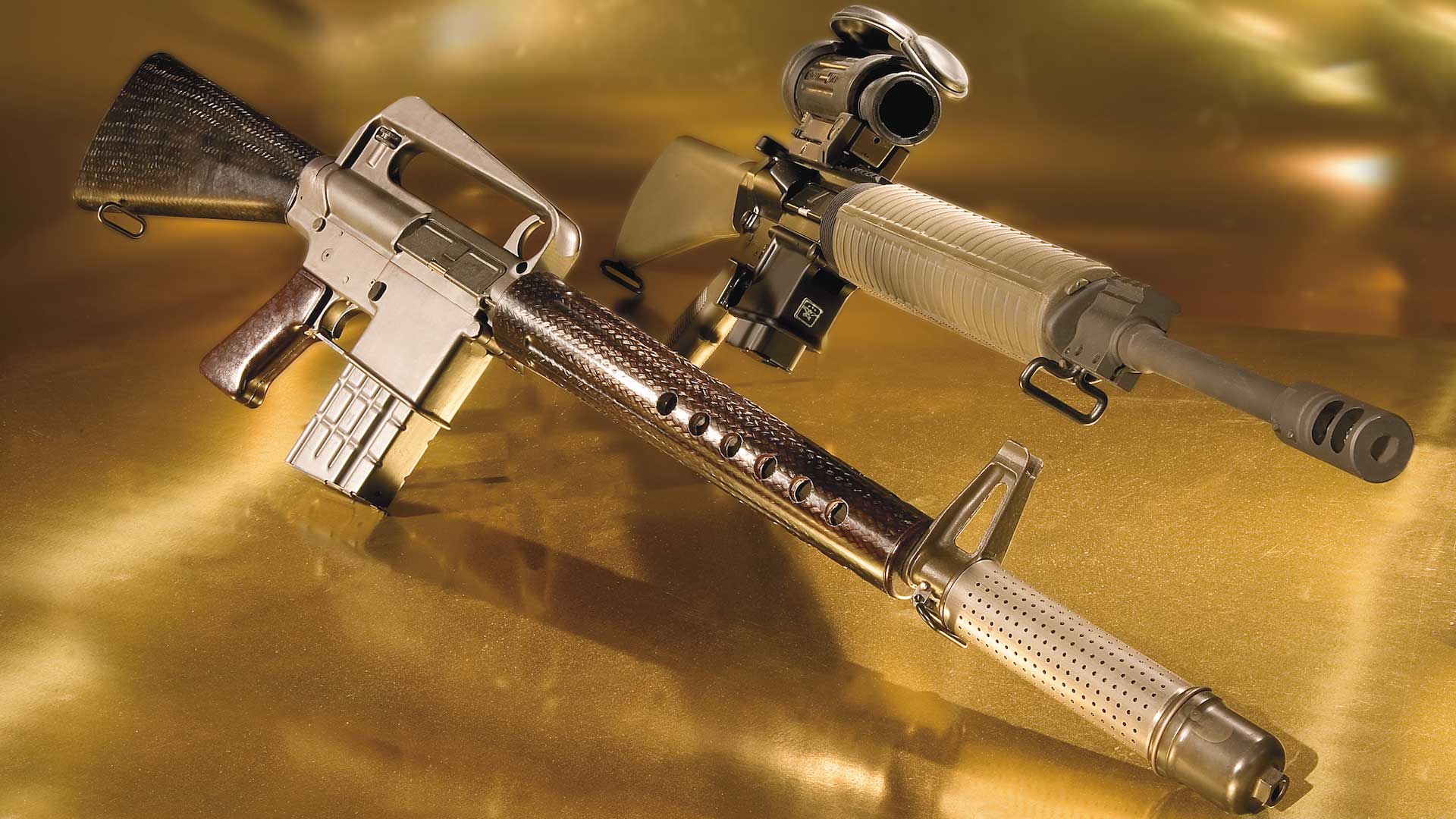
A 1950s AR-10 prototype (l.) is shown next to a state-of-the-art AR-10A4 flat-top, this one mounted with an Arma-ment Technology ELCAN 3.4x scope.

As envisioned by Sullivan, ArmaLite was not intended to be a firearm manufacturer; ArmaLite’s stock-in-trade was to be ideas. The company would use knowledge of materials and manufacturing techniques gleaned from the aircraft industry to create radical new designs. It would then build prototypes of those designs and market them to manufacturers who would produce them under license. Sullivan proposed that Fairchild purchase ArmaLite and make it a division of the company, and in that way inject additional capital into the venture. Boutelle agreed and, on October 1, 1954, ArmaLite became a division of Fairchild Aircraft.

A Change Of Direction

Advertisment rifle survival rifle gun right side camo ad magazine

The AR-7 was a commercial, .22 LR-cal. version of the Air Force AR-5 survival rifle. The barrel and action could be detached and stored within the stock.

Shortly thereafter, ArmaLite was invited to submit a rifle for consideration by the Air Force for its new survival rifle. The firearm the company submitted, a .22 Hornet-cal. bolt-action takedown with a four-shot magazine, was dubbed the AR-5. The gun’s barrel could be detached from the action and stored in the plastic stock. With the buttcap then replaced, the 2 3⁄4-lb. gun could float. The Air Force adopted the gun as the MA-1, but never purchased it in quantity. Despite that, though, the interest shown by the military took ArmaLite in a whole new direction. From that moment on, the company would focus on military designs.

While testing an ArmaLite prototype at the Topanga Canyon Shooting Range in southern California, Sullivan met a gentleman who lived in nearby Los Angeles and made dental plates for a living. He was a former Marine who also happened to be an amateur firearm designer. In fact, he was testing one of his own designs that day. His name was Eugene Stoner. Shortly thereafter, Stoner found himself in the employ of ArmaLite as its chief design engineer.

While Sullivan had been the company’s visionary, day-to-day operations were run by Charles Dorchester, who served in numerous executive capacities, including president and eventually chairman of ArmaLite. While the company conceived and developed various designs, it was a semi-automatic rifle with an unusual locking action and unique gas system that would make Stoner—and ArmaLite—famous. It was called the AR-10 and was the focus of ArmaLite’s efforts from 1955 until 1959.

Tomorrow’s Rifle—Today
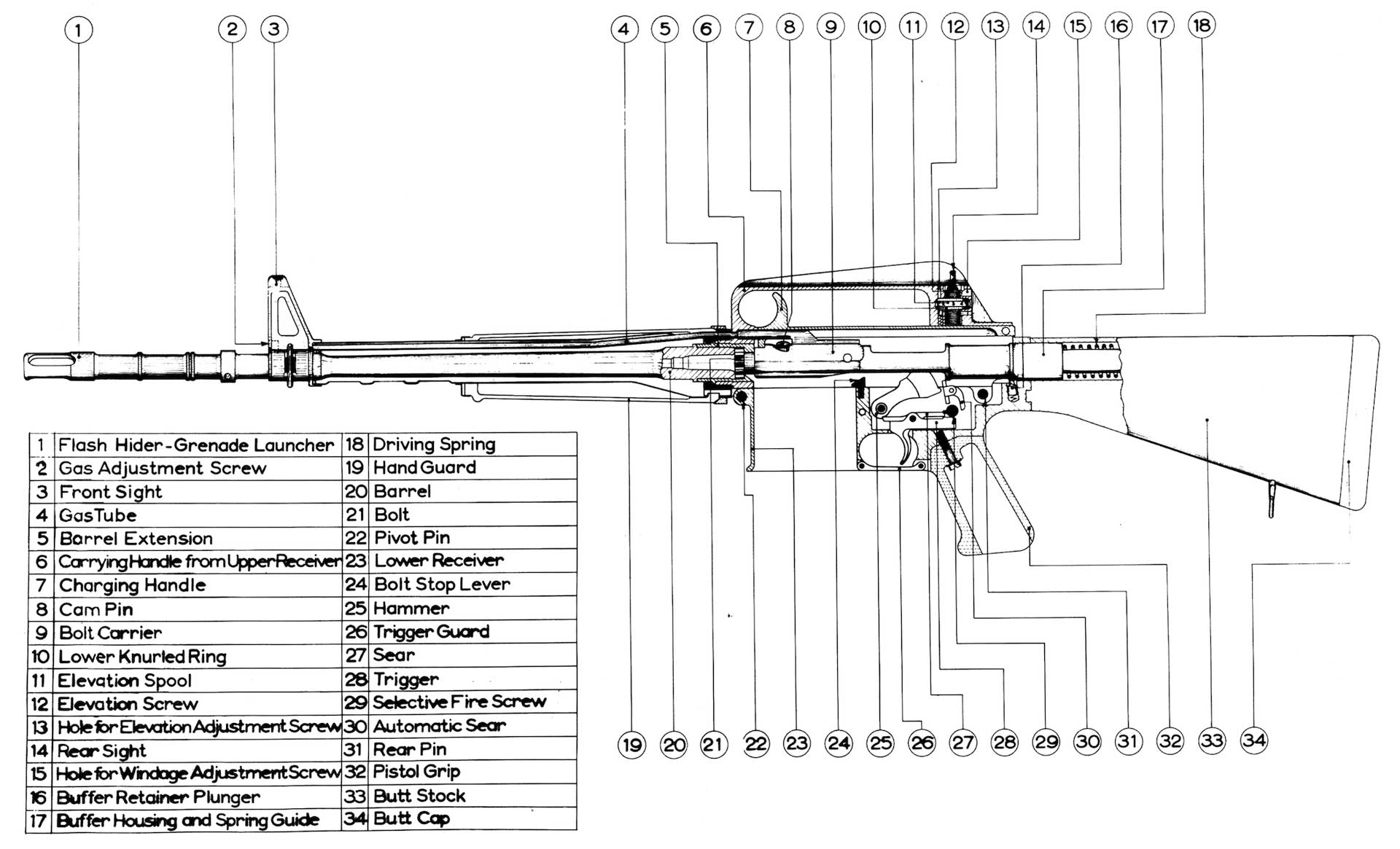
The AR-10 looked radically different from anything previously seen. It had an integral carry handle atop the receiver that contained the gun’s iron sights. The cocking lever was on top of the receiver and articulated in the opening of the handle. The fore-end was not wood, but fiberglass and, later, plastic, thanks to plastics engineer Tom Tellefson. Inside, it was just as radical with an eight-lug, rotary bolt locking not into the receiver, but into a steel barrel extension. That allowed the receiver to be made from lightweight, rustproof, forged aluminum rather than heavy, rust-prone steel.

drawing black white gun rifle parts callouts descriptions schematic

The rotary bolt and barrel extension was borrowed from the Johnson rifle designed by Melvin M. Johnson. (Johnson was the East Coast military rifle consultant for ArmaLite and had a contentious relationship with the military dating back to his efforts to get the Johnson rifle adopted in place of the M1 Garand. Some speculate that his involvement with ArmaLite didn’t help the company’s chances with the military.) The lock-up may have been Johnson’s, but the gas system was Stoner’s.

As described in The Black Rifle:
“[S]toner’s gas system utilized a simple open pipe, a concept first used in the Swedish Ljungman Gevar 42 and the later French 1944 and 1949 MAS semi-automatic rifles. In these relatively rudimentary applications, the gas piston and spring of a conventional gas-impingement system were replaced by the jet of hot gas itself, which traveled back through the hollow gas tube and impinged directly onto the face of the bolt carrier. The kernel of genius in Stoner’s gas system was that the AR-10’s gas tube, running along the left side of the barrel under the handguard, fed the gas through aligned ports in the receiver and bolt carrier wall into a chamber formed between the tail of the bolt and the surrounding bolt carrier. This forced the bolt carrier back. After about 1/8” of movement, the port in the carrier no longer lined up with the port in the receiver, and the further flow of gas was cut off. The momentum already imparted was sufficient to keep the bolt carrier moving, which unlocked the bolt by rotating it with a connecting cam pin, thus beginning its rearward travel. With the gas cylinder at maximum size and the bullet long since out of the muzzle, what little pressure remained was exhausted as a weak ‘puff’ through slots in the right side of the bolt carrier.”

Battling The Big Boys

guns drawing stack four rifles military guns armalite advertisement

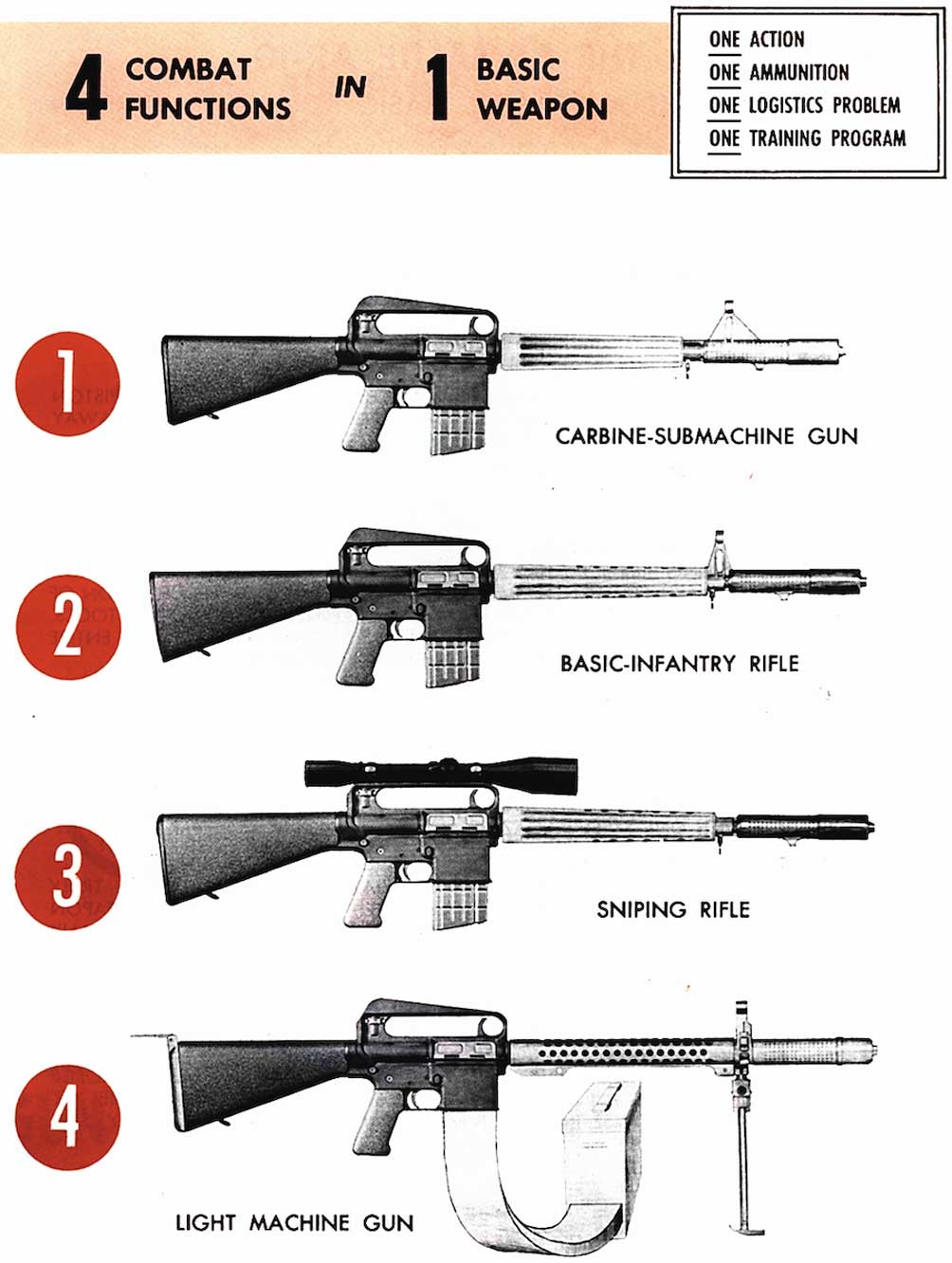
The gun was quickly entered into the ongoing service rifle competition then pitting the Springfield T44 against the T48, a version of the FN FAL. The AR-10 arrived on the scene too late and with too little development to best the other rifles in the trials and the contract was awarded to the T44, which was adopted by the military as the M14.

However, a handful of researchers at Aberdeen Ballistics Research Laboratories—among them American Rifleman Ballistics Editor William C. Davis—had come up with some pretty radical notions of their own. Despite years of insistence by Army brass on .30-cal. rifles for combat use, some ballisticians within the military had begun to explore the feasibility of lesser calibers. The Hall Study, conducted by Donald L. Hall, had concluded that, given a rifle and ammunition combination with a total weight of 15 lbs., a soldier armed with a small-caliber rifle could kill, on average, 2.5 times as many of the enemy as a soldier armed with an M1 rifle and ammunition.

This was followed shortly by The Hitchman Report prepared by Norman Hitchman. It determined that most soldiers do not engage the enemy until he has closed to 300 yds., and that hit potential was rather low until combatants had closed to 100 yds. Therefore, the accuracy and power of .30-cal. U.S. battle rifles—built to a 600-yd. standard—were excessive. Practically speaking, equal results could, in theory, be achieved with smaller, less powerful, less accurate and less costly arms. This led to the Small Caliber, High Velocity (SCHV) concept. In addition to maintaining practical effectiveness, a small cartridge would recoil less, be more controllable in fully automatic fire (a distinct problem encountered with the .308 Win.-cal. M14), could be carried in greater quantity by individual soldiers and would allow a lighter, handier rifle than a .30-cal. cartridge. ArmaLite was consequently asked to explore reducing the AR-10 to .22-caliber. The company agreed, though it continued to seek sales of its .30 cal. domestically and abroad.

man white shirt black pants black rifles wall line row guns carbines engineer

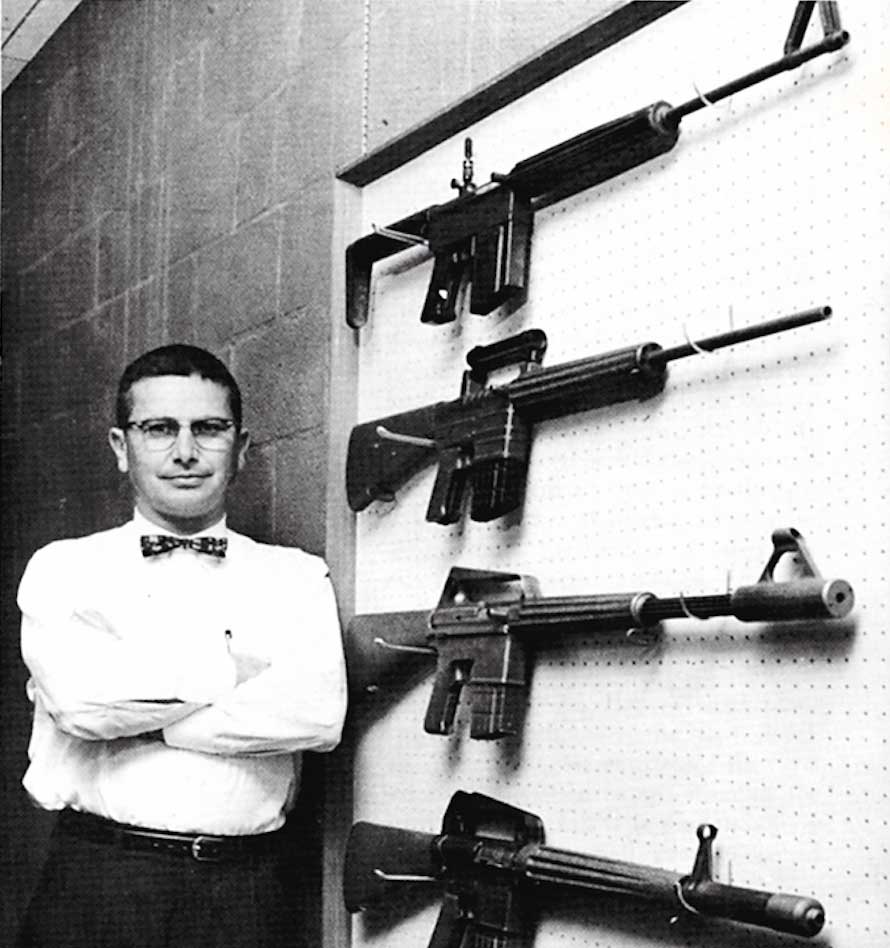
Firearm designer Eugene Stoner poses beside various incarnations of the AR system. His greatest strength may have been his ability to take clever, yet disparate design elements and integrate them into a single, functional firearm. The AR-15/ M16 that evolved from his design has been with us for about 40 years now.

When the military requested that ArmaLite investigate downsizing the AR-10 to accommodate a .22-cal. cartridge, it’s doubtful the company realized how significant the request was to prove. Modifying the .222 Rem. cartridge and freely building on the work done at Aberdeen, Stoner—no ballistician—created the round that eventually became known as the .223 Rem. (5.56 mm NATO). Meanwhile, Arma-Lite designers Robert Fremont and L. James Sullivan downsized the AR-10, not an easy task since it wasn’t a matter of a consistent ratio of reduction from the large gun to the small one.

Once completed, the new gun—referred to as the AR-15—was largely ignored by the military bureaucracy that had initiated its development. Factions within the military were still uncomfortable with SCHV, while some felt the military was too far along in its commitment to the new M14 service rifle to change at that point.

From Bad To Worse
In the meantime, things were going badly with the AR-10. It is important to remember that Armalite was conceived of as a design shop rather than a manufacturing entity. The company contracted with Artillerie-Inrichtingen, the Dutch arsenal, to build the rifle, hoping for sales to foreign militaries. However, the company had never had the funds to properly develop the gun completely. There were numerous bugs that had to be worked out of the design, bugs a larger company might have anticipated and dealt with easily. Moreover, manufacturing obstacles continually delayed production, frustrating ArmaLite executives. Further, with the exception of a contract with Sudan—which no one has ever mistaken for a world power—the rifles weren’t selling, even to the Dutch whose arsenal was building them.

right side rifle armalite ar-180b black gun carbine

AR-180B (.223 Rem.)

Finally, with no future AR-10 sales on the horizon, the military’s interest in the SCHV concept apparently waning and Fairchild strapped for cash, ArmaLite chose to cut its losses and, in early 1959, licensed the rights to both the AR-10 and AR-15 designs to Colt’s Manufacturing for $75,000 and a 4.5 percent royalty.

Although it is widely regarded as a milestone in the history of bad ideas, the licensing agreement with Colt’s was not irrational given what was known at the time. Colt’s—itself near bankruptcy—was taking a gamble. Fortunately, that company’s luck was much better than ArmaLite’s. Its luck came in two forms: rising tensions in Vietnam, and the person of Robert W. “Bobby” MacDonald.

New Shooter
When the U.S. decided to intervene in Southeast Asia, it helped set the stage for the ultimate triumph of the AR-15. The election of John F. Kennedy and the appointment of Robert S. McNamara as Secretary of Defense meant that change had come to arms procurement. With McNamara’s “Whiz Kids” steeped in no tradition save arrogance, the traditional channels of trial, development and adoption could be breached. That is just what happened when Colt representatives took the AR-15 to Indochina.

The American government had decided that, despite the focus on strategic nuclear weapons, small arms for fighting limited wars against insurgents were needed and had been neglected. Developing and securing such weapons was to be the mandate of the Advanced Research Projects Agency (ARPA). These weapons were not to be carried by U.S. personnel, per se, but were to arm U.S.-backed foreign nationals. It was the result of such a program, specifically Project AGILE, that brought Colt’s representatives, including MacDonald and now Stoner, to the Far East to demonstrate the AR-10 and AR-15. The smaller arm was a tremendous hit with the diminutive foreign troops. The gun and its shooting characteristics appealed to those of smaller stature far more than did the AR-10 or any other .30-cal. battle rifle. Moreover, the AR-15 had virtually no competition from like-chambered combat rifles—there were none. MacDonald promptly informed Colt’s to focus on the AR-15 rather than the AR-10 and to gear up for the Asian market.

right side rifle gun carbine green plastic stocks armalite ar10

ArmaLite AR-10A4 (.308 Win.)

Stateside, MacDonald was no less effective. At Boutelle’s birthday party in Maryland, MacDonald handed Air Force General Curtis LeMay an AR-15 and let him shoot a couple of watermelons with devastating effect. The result was two exploded melons and LeMay’s quick request that AR-15s be purchased to replace M1 Carbines for Air Force personnel responsible for the security of Strategic Air Command bases.

In Vietnam, the role of the “black gun” continued to expand. Although it was supposed to be issued only to foreign troops, U.S. personnel gradually began carrying the new rifle, too. Obviously, this made logistic sense since they were traveling with AR-15-equipped ARVN soldiers. But also, American personnel noted that the light, fast-handling gun was better suited to jungle warfare than any other battle rifle-caliber longarm available. At first it was issued only to specialized personnel, but soon became a general-issue arm. ArmaLite could only watch in bitter astonishment as the AR-15 became the standard-issue U.S. service rifle, supplanting the bulky M14.

There were, of course, problems with the AR-15 (which was subsequently given the military designation M16). Many of those problems were directly attributable to how the arm was adopted—without adequate testing of the gun nor training for the soldiers. However, with the wherewithal that comes from having enormous government contracts, Colt’s, with Stoner as a consultant, was eventually able correct serious problems, especially the extraction and jamming issues that plagued the early guns and were only discovered after the rifles were widely issued.

After having reduced the AR-10 to produce the AR-15, ArmaLite reversed course and took what had been learned from the AR-15 and scaled it up to create a new, improved AR-10 called the AR-10A. The future, however, was clearly with the .223-Rem.-chambered rifle, and it appeared that the age of the AR-10 would never come.

right side rifle ar15 armalite gun

ArmaLite M15A2 National Match (.223 Rem.)


The Dream Winds Down

Boutelle was eventually relieved of his position with Fairchild. George Sullivan, the ArmaLite muse, landed more softly: He had never left his position with Lockheed.

Recognizing that the .223 Rem. was the hot ticket, ArmaLite was faced with the problem that the AR-15 patents now belonged to Colt’s. The company then created a “poor man’s .223” called the AR-18. It was to be a low-cost .223 rifle made from stampings rather than forgings and having a different gas system than the AR-15. It would allow less-wealthy countries to equip their militaries with a .223 Rem.-cal. rifle.

However, despite two decades of effort, the company’s luck ran true to form and sales of the AR-18 were very limited. In the end, ArmaLite was sold to Elisco Tool Manufacturing Company, a Philippine concern whose U.S. component folded with the overthrow of Philippine president Ferdinand Marcos.

Restoring The Dream
In January of 1994, Mark Westrom, a former Army Ordnance officer and civilian employee of the Weapons Systems Management Directorate of the Army’s Armament Materiel and Chemical Command (AMCCOM) purchased Eagle Arms, a small company that made AR-15-type rifles and parts following the expiration of Stoner’s patents. A business associate of Eagle Arms, Dr. John Williams, had worked for ArmaLite in his youth and introduced Westrom to former ArmaLite Production Manager John McGerty who, in turn, introduced Westrom to John Ugarte. Ugarte had been the last president of record at ArmaLite and had retained the rights to the trademark; Westrom promptly purchased those rights. Thus was the ArmaLite marque reborn.

logo print lion armalite