“It was a painfully thrilling moment,” William Pittenger recalled of the beginning of the heist. “We were but twenty, with an army about us, and a long difficult road before us, crowded with enemies.” 1 On the morning of April 11, 1862, Private Pittenger and his comrades from the Ohio Volunteer Infantry units of Brig. Gen. Ormsby Mitchel traveled aboard the train General disguised as a rag-tag group of new recruits headed north from Marietta, Georgia, to join the Confederate army. Tension mounted among the incognito Union troops as the white tents of Confederate Camp MacDonald loomed ever larger in the train’s rain-spattered windows. When the General pulled into the station at Big Shanty, James J. Andrews gave the signal that started one of the most dramatic episodes of the Civil War.
While the other passengers disembarked for a twenty-minute breakfast stop, the Buckeye band followed their leader’s instruction and made their way toward the head of the train. Andrews, a civilian Union spy employed by Mitchel, enjoyed an authoritative air that left those in his presence hesitant to question him. So when he commanded three of his men to uncouple the passenger cars— leaving only three empty baggage cars and the tender still attached to the locomotive— the Confederate soldiers milling about the train did not dare interfere.
With the train ready to pull out, Andrews and his engineers jumped into the cab of the General; the rest of the men, including Pittenger, hurried their way into the last attached car. As the abbreviated train pulled away from the camp, an armed, but stunned, Confederate sentinel stared in disbelief.2
Andrews and his raiders traveled roughly seventy miles on the General along the Western and Atlantic Railway, cutting telegraph wire, uprooting railroad tracks, and setting bridges afire in northern Georgia to aid Mitchel’s advance. A constant dreary rain, however, checked the fires set on the bridges. The tenacious Confederate engineers of the General proved even more troublesome. After running two miles on foot, then commandeering a handcar, they stumbled upon another locomotive, the Yonah, and pressed it into service to make good their chase. They followed close on the heels of their train’s captors, hampering any large-scale destruction and, more important, preventing the refueling of the locomotive’s wood supply. As the General ground to a halt in the hills of northern Georgia, Andrews and his men were forced to make a break through the woods in hopes of reaching Mitchel’s forces near Chattanooga.
Within days, all of Andrews’s Raiders were captured. On June 7, 1862, Andrews was hanged as a spy, followed eleven days later by seven of his men. Six of the remaining twelve were exchanged within a year; the remaining six later escaped.3
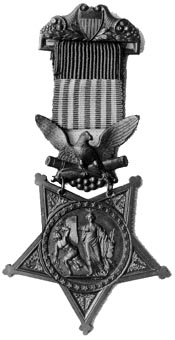
On March 25, 1863, almost a year after the foiled heist and only a week after being paroled, the six exchanged prisoners were summoned to the secretary of war’s office, where Edwin M. Stanton, Treasury Secretary Salmon P. Chase, and Vice President Andrew Johnson greeted them as heroes. After congratulating each soldier for his bravery, Stanton left the room and returned with a fistful of medallions. “Congress has by a recent law ordered medals to be prepared. . . . and your party shall have the first.” Stanton then presented the first Medals of Honor to the six veterans of Andrews’s Raiders, including Pvt. William Pittenger of the Second Ohio Volunteer Infantry.4
The Medal of Honor was not the first honor recognizing American soldiers for feats of bravery. During the Revolutionary War, the Continental Congress ordered special medals struck to recognize the outstanding achievements of several generals including George Washington, Horatio Gates, and Daniel Morgan. In 1780 the fledgling legislative body also authorized a special medal be awarded to each of the three captors of Maj. John André, Benedict Arnold’s British partner. Known as the André Medal, it was the first medal bestowed upon enlisted men by the colonial, and later U.S., government.
Other special medals were ordered struck by the federal government as well as by different states and military commanders. But not until 1847, when the Certificate of Merit was approved, was a systematic award established to recognize privates in the army for actions or feats of heroism in war and peacetime. In 1854 this honor was extended to noncommissioned officers, but it was not until 1905 that a medal was authorized to accompany the certificate.
The Medal of Honor was the first medal for which all enlisted men in the U.S. military could be nominated. A bill introduced by the junior senator from Massachusetts, Henry Wilson, on February 17, 1862, calling for the introduction of an army Medal of Honor, was fashioned after a navy medal bill signed by the President two months earlier. The navy medal sought to “promote efficiency in the Navy” by awarding “upon such petty officers, seamen, landsmen, and marines as shall most distinguish themselves by their gallantry in action and other seamen like qualities during the present war.”5 On July 12, 1862, Lincoln signed Wilson’s bill into law, which called upon the President to present the Medal of Honor “in the name of Congress to such noncommissioned officers and privates as shall most distinguish themselves by their gallantry in action and other soldier like qualities during the present insurrection.”6
Legislation passed in the following months spelled out more details for both branch’s Medals of Honor. Four days after the initial army medal bill was signed, Congress passed legislation allowing the navy medal to be awarded beyond “the present war.” More important, the act established a system for nominating sailors for the award.
On March 3, 1863, Lincoln signed a measure broadening the President’s authority to award the army Medal of Honor to “such officers, noncommissioned officers and privates as have most distinguished, or who may thereafter most distinguish, themselves in action.”7 The act not only expanded the pool of eligible candidates to include commissioned officers but also allowed the medal to be awarded for deeds performed before the start of the Civil War. The army act, unlike the navy act, however, failed to set down a system for nominating army candidates for the honor— an omission that led to controversy in later years.8
One example of this controversy is revealed in the pages of the Medal of Honor file for J.C. Julius Langbein. Correspondence concerning Langbein’s application for the medal includes a clipping from the Grand Army Journal dated June 23, 1893. That newspaper article recounts the story of a thirteen-year-old drummer boy who enlisted with the Ninth New York Infantry Volunteers, Hawkins’ Zouaves, on May 4, 1861. Because of his girlish looks and slight stature, Langbein was called “Jennie” by the soldiers of the Ninth New York, a name he failed to shake until leaving the unit two years later. Despite the ridicule over his feminine features, Jennie so proved his mettle to the unit that the officers invited him to bunk and mess in their quarters. Second Lt. Thomas L. Bartholomew became particularly fond of Jennie and promised the boy’s mother that he would personally look after him.
Tromping through the lowlands of eastern North Carolina on April 19, 1862, the Ninth New York met with units under the command of Gen. Jesse Lee Reno at South Mills, roughly twenty miles south of Norfolk, Virginia. With the amassing Union forces in their sights, a Confederate artillery unit, under the command of Capt. William W. McComas, opened fire. In the ensuing battle, a shell fragment struck Lieutenant Bartholomew just above his right ear, rendering him unconscious.
“My first impression on being struck was, that I had been clubbed with the butt of a musket. I lost consciousness almost immediately,” recalled Bartholomew. “When Jennie saw me fall . . . he rushed upon the field and amid the shot and shell and the din and smoke of the battle, caught me and tenderly led me back to a ditch. . . . He left but soon returned with Dr. Humphreys.”
Hustling from wounded to wounded, the doctor quickly examined the lieutenant’s injuries, concluded Bartholomew would soon die, and left him to tend to other wounded. Undaunted, Jennie left once again and returned with the unit’s drum major. Together they carried Bartholomew to the safety of a nearby house. Hours later, as the regiment prepared to pull out of the area, a doctor again determined Bartholomew too enfeebled to be moved and “left [him] to the tender mercies of the enemy.”
Again, Jennie defied authority. “He quietly came to my bedside and whispered ‘Keep quiet, Lieutenant, you shall not be left behind. I have arranged it all.'” After seemingly leaving Bartholomew alone with the other men left to face the approaching enemy, “Jennie and . . . two comrades . . . quietly but quickly . . . placed [me] in the rear of the end of the wagon, where there was hardly room to put a child, but I was actually squeezed in just as the wagon started.”9
Bartholomew was taken to a hospital where he recovered from his near-fatal wounds. The other officers of the unit recognized Jennie’s heroism. First Lt. G.A.C. Barnett of the Ninth New York Volunteer Infantry granted Jennie a thirty-day furlough to return home and gave him a message to pass on to his mother.
I must say that as a boy he is good and as a soldier he is excellent. Beyond all things I must speak well of his bravery and attention to his duties on the field. . . . You should be proud of such a son for we all are.
Langbein continued his success after the war. After attending law school and opening his own practice, he served as an assemblyman in the New York State legislature and as judge of the Seventh Judicial District Court. But it was not until thirty years after his daring feat that Langbein wrote to the Record and Pension Office of the AGO to inquire about receiving a Medal of Honor. After completing some paperwork, the AGO delivered Langbein’s medal through the U.S. mail on January 7, 1895.10
Langbein was not alone in asking for recognition more than three decades after the close of the war. Between 1890 and 1894, the AGO received a near-geometrically growing number of applications for the Medal of Honor. In 1890, 33 medals were awarded, which doubled the following year to 67, and mushroomed to 127 in 1894.11 More than five hundred medals were awarded between 1891 and 1897 for actions performed during the Civil War.12 Because the army had not established a system for applying for the medal (as the navy had done in 1862), some medals were awarded based on scant evidence. As word spread of the availability of the medal, veterans all over the country sought to secure a piece of glory for themselves. Because many of these honorees were not required to provide hard evidence of their heroics, some critics of the AGO felt the integrity of the medal was in jeopardy.
Further depreciating the value of the medal, the Grand Army of the Republic and other veterans groups began giving out their own medals, some of which looked conspicuously similar to the Medal of Honor.13 On April 23, 1890, a group of U.S. veterans founded the Medal of Honor Legion to protect the medal and the principles upon which the medal had been established. The organization included many powerful former members of the U.S. military (Langbein later served as the legion’s commander) and lobbied for measures that would preserve the medal’s reputation.
Faced with the growing onslaught of requests, and spurred on by groups such as the legion, the army and the War Department looked for a solution. On June 26, 1897, Secretary of War Russell A. Alger announced that future Medals of Honor would be awarded based on “incontestable proof of the most distinguished gallantry in action.” Alger also stipulated that future recommendations would have to be submitted to the AGO within one year of the act.
Later, the army declared that verification of these acts had to come from “official reports . . . records of events, muster rolls, and returns and descriptive lists.” Additionally, all new recommendations for the award had to be accompanied by the notarized affidavits of eyewitnesses. The ruling also required nominations for Medals of Honor for actions taking place after January 1, 1890, to be submitted by another officer or soldier having personal knowledge of the action, not by the applicant himself. The following year, only officers could submit recommendations.
Still, past blunders haunted the integrity of the Medal of Honor. The story of the Twenty-seventh Maine Volunteer Infantry serves as an excellent example. This nine-month regiment was organized September 30, 1862, and its term was set to expire as Gen. Robert E. Lee led the Army of Northern Virginia northward through southern central Pennsylvania. Directed by Gen. George Meade, almost every available unit around Washington marched northwest to meet the challenge, leaving the Union capital vulnerable to attack should Lee prove successful at Gettysburg. Secretary of War Stanton appealed to the few troops left in Washington, the men of the Twenty-fifth and Twenty-seventh Maine Infantries, to extend their tours of duty until the crisis ended. Either lured by the prospects of bounties for enlisting in other regiments, or perhaps just weary of war, every man of the Twenty-fifth Maine walked out. Most in the Twenty-seventh followed suit. However, about three hundred remained to defend the capital. In gratitude for this selfless act, Secretary Stanton thanked these men with the best gesture he had at his disposal, the Medal of Honor.
But through a clerical error, the medals were struck not only for the three hundred volunteers but for all of the members of the Twenty-seventh Maine. When the former commander of the regiment, Col. Mark Wentworth, received the more than eight hundred medals, he immediately recognized the gaff, and he gave the deserving three hundred volunteers their medals and stored the rest in his barn. By the 1890s, word of the stowed medals reached the other members of the regiment, who promptly broke into Wentworth’s barn and seized the medals.14
Much as counterfeit currency depreciates the value of money, reasoned the Medal of Honor Legion, the awarding and taking of these medals cheapened the highest honor bestowed upon soldiers of the U.S. Army. The legion repeatedly argued that the Twenty-seventh Maine be stripped of its medals. Reacting to a circular published by the legion, President Theodore Roosevelt penned a letter to the secretary of war dated October 8, 1904:
It is of course a rank absurdity that the highly prized . . . Medal of Honor should have been issued to the Twenty-seventh Maine Regiment. . . . If it be true that a new medal is about to be exchanged for the medals now held by those to whom the . . . Medal of Honor have been awarded in the past, I believe that the memorial of the Medal of Honor Legion should be complied with as concerns the issuing of these medals.15
Indeed, Congress was deliberating about authorizing a new design to restore the Medal of Honor’s unique quality. Groups such as the legion urged the government not to issue medals of the new design to those who had not truly earned it through heroism on the battlefield. On April 23, 1904, Congress approved the new medal design. To discourage any potential medal piraters, patent number 37236 on the design was issued on November 22, 1904, and two weeks later it was transferred “to W.H. Taft and his successor or successors as Secretary of War of the United States of America.”16 Additionally, prior medal winners had to trade in their old medals to receive the new ones. Reluctant to turn in the medals to which they had become attached, medal honorees lobbied to keep both medals. On February 27, 1907, Congress allowed prior honorees to keep medals of both design and ordered the Department of War to return the medals to those who had surrendered them.
Additionally, after much political wrangling, the attorney general deemed that every soldier who had received the Medal of Honor prior to the release of the new design was entitled to a new medal. But it was not until congressional action in 1916 that a review of all Medal of Honor cases was finally instituted. The first measure, passed on April 27, authorized a special ten-dollar-a-month pension to be awarded to the “holders of the Medal of Honor who had reached the age 65 and who had been awarded the medal for action involving actual conflict with the enemy, distinguished by conspicuous gallantry or intrepidity, at the risk of life, above and beyond the call of duty.”17 Upon a case-by-case review, the “Army and Navy Medal of Honor Roll” was established, listing those who had earned the medal through the above criteria.
The National Defense Act, passed on June 3, 1916, included a measure that authorized a panel of five retired generals to review the remaining cases individually, and “in any case in which said board shall find . . . said medal was issued for a cause other than hereinbefore specified the name of the recipient . . . shall be stricken from the official Medal of Honor list.”
All of the more than twenty-six hundred medals were reviewed, and more than nine hundred names were stricken from the roll. The law excluded several groups, including all 864 men of the Twenty-seventh Maine Infantry; Lincoln’s funeral guard; several civilian scouts, including William “Wild Bill” Cody; and the only female awardee of the Medal of Honor, contract surgeon Mary Walker.18
The Medal of Honor Files
The term “Medal of Honor file” may be misleading. There is no series solely designated within the records of the Adjutant General’s Office (Record Group 94) similar to compiled service records or pension files that documents the awarding of the army Medal of Honor. Instead, files of correspondence relating to the Medal of Honor awards are peppered throughout the vast files of the AGO, and their locations reflect the evolving nature of the army’s late nineteenth-century correspondence filing systems. The location of an honoree’s file within the AGO records depends largely on the rank of the individual and the date of application, as well as a myriad of other factors. Some listings are straightforward, while the reasoning for the locations of other files seem to have disappeared with the diligent clerks of the AGO.
For example, the file for “Langbein, J.C. Julius,” who first inquired about applying for the Medal of Honor in 1894, is found in AGO Document File 920202 from the Document File of the Record Card Period 1890 – 1917 (Record Group 94, Entry 25).
However, the correspondence regarding the bestowal of the Medal of Honor to members of Andrews’s Raiders, including William Pittenger, is listed in the file A-3133-EB-1879. This file refers to the Letters Received, 1862 – 1889, Enlisted Branch of the AGO (RG 94, entry 409), where much of the correspondence regarding enlisted soldiers for 1862 – 1889 settled. The “A” refers to the register clerk who received the correspondence, and the numbers reflect that this correspondence was letter number 3133 in register “A” in 1879. Although Pittenger and his comrades received their medals in 1863, the Andrews’s Raiders correspondence was later consolidated in the Enlisted Branch files of 1879.
Other record series that hold correspondence of Medal of Honor recipients include the Record and Pension Office (R&P) Document File 1889 – 1904 (RG 94, entry 501), Volunteer Service (VS) Letters Received 1861 – 1889 (RG 94, entry 496), Letters Received by the Office of the Adjutant General (LR) (available on several microfilm publications depending upon the year), and several more. Of particular interest to researchers of Medal of Honor recipients in the U.S. Colored troops is the Letters Received 1863 – 1888 of the Colored Troops Division (RG 94, entry 360).
An unpublished finding aid, “19th-Century Army Medals of Honor,” available to researchers at the National Archives Building in Washington, D.C., cuts through the confusion by alphabetically listing all army Medal of Honor recipients between 1863 and 1904, along with their rank, the unit they served at the time of their honored feat, and the file number.19 To return to our earlier example, the listing for Julius Langbein shows he served as a musician with Company B, Ninth New York Infantry. Additionally, the correspondence concerning the issuance of the Medal of Honor is cited in AGO Document File 920202 (RG 94, Entry 25).
For the years 1904 – 1917, researchers should consult the Index to General Correspondence of the Office of the Adjutant General’s Office, 1890 – 1917 (RG 94, National Archives Microfilm Publication M698) and search for the name of the honoree. After locating the file number(s) from the index, order the corresponding paper files. Although several file entries may be found for one individual in the index, they are often consolidated into one file. Finding the consolidated file, however, sometimes requires patience as persistent researchers sometimes must follow a trail of “See File XXXX” slips before reaching the sought file. To facilitate this searching, order all of the file numbers listed in the Index for a given Medal of Honor recipient.
Much of the correspondence found in Medal of Honor files are the dry notices that reflect the legal evolution of the Medal of Honor outlined earlier. The size and content of the files, however, vary considerably. For example, in addition to the AGO circulars regarding the evolving regulations, Langbein’s file holds letters of corroboration and recommendation from several officers of the Ninth New York Volunteers as well as the newspaper story of Langbein’s exploits on the battlefield. Perhaps of more interest to genealogists are the letters written by his own hand to the AGO, several of which are written on the letterhead of the Medal of Honor Legion. Other letters written by him reveal the Manhattan addresses of his office and home and other gems of personal information that reward the persistent researcher.
Researchers should note that not all files hold the correspondence regarding one honoree or even reveal personal information about awarded individuals. For instance, Record and Pension File (R&P) 380505 documents the awarding of the Medal of Honor to the men of the Twenty-seventh Maine Infantry and the controversy surrounding the award. However, little personal information about the eight hundred members of the unit is found in the file.
File B-11524 EB 1877 of the Enlisted Branch of the AGO holds correspondence regarding the awarding of the medal to Sgt. Henry Wilkens, Cpl. Harry Garland, Farrier William H. Jones, and Pvt. Wilfred Clark of Company L of the Second U.S. Cavalry but offers little personal detail. A short letter of recommendation lists the names of the honorees and explains they were “wounded in action with the Nez Perces Indians August 20, ’77.” Letters of acknowledgment from each honoree attest to their receiving the medals, but the file offers limited information about these men.
Of the 3,434 army Medals of Honor awarded as of December 8, 2000, more than 1,500 were bestowed for acts conducted during the Civil War. During the medal’s first fifty-five years, medals were also awarded to veterans of the Indian Wars, the Spanish-American War, the Philippine Insurrection, the Mexican Punitive Expedition, and other conflicts. For information about the winners of this award, see Medal of Honor Recipients, 1863-1994. This tome offers an alphabetical listing of honorees as well as basic information about the circumstances of the awarding of the medal. But for those wishing to study the correspondence found in a particular honoree’s file, one must turn to the files of the AGO.
Visitors to the National Archives and Records Administration may consult the “19th-Century Army Medal of Honor” finding aid for recipients between 1862-1904, or the Index to General Correspondence of the Office of the Adjutant General’s Office, 1890 – 1917 (M698) for recipients from 1904 to 1917 at the downtown Washington, D.C. Also available at the National Archives Building are two specialty microfilm publications including Documents Relating to the Military and Naval Service of Blacks Awarded the Congressional Medal of Honor From the Civil War to the Spanish American War (M929) and Records Relating to Military Service in the Civil War of Medal of Honor Winners From Michigan (T732).
To obtain copies of particular files by mail, please write to: National Archives and Records Administration, Old Military and Civil Records, 700 Pennsylvania Ave, Washington, DC 20408-0001, and provide the name of the honoree and the unit in which he served at the time of the honored event.
Medal of Honor case files after 1917 are much more difficult to locate among the army records at the National Archives. The War Department did not consolidate recommendation papers and witness statements into one file, and in many cases the information is no longer extant or was transferred to an individual’s service record. The service records are among the holdings of the National Personnel Records Center in St. Louis, Missouri. If these documents do exist elsewhere, they may be included in the organizational files contained in several different record groups. For information on Medal of Honor recipients after 1917, please contact the Modern Military Records Branch of the National Archives at College Park at 8601 Adelphi Road, College Park, MD 20740-6001.
See also this related article:
Notes
1. William Pittenger, “The Locomotive Chase in Georgia,” in Famous Adventures and Prison Escapes of the Civil War (1909), p. 88.
2. Ibid., pp. 88 – 89.
3. For more information about Andrews’s Raiders, see Bruce Jacobs, Heroes of the Army: The Medal of Honor and Its Winners (1956), and Above and Beyond: A History of the Medal of Honor from the Civil War to Vietnam (1985).
4. Department of the Army, The Medal of Honor of the United States Army (1948), p. 8.
5. 12 Stat. L. 329 – 330, Dec. 21, 1861.
6. 12 Stat. L. 623 – 624, July 12, 1862.
7. 12 Stat. L. 744 – 754, Mar. 3, 1863.
8. 38 Stat. L., Part 1, 928 – 953, Mar. 3, 1915. The act provides for the awarding of the navy Medal of Honor to navy officers.
9. Grand Army Journal, June 23, 1893, Correspondence File 920202, Records of the Adjutant General’s Office, 1780’s – 1917, Record Group (RG) 94, National Archives Building (NAB), Washington, DC.
10. Document File 1890 – 1917, Records of the Adjutant General’s Office, File 920202, RG 94, Entry 25.
11. The Medal of Honor of the United States Army, p. 15.
12. Above and Beyond, p. 123.
13. Because the Grand Army of the Republic was a private organization, the National Archives and Records Administration does not hold its records. For information about the GAR and its records holdings, contact the Grand Army of the Republic Civil War Museum and Library at 4278 Griscom Street, Philadelphia, PA 19124-3954 or on the World Wide Web at http://suvcw.org.
14. Above and Beyond, pp. 33.
15. President Theodore Roosevelt to the Secretary of War, Oct. 8, 1904, Records and Pension File 380505, AGO, RG 94, NAB.
16. Document File 1890 – 1917, Records of the Adjutant General’s Office, File 461998, RG 94, Entry 25.
17. U.S. Statutes At Large, 64th Cong., 1st sess., chap. 88, Apr. 27, 1916.
18. Mary Walker’s Medal of Honor was reinstated in 1977. She remains the only female recipient of the army Medal of Honor.
19. Because this finding aid is derived from an earlier list of award recipients published at the direction of the Secretary of War in 1904, it includes the recipients later stripped of their medals.