




The Townsend Whelen Challenge
Townsend Whelen was one of the great American riflemen of the past. He’s one of the people who worked to bring us some of the best of riflery. Germán Salazar has a nice biography of him here. Thewikipedia entry is appallingly brief, but it does tell us that his friends called him “Townie” and that “An expert rifleman with few peers, Whelen could reportedly hit man-sized target at 200 yards using the bolt action, open-sighted M1903 Springfield.30/06 service rifle, scoring six hits in ten seconds flat, and could do it on command.” That’s pretty fast shooting with good accuracy for the speed. I decided to take the challenge up for myself.

Let’s examine the difficulties. I don’t know what they mean by “man-sized target”. If we omit the legs of a man, we might have a target of approximately 36” in height. As far as width, I’m guessing about 24” to the edge of each shoulder. Because Townie was a world class rifleman, let’s assume that his target was a bit smaller, something on the order of 18” x 28”. At 200 yards your accuracy standard should be better than 9 moa. Not hard at all until you factor in the rate of fire.
His rifle was a long action turnbolt, essentially a copy of the Mauser K98. The internal magazine held 5 rounds. Since he fired 6 times, I’m guessing he also had one in the chamber prior to starting. That means that part of his 10 seconds is going to involve working the bolt at least 5 times. Townie was apparently somewhat of an authority on bolt work. Let’s examine that aspect of the problem. The length of pull (LOP) for the 1903 is known as being “short”. I searched for dimensions and came up with “short” everywhere I looked. I’ll call my LOP “long” at 14.25”. With my long LOP I can get by working the bolt while keeping my cheekweld without getting hit in the face by the bolt shroud.
In prone I have trouble reaching the bolt knob, which leaves me working it without using my thumb, or leaning right. Leaning to the side increases the reach and leverage of the hand working the bolt. For an odd task such firing rapidly at a single target from a relatively long (in combat terms) distance, the faster technique must be favored at the expense of maintaining a perfect sight picture throughout the bolt cycling.
I’m not sure exactly why, call it rifleman’s instinct, but for some reason I assumed without thinking about it that Townie would have used the prone position for this feat of skill. I didn’t question that assumption until I started working at it. Now I’m not sure if another position would better balance the accuracy and speed needed for this specific skill.I’m still working it in prone, but leaving my options open.
If we can take the wikipedia entry at face value (it is the internet after all, what could go wrong?), Townie was using open sights. This would seem to place him at a disadvantage to an aperture sight or optic. I don’t think this would have been too great a disadvantage to him in this case. First, he doesn’t need to be close to the rear sight, as when using an aperture, so it gives him enough eye relief to have plenty of “bolt relief”. Secondly, once he has his NPA, he really doesn’t need to realign his sights; he just needs to verify that his sight picture is still acceptable. Note that all you need is a hit; it doesn’t need to be a perfect shot. Hitting a “man size” target at 200 yards, even with open sights, is not too much of a problem in the way of sighting.
After a lot of guessing based on a sentence from a Wikipedia article, I found one of his books at the library. He never mentioned “man sized target” or 6 shots in 10 seconds, but he did mention, in a discussion of bolt action rifles that “Six shots in 12 seconds, all of the striking within a 20 inch bull’s eye at 200 yards was a common and not particularly remarkable performance on the part of members of the Army Infantry Rifle team during the years 1907 to 1909, with the Springfield rifle which has a Mauser type of mechanism” (The Hunting Rifle; 39).
When I originally read about this, I thought, “Cool, something else to try, then write about.” I knew that I currently was not able to do it, so it gives an opportunity for improvement. The problem for me would be to find a way to operate the bolt in a slung prone position as quickly as I could in offhand.
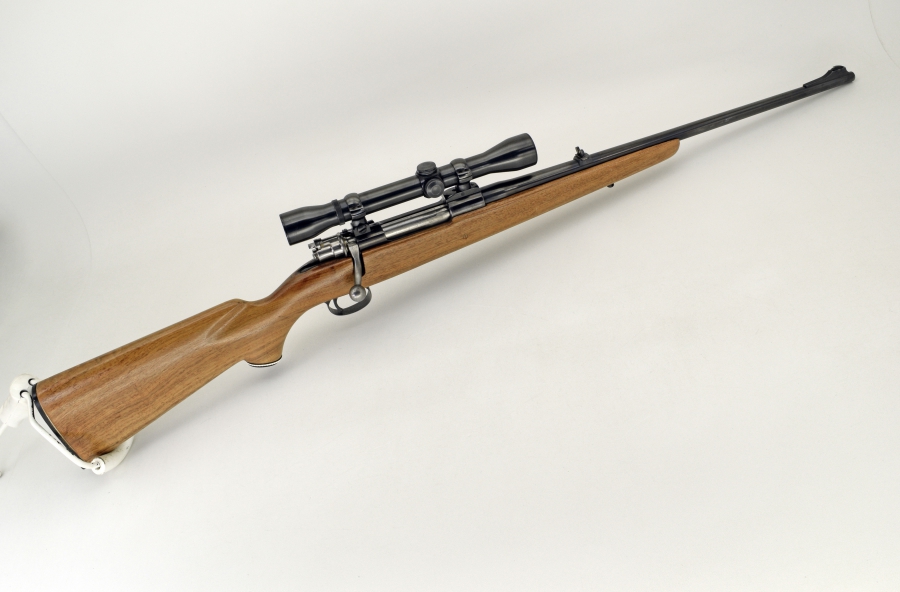
My equipment is a little bit different than Townie’s. I don’t own a 1903, or I would try it with one. I have #1 (my Sako 75). Like the 1903, it’s chambered in 30-06. The action length is similar. The differences would be that the Sako has a shorter bolt lift. I also have a scope instead of open sights. This is a big advantage that I can’t really do anything about. The only thing that comes to mind is to reduce the size of the target.
I found that one of the main problems I had in live fire was that the butt has a tendency to slip from the shoulder. Townie had some advice for me. One tip was to utilize the support hand to pull the butt into the shoulder while working the bolt. Good. That will help. Another tip was to use the cheek to press into the rifle. I had already stumbled into that for offhand, but had not thought to apply it here. Another tip was to wet the stock so that it will adhere slightly to the shoulder. Interesting…
I spent a couple weeks dry firing to get my speed together in prone with the sling. This was not a fast combination up to this point, but I figured out what I needed to do to get the bolt going, which was basically to compromise my position after each shot. Luckily, this was not a super precise shot.
I used the metronome to build my speed in dry fire. I got up to about 72 BPM. I wasn’t sure if this was fast enough. I had a feeling that I might not make the 10 second time limit, but that it would be close. I wanted to at least make the 12 second limit that I had read about in Townie’s book.
I tried a couple of practice runs at 100 yards on a 10” paper plate. On about shot 4, the butt would slip out of the shoulder pocket. My accuracy was fine, just under 4”, but my time was a bit over. I tried to work on the slipping problem in dry fire after this.
My target at 200 yards was steel, so I could document this in video and give the viewer instant feedback. The target is a humanoid steel target approximately 13” wide, 23” from top of the head to bottom of target, and approximately 18.5” in height not counting the head, which was not part of my intended target. I was shooting #1, my Sako 75 Hunter, chambered in 30-06 Springfield. My Leupold Vari-X 3 was set to the minimum zoom setting, ~3.5. I was using a TAB gear standard sling. I had 5 rounds in the mag and one in the chamber. On my first run, the butt slipped again on shot 4. I only had a little daylight, a little time, and enough ammo for one more run. I then remembered that one of Townie’s tips was to wet the shoulder to butt interface. Check out my bottle of Aquafina in the following video:
You can time it like I did and it should come out to just over 11 seconds from the 1st shot to the 6th. All shots hit steel. I didn’t measure my group at the time, but from a photo, it appears as though it’s approximately 9.75”, which would make it in the ballpark of 4.6 MOA.

A photo of me and my buddy Steele. About the new face: a reader, who is also a well respected rifleman, suggested something more dignified than blacking my face out. Ask, and you shall receive…
Obviously this is over the 10 second limit, but according to Townie it’s good enough to hang with him on his team. Also, figure in that I’m not the commander of the Frankford Arsenal or a member of an armed forces shooting team, and there you have it. It was the gap between shots 1 and 2, and 4 and 5 that got me. I tend to be a little slow out the gate, and the bolt work following shot 4 was slightly flubbed. Even if I’d have gotten it, I can’t do it “on command” yet.
Watching the video is interesting for me, because I clearly break my cheekweld. I don’t notice this in practice, in fact I can still see through the scope. I had also expected more body movement (reaching for the bolt knob) than there actually is. I recommend recording a video of yourself so you can nitpick.
Here’s the rating system breakdown for a clean run:
Over 30 seconds: Why did you even try this, get to workin’ that bolt son!
Over 20 seconds: See above.
Over 15 seconds: More dry fire in the future for you I see, hmm, yes.
Over 12 seconds: Nice try kid.
Over 10 seconds: He’s good… with my help he could be the best
Under 10 seconds: May your shooting career be glorious and your wikipedia
entry brief, Mister Rifleman!
Under 7 seconds: STANGSKYTER!!!
Here’s someone who can get 6 off in under 7 seconds, then reload and fire another 2 under 10 seconds, with a higher degree of accuracy than I was trying for:
Here’s someone who can get 6 off in under 7 seconds, then reload and fire another 2 under 10 seconds, with a higher degree of accuracy than I was trying for:
What’s the point of all this? It’s fun, and it’s a challenge. Is it worth it to get to the stangskyting level? Not for me. Is it useful? That’s a better question to ask in order to guide our practice. Here’s an easy test question to get to the bottom of this: Ten crows are sitting around a dumpster. You shoot one. How many are left around the dumpster? If you answered 9 your math is fine but your common sense needs work. The practice of firing rapid fire at a single target is really only useful in order to develop the consistency to be assured that your first shot is going to hit, and the speed to be ready for a second shot. That’s really it. The first shot is worth more than all the others combined.
I may revisit this type of shooting, but for now I’ll be moving on to less conventional, more practical type shooting.