Categories
Gun Info for Rookies

How to Shoot a Rifle by Brett

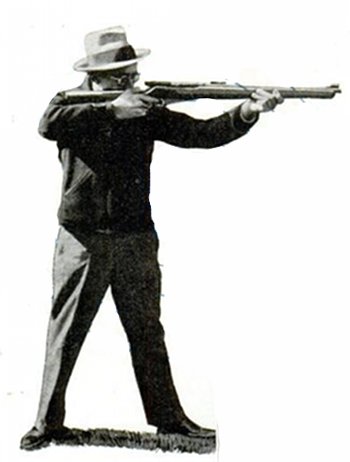
vintage man standing holding shooting rifle

From some men, learning how to properly and safely fire a rifle is a skill they picked up when they were just knee high to a grasshopper. These guys probably got a .22 for their 12th birthday and spent summers in the woods plinking tin cans and squirrels and autumns hunting deer with their dads and grandpas.
Me? I wasn’t one of those guys.
But lately I’ve been wanting to learn how to fire a variety of firearms. I’m sure there are other men out there who, like me, went their entire life not ever shooting a rifle, but now have the desire to learn. It might be because he wants to take up hunting. Maybe he’s interested in home protection. Or perhaps he’s just interested in marksmanship as a hobby in and of itself. Whatever your reasons are for wanting to learn how to fire a rifle, you need to know how to do it safely and correctly.
A few months ago we did a post on firing a handgun safely and correctly. This time we’ll focus on how to shoot a rifle. So I headed back over to the U.S. Shooting Academy here in Tulsa, OK to talk to Mike Seeklander, Director of Training at the Academy. He explained the very basics of firing a rifle and today I’ll share what I learned with you.

The Four Cardinal Safety Rules of Firing a Rifle

Just as he did when we talked about firing a handgun, the very first thing Mike brought up were four rules, that if followed strictly, will keep you and others safe so you can have a good time firing off a few rounds.
1. Always treat every firearm as if it were loaded. No ifs, ands, or buts. Even if you know the gun is unloaded, still handle it as if it were loaded.
2. Always keep the firearm pointed in a safe direction, a direction where a negligent discharge would cause minimum property damage and zero physical injury. The safest direction to point a gun is always downrange (as long as there aren’t any people downrange!).
3. Always keep your trigger finger off the trigger and outside the trigger guard until you have made a conscious decision to shoot.

4. Always be sure of your target, backstop, and beyond. You want to be aware of what’s in your line of fire. This isn’t usually a concern if you go to a professional gun range. They make sure that people and property stay out of the path of the guns firing downrange. Where this becomes a concern is when you go shoot with your buddy out on his property. This is especially important when firing high powered rifles as their bullets travel further than bullets fired from a handgun.
Listen to Mike: “Ask your friend what exactly is beyond the target and backstop you’re shooting at, especially when you’re shooting into a wooded area. Don’t just settle for, ‘Oh, don’t worry. There’s nothing back there.’ Ask specifically if there are any houses, property, etc beyond your backstop. Err on the side of being overly cautious.”

Types of Rifles

Rifles are high powered firearms typically used to hit targets at long distances. Rifles are designed to be fired from the shoulder. Grooves, called rifling (hence the name rifle), are cut into the barrel of a rifle. Rifling makes the bullet spin as it leaves the muzzle, making the bullet much more accurate and stable in flight.
There are a variety of rifles out on the market that serve different purposes. Here’s a quick rundown of the most common.
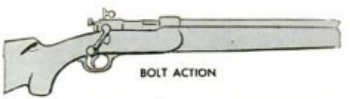
bolt action rifle diagram illustration
Bolt action rifles. Hunters often use a bolt action rifle like the Winchester Model 70 which requires the shooter to manually open and close the breech of the gun to eject a spent casing and load a new one.
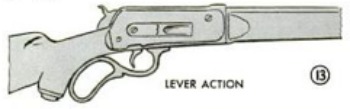
lever action rifle diagram illustration
Lever-action rifles. If you’re a fan of Westerns, you probably noticed the cowboys in the films firing lever-action rifles. Lever-action rifles use a lever located around the trigger guard area to load fresh cartridges into the chamber of the barrel when the lever is worked. The most famous lever-action rifle of the Wild West was undoubtedly the Winchester rifle, a favorite firearm of badasses like Bass Reeves.
semi automatic rifle ar-15
Semi-automatic rifles. A semi-automatic rifle fires a single bullet each time the trigger is pulled, automatically ejects the spent cartridge, and automatically chambers a new cartridge from a magazine. Most modern semi-automatic rifles are made from lightweight synthetic materials that make them easy to hold and carry.  The most popular semi-automatic rifle is the AR-15. Here in the United States, there are no federal restriction on civilians owning AR-15s, though some states, like California, do place restrictions on ownership. Other states, such as Texas, have no restrictions and even allow semi-automatic rifles for hunting. The rifle Mike used in our photos was a JP-15.

How to Stand When Firing a Rifle

There are two common stances when firing a rifle: bladed-off and a squared, “athletic stance.”
Bladed-off stance. A bladed stance is when your weak-side shoulder is facing the target. So if you’re right handed, your left shoulder is facing the target; if you’re left handed, your right shoulder faces the target. It sort of looks like how a baseball batter would stand in the batter’s box.  Here’s Mike, showing a bladed stance:
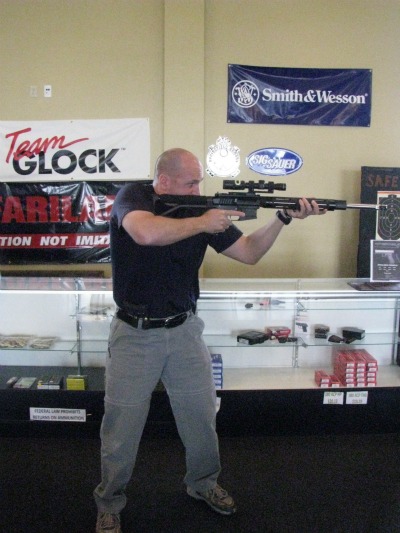
bladed off stance shooting how to shoot rifle

Bladed-off Stance

Many first-time shooters stand in a bladed-off stance when firing a rifle. They probably saw their favorite cowboys or action heroes in movies take this stance, so they assume it’s the best way to stand. Mike says that while a bladed stance is good for competition shooters who need precision in their aim, it’s not a great stance for shooters in more tactical situations that require rapid shots with minimal muzzle rise.
Squared or athletic stance. Mike and the folks at the U.S. Shooting Academy teach their students to assume an athletic stance when firing a rifle. Square your shoulders up with the target. Stand with your feet shoulder-width apart on a straight line. Stagger your strong side foot about six inches behind your weak side foot.
Place the buttstock of the rifle near the centerline of the body and high up on the chest. Keep your elbows down.
Here’s Mike now showing the athletic stance:
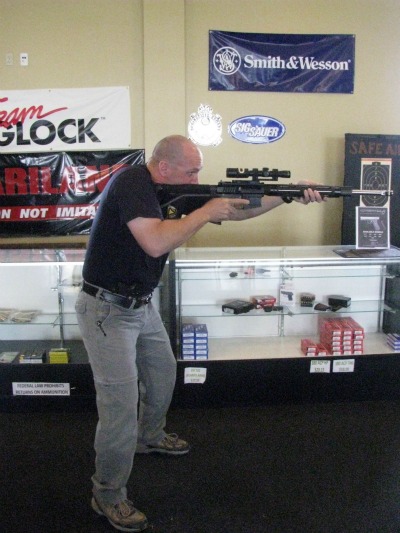
athletic stance shooting how to shoot rifle

Athletic rifle stance

The biggest advantage of the athletic stance over the bladed stance is that it helps in reducing the effects of  recoil when firing a rifle. Think about it. If you’re a lineman in football and you want to resist the other guy pushing you backwards, what stance would give you more balance? Being squared up with the other guy or standing sideways with just one of your shoulders towards him? Squared up, of course.
Another advantage the athletic stance has over the bladed stance is that the athletic stance allows you to track a moving target better. A bladed stance limits how much you can twist your body. An athletic stance allows you to swivel right or left much more easily.
Mike recommends an athletic rifle stance for most shooting situations.

How to Hold a Rifle

Trigger Hand Grip
Rifle with pistol grip. If your rifle has a pistol grip, like the AR-15 or JP-15, center the grip in the “V” at the junction of the thumb and index finger of your trigger hand. Grip the gun high on the back strap (the back strap is the back of the grip on the gun). Like so:
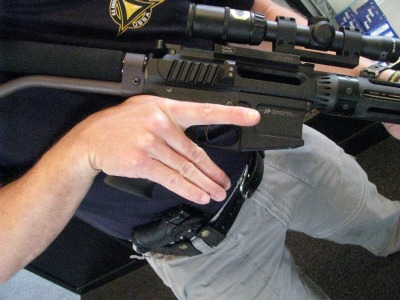
rifle with pistol grip
Rifle without a pistol grip. Most bolt action or lever action rifles don’t have a pistol grip like the AR-15. What they typically have instead is a crook between the stock and the trigger guard.  Like so:
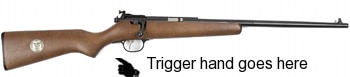
rifle without pistol grip diagram illustration
With these sorts of rifles, center the nook in the “V” at the junction of the thumb and index finger of your trigger hand. Grip the gun high on the nook.
Support Hand Grip
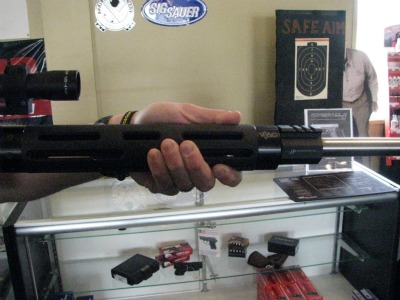
The support hand should grip the forestock (or handguards if you’re shooting an AR-15) of the rifle roughly midway down the length of the rifle. Here’s Mike demonstrating for us:
support hand grip shooting how to shoot rifle
Putting your support hand further forward on the forestock will give you finer control over the muzzle when aiming, which you want when precision is key. The disadvantage of putting your support so far out on the forestock is that it’s a little less stable.
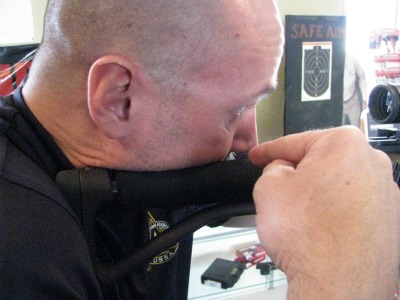
Bring the rifle to your head and press your cheek firmly into the stock. Keeping your head up, bring the rifle to your head. Place the buttstock of the rifle near the centerline of the body and high up on the chest. Press your cheek firmly to the side of the stock of the gun, like so:
proper cheek lock shooting how to shoot rifle

Mike demonstrating proper cheek lock.

You’re now ready to aim and fire your rifle.

How to Aim a Rifle

Rifles can have different kinds of sighting systems depending on what you’re using your rifle for. What sighting system a rifle has also depends a lot on the preference of the shooter. Three common sighting systems you’ll see on a rifle are: open sights, aperture sights, and scope sights.
Aiming a Rifle with Open Sights
aim rifle correct sight alignment diagram illustration
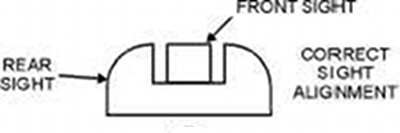
Open sights use a notch of some sort as the rear sight. They come standard with most rifles. We talked about how to aim with open sights in our post about firing a handgun. The same principles apply here. I won’t repeat what I wrote, so refer back to that post for tips on aiming a rifle with open sights.
Aiming a Rifle with Aperture Sights
aiming shooting rifle with aperture sight barrel view

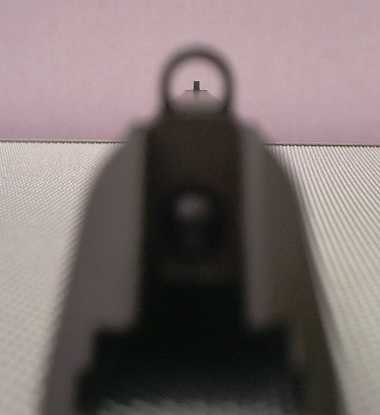
Aperture sight

Aperture sight (or peep sight) rifles have a similar front sight to open sight rifles. The difference is the rear sight. Instead of an open notch, the rear sight is a small ring mounted close to the shooter’s eye. There are different kinds of aperture sights, the most common being the ghost ring sight.
Aperture sights allow you to acquire your aim more quickly and more accurately than when using open sights. One of the problems with open sights is that it forces the eye to focus on three objects at the same time: the rear sight, the front sight, and the target. This is impossible to do, so one of the points of focus will be blurry. Aiming an open sight gun requires the shooter to know which object needs to be blurry and which objects need to be in focus. Focusing on the correct points can take precious time.
Aperture sights speed-up getting a correct sight picture by removing one of the objects in the shooter’s line of sight, specifically the rear sight. Looking through the rear ring causes your eye to automatically center on the front sight at the muzzle of the gun, thus providing you with a more accurate aim, acquired more quickly compared to using an open sight.
To aim with an aperture sight, simply look through the rear ring sight, attempting to only focus on the front sight and the target. The ring will blur until it is almost invisible (hence the name, ghost ring sight).
The front sight should be centered in the rear ring. The greater the distance to the target, the more perfectly you need to center the front sight in the rear ring. A closer sight requires less sight precision. Aim your front sight right underneath the point you want the bullet to hit. Before firing, shift all your focus to the front sight.
How to Aim a Rifle With a Scope
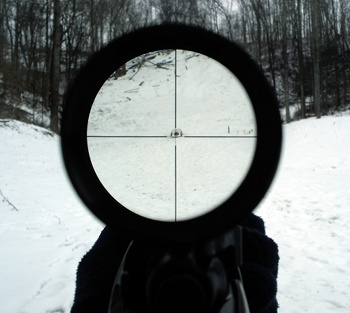
aiming shooting rifle with scope barrel view Scopes provide the most accurate and easy sighting on a rifle. They allow the shooter to magnify their target for better target definition at long ranges. A scope’s most useful attribute is that everything in the shooter’s field of view is in the same optical plane. Translation: there’s no need for your eye to balance focusing on multiple objects like you do with open sights and aperture sights. You can keep both the crosshairs and the target in focus. Just aim your cross hairs at your target and shoot.
Well, I wish it were that easy. A novice shooter might notice that despite a steady hand, all their shots end up nowhere near the crosshairs of the scope. For maximum accuracy with a scope, you have to “zero” it. Zeroing a rifle is a somewhat technical process for a beginner shooter and warrants its own article explaining how to do it. I’ll do a follow-up article on how to zero a scope in the future.

Trigger Management (aka Pulling the Trigger)

To fire a gun, we often use the popular phrase “pull the trigger.” However, to fire a gun properly, you don’t actually want to pull the trigger, but rather press it in a controlled fashion so you don’t disrupt your sights. Managing the trigger on a rifle is similar to doing so on a handgun, so here’s a review of the basics we covered last time:
1. Press, don’t pull. Instead of pulling the trigger, press (or like my dad likes to say “squeeze”) the trigger straight to the rear. Apply constant, increasing reward pressure on the trigger until the weapon fires. Ensure that you’re only applying pressure to the front of the trigger and not the sides.
2. Take the slack out of the trigger. Squeeze the trigger to the point you start feeling resistance.
3. Surprise yourself. Keep pressing the trigger straight to the rear until the gun fires. Don’t anticipate when the gun will fire. You sort of want to surprise yourself as to when the gun actually discharges.
Have any other tips for the first time rifle shooter? Share them with us in the comments!
Editor’s note: This article is about how to fire a rifle safely and correctly. It is not a debate about gun rights or whether guns are stupid or awesome. Keep it on topic or be deleted.

_____________________________________________________________________________
Special thanks goes out to Mike and the crew at U.S. Shooting Academy for their help on this article. Mike along with the U.S. Shooting Academy Handgun Manual were the sources for this article.   If you’re ever in the Tulsa area, stop by their facility. It’s top notch and the staff and trainers are friendly, knowledgeable, and super badass.

Categories
All About Guns

Savage Storm .270: An Updated Classic Rifle In A Classic Caliber

savage storm
Savage Storm decked out with a Zeiss 3-9x scope, Warne QD mounts and a Montana leather sling.

I’ve always had a soft spot for Savage rifles. Savage Arms was one of the very few gun manufacturers that produced left-handed bolt rifles as a standard item when I was a young shooter — for us lefties, we are grateful. Prices on Savage bolt guns, 110 series, are also very affordable. Some thought the rifles were ugly, but for me, the beauty that mattered was the size of the groups it produced. Others besides me must have thought highly of them because several million Savage 110s have been manufactured. In those early days of production, the buyer had a choice ranging from economy to expensive, with the standard-grade rifles having decent walnut and some cut checkering. You got a lot for your money with a Savage.
Savage still makes the same bolt rifle that over time has evolved into a very accurate shooting machine. For more than five decades, Savage has built an enviable reputation for crafting some of the most accurate barrels in the business. They’ve also upgraded fit and finish along the way, making the newer Savages more appealing.
Related Videos: Power & Precision: New Savage 110 Wolverine in 450 Bushmaster

savage storm
The bolt body is nicely engine-turned/damascened. Weaver-style bases are included and pre-mounted. A great idea that saves the shooter money and the hassle of finding the proper bases.

In 2002 Savage fixed the lawyer-mandated heavy trigger issue with a safe, user-friendly adjustable trigger design. No more trips to the local gunsmith for a “trigger job” or having to buy an expensive replacement. Called the “Accutrigger”, the Savage unit offers the shooter a two-stage pull that is totally safe, creep-free and adjustable for weight of pull by the user. The trigger weight can be easily set by the owner for anywhere between 1.5 lbs. to 6 lbs. When I got in the new Storm chambered in .270, I set my Accutrigger weight for just under 3 lbs. I’ve shot all kinds of rifles with adjustable triggers and I have to say the Accutrigger is the best factory-produced adjustable trigger available today. Yes, it’s that good.
The safety that Savage uses in conjunction with the Accutrigger is a 3-position top-tang design that is comfortable, accessible and ambidextrous. Fully forward is fire, middle position is on-safe/bolt operable (used for loading/unloading) and fully to the rear is on-safe, bolt locked. It works smoothly and silently when pushed forward to the fire position.  A tang safety is another Savage feature that isn’t seen on most other bolt guns but makes total sense on a hunting rifle.

savage storm
3-position tang safety. The best place for a safety on a bolt rifle is under the thumb, where it’s quick and accessible to either hand.

The most striking feature of the new Storm is the stock. It incorporates the “AccuStock” bedding system, Savage’s attempt at factory-bedding their barreled actions into the stock snugly and efficiently. Basically, it’s a rigid chassis that locks the barreled action into the stock, not allowing any movement during firing. The chassis runs the full length of the action and forend, contributing to the stiffness of the entire unit. A great idea and another step forward in the evolution of the Savage bolt rifle.

savage storm
Storm synthetic buttstock is adjustable for both comb height and length of pull. The recoil pad is thick, soft and soaks up the recoil of a light hunting rifle.

The problem before the introduction of the Storm (and the Accustock) was the stock itself — it was flimsy, cheap-looking and not really a good stock for an accurate rifle. Savage factory synthetic stocks were usually replaced or extensively modified after purchase. Many owners then covered the stock with some interesting spray paint color schemes in an attempt to help the appearance. A good aftermarket fiberglass stock would have worked better, but that takes the Savage bolt rifle out of the best-buy realm. The synthetic stocks from a few years ago turned off a lot of potential Savage customers.

Enter The Storm.

Savage got it right with the new stock. It’s rigid from the tang to the end of the forend due to the chassis the barreled action rides in. No more flimsy, thin forends rubbing the barrel on one side or the other. The barrel channel is floated without a huge gap on either side. The stock itself has a “modern” look to it (along with a square trigger guard) that isn’t too jarring for a traditionalist like me. It’s also adjustable for length of pull and comb height — for the perfect fit.  It looks great and feels super solid.’
Related Videos: VIDEO: New Savage Arms AccuFit Stock Introduced for 2018
Savage calls this synthetic stock an “Accufit” — for good reason — It sets the bar high for what I would call semi-custom fit. The Savage Storm is one of 13 rifles getting revamped in 2018 with the new stock, which is easily adjustable by the user. All that’s needed is a Phillips-head screwdriver and a few minutes. Packed inside the box along with the rifle are 4 comb-risers that adjust the height in 1/8″ increments and 3 extra inserts that adjust the pull length in ¼” increments. You end up with a rifle that fits you perfectly and takes into account your neck, scope height and eye relief. The recoil pad is thick, well fitted and soft. It works well in reducing the felt recoil of a lightweight hunting rifle.

savage storm
Savage Storm synthetic stock with the plastic inserts that come with the rifle. The shooter is able to customize both comb height and the length of pull out of the box, without extensive modifications or an expensive new custom stock.

Range Time

Over the course of a month, four range sessions and 120-plus rounds I got to know the Savage Storm rifle well. Along with the usual accuracy stuff at 100 yards, I was able to do some chronograph/velocity comparisons, using a LabRader Doppler chronograph.
I mounted an older, proven Zeiss Conquest 3-9X on top, in Warne quick detachable (QD) steel rings. Savage thoughtfully supplies Weaver-style bases with the Storm, already installed, so adding a scope of your choice is an easy 20-minute job. The Warne QD rings went on without a hitch. I’m warming to the idea of QD rings on a well-traveled rifle. Having 2 pre-zeroed scopes in QD rings along on an expensive hunt isn’t a bad idea. I like Warne rings and have used them on several other rifles. They’re rugged, beautifully machined and nicely finished. And they hold zero after being removed and replaced.
Related Videos: SootchZone Installation: Remington 700 Extended Bolt Handle Mod
I didn’t do a barrel break-in — I shot the rifle and then cleaned it after each range session, which has been a routine of mine since my Army Marksmanship Unit days. What I’ve noticed in many light-barreled rifles is a change in the point of impact of a clean barrel versus a fouled one. First shot from the clean cold barrel of the Savage was usually about an inch high. Not bad, but noticeable. The best advice I can give is to confirm your zero before the hunt, then leave your barrel “dirty” throughout the season. A zero check mid-season isn’t a bad idea, also. This should keep point of impact surprises to a minimum.
Nothing unusual occurred during my range sessions with the Savage — it grouped like I thought it would. I was really impressed with the performance of the Federal “Non-Typical Whitetail” ammo, though. Best group of all was with the 150-grain “Whitetail” softpoints; one 3-shot string grouped into ½”. It was also the most consistent from shot group to shot group. The Fed Premium 130-grain Partitions took follow-up honors. That’s amazing accuracy from a light hunting rifle and factory ammo. No loads went over 2″, with the majority of the groups staying within 1.5″. I started each day with a clean, cold barrel, shot 3 round groups exclusively and let the barrel cool for several minutes between each group.

LabRadar Chronograph

The most interesting part of preparing this article was working with the LabRadar chronograph and finally getting accurate feedback on the velocity of the loads I used. Prior to this I relied on other shooters with a Chrono or called the factory engineers at the various ammo companies and asked them what their best guesses were. Due to the shorter barrel lengths, I was working with (most companies use 24″ to 28″ test barrels), the “educated guesses” I got from the ammo companies were just that — guesses. There are other factors that go into accurate velocity readouts besides rifle barrel length like the smoothness of the bore and barrel wear, outside temperature, different ammunition lots, etc. Without a chronograph, I was literally “flying blind” when I wanted to know what the actual velocity was.

savage storm
The LabRader chronograph that Bob used was easy to set up and use and would make and excellent addition to any hard-core shooter’s range equipment. Read-outs aren’t affected by wind, rain, clouds or other atmospheric conditions.

The chronograph that LabRadar sent me ended all that speculation. Velocities obtained via this Doppler radar chronograph are, according to the manufacturer, the most accurate readings you can get. It’s easy to set up and take down and isn’t affected by wind or light conditions. Just put your LabRadar next to the rifle (within 18″), “aim” the chrono at the target and you’re set. And it also works with arrows and pellets.
After I completed bench testing, I had some fun shooting 3 and 4-shot strings at a small steel plate 200 yards away. I shot from sitting and offhand, using a hasty sling in the sitting position. It was easy whacking the plate consistently, staging the Accutrigger while snugged up in a Montana sling. I had the Zeiss set at 4 power. This little exercise confirmed the rifle functioned flawlessly after zeroing. Feeding and chambering was smooth; a touch of heavy grease on the receiver rails helped slick up the new stainless action. It’s always a good idea to shoot your rifle away from the bench after you’ve gotten your zero. Rifle zeros can change, sometimes quite noticeably, from bench to field. And a few strings will confirm that your rifle actually functions as intended. Basic stuff, but many shooters never leave the bench nor get away from single-loading their hunting rifle during pre-season range practice.
Related Stories: 14 Awesome Rifles And Shotguns That are Great For Youth Shooters

ACCURACY RESULTS

All groups were 3 shots, fired from 100 yards using a heavy bag and a smaller toe bag. A minimum of 4 groups was fired with each load. Temperatures ranged from the mid 60’s to the low 80’s, sunny with negligible wind and low humidity. All shooting was done with Federal factory ammo.
Federal Premium 130-grain Nosler “Partition” – Smallest: ¾” Largest: 1.2″
Federal Premium 130-grain Barnes “Triple Shock” – Smallest: 1.5” Largest: 2.0″
Federal 130-grain softpoint (blue box #270AC) – Smallest: 1.5” Largest: 1.8″
Federal “Non-Typical Whitetail” 130-grain softpoint – Smallest: 1.0″ Largest: 1.4″
Federal “Non-Typical Whitetail” 150-grain softpoint – Smallest: ½” (best group overall) Largest: 1″
Federal “Fusion” 130-grain softpoint – Smallest: 1.4” Largest: 2.0″

savage storm
Best group that was fired in four range outings. 150-grain Federal factory “Non-Typical Whitetail” ammo, 100 yards. Like most every rifle, the Savage Storm has its preference in the ammo it’s fed. Best thing is to try several loads and bullet weights to find what your rifle likes.

Related Videos: SootchZone Rifle Review: James River Armory Forged Receiver M-14

VELOCITY RESULTS

I got my chronographed velocities from an average of three-shot groups. Some of the velocities recorded were eye-openers — especially the “blue box” Federal 130-grain, which was faster than the manufacturer’s stated velocity. All the averages were very close to the published factory velocity of each load. Looks like you’re not losing too much speed with a shorter, 22″ barrel. “Actual” is the chronographed readings I got from the LabRadar unit.
Fed Premium 130-grain “Partition”  – Actual: 3,027 fps Published: 3,060 fps
Fed Premium 130-grain “Triple Shock” – Actual: 3,049 fps Published: 3,060 fps
Fed 130-grain softpoint “blue box” – Actual: 3,065 fps Published: 3060 fps
Fed “Non-typical Whitetail” 130-grain softpoint – Actual: 2,936 fps Published: 3060 fps
Fed “Non-typical Whitetail” 150-grain softpoint – Actual: 2802 fps Published: 2,830 fps
Fed “Fusion” 130-grain softpoint – Actual: 2,920 fps Published: 3,050 fps

AN AMERICAN CLASSIC

I like this rifle a lot — it functioned reliably and shot superbly “out of the box”. It’s light, quick handling and looks pretty good, too. After almost 60 years of production, Savage knows how to build an accurate, functional, user-friendly rifle. And it’s made in a lefty version, too. Despite the revisions and upgrades, Savage Arms is still making the same bolt rifle that American shooters want, at a price that shooters can afford.

SAVAGE 110 STORM SPECIFICATIONS    

  • Manufacturer: Savage Arms Co, Westfield, MA
  • Caliber (tested rifle): .270 Winchester. Seventeen (17) calibers available in right-hand, nine (9) in left-hand
  • Action: magazine-fed stainless steel. Push-feed, two-lug rotating bolt, left or right handed
  • Magazine capacity: 4 (.270), detachable box
  • Barrel: 22″ length (standard calibers), matte stainless, button rifled. Magnum calibers, 24″
  • Stock: Gray/black synthetic with “AccuStock” bedding. Easily user-adjustable for comb height and length of pull
  • Trigger: two-stage “Accutrigger”, adjustable from 1.5 to 6 lbs.
  • Safety: Top-tang, three position
  • Weight (empty): 7.15 to 7.35 lbs.
  • Overall length: 42-44″ (depending on caliber/barrel length)
  • MSRP: $849.00

Weaver-style bases for scope mounting, factory-installed. New “Accufit” stock is easily adjusted for length of pull and comb height by the user, with only a Phillips head screwdriver.
Related Videos: SootchZone: Primary Arms 1-6x KISS Reticle Scope
For more information:
Savage Arms Co: www.savagearms.com
Federal Ammunition: www.federalpremium.com
Warne Scope Rings: www.warnescopemounts.com
Montana Rifle Slings: www.montanagunslings.com
LabRadar Chronograph: www.mylabradar.com
Targets: www.PrecisionPlusTargets.com

Categories
Dear Grumpy Advice on Teaching in Today's Classroom Well I thought it was funny!

Something for my Former Students! Grumpy

Image may contain: text
Just kidding Guys and I hope that you have made your Old Teacher Proud!

Categories
Uncategorized

3D Glock Animation – How to disassemble and reassemble the G20

Categories
Gear & Stuff

1911 and 1911A1 Military Magazines from the CMP $8.70 ea.


Image result for 1911 and 1911A1 Military Magazines from the CMP $8.70 ea.
https://youtu.be/8JdqBEs7sgg

Categories
All About Guns Anti Civil Rights ideas & "Friends" Born again Cynic! Dear Grumpy Advice on Teaching in Today's Classroom

A Little something about our friends from the other side of our house – A Compulsion to Disarm: The History of Grabby Governments Since 1026 BC JAMES WESLEY RAWLES

In the wake of the 2018 mid-term elections, so-called “gun control” is back in the news. Even though the murder rate in the United States is declining and at a 33-year low, the mass media’s much-heralded “threat of gun violence” has politicians in a frenzy much like those seen in 1968 and 1994. Gun control laws and decrees should be called out for what they really are: Systematic Civilian Disarmament.
In Western nations, most such legislation usually starts small, progressing from registration to wholesale confiscation. First one category of weapons is banned, and then another. Gradually, these draconian laws can ramp up to the point where most citizens can’t even possess air rifles and crossbows. To understand the origins of these laws, we need to examine both some psychology and some history.

INHERENT COMPULSIONS

There is a distinct psychology of humans who gain positions of power. They almost immediately develop a “we/they” outlook on life that can eventually develop into narcissism and paranoia. This is most pronounced in dictators, but even petty bureaucrats display the same sinful tendencies:

  1. The desire to consolidate and accumulate more power.  (In its extreme, totalitarianism and megalomania.)
  2. Fear and dislike of competitors to their power.
  3. A tendency toward corruption and nepotism. (Typically, as a means to consolidate power in an inner circle.)
  4. Belief that laws only apply to “little people.”
  5. A compulsion toward a monopoly of force, that necessitates arming the “we” whilst disarming the “they.”

With that sadly almost universal psychological makeup in mind, let’s move on to some historical examples of governors and governments that have felt compelled to disarm those they rule.
They leave arms only in the hands of those that they trust. (These trusted folks are usually called “comrades” (cronies), “bodyguards”, “trained police”, “military professionals”, and “loyal cadres.”)
Many people mistakenly believe that systematic civilian disarmament was an invention of the 20th Century. Here in America, gun restrictions actually got a very early start. The first General Assembly of Virginia met in Jamestown in 1619. There, the settlers enacted more than 30  laws to govern the fledgling colony.
One of these laws was a monopoly of force provision that included this wording : “…[t]hat no man do sell or give any Indians any piece, shot, or powder, or any other arms offensive or defensive, upon pain of being held a traitor to the colony and of being hanged as soon as the fact is proved…”  Yes, they had the death penalty for selling a firearm or ammunition to an Indian!
Gun laws were not systematic, widespread, and applicable to the general citizenry until after the Civil War.
It was in the late 1860s that such laws got their start at the  state level. In this Reconstruction period in the former Confederate States, state governments sought to keep freed slaves from asserting their rights.
These were the first states to systematically ban carrying concealed knives or handguns. Not surprisingly, those inherently racist laws were only selectively enforced, based on skin tone.

 THREE MILLENNIA OF DISARMAMENT

But to back up even more… If we dig in to historical texts, we can see that organized efforts to disarms civilians have been going on for at least three millennia.
In the Bible we read an early account of civilian disarmament in the book of 1st Samuel, where it describes a successful effort by Philistine governors to disarm the Israelites. This was at about the same time that Saul was anointed as Israel’s first king (in 1026 BC):

“Now there was no smith found throughout all the land of Israel: for the Philistines said, Lest the Hebrews make them swords or spears:
But all the Israelites went down to the Philistines, to sharpen every man his [plow]share, and his coulter, and his axe, and his mattock.
Yet they had a file for the mattocks, and for the coulters, and for the forks, and for the axes, and to sharpen the goads.
So it came to pass in the day of battle, that there was neither sword nor spear found in the hand of any of the people that were with Saul and Jonathan: but with Saul and with Jonathan his son was there found.” – 1Sam. 13:19-22 (KJV)

Later, the Israelites were systematically disarmed by successive waves of invaders, most notably:

  1. The Babylonians–following the Battle of Carchemish in 605 BC.
  2. The Macedonian Greeks led by Alexander The Great in 332 B.C.E.. After Alexander’s death in 323 BC, Greek occupational rule of the Levant was continued by the Seleucid Greeks. The Jewish revolt against Seleucid rule was described in detail in the apocryphal books 1st and 2nd Maccabees. Aside from the Greeks defiling the Temple in Jerusalem, one of the main reasons for the Maccabean Revolt was that the Greeks had disarmed the Jews to the extent that they could not even carry a knife to defend themselves against robbers.
  3. The Romans–from 6 AD to 135 AD. This occupation was detailed by Flavius Josephus, in his histories titled Antiquities of the Jews and Wars of the Jews. (After the burning of Jerusalem in AD 70, the great Diaspora began. The nation of Israel would not be reconstituted until 1948.)
  4. Under the British Mandate, by the British Army from 1945 to 1947. Jews had to create more than 1,500 hidden weapons caches, while waiting out the British Army’s departure.
  5. Finally, starting in 1948, by their own newly established government. Since most of the leaders of the new government had a European background, they foolishly imitated their former masters and set up small arms registration schemes for Israel. And, like the Europeans, they fairly quickly banned private ownership of heavier weapons. Getting a permit to own a firearm in modern day Israel is a minor nightmare. It now requires a background check, a physician’s statement, and paying a regular fee. Further, most permit holders are only allowed to own one firearm (usually a pistol), and to possess no more than 50 rounds of ammunition at a time.  Roughly 40 percent of requests for gun permits are rejected.
THE JAPANESE SWORD HUNTS

In the Wiki world, we read about systematic civilian disarmament in Feudal Japan:

“Several times in Japanese history, the new ruler sought to ensure his position by calling a sword hunt (katanagari). Armies would scour the entire country, confiscating the weapons of the enemies of the new regime. In this manner, the new ruler sought to ensure that no one could take the country by force as he had just done. The most famous sword hunt was ordered by Toyotomi Hideyoshi in 1588.
Prior to the sword hunt called by Oda Nobunaga towards the end of the 16th century, civilians were free to carry swords for defense or simply for decoration. Nobunaga sought an end to this, and ordered the seizure of swords and a variety of other weapons from civilians, in particular the Ikkō-ikki peasant-monk leagues which sought to overthrow samurai rule.”

You can read the entire article at Infogalactic.
It is interesting to note that both the Israelites and the Japanese peasantry resorted to using farming implements as weapons, after they had been disarmed. Most famously, the martial arts weapon known as Nunchaku (aka “Nunchucks’ in modern parlance) got their start as a two-piece grain harvesting flail.
Here is another wiki quote: “Okinawans, under the rule of foreign powers, were prohibited from carrying weapons or practicing with them in public. But the weapons-based fighting that they secretly practiced (and the types of weapons they practiced with) had strong Chinese roots.”  Many of these weapons were repurposed or simple adaptations of existing farming tools.”

EARLY EUROPEAN DISARMAMENT PROGRAMS

Perhaps the earliest systematic civilian disarmament scheme in Europe was created by Holy Roman Emperor Frederick Barbarossa The First. He issued the Peace Ordinance of 1152. That law forbade peasants from carrying swords and lances. Only nobles were allowed to be armed, in peacetime.
The French nobility also got an early start at disarming those Deplorable Peasants. In the 1440s King Louis XI signed an order called The Noble Privileges, which mentions the right of Nobles to carry swords. All others had no such privileges.
In 1533, the crown of England issued this edict:

“An Act for shooting in Cross Bows and Hand Guns Whosoever shall shoot in any Hand Gun or Cross Bow or keep any in his House except he has Land Annuities or Offices to the yearly Value of an Hundred Pounds shall forfeit Ten Pounds for every Offence and a Justice of the Peace may commit the Offender to Gaol until he hath paid the same Forfeiture All former Placards made to shoot in either of them shall be void.”

It is interesting that the 1533 English law exempted wealthy people–that is, anyone with a net worth of One Hundred Pounds. In today’s currency, that is the equivalent of near $800,000 USD.  Once again, it was the Deplorable Peasants that powers the Powers That Be of that era meant to disarm.
Weapons prohibition gradually increased in western Europe in the 17th, 18, and 19th centuries.  Along with mass production of arms in the 1800s came the standard practice of stamping serial numbers. And that opened up the opportunity for governments to register not just owners but particular guns to particular owners.

THE 20TH CENTURY: THE CENTURY OF GENOCIDE

What is now called “common sense gun control” was adopted by many nations around the world in the 20th Century, with disastrous results for human life and liberty. Although nearly all of Europe now has gun registration, there have been a number of notable campaigns to outright disarm the European citizenry:
The Ottoman Turkish government began systematic civilian disarmament in the 1890s. These laws were not equally enforced.
It was non-Muslims that were singled out for prosecution. In 1901, H. F. B. Lynch–a British travelogue writer–described the Armenians of Turkey as “rigorously prohibited from possessing firearms.” The Armenian Genocide (1915 to 1922) saw some 1.5 million disarmed Armenians killed.
They died at the hands of Turkish Army troops, police, and civil administrators. Most of the Armenian genocide victims were Christians.
As early as 1918, the Soviet Union established systematic civilian disarmament. In December of 1918, the Council of People’s Commissars issued decree on the surrender of weapons.
As documented at the Infogalactic wiki: The citizenry was ordered to surrender “…any firearms, swords, bayonets and bombs, regardless of the degree of serviceability. The penalty for not doing so was ten years imprisonment.
Members of the Communist Party were allowed to have a single weapon (a pistol or a rifle) and possession of the weapon was recorded in the party membership book. On December 12, 1924 the Central Executive Committee of the USSR promulgated its degree “On the procedure of production, trade, storage, use, keeping and carrying firearms, firearm ammunition, explosive projectiles and explosives”, all weapons were classified and divided into categories.
Now the weapons permitted for personal possession by ordinary citizens could only be smoothbore hunting shotguns. The other category of weapons were only possessed by those who were put on duty by the Soviet state; for all others, access to these weapons was restricted to within state regulated shooting ranges.
Illegal gun possession was severely punished. Since March 1933 the manufacture, possession, purchase, sale of firearms (except for smoothbore) hunting weapons without proper authorization was punishable by up to five years in prison. In 1935, the same penalty was imposed for possession of knives.”
From 1929 to 1953, about 20 million disarmed dissidents in the Soviet Union were either systematically starved, exiled to Siberian gulags, or exterminated. Some of these pogroms were on a grand scale.
Most notably, there was the forced starvation in the Ukraine, called The Holodomor. (“To kill by starvation”). This man-made famine of 1932-1933 was also also known as the Terror-Famine or the  Famine-Genocide.
Nazi Germany established systematic civilian disarmament in 1938. Under the Law on the Reunification of Austria with Germany of 13 March 1938, most guns in Germany became subject to registration.
But even earlier, in Section 5 of the First Regulations of the German Citizenship Law of 14 November 1935 (Reichsgesetzblatt 1, p. 1332) Jews were named in particular as prohibited from “acquiring, possessing, and carrying firearms and ammunition”, as well as “truncheons or stabbing weapons”.
From 1939 to 1945, no less than 6 million Jews and 4 million others were segregated, rounded up, and systematically worked and/or starved to death or outright exterminated by gassing or gunfire. Their bodies were then either cremated or buried in mass graves.
During World War II, Nazi Germany invaded and occupied parts or all of 18 countries. (This included some of the Channel Islands that were part of the United Kingdom.)
In the majority of those countries, the Nazis immediately seized gun registration records held by local police. Using those records, they confiscated nearly all guns in private hands.
This systematic civilian disarmament made occupying these nations much easier, and any organized resistance quite difficult.
In Hungary, systematic civilian disarmament began soon after the end of World War II. The Soviets were successful in quashing the attempted counter-revolution of 1956 because they mainly faced unarmed (or grossly under-armed) civilians. More than 2,500 Hungarians died in the failed counter-revolution.
Yugoslavia began systematic civilian disarmament immediately after the end of World War II.  In the Kosovo War that erupted with the inevitable breakup of Yugoslavia, there were widespread kidnappings, summary executions, and civilian massacres.
Programs of “ethnic cleansing”–primarily through forced property dispossession and relocation–caused untold misery in the late 1990s.
In the Kosovo War it was primarily ethnic Albanians who were systematically killed. The worst of these were in the Dubrava Prison massacre, the Meja massacre, and the Orahovac massacre.
These massacres underscored the sad truth: Disarmed people can be victimized en masse. And in this case, it was a nominally Christian government that was oppressing  Muslims.

SYSTEMATIC CIVILIAN DISARMAMENT IN EAST ASIA

In 1948, Indonesia established systematic civilian disarmament with enactment of Law No. 8/1948 On Firearms, followed by Emergency Law No. 12/1951 On the Illegal Possession of Firearms , and Law No. 62/1960 On Gun Licenses.
Beginning in December 1975 and up until October 1999, Indonesia conducted a brutal occupation and mass killings in East Timor (Timor-Leste).  In each village that the Indonesians successively occupied, Indonesian troops knew exactly where to go to round up Timorese-owned guns.
Most of them had been dutifully registered. The civilian death toll for East Timor in the period of 1974 to 1999 was estimated at roughly 103,000 people.
Communist China established systematic civilian disarmament throughout all their territories in 1935. From 1948 to 1952, 20 million disarmed political dissidents were rounded up and exterminated.
Then, again in from 1966 until 1976, Chairman Mao initiated the Cultural Revolution. This was intended to purge “remnants of capitalist and traditional elements” from The People’s Republic. According to Wikipedia:  “…millions of people were persecuted and suffered a wide range of abuses including public humiliationarbitrary imprisonmenttorturehard labor, sustained harassmentseizure of property and sometimes execution.
A large segment of the population was forcibly displaced, most notably the transfer of urban youth to rural regions during the Down to the Countryside Movement. Historical relics and artifacts were destroyed and cultural and religious sites were ransacked.”
Simultaneously, The Great Famine, created by communist Central Planning resulted in the deaths of approximately 45 million Chinese citizens.
Any attempts at rebellion by anti-communists were put down with extreme force by the People’s Liberation Army (PLA). The PLA was successful because they had a monopoly on force. Only loyal communist cadres were armed. All others had long since been systematically disarmed.
Communist China invaded Tibet in 1950. There, they quickly embarked on systematic civilian disarmament. The PLA had a devious three-part plan to subjugate Tibet:  Gun restrictions, imprisoning or deporting those who resisted, and bringing in thousands of ethnic Chinese settlers, to shift demographics. Those all worked, and Tibet is still under Chinese control, nearly 80 years later.
Cambodia (aka Kampuchea) established systematic civilian disarmament in 1956. From 1975 to 1977, mostly during the second term of Pol Pot, as General Secretary of the Central Committee of the Communist Party of Kampuchea, one million intellectuals, unable to defend themselves, were rounded up and exterminated.

IN AFRICA

Uganda established systematic civilian disarmament under the Firearms Act of 1970. During the rule of Muslim dictator Idi Amin (from January 1971 to April, 1979), 300,000 people mostly Christians, unable to defend themselves, were rounded up and exterminated.
Here is an insightful quote from the Infogalactic wiki: “Amin recruited his followers from his own ethnic group, the Kakwas, along with South Sudanese. By 1977, these three groups formed 60 percent of the 22 top generals and 75 percent of the cabinet.
Similarly, Muslims formed 80 percent and 87.5 percent of these groups even though they were only 5 percent of the population. This helps explain why Amin survived eight attempted coups.”
Zimbabwe’s dictatorship led by Robert Mugabe and his ZANU-PF party began systematic civilian disarmament in 1981. They focused on disarming the minority Ndebele tribe of western Zimbabwe.
Then, starting in 1983, there was a series of hushed-up massacres in Matabeleland by the Fifth Brigade of the Zimbabwean Army. Those took the lives of 20,000 Ndebele tribe men, women, and children. In 2015 it was revealed that Mugabe had personally ordered the main massacre series, commonly known as The Gukurahundi killings.
The nation of Sudan (which later partitioned into Sudan and South Sudan), ruled by an Islamist government, implemented the “Arms, Ammunition and Explosives Act of 1986.”  This law requires the registration of most firearms, and entirely bans civilian possession of most military weapons.
According to Pierre-Richard Prosper, Ambassador-at-Large for War Crimes Issues of the U.S. State Department, in the Second Sudanese civil war (1983 to 2005), “…the Government of Sudan engaged in a policy to destroy the predominately Christian and animist south.
Death and destruction reached staggering proportions. Credible estimates from human rights organizations suggest that two million people have perished, four million have been internally displaced, and nearly 400,000 have been forced to live in neighboring countries as refugees.”

SYSTEMATIC CIVILIAN DISARMAMENT IN THE AMERICAS

Cuba established systematic civilian disarmament soon after Fidel Castro took power on July 26th, 1959.  By restricting firearms almost all gun ownership to the military, police, and a few loyal communist paramilitary cadres, any organized resistance to to the Castro regime was almost impossible.
Guatemala established systematic civilian disarmament in 1964, by the Directorate General for Control of Arms and Ammunition (DIGECAM). From 1964 to 1981, roughly 100,000 disarmed Mayan Indians were rounded up and killed.

The Mexican Constitution of 1857 promised that: “…every man has the right to keep and to carry arms for his security and legitimate defense.” However, in 1917, in response to a revolution led by Pancho Villa, their constitution was amended.

 Under one amendment citizens were precluded from being able to buy weapons “reserved for use by the military”.  Another amendment forbade carrying “…arms within inhabited places… …without complying with police regulations.”

Mexico was successful in stopping several revolutions. Gun laws were a key part of their strategy.  But now, in the 21st Century, there has been an unintendend consequence: Mexico’s drug cartels now run rampant.

They just ignore the country’s gun registration, caliber restriction, and firearm category restriction laws. The gangs import or even manufacture weapons, with impunity. The police are outnumbered.

And because of civilian disarmament laws the general citizenry is vastly out-gunned by the drug gangs. They are at their mercy.

In the United States, there were no Federal gun laws until 1934. Then, in the midst of the Great Depression, with a Democrat-dominated 73rd Congress and with Democrat Franklin Delano Roosevelt in the White House, the National Firearms Act of 1934 (NFA-34) was enacted.
This law put a $200 tax on machineguns, silencers, short-barreled rifles, and short-barreled shotguns. The machinegun law was expanded in 1986, when an outright freeze on the production or importation of any new machineguns transferable to civilians was enacted.
After the NFA-34 tax morphed into a quasi-ban, the prices of transferable machineguns have risen astronomically. Just a two ounce AR-15 registered drop-in autosear now sells for as much as $34,000!
As you can see, over the centuries the gun-grabby compulsions of governments keep coming back, like a bad rash.
Sooner or later, centralized governments almost always gravitate toward a monopoly of force. And even in nominally “democratic” countries, gun prohibition laws have led to suffering and death on a monumental scale.

WE, THE DEPLORABLES

The gun politics of the 21st Century have become intensely divisive. The increasingly populous and liberal coastal states are at odds with the conservative lightly-populated interior.
The published talking points and “messaging’ of the gun grabbers reveal that they are willing to twist statistics, mischaracterize events, and vilify their enemies, in order to get their way.
We are now viewed as “deplorables” by the media, academia, the Democrat party, and even by the euphemistically-labeled “moderate” wing of the Republican party. To the urban elite, we are seen as disloyal, deplorable, and despicable country bumpkins.
This viewpoint was revealed in 2008 by then-candidate Barack Hussein Obama, when he went off-script at a campaign town hall meeting. In those remarks, he described working-class people in traditional industrial towns thusly: “They get bitter, they cling to guns or religion or antipathy to people who aren’t like them or anti-immigrant sentiment or anti-trade sentiment as a way to explain their frustrations.”
I’m proud to call myself a Bitter Clinger. I will defy their unconstitutional gun laws, even if means going to prison or dying in combat. The alternative–complying and simply watching the history of genocide repeated–is not acceptable to me.
Whether its now spoken or not, Obama’s view of the We/They Paradigm is clearly shared by leftists and statists at all levels of government. They see us clinging to our guns as a threat to their power.
And in one sense, they are right. We will continue to cling to our guns as long as governments continue to pursue a monopoly of force and creep toward total government. This is what the Second Amendment is all about: It provides a final check on the ambitions of those with unlimited ambition.

Learn from the mistakes of history. Do not allow them to be repeated! – JWR
Note: Permission is granted for re-posting of this article, but only if done so in full, with proper attribution to James Wesley, Rawles and SurvivalBlog.com, and only if the included links are preserved.)

Categories
All About Guns

Smith & Wesson Model 53 in .22 Remington Jet (One really weird looking round)

Image result for smith and wesson model 53 22 jet
Related image
Image result for smith and wesson model 53 22 jet
 

Attachments area
Preview YouTube video Smith & Wesson Model 53 22 Remington Jet Magnum Revolver

& here is some information about the .22 Remington Jet

From Wikipedia, the free encyclopedia
.22 Remington Jet
.22 Remington Jet with .22 Hornet and .223 Rem.JPG

.22 Remington Jet (center) with .22 Hornet (left) and .223 Rem(right).
Type Revolver and rifle
Place of origin US
Production history
Produced 1961
Specifications
Bullet diameter .222 in (5.6 mm)
Neck diameter .247 in (6.3 mm)
Shoulder diameter .350 in (8.9 mm)
Base diameter .376 in (9.6 mm)
Rim diameter .440 in (11.2 mm)
Case length 1.28 in (33 mm)
Overall length 1.58 in (40 mm)
Rifling twist 1:10
Primer type Small Pistol (Boxer)

Boxer primer type pocket”

Ballistic performance
Bullet mass/type Velocity Energy
40 gr (3 g) 1,710 ft/s (520 m/s) 261 ft·lbf (354 J)
40 gr (3 g) 1,700 ft/s (520 m/s) 258 ft·lbf (350 J)
45 gr (3 g) 1,630 ft/s (500 m/s) 267 ft·lbf (362 J)
Test barrel length: 8½ in (22 cm)
Source(s): Barnes & Amber 1972

The .22 Remington Jet (also known as .22 Jet.22 Center Fire Magnum, or .22 CFM)[1] is a .22 in (5.6mm) American centerfire revolver and rifle cartridge.[1]
Developed jointly by Remington and Smith & Wesson, it was to be used in the Model 53 revolver, which first appeared late in 1961.[1] While it traced its origins to potent wildcats such as the .224 Harvey Kay-Chuk,[2]which ultimately derive from the .22 Hornet,[2] it was a bottlenecked cartridge based upon the .357 Magnumcase necked down to a .22 caliber bullet.
By 1972, the Model 53 remained the only revolver chambered for it,[1] while Marlin in 1972 was planning a lever rifle in .22 Jet.[1]
The .22 Jet was designed as a flat-shooting hunting round for handguns, and it is suitable for handgun hunting of varmints and medium game out to 100 yd (90 m).[1] The 2460 ft/s (750 m/s) and 535 ft-lbf (725 J) claimed for factory test loads did not prove out in service weapons.[1]

Smith & Wesson Model 53

See also[edit]

References[edit]

  1. Jump up to:a b c d e f g Barnes, p.148, “.22 Remington Jet”.
  2. Jump up to:a b Barnes, p.148, “.22 Remington Jet”, & p.131, “.224 Harvey Kay-Chuk”.

Sources[edit]

  • Barnes, Frank C., ed. by John T. Amber. “.22 Remington Jet”, in Cartridges of the World, pp. 148, & 177. Northfield, IL: DBI Books, 1972. ISBN 0-695-80326-3.
  • ______ & _____. “.224 Harvey Kay-Chuk”, in Cartridges of the World, pp. 131. Northfield, IL: DBI Books, 1972. ISBN 0-695-80326-3.
Categories
All About Guns

Buying Used Pistols – What To Look For

https://youtu.be/sCeBYFTl9vA
Image result for Buying Used Pistols – What To Look For

Categories
Born again Cynic! California

California, I kid you not!

Categories
All About Guns

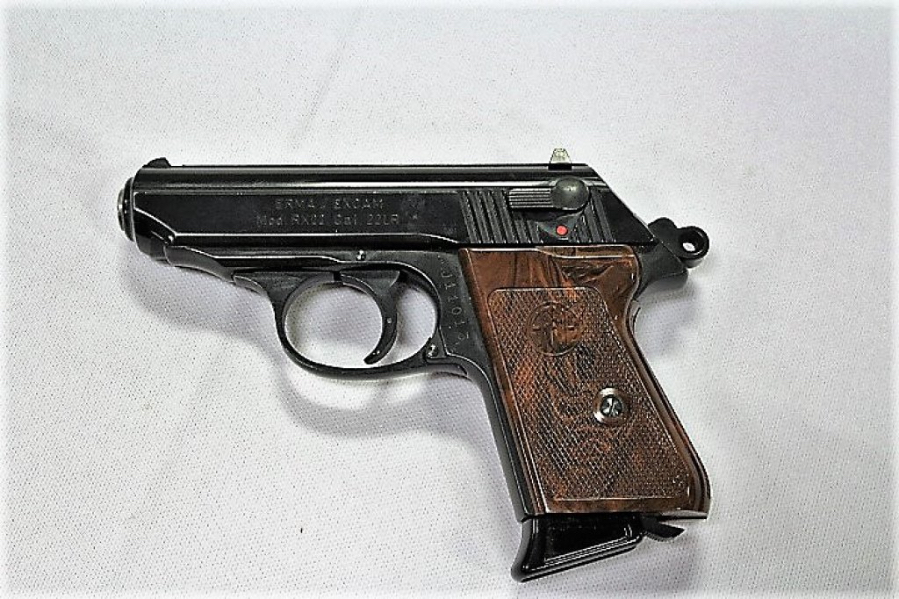
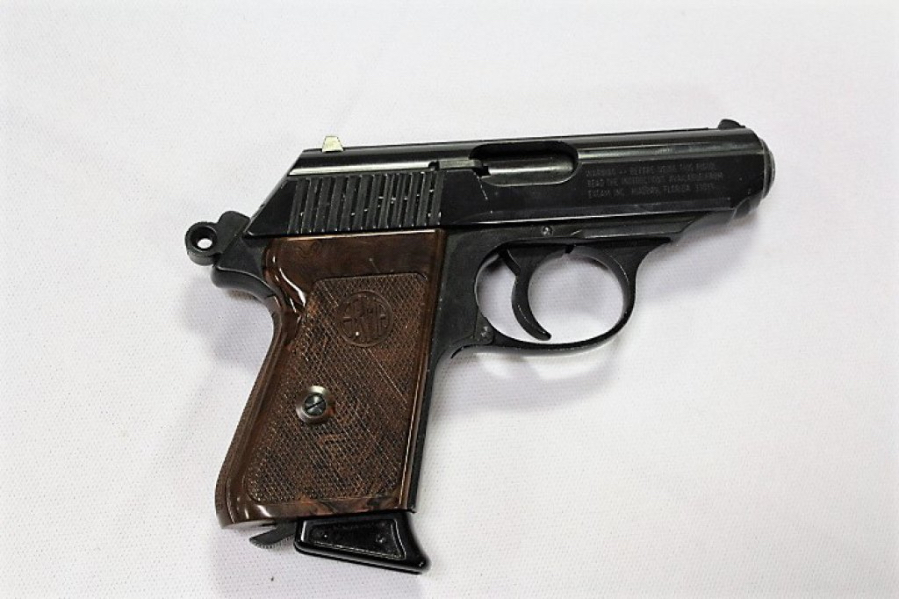
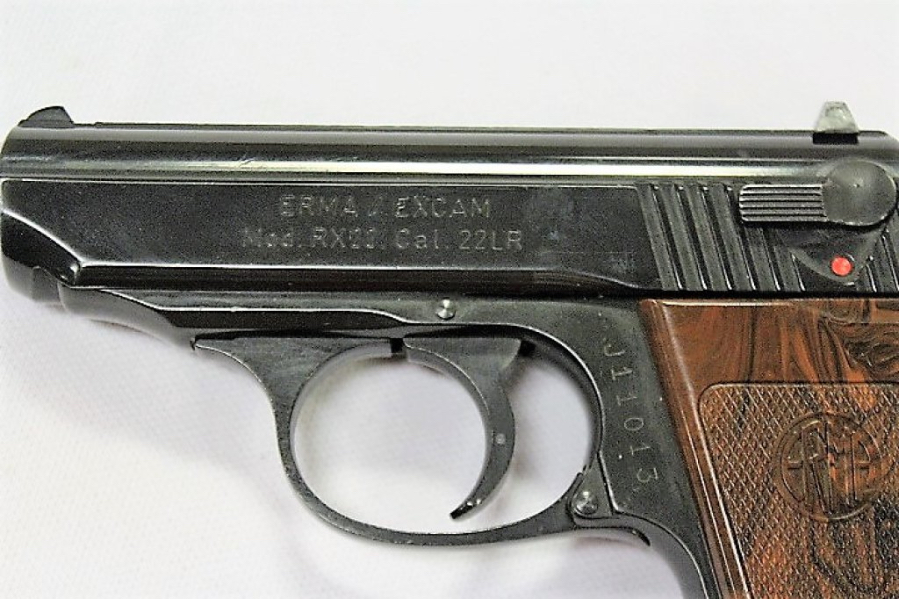
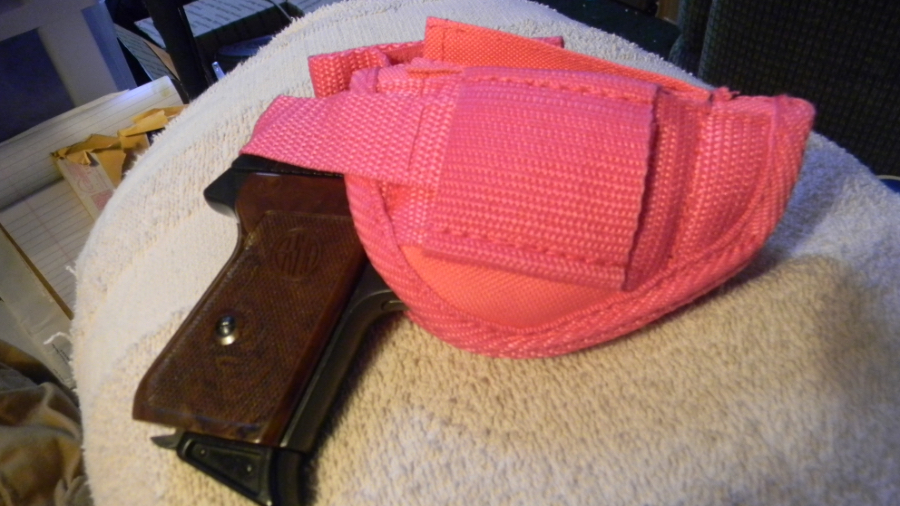
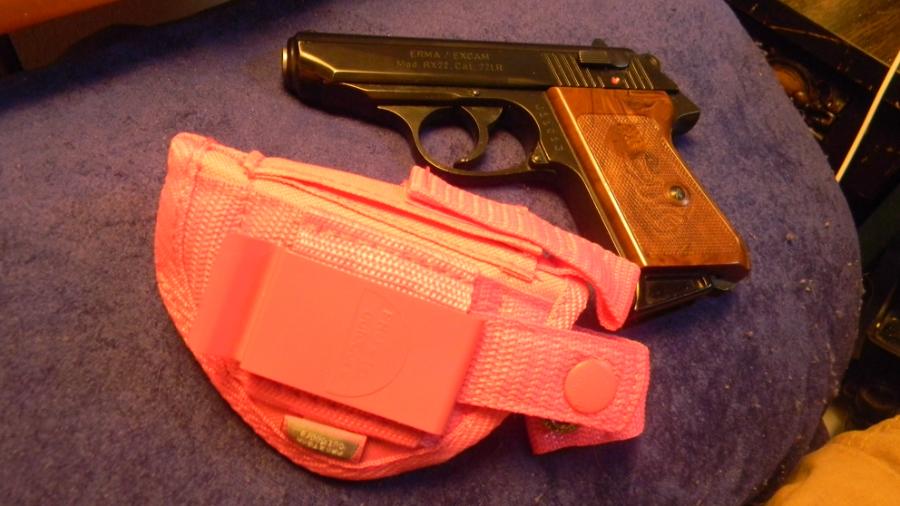
Erma Werke Rx22 Semi Auto Pistol In 22LR

Erma Excam - Erma Werke Rx22 Semi Auto Pistol In 22lr - Picture 1

Erma Excam - Erma Werke Rx22 Semi Auto Pistol In 22lr - Picture 2
Erma Excam - Erma Werke Rx22 Semi Auto Pistol In 22lr - Picture 3
Erma Excam - Erma Werke Rx22 Semi Auto Pistol In 22lr - Picture 4
Erma Excam - Erma Werke Rx22 Semi Auto Pistol In 22lr - Picture 5
Erma Excam - Erma Werke Rx22 Semi Auto Pistol In 22lr - Picture 6
Erma Excam - Erma Werke Rx22 Semi Auto Pistol In 22lr - Picture 7
Erma Excam - Erma Werke Rx22 Semi Auto Pistol In 22lr - Picture 8
Erma Excam - Erma Werke Rx22 Semi Auto Pistol In 22lr - Picture 9