When I was in the service, I did basic in 1985 and we were issued the M16A1 pattern rifle. I always was fascinated with the M16 rifle.
I completed Basic, went to AIT at Fort Devens and went to Germany with the 1st Infantry Division (Big Red One), while I was with 1ID we got issued M16A2, I liked the A2 better, it felt more substantial and studier than the A1 but I didn’t care for the 3 round burst.
I preferred the full auto version. We went to the range and got training and qualified with the rifle. The biggest reason I didn’t like the A2 was the 3 round burst.
I honestly believed the a well trained soldier can control the weapon better than a mechanical device. Other than that I really liked the weapon.
When I went to my second unit, we still had the A1. I became the armorer of this unit and went to SAM31(Small Arm Maintenance) class at Hohenfels, after I came back, I ordered A2 furniture and depending on the soldier, I would “size” the rifle for the soldier.
The A2 stock was longer than the A1 stock and I would use variations of A1 and A2 options to make the rifle more comfortable to shoot. I hate to brag, but this is part of the reason I got an ARCOM for my Armorer duties.
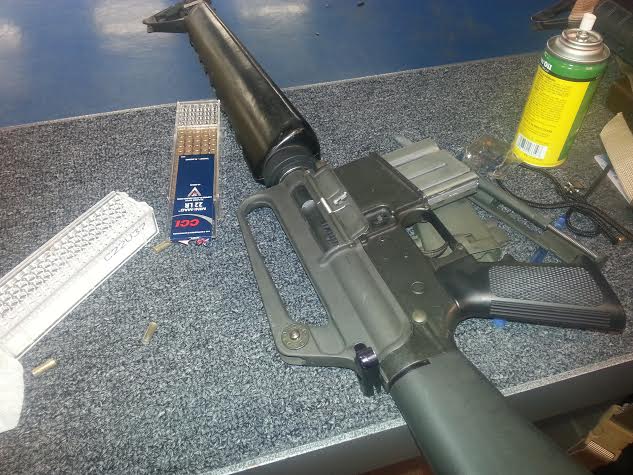
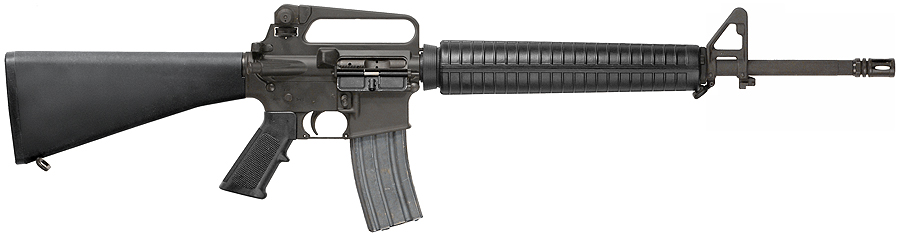
When we went to the Gulf, a lot of the rifles we had were modified A1’s, Mine had the A2 furniture and the barrel and upper was A2 but the lower was A1. I preferred this configuration. When I got out I bought my AR, it looked like this..
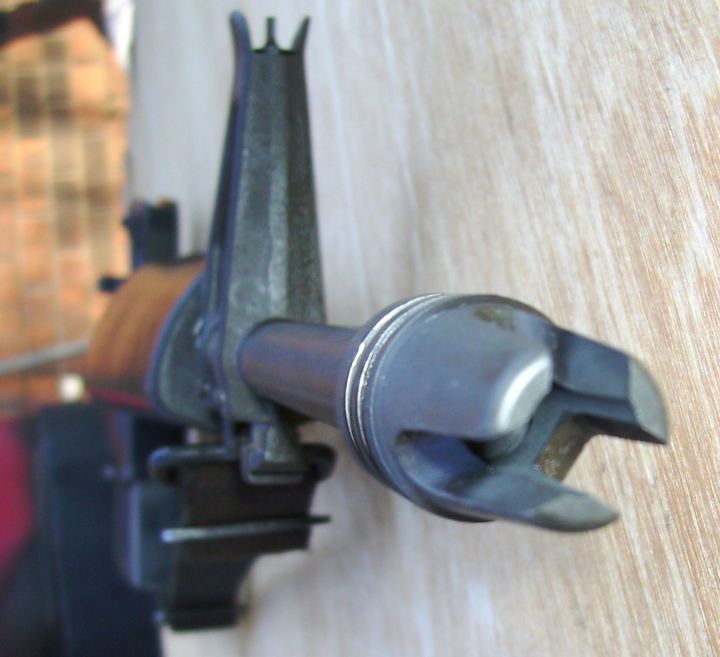
Even down to the Flash Supressor, ..
Mine looks like this one…
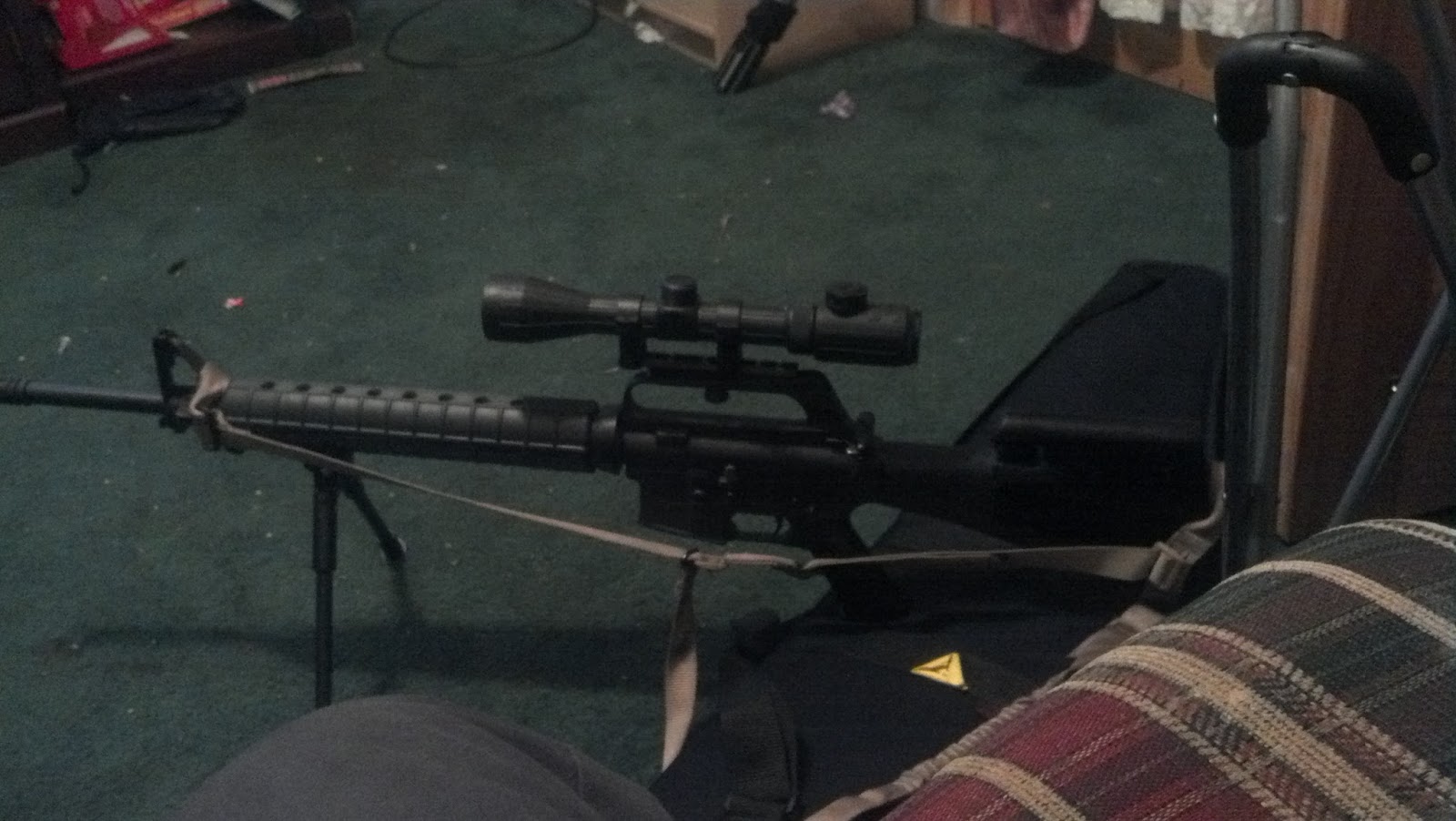
This was the style of my rifle since the mid 90’s, not very practical. but I shot for accuracy back then.
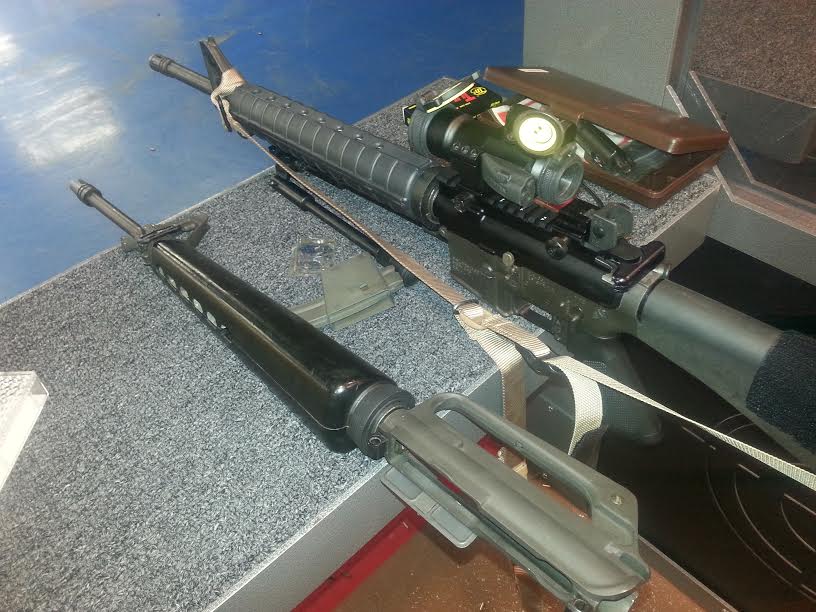
This is the current configuration. I love the modular configuration.
This is both configurations, One day I will buy a lower and make 2 rifles rather than play mix and match.
I am very comfortable with the A2 pattern rifle, I would carry one into war tomorrow, I am very comfortable with it. Although I would try to find a A1 lower and match it up like what I carried in the Gulf when I got deployed.
I saw this on
WeaponsMan blog and decided to snag it. I grabbed a bunch of pics from “google” to add to the story.
The M16A2 was adopted by the Marines in 1983, and then by the Army three years later, but all of its development was done, largely on a shoestring, by the Marines
For example, the finger bump on the A2 pistol grip? The very first prototype was built up by a Marine officer on an A1 grip, using plastic wood or body filler! Most of the modifications to the A2 were aimed at:
- Increased practical accuracy;
- Increased effective range;
- Increased durability; and,
- NATO compliance (adopting a NATO round equivalent to the FN SS109 round).
In a brief overview of the service life of the M16 series for American Rifleman in June, 2012, Martin K.A. Morgan encapsulated this history well:
In November 1983, the U.S. Marine Corps adopted a product-improved version of the M16A1 chambered for the 5.56×45 mm NATO round. The new rifle was called the M16A2 and it differed significantly from its predecessor: improved rear sights, a brass deflector, a heavier barrel and 1:7-inch rifling were among the changes. The M16A2 also replaced the M16A1’s “AUTO” selector setting with a “BURST” setting delivering three rounds with every trigger pull. The Army followed the Marine Corps’ adoption of the improved rifle in March 1986 when it ordered 100,176 M16A2 rifles from Colt. In September 1988, the U.S. government placed an initial order for 266,961 M16A2s with Fabrique Nationale’s North American subsidiary, FN Mfg., Inc. of Columbia, S.C. Late the following year, when 57,000 U.S. military personnel conducted the Operation Just Cause invasion of Panama, the M16A2 was used in combat for the first time.
For practical accuracy, the A2 had new sights, with a square front post; for range, a new round with a heavier bullet, and new rifling to match; and for durability, new stocks and handguards and significant metal reinforcement in the lower receiver’s weak areas, the pivot pin bosses and buffer tower.
The rifle was not without controversy in the Army. Indeed, contractors for the Army Research Institute for the Behavioral and Social Sciences examined the rifle and concluded that, as their paper’s abstract notes:
[U]se of the M16A2 rifle by the Army would be extremely problematic, a-fact due, in part, to the vast differences between the marksmanship training philosophies of the Army and the Marine Corps.
(The paper is here: http://www.dtic.mil/dtic/tr/fulltext/u2/a168577.pdf)
The Army had been researching improvements to the M16A1 for years, but hadn’t actually implemented any.
In the foreword to the Army Research Institute paper, the word “problematic” crops up again and one gets the sense that the
problem was this solution was Not Invented Here, and moreover, not developed the
way the Army wanted to develop one.
Referring to earlier research, they wrote:
A detailed evaluation of M16Al performance was conducted to determine adequacy, peculiarities, etc. The findings clearly indicated that the M16Al was an adequate combat rifle; however, many shortcomings were identified that should be addressed in a new rifle or any rifle Product Improvement Program (PIP).
They considered that the improvements in the A2, listed below, were suitable only for the peculiar circumstances of Marine Corps service.
The Marine Corps test results stated the following advantages for the PIP [Product Improvement Program -Ed.] rifle:
- Ease of training (handling and ease of sight movement).
- Improved safety (no hazard when adjusting elevation on the rear sight even with loaded weapon).
- Increased effectiveness at long ranges (more hits, better accuracy, and greater penetration).
- Improved handling characteristics and durability in hand-to-hand close combat.
- Reduced barrel jump and muzzle climb during automatic and rapid fire.
- Increased contrast and less glare with square front sight post.
- Stronger, more durable and improved grasping characteristics of front handguard.
- Stronger barrel with quicker twist to take advantage of increased effectiveness provided by new ammunition.
- Improved sighting characteristics providing quick target acquisition for moving targets and better detection of targets in low level light conditions at close ranges, and more accurate long range fire by use of two modified rear sight apertures.
- Increased ammunition conservation and more effective use of ammunition with burst control device.
- Conformity to human factors standards by lengthening stock (alleviating bruised eyebrows, noses, and lips).
- Stronger, more durable stock.
- Stronger, more durable buttcap which also reduces slipping on the shoulder during firing.
- More controllable and comfortable pistol grip contoured to the shape of the hand.
- Improved brass deflector which protects left handed shooters from hot ejected brass casings.
- Can use NATO type improved ammunition (XM855) which provides improved performance and penetration at long ranges.
The Army evaluators were impressed by that list of solutions, but thought they all traced back to four specific USMC objectives or requirements:
The above list of advantages is very impressive. It appears that the rifle meets the primary requirements stated by the Marines:
- A sight adjustable to 800 meters.
- A bullet with better accuracy at 800 meters and the capability to penetrate all known helmets and body armor at ranges of 800 meters.
- A rifle with more durable plastic parts and barrel which will take a beating during bayonet training and extended field exercises.
- The replacement of the full automatic capability with a burst mode which fires a maximum of three rounds with each pull of the trigger.
…but they thought that the requirements were too Marine-centric.
The list, however, represents the objective and subjective evaluation of Marine Corps personnel who are emphasizing the most positive aspects of rifle characteristics as they pertain to envisioned Marine Corps requirements.
This is the first of a three part series. In the second part, tomorrow on WeaponsMan.com, the Army contractors damn the A2 with faint praise and list a litany of A1 shortcomings that they believed that the A2 did not resolve.
In the third part, the modifications that they suggested in lieu of or in addition to the A2 mods are enumerated.
As it was, the contracting officer’s representative approved the paper in February, 1986. In March, and probably before any of the responsible officers read the paper, the Army went ahead and adopted the M16A2, just the way the Marines had shaken it out.
That makes this paper a time capsule
he M16A2 was adopted by the Marines in 1983, and then by the Army in 1986. Shortly before its adoption, an Army contract analyzed the M16A2 — and found it all wrong for the Army. The report is here:
http://www.dtic.mil/dtic/tr/fulltext/u2/a168577.pdfThis is the second of a three part series. In
the first part, yesterday on WeaponsMan.com, the Army contractors noted the specific solutions implemented on the A2 and the problems the Marines solved thereby, but complained that the problems and solutions were too USMC-specific.
In this part, we’ll discuss just what they thought was wrong about the Marines’ product. In the third part, which we’ll post tomorrow, we’ll list the modifications that they suggested in lieu of or in addition to the A2 mods.
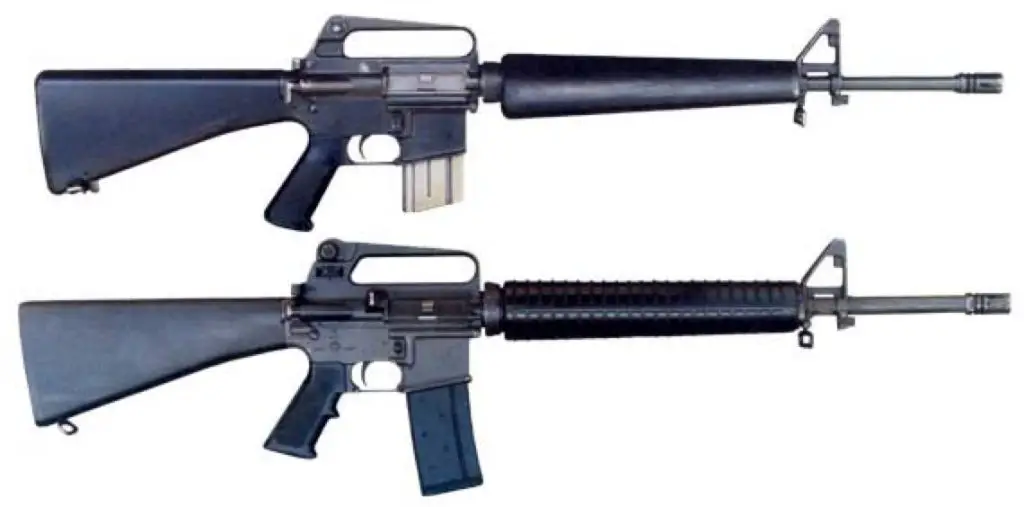
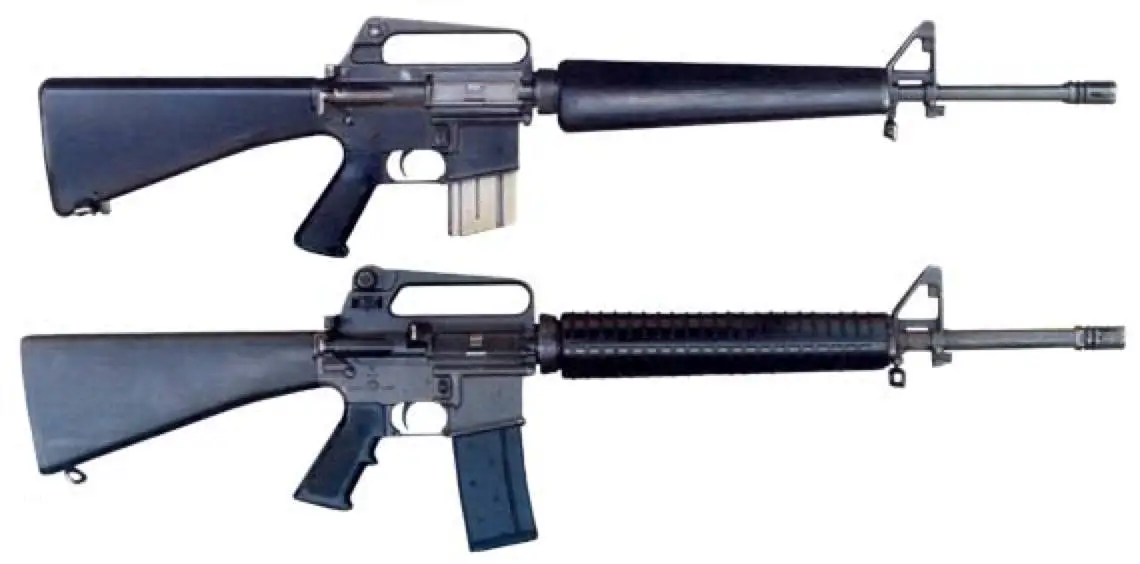
M16A1 (top) and M16A2.
As we recounted in yesterday’s post, the Army let a contract to analyze the Marines’ product-improved M16A1, originally called the M16 PIP (Product Improvement Program but in November 1983, type-classified as the M16A2. Did the A2 meet the Army’s needs for an improved rifle?
The contractors recounted 17 improvements in the A2 versus the A1, and traced those improvements back to four or five fundamental goals of the Marine program: more range, accuracy and penetration at that range, more durability, and a burst-fire capability in place of the full-auto setting.
The Army contractors recognized what the USMC had done — and damned it with faint praise.
The M16A2 rifle was developed and tested by the U.S. Marine Corps. The purpose of this present analysis was to evaluate M16A2 rifle features as they relate to U.S. Army training and combat requirements.
It was found that the M16A2 did not correct major shortcomings in the MI6Al and that many M16A2 features would be very problematic for the Army. Accordingly, this report provides several suggested rifle modifications which would improve training and combat performance.
The A1 shortcomings that the paper’s authors thought went unameliorated, or were worsened, by the A2 included:
- 25 Meter Setting: The M16A2 does not have a sight setting for firing at 25 meters, where zeroing and most practice firing occurs.
- Battlesight Zero: The M16A2 does not have a setting for battlesight zero, i.e., 250 meters.
- Aperture Size: The M16A2 probably does not have an aperture suitable for the battlesight, e.g., the single aperture used for most marksmanship training, the record fire course, the primary aperture for combat, etc. The 5mm aperture used for 0-200 meters is probably too large and the 1-3/4mm aperture used for 300-800 meters is probably too small.
- Sighting System: The M16A2 sighting system is too complex, i.e., elevation is changed three different ways, leaving too much room for soldier error.
- Sight Movement: Sight movements on the M16A2 result in changing bullet strike by different amounts; .5, 1, 1.4, and 3 minutes of angle (MOA)*. The sights intended for zeroing, .5 and 1.4 MOA, are not compatible with old Army zero targets or the new targets being fielded.
- Zero Recording: The M16A2 does not have a sighting system which allows for easy recording of rifle zero. Also, the zero cannot be confirmed by visual inspection.
- Returning to Zero: The M16A2 does not have a reliable procedure for setting an individual’s zero after changing sights for any reason, e.g., using MILES or .22 rimfire adaptors.
- Night Sight: The M16A2 does not have a low light level or night sight.
- Protective Mask Firing: The M16A2 has not been designed to aid firing while wearing a protective mask.
- Range Estimation: The M16A2 sight has not been designed to aid in the estimation of range
Let’s consider those, briefly. Note that every single one of those objections relates to the sights. There are no complaints about the other Marine improvements (not even the hated burst switch).
Most of the sight squawks were because the sight was different from the sights of the A1, which were pretty much as Stoner, Sullivan et. al. designed them circa 1959 (the earlier AR-10 sights are different, but the later AR-15 prototypes and their descendants all used something extremely close to the M16 and M16A1 sights.
(The USAF/USN M16 and the Army/Marine M16A1 differed only in the absence and presence respectively of a forward assist).
Even the protective mask issue is basically a sighting problem — with the then current US M17 gas mask, the rifle had to be held canted to use carrying-handle based rear sights.
Complaints 1-5 relate only to the M16A2 sights, but 6-10 are just as applicable to the then-issued Army M16A1.
Even at the time, it was clear that optical sights were better than irons — scopes for distance and red dots for close-in work. Army special operators had already tested — on the flat range, in the tire house, and on the two-way range — such early red-dots and both-eyes-open sights such as the Single Point and the Armson Occluded Eye Gunsight (OEG).
In the early 21st Century, universal optics would end the long run of the M16A2, and sweep away all these problems the 1986 Army contractors worried about.
But there was no way to predict that in 1986, not with any certainty.
And that’s Part 2 of our story. Tomorrow, we’ll cover the modifications to the M16 that the authors recommended in place of the A2.
The previous two stories set the stage, for a look at a report drafted for the Army Research Institute for the Behavioral and Social Sciences the Army was still pursuing the “best” (an upgraded M16 meeting all Army objectives) instead of the “good” (the M16A2, which was developed and revised to meet Marine objectives).
Of course, we all know the spoiler aleady: the Army accepted the Marine M16A2 as is, leaving the report as an orphaned artifact. The report is here:
http://www.dtic.mil/dtic/tr/fulltext/u2/a168577.pdf

Colt factory shot of the M16A2. The A2 was developed by the USMC, but was manufactured by Colt and FNMI.
This is the third of a three part series. In the first part, Thursday on WeaponsMan.com, the Army contractors noted the specific solutions implemented on the A2 and the problems the Marines solved thereby, but complained that the problems and solutions were too USMC-specific.
In
the second part, posted yesterday, we discussed just what they thought was wrong about the Marines’ product. In this, third, part, we’ll list the modifications that they suggested in lieu of or in addition to the A2 mods.
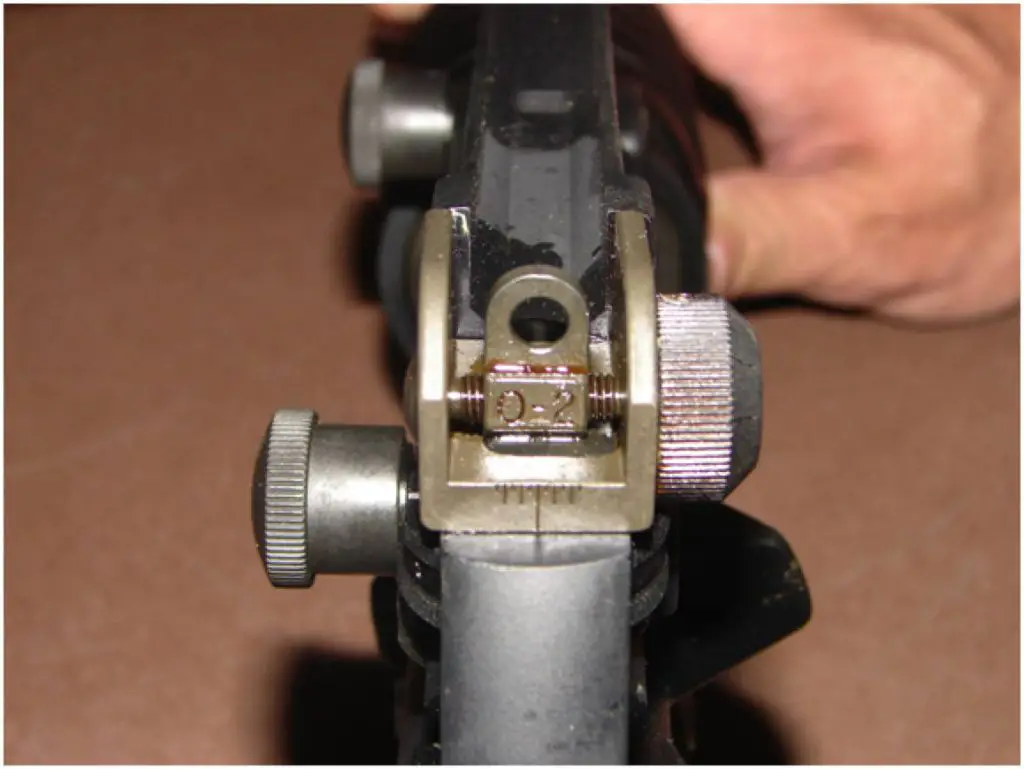
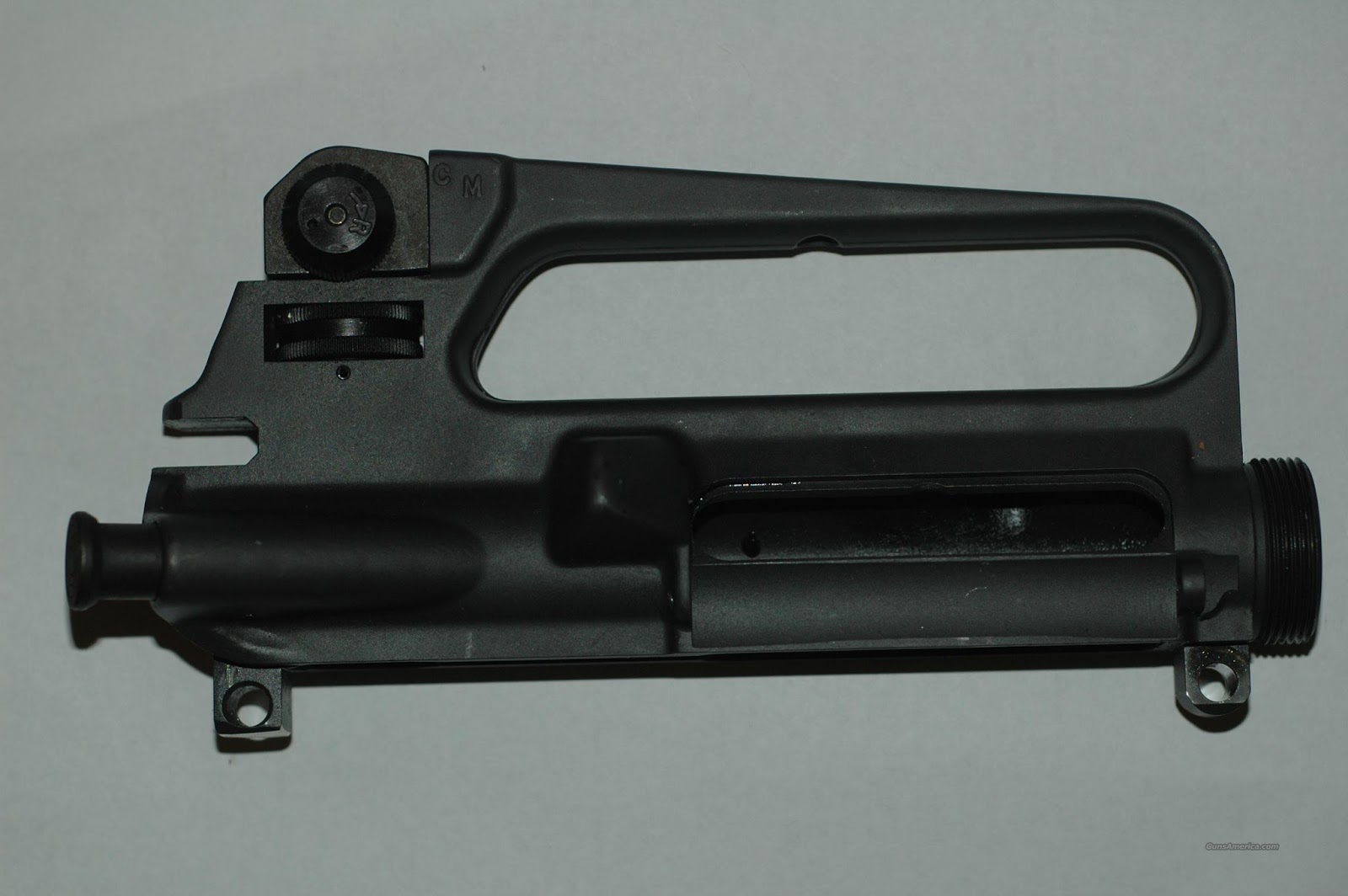
Most of the Army’s problems with the A2 related to the burst mechanism, and the sights, especially the complicated rear sight. (This is actually an A3/A4 or M4: note the knobs, left, for removing the carrying handle. The A2 handle was forged as part of the upper receiver.
Reliability
We should note that the Marines’ tests, as reported in this document (p,7), demonstrated significantly lower reliability, and increased fouling in the A2 compared to its older brother. These tests are suspect because the early lot of XM855 used was considered bad ammo, but the M16A1 did outperform the A2.
Thirty Ml6A1 rifles firing 26,010 rounds of M193
Failures to fire – none
Failures to feed – 3 (Not locking magazine in place)
Thirty M16A2 rifles firing 26,010 rounds of XM855
Failures to fire – 52 (27 – bad ammunition) (25 – mechnanical [sic] malfunctions)
Failures to feed – 3 (Improperly loaded magazines)
Those failures to fire that were not attributed to bad ammo were thought to be caused by the A2 trigger system’s Achilles’s heel, the burst trigger mechanism.
The A2 performed even worse in a cold weather test, but again, it was with the questionable ammunition, and many of the failures to fire were also laid at the feet of the burst mechanism.
The report has an interesting discussion of the burst mechanism and its rationale in Marine, but not Army, small arms doctrine:
The M16A2 has less combat capability due to the elimination of full automatic fire. Full automatic fire enhances the ability of Army units to clear and defend buildings, to conduct final assaults on enemy positions, to defend against an enemy final assault, to conduct an ambush, to react to an enemy ambush, to engage an enemy helicopter or fast moving vehicle, etc.
While the Marines claim greater accuracy and conservation of ammunition for the 3-round burst control, no data were generated during the test to support these contentions and no supportative [sic] data are known to exist.
Also, it should be noted that room-to-room fighting was conducted with blanks, no close-in firing was conducted, no firing with short time limits was conducted, no firing at aircraft was conducted, etc.
In other words, for all of the automatic/burst firing conducted during the test, a semi-automatic mode of fire would have probably resulted in a greater number of target hits.
Finally, to be given very serious consideration, is the fact that the burst control requires nine (9) new parts in the lower receiver, evidently contributing to the large number of weapon malfunctions during testing of the M16A2.
They also took issue with the heavy barrel (“heavy in the wrong place”), the twist rate (preferred 1:9), stock length increased when even the A1 stock was too long for small soldiers, and the fast twist’s incompatibility with the .22 subcaliber system.
The article includes an extensive comparison of the pros and cons of Marine KD vs. Army Trainfire marksmanship modalities.
These training differences result from the different combat envelopes for the rifleman: the Marines need to engage with rifles in the 300-to-800 meter space, because they don’t have the supporting arms that the Army can count on, at least, not in the same quantity.
A unit that must fight with just its organic weapons needs to get the very most out of these weapons. The Army of 1986 did not consider a 500 or 600 meter target a primary rifle target, but a crew-served-weapons target.
In the end, the recommendations the contractors made were mostly about the sights. They put their recommendations in a table with the M16A1 and M16A2 stats.
Since the latter are probably familiar to most readers, we omit them now to save time, and just show the contract recommendations.
| Item |
Recommended |
| Front sight (day) |
Fixed blade, 0.090″ |
| Front sight (night) |
Luminous dot on each sightguard |
| Rear Sight (day) |
single 2mm peep. A single elevation knob marked for 200, 250, 390, 25, 400, 500, 15, 600, 700, and 800 meters. Windage knob at rear. Each click equal to 1 MOA |
| Rear Sight (night) |
Two luminous dots on upper portion of receiver (or a single flip- up luminous dot located forward of the carrying handle) are aligned with front dots for shooting at night |
| Zero Recording |
Yes |
| Zero Inspection |
Yes |
| 25m setting (day and night sights) |
Yes |
| Mechanical Zero |
Yes |
| 250-m battlesight |
Yes |
| Firing mode |
Semi and Auto |
| Barrel |
20″. Slightly heavier than A1 at receiver and mid-barrel. 1:9″ twist |
| Handguard |
Same as M16A2 except held in place with a securely fastened ring nut to provide rigidity. |
| Buttstock |
Same material as M16A2. Same length as M16A1. Option for adjustable length. |
There are several interesting observations to make here. First, the contractors recommended that the Army make changes that would decrease the mechanical accuracy of the proposed M16Ax relative to the Marines’ A2.
Specifically, these changes included the wider fixed front sight blade, the 1-MOA adjustments on the rear sight (A2 offers ½-MOA), and arguably the simplification of the rear sight.
The trade-off was simplicity and ease of training, instead of superior bullseye performance.
Second, some of the proposals would definitely improve the utility of the firearm, including restoring the short stock, or replacing it with an adjustable one; increasing the barrel diameter towards the chamber rather than the muzzle, thus improving sustained fire accuracy and reliability; reverting to automatic fire from the burst mechanism (which also has side benefits, in improving the trigger’s feel and consistency). The night-sight proposal was truly ingenious.
Third, in some of these road-not-taken proposals, the Army was reverting to the original AR-10 design and rejecting changes that were largely imposed on the AR design by the Army in the previous decade. These include the rigid fastening of the handguard, and the fixed front sight blade.
Finally, these proposals were almost the last gasp of the iron-sighted military rifle. As this document passed from the contracting officer to file cabinets across the service, without action, special operators were already wringing out scopes and single-point sights, and a few visionaries were already arguing that the day of the iron sight had run its three centuries, and was now at an end.
A new generation of optical technology was eliminating the two objections that had kept optics off the rifles of most soldiers: less durability than irons, and slower target acquisition.
Many men’s efforts went into winning over the Voices of Experience who still said “no” to anything with a lens, thanks to memories of Uncle Joe’s elk lost because his scope fogged up, or the VC that got away because somebody attached an unauthorized 4×32 Colt scope to the carrying handle of his M16.