Categories
Month: May 2018
California Cities Are Free to Regulate Gun Stores Out of Existence
More Second Amendment setbacks in the Golden State when the Supreme Court declines to take a case about city zoning
The U.S. Supreme Court on Monday sent a clear message to millions of gun owners in California: You’re living in a Second Amendment-free zone.
In an order on Monday, without explanation or comment, the Court rejected a civil rights lawsuit brought by the Calguns Foundation and the Second Amendment Foundation. Those groups had hoped the justices would rule that the Second Amendment continues to apply even in the progressive enclaves of the left coast—and that law-abiding California residents possess the right to buy and sell firearms.
Instead, the Supreme Court declined to hear the case, a decision that underscores its willingness to let California legislators and judges evade the Second Amendment within the borders of the state.
In an order on Monday, without explanation or comment, the Court rejected a civil rights lawsuit brought by the Calguns Foundation and the Second Amendment Foundation. Those groups had hoped the justices would rule that the Second Amendment continues to apply even in the progressive enclaves of the left coast—and that law-abiding California residents possess the right to buy and sell firearms.
Instead, the Supreme Court declined to hear the case, a decision that underscores its willingness to let California legislators and judges evade the Second Amendment within the borders of the state.
“There are no significant Second Amendment obstacles to local and state gun control at this point,” said Don Kilmer, an attorney in San Jose, California, who is representing the gun rights groups. Also representing them is Alan Gura, who has taken two Second Amendment cases to the Supreme Court before.
Their lawsuit challenges a decision by Alameda, a California county that includes Oakland and other east bay cities, to enact a zoning law so onerous it effectively bans gun stores. The U.S. Court of Appeals for the 9th Circuit sided with Alameda in 2017, saying that “no historical authority suggests that the Second Amendment protects an individual’s right to sell a firearm.”
At least Monday’s decision serves one useful purpose: It exposes the federal judiciary’s willingness to elevate some constitutional rights over others.
If a city enacted zoning laws that effectively outlawed abortion clinics, and a federal appeals court had permitted it, the Supreme Court would have stepped in a heartbeat later. Under precedents going back to Maher v. Roe (1977), any law representing “direct state interference” with abortion is evaluated using strict scrutiny, the most exacting standard of legal review. Few such laws survive. (The 9th Circuit did not apply strict scrutiny to Alameda’s law.)
In today’s California, even adult movie theaters enjoy greater legal protections than gun stores. In a 1986 decision, the Supreme Court said the First Amendment allows municipalities to restrict such theaters (apparently they were a thing before the Internet) only if zoning laws provide a “reasonable opportunity to open and operate an adult theater within the city.”
The current lawsuit arose when three entrepreneurs, John Teixeira, Steve Nobriga, and Gary Gamaza, formed a partnership called Valley Guns and Ammo and started to look for potential locations in Alameda County. They planned to open a specialty shop that, in addition to selling firearms and ammunition, would have been the only store in the area to offer firearm safety training and certification, gunsmithing and repairs, and consignment and appraisal services.
Finding a location was difficult. An Alameda County zoning ordinance singles out gun stores by imposing extraordinarily strict rules. The location must be 500 feet away from any residentially zoned area, from any elementary, middle, or high school, from any preschool or day care center, from any other firearm retailer, and from any liquor stores, bars, or restaurants where liquor is served.
Alameda’s true motive, of course, was to outlaw gun stores. But the three men managed to find a location that complied—it was over 500 feet from the store to the front door of the nearest home—and Alameda’s zoning board approved the application. After complaints from anti-gun activists, however, the county changed its policy to require a distance of 500 feet from the store to the nearest area that was zoned for residential use. That made the distance from the store to the nearest home 446 feet, which the county said was not far enough.
The Calguns Foundation, the Second Amendment Foundation, and the California Association of Federal Firearms Licensees sued on behalf of the three entrepreneurs, but the outcome before the 9th Circuit was predetermined. This is one circuit that has never seen a Second Amendment violation and, unless President Donald Trump fills the current vacancies with reasonable picks, likely never will.
In theory, after the Supreme Court’s Heller decision in 2008, the Second Amendment right to self-defense joined the pantheon of constitutional rights including the right to worship, the right to be free from unreasonable searches, and the right to speak freely. After the court’s followup McDonalddecision in 2010, it was supposed to be another fundamental right for all Americans to enjoy.
Alas, the Bill of Rights is not self-enforcing; our judiciary is entrusted with upholding and defending it. But the unfortunate reality today is that many federal judges, including a majority of the 9th Circuit, have creatively defined away Americans’ right to self defense. And a majority of the justices on the Supreme Court have shown themselves, repeatedly, to be unwilling to do anything about it.
“If a lower court treated another right so cavalierly, I have little doubt that this Court would intervene,” Justice Clarence Thomas wrote in a dissent from his colleagues’ decision not to intervene after the 9th Circuit upheld another California anti-gun measure in February. “But as evidenced by our continued inaction in this area, the Second Amendment is a disfavored right in this Court… The right to keep and bear arms is apparently this Court’s constitutional orphan.” (Justice Neil Gorsuch joined Thomas in a separate dissent last year that made a similar point.)
Kilmer, the San Jose attorney representing the gun rights groups against Alameda, says: “The problem with the 9th Circuit’s activism, and the refusal of the Supreme Court to cabin in their abuses, is that the California legislature and local municipalities will feel free to do whatever they want.”
Exactly so: the Second Amendment has been effectively repealed inside California. I suspect that California’s millions of gun owners, who are subject to intrusive new registration requirements starting in July, are beginning to wonder: If federal judges routinely ignore the law, why can’t I?
Photo Credit: Benkrut/Dreamstime.com






Categories
Drilling & Combination Guns
Somebody means business!

Now most folks that have spent anytime around guns have seen a Savage 24 Shotgun & rifle combo.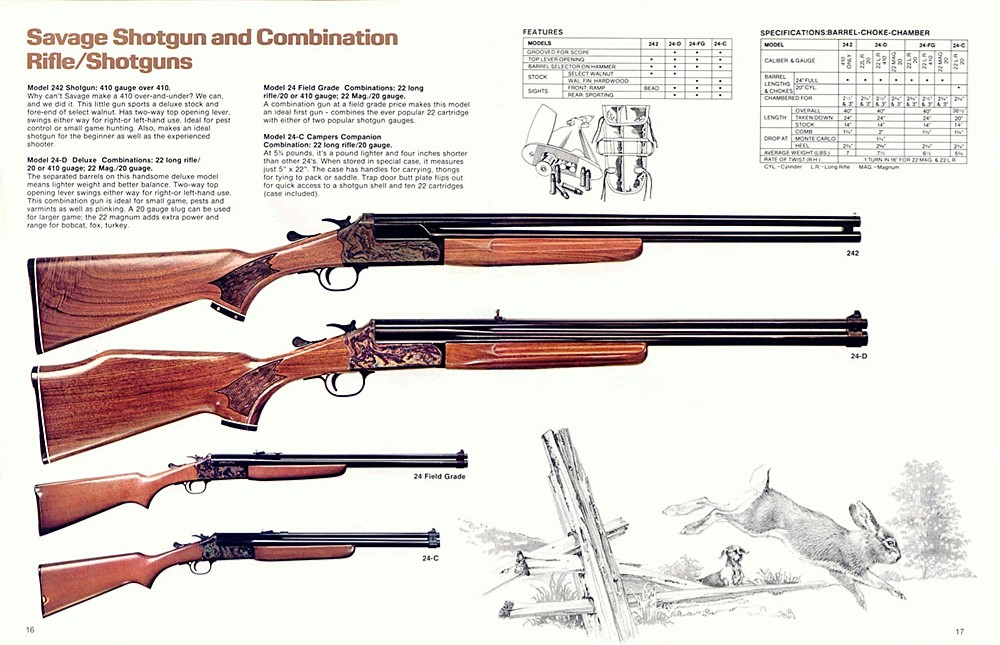
I first saw one over in Arizona when my Grandfather Morris pulled one out of the trunk of his car back in the 60’s.
But it was the Germans who took this idea back in the day. Who said why not make it a triple. Especially when the local Jager & or Graf (German Noble) wanted to go out and do some shooting on their estates.

With this kind of gun, he did not have to pack a couple guns but instead just have one. Makes sense right?

But as you can guess these guns were and still are. Extremely expensive to make and own. Which is why they are economically restricted to the upper classes.
Because if you can imagine. It takes a lot of time & skill to weld these barrels together in a manner that will guarantee accuracy.
So if you want one of these guns to add to the old collection. Be prepared to bring a lot of cash to the bargaining table. Here is some more information & stuff about this guns!
Attachments area




Combination gun
 |
A picture showing typical combination gun (top), drilling (middle, common drilling upper left), and vierling (bottom) barrel layouts
A combination gun is a break-action hunting firearm that comprises at least one rifled barrel and one shotgun barrel. Combination guns using one rifle and one shotgun barrel usually are in an over and under configuration. Side-by-side versions are referred to as cape guns. A drilling (German for “triplet”) is a combination gun that has three barrels. A vierling (German for “quadruplet”) has four barrels. Combination guns generally use rimmed cartridges, as rimless cartridges are more difficult to extract from a break-action weapon.
Contents
[hide]
Use[edit]
Combination guns have a long history in Europe, Africa, and Asia, dating back to the early days of cartridge firearms. These guns are almost exclusively hunting arms. The advantage of having a single firearm that can fire both rifle and shotgun cartridges is that a single gun can be used to hunt a very wide variety of game, from deer to game birds, and the shooter can choose the barrel appropriate for the target in seconds. As a result, they are popular with gamekeepers who often need the flexibility of the combination gun during their normal duties.
Firing mechanisms[edit]
The earliest combination guns were called swivel guns (not to be confused with the more widely known small cannon), which used a set of barrels designed to rotate to allow either the rifled or smooth-bore barrel to line up with a flintlockmechanism.[1] Modern combination guns tend to resemble double-barreled shotguns and double rifles, and are almost universally break open designs. Combination guns generally have a selector that allows the user to choose which barrel will fire. Drillings with two shotgun barrels and one rifle barrel may have two triggers, one for each shotgun barrel, and a selector that will allow one trigger to fire the rifle barrel. Four-barrel versions known as Vierlings generally have two triggers, and selectors to switch each between shotgun and rifle.
Layouts[edit]
Combination guns[edit]

M6 Aircrew Survival Weapon
Combination guns are over/under designs, usually with a shotgun barrel over a rifle barrel. Iron sights are commonly used for aiming the rifle, and the front sight alone is sufficient to point the shotgun. Scope mounts are available, sometimes with a cutout for aiming the shotgun barrels. However, the thinness of the shotgun barrels that are usually on top make the scope mounting awkward.
An interesting combination gun is the Ithaca M6 Aircrew Survival Weapon and a civilian version Springfield Armory M6 Scout, an all-metal folding combination gun in .22 Hornet over .410 bore.
Cape guns[edit]
A cape gun is a side-by-side version of a combination gun, and is typically European in origin. These were at one time popular in southern Africa where a wide variety of game could be encountered. British versions are commonly chambered for the .303 British service cartridge and a 12-gauge shotgun barrel, with the rifle barrel positioned on the left. German and Austrian cape guns have the rifle barrel on the right side and it is fired by the front trigger. The front trigger is usually a set trigger as well. The German and Austrian versions are commonly chambered in 9.3×74mmR and 16-gauge, although they were chambered in a wide variety of rifle and shotgun cartridges.
Drillings[edit]

Common drilling barrel arrangement side-by-side shotgun barrels over a rifle barrel

Scoped Drilling with a shotgun, center-fire rifle and rim-fire rifle barrels.
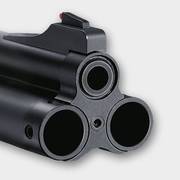
Drillings normally consists of two matching shotgun barrels and a rifle barrel (German: Normaldrilling, common drilling), but may cover a much broader range of shapes and configurations:[2]
- Two matching rifle barrels and one shotgun barrel
- Two rifle barrels of different calibers (typically one rimfire and one centerfire) and one shotgun barrel
- Three matching shotgun barrels
- Three matching rifle barrels
Since drillings were generally made by small manufacturers, each maker would pick whichever layout they preferred, or whatever layout the customer ordered. The most common layout was a side-by-side shotgun with a centerfire rifle barrel centered on the bottom. A similar arrangement of a side-by-side shotgun with a rifle barrel centered on top, generally a .22 caliber rimfire or .22 Hornet, was also fairly common.
Rarer were the drillings that used two rifle barrels and a single shotgun barrel. These were harder to make, since, like a double rifle, the rifle barrels must be very carefully regulated, that is, aligned during manufacture to shoot to the same point of aim at a given distance. This requires more precision than regulation of double-barreled shotgun barrels, which are used at shorter ranges with wide patterns of shot where a small misalignment won’t be significant. If the rifle barrels were the same caliber, then the three barrels were generally arranged in a triangle, both rifle barrels on top, or one rifle and the shotgun barrel on top (this being known as a cross-eyed drilling). If the rifle barrels differed in caliber, generally the layout would be an over/under using the shotgun and a centerfire rifle barrel, with a rimfire rifle barrel mounted between and to one side. These configuration, with shotgun/centerfire/rimfire barrels, are the most desirable configuration for modern collectors.
The triple barrel shotgun is the rarest configuration, and arguably is an odd variant of a double-barreled shotgun rather than a drilling, since it lacks the rifle/shotgun combination that all the other drillings have. The triple barrel shotgun is generally laid out like a side-by-side shotgun, with the third barrel centered and below the other two. The barrels are all the same gauge.
An unusual but notable drilling is the TP-82, or space gun, is a short-barreled drilling pistol consisting of two 12.5 mm smoothbore barrels over a 5.45 mm rifled barrel, with a detachable shoulder stock. It was developed by the Soviet Unionas a survival gun for their space program, and was in use from 1987 to 2007, when it was retired due to the fact that the unique ammunition it uses had degraded too far to be reliable.
Vierlings[edit]
Vierlings generally consist of two matching shotgun barrels, a .22 caliber rimfire rifle barrel and a centerfire rifle barrel. Although, they can come in a variety of configurations. Vierlings are quite rare and are almost always custom made for the high-end commercial market.
Calibers/gauges[edit]
 |
This section’s factual accuracy is disputed. (February 2012) (Learn how and when to remove this template message)
|
Few modern American makers make high quality combination guns for the retail market; most are simple, spartan models designed as survival guns or youth models. Combination guns show a fairly wide range of calibers and gauges; Savage Arms, for example, made models from .22 LR over .410 bore shotgun up to .30-30 Winchester over 3″ 12 gauge magnum (the Savage Model 24). The Springfield Armory survival guns are typically .22 long rifle or .22 Hornet over .410 bore Drillings are even rarer, and are almost invariably custom made to order. If ordering a custom model, the layout and gauge/caliber choices are up to the customer, so it is difficult to make generalizations about them. The used market shows some strong preferences, however; the side-by-side shotguns with single rifle barrel is the most common type, and therefore the least expensive. The single shotgun barrel with two different caliber rifle barrels is the most desirable, and will bring double the price, even more if one of the rifle barrels is .22 Long Rifle.
Vierling are especially rare, they generally have two side-by-side 12 gauge barrels, a .22 Long Rifle barrel on top and a center-fire rifle barrel below the shotgun barrels.
Since these guns tend to be break-open designs, they work best when chambered in rimmed cartridges. Rimmed case rounds like the .22 Hornet, .30-30 Winchester, 7×65mmR, 8×57mm IR(S) and 9.3×74mmR are all common choices, with 7×57mmR and 8×57mm IR(S) being the most common, as well as the heavier 9.3×74mmR, a round used commonly in Africa by European hunters. Gauges tend to be large, 16 or 12 being most common. Since drillings and vierlings are primarily European, American calibers are rarer and, at least in the American market, more desirable and expensive. Twenty-gauge drillings and vierlings also command a premium due to the relative rarity compared to the larger gauges. Many pre–World War II European guns are chambered for 65mm or 2- 9⁄16” shotgun shells. .
It is not uncommon to find combination guns paired with sub-caliber inserts for the shotgun barrels. These inserts, usually 9 to 11 inches long, slip inside the shotgun barrel(s) and chamber rimfire cartridges such as the .22 LR or .22 Magnum. These further increase the flexibility of the guns, and will add considerably to the value.
See also[edit]
- FAMARS Rombo a two caliber four barrelled break open shotgun
- LeMat Revolver
- Marble Game Getter
- Multiple barrel firearm
Categories
Oops or Gee Sir I can explain!
Categories
This Won’t Be Good by KIM DU TOIT
So this little snippet arrived in my Inbox a while ago, sent on by Loyal Reader Max H., who asks, “Waddya think?”
Oh FFS.
Oh FFS.
The US Army’s PEO Soldier – Project Manager Soldier Weapons has issued an Request for Information (RFI) to obtain industry feedback on possible submissions to Sub Compact Weapons (SCW) evaluations. The specification details offered by the Project Manager Soldier Weapons (PMSW) are scant and extremely broad. Describing potential SCWs as being select fire weapons, chambered in 9x19mm and having MIL-STD 1913 rail (Picatinny Rail) space.
The RFI, published 2 May, makes no mention of physical dimensions such as size or weight and instead seeks to cast as wide a net as possible for potential submissions. It does, however, call for suppressors, spares and slings for the weapon (not holsters). Potential future SCW submissions will have to chamber ‘9×19 mm military grade’ ammunition – meaning both M882 ball and the new XM1153 Special Purpose 9mm Round from Winchester.
The RFI gives interested parties until the 18 May to submit their responses. It remains to be seen what purpose the SCW would serve and to whom it might be issued. If earlier Army references to a Sub Compact Weapon system are to be believed the new weapon is likely destined for rear echelon troops – in the traditional PDW / submachine gun role.
It starts when the new acronym SCW (Sub Compact Weapon) is used instead of the universally-known SMG (Sub-Machine Gun). (When did the .dotmil start this fucking bullshit? Never mind, I know the answer.)
People, this is not difficult. You take a simple, basic and easy-to-produce concept like the venerable M3 Grease Gun, add the doodads the Army wants, and away you go. Most of the serious firearms manufacturers like SIG, CZ or IMI could do this in their spare time, like over a couple weekends.

Why use the Grease Gun concept as the platform? Because it fucking works, as countless dead Nazis, Japs or Commies would tell you, if they could. With modern steel and production CNC machining, you could have a prototype put together in two weeks, and after a couple months of testing, into full production.
Which is kinda what the .dotmil did with the M3 (minus the CNC) back in the Big One, and it served until the 1990s when the .dotmil ditched it because OMG it wasn’t cool enough anymore. (That’s not the official reason, of course, but it’s the real one.)
Simplicity is just not gonna happen here, of course. What will emerge is some massively over-priced, over-engineered and over-complicated abortion which will be too heavy and too unreliable, because the current loose parameters of the RFI are going to be tightened and tightened until they cry for mercy, and the REMFs are going to get something which they’ll ditch in favor of their handguns at the first opportunity. Something like the HK MP7:

…which begs the question, “Why not just use the MP7?” (It sure as hell is ugly enough.) Of course, that would be just too simple. The .dotmil hates simple, which is why they got rid of the perfectly-capable M3 Grease Gun.
Also, the .dotmil would never adopt a foreign-made SMG with a simple operating mechanism — such as the MP7 or Kalashnikov’s KR-9 SBR (short-barreled rifle) — because OMG Russia, even though Kalashnikov USA is the same type pf corporation as Beretta USA (which supplied the .dotmil with the M-9 pistol, lest we forget).

And the KR-9’s operating system is simple — again that damning word — when we all know that the Pentagon will only consider whizzbang-gee-whizz-complicated guns because that’s how they’ve operated since WWII.
Never mind that everything the Pentagon wants is right there in that photograph, and ready to ship for testing tomorrow. But that would be too easy. Let’s rather take five years to reach a decision and end up with something that doesn’t work well, costs too much and will be in production only after a further five years. (The cost of the KR-9, in the quantities that the Pentagon would order, would be about $395 per piece. Unthinkable.)
And I haven’t even broached the touchy subject of the .dotmil wanting to use the under-powered and pointless 9x19mm cartridge…
Bah.
Just so we’re all clear on the concept: I’ve fired some of the “modern” SMGs myself, notably the Uzi, Skorpion, the MP5 and yes, the Grease Gun. Of all, the little Skorpion was the easiest to manage and the most reliable, probably because of its dinky lil’ cartridge. But neither the simpler Uzi or Skorpion designs will ever be used because old and made by furriners. Also, they just don’t look ugly modern enough for today’s Army.
The .22LR is about as American as apple pie and it’s safe to say that no other .22 rifle is as American as the Ruger 10/22. Since the 1960’s, the Ruger 10/22 has been responsible for the countless shot-up cans, the taking of small game, and general fun having then just about any other .22LR made. This is for good reason. Similar to the AR-15, the 10/22 is manufactured in a way that makes it easy to swap out components to go from plinker to tack driver in no time. The most common way to do this is to swap the Ruger’s relatively thin factory barrel out for a heavy .920-inch bull barrel for better accuracy.


The Titan stocks are available in three, molded in colors. Black, Tan, and Green.
Since the factory stock’s barrel channel is only made for the thin barrel, the new bull barrel isn’t going to be able to just drop back down in the old stock, a new one is needed. Now, aftermarket stocks for the 10/22 are very plentiful and it’s easy to find one that can fit any budget but they are not without their pitfalls. For several years I had been using a Bell & Carlson 10/22 stock that closely emulated the B&C Light Tactical to create a sort of tactical trainer rifle. That stock was good but I decided an upgrade was needed and boy did I did I find it in the Victor Company Titan 10/22 stock.

The Titan pistol grip is nearly vertical so it’s very comfortable to shoot with a variety of positions. The texturing also keeps the hand firmly in position.
SPECS
- Type: Aftermarket stock; fits Ruger 10/22
- Material: Ultra-rigid engineering fiberglass; hardened aluminum bed anchor locking system
- Finish: Black, FDE, OD Green
- Features: Accepts free-floated barrels up to .920 in.
- Rail: Mini Picatinny Rail section
- Sling: QD swivel sling studs
- Design: Ambidextrous
- MSRP: $170
- Manufacturer: Victor Company USA
Victor Company USA has been around for a while, mostly making aftermarket skins and accessories for the Accuracy International chassis systems. A few years ago they branched out and introduced a new stock for the Ruger 10/22, which I’m sure made some enthusiasts roll their eyes at “another Ruger 10/22 stock”. If you start to peel back the layers though and start going down through the features and specs, it’s easy to see that this stock isn’t just another 10/22 stock. For starters, when you take the Titan out of the box the feel and quality of the stock belies its relatively low price point of just $170. It’s constructed not of cheap plastic or laminated wood but from a rigid fiberglass composite resin with hardened aluminum inserts to help support the action. The stock will fully free float a .920 bull barrel with room to spare and multiple sling attachment points and methods mean that a variety of slings can easily be used for carrying or shooting the rifle. It’s available in three colors, but the finish isn’t painted on, the colors are molded in for maximum durability over time without any peeling or chipping. The profile and feel aren’t too dissimilar from some of the popular tactical rifle stocks such as the McMillan A3 or Manners T2 so it can be a good choice for someone wanting to put together a .22 that mimics their centerfire rifle.

Even with the heavy target barrels there is more than enough room to spare.
As I said before, I’d been using a B&C stock for quite some time but it had its quirks. The receiver area was tight and I ended up having to relieve some material with a file in order to get the safety to function properly and have magazines drop free. The stock also didn’t completely free float the barrel, it had two barrel pads at the front and rear of the barrel channel for support. This meant that if I wanted to sling up to practice positional shooting I could count on my zero shifting in some form or fashion. In the B&C stock the rifle was also prone to experiencing inexplicable zero shifts, which was a bit annoying, especially if I was looking for accuracy and precision. Many of these issues could’ve been cured by pillar bedding the action but that is a time-consuming and messy affair I’d rather do without. Bedding a traditional stock like the B&C for a Ruger 10/22 involves installing a front bedding pillar, relieving the rear of the stock to create a shelf, and then bedding the rear of the receiver to that shelf. Most people that are looking to make enhancements to the 10/22 simply want to able to put a new barrel on, drop it in a stock, tighten a screw, and hit the range. This is where the Titan 10/22 stock comes in.

Not only is the stock equipped with flush cup mounting points but also features standard sling swivels and accommodations for a front Picatinny rail for QD bipods.
The Titan 10/22 stock isn’t really like other 10/22 stocks because it has what Victor Company calls the Anchor Lock System, which creates a chassis-like bedding interface for the receiver. It starts in the back of the receiver channel where a hardened aluminum insert creates a cozy shelf for the rear of the receiver to rest on. In many ways, it’s just like in a traditional 10/22 stock that has been relieved and bedded but with a twist those other stocks don’t have. The aluminum insert has a threaded hole that you use to insert a nylon tipped set screw so that it just barely protrudes out of the bottom. The nylon tip contacts the trigger assembly hanging below the receiver as it’s inserted into the stock and creates a bit of a wedge action that holds the rear solid. The front takedown screw is likewise well supported by a generous bedding pillar that has a surface area almost equal to the v-block holding the barrel on. When done correctly you should not feel any movement between the rear of the receiver and the stock when you flex the barrel as it sits in the barrel channel. I will say that I had to do zero inletting or fitting to the stock to get the magazines to drop free or the safety to engage properly. This wasn’t by chance though, Victor Company intentionally enlarged those areas to have additional clearance to mitigate any fitment issues across the wide range of aftermarket parts for the 10/22. At this point the receiver is locked in, the barrel is fully free floated back to the v-block, and it’s ready for some range time.
Article Continues Below

The front grip of the Titan stock is textured to limit slipping and features flush cup mounting points on both sides.
To be fair, this isn’t my first outing with my Ruger 10/22 in the Titan stock, I’ve actually had it for a few months but this is the first time that I’ve had the action in and out of the stock without confirming my zero. This would be a good test of the stock’s zero retention capabilities that I could then use to compare to my experiences with the B&C stock. My plan for the range was pretty simple, get a zero at 50 yards, shoot some groups, maybe do some positional stuff, and basically just have fun. You know the typical stuff that you do with a 10/22. Well, I couldn’t quite get 50 yards in the bay that I was in but I could get 45 yards so that would just have to do. At first, my intent was to shoot a partial box of Aguila rimfire ammo only in hopes of getting on paper and then getting a final zero with CCI Mini-Mags. Instead what happened is that I shot three very impressive groups with the Aguila that were so close to the original zero that I didn’t have to make much of an adjustment to the scope to the get the rounds hitting to point of aim. The first ten shot group measured about 5/8 inch, and it was really nothing more than a large hole in the paper. The next two ten shot groups both measured right around 3/4 inch but I was noticing that the groups were staying fairly consistent.

The barrel channel free floats the barrel and it can readily accept heavy .920 bull barrels.

This author was very satisfied with the accuracy performance of the rifle after being dropped into the Titan stock. The average group size for all 60 shots on paper was .676 inch.
I haven’t shot much of the Aguila ammo but I was liking what I was saw. I switched over to my usual CCI Mini-Mags to double check the zero on the scope and let loose with the first 10-round magazine. The first shot went a little low right but the next nine shots created a ragged hole just a little left of center, I almost couldn’t believe how good the group was. Keep in mind that CCI Mini-Mags are not match grade .22LR bullets so to me this kind of accuracy was awesome. I shot two more 10 shot groups with the CCI Mini-Mags before I concluded that after taking the action in and out of the stock twice, the elevation required no adjustment and I only needed to add .2 mils of right adjustment to get it shooting to point of aim. That is pretty darn good considering that in the B&C stock if I had to remove the action for cleaning or switch out parts, I could count on the zero shifting considerably. I measured all six groups with the smallest 10-shot group being .530 inch while the largest group was .903 inch. When I averaged the groups together it yielded an aggregate group size of just .676 inch over 60 shots between two different brands of ammunition. I can tell you honestly that I’ve never seen that kind of consistency and accuracy when the rifle was installed in the B&C stock.
I’m also happy to report that slinging up in shooter’s sling to add some stability in the sitting or kneeling positions also didn’t have a negative impact on the zero. The Anchor Lock system and the free floated barrel allowed me to really get some tension on the sling so that I was pretty steady looking downrange. I’d found some clay pigeons that got left on the range so I threw a few out and loaded up another magazine to see how well I could break them up from the kneeling. The comfortable grip angle, texturing in all the right places, and consistent accuracy that was afforded to me by the Titan stock meant that nine out of the tens shots broke those pigeons up into small bits. I spent a good portion of the afternoon ringing some of the steel targets and thoroughly enjoying this little rifle. The Titan 10/22 stock has breathed a little fresh air into this Ruger that I’ve had since I was 14 years old and it was a complete drop-in affair. It’s pretty hard to not like that.

Tin cans, varmints, and targets beware, the Titan stock is here.
Not only will Victor Company USA sell you the Titan 10/22 they also have accessories for the stock that some might find quite useful. There’s a cheek riser system that screws into the comb of the stock to tailor the stock to the shooter’s eye so they’re more comfortable behind the gun. A small Picatinny rail section can be attached to two pre-installed holes in the forend near the front swivel stud that allows a shooter to attached their Atlas or other quick detach bipod. To some people, the Titan 10/22 may not be the prettiest stock or the lightest but it does offer a solid set of features at an incredibly affordable price that makes it an excellent choice for those wanting to enhance the performance of their 10/22.
For more information about Victor Company USA, click here.
For more information about Aguila ammunition, click here.
For more information about CCI Mini Mags, click here.
To purchase a Ruger 10/22 on GunsAmerica, click here.