The first British use of the Gatling gun came in 1879 during the Zulu War. At the Battle of Gingindlovu, two guns broke up a Zulu attack with long bursts of suppressive fire that forced the Zulus to take cover.
At the Battle of Ulundi the guns were used to great effect, despite several jams. The British commander, Lord Chelmsford, later wrote that the Gatlings: “proved a very valuable addition… machine guns are, I consider, most valuable weapons… where the odds against us must necessarily be great.”
Indeed, this statement typified the use of the Gatling during the late 19th century: The guns, with their incredible volume of firepower for the time, acted as force multipliers in engagements where the enemy were far more numerous.
The Gatling would go with British units to Afghanistan, Egypt, and the Sudan in the late 1800s, remaining in service until the Maxim gun came around.
The British were not the only European nation to embrace the Gatling gun, Imperial Russia made large orders, and the Tsar used his Gatling guns against the Ottoman Empire during the Russo-Turkish War 1877-8 and again in 1905 during the Russo-Japanese War.
Gatling guns went to South America during the War of the Pacific, with Peru deploying them first in 1879. By 1880, nations and individuals around the world had bought Dr. Gatling’s guns.
The Gatling gun of the late 1870s was greatly improved from the early models, of tremendous rates of fire they were lighter, more reliable and extremely well made.
The improved Gatling gun’s finest hour came during the Spanish-American War. During the Battle of San Juan Hill, Lieutenant John Parker’s Gatling Gun detachment laid down suppressive fire on Spanish positions by firing over 18,000 rounds during the American attack, preventing the Spanish from firing down on the U.S. forces.
The detachment turned back the Spanish counter-attacks, too, by decimating an attacking battalion of Spanish regulars.
This success helped to prove to the U.S. Army that machine guns could be used offensively as well as defensively, with President Theodore Roosevelt himself praising Parker’s “invaluable work on the field of battle, as much in attack as in defense.”
But the end would come soon.
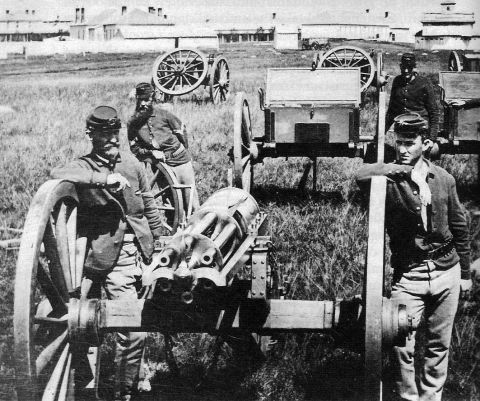
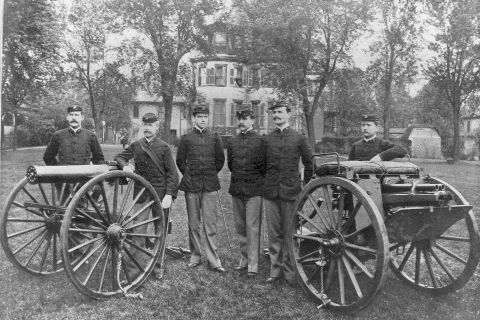
Officers of the US Marine Corps pose with two Gatling Guns, c.1896 USMC Historical
Despite American forces using the weapon into the 1890s, the Gatling gun fast became obsolete. The culprit in its quick death was Hiram Maxim’s new automatic machine gun, introduced in 1886.
The weapon would come to define early 20th century warfare. Maxim’s gun was recoil-operated, using the recoil energy created when the weapon was fired to cycle the action. Feeding from a cloth belt, the Maxim could fire up to 600 round per minute.
Gatling tried several times to revive his design after he saw market share slipping away. In 1893 he patented a Gatling powered by an electric motor.
In 1895, he tried to create a truly automatic gas-operated Gatling gun. These designs proved to be too complex or cumbersome, losing the simple practicality that made the original Gatling so good.
In 1911, the U.S. Army declared all its remaining Gatling guns obsolete and began a process of rearming with automatic machine guns.
Gatling himself never confined his life’s work to firearms design. The inventor patented a successful seed planter and wheat drill in 1855.
He later patented designs for flushing toilets, a device to control wagon reins, and a steam plough. He died in February 1903 at the age of 84.
More than a hundred years later, the Gatling gun is one of a rare few weapons that are iconic and instantly recognisable.
The Gatling owes a lot of its fame to its unique operation and appearance, one cemented in the public imagination first through Buffalo Bill’s Wild West Shows and later through comics, pulp fiction, and countless films.
Today Gatling’s design lives on in the form of electrically powered M134 Minigun and fearsome auto-cannons like the GAU-8 used in the USAF’s A-10. Even in the 21st century, the Gatling gun is no mere museum piece.







 Lee-Enfield No. 4 Rifle (1943), courtesy

_-_UK_-_cal_303_British_-_Arm%C3%A9museum.jpg)