The United States Marine Corps (USMC) is a desegregated force, made up of troops of all races working and fighting alongside each other. In 1776 and 1777, a dozen Black American Marines served in the American Revolutionary War, but from 1798 to 1942, the USMC followed a racially discriminatory policy of denying African Americans the opportunity to serve as Marines. For more than 140 years, the Marines recruited primarily European Americans and white Hispanics, along with a few Asian Americans.
The USMC opened its doors to blacks in June 1942, with the acceptance of African Americans as recruits in segregated all-black units. Other races were accepted somewhat more easily, joining white Marine units. For the next few decades, the incorporation of black troops was not widely accepted within the Corps, nor was desegregation smoothly or quickly achieved. Spurred by executive orders in 1941 and 1948, the integration of non-white USMC personnel proceeded in stages from segregated battalions in 1942, to unified training in 1949, and finally full integration in 1960.[1]
By 2006, approximately 20% of the USMC was Black American and 15–18% Hispanic;[2] more than the 30 to 31% of the U.S. ratio of minorities in the general population.[3]
History
Background
In America, blacks fought alongside whites in the Continental Army against Great Britain, and in every war up to the War of 1812. The first black American to fight in a Marine role was John Martin, also known as Keto, the slave of a Delaware man, recruited in April 1776 without his owner’s permission by Captain of the Marines Miles Pennington of the Continental brig USS Reprisal.
Martin served with the Marine platoon on the Reprisal for a year and a half, involved in hard ship-to-ship fighting, but was lost with the rest of his unit when the brig sank in October 1777.[4]
At least 12 other black men served with various American Marine units in 1776–1777; more may have been in service but not identified as blacks in the records.
However, in 1798 when the Marine Corps was officially re-instituted, Secretary of War James McHenry specified in its rules: “No Negro, Mulatto or Indian to be enlisted”.[4]
Marine Commandant William Ward Burrows instructed his recruiters regarding USMC racial policy, “You can make use of Blacks and Mulattoes while you recruit, but you cannot enlist them.”[4]
This policy was in line with long-standing British naval practice which set a higher standard of unit cohesion for Marines so that they would remain loyal, maintain shipboard discipline and help put down mutinies.[4]
In the United States Civil War, some 180,000 African Americans joined the Union Army and mostly served in support roles as teamsters, laborers, construction workers and cooks.[citation needed]
Some fought the Confederate Army under European American officers in segregated units. In later conflicts, the United States Army used black soldiers in the Spanish–American War and in World War I.
However, when the United States Army Air Service was formed, only white people were allowed.[5] Mexican Americans served in World War I integrated with European Americans in all of the service arms.[6]
The United States Navy used black sailors as cooks, stewards, construction workers and unskilled labor, but did not train them to fight.
The Marine Corps, being a combat arm of the Navy, did not recruit any black soldiers. Instead, the USMC was serviced by US Navy supply personnel including black laborers.
Unlike the US Army which had separate regiments that a soldier could remain in for his entire military career, Marines were individually transferred to various ship’s detachments and naval bases.
After World War I, the number of blacks in both the Navy and the Army was reduced to about 1.5% of the total number of active servicemen, a proportion much lower than the number of blacks in the general population.[5]
Franklin Roosevelt administration[edit]
During the administration of Franklin Delano Roosevelt, the growing political power of African Americans was increasingly felt in Washington, DC. Civil rights groups such as the National Association for the Advancement of Colored People (NAACP), the National Urban League, and the National Negro Congress called for greater equality between the races.
In 1938, the Committee on Participation of Negroes in the National Defense Program was formed by the Pittsburgh Courier, a newspaper with a large black readership. Further calls to increase the proportion of blacks in the military were published in 1939.[5]
After wars broke out in the late 1930s in Africa, China and Europe, black community leaders determined to use the black workforce’s loyalty as leverage to gain greater racial equality at home.
In June 1940, the NAACP’s magazine, The Crisis, published a declaration that the fighting around the world was certainly bad, “but the hysterical cries of the preachers of democracy for Europe leave us cold. We want democracy in Alabama, Arkansas, in Mississippi and Michigan, in the District of Columbia, in the Senate of the United States.”[5]
During the 1940 presidential election, both parties courted the black vote. Incumbent President Franklin Delano Roosevelt was re-elected, partly because substantial numbers of black voters crossed previous party lines and voted for the Democratic Party candidate.
In April 1941 the US Navy convened its General Board to discuss expansion of the USMC. Major General Thomas Holcomb, Commandant of the Marines, who lived in Delaware and Washington, DC in his early years and attended private schools, said that African Americans had no right to serve as Marines.
He said, “If it were a question of having a Marine Corps of 5,000 whites or 250,000 Negroes, I would rather have the whites.”[7]
In 1941, civil rights activists Bayard Rustin, A. Philip Randolph, and A. J. Muste pushed Roosevelt to order fair employment for blacks in the federal government.
The activists threatened to march on Washington, DC, in July 1941, and Roosevelt intended to prevent such a public relations disaster for his presidency.
On June 25, 1941, Roosevelt issued Executive Order 8802; the elimination of racial discrimination from federal departments, agencies, the military, and from private defense contractors. The black activists cancelled their planned march.
Directed by Roosevelt and US Navy Secretary Frank Knox to accept black recruits, Holcomb proposed a separate battalion of African Americans, a seacoast defense battalion armed with anti-aircraft and anti-shipping artillery.
To make this battalion self-supporting, Holcomb determined that it would contain a rifle company, special weapons platoons, and a light tank platoon—all manned by black Marines.[7]
World War II[edit]
In early 1942, Philip Johnston, a U.S. Army veteran of World War I, suggested to the USMC that they follow the example of the Army and recruit native speakers of the Navajo language to pass important tactical messages by radio, to serve as code talkers on the battlefield.
On May 5, 1942, the first group of 29 Navajo recruits was accepted at Marine Corps Recruit Depot San Diego.[8] From 1942 to 1945, some 375 to 420 Navajo trained as code talkers, part of about 540 Marines who were native Navajo speakers during World War II.
All of these soldiers served in desegregated units alongside Marines of various races.[9] A total of 874 Native Americans of various tribes served in the USMC in World War II.[10]
After the Japanese attack on Pearl Harbor, men of Japanese birth and descent were classified as enemy aliens and excluded from the United States draft.
In addition, on the US mainland, the federal government forced most ethnic Japanese Americans to relocate from Pacific coastal areas to internment camps located inland of the Pacific and controlled by armed guards.
It was not until 1944 that a fighting unit of Japanese-American Nisei (American-born) men were recruited and trained for military service. Japanese Americans were allowed to join only the Army, not the Navy, Marines or Air Corps.[10] The 442nd Infantry Regiment, consisting primarily of Japanese Americans, fought in Europe.
The USMC did not form battalions of Asian Americans. Rather, it integrated Asian-American recruits with European-American soldiers.[citation needed] The first Chinese American USMC officer, Wilbur Carl Sze, was commissioned as a second lieutenant in December 1943.[11][12]
In contemporary times, proportionately fewer Asian Americans join the U.S. military than appear in the U.S. general population.[13]
On June 1, 1942, the initial group of black USMC recruits was admitted, but they were not immediately trained because separate, segregated facilities had not been completed.
Black volunteers began their basic training in August at Montford Point in North Carolina, a satellite base to Marine Barracks, New River, later called Marine Corps Base Camp Lejeune.
The first black recruit to arrive in camp was Howard P. Perry on August 26, followed that day by 12 others.[14] These and subsequent recruits were organized into the 51st Composite Defense Battalion,[15] a static artillery unit intended to hold land against attack.
By October 29, only 647 of a planned 1,200 recruits had passed entrance examinations—to avoid forming segregated training units to teach typing, truck driving and other specialist skills necessary to run the battalion.
Holcomb required more than half of the recruits to demonstrate proficiency in these skills prior to acceptance.[7] This requirement was dropped in view of the delay it caused in bringing the battalion up to strength.
Recruits were taught specialist skills by white USMC instructors brought into Montford Point, or they were sent to nearby Army classes.[7]
The black recruits were not allowed in Camp Lejeune unless accompanied by a white Marine, and their service papers were stamped “Colored”.[16]
Although the U.S. was by this time fully engaged in war, the recruits were assigned to inactive duty in the Marine Corps Reserve.
Their units were segregated—all the enlisted servicemen were black, with white officers and drill instructors.
The commander of the black Marines at Montford Point was Samuel A. Woods Jr who worked to enforce segregation, protecting his troops from being detained by local authorities while they were visiting town.[17] By early 1943, the white drill instructors were leaving for war and were being replaced by black sergeants and corporals.[16]
After accepting more black recruits, the USMC formed the 52nd Defense Battalion. Both the 51st and 52nd shipped out to fight in the Pacific War, but as defense units holding land far behind the front lines they did not see much action.[18]
In total, 19,168 African Americans joined the Marines, about 4% of the USMC’s strength; some 75% of them performed their duties overseas. About 8,000 black USMC stevedores and ammunition handlers served under enemy fire during offensive operations in the Pacific.
Following the June 1944 Battle of Saipan, USMC General Alexander Vandegrift said of the steadfast performance of the all-black 3d Marine Ammunition Company: “The Negro Marines are no longer on trial. They are Marines, period.”[1]
1948 to 1960[edit]
After World War II, the USMC reduced in size; the number of African-American Marines dropped to 2,000 men, which was one-tenth of wartime levels.[1]
In 1947, the Marine Corps forced African-American men to choose between leaving the service or becoming a steward (a food service position).[1]
A few non-white Marines advanced in grade, such as Kurt Chew-Een Lee, a Chinese-American soldier who was commissioned a second lieutenant in 1946. Lee earned the Navy Cross under fire in Korea in September 1950, serving in the 1st Battalion 7th Marines; at the time this was a primarily Euro-American unit.[19]
On July 26, 1948, President Harry S. Truman issued Executive Order 9981 establishing equality of treatment and opportunity in the U.S. military regardless of race.
He appointed the President’s Committee on Equality of Treatment and Opportunity in the Armed Services, two of whose five members were African American. In January 1949, the Fahy Committee (nicknamed after its chairman) met to hear concerns by armed forces’ leaders about the new executive order, and both the Army and the Marine Corps leadership defended their practices of segregation.
The Navy and the newly formed United States Air Force announced their intentions to follow the order. The USMC said that it had only one black officer among 8,200 white ones.[20]
In late 1949, all-black USMC units persisted, but the Marines had black and white recruits beginning to train together. The few black USMC officers were assigned exclusively to black units; they were not asked to lead white Marines into combat.
In 1952 after two years of the Korean War, the Marines cautiously integrated blacks into combat units.[1] In the late 1950s, black Marines were not rewarded with preferred or high-visibility assignments, such as embassy guard duty and guard duty in the nation’s capital.[1]
By 1960, full integration of the races had been completed by the USMC, but racial tensions flared up through the next decade, a period of civil rights activism in the larger society.[1]
Representation in other media[edit]
In May 2011, The Black Rep of Saint Louis, Missouri gave the world premier of The Montford Point Marine, a new play by Samm-Art Williams about a veteran of the unit and his life after his groundbreaking training and service in Korea.[21]
See also[edit]
Montford Point Marine Association
From Wikipedia, the free encyclopedia
This article is about the nonprofit organization. For the article about the military base, see
Montford Point.
The Montford Point Marine Association (MPMA) is a nonprofit military veteran’s organization, founded to memorialize the legacy of the first African Americans to serve in the United States Marine Corps. The first African American U.S. Marines were trained at Camp Montford Point, in Jacksonville, North Carolina, from 1942 to 1949.
The association’s stated creed is:
To promote and preserve the strong bonds of friendship born from shared adversities and to devote ourselves to the furtherance of these accomplishments to ensure more peaceful times.
The organization supports educational assistance programs, veterans programs, and community services, with an emphasis on improving the social conditions of the growing population of military veterans who are disabled or senior citizens.
Membership in the nonprofit organization is open to veterans and active members of all branches of the U.S. Armed Forces regardless of race, creed, or national origin. The MPMA also hosts the MPMA Ladies Auxiliary. Membership in the Ladies Auxiliary is open to wives, daughters, sisters, and mothers of members or former members of the United States Armed Forces.
History of Camp Montford Point[edit]
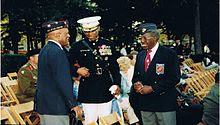
Reuben J. McNair, Sr., and a fellow veteran of the Montford Point Marine Association, converses with a present-day African American Marine officer.
In 1940 while the United States prepared for war, millions of jobs in the defense industry were being created. Blacks seeking jobs in the growing defense industries suffered violence and discrimination. Many black leaders, including A. Philip Randolph, president of the Brotherhood of Sleeping Car Porters and the most widely known spokesperson for black working-class interests in the United States, met with Franklin D. Roosevelt and his administration to demand that he sign an executive order banning discrimination against black workers in the defense industry. Randolph threatened to bring tens of thousands of marchers to Washington, D.C. On June 25, 1941, days before the march was to occur, Roosevelt issued Executive Order 8802, which barred government agencies and federal contractors from refusing employment in industries engaged in defense production on the basis of race, creed, color, or national origin. It was the first Presidential decree issued on race since Reconstruction. The order required the armed services, including the Marine Corps, to recruit and enlist African Americans.
Recruiting for the “Montford Marines” began on June 1, 1942. Thousands of African American men, eager to serve, flocked to recruiting offices. The first black recruits received basic training at the segregated Camp Montford Point in Jacksonville, North Carolina. The 1,200 men in the quota were housed in prefabricated huts. Racism continued in the Marine Corps after the issuance of Executive Order 9981, reflecting that in the society. Railroad tracks divided white residents from the camp for African American troops, and the black recruits were not allowed to enter the main base of nearby Camp Lejeune unless accompanied by a white Marine. By 1945, all drill instructors and many NCOs at Montford Point were African Americans.
Between 1942 and 1949, more than 20,000 men were trained at Montford Point. In July 1948, despite strong opposition from Democrats of the segregated South, President Harry S. Truman signed Executive Order 9981, which required the desegregation of the military. In 1949 Montford Point was deactivated, and new black recruits were sent to Parris Islandand Camp Pendleton. During the Korean War, the United States Marine Corps fully integrated.
In 1965, a reunion of Marines was held in Philadelphia which included former Montford Point Marines along with Marines on active duty. With more than 400 Marines from throughout the United States gathered, they decided to establish the Montford Point Marine Association as a nonprofit veterans organization, to preserve military history and help people in need. The association has many chapters, and is a member of the Marine Corps Council, a council of Marine-related service groups.
The Montford Point Marine Association maintains archives, and the Montford Point Marines Museum at Camp Gilbert H. Johnson, Jacksonville, North Carolina. It holds an annual convention to celebrate the Montford Point Marines, make organizational decisions, and distribute scholarships.
On 27 June 2012, the Congressional Gold Medal was awarded to the Montford Point Marines.
Notable Montford Point Marines[edit]
-
Training picture of Eugene Groves, one of the first African Americans to enlist in the United States Marine Corps and train at Montford Point
-
Sgt Maj Gilbert “Hashmark” Johnson, one of the first African American drill instructors in the Marine Corps
Appearances in Popular Culture[edit]
The main character of the long-running crime drama NCIS, Leroy Jethro Gibbs is played by Mark Harmon and his character is named for his father’s best friend, Leroy Jethro Moore, a Montford Point Marine (played by Billy Dee Williams). The character L.J. Moore was depicted receiving the Medal of Honor for his actions in the Pacific Theater of World War II, notably only receiving the medal after corrective actions were taken by U.S. Congress in 1996. A photo showing Williams shaking hands with President Bill Clinton was also displayed, lending some extra realism to the story. The episode titled The Namesake was the fifth episode of the tenth season and originally aired on CBS on October 30, 2012. The episode ends with a dedication to the Montford Point Marines “Honored with the Congressional Gold Medal, June 27, 2012.”