


John Barkley was an unlikely hero.
In his youth, Private First Class John Lewis Barkley was a bit of a troublemaker. He was known to sneak liquor into his unit area and had a not inconsiderable weakness for women both French and German. Interestingly, when he had originally attempted to enlist he was denied due to a severe stutter.
John Barkley ultimately made it into the Army on his second try.
Later, at age 22, Barkley found his way into the US Army after the need for troops became severe. Barkley was an otherwise typical young American hailing from a small town in Missouri. In World War 1 he found the greatest adventure of his life.

John Barkley’s job was to kill Germans and he embraced it.
John Barkley served with Company K of the 4th Regiment of the 3d Infantry Division in most of the major American engagements during the First World War. A reconnaissance specialist and sharpshooter, Barkley spilled more than his share of German blood. However, he understood the war to be a fight between good and evil and he had few qualms about the violence he visited upon the enemy. Barkley was satisfied with his lot as a private soldier and eschewed promotion when the opportunity arose. His job was to kill Germans pure and simple, and he threw himself into it.
A near miss from artillery during the Second Battle for the Marne changed Barkley’s life.
During the Second Battle for the Marne, artillery fire splintered a nearby tree and dropped a heavy branch onto him, leaving him unconscious for several hours. He awoke without his stutter. His mom viewed this as a miracle conjured from amidst a veritable sea of blood.
Beginnings
Barkley headed off to war a self-confident young sharpshooter.
John Barkley was born in Blairstown, Missouri, in August of 1895. A hard man from a nation of hard men, Barkley grew up knowing austerity and deprivation. When he went off to war he was enthusiastic, driven, and dangerous.
Barkley’s introduction to the messy bits of war was viscerally overwhelming.
As is always the case, Barkley’s introduction to practical war was both shocking and stark. On board a troop train packed with wounded these were his initial observations, “The train was packed with men. Men lying as still as if they were already dead. Men shaking with pain. One man raving, jabbering, yelling, in delirium. Everywhere bandages . . . bandages . . . bandages . . . and blood.”
The Medal of Honor
The Germans during World War 1 were well-trained and formidable fighters.
On October 7, 1918, World War 1 had just over a month to go before it bled itself dry. John Barkley found himself this fateful day in an observation post some five hundred meters from the German lines.

Cunel, France, was a desolate place during the war.
Before the war had blasted everything to hell, there had been a small picturesque French community nearby called Cunel. This particular bloodbath came later to be known as the battle for the Argonne Forest.
WW1 battlefields in 1918 were ravaged places.
Artillery, machine guns, and poison gas transformed the World War 1 battlefields into something out of Dante. This late in the war the toxic combination of tanks and desperation drove men to truly extraordinary efforts. That desperation became the soil from which true heroes are raised.
The WW1-era French Renault FT tank was small, lightweight, and vulnerable. More than 3,700 were produced.
An earlier assault had left a small French tank destroyed near Barkley’s fighting position.

Disabled weapons litter the industrial battlefield. PFC John Barkley found himself with a disabled German Maxim gun in need of attention.
Among the detritus of combat, he also found himself in possession of an inoperative German Maxim gun and an ample supply of belted ammunition. Like most men of his generation, John Barkley was fairly adept at fixing things. Throwing stuff away when it no longer works is a recent disease.
The classic MG08 Maxim gun mounted on a massive sled mount but was reliable and fairly easy to run.
In relatively short order he had the German MG08 up and running. It turned out that on this particularly bloody day he would soon have desperate need of that captured German gun.
The Germans in WW1 were smart and relentless. Over time, John Barkley came to read their intentions from the state of the battlefield.
A man in combat develops a sixth sense for trouble.

A nearby disabled French Renault FT tank became John Barkley’s improvised hard point.
John Barkley could tell the Huns were up to no good, so he climbed into the disabled French armored vehicle and mounted his captured German gun where it gave him a generous field of fire. In short order the Germans slathered his position with artillery fire, driving his comrades back or to ground.
John Barkley turned an enemy Infantry assault into a deadly ambush.
Throughout it, Barkley crouched inside the derelict French tank awaiting the inevitable Infantry assault that he could feel was coming.
Barkley waited until the Germans were abreast his position.
Barkley waited patiently until the advancing German troops were in line abreast his position.
John Barkley killed multiple dozens of German assault troops single-handedly.
When the moment was perfect he leaped up from the tank and triggered the German gun, mowing down the shocked Hun soldiers by the bushel. John Barkley’s audacious surprise attack splintered the German assault, killing or wounding dozens of enemy soldiers.
The Germans responded with concentrated artillery fire from a cannon like this 77mm monster. One 77mm round struck the derelict tank’s drive wheel and exploded.
Desperate for a breakthrough, the German commanders directed concentrated artillery fire on Barkley’s already ventilated tank at point blank range. One 77mm high explosive round struck the tank’s drive wheel and exploded, rocking the little vehicle and showering the surrounding area with dirt. Throughout it all John Barkley remained in position, manning his gun singlehandedly in the face of overwhelming odds.
When the dust settled German dead were scattered all around Barkley’s position.
Satisfied that this one American soldier with his captured German gun had been silenced, the Huns launched a second massive assault on Barkley’s position. The lone American repeated his performance a second time, shattering the attack and leaving more than a hundred German dead surrounding his position.
Barkley held his position through guile and force of personal will.
The resolute defense PFC Barkley established enabled American troops to advance and seize the strategic hilltop near John Barkley’s last stand. When fresh troops retook the area they found more than four thousand expended shell casings inside John Barkley’s ruined French tank.
The Human Cost
The sights, sounds, and smells of war tend to change a man.
John Barkley sent his brother a letter soon after his heroic defense of that forlorn moonscape. His words explain what a close thing that engagement actually was. Time, distance, and the limitations of the language conspire to mute the horror of that day.
The end result of John Barkley’s implacable defense was bodies stacked like cordwood.
“Don’t think I’m going to tell you anything about that tank deal. It is too bad to tell a civilized man. I played them dirty every chance I got, and this is not the first time I ever did this.”
“I fired my last round of ammunition from the machinegun but kept my automatic pistol for hand-to-hand fighting: plunged out of that tank with a sudden dash. I had three bullet marks in my clothes and a burnt legging string.”
The Guns
The original German MG08 Maxim gun was adapted from Hiram Stevens Maxim’s original design.
The MG08 Maxim gun revolutionized the way men killed each other. The brainchild of American-born British inventor Hiram Stevens Maxim in 1884, the infamous Maxim gun armed both sides throughout World War 1. While the Germans employed what may be seen as the definitive model, the British Vickers was based upon the same internal mechanism.
The MG08/15 was a lightened version of the earlier sled mount gun. Despite its svelte lines the gun still weighed 39 pounds empty.
The Maxim was a recoil-operated weapon and was actually one of the first recoil-operated guns ever devised. The Maxim in its ground configuration was a water-cooled beast that fired at around 600 rounds per minute.
The British version of the Maxim action was the improved Vickers gun.
The Maxim ultimately saw service with the English, Russians, Germans, Finns, Chinese, Americans, and many more.
When properly serviced and supported the MG08 Maxim would run almost indefinitely.
The Maxim gun was sinfully heavy by modern standards and was typically crewed by between four and six men. However, when properly stoked and supplied with an ample supply of water for the barrel jacket the gun could fire almost indefinitely. The end result was carnage on an unprecedented scale.
The Colt 1911 pistol was a revolutionary gun for its day.
The automatic pistol John Barkley carried was an early example of the legendary Colt 1911 in .45ACP. Designed by the firearms luminary John Moses Browning, the 1911 was the finest combat handgun of the war. Offering superb reliability, exceptional accuracy, and unrivaled knockdown power, the 1911 remains in service with some specialized military units even today.
The Colt 1911 .45ACP pistol that John Barkley carried for personal defense was a rugged and effective combat handgun.
The combat handgun has evolved profoundly in the past century. However, John Barkley’s 1911 set a standard for battlefield effectiveness that has not since been bested. Despite indescribable gore and deprivation aplenty, Barkley could take solace in the fact that the pistol that rode on his hip in October of 1918 was the best combat sidearm on the planet.
Denouement
John “Blackjack” Pershing was commander of the American Expeditionary Forces during WW1.
PFC John Barkley received his Medal of Honor in 1919 from the legendary General John “Blackjack” Pershing.
Field Marshal Ferdinand Foche was renowned for his ample whiskers.
He also received the Medaille Militaire from French Field Marshal Ferdinand Foche. When Foche kissed him on the cheeks, per the French custom, his bushy mustache brushed Barkley’s face and caused him to sneeze violently. A young American officer named Douglas Macarthur was in attendance and nearly disrupted the proceedings with laughter.
John Barkley’s memoirs were republished years after his death. This book has been likened to All Quiet on the Western Front.
Barkley published an autobiographical work in 1930 titled “No Hard Feelings.” In more recent years the book has been edited and republished as “Scarlet Fields: The Combat Memoir of a World War 1 Medal of Honor Hero.”
John Barkley remained a humble man throughout his life.
John Barkley came home from the war and settled into a humble life, farming two hundred acres around Johnson County, Missouri. Barkley died in 1966 at the age of 70.

John Barkley’s grave is nondescript with little to inform the casual observer of his remarkable wartime feats of heroism.
He is buried in the Forest Hill Cemetery in Kansas City, Missouri.
John Barkley was a highly decorated WW1 American hero.
John Barkley has been described by those who knew him as unassuming, likable, and modest. On a particularly dark day in October of 1918, Barkley singlehandedly stopped an aggressive German Infantry assault using a captured German machinegun and a knocked-out French tank. John Barkley personified American heroism and courage.
Barker’s exploits have been memorialized in his home state of Missouri.
The Guns
| MG08 Maxim | Colt 1911 | |
| Caliber | 7.92x57mm | .45ACP |
| Weight | 60 lbs | 2.4 lbs |
| Length | 42.5 in | 8.25 in |
| Barrel Length | 26.5 in | 5.03 in |
| Action | Recoil-Operated | Short Recoil |
| Cyclic Rate of Fire | 550-600 rpm | N/A |
| Feed System | 250-rd Canvas Belt | 7-rd Box Magazine |
 Funny but there is not a beer bottle in sight! Grumpy Ex 18th US Cavalry
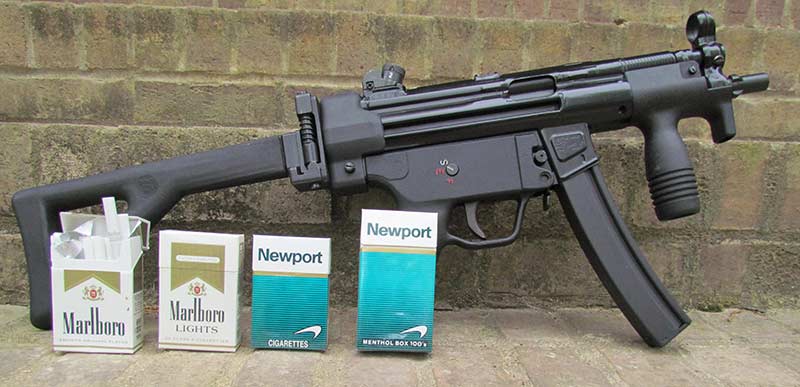
I absolutely despise cigarettes. They kill 478, 000 Americans
per year, roughly the same number we were losing at the
height of the Covid pandemic.
“I can’t breathe, doc,” the man said. Dave is 56 years old and a lifelong smoker.
Vitals were pretty decent. No fever. I could smell it when I walked through the door. He is nicely dressed but smells like a stale campfire mixed with feet. He looks 25 years older than he is.
“Hey, bro, what can I do for you today?” I already knew the answer. This was not the first time we’ve had this conversation.
“I got the crud again. Happens to me this time every year. Coughing’s driving me crazy. Can’t sleep. That’s driving my wife crazy. She’s driving me crazy. Can’t get any work done. Nobody wants to buy a car from somebody who sounds like he has TB. I want a shot.”
He stares at me quietly now. The look in his eyes communicates that the fact that he is sick is somehow my fault.
“Any fevers?”
“Nope.”
“Coughing anything up?”
“Green crap. Looks like rotten peanut butter. Tastes like hell.”
“You don’t have any sugar problems, do you?”
“You never told me I did.”
“Any drug allergies?”
“I’m allergic to clams and ugly women. They both make me swell up like a toad.”
He smiles. He’s told me that before. I smile back just to keep him happy.
I put my stethoscope on his chest and ask him to hold his breath. His heartbeat is sinus, and I don’t hear any murmurs. I press my scope against his back in half a dozen places. His lungs sound like a harmonica factory — soft musical wheezes but no crackles. In the absence of fevers or more troublesome lung sounds, he likely doesn’t have pneumonia. I put my stethoscope around my neck and take a glance in his mouth. His tongue is brown. I study his hands. His fingertips are yellow.
“You know it’s coming, don’t you?” He slumps his shoulders and looks deflated but doesn’t say anything.

We invest ludicrous amounts of time and treasure on survival.
A fraction of that effort spent on healthy living would pay
much greater dividends.
“When you gonna to put ’em down, buddy? They’re killing you right before my eyes. I don’t think you have pneumonia today. Four months ago, you did. Remember that? Nearly killed you then. You spent what, four days in the hospital? Let me help you with this, brother. I got all sorts of tools that can help get you off those things.”
“C’mon, doc. Just give me my damn shot. I got a stressful job. If I don’t sell cars, I don’t eat. If I didn’t smoke, my wife would strangle me. That time two years ago, you talked me into quitting, she went out and bought me a pack three days into it just so I wouldn’t be so bad to be around. I just caught something.”
“Listen, stud, I tell people they are going to die from lung cancer about once every six weeks, and I deal with the stress of my job without cigarettes. You can, too. That’s an excuse. Be a man.”
He didn’t say anything, but he was clearly ready to move on.
“Help is a phone call away anytime, and you know it. Leave me a message, and I’ll call you in some medicine to help you put them down. For now, I’ll send you some antibiotics for 10 days and some of that nighttime cough medicine that helps you sleep to the pharmacy. I’ll get you a prescription for a puffer that will help open your chest up as well. My nurse will be here in a minute with a shot of steroids. You know how that’ll make you feel. Come back if you’re not better in four or five days, and we’ll do a chest X-ray. Go to the ER if it gets worse. You got any questions?”
He spunked up when he realized his sermon was over. Now, he was a salesman again.
“Nope. Thanks, doc. Tell your wife hi for me. You ever want to trade in that antique jeep you drive for a proper set of wheels, you come see me. I’ll make you a good deal.”
He meant that. Despite my best efforts to the contrary, I genuinely like this man.
“You tell your bride hi for me, too, Dave. Holler at me if you don’t get better.”
I was in and out in seven minutes. It took me longer than that to write about what we had discussed, order his shot and send his prescriptions to the pharmacy electronically. Smokers are great for business. We ought to put a big bowl of Camels in the waiting room with a sign that says, “Free, Take One.”

Throughout the 19th and 20th centuries, one of the world centers of gunmaking was the Belgian city of Liège, which sits on the banks of the Meuse River in the country’s Wallonia region. Today, this city still remains a prominent part of the worldwide firearm industry, as it still is the home of one of the world’s most-recognized gunmakers, Fabrique Nationale.
But FN is one of the last surviving remnants of what was once a diverse and thriving gun trade that produced everything from common military muskets to some of the finest sporting arms of the age. One of the longest-lived companies producing fine guns in Liège was the firm of Auguste Francotte, founded in the early years of the 19th century.
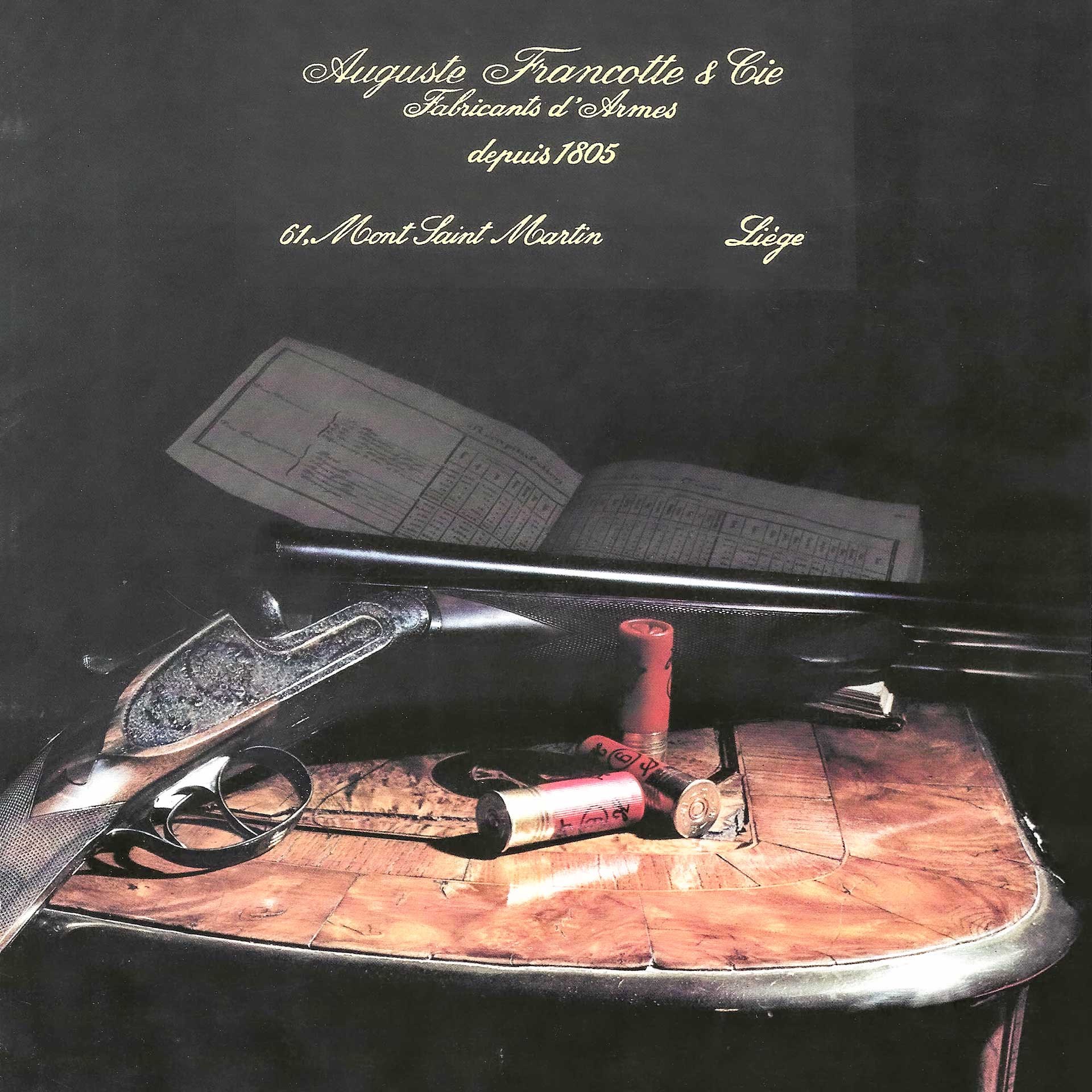 The cover page of A. Francotte’s 1990 catalog illustrates the company’s traditional approach to fine sporting arms. American Rifleman archives.
Like many Belgians in Liège, Francotte got his start in military guns, but turned to the production of fine sporting arms, which were produced by a highly skilled team of gunsmiths using traditional techniques. This traditional approach to gunmaking would remain a hallmark of the company and would continue to be the primary method by which Francotte sporting arms were made until the turn of the 21st century.
Remarkably, the Liège firm of A. Francotte would outlast many other Belgian makers, despite its adherence to traditional methods of manufacture. For much of the 19th century, guns were made by hand, with parts produced and fitted together by individual workers and gunsmiths into one-of-a-kind examples made to a general pattern. These parts could not interchange with parts in other guns, but by the end of the 19th century, production processes changed to meet the demands of military and commercial customers.
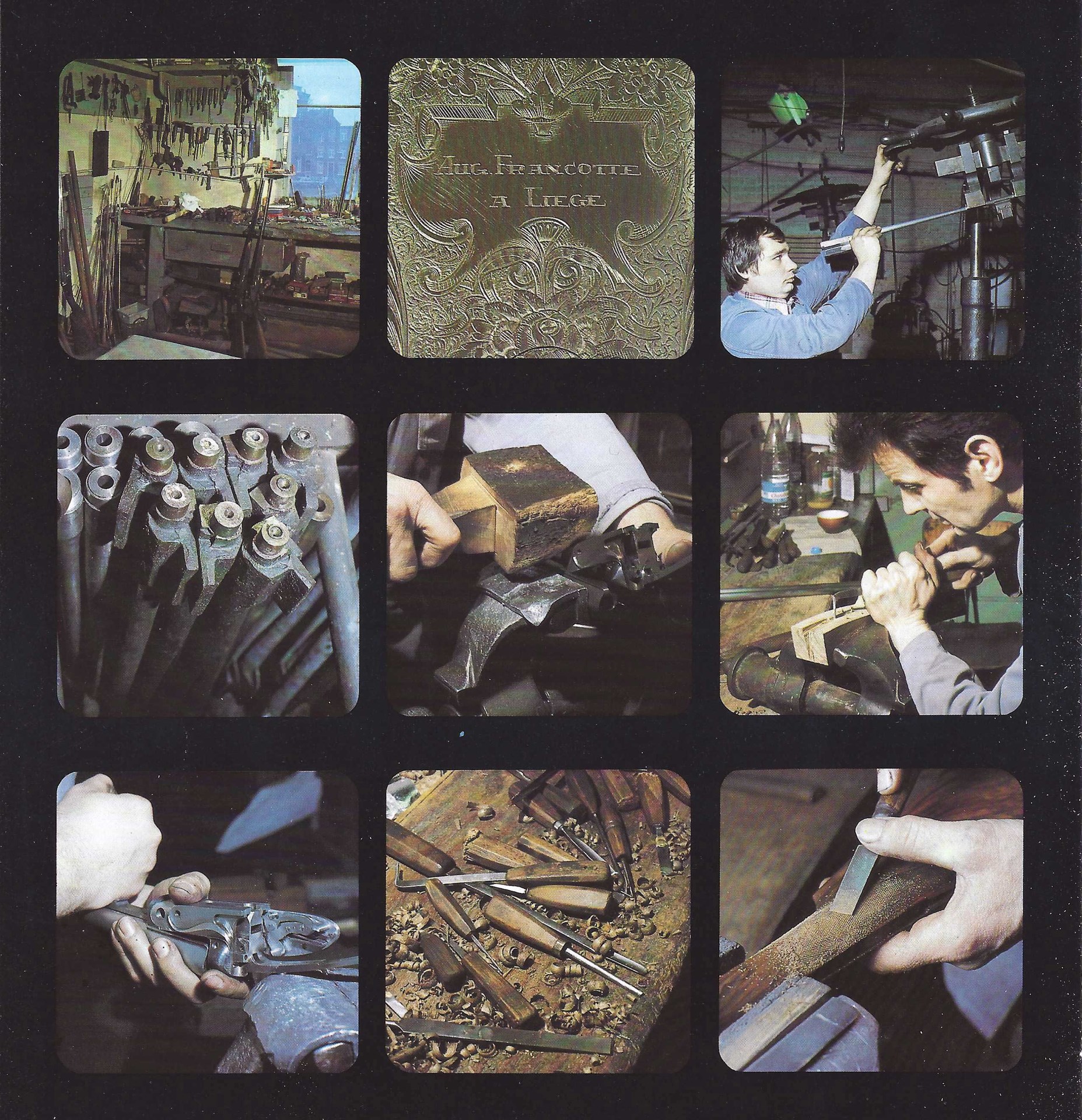 Even in the 1990s, Francotte’s gunsmiths used tools and techniques that were more familiar at the turn of the 19th century rather than the turn of the 21st century, as shown in the company’s marketing material. From American Rifleman archives.
In 1889, an order placed by the Belgian government for 150,000 Mauser rifles led more than a dozen Liege manufacturers to band together, creating Fabrique Nationale d’Armes de Guerre, literally translating to “National Factory of Weapons of War.” Francotte was one of these 18 companies to contribute towards the modernization of Liège armsmaking, but when it came to its own arms production, processes remained traditional and slow.
Despite this, a market clearly remained for Francotte’s products, as the company outlasted other Belgian makers that folded as the 20th century unfolded. American Rifleman tested one of Francotte’s fine side-by-side shotguns in January 1991, noting that “the only failing we could find was that the Francotte doesn’t fit any pocketbooks here.” At the time, this “entry-level” Francotte sporting arm carried a suggested price of $18,000.
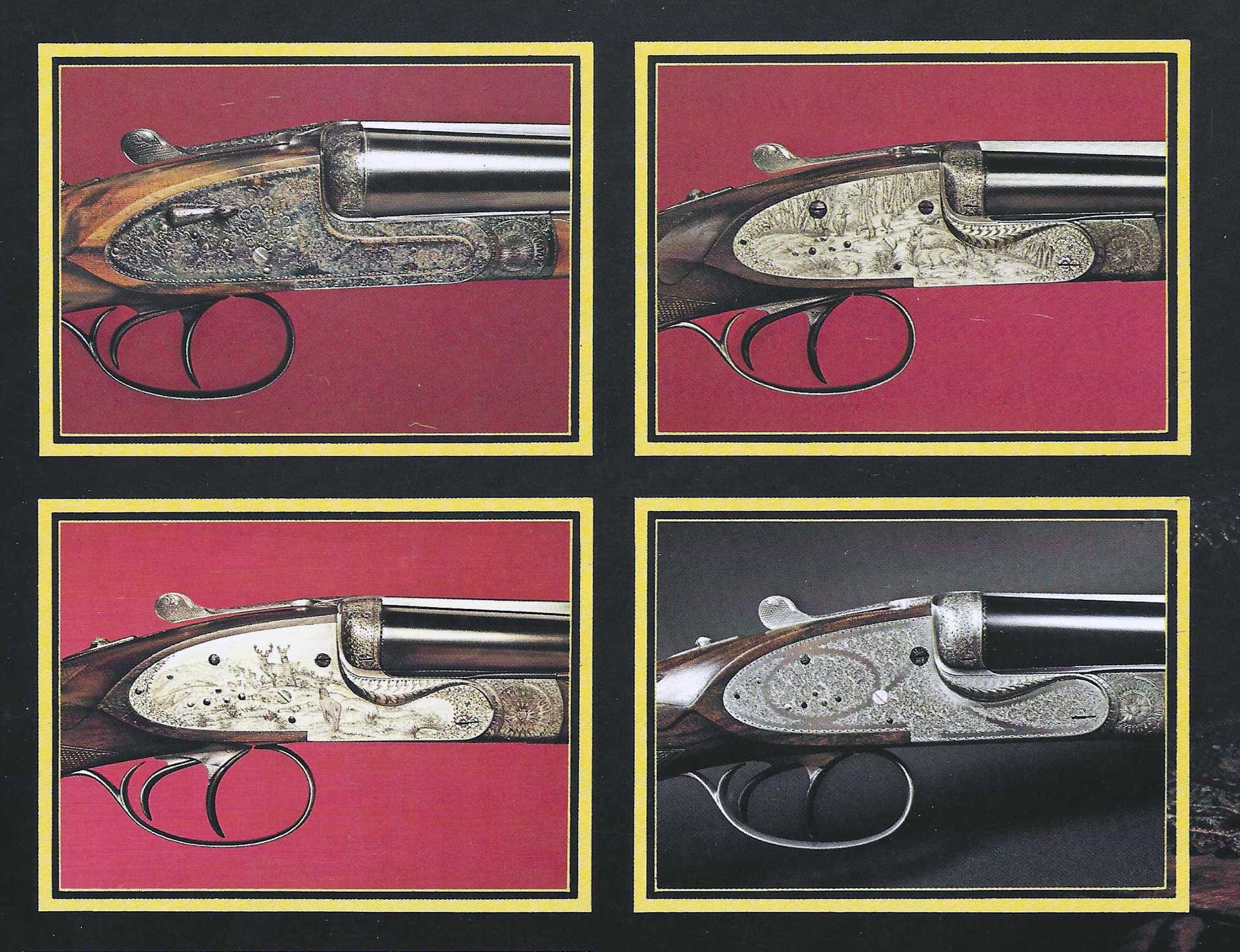
Whereas modern makers offered specific models of arms, Francotte remained entirely traditional. Each gun was crafted to the unique requirements of its owner, who could specify the type of action, caliber or gauge, style and length of barrels and any number of options and embellishments. While a basic Francotte could be had for $18,000, guns with custom features and engraving could cost as much as $80,000 in the early 1990s.
As expensive as the guns could be, by the end of the millennium, Francotte was still producing about 100 fine sporting arms a year, but the business struggled. By the mid-20th century, competition from other makers who could produce finely built, yet more affordable, arms put pressure on the business. The Francotte family sold the company in 1973, but fierce competition from builders in England and Italy continued to hamper sales. By the end of the 1990s, only three employees remained.
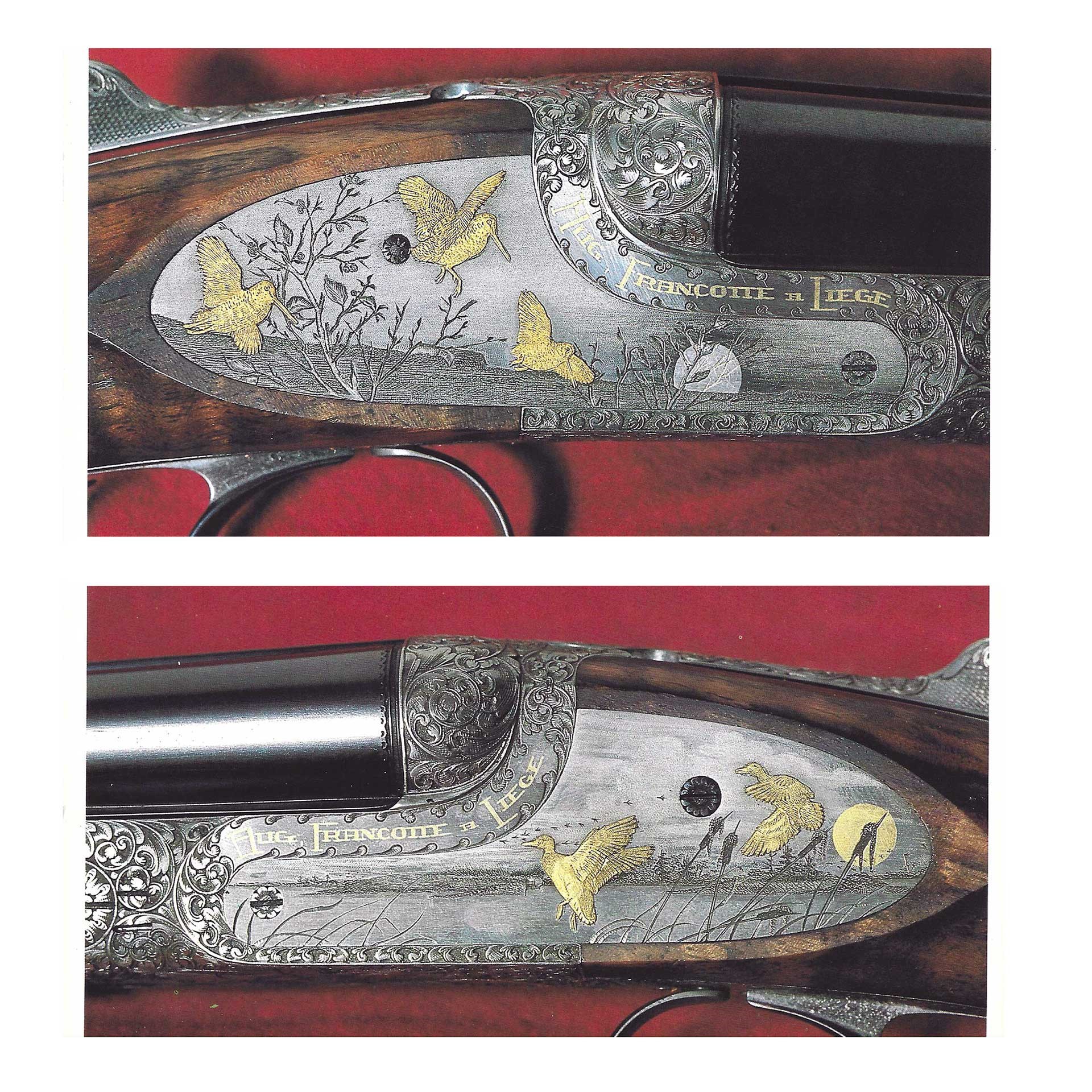
 Even up to the company’s dissolution, Francotte’s marketing materials illustrated the skill with which its team of gunsmiths and engravers could approach fine arms manufacture, as illustrated by the hand-engraved game scene shown above. From American Rifleman archives.
In November 1998, Tom Derksen, a Dutch entrepreneur and former professor of psychology, was an avid hunter who bought the Francotte firm in an attempt to save it from dissolution. In 1998, Derksen told the Dutch-language magazine Trends that staffing had increased to nine employees, and that he was optimistic about the future of the company.
“The demand for handcrafted shotguns is increasing every year,” he told the publication (translated from the original Dutch). “You can compare the trend with that in the watch or car industry. There, too, you see an increasing demand for increasingly beautiful, increasingly exclusive products.”
Despite Derksen’s optimism and the modernization of Francotte’s production, which had begun to incorporate machine-made parts into its traditional system of production, by 2001, the company had closed its doors, leaving a legacy of fine sporting arms that still graces the collections of hunters and sport shooters around the world.
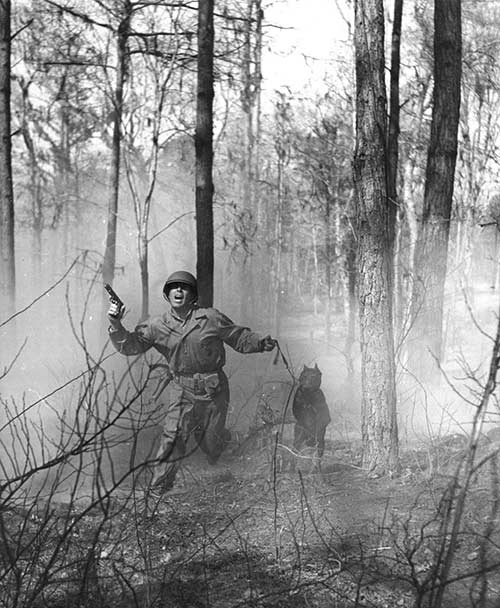
The 1911 pistol served proudly in the hands of members
of the US military for decades. Image courtesy of USMC.
Sgt. Baker was seriously wounded but he insisted on remaining in the line and fired at the enemy at ranges sometimes as close as 5 yards until his ammunition ran out. Without ammunition and with his own weapon battered to uselessness from hand-to-hand combat, he was carried about 50 yards to the rear by a comrade, who was then himself wounded.
At this point Sgt. Baker refused to be moved any farther stating he preferred to be left to die rather than risk the lives of any more of his friends. A short time later, at his request, he was placed in a sitting position against a small tree. Another comrade, withdrawing, offered assistance.
Sgt. Baker refused, insisting he be left alone and be given a soldier’s pistol with its remaining eight rounds of ammunition. When last seen alive, Sgt. Baker was propped against a tree, pistol in hand, calmly facing the foe. Later Sgt. Baker’s body was found in the same position, gun empty, with eight Japanese lying dead before him.
—Excerpted from Medal of Honor Citation for SGT Thomas A. Baker
Killed in Action, Saipan, July 7, 1944
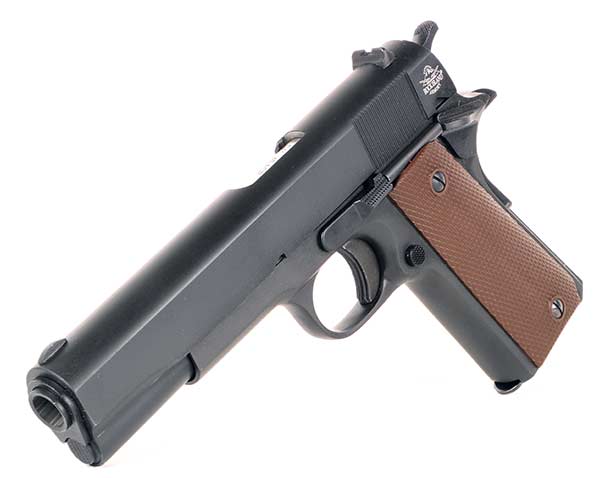
The Rock Island Armory GI Standard .45 is a close but not quite perfect rendition of the original 1911A1 service pistol at a very sweet price. Drop another $20 for a GI magazine and some plastic surplus grips and you have an almost clone version of the original at a fraction of the cost.
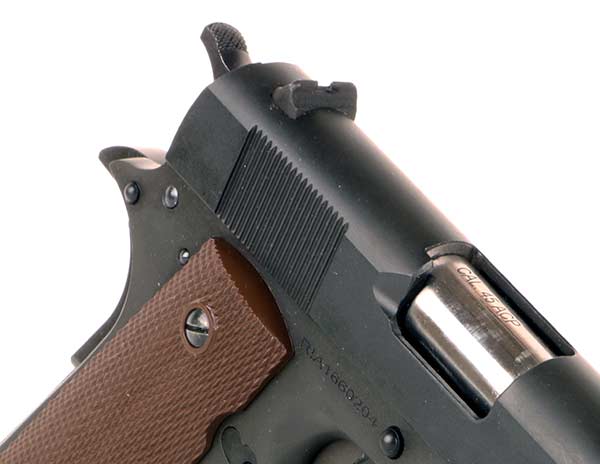
One notable change on the RIA pistol from a true 1911A1 is the lowered and flared ejection port to enhance reliability and function.
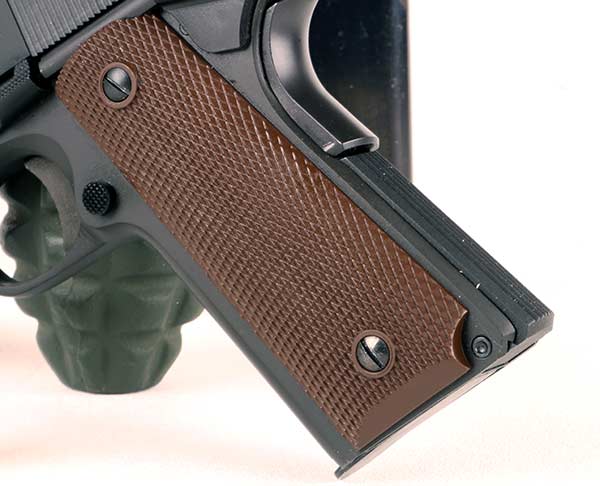
The RIA GI Standard .45 sports a flat 1911-style mainspring housing
rather than the arched sort of the GI-issue 1911A1. The arguments
concerning the various salient attributes of each have yet to be resolved.
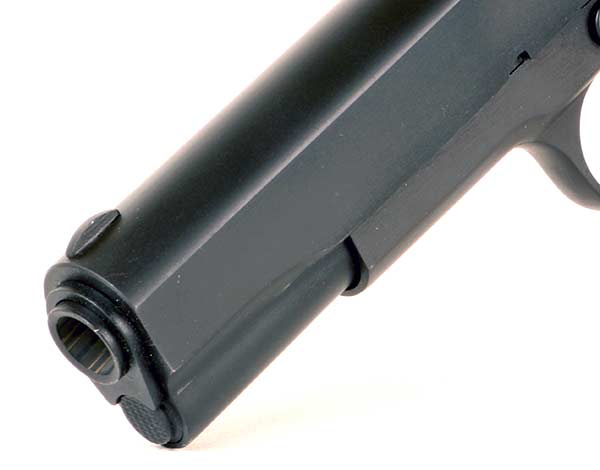
Anyone who knows their way around a traditional 1911 will be right at home with the RIA GI Standard. Note the small front sight and conventional barrel bushing system.
John Moses Browning’s inimitable 1911 pistol armed America’s warriors through four major wars. For 74 years every American who wore the uniform had some link to Browning’s 1911. Rugged, dependable, effective and awesome, every proper gun collection needs at least one.
Believe it or not, back in the old days when the military grew weary of weapons, they frequently just sold them off to American citizens. Countless thousands of M1 Carbines, M1 Garands and 1911 pistols found their way into American gun collections via this route. Nowadays the very thought would be adequate to induce the fantods in less durable members of our society.
The farther we get from the old 1911’s original production the more eligible collectibles there are. Given a fixed supply and increasing demand, prices inevitably skyrocket. I stole my mint 1944-era Remington Rand 1911A1 on Gunbroker for a cool $1,000 and was thrilled to land it. I cannot yet afford an original Colt. For those legions of burgeoning gun nerds desirous of a GI .45 of their own, there’s a more economical solution.
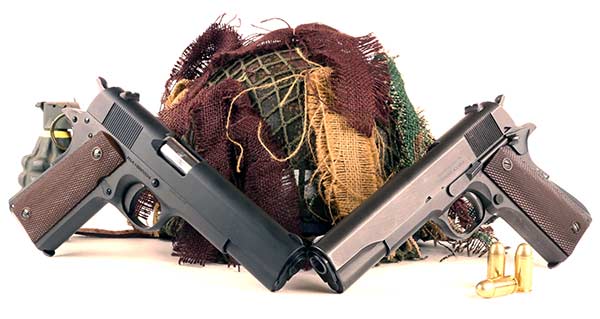
What is the primary difference between the RIA GI Standard .45 on the left and the pristine original 1944-era Remington Rand 1911A1 on the right? About $1,000.
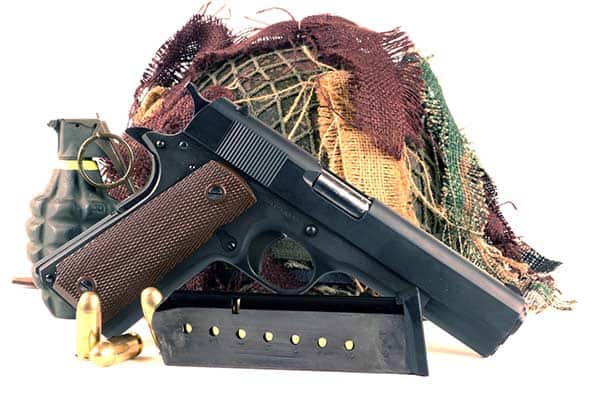
The magazine that comes with the RIA GI Standard .45 packs
8 rounds instead of 7 and extends ever so slightly out the
bottom of the grip as a result.
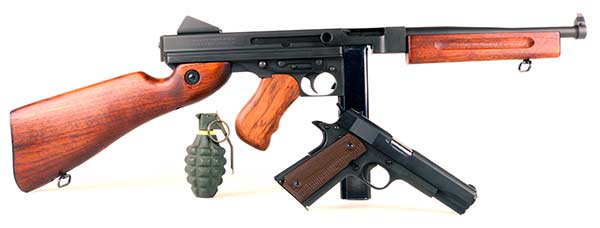
Certain pieces of military hardware are simply iconic. This M1A1 Thompson is WWII-original, and the pineapple grenade was a standard piece of dogface kit. The RIA GI Standard .45 fits in with this rarefied company quite nicely.
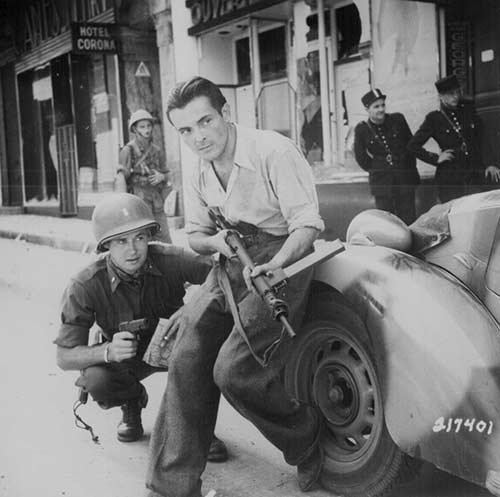
An American officer and a French partisan with a Sten sub-machinegun crouched behind a car during a street fight in a French city, June 1944. Image courtesy United States National Archives.
The 1911 design is more than a century old, and these classic pistols keep flowing forth from modern assembly lines every day. What might surprise you to know is the planet’s most prolific producer of 1911 pistols is not even located within the United States. Armscor of the Philippines is the largest weapons manufacturer in Southeast Asia, and they produce more 1911 pistols than any other company in the world. On this side of the pond their American face is Rock Island Armory.
RIA offers about a zillion different variations. Disparate calibers, magazine capacities, barrel lengths and finishes vigorously populate their product lineup. The .45 ACP brings the rain today just as well as it did a century ago. RIA 1911’s chambered in 9mm, .38 Super, .380 ACP and .22 LR are also available. Their revolutionary .22 TCM cartridge is a 9mm case necked down to accept a 40-grain .22-caliber jacketed hollow point bullet. In a high-capacity 1911 platform this zippy little monster can break 2,000 fps out of a pistol-length tube and remains my hands-down, all-time favorite handgun. But there is another great 1911 lurking in the RIA line of pistols, a no frills slab-sided 1911 called, appropriately enough, the GI Standard .45.
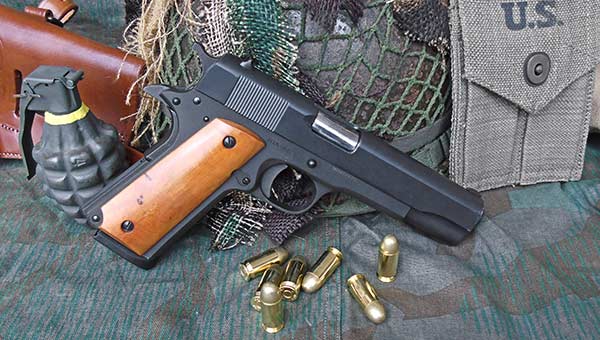
As it comes out of the box, the RIA GI Standard .45 includes wooden grips and a slightly extended 8-round magazine.
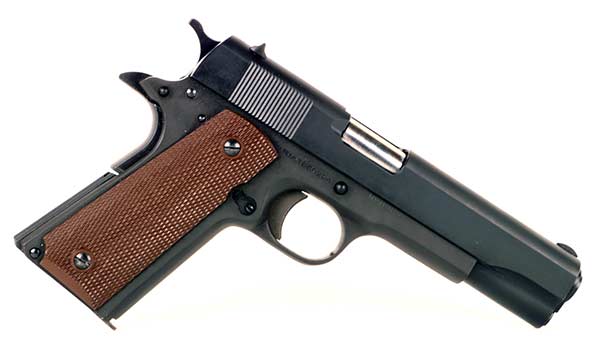
All the basics of a World War II-era 1911A1 are there on the RIA pistol; a spur hammer, short trigger, low-profile grip safety, etc. It has some inconsistencies, too, like the flat mainspring housing.
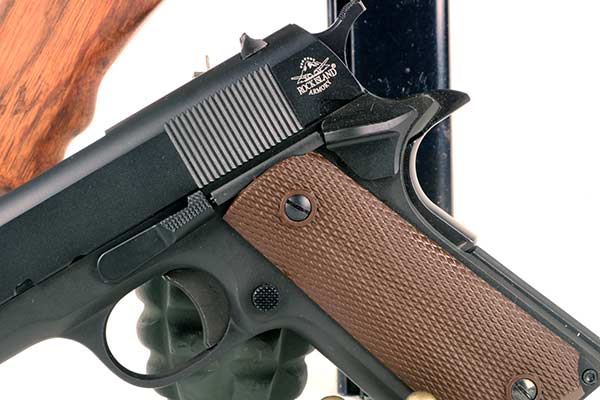
The heft, balance and operation of the RIA 1911 was just like Will’s original 1911A1, except the newer pistol shot better.
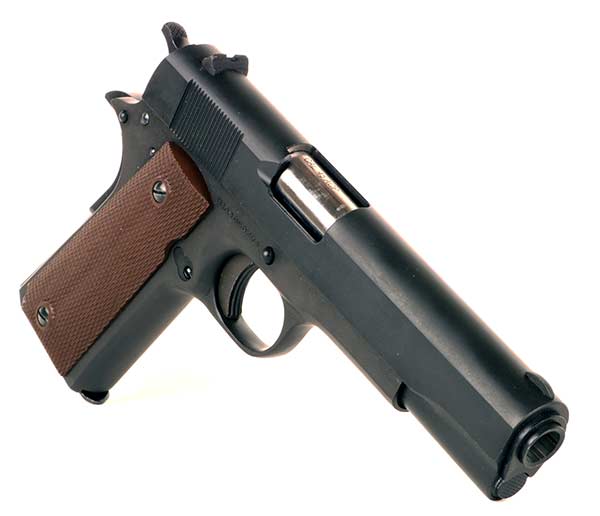
The RIA GI Standard is a very handsome pistol for a shockingly low sticker price of under $400.
The RIA GI Standard .45 is a close but not quite perfect rendition of the classic 1911A1 Government Model with which our forebearers freed an enslaved planet. The finish is a rich military-looking Parkerizing, and the hammer and 5-pound trigger are both GI-standard style. The safety is one-sided and in the expected spot, just like the original. The gun looks, strips, shoots and wears just like the 1940’s-era real deal.
However, there are a few nods to modernity. The ejection port is lowered and flared for better reliability and performance. This will offend the purists in the audience, but normal folks will never notice. Such treatment enhances ejection and makes for a better, more reliable utility gun.
Also, the grips on the RIA GI Standard .45 are cut from light-colored wood rather than the original GI-issue plastic. The mainspring housing is flat like that of the 1911 rather than being rounded like the 1911A1. The debate regarding which design is preferable is vociferous, spirited and ongoing. Additionally, the extended-capacity magazine carries eight rounds rather than seven and sports a slightly thicker baseplate than the originals as a result.
For me the grips were a deal breaker, so I landed a milsurp pair of the brown nylon sort on eBay for $9 with free shipping. Two minutes with a screwdriver swapped them out, and we were ready to hit the range. I also exchanged the slightly extended magazine for a flat-bottomed aftermarket version for $10. In dim light it’s tough to distinguish between my spendy original and the RIA replica.
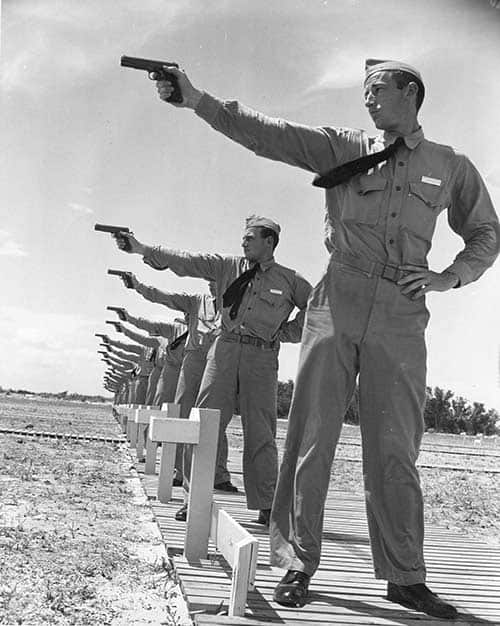
Naval Aviation Cadets from the Naval Air Station at Corpus Christi
at the pistol range with Colt M1911-A1 .45 caliber pistols, Corpus Christi, Texas, United States, circa 1941. Image courtesy of National Museum of Naval Aviation.
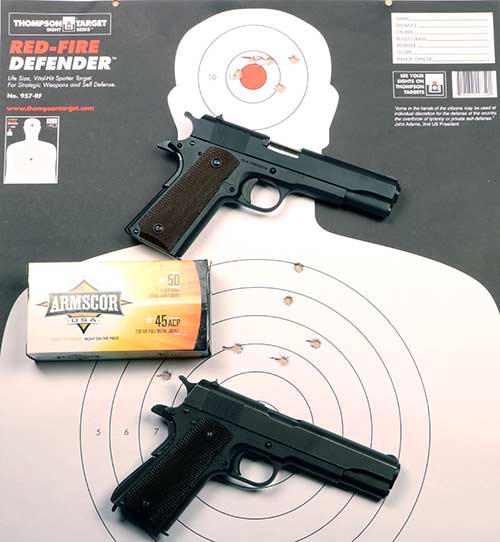
The RIA GI Standard .45 (top) actually printed a good deal better than Will’s 1944-era Remington Rand original.
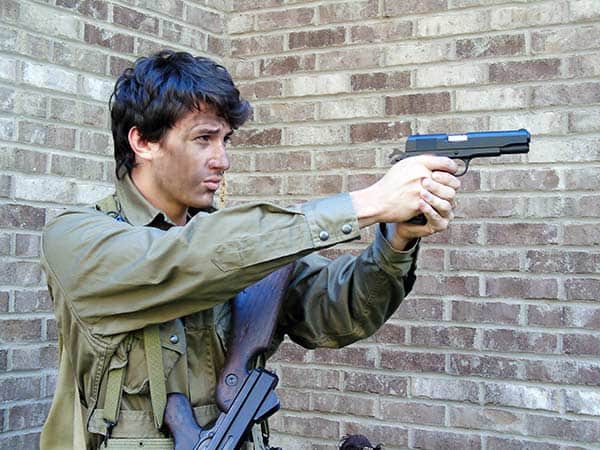
In the hands of fighting men during World War II, the classic 1911
helped free the world from tyranny. Now, thanks to Rock Island Armory,
you can own your own version of this classic on the cheap.
To be frank, the sights on the pistol are too small, but everybody’s sights were too small back then. The grip width is the very essence of perfection, and this classic heater drops into my palm like it was born there. At rest, the trigger has just the tiniest smidgen of a wiggle, just like the originals.
Slap a magazine full of .45 ammo into the butt and rack the slide in a forceful, intentional, manly fashion. This is a serious gun cut out of big blocks of serious steel. There’s none of the flimsy “Glocktastic” plastic to be found anywhere. The 1911A1 is heavy, tough and mean, just like the nation originally producing it.
Recoil is serious without being unpleasant. The experience hearkens to the first time I met the 1911 professionally back when I initially donned the uniform. All of our guns back then had been through the rebuild process a time or three; all showed their age. My modern RIA Standard GI .45 is tight and quiet when you shake it. Our GI-issue 1911’s back in the day rattled like a baby’s plaything. However, they also never failed us, and those big fat bullets meant not having to say you’re sorry in any language.
The gun rocks through a magazine in short order, and tactical reloads set the standard for everything else. My wife’s grandfather, one of my favorite people, carried a gun such as this through two years of combat in North Africa and Europe during World War II. He carried his pistol alternately in either a shoulder holster or a low-ride thigh rig he made himself. His gun kept him alive throughout the war, and he has more combat cred than anybody I ever met.
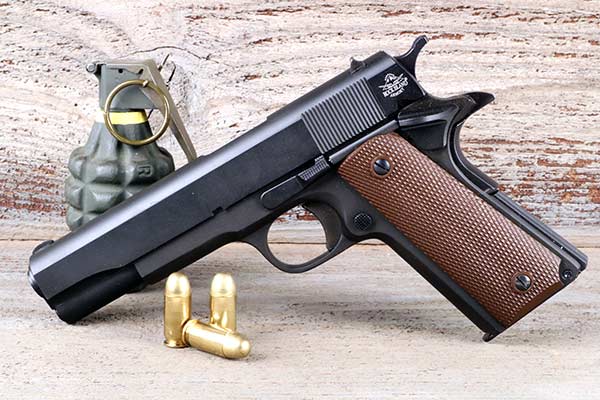
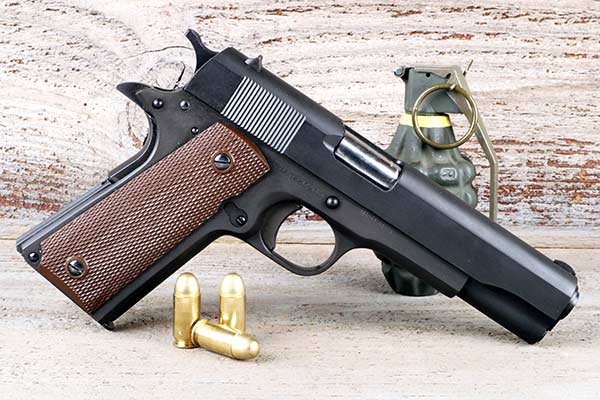
The new RIA pistol makes for a pretty good clone of an original (and much more expensive) 1911A1. Change out the grips and the magazine to original-style units, and this gets it even closer to the original.
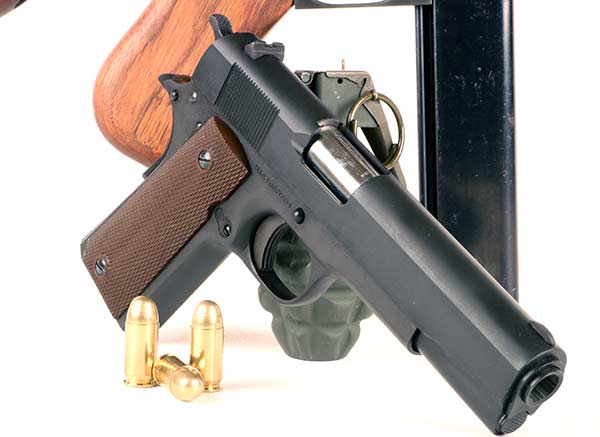
The heft, balance and operation of the RIA Standard GI .45
was just like Will’s original 1911A1, except the newer pistol shot better.
In addition to being a near perfect ringer for the original GI-issue 1911 pistol (with my few mods added, of course), the RIA Standard GI .45 is also just dirt-cheap. I poked around and found them listed new for less than $400. Mine runs like a champ. If it doesn’t, RIA also offers a lifetime warranty.
Everybody really needs a military-grade 1911 in his collection. If nothing else shooting a GI 1911 is a unique experience adding a spot of flavor to any serious shooter’s repertoire. You can fork over a month’s pay and land a pristine original WWII-era Colt too expensive to shoot, or you could pick up an inexpensive battle blaster you won’t be afraid to really wring out. It cost me less than $10 to replace the grips with something more GI-looking, and any subsequent dings and bumps give the old girl character.
Recoil on the RIA Standard GI .45 is present without being mean, and you will squint to see the sights, just like our grandparents did back when they faced down the Nazis. If you’re old and ever wore the uniform, the RIA gun will inevitably bring back memories. For me, I recall watching one young stud launch his recoil spring plug into the stratosphere during a timed disassembly/reassembly competition at Fort Benning. That poor guy did not fare well overall.
The clothes, gear, weapons, tanks and planes our forefathers used to win World War II were the product of American industry operating at breathtaking capacity to arm the free world. The sidearm those guys carried was the best their nation could produce. Thusly equipped, literally millions of citizen-soldiers gave whatever it took to liberate the planet from tyranny. The RIA Standard GI .45 lets you get the tiniest taste of what those remarkable times were like.
For more info:
Rock Island Armory, (775) 537-1444
Special thanks to
www.worldwarsupply.com
for their assistance in outfitting our WWII-era paratrooper.
.jpg)



.gif)

.jpg)


