As of today, every state in the USA has some type of provision to allow citizens obtain a permit to carry a concealed handgun while engaged in lawful activity. In some states, that permit is easy to get. In others (like California or Hawaii) it is almost impossible unless you are politically connected.
What many people don’t know is that the UNCONCEALED (or open) carry of firearms is not legally regulated in many states. Here in Ohio, it is completely legal for anyone over the age of 21 (without a history of mental illness, drug addiction, or felony conviction) to carry a firearm in public. No permit is needed as long as the gun is not concealed.
Did you know this was legal activity?
It’s rare, but occasionally you will see someone carrying openly. Most do it as a political statement. They are trying to raise awareness for better concealed carry laws and promote the idea that guns can and should be safely carried by anyone who wants to. I applaud the gun rights activism. I think people should recognize that guns are not necessarily bad and get used to “normal” people carrying them.
This article got me contemplating the issue. I’ve come to the conclusion that open carry just isn’t a very good idea most of the time. It seems especially bad in this time of pandemic when people are already acting irrationally.
First of all, if you live in a state where open carry is legal, I am not trying to limit your rights to carry a gun. Go for it if you want. I’d just ask you to put some thought about risks versus benefits before you openly carry your gun into WalMart. I know a lot about carrying guns. Hopefully my arguments will make you think twice about carrying openly.
Open carry can lead to numerous problems. As a cop responding to calls about this activity and as a citizen who carries a concealed handgun everywhere, I have unique insight into the problem. Here are some of the issues:
1) Open carry will cause hassles with other people and eventually the police. Unless you live in rural area or a western state, open carry isn’t very common. When the uneducated populace sees someone carrying a gun (without a badge), they assume that a law is being broken. They panic and call the cops. What they tell the dispatcher when they call generally has no basis in truth. It usually ends up being something like:
“There’s a man with a gun running around the grocery store scaring people!”
If you were a cop, how would you respond to that call?
Things would turn out differently if the caller would have been honest and said:
“There’s a person walking around the grocery store who has a gun on his hip. He isn’t threatening anyone and appears to be shopping.”
As a cop, I wouldn’t even approach you. I’d educate the caller that no laws were being broken and leave.
But that’s just not how it happens in real life. Blame it on whomever you like, but reality dictates you’ll get a police response. The police response may be positive, or it may be negative. Who wants to deal with that when you can simply cover your gun?
2) Criminals may not be deterred by openly carried guns. For an obvious example of this, look at the article linked above. For more than 60 additional examples, read my article Friends Don’t Let Friends Open Carry.
The guy in the linked article just waited for the gun carrier to look the other direction and he attacked, trying to rip the gun out of the holster. Any serious violent criminal who has been in the game for awhile knows how to check the crowd before he commits the crime. He’s looking for witnesses, cops, security guards, and anyone who will likely intervene. If he finds one of those people, he deals with them FIRST, then he goes on to commit the crime.
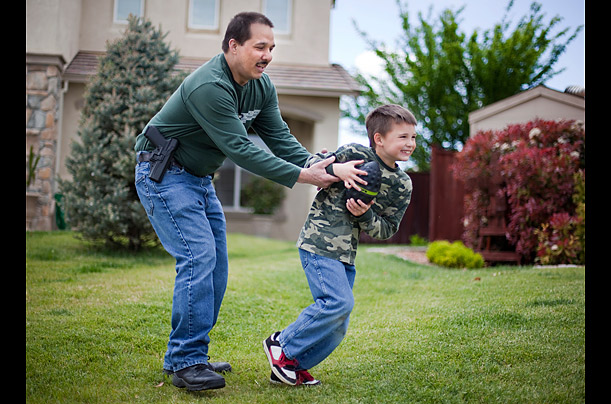
The armed robber (who has his gun concealed) could just shoot you in the back of the head before moving on to take the cash. Or he might do worse. What if he takes your child hostage and orders you to give up your gun? Most people don’t think about that possibility.
A criminal looks at this scene differently. He thinks, “If I snatch the kid, Dad will give up the gun.” And most of the time, the criminal is right.
Keep your cards hidden. That gives you multiple response options. Once the armed criminals know you are packing, you’ll be the first one shot.
3) Getting your gun taken away is always possible. Most people who carry guns tell me:
“I never let a criminal get within 10 feet of me. I’m constantly aware of my surroundings.”
It’s bullshit. They are deluding themselves. It’s physically impossible for one human to simultaneously scan 360 degrees at the same time. You always have to turn your back to something. Especially in a crowded public area, you simply can’t process all of the information fast enough to decide who is a threat and who isn’t.
Historically (since the 1960s when such statistics were first gathered) about 10 percent of the cops who are killed (by gunfire) in the line of duty are killed with their own firearms. Cops are trained to be alert, they often work with partners, and they have the best retention holsters available. Yet they still get their guns taken from them. You think you can do better because you took a one-day CCW course? Understand reality. You can’t see everything and you can’t win every fight. Your gun can be taken and used against you.
4) Most people who carry guns have crappy holsters and no weapon retention skills. I teach force-on-force fighting skills to cops and citizens. In those courses, I teach my students what to do if someone grabs their holstered gun. Even after multiple days of training, the students still have trouble retaining their firearm in a surprise attack. Most pistol packers don’t even have the benefit of this kind of training.
Think about this for a second. You are open carrying a gun on your right hip. I walk up to you and engage you in casual conversation. I say something like:
“Hey! Don’t our kids go to the same school together?”
As you are trying to figure out who I am, I move closer and extend my hand to shake. When you reciprocate the gesture, I grab your right hand with my right hand and pin it to my chest. You struggle, but because I’m stronger, you can’t free yourself. As soon as I have the arm controlled, I grab your holstered pistol with my left hand. How are you going to stop that?
I’ve done that scenario on dozens of students. It almost always works. I end up with their gun and they have a puzzled look on their face.
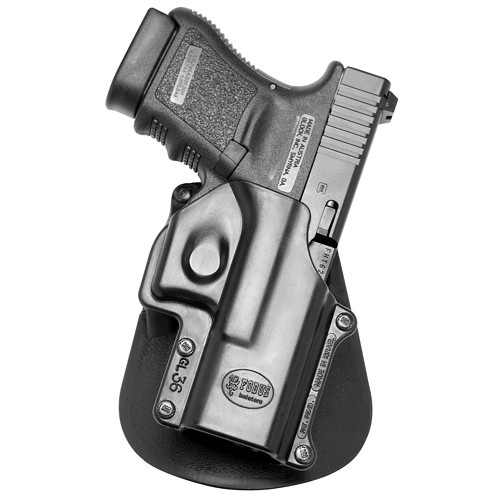
It’s even easier to do when you are wearing a crappy holster. That “great deal” you found at the gun show will rip right off your pants if I yank on it. Trust me. I have some trophies from my force-on-force training sessions. In most classes, I destroy a Fobus or Uncle Mike’s holster with one pull. Those holsters are trash. If you don’t believe me watch THIS VIDEO.
It isn’t just the Fobus. I’ve done similar things with lots of other poorly designed holsters. Smart gun owners don’t use junk holsters.
If your defensive holster looks like this, you are going to have a big surprise if you have to fight over your gun.
Just because you can carry openly doesn’t mean you should. Your carry method may be legal, but it may also cost you your life.
Think deeply about the potential consequences before you open carry your pistol.
I support the right to carry openly. I don’t support the practice in general.
On Sunday, President Biden told a large assembly: “We must all work together to address the hate that remains a stain on the soul of America. . . . Our hearts are heavy once again, but the resolve must never, ever waver.”
He was responding, of course, to the mass shooting at the Tops Friendly Markets grocery store in Buffalo, New York, which left ten people dead and three injured.
The alleged shooter, 18-year-old Payton Gendron, drove several hours from his home in Conklin, New York, to a neighborhood and a market where shoppers were, in his estimation, most likely to be black. He was wearing tactical gear and armed with the Bushmaster XM-15 assault rifle he had bought legally in Endicott, New York, with the intention—reportedly detailed in his racist manifesto—to use it to shoot blacks.
Hate is not, as Biden labels it, an abstract stain on the soul of America. It is an idea that festers in the minds of violent people. It is our duty to get better at identifying and stopping these individuals before they hurt others.
And we can get better at identifying and stopping them.
Gendron had been actively ranting online about his hatred for blacks. He took inspiration from racist conspiracy theories on online message boards and explicitly identified himself as a fascist, white supremacist, racist, and anti-Semite. On the Internet, he had detailed plans to carry out a shooting targeting blacks similar to the one he wound up perpetrating in Buffalo.
Similarly, Frank James, the black man who traveled to New York from Philadelphia last month to shoot up ten passengers on a rush hour subway, had been raging online for a decade about blacks, whites, Latinos, and Jews. He also fumed against New York mayor Eric Adams and the city’s subway system and alluded to leaving Philadelphia to take action. And Robert Gregory Bowers had written colorfully about his intention to attack Jews (and his murderous hatred for blacks) before driving to Pittsburgh’s Tree of Life Synagogue in 2018 and massacring 11 worshippers.
We should be devoting more resources both to intelligence-gathering about action-oriented violent rhetoric online and to the manpower needed to follow up on all such threats. These types of investigations, occurring in both federal and local agencies, are resource- and training-intensive.
Violently manifested hate is definitely growing. Anti-Semitic incidents broke records in 2021, and anti-Asian hate crimes have broken records for the past two years. In New York City, the country’s epicenter for hate crimes (thanks, in part, to its demographic diversity), crimes against blacks and gay men have doubled since last year. Who perpetrates these crimes? Whites, blacks, Latinos—it’s a sickness that crosses all racial and ethnic boundaries.
One commonality among attackers is a high degree of mental illness. As announced this month at a New York City Council hearing, police designated nearly half of all hate-crime arrestees as emotionally disturbed. The NYPD admitted that it wasn’t doing enough to track whether these suspects receive treatment or to coordinate with mental-health professionals.
High-risk mental illness was a known issue for Gendron, whom state police brought to a hospital last June after he wrote in high school about wanting to shoot people. The hospital released him a day and a half later. This story is tragically familiar. In 2017, Martial Simon reportedly “told a psychiatrist at the state-run Manhattan Psychiatric Center that it was just a matter of time before he pushed a woman to the train tracks.” This past January, he pushed Deloitte executive Michelle Go to her death from a Times Square subway platform.
In addition to these gaps in psychiatric oversight for individuals who have voiced an intention of committing violence, states including New York have reduced in-patient psychiatric beds dramatically. Sweeping criminal-justice reforms have hampered judges’ ability to induce unbalanced offenders into psychiatric care as a means of avoiding jail time.
Policymakers at all levels need to prioritize closing these gaps between police, prosecutors, and psychiatric practitioners and ensuring that sufficient spaces are available for the small but critical segment of the population that requires long-term supervision. As the president said, our hearts are heavy. Now let’s use our heads.
Even if the Biden administration refuses to quell threats and intimidation, pro-lifers and religious believers have – and should use – the remedies that the law provides for them.
Pro-abortion groups this past week have called for increased lawlessness to express their opposition to the expected reversal of the Supreme Court’s decision in Roe v. Wade. Apparently having failed to persuade either the court of the soundness of their legal position or Congress of the necessity of codifying Roe in a federal statute, these groups are committing, or threatening to commit, hate crimes targeting churches and worshippers.
The real or intended victims of these outrages are not defenseless. The legal system affords them robust protections against violations of their right to free exercise of religion. These include both federal and state criminal and civil remedies and private civil actions under federal and state law.
Churches and congregants alike should make full use of our legal system to protect themselves against pro-abortion forces that are vandalizing church property and attempting to intimidate believers as they worship. Not only do they owe it to themselves to defend their religious liberty, they have a duty to the larger community to combat these unmistakable hate crimes.
To date, President Biden has failed to personally denounce these threats to religious liberty by the pro-abortion forces that are Democrats’ political allies and core constituents. So has his Justice Department, which was quick to condemn parents appearing at public school board meetings. An unnamed White House official made a meaningless comment, and Press Secretary Jen Psaki finally condemned “violence, threats, or vandalism” on Twitter Monday, but the president himself has yet to speak out against pro-abortionists’ recent violent tactics.
Biden and Attorney General Merrick Garland should be publicly shamed if their inaction continues. And if the administration chooses to turn a blind eye as the legal rights of American believers are trashed, state attorneys general can and should fill the breach.
Private persons can also bring tort actions under federal and state law, and if successful might obtain monetary damages in amounts that could be a significant blow to the pro-abortion movement and its (often undisclosed) donors.
Two Forms of Attack on Religious Liberty
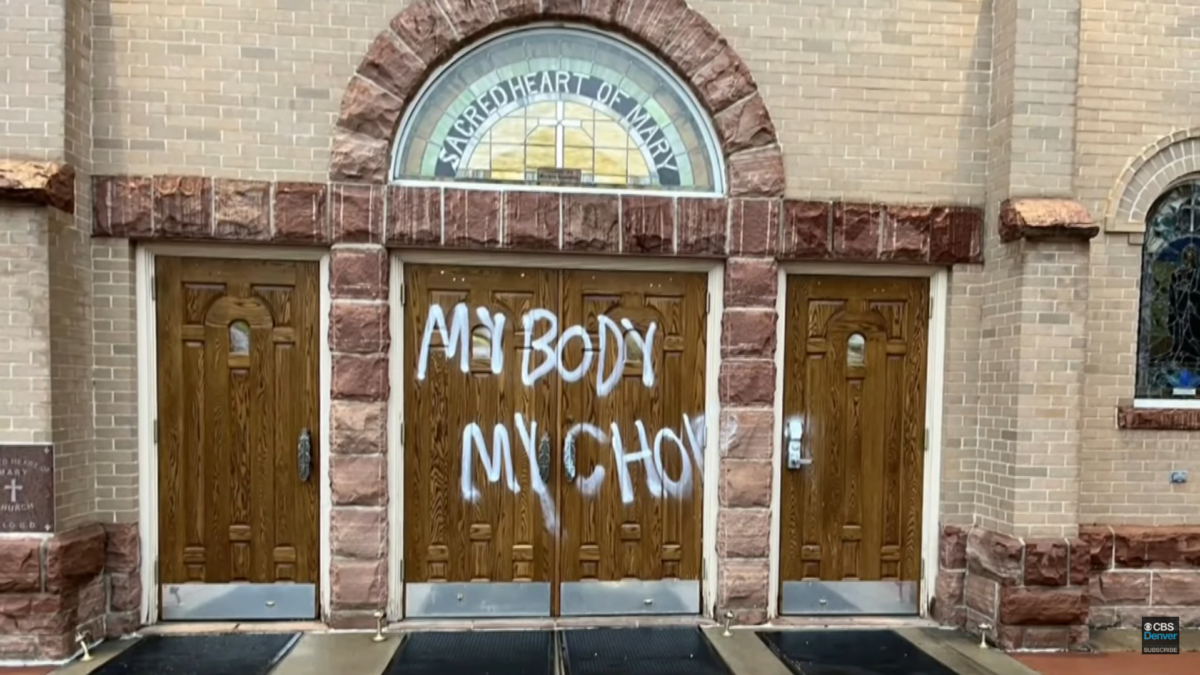
The assaults on religious liberty are coming in two forms. One is the vandalization of church property, such as happened in Boulder, Colo., soon after the leak of the draft Supreme Court opinion in Dobbs. Vandals broke the windows and spray-painted over the doors of the Sacred Heart of Mary Church and left pro-abortion messages, including “keep your religion off our bodies” and “my body, my choice.”
Over the past two years, Colorado has seen a series of attacks (not all proclaiming pro-abortion views) on Catholic churches. These attacks include one last October on the Cathedral Basilica of the Immaculate Conception in Denver, and another in September on St. Louis Catholic Church in a Boulder suburb (involving pro-abortion graffiti).
What is happening in Colorado unfortunately has been happening throughout the country. In January, the U.S. Conference of Catholic Bishops reported that there had been at least 129 attacks on Catholic churches in 35 states and the District of Columbia since May 2020. Secular sources like The Wall Street Journal have noted the increase in desecration of Catholic churches as well. If Roe is indeed overruled, expect worse.
In a second line of attack, the shadowy pro-abortion group Ruth Sent Us has called, not only for demonstrations outside the homes of six Supreme Court justices, but also for the disruption of services in Catholic churches on Mother’s Day during Sunday mass. The group posted a message on Twitter, stating “Whether you’re a ‘Catholic for Choice,’ ex-Catholic, of other or no faith, recognize that six extremist Catholics set out to overturn Roe. Stand at or in a local Catholic Church Sun May 8.”
Protesters disrupted planned services at Old St. Patrick’s Cathedral in New York City, some engaging in grotesque pantomimes of abortion immediately outside the church grounds. Christopher Plant, whose bio says he is the pastor of St. Bartholomew the Apostle Catholic Church in Katy, Texas, took to Twitter on Monday to report that the church’s tabernacle had been stolen the night before.
Meanwhile, a Molotov cocktail was thrown into the headquarters of pro-life group Wisconsin Family Action in Madison, Wis., with the words “If abortions aren’t safe you aren’t either” graffitied outside. A pro-life center in Denton, Texas was also defaced.
Federal Remedy: The FACE Act
These dangers to the peaceful exercise of religious liberties must be confronted and overcome. Even if the Biden administration refuses to quell threats and intimidation, believers have – and should use – the remedies that the law provides for them.
Of these remedies, one powerful option is, ironically, The Freedom of Access to [Abortion] Clinic Entrances Act (FACE). In an obvious legislative compromise, FACE protects not only abortion facilities, providers, and clients, but also criminalizes actions or attempts intended “by force or threat of force or by physical obstruction” to injure, intimidate or interfere with “any person lawfully exercising or seeking to exercise the First Amendment right of religious freedom at a place of religious worship.” Likewise, FACE criminalizes the actions of anyone who “intentionally damages or destroys the property of a place of religious worship.”
Enforcement of these criminal provisions is, however, in the hands of the vehemently pro-abortion Biden administration, which can be expected to tailor the execution of the laws to its political ends. Even so, FACE offers other means for vindicating religious liberties.
This is because FACE also authorizes churches and individual worshippers injured by the relevant misconduct to bring private actions on their own behalf. If entitled to relief, they may obtain either (or both) an injunction against the misconduct or “compensatory and punitive damages,” along with an award of reasonable legal fees. These legal awards, especially if they include punitive damages, could be crippling for pro-abortion defendants.
Finally, FACE authorizes state attorneys general who find “reasonable cause to believe” that a violation “is being, has been, or may be” occurring, to bring civil actions. The Virginia attorney general has already signaled his intention to refer any criminal violations for prosecution. Concerned citizens should demand that their state attorneys general follow suit.
State Criminal Law Protections
States also commonly have hate crimes statutes that are similar to these federal civil rights laws. Colorado, for example, has at least two statutes that might apply to the vandalization of a Catholic church in that state. One statute makes it a crime knowingly to “desecrate” (which includes defacing) “any place of worship.” It will be interesting to see if the state’s Attorney General Phil Weiser, who served in the Clinton and Obama administrations, will bring a case under the state’s anti-desecration law on behalf of the Catholic churches in his jurisdiction.
Privately Enforceable State Tort Laws
Lawsuits against the pro-abortion extremists who attack churches or worshippers can also be brought under state tort laws by the injured parties. Professor John Banzhaf of George Washington University Law School has argued that civil actions, especially if class actions, can bring justice to those who suffered injuries when “peaceful protests” have turned into violence that damaged their lives or property. For instance, journalist Andy Ngo sued those who beat when while he was covering a “peaceful protest” that turned into a riot, alleging the torts of assault, battery, and intentional infliction of emotional distress as well as a violation of the state’s anti-racketeering act.
Legal Self-Defense
Finally, churches and worshippers should remember that they have a legal right of self-defense against threats to life and limb. The choice of forms that self-defense should take – churches might install security cameras, provide cans of pepper spray to their congregations, or even bring in defenders who openly bear arms – is best left to the consciences of pastors and congregants within the confines of applicable law.
Robert Delahunty is a Washington Fellow of the Claremont Institute for the American Way of Life. Teresa S. Collett is a Professor of Law at the University of St. Thomas School of Law in Minneapolis, where she directs the Pro-Life Center.
Sadly most wood frame houses do not stand much chance against fire or say a RPG Missile. So I’ll pass. Better in my humble opinion to have cover and hides outside the living quarters. Bunker up if you want, I want fire and maneuver. Grumpy
Every outdoorsperson should know the nuts-and-bolts of the compass. We live in an age when digital navigational tools abound: GPS receivers, satellite messengers, smartphone maps, and apps. These are all well and good, wonderful resources to have—but they aren’t foolproof, and overreliance on them without backbone knowledge in tried-and-true map-and-compass wayfinding can leave us in dire straits.
In this article, we’ll introduce the basics of how to use a compass: what the tool does, how it’s put together, and all the invaluable locational and route-finding information it can provide out there in the backcountry.
Why Should I Learn to Use a Compass?
A compass always has your back, keeping you from going in the wrong direction when navigating through remote wilds. Your smartphone might die, your GPS unit may act up, but that compass of yours—as long as you keep the magnetic needle away from interfering metal—points north through thick and thin. You can walk a straight course and stay oriented even when socked in by a cloud (or caught by darkness).
Now, even as we underscore the tremendous power of a compass, it’s worth noting there’s a surprising amount of sturdy wilderness navigation you can do withoutone. In many landscapes, experienced outdoorspeople can stay oriented just by matching obvious physical landmarks with their mapped locations.
Using such on-the-ground navigational aids as handrails (long linear features such as rivers, roads, or powerline corridors roughly aligned with your desired course of travel) and catchpoints (mapped landmarks along a handrail that peg your location), you can cover a lot of ground without peeking at your compass.
But the point is, you should have a compass to peek at it if you need it—and, in many situations, using a compass and map together is the surest way to stay on track and avoid getting dangerously turned around.
Introducing the Tool: Parts of a Compass
A magnetic compass consists of a freely rotating magnetized needle that lines up with the Earth’s magnetic field, one end of it usually a red arrow pointing north. (We’ll get into just what “north” means in this context shortly.) The needle does its thing within the compass housing, filled with a liquid that dampens the compass needle’s otherwise jittery movement.
Along the rim of the housing or case, the 360 degrees describing a circle come hatched and labeled on a dial (aka azimuth ring or bezel ring). The four cardinal points (cardinal directions)—North, South, East, and West—are labeled at 360 degrees (or 0 degrees), 180 degrees, 90 degrees, and 270 degrees, respectively.
Some compass models denote not only the cardinal points but also the intercardinal points of North East, South East, North West, and South West, and occasionally even finer-scale divisions (North-Northeast, South-Southwest, and other secondary intercardinal points).
Different Types of Compass
The cheapest compasses are fixed-dial models, but, while better than nothing, these aren’t the go-to choice for a dyed-in-the-wool hiker, backpacker, climber, or hunter.
That would be the baseplate compass, also known as the protractor compass given it serves as that tool in mapwork, or as an orienteering compass due to its original invention for use in that sport.
It goes without saying that the same skills competitive orienteer employs are part of a backcountry traveler’s basic route-finding toolkit.
Baseplate Compasses
Baseplate compasses consist of a rotating bezel-set atop a see-through, square-edged base plate. Within the compass case, below that free-swinging compass needle, parallel lines known as meridian or orienting lines can be used to match with the north-south grid lines of a topo map.
At the center of the case and aligned with those meridian lines, an orienting arrow points to north on the compass housing.
The base plate will also typically include a direction-of-travel line or direction-of-travel arrow pointing toward the front edge of the compass. Its back end meets the rotating bezel at an index line. Two or three of the base-plate edges include multiple ruler measurements and scales for determining distances on a map.
Many orienteering compasses include a hinged cover with a sighting mirror. Run through with a line, this design allows you to hold the compass at eye level when pointing toward a target landmark or along a desired bearing, using the mirror (set at about a 45-degree angle) to confirm the direction where the index line meets the dial.
Other Types of Compasses
Now, keep in mind there are a number of other kinds of compasses: the stripped-down thumb compass, non-magnetic compasses such as the gyrocompass, the military-style lensatic compass or magnetic-card compass, digital compasses, and more.
A thumb compass and a military-style lensatic compass (also known as a sighting)
But, given considerations of accuracy, ease-of-use, affordability, and general wilderness suitability, your average outdoor user is going to want to obtain—and, naturally, eventually master—a baseplate model.
For that reason, the rest of this article focuses specifically on baseplate-compass basics.
Understanding & Accounting For Magnetic Declination
Accurately using a compass and a topo map together in most parts of the world necessitates a bit of translation, you might say. The reason is that the two navigational tools actually have their own, different definitions of “north”: Your compass points to a different reference point than your map.
Declination: True North & Magnetic North
The north marker on your topo map refers to true north, aka “geographic north.” True north indicates the North Pole, the ultimate northern reference point we all tend to envision. But the arrow of your compass’s magnetized needle points to a different north: magnetic north.
Compared with stolid, unchanging true north, magnetic north describes a transient location: the northern tip of the Earth’s magnetic field—the so-called “magnetic North Pole”—which actually moves around due to the molten messiness of Earth’s deep innards.
So there are two complications we face when trying to use our compass with our topo map to find our way.
The first is the fact that magnetic north and true north differ. Magnetic declination describes the difference between true north and magnetic north in cardinal degrees. That difference is negligible along what’s called the line of zero declination, where true and magnetic north agree.
Magnetic declination is the angle between magnetic north and true north.
But off that line, you need to correct for a west or east declination in order to have your compass needle and map sync with one another. Without proper declination adjustment, your bearings translated between compass and map will be off, which can result in trekking majorly astray.
The other complication is the magnetic north’s roving ways. Many topo maps will indicate their depicted area’s declination via a diagram at the bottom, but this measure changes year by year; that becomes an issue after a while. This speaks to the value of checking your map’s revision date and going with as current an issue as you can.
Compass with adjustable declination for rotating the orienting arrow independently of the compass dial.
Many baseplate compasses offer built-in adjustable declination, achieved with the turn of a screw or some other mechanism. You can also use tape to identify your area’s declination correction or simply go through the math (subtracting or adding degrees per the given declination) when making measurements with a map and compass.
Fixing the declination with a fixed declination scale compass.
You can also correct for declination on the map rather than the compass by drawing in the appropriately offset lines, but that’s more troublesome; just pay the marginal amount more for a compass with adjustable declination.
If you’re planning a hiking trip in a different geographic region than where you usually go backpacking, remember to check the area’s declination and adjust your compass accordingly before hitting the trail.
All of what follows assumes you’ve corrected for declination on your compass.
How to Use a Compass to Take Bearings
Standard compass bearings have sixteen different directions, each 22.5° apart.
A bearing describes the direction between two points as defined by the angle made by a line run through both locations and a given baseline, which in orienteering work is either magnetic or true north.
You can use a compass to take bearings from the landscape—considering your current position against a visible landmark—or from the map, measuring the angle between two mapped points.
Direct Bearings
Take a direct bearing from a landmark you can see—a mountain peak, a lake, a grand old tree—by holding your compass level at your chest or (with a sighting mirror) in front of your eyes and pointing the direction-of-travel arrow at the feature.
Then rotate the compass housing until the compass needle’s contained within the orienting arrow, and read the measurement where the direction-of-travel arrow meets the dial. That measurement identifies the direction between your current position and the landmark.
Back Bearings
You can also take a back bearing from such a landmark—useful if you’re not sure of your position. This can be done by repeating the above process, except “boxing” not the north end but the south end of the compass needle with the orienting arrow, then reading the degrees where the direction-of-travel line hits the dial.
Or you can just measure a direct bearing and then—because the back bearing is simply the very opposite of it—either subtract 180 degrees (if the direct bearing reads 180 or more degrees) or add 180 degrees (if the direct bearing reads less than 180).
Measuring Bearings on a Map
Measuring direct or back bearings from visible landmarks with a compass alone relies on the magnetized needle. But if you want to take bearings from a topo map—in other words, find a course—you actually completely ignore that needle (not to mention declination) and simply use the baseplate compass’s rotating bezel. Here’s where the baseplate compass serves essentially as a protractor.
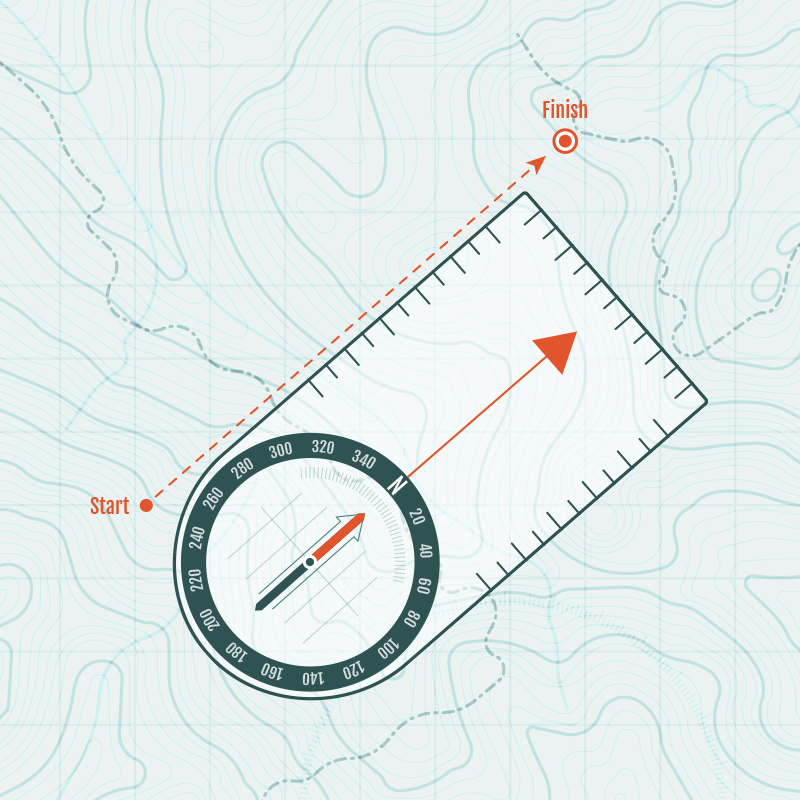
Place the compass flat on the map with the travel arrow pointed in the general direction of north and one of the base plate’s long edges linking your location and your destination; you may need a straight-edge to make the connection, depending on the map’s scale and the distance to be covered.
Then turn the housing so that its meridian lines run parallel to the north-south grid lines of the map (1). Identify the bearing where the index line meets the dial (2).
How to Use a Compass to Plot Bearings in the Field
If you’ve taken a bearing (or found a course) from a topo map (1), you can steer yourself along with it by holding the compass level, then turning your body (2) so that the needle’s boxed by the orienting arrow (3). When that happens, you’re facing your destination (4) with the direction-of-travel arrow pointing (5) the way to go.
You can, of course, use this method to follow a course from any known bearing, not just a topo-taken one. For example, a guidebook (or experienced buddy) may give you precise directions to a dispersed campsite or a water source somewhere out of sight but reachable by following a bearing from a certain location on the trail.
Turn the azimuth ring to set that bearing at the index line and follow the same procedure to orient yourself and strike off.
Use a Compass to Plot Bearings on a Map
You can also plot a known compass bearing on the map—the reverse process. This may arise when you don’t know your current position but have taken a back bearing from a visible landmark (1) you can identify on the map. Turn the compass dial so that the bearing intersects the index line (2).
Then put the base plate on the map with one of the front corners on the mapped landmark. Turn the whole compass until the meridian lines lie parallel with the map’s north-south lines. This gives you a position line (3) along which you know you are.
If you’re hiking a trail or following a river or ridgetop or otherwise situated along with a mapped linear feature, that position line revealed by your field back bearing will pinpoint your location.
Crisscrossing Position Lines & Contours
If you aren’t along with such a reference feature, you can still fix your position by taking one or more additional back bearings from other mapped landmarks (as far apart from one another as possible) and drawing position lines from them on the map. Your point position is where those position lines cross.
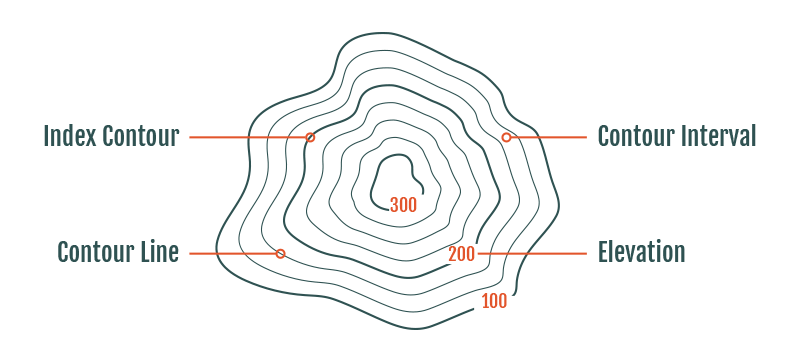
Maybe, though, you can only recognize one landmark you can definitely locate on the map. You can often still get some idea of your rough location by identifying your elevation using an altimeter and seeing where the position line crosses that particular contour.
Obviously, it may cross multiple contour lines of that elevation, but cross-referencing with other topographic or geographic features will hopefully narrow down the possibilities.
How to Use a Compass to Locate Yourself With a “Running Fix”
You can also try to mark your general location from a single mapped landmark by obtaining a “running fix,” as mariners use in nautical navigation.
Take a back bearing from the landmark and draw your position line, then walk a straight line (aided by your compass), keeping some rough track of the distance you’re covering until you reach a point where another back bearing taken from the landmark is at least 30 degrees different from the first.
Draw that bearing line on the map.
Put a straight-edge parallel to your course that intersects both position lines, and slide it along the map until the distance between the two lines, as gauged by the map scale, matches (more or less) the ground you covered between taking the two back bearings. You’re about where the straight edge hits the second position line.
Finding & Identifying Landmarks
The same principles we’ve outlined above can easily be used to find a mapped landmark on the landscape or, conversely, identify visible distant objects on the map. Mountain peaks or major hilltops are obvious examples.
Identifying a mapped summit in a sea of peaks from some known vantage is the same as matching a bearing measured on the map to the field; sight along the set course, and you should be looking at the peak in question.
And all it takes to I.D. an unknown peak—assuming it’s named or at least labeled with elevation on the topo—is to take a bearing off it and then plot that on the map.
Using Your Compass to Orient Your Map
Depending on how your brain visualizes things, you may get along just fine studying your map with the top of the chart always pointing up. But some navigators prefer orienting the map to the landscape, which also may be necessary for the particularly confusing countryside.
Sometimes it’s easy enough—and, from an orientation perspective, good enough—to simply turn the map to conform to the arrangement of obvious, recognizable, mapped landmarks in view. But if you can’t identify surrounding landmarks, or if you want to be as accurate in orienting your map as possible, use your compass.
Turn the dial so that the ring’s north marker (0 or 360 degrees) hits the index line (1). Then place the left or right edge of the base plate along the analogous margin (2) of the topo—placed on a flat surface—with the direction-of-travel line pointing toward map north (3), and turn compass and map together until the orienting arrow boxes the north-pointing needle. The map’s oriented to the landscape as you see it.
Following a Compass Course
The trick to following a compass course long-distance is to use intermediate destinations along the desired bearing to keep you on track toward your intended destination. You may or may not have your destination in view when you begin following your bearing: maybe you can see a particular peak or lake, but maybe you’re trying to navigate to that out-of-sight, possibly fairly far-off campsite from the trail.
But unless you’re trekking across open, fairly level tundra, steppe, or desert, you’re not likely to have, say, a target peak in view the whole way—not when you’re traversing dense forest or dropping into valleys or ravines along the bearing, or entering ranges of foothills before hitting the ultimate slopes you want.
The term lateral drift refers to drifting left or right of the line of travel
It’s impractical, too, to keep your compass out the whole hike, following the direction-of-travel arrow and keeping the needle boxed. It doesn’t make cross-country travel very easy, for one thing, and you’re just about guaranteed to stray to one side or another of your desired course.
You can drift laterally this way and still find your compass reading the proper bearing, though following it won’t get you to a destination point. And, of course, you’re very likely to hit obstacles along the way that force you to detour.
Using Intermediate Landmarks to Follow a Compass Bearing
To embark on your course by sighting down your desired bearing and locating a near-range landmark, such as a rock formation (1), a lofty tree (2), or a big log, along with it. Then you can simply walk whichever way is easiest to the landmark.
Repeat the process by sighting ahead along your bearing and finding another strategically positioned landmark. By doing this, you’ll stay true to your course and you won’t have to be referencing your compass all the time.
Making use of intermediate landmarks is even more reliable when you take back bearings along the way to previous “waystations” to check that you’re headed in the right direction.
Dealing With Obstacles Along a Compass Bearing
You’ll often need to be negotiating obstacles—lakes, swamps, impassable terrain, nasty stretches of blowdown, and the like—when following your compass course. If you can see across the obstacle and there’s a landmark on the other side along your bearing line, just work your way around and get to that touchstone so you can resume your course.
If there isn’t an opposite-side landmark but you can easily identify your starting point in detouring, get to the other side and take a back bearing from the starting point.
If you can’t see across the obstacle or you don’t have any reference points to use on either side of it, execute your detour by making right-angle turns and counting your steps along with straight-line courses between turns—however many are required to get around.
By compensating for your side-tracking with an equal number of steps in the opposite direction on the other side of the obstacle, you should be able to exactly resume your course.
Another Wayfinding Trick With the Compass: Aiming Off
A very important practice to learn as a backcountry traveler is what’s known as aiming off or international offset. This is a safety-net procedure to allow you to navigate back to a starting point located along a baseline of some kind. For example, you might want to return to a vehicle parked along a road, or to a campsite along a trail.
A baseline is a reference line that lies across your route
You’ve followed a bearing on your hike from the starting point, and now want to get back to that car or that campsite. You could follow the back bearing exactly, but you’re invariably going to drift a bit, and then when you hit the road or the trail you won’t know which way to turn to get to your destination.
So instead of following your return bearing exactly, you “aim off”: that is, you intentionally hike significantly to one side or another of the exact course—by more than just a few degrees. Veer off by, say, 10 to 20 degrees, enough to ensure that when you intersect the baseline, you’ll know for sure you’re to the right or the left of the starting point, and thus be confident which direction to go.
Negotiating Obstacles While Aiming Off
Effectively aiming off requires that, should you hit an obstacle on your return hike, you always detour to the offset side you’ve chosen to maintain the correct direction. If you’re heading northeast to reach a campsite roughly due north, for example, and you hit a tangle of deadfall, you should go bypass it by angling around to the east.
Put in the Field Practice to Master Compass Navigation
Reading about the ins-and-outs of using a compass correctly is all well and good, but it won’t get you very far: You need to invest plenty of quality time in practicing out in the field. Start with your neighborhood, maybe your nearest city park; then graduate to more “real-world”-style map-and-compass exercises out in the woods.
Before long, sighting and plotting bearings will become second nature—and, more magically yet, you’ll find yourself striding with genuine confidence out into big, trackless backcountry, feeling firmly centered in—and all the more connected to—the landscape around you.
I’m an independent naturalist and researcher with a special interest in landscape ecology, terrain and ecosystem classification, and natural geography. When I’m not in the backcountry doing my own fieldwork, I write on a variety of related topics, including earth science, natural history, outdoor recreation, and wildlife.
About Outdoors Generations
We are a family-run site with a team of outdoor experts who strives to inspire and motivate people of all ages to venture outside with confidence. A little more about us.