PARRIS ISLAND, S.C. —
1946 – 1950
Once World War II came to a close, Marine Barracks, Parris Island was renamed Marine Corps Recruit Depot, Parris Island in September 1946, according to Eugene Alvarez, a researcher for the Marine Corps Historical Division.
Alvarez writes that along with the name change, women were allowed to return to the Corps on a permanent basis.
President Harry S. Truman signed the Women’s Armed Services Integration Act in 1948, which caused the reactivation of 3rd Recruit Training Battalion for training women Marines, Alvarez writes.
Prior to the act, women were only allowed to serve during times of war.
Alvarez said while female training consisted largely of learning clerical duties, the women did indulge in hours of drill and participated in such exercises as going through the gas chamber while singing “The Marines’ Hymn.”
The integration of black recruits into training began with the closure of Montford Point in Marine Corps Base Camp Lejeune, when Commandant General Clifton B. Cates ordered the desegregation of recruit training.
Recruit training remained relatively the same after World War II, said Dr. Stephan Wise, the Parris Island museum curator.
Wise, of Toledo, Ohio, said while recruit training remained the same as it had during the war, it may have become stricter due to the Corps’ strive to live up to its reputation earned in World War II.
In 1948, a 10-week recruit program was altered to include longer hours of instruction on the M1 Garand rifle, additional drill and guard duty and reduced hours in subjects such as field sanitation and first aid.
Weapons Training Then:
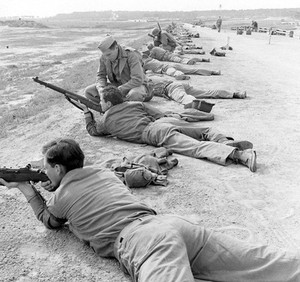
While noncommissioned officers teach recruits how to fire their weapons today, in the 1940’s newly graduated Marines, such as Pfc. Milburn Pack, helped teach recruits the fundamentals of marksmanship.
Pack, of Danese, W.V., said he completed recruit training in 1942 and upon graduating was immediately assigned to a field training company to help other future Marines become marksmen.
Pack had shot the highest score on the range in his company during training while firing the 1903 Springfield rifle. He said it was the reason he was chosen to remain aboard the Depot for 19 months to help others with marksmanship skills.
In Dec. 1948, a new rifle course with a possible score of 250 points was introduced, similar to the scoring system used today.
Weapons ranges aboard the Depot saw drastic changes in the years leading up to the Korean War. The contraction of concrete grenade pits, and an indoor .22-caliber rifle range were several that occurred, Alvarez writes.
Alvarez writes, recruits fired the .22-caliber rifle prior to firing the M1 Garand to qualify on the range and were also familiarized with the Browning Automatic Rifle.
The first week on the range was devoted firing with no ammunition while aiming at large black dots painted on white wooden posts. The second week recruits fired both the .22-caliber and M1 rifles, and worked pulling targets in the rifle range pits.
“Record day” was a high point in recruit training and occurred during the third range week. Shots were fired in the standing, sitting, kneeling, and prone positions at the 200, 300 and 500-yard lines for a maximum score of 250 points. This system remained in place until 2007.
One hundred and ninety points were required to achieve the marksman’s medal, 210 points for a sharpshooter, and an expert rifleman had to score 220-250 points, Alvarez writes.
Weapons Training Now:
Sergeant Denver Houck, a Primary Marksmanship Instructor, said recruits still receive considerable time learning the fundamentals of firing a weapon.
Training day 30 instroduces the fundamentals of weapons firing to recruits.
Recruits spend “Grass Week,” the sixth week of training, learning different firing positions, how to compensate for wind speeds and how to correct their sights elevation.
The first four days of Grass Week recruits take their time “snapping in,” where they practice firing at fake targets as they begin moving from each of the four positions they will be firing from.
Houck, of Orlando, said snapping in allows the PMIs to help recruits refine their positions and find stable ones.
In addition to snapping in, recruits spend three days at the Indoor Simulated Marksmanship Trainer, a facility where recruits shoot compressed-air-modified M-16 A2 service rifles at virtual targets.
“The ISMT allows us to see any mistakes recruits make and see if recruits can apply the fundamentals of shooting that we’ve taught them,” said Houck, of Orlando.
Upon completing grass week, recruits move into firing week and practice firing rifles to qualify and be proficient enough to become Marksman, the basic level of marksmanship in the Marine Corps.
Houck said that, while training has changed to accommodate new technologies and conform to modern day battlefields, many concepts and traditions remain the same.
“Parris Island has always been a training ground to make professional marksmen,” Houck said. “That training continues to this day.”